TUC Equality Audit 2026
The passing of the Employment Rights Act into law in December 2025 was a seismic moment for the trade union movement. A new raft of protections for workers, across all industries and sectors, marked a step-change for unions both in terms of enhancing workers’ rights as well as our ability to organise and grow our movement.
At the heart of this new legislation is an opportunity for our movement to address the inequalities workers face in the labour market today. Precarious, insecure work – where women and Black workers are disproportionately represented – will be curbed, bringing in certainty and stability for those who need it most. New day one rights to sick pay, parental leave and new requirements about handling flexible working requests will support working parents, carers and disabled workers. And statutory rights for trade union equality representatives being introduced later this year will strengthen collective bargaining but also provide new organising opportunities across our movement.
This year’s equality audit focuses on what steps unions have taken in the last four years to promote equality in their membership, structures and processes, and to ensure they reflect the diversity of our membership. Building a diverse movement, that is reflective of our membership across all levels, is a crucial strategic priority for the TUC and something I have prioritised since becoming general secretary in 2023.
The findings of this audit show that as a movement we need to focus our efforts on organising young workers specifically. The future of our movement rests on our ability to build a diverse pipeline of future leaders. Investing in robust, inclusive structures is a key challenge for affiliates, but one which the TUC is ready to support.
For this audit, we also asked affiliates additional questions on the work they’re doing to counter the rise of the far and populist right in workplaces. In this report, you’ll see some really positive examples of unions rolling out comprehensive training, delivering impactful campaigns that reiterate the power of unions to improve working conditions for our members, and undertaking specific organising activity which grows our movement and underlines our principles or solidarity and equality.
With populist political actors claiming to stand for workers, while simultaneously attacking our hard-won rights, it’s vital that unions are able to effectively communicate the positive impact we have. Our challenge is to ensure that this work reaches all of our members; on the shop floor, in our public services, in industrial heartlands and for those working in the gig economy. Through our Unity Works campaign, we’ve been celebrating the rights trade unions have won, but also challenging our movement to unite around our calls for strong public services, fair taxes and secure, decent work that pays.
I hope you’ll find this report inspiring and motivating. We have a huge opportunity to grow our movement, ensuring equality is at the heart of what we fight for.
Paul Nowak
Overview
The TUC and our affiliates are committed to promoting equality in all aspects of our work. In 2003, we changed our rules to reflect this goal, and the biennial TUC Equality Audit is a key part of delivering on that commitment and tracking our progress. The audits alternate between examining collective bargaining for equality and exploring union efforts to improve representation and participation. The 2026 audit focuses on trade union representation and participation.
Questionnaires were sent to the 47 unions affiliated to the TUC. Completed questionnaires were received from 43 unions, which is 90 per cent of TUC affiliates. This is a higher response rate than for the last equivalent audit in 2022 when 41 out of 48 TUC affiliates participated (85 per cent).
The unions responding in 2026 represent 99 per cent of all TUC-affiliated union members (see Appendix). The audit data was collected and analysed by the Labour Research Department on behalf of the TUC.
The executive summary highlights two key themes: equality monitoring across membership and activist structures, and sexual harassment.
It’s worth noting that affiliates were asked additional questions regarding rules or objectives related to membership of far-right or racist political parties. 79 per cent of trade union members are affiliated to an organisation which prohibits membership of such groups. There is more detail on the work unions are doing to tackle the rise of the far and populist right included in the audit.
As part of our ongoing anti-racism work, affiliates were asked questions regarding their work on equality monitoring, diversity of membership and ethnicity pay gap reporting. This information will feed into our anti-racism data dashboard.
Monitoring equalities in membership and within activist structures
Equality monitoring
The audit looks at the number of unions who keep statistics on the diversity of their membership. Building a diverse membership, that is reflective of the broader workforce and society is crucial to ensure that affiliates are responding to the needs of members. To understand whether they reflect the full diversity of their membership, unions need to monitor the make-up of their members and representative structures. This means collecting disaggregated statistics, broken down by equality strand, across membership, activist roles and democratic structures. Several unions reported improvements in equality monitoring and data collection.
While the monitoring of women is widespread, the monitoring of Black, disabled and LGBT+ members drops substantially, especially among small unions. Compared with 2022, there has been a slight drop-off in the amount of monitoring except in the case of disabled members.
Over half of the unions had taken specific actions to recruit new members from various equalities groups, with 40 per cent of affiliates reporting activity to recruit more Black workers into their membership.
Data on young members is more likely to be collected than other characteristics, however the monitoring of young activists is inconsistent across unions. As unions seek to build diverse pipelines of activists, it is crucial that young workers are encouraged to become actively involved in union campaigns, bargaining and organising activities.
Monitoring of activists and union roles
Supporting members from all equality strands to become active within their union is a challenge that unions are working to address. Unions are generally more likely to monitor the representation of equalities groups at conferences and in their national executives than of workplace or branch-level roles such as equality reps and learning reps. Monitoring of equality reps is particularly limited, with only around half of unions collecting this information.
Capturing equality data for workplace representatives and activist is crucial to ensure affiliates are providing appropriate training and support, particularly when considering any reasonable adjustments reps may require to carry out their duties.
New statutory rights for equality reps, which come in to force later this year, will provide a significant opportunity for affiliates to support members to become more actively involved with their union. Equality reps in the workplace or branch raise awareness of equality concerns, help ensure equality is built into workplace consultation and bargaining, and support members who may face discrimination or harassment. Collecting data on equality representatives at this stage can help build a more diverse movement that responds to the concerns of all members.
Currently, around 85 per cent of members in unions responding to the audit are in unions who have a specific role or practice for overarching equality reps. Coverage is also relatively high for equality reps focusing on women, at around 73 per cent of members, but lower for Black members (around 53 per cent), young members (around 50 per cent), and disabled and LGBT+ members (both around 36 per cent).
The strongest growth appears to be in networks for Black members. In 2026, 19 unions reported having an informal network or group for Black members, making this the most common type of strand-specific informal structure. There were also 16 unions with informal women’s and LGBT+ networks, 13 with disabled members’ networks and 12 with young members’ networks. This investment in networks from affiliates is a positive step forward whilst retaining formal spaces where equality groups can influence union democratic decision making; you’ll find more details and examples within the report.
You will see from the report that many unions are seeking to ensure that the equality work they undertake is intersectional, focusing on the cross-section of issues members face and how elements of discrimination can interact. Unions have increasingly used joint advisory groups and seminars bringing together different equality strands to ensure equality work is not siloed.
Unions were also asked whether they monitor equality of access to the services they provide to all members. Just six unions (14 per cent) reported monitoring their general service provision to assess whether it delivers equality of access, although this rises to half of large unions. This suggests that, while many unions provide targeted services for particular groups, relatively few systematically assess whether their wider services are equally accessible across their membership.
Sexual harassment
In this year’s Equality Audit, unions were asked more detailed questions about the policies and procedures they have in place to prevent and respond to sexual harassment involving staff and members. New questions were included to reflect the Worker Protection Act 2023 (Amendment of Equality Act 2010), which came into effect in October 2024 and introduced a duty on employers to take reasonable steps to prevent sexual harassment of workers.
Many affiliates reported having undertaken work to protect their staff following the introduction of the Worker Protection Act. Encouragingly, unions also appear to be undertaking reviews, furthering their understanding of the issue and its impact and undertaking more risk assessments.
The TUC’s Building preventative cultures’ training has continued to be delivered through affiliates, with trainers working directly with unions to tailor content and reach all levels within organisations. Affiliates did however identify that finding appropriate trainers was sometimes difficult, and that while creating cultural change as part of plans to tackle sexual harassment remains a priority, this change can often be incremental and slow to progress.
From a member-facing perspective, unions reported new initiatives, clearer guidance and training for reps to ensure awareness of the new requirements. A third of unions told us they had reviewed their work for members on sexual harassment in light of the TUC report on Black women’s experiences of sexual harassment and misogynoir. Unions provided examples of intersectional work in this area. This has led to a greater understanding and greater confidence in reporting and handling case of sexual harassment.
There have been significant changes in Britain since the last TUC Equality Audit of this kind in 2022. The composition of the workforce has continued to evolve, with migration contributing to more diversity across many sectors and occupations. At the same time, economic uncertainty and rapid social change have been accompanied by the growth of far-right and populist political movements that have sought to exploit concerns about migration, the cost of living and diversity for political gain.
The period has also been marked by important developments in workers’ rights. The Worker Protection Act came into effect in 2024, introducing a new duty on employers to take reasonable steps to prevent sexual harassment of their employees in the workplace. In the same year, the election of a Labour government heralded a new Employment Rights Act which was passed into law in December 2025. While it is too early for the impact of the latter to be felt in this audit, there is reason to hope that the stronger workplace protections and measures to support trade union organisation will contribute to further progress in union equalities work by the time of the next audit.
The TUC Equality Audit 2026 considers the steps unions have taken in the last four years to promote equality in their membership, structures and processes, and to ensure they reflect the diversity of their membership.
It also looks at the extent to which unions as employers provide equal opportunities for their own staff. It is complementary to the Equality Audit 2024, which looked at unions’ efforts to promote equality through collective bargaining.
Questionnaires were sent to the 47 unions affiliated to the TUC in November 2025, with a completion deadline of 2 February 2026. Completed questionnaires were received from 43 unions, which is 90 per cent of TUC affiliates. This is a higher response rate than for the last equivalent audit in 2022 when 41 out of 48 TUC affiliates participated (85 per cent).
The unions responding in 2026 represent 99 per cent of all TUC-affiliated union members (see Appendix). The audit data was collected and analysed by the Labour Research Department on behalf of the TUC.
The TUC Equality Audit 2026 considers the steps unions have taken in the last four years to promote equality in their membership, structures and processes.
One of the most fundamental ways unions can show their commitment to equalities is by adopting the TUC model equality clause into their rulebooks (see box) and creating other rules covering equalities issues.
TUC model equality clause
TUC rules require unions to show a clear commitment to equality for all and to eliminate all forms of harassment and discrimination within their own union structures and through all activities. One way to do this is adopting the clause in the box below.
TUC model equality clause
The objects of the union shall include:
(a) The promotion of equality for all including through:
(i) collective bargaining, publicity material and campaigning, representation, union organisation and structures, education and training, organising and recruitment, the provision of all other services and benefits and all other activities;
(ii) the union’s own employment practices.
(b) To oppose actively all forms of harassment, prejudice and unfair discrimination whether on the grounds of sex, race, ethnic or national origin, religion, colour, class, caring responsibilities, marital status, sexuality, disability, age, or other status or personal characteristic.
Sixty-seven per cent of unions answering the audit said they had adopted the TUC model equality clause. This is slightly down from 2022 due to more smaller unions responding and a slight change in the composition. Ten unions or 23 per cent say they do not use the clause and a further four (9 per cent) did not answer this question.¹ Excluding unions that did not provide a response, 78 per cent of members are in unions that reported adopting the TUC recommended model equality clause, compared with 22 per cent in unions that reported not adopting it.
Since 2022, two unions have adopted the clause. These are:
- Musicians’ Union
- Royal College of Midwives
¹ All percentages are rounded to the nearest integer.
New national rules on equality issues
The context for union action on equality is evolving and more than two fifths of unions answering the audit had introduced new national rules on equality since 2022.
The most common theme was the creation of new equality structures and measures to improve representation. For example:
- GMB reported that it had “introduced reserved seats for women within the five national race reserved seats on the Central Executive Council” and “widened eligibility for race, young, LGBT+ and disabled members’ reserved seats on regional councils.”
- ASLEF reported that it had “established a National Disabled Members Committee” and increased joint meetings of equality committees.
Several unions reported rule changes aimed at clarifying expected standards of behaviour and strengthening the process for dealing with harassment, discrimination and bullying. For example:
- NASUWT updated its National Code of Conduct to include “a new section on expected behaviour at meetings, conferences and events, and sanctions for the use of discriminatory language.”
- Accord updated its rules to “strengthen protections against harassment, abuse, assault and discrimination” and introduced “new rules for handling sexual harassment and discrimination allegations, including use of external investigators and safeguards for those involved”.
Finally, some unions reported more substantive changes. For example:
- NAHT undertook a “complete rewrite of constitution and rules” including “new equality, diversity and inclusion statements and a Code of Conduct for meetings.”
Rules or objectives related to membership of far-right or racist political parties
During a period of growing visibility of the far right and rising hate crimes, unions were asked if they had any rules or objectives related to the membership of far-right or racist political parties. Forty-four per cent of unions did, whilst 47 per cent did not, although most of these were smaller unions. However, due to the size of the unions that have a rule/policy, the majority of members are covered, 79 per cent (down slightly from 81 per cent in 2022). Large unions are much more likely to have such a rule than smaller and medium-sized unions.
Challenging the far right
Since 2022, the far right has risen in prominence in Britain. Unions were asked to give details of developments regarding formal rules and objectives relating to far-right or racist political parties. The majority of examples submitted concerned rules on the racist behaviour of members, or on equality, representation and inclusion within the union, which are covered in different sections of this report. However, some unions reported explicit rules against the far right:
- UCAC’s National Executive have directed that the union must have no contact with far-right parties, including Reform. However, nothing has been ruled regarding membership.
- The GMB has had rule ‘4a’ on far-right/racist parties for over four years. According to it, “The Central Executive Council or a regional council or regional committee may […] take action […] where they determine that a member has [...] encouraged or taken part in the activities of, or communicated with, any organisation or group whose policies or aims are racist or promote racist beliefs”.
- UCU has a rule to “refuse membership to, or expel from existing membership, any person who is a known member or activist of any extreme right wing political organisation”.
Alongside formal rules, unions reported a range of educational, campaigning and organising activity aimed at challenging racism and far-right narratives.
- PCS worked with the TUC to launch its Challenging conversations - shifting the narrative course, designed to help reps challenge scapegoating narratives and engage confidently in discussions about migration, asylum and the far right.
- CWU has a Tackling the far right campaign which recognises intersections between racial justice, extremism, sexism, homophobia and transphobia and discrimination, linking multiple equality strands. It is starting a new workshop for reps.
- RMT piloted a Challenging the rise of the far right course in 2025, which has now become part of its 2026 education programme.
- Equity reported training for committee chairs on countering the far right alongside political education weekends for activists.
- The EIS has a programme of work on anti-far right which is intersectional - the EIS received funding from the STUC’s United Workplaces Fund for a project titled Disrupting Disinformation - Let’s change the story, short scenario based social media videos that seek to disseminate EIS’s advice on best practice social dialogue to tackle prejudicial narratives.
- The FBU have instigated a specific group to develop polices, guidance and support to officials regarding taking the arguments against right wing populism into the wider membership.
- The Musicians’ Union Executive Council have recently signed off a new anti-far-right strategy to focus their efforts on tackling the rise of the far right and have plans to launch an anti-far-right hub with education resources and briefings.
- The RCM delivered bespoke far-right training facilitated by the TUC.
Many unions also reported broader anti-racism initiatives:
- GMB is rolling out its No Place for Racism campaign and toolkit.
- UNISON highlighted its Challenging Racism in the Workplace toolkit, support for Stand Up To Racism activities and affiliation to the Together Against the Far Right campaign.
- Unite reported expanded ‘Unity over Division’ materials and education courses, alongside its ‘Union towns’ initiative.
- Usdaw published and debated a policy paper at its 2025 annual conference, produced a short film, is developing an anti-racism online learning course, and has worked with organisations including Migrant Voice, Show Racism the Red Card and Hope not Hate. The union also reported activity aimed at countering myths and disinformation by promoting the lived experiences of members and workers.
Other unions said they had provided webinars, workshops, political education events and dedicated resources:
- NASUWT delivered webinars and targeted sessions through its equalities training and development days.
- NAHT ran a Promoting Equality and Anti-Racism workshop to all paid staff run by Show Racism the Red Card. This was followed by the introduction, in May 2024, of mandatory e-learning for all staff (and new joiners), which included an EDI module Unconscious bias for employees and Unconscious bias for managers. They have also created a member webpage on countering hatred and division.
- CSP will implement anti-racism training Countering hate in 2026 as well as roots of racism training.
The law on unions and members of far-right parties
In February 2007, the European Court of Human Rights held that UK law, which prevented ASLEF from expelling a member of the British National Party (BNP), violated the union’s right to freedom of association. The Trade Union and Labour Relations Act 1992 was subsequently amended to allow a union to expel a member of a political party if membership of that party is contrary to a rule or an objective of the trade union.
Discrimination and harassment rules and procedures
Another important marker of unions’ equalities work is whether they have rules and procedures around allegations of discrimination or harassment made against its lay activists, officers and full-time officials.
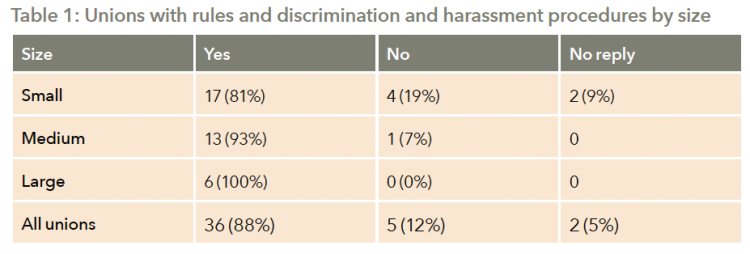
All six of the large unions responding to the audit had such rules, as well as 13 (93 per cent) of the medium unions and 17 (81 per cent) of the small unions. This is broader coverage than in 2022, and well over 95 per cent of union members are covered by rules or procedures concerning discrimination or harassment.
Unions that have made recent major revisions to these policies include:
- CWU (2024)
- Accord (updated 2024)
- Advance (2024)
- ASLEF (2024)
- Usdaw (2025)
- Nautilus International (2025)
- BDA (2025)
- RMT (2023)
- EIS (2023)
Others such as the NUJ and Royal College of Podiatry undertake regular revisions or have a process ongoing.
There is much more on the type of policies covering discrimination and harassment and particularly sexual harassment and the work unions are doing in this area in the section ‘Unions as employers’ (see page 50).
To ascertain whether it truly represents the full diversity of its membership, a union needs to monitor the composition of both its members and its various representative structures. This means keeping disaggregated statistics – that is, statistics broken down by equality strand – for their membership, in their activist ranks and in their democratic structures.
Not all unions that collect data are able to state confidently how many of each equality strand there are at a given time because the data often comes from a sample of members or activists rather than the entire membership. This is generally either because not all members have provided the union with the information, or because the information is collected through application processes devised only after a certain date. We would therefore urge caution when using the figures in this section.
Monitoring equalities in membership
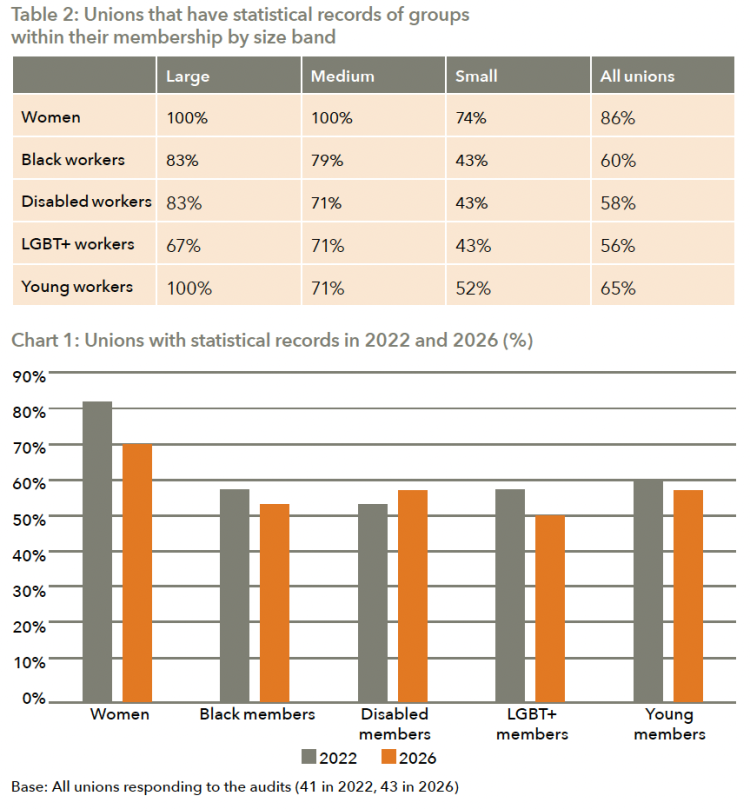
The first part of this section looks at the number of unions who attempt to keep statistics on the diversity of their membership. The tables below show the percentage of unions that undertake equalities monitoring of their membership broken down by union size.
They show that larger unions are consistently more likely than smaller unions to monitor equality characteristics. While the monitoring of women is widespread, the monitoring of Black, disabled and LGBT+ members drops substantially, especially among small unions.
Compared with 2022, there has been a slight drop-off in the amount of monitoring except in the case of disabled members.
Monitoring of activists and union roles
Unions are generally more likely to monitor the representation of equalities groups at conferences and in their national executives than of workplace or branch-level roles such as equality reps and learning reps. Monitoring of equality reps is particularly limited, with only around half of unions collecting this information.
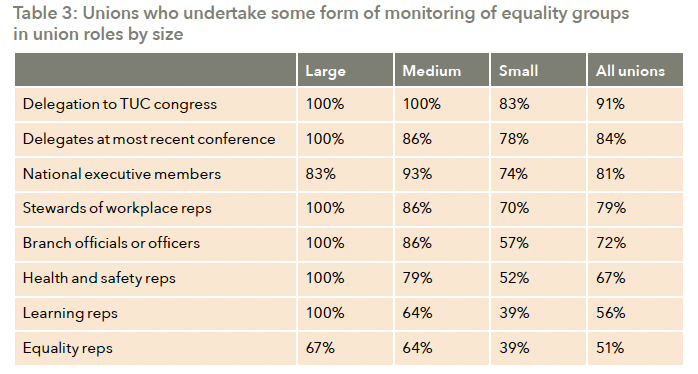
Although gender monitoring is more established than monitoring for other equality strands, a significant minority of unions are still not collecting data across all rep roles.
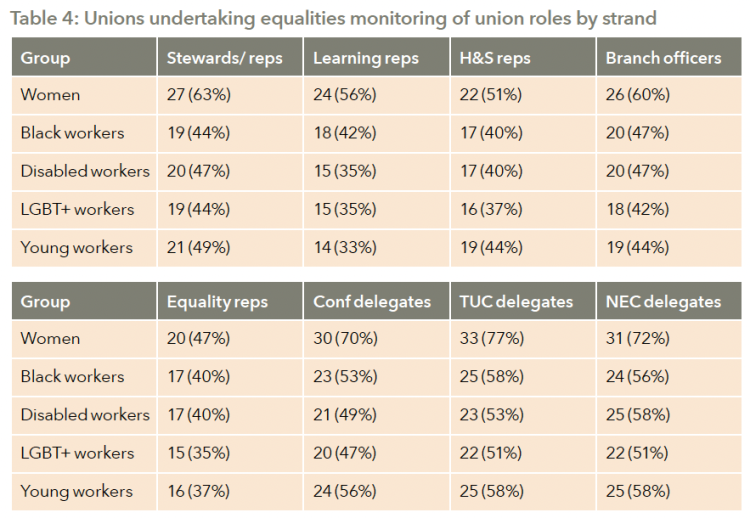
In terms of the monitoring of activists at workplace or branch level, there appears to have been some improvement since 2022. Although the only group which is consistently monitored by the majority of unions is still ‘women’, the table below shows that most now do this across all roles, apart from equality reps (it was only two in 2022).
Women
A small number of unions have rules or targets for equality training, such as Unite’s Women make up a majority of members in 20 unions responding to the audit, particularly in education, health and public sector and civil service unions. Several unions report memberships that are more than 70 per cent women, including the NEU, UNISON, RCM and NASUWT. By contrast, some transport and manufacturing unions continue to report predominantly male memberships, including ASLEF, the PFA, RMT and the Fire Brigades Union. Although gender monitoring is more established than monitoring for other equality strands, a significant minority of unions are still not collecting data across all rep roles.
Black workers
The number of Black and Minority Ethnic workers has risen considerably since the last audit. Official statistics show that in 2025 they made up 18.4 per cent of all employees (13.1 in 2021) and 15.6 per cent of union members (11.8 in 2021). In the audit data, the PFA (40 per cent), RMT (26 per cent) and BFAWU (24 per cent) have the highest proportion of Black workers. Fewer unions have disaggregated figures for Black activists, with under half doing so for most roles, although this is slightly up on 2022. Just 19 unions responding to the audit (44 per cent) do so for stewards/workplace reps, 18 (42 per cent) for learning reps, 17 (40 per cent) for health and safety reps, 20 (47 per cent) for branch officers and 17 (40 per cent) for equality reps. Monitoring is more common for conference roles.
Disabled workers
Fewer than half of unions responding to the audit monitor disability across most activist and rep roles. The most monitored roles are stewards/workplace reps and branch officers (twenty unions or 47 per cent have data on these).
LGBT+ workers
Monitoring of LGBT+ status among activists and reps remains limited across most unions and roles. However, 19 unions (44 per cent) collect LGBT+ data for stewards/ workplace reps, the same as for Black workers. As with other equality strands, monitoring is more common for conference delegates but fewer unions monitor this strand than the others.
Young workers
Monitoring of young workers among activists and reps is also inconsistent across unions. Twenty-one unions responding to the audit (49 per cent) collect agerelated data for stewards/workplace reps, but only 14 (33 per cent) for learning reps.
Fewer than half of unions responding to the audit monitor disability across most activist and rep roles. The most monitored roles are stewards/workplace reps and branch officers,
How unions collect equalities data
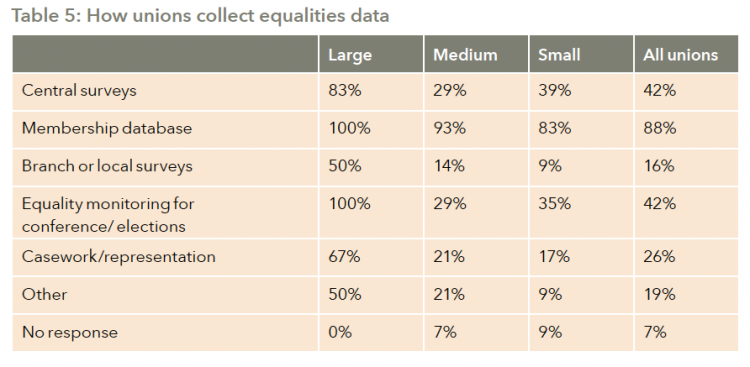
The most common way that unions collect equality data is when a member first joins, often via application forms on paper, online or via apps. This data is then added into membership databases or CRM systems. 88 per cent of all unions collect their data this way. However, as unions such as BFAWU and the Artists’ Union of England note, filling these sections out is often voluntary and therefore the data is not necessarily complete. To try and overcome this issue, unions use other strategies, for example the FBU uses an app via which members can update their details at any time.
After members join, unions use other ‘contact points’ to fill any gaps in their data.
The second most common way unions collect equalities data is through central surveys and equality monitoring during conferences, elections, and training (although the latter was not included as a tick-box option in the audit). Collecting data in this way means obtaining information from a sample of the membership. Interestingly, a higher proportion of smaller unions do this than medium-sized unions. Casework is another opportunity to collect equalities data, and it is used by a quarter of unions.
Unions commenting on the use of these methods include:
- Usdaw collects age and sex data when members join, other characteristics are captured via monitoring forms at events, training, and surveys.
- UNISON monitors members at events using proportional and fair representation forms.
- NASUWT members are encouraged to submit information at multiple engagement points including casework, advice line, courses, and conferences.
- The Chartered Society of Physiotherapy (CSP) conducts equality monitoring for attending events and wants to capture data on trans members.
- Aegis uses surveys delivered by its diversity and inclusion working group.
- Equity: Members are asked to update regularly. A census is planned in the next year.
- Prospect: Their CRM collects gender and age; equalities data are also gathered via surveys every two years.
- The CWU monitors reps’ equalities data on its reps database, a separate part within its membership system.
Actions taken to recruit members from equalities groups
Over half of the unions had taken specific actions to recruit new members from various equalities groups, often linking these recruitment efforts to organising campaigns aimed at encouraging members from those groups to become more active in their union.
Women
Unions reported using a combination of women’s networks, leadership development initiatives and campaigning on issues such as equal pay, maternity rights, menopause and sexual harassment to recruit and engage women members.
- The FDA partners with Total Events on Women into Leadership events and runs recruitment and breakout sessions.
- RMT reported that “specific efforts were made to encourage women members to be H&S reps.”
Black workers
Recruitment activity often combined Black members’ networks and conferences with leadership development programmes, anti-racism organising and targeted outreach.
- GMB highlighted its recruitment of gig economy workers and GRASP - GMB Race Achievement Scholarship Programme which has “brought through new Black and global majority leaders from every region in the union.”
- CWU says that in Scotland “holding workplace surgeries for BAME members has increased membership by four per cent.”
Disabled workers
Responses emphasised accessibility, disability equality campaigning, dedicated disabled members’ structures and targeted recruitment activity.
- Unite described a programme including a “disabled members survey open to non-members”, a “disabled leadership development programme” and measures to “ensure all union meetings and events are fully accessible”. It promotes the social model of disability, has raised awareness of neurodiversity and ran a public campaign against welfare cuts.
LGBT+ workers
Many unions sought to recruit LGBT+ workers through networks and safe spaces, Pride and LGBT+ History Month activity, targeted recruitment materials and leadership opportunities.
- The FBU says it holds an annual AGM and regular meetings of LGBTQ+ members and uses it as an opportunity to organise and reach out to the wider workplace.
- NASUWT hold an Annual LGBT Teachers’ Consultation Conference - free to members, with expenses covered. Members/attendees are encouraged to “recruit and bring a friend”. Promoting LGBTI equality in schools and colleges and lobbying for Trans equality, and for Relationships and Sex Education to include LGBTI equality, attracts new LGBTI members to the Union. The provision of safe spaces for LGBTI members to discuss and share their experiences helps recruitment.
Young workers
Recruitment strategies focused on students, trainees and early-career workers, alongside leadership development, activism and organising opportunities.
- The Chartered Society of Physiotherapy (CSP) said that it had “re-instated student reps” so that it was “recruiting more students at university level who then go onto remain members into the workplace”.
- RMT reported that young members are “spearheading the RMT apprenticeship organising campaign” and were involved in the Young Safety Reps campaign.
Migrant workers
Recruitment activity frequently centred on providing practical support and advice, and campaigning on issues affecting migrant workers.
- PCS used its Learning Fund to provide ESOL classes for members where English is their second or even third language to improve accessibility and participation.
- The NEU has been actively involved in work around the treatment of overseas trained teachers, including taking action across a multi-academy trust that saw a general increase in membership.
- The CSP has partnered the Health and Care Professions Council for outreach and offered three months free membership to new internationally educated members which has seen the membership base increase.
Other groups
A small number of unions reported initiatives aimed at engaging groups beyond the main equality strands, including faith groups, workers from working-class backgrounds and returning workers.
- GMB launched a Jewish faith workers’ branch in its London region.
- WGGB established Challenging class privilege, Challenging ageism and Returning workers networks.
This section looks at the officials and lay reps dedicated to delivering equalities work within unions.
National officers
Full-time equality officers can play an important role in leading on equality. Some unions approach this with an officer for overall equality, while others have officers responsible for one or more strands. Some unions have both. The table below shows the breakdown by responsibility and equality strand.
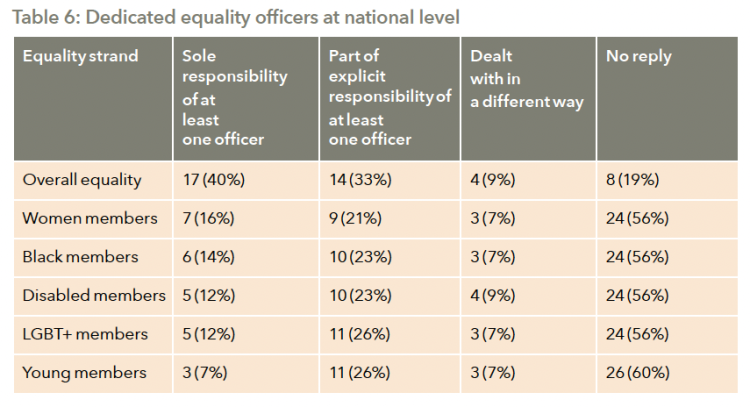
The audit shows that 17 unions (40 per cent), down slightly from 18 in 2022, have at least one officer at national level whose sole responsibility is for equality overall.
In addition, a number of unions employ officers dedicated to specific equality strands, including women, Black members, disabled members, LGBT+ members and young members.
A further 14 unions (33 per cent), down from 15 in 2022, do not have dedicated equality officers but do have officers at national level for whom equality work forms part of their explicit responsibilities. Four unions (9 per cent) said equality issues are dealt with in other ways, including through committees, shared staff responsibilities or elected lay structures.
All six large unions have dedicated equality officers or staff with clear equality responsibilities of one sort or another. Some, such as UNISON, have officers whose only responsibility is equality across all strands, while others combine dedicated overall equality posts with strand-specific responsibilities. The National Education Union, for example, does not have a single officer solely responsible for equality overall, but does have officers dedicated to individual equality strands.
Among medium-sized unions, the picture is mixed. Several unions, including the CWU, RMT and Musicians’ Union, have dedicated officers responsible for equality overall, while others allocate equality work as part of broader officer roles.
Among small unions, dedicated equality staffing is less common, although several unions reported having officers with explicit equality responsibilities. Others indicated that equality work is carried out collectively by senior staff, committees or elected reps because of limited organisational size and resources. Several small unions specifically noted that they were too small to justify separate equality posts.
Full-time equality officers can play an important role in leading on equality. Some unions approach this with an officer for overall equality, while others have officers responsible for one or more strands. Some unions have both.
Coverage at regional level is considerably more limited than at national level. Only three unions (7 per cent), down from four in 2022, reported having a dedicated regional officer whose only responsibility is for equality overall (although we do not know if that is across all regions), while eight unions (down from seven in 2022), said equality formed part of the explicit responsibilities of regional staff. Five unions (12 per cent) said equality issues were dealt with through other arrangements.
Dedicated regional officers for specific equality strands are uncommon. Only two unions (5 per cent) reported dedicated regional officers for women members, while no unions reported dedicated regional officers solely for Black, disabled, LGBT+ or young members.
Equality reps in the workplace or branch raise awareness of equality concerns, help ensure equality is built into workplace consultation and bargaining, and support members who may face discrimination or harassment.
Workplace and branch reps
Equality reps in the workplace or branch raise awareness of equality concerns, help ensure equality is built into workplace consultation and bargaining, and support members who may face discrimination or harassment. The table below shows the number and percentage of unions whose rules provide for or in practice have local equality reps broken down by the equality strand they cover.
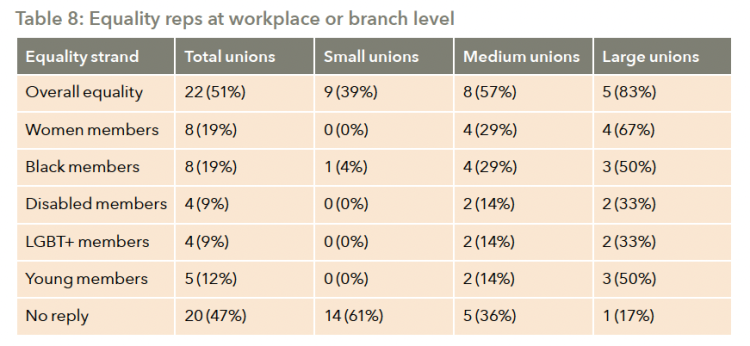
In 2026, over half of unions (22) responding to the audit (51 per cent) have a rule or practice to elect or appoint workplace or branch reps for overall equality, up slightly from 20 unions (49 per cent) in 2022. Fewer unions have rules or practices for reps covering specific equality strands: eight unions (19 per cent) for women members, eight (19 per cent) for Black members, four (9 per cent) for disabled members, four (9 per cent) for LGBT+ members and five (12 per cent) for young members.
The system of local equality reps remains much more common in larger unions. Five out of six large unions (83 per cent) have overall equality reps, compared with eight of 14 medium-sized unions (57 per cent) and nine of 23 small unions (39 per cent). The same pattern is seen for strand-specific equality reps, which are rare among small unions.
Because larger unions are more likely to have these roles, a much higher proportion of members are covered than the union-count figures alone suggest. Around 85 per cent of members in unions responding to the audit are in unions with a rule or practice on overall equality reps. Coverage is also relatively high for women’s equality reps, at around 73 per cent of members, but lower for Black members (around 53 per cent), young members (around 50 per cent), and disabled and LGBT+ members (both around 36 per cent).
Developments since the last audit
Several unions highlighted expansion of equality rep networks, new training initiatives and attempts to formalise equality roles within union structures. Examples included:
- Community reported a “50 per cent increase in number of equality reps”, alongside the introduction of “advanced equality representative training” and equality training “designed for all reps”.
- PCS reported that it had “initiated a new Young Members Officer role” intended to increase participation by young members and encourage them to become members of branch executives.
- The CWU said that although Branch Disability and LGBT+ Champions “are not formal positions recognised under CWU rules”, there had been “a noticeable increase” in branches introducing the roles. The union reported that 13 per cent of branches now have a Disability Champion and 25 per cent have an LGBT+ Champion.
- The Chartered Society of Physiotherapy (CSP) does not have branches but described significant growth in its equality rep network. Following an initial pilot involving eight equality reps in 2021, the union reported that by 2025 there were 72 equality reps across the UK supported by a permanent equality officer working full time on network development.
- The NAHT said it was “currently running a pilot to implement equality reps at a regional level”, running from October 2024 to October 2026, after which a decision would be made through its 2027 AGM on whether to adopt the model permanently.
This section examines the presence of formal lay structures and/or informal networks focussed on overall equalities work or work on individual strands.
Formal equalities structures
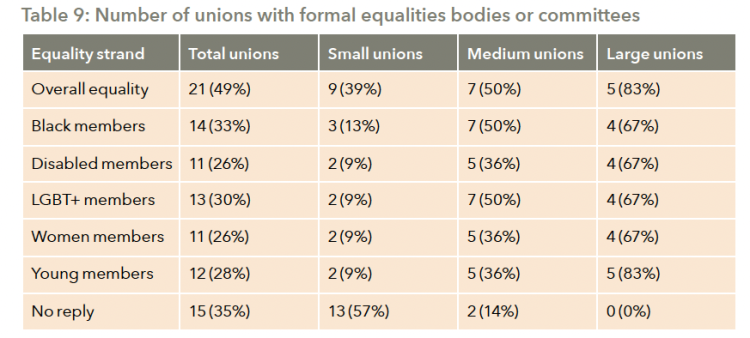
Twenty-one unions responding to the audit reported having a formal national body or committee for overall equality (this is up on 18 in 2022). As in previous audits, overall equality committees are considerably more common than strand-specific structures.
Compared with the previous audit, there appears to have been some modest growth in formal structures for certain equality strands, particularly for LGBT+ members and young members. The number of unions reporting national committees for LGBT+ members increased from the relatively low levels seen in earlier audits to 13 unions in 2026, while 12 unions now report formal structures for young members. There has also been some expansion in structures for Black members, although formal committees for disabled members and women members remain comparatively limited.
Large unions are more likely than small unions to have national committees covering equality overall and specific equality strands. Five of the six large unions responding to the audit reported having a formal national equality body overall, and large unions were particularly likely to report dedicated structures for young members, Black members and LGBT+ members.
Informal equalities structures
Informal networks tend to be more widespread than formal committees for individual equality strands. For example, while only 11 unions reported formal national committees for disabled members, 13 reported informal disabled members’ networks. Likewise, 16 unions reported informal LGBT+ networks compared with 13 reporting formal LGBT+ committees. Whilst larger unions have both formal and informal strand-specific committees in equal numbers, medium-sized unions are slightly more likely to use informal structures.
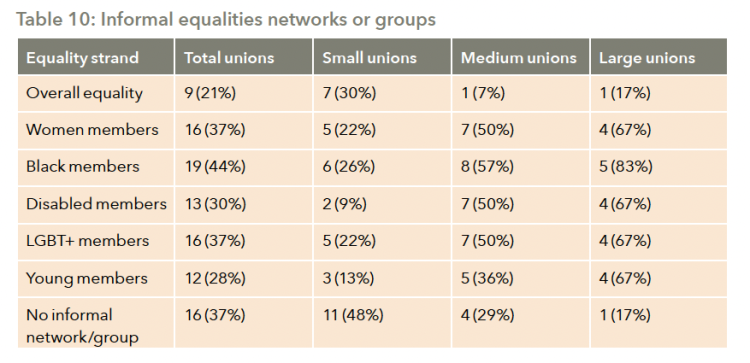
Compared with the 2022 audit, the 2026 findings suggest some growth in the use of informal equality networks and groups, particularly for Black members, LGBT+ members and young members.
The strongest growth appears to be in networks for Black members. In 2026, 19 unions reported having an informal network or group for Black members, making this the most common type of strand-specific informal structure. There were also 16 unions with informal women’s and LGBT+ networks, 13 with disabled members’ networks and 12 with young members’ networks.
As in 2022, larger unions remain much more likely to have informal equality networks than small unions. Five out of six large unions reported networks for Black members, women members, LGBT+ members and young members, while four out of six reported disabled members’ networks. Medium-sized unions also reported relatively high levels of informal equality structures, especially for Black, women’s and LGBT+ networks. Small unions were much less likely to report informal networks of any kind, with almost half reporting no informal equality networks or groups at all.
Changes since the last audit
Several unions reported developments in their equality committee and network structures over the last four years, including expanding participation and creating new networks.
- Unite reported regional and national joint equality networks, women’s industrial networks in construction, energy, chemicals and passenger transport sectors, a Black women’s network and young members regional WhatsApp groups.
- NASUWT described advisory committees for under-represented groups linked to its Equal Opportunities Committee (EOC). It reported changes to the election mechanism for the LGBTI Members’ Advisory Committee to protect privacy, more Black members’ network groups in the regions, recommencement of joint advisory committee meetings “to allow for a more intersectional approach”, and caucus meetings for women, Black, disabled, LGBTI and young members at annual conferences.
- PCS reported the re-establishment of “Equality networks in each region and nation supported by targeted communication to members”.
- The CWU described “significant changes” to its equality structures, including a dedicated half day equality day at annual conference, “sub regional equality committees” linking branches into national and equality networks. The union said these changes were intended to ensure equality was “not siloed but embedded in the union’s core work”.
- NAHT reported launching its Women’s Network in late 2024 following the creation of leaders for race equality, LGBT+ and disabled members’ networks. It said the Women’s network had already grown to “nearly 90 members” and that across all networks it now had “over 400 members”.
- Community reported the “Introduction of the executive equality committee” in early 2025.
- PFA described networks for “Players who are mothers, South Asian heritage players, Black players and coaches, LGBT players”.
- ASLEF said it had “introduced networks for women and Black members in the last four years”. Napo reported that “LGBT and young members networks have been established”.
- Aegis said it had established “a national D&I working group” in January 2025.
- Artists’ Union England reported “establishing the Black members network and the LGBTQ+ members network across 2024 and 2025”.
- WGGB stated that “all its networks were established in the past four years”.
A smaller number of unions reported limited developments or difficulties maintaining networks. Accord said its equality network “has been disbanded due to difficulty in maintaining engagement” and that a women’s network “didn’t take hold”, leading the union towards “more regular and tailored communications” instead.
Unions were asked if they held regular conferences or seminars either for overall equality or for specific strands of members.
National events
The number of unions holding national equalities events can be seen in the table below:
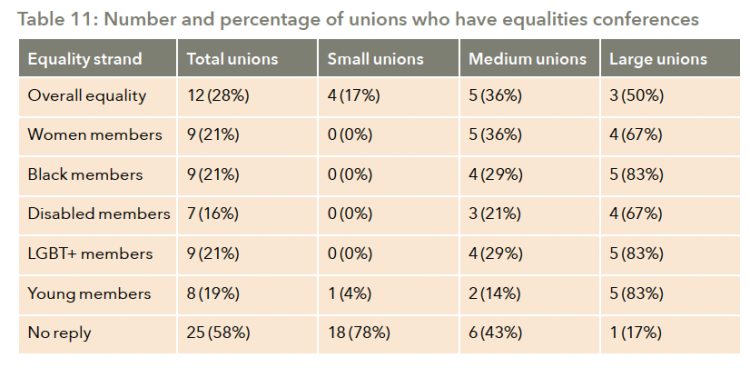
Since 2022, there has been an increase in the number of unions holding national equality conferences. Twelve or 28 per cent of respondent unions hold national conferences or seminars for overall equality (it was eight unions (20 per cent in 2022).
However, there has been a decline across the board in the individual equality strands, continuing a trend that has been seen for most of the last decade (see Chart 2).
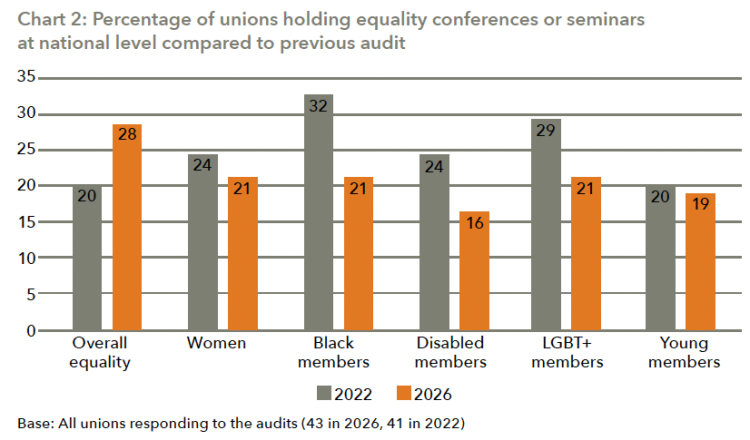
Holding national conferences for specific equalities groups is much more common for larger unions – although they have also seen a decline. Unlike in 2022, not all large unions responded, however, amongst those that did, all held events for Black, LGBT+ and young members.
Small numbers of other unions do still hold national equality events. Conferences for overall equality, and women members are held by five medium-sized unions (36 per cent) and 17 per cent of small unions also hold equality conferences.
There has been a decline across the board in the individual equality strands, continuing a trend that has been seen for most of the last decade.
Sub-national events The following table shows the numbers and percentages of unions that hold equalities events at the sub-national level. Of the 39 unions completing the main questionnaire, 12 or 31 per cent (down from 16 in 2022) hold conferences or seminars on overall equality at sub-national level. (This question was not asked of those completing the abridged questionnaire.)
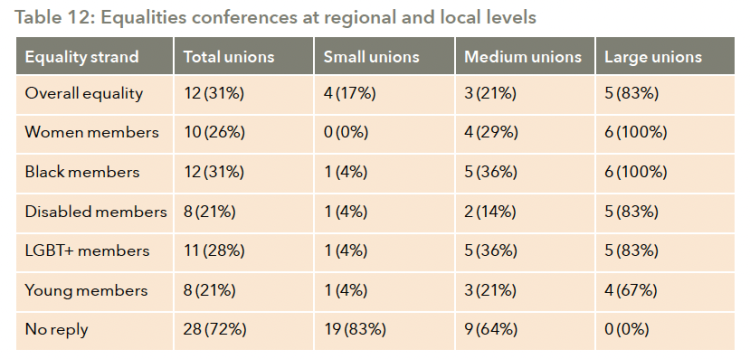
Out of the 39 unions answering this question, a small number of unions held sub-national events for individual equality strands: 26 per cent of unions held conferences for women; 31 per cent for Black members (both roughly equal to 2022); there has been a slight drop in the number of events for disabled members 21 per cent (down from 27); and also for LGBT+ members 28 per cent (down from 32 per cent in 2022); and 19 per cent for young members.
UCU highlighted work in Scotland on challenging and organising against the far right, including support for STUC anti-racism events.
Developments in Wales and Scotland
Wales
A number of unions reported developments aimed at strengthening equality work in Wales over the last four years. Examples included:
- GMB reported a Wales TUC equality committee sub-group as well as other regional equality committees.
- PCS reported that a conference motion established Devolved Nations within PCS for both Wales and Scotland. Each nation now has its own annual conference, committees and constitution. The union stated that both nations are working towards establishing fully functioning equality committees focused on issues within their own nation.
- RCM highlighted a range of Wales-specific conferences, networks and projects, including an Inclusive Maternity themed St David’s Day Conference, the Maternity Inclusive Network, work with Diverse Cymru, a Maternity Leadership and Development Group, Queer Birth Club and Birthrights training, and neurodiversity and Welsh language projects.
- UCAC reported establishing an Adran Cydraddoldeb (Equality Department).
Scotland
Several unions also reported developments specific to Scotland.
- NASUWT reported establishing a Scotland Neurodiverse Network and a Scotland Women’s Conference Skills event.
- The EIS, a Scottish union, created two new posts: Equality Related Learning and Development Co-ordinator, and National Officer (Education and Equality), with responsibility for poverty-related work.
- UCU highlighted work in Scotland on challenging and organising against the far right, including support for STUC anti-racism events. The union also reported that one of its members, Gina Gwenfrewi, received the STUC Equality Reps Award in 2025 for work on trans and non-binary equality.
- Other developments with relevance across the devolved nations included the establishment by NSEAD of an anti-racist art education group, anti-ableist pedagogies group and gender and transformative education group.
Reported changes to equalities events in the last four years
Unions that commented described an expansion of equality-focused conferences, seminars, and networking events, alongside a growing emphasis on intersectional or ‘pan-equality’ approaches. At the same time, a small number of unions reported scaling back or restructuring their equality conference arrangements.
- Community reported that a bi-annual equality conference was established in 2023.
- The NEU reported that its 2025 annual conference voted to establish a women’s conference, with the first conference scheduled for October 2026.
- Usdaw reported increased support for regional equality activity, including Black activists events linked to the Breaking Down Barriers Programme and regional LGBT+ member events, often linked to local Pride activities.
- PCS reported a move towards pan-equality seminars, bringing together members with different protected characteristics to work collaboratively and recognise the intersection of inequalities.
- CWU highlighted its Annual Equality Day, regional seminars, workshops and networking activities, alongside an Annual Young Workers Conference and networking events for women, BAME and LGBT+ members.
- Napo reported that “funding restrictions have prevented us from holding conferences as we used to”.
Unions that commented described an expansion of equality-focused conferences, seminars, and networking events, alongside a growing emphasis on intersectional or 'pan-equality' approaches.
TUC Congress monitoring
At the 2025 TUC Congress, equality monitoring of delegates was carried out. Any comparisons are to 2021 (held online due to Covid-19). All 524 delegates completed the monitoring form, though delegates were able to select ‘no answer’ or ‘prefer not to say’ for questions.
TUC data showed that 49 per cent of delegates were women, compared to 52 per cent in 2021. 50.2 per cent of delegate speakers were women, compared to 57.6 per cent of delegate speakers in 2021 – although worth noting Congress in 2021 was held online, making it difficult to make direct comparisons.
In 2025, 17.4 per cent of delegates identified as BME compared to 12.6 per cent in 2021. 23.7 per cent of delegates identified as disabled, up from 19 per cent in 2021, and 11.6 per cent of delegates identified as LGB or another term relating to sexual orientation, again an increase from 10 per cent in 2021. 1.5 per cent of delegates identified as trans. The proportion of delegates under 35 increased to 8.6 per cent (7.5 per cent in 2021 and 7.4 per cent in 2019).
Some unions have rules on reserving or guaranteeing seats on elected union structures and delegations to ensure a certain level of representation for groups that have traditionally been under-represented.
All unions responding to the survey were asked about reserved seats on national executives, conference delegations and TUC Congress delegations. Those who answered the main survey were also asked about sectoral executives, conferences and branch committees. The number answering and the groups they reserve seats for can be seen in the table below.
National conferences and structures
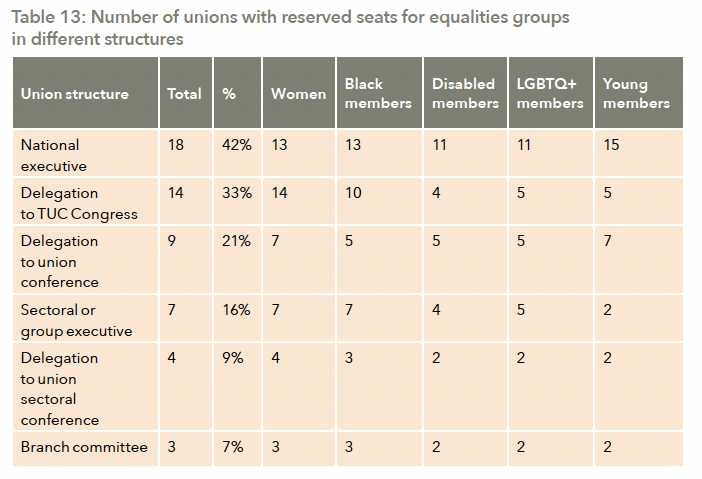
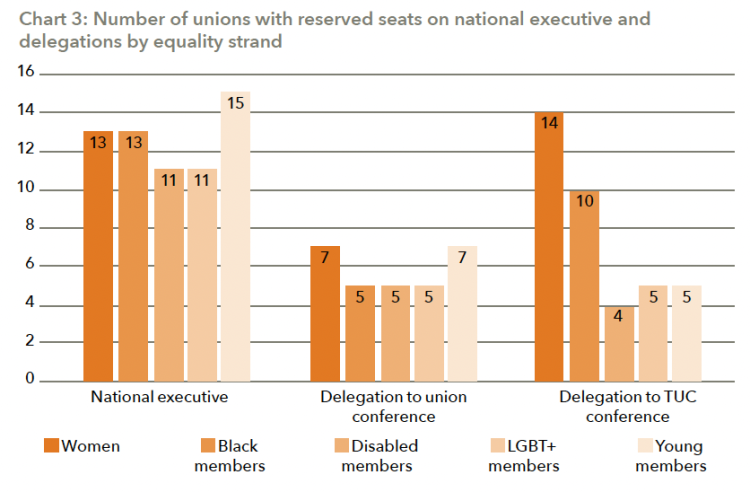
The large unions are more likely than medium and small unions to have reserved seats on these bodies and delegations, although 50 per cent of medium-sized unions reserve seats on their NECs.
Changes since the last audit
The following chart shows the changes in unions with reserved seats within their democratic structures since 2022. While there are more reserved seats overall for women, LGBT+ and young members, there has been a slight fall in numbers for the other equality strands (see chart 4).
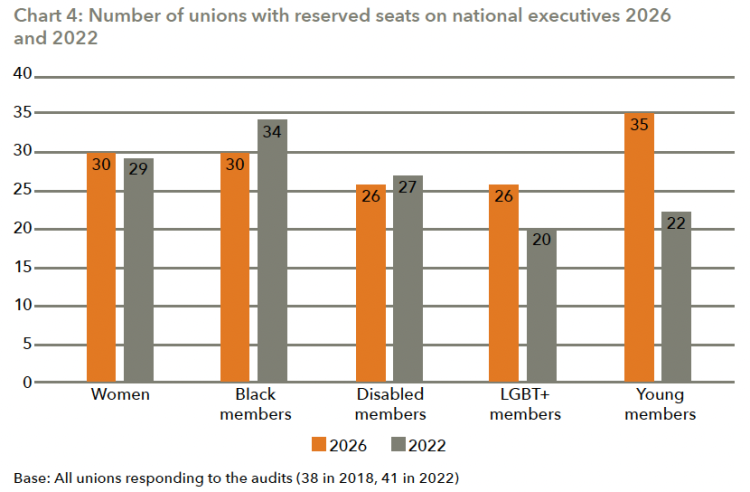
The FDA noted that one branch operates two Convenor positions, with one position reserved for 'a member who is either a woman, trans, or non-binary.
A small number of unions reported significant changes to reserved seat arrangements:
- Equity reported the most significant change. Following consultation in 2022, including with equalities activists, “most” reserved seats were removed because they were “seen as not improving representation”, although reserved seats were retained on the National Executive. The union stated that it has “seen significant improvements in representation since we removed reserved seats”.
- Musicians’ Union moved in the opposite direction. A rule change at the 2025 Delegate Conference introduced reserved Executive Committee seats, with two seats each reserved for Disabled Members, Members from the Global Majority, LGBT+ Members, Women Members and Young Members.
- GMB reported changes to its TUC Congress delegation arrangements. Since 2024, four “equality top up” seats have been allocated according to which groups have been most underrepresented in recent delegations. In 2024 and 2025 the seats were open to women, Black members and young members, with 50 per cent reserved for women.
- NAHT reported that its EDI Committee includes “one seat per equality network” to ensure each network has a representative voice feeding into the National Executive. It also now draws representation for TUC Equality Conferences from its equality networks.
- The FDA noted that one branch operates two Convenor positions, with one position reserved for “a member who is either a woman, trans, or non-binary”.
Representation at TUC statutory conferences
Unions were asked whether they had rules governing representation at the TUC’s statutory equality conferences. Fewer than half of the unions have such rules, although most large unions and several medium-sized unions do. Several smaller unions commented that, while they do not have formal rules, they take an informal approach to ensuring that their members are represented at the conferences.
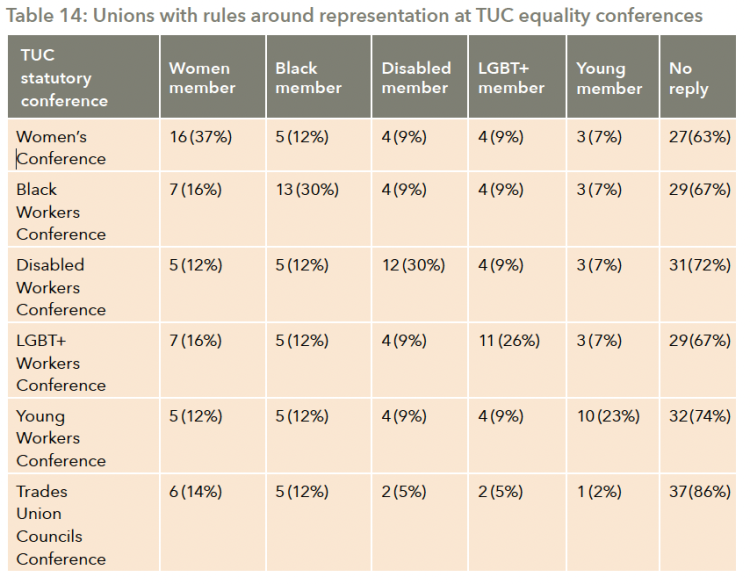
Many unions commented that it was their rule or policy to send delegates that identify with the relevant equality strand to TUC conferences, although this is not always done via formal rules. Some examples of the types of practices used were:
- GMB reported that all delegates to statutory equality conferences “must belong to the relevant strand”. While there are no formal diversity rules for delegations, the union said it seeks to achieve this “organically” and that it would be “very unusual” for delegations to be all-white or all-men.
- RMT reported that there are two seats reserved for women in its TUC LGBT+ Workers Conference delegation. Since 2024, branch circulars have encouraged branches to take account of “the diversity of our membership, including women and Black and ethnic minority members”. The union has also introduced reserved seats for women and B&EM members in its LESE delegation.
- NAHT reported that delegations to TUC Equality Conferences are drawn from self-nominating members of the relevant equality networks and are then ratified by its EDI Committee.
- Among smaller unions, Accord reported that it has no formal rules but reviews attendance and has “consistently sent appropriate delegations” to the Women’s, Black Workers, Disabled Workers and LGBT+ Workers Conferences, while noting that small delegation sizes can make wider representation difficult. BFAWU requires delegates to comply with TUC eligibility requirements, the Association of Educational Psychologists said it does its best to ensure members are represented at all TUC conferences, Aegis reported that representation arrangements are under review, and WGGB has introduced a rule requiring all conferences to be advertised to the membership.
Since 2024, branch circulars have encouraged branches to take account of the 'diversity of our membership, including women and Black and ethnic minority members.
One way in which unions can support different equality groups is by providing targeted services. These may include dedicated publications, online resources, telephone helplines, training, and other learning opportunities. This section examines the extent to which unions provide services specifically aimed at women, Black, disabled, LGBT+, and age-related groups of members.
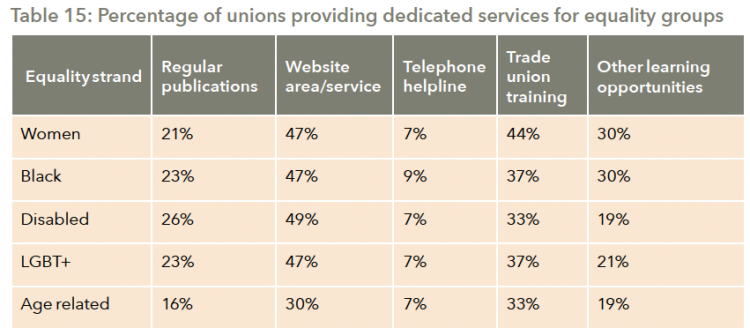
Dedicated website content is the most common form of support across all union sizes, closely followed by training – although still under 50 per cent of unions provide this, see table above. Overall, age-related provision is generally less developed than provision for other equality groups.
Large unions are consistently much more likely to provide dedicated equality services. All six large unions reported dedicated website areas or services for women, Black, disabled and LGBT+ members, while the majority of large unions reported dedicated trade union training and regular publications for most of these groups. Large unions were also the most likely to offer other learning opportunities.
Among medium-sized unions, around 70 per cent provide dedicated website areas for women, disabled members and other equality groups. Small unions are much less likely to do so, with only 13-22 per cent reporting dedicated website provision. With regards to training, forty-four per cent of unions provide dedicated trade union training for women members, while around a third do so for other equality groups.
Regular publications remain relatively uncommon, especially in smaller unions. Fewer than a quarter of unions overall produce dedicated publications for most equality groups. Among small unions, fewer than one in seven do so for any strand, compared with around four-fifths of large unions for Black, disabled and LGBT+ members.
Around 30 per cent of unions provide additional learning opportunities for women and Black members, but fewer than one in five do so for disabled and age-related groups. Again, provision is concentrated in medium and large unions.
Dedicated telephone helplines are rare across the movement. Fewer than one in ten unions overall provide strand-specific helplines, and no small union reported doing so. Even among large unions, only two reported dedicated helplines.
Finally, unions were asked whether they monitor equality of access to the services they provide to all members. Just six unions (14 per cent) reported monitoring their general service provision to assess whether it delivers equality of access, although this rises to half of large unions. This suggests that, while many unions provide targeted services for particular groups, relatively few systematically assess whether their wider services are equally accessible across their membership.
All six large unions reported dedicated website areas or services for women, Black, disabled and LGBT+ members, while the majority of large unions reported dedicated trade union training and regular publications for most of these groups.
Discrimination cases
Equality issues frequently come to the attention of unions through discrimination cases brought by members. The extent to which unions monitor such cases and train reps to handle them well provides an indication of how equalities approaches are embedded in union services. The audit therefore examines whether unions monitor discrimination cases taken to tribunals on behalf of members and whether they provide training for paid officials and lay reps involved in handling such cases.
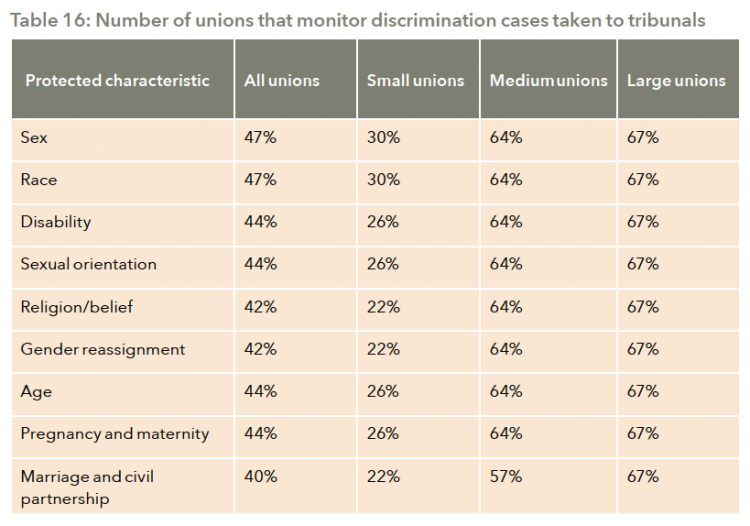
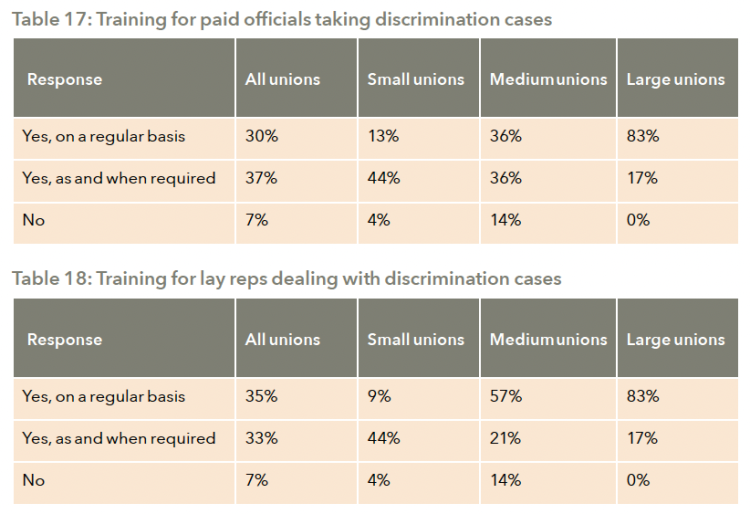
In terms of training, unions are slightly more likely to provide regular training for lay reps (35 per cent) than for paid officials (30 per cent). Large unions are much more likely to provide regular training, with 83 per cent doing so for both officials and lay reps. Small unions are more likely to rely on ad hoc training, with 44 per cent providing training “as and when required” for both officials and lay reps. The pattern for officials and lay reps is remarkably similar, suggesting that unions tend to adopt a consistent approach to discrimination case training across both groups.
Equality issues frequently come to the attention of unions through discrimination cases brought by members. The extent to which unions monitor such cases and train reps to handle them well provides an indication of how equalities approaches are embedded in union services.
Trade union training
Unions were asked about how they encourage participation in education and training by equality groups. Based on the comparison with 2022, there appears to have been a noticeable increase in the proportion of unions taking action in this area. In 2022, 34 per cent of unions reported taking such steps for women members, 27 per cent for Black members, and 22 per cent for disabled and LGBT+ members. By 2026, the equivalent figures had risen to 40 per cent for women, 42 per cent for Black members, 37 per cent for disabled members and 40 per cent for LGBT+ members. Unions commented that doing online training and better monitoring helped to increase participation:
- NEU reported that “many courses are held on-line which has increased participation.”
- NASUWT reported that development courses for underrepresented members have been “reviewed and updated” and that the union has moved to hybrid delivery for some courses “to make them more accessible for those with carer needs or mobility issues”.
- BFAWU reported using equality monitoring data from its education provider and working “to encourage more of the categories to attend through targeted emailing and the equality network meetings”.
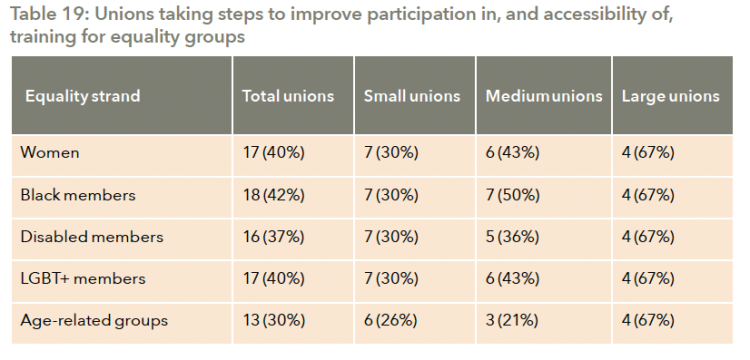
Unions completing the main questionnaire were also asked if they conduct monitoring of attendance by particular groups at union courses. This only occurs in a minority of unions. The highest notable proportions are in monitoring women’s attendance (44 per cent of unions) and the attendance of Black members (41 per cent of unions). This is an improvement since 2022.
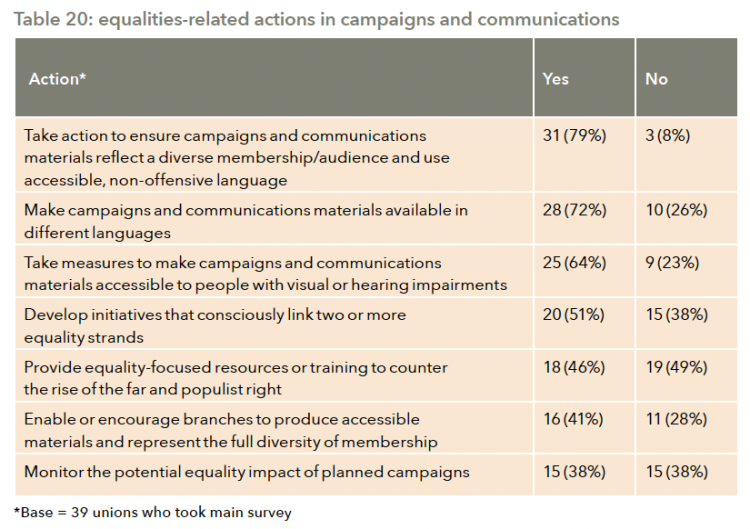
Most of the unions asked (79 per cent) say they take some action to ensure that their materials indicate a diverse membership or audience and that language is accessible and does not cause offence to particular groups (this is slightly down on 82 percent in 2022).
Making materials more accessible
Unions mentioned the use of alt-text and captioning, subtitles for videos, BSL interpreters, and website accessibility tools to ensure materials were accessible.
- Accord: Reported launching “a new online magazine which is suitable for use with screen readers”, replacing an older recording format which was “large and impossible to navigate around”.
- PFA: uses subtitles in comms materials on social media and filmed resources.
- UNISON: produced Representing Deaf (Native BSL) Members: A steward’s guide and Representing Disabled Members: A steward’s guide.
Using different languages
Several unions noted that their materials were available in Welsh. Other examples included:
- EIS reported that, although it does not routinely translate materials, some of its Pay Attention campaign materials in 2022 were published in a number of languages “to engage with communities of parents”.
- PCS using tailored communications and translators in campaigns involving migrant workers or workers for whom English is a second language. Its website accessibility tool includes translation into more than 100 languages.
Initiatives linking two or more equality strands
Amongst details on intersectional initiatives were:
- Equity which highlighted its campaign on “equal hair and make-up provision for Black women and other women with textured hair in the performing arts.”
- Unite that reported a “Black women’s network to encourage activism amongst our BAEM/women’s membership” and a “Black women’s maternity/health campaign”.
- The National Union of Journalists highlighted its Show Us the Money campaign on equal pay, linked to gender, ethnicity and disability pay gap reporting.
Monitoring impact of equality campaigns
Several unions reported using formal equality impact assessment processes or checklists when developing campaigns.
- PFA reported undertaking “Impact reports for “AIMS” and Professional Player to Coach scheme programmes”.
- Aegis reported that its D&I Working Group reviews campaigns both before and during their implementation.
Helping branches with diverse accessible communications
Several unions reported providing guidance, templates or style guides to help branches produce accessible and inclusive communications.
- NEU provides guidance on accessibility, including the use of hybrid meetings and suitable meeting venues.
- NAHT reported that its new regional equality reps are supported to help branches make events and communications more accessible and representative.
This section of the audit focusses on unions as employers. It covers whether unions undertake equalities monitoring of employees, promote pay equality and have policies to protect staff and members from any kind of discrimination and harassment, including sexual harassment.
Monitoring of staff diversity
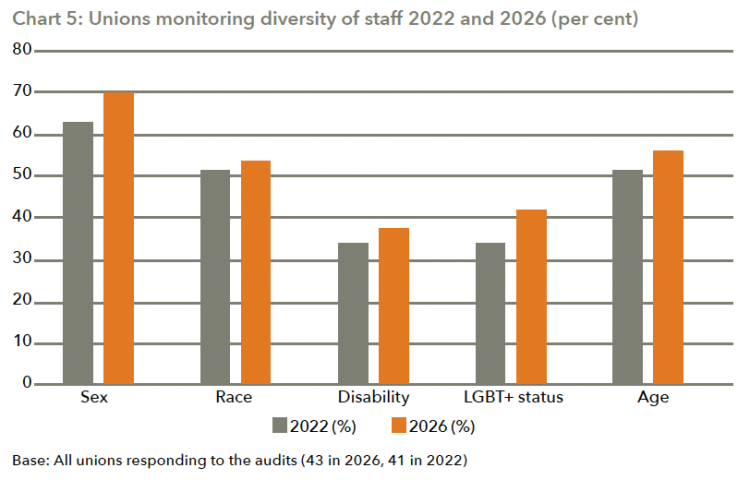
Monitoring of staff diversity has improved across the board since 2022, a reversal of trend in decline seen since 2014. As the table shows, 70 per cent of unions have statistical records of the number of staff who are women up on 63 per cent in 2022. The latest figures include 100 per cent of large unions (up from 83 per cent), 86 per cent of medium unions (up from 64 per cent) and 52 per cent of small unions which is slightly down on the 57 per cent during the last audit.
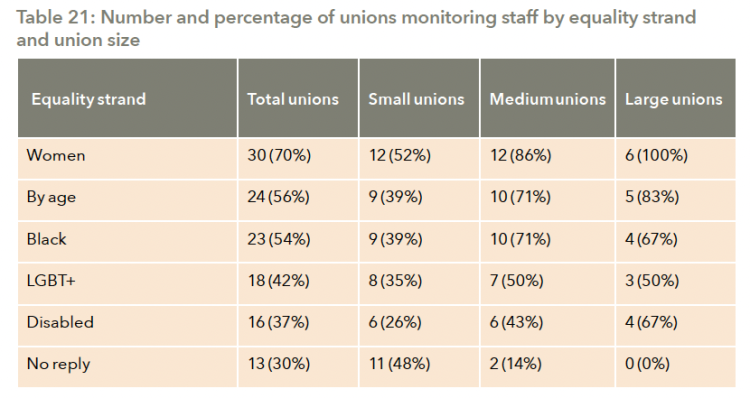
Over half of unions (54 per cent) have records of Black staff compared with 51 per cent in 2022, while 37 per cent do so for disabled staff (up from 34 per cent four years ago). Forty-two per cent have records for LGBT+ staff (up from 34 per cent). In all cases, the likelihood of a union keeping these statistics is lower the smaller the size band of the union.
Workplace policies
The Chapter on Rules showed that in 2026, 36 unions had a general equal opportunities or non-discrimination policy. This number dropped when asked if they had separate policies referring to individual equality strands. Five out of the six large unions had a general policy, but all also had a policy referring explicitly to Black members. The answers were roughly consistent with 2022 figures.
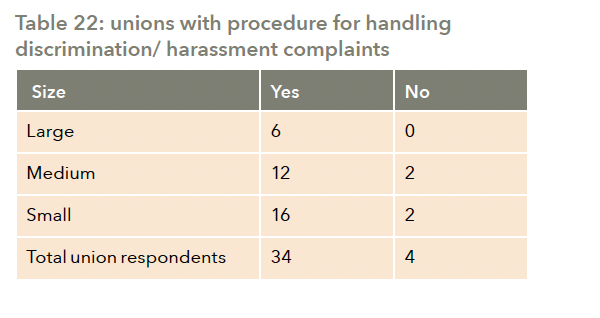
The vast majority of unions had a complaints procedure for staff affected by breaches of the equalities/non-discrimination policy – 7 out of 39 did. Nearly the same number had an explicit reference to dealing with harassment/discrimination within their internal complaints, disciplinary or grievance procedures. 79 per cent of the total (again slightly down on 83 per cent in 2022).
Staff pay and conditions
Unions were asked if staff pay and conditions have been reviewed in the last four years to ensure they do not discriminate against any strands. There has been a significant increase in the number of unions undertaking pay audits since 2022.
Twenty-one have done audits to ensure they don’t discriminate on grounds of sex (up from 13 in 2022), 18 for ethnicity (up from 12), 17 for disability (up for 9), eight for LGBT+ status and 10 for age.
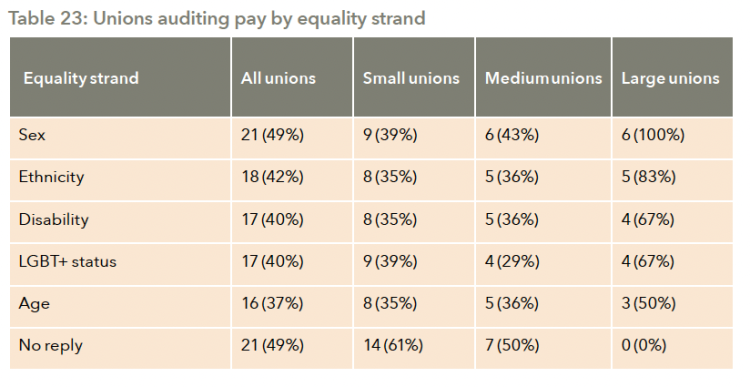
Unions were asked if staff pay and conditions have been reviewed in the last four years to ensure they do not discriminated against any strands. There has been a significant increase in the number of unions undertaking pay audits since 2022.
Several unions review their pay and grading on an annual basis:
- NEU reported that it undertakes an annual pay gap report covering gender, race, disability and LGBT+ staff.
- NASUWT reported annual gender and race pay gap reporting, with reviews each year to identify trends and disparities. It also publishes reports on both sex and gender pay gaps, as well as race pay gaps, even though race pay gap reporting is not a legal requirement.
- Aegis reported that its Remuneration Committee, elected by the National Executive, reviews pay annually.
- WGGB reported carrying out an annual review as part of the pay claim process and stated that salary levels and increases have been adjusted to ensure fairness.
- Others had undertaken substantive processes in the last four years:
- Community undertook a full pay review and benchmarking exercise in 2023.
- NSEAD reported that its most recent review took place in August 2024 and that “no positive action [was] required”.
- GMB completed a whole-organisation equal pay audit in 2024-25. The audit concluded that the union benefits from high levels of pay transparency and could be confident that it pays equally for like work, work rated as equivalent and work of equal value. The audit also identified some areas of risk, leading to updates to HR systems and the implementation of a revised internal job evaluation scheme. GMB also reported collecting qualitative information on barriers to progression and engagement for staff with protected characteristics and stated that introducing staff equality monitoring is a goal for 2026.
- Advance Union reported carrying out a full audit and review at the end of 2024.
- Association of Educational Psychologists reported reviewing and creating a new pay and reward policy, with a further review due in 2026.
Pay reporting
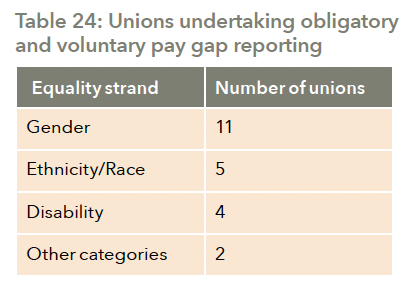
UNISON, Unite, GMB, NEU, Usdaw, NASUWT and Prospect are all legally obliged to undertake gender pay reporting. Some unions voluntarily undertake other types of reporting shown in the table below. A couple of unions mention that these are for internal use only and at least one monitors the pay of LGBT+ staff.
In this year’s Equality Audit, unions were asked more detailed questions about the policies and procedures they have in place to prevent and respond to sexual harassment involving staff and members. New questions were included to reflect the Worker Protection Act 2023 (Amendment of Equality Act 2010), which came into effect in October 2024 and introduced a duty on employers to take reasonable steps to prevent sexual harassment of workers.
Preventing sexual harassment of staff
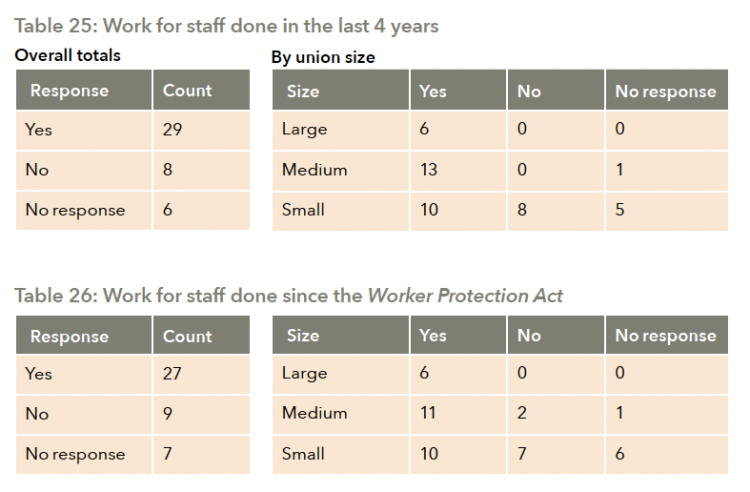
Unions were asked about work done to prevent sexual harassment amongst staff since the last audit in 2022 and since the introduction of the Worker Protection Act. The tables below show the number of unions that indicated they had carried out work – the overall numbers and by union size. Twenty-nine said they had undertaken new work, including all large unions, nearly all medium-sized unions but less than half of smaller unions.
Preventing sexual harassment of members and activists
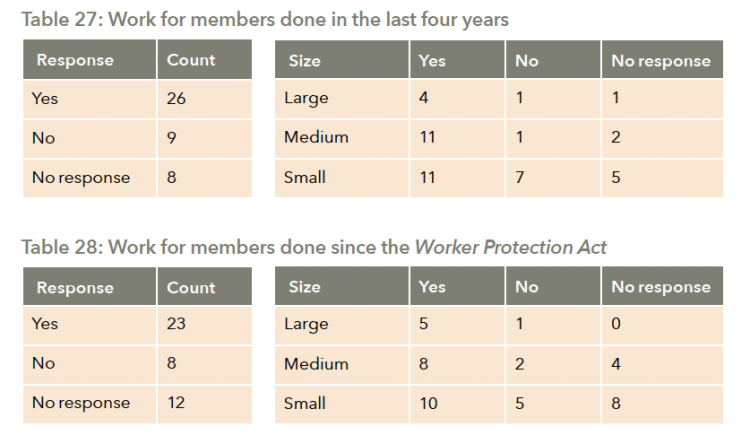
Unions were also asked about work done to prevent sexual harassment within their membership. Fewer unions answered this question overall, with slightly fewer large and medium-sized unions reporting that they had done work on this area for members. In contrast, the smaller unions were just as likely to have done work with their membership as with their staff, but less than half of them reported that they had done any.
Actions taken around sexual harassment
When asked about what specific actions they had taken, most unions reported a range of activity. The table below shows the numbers taking each action.
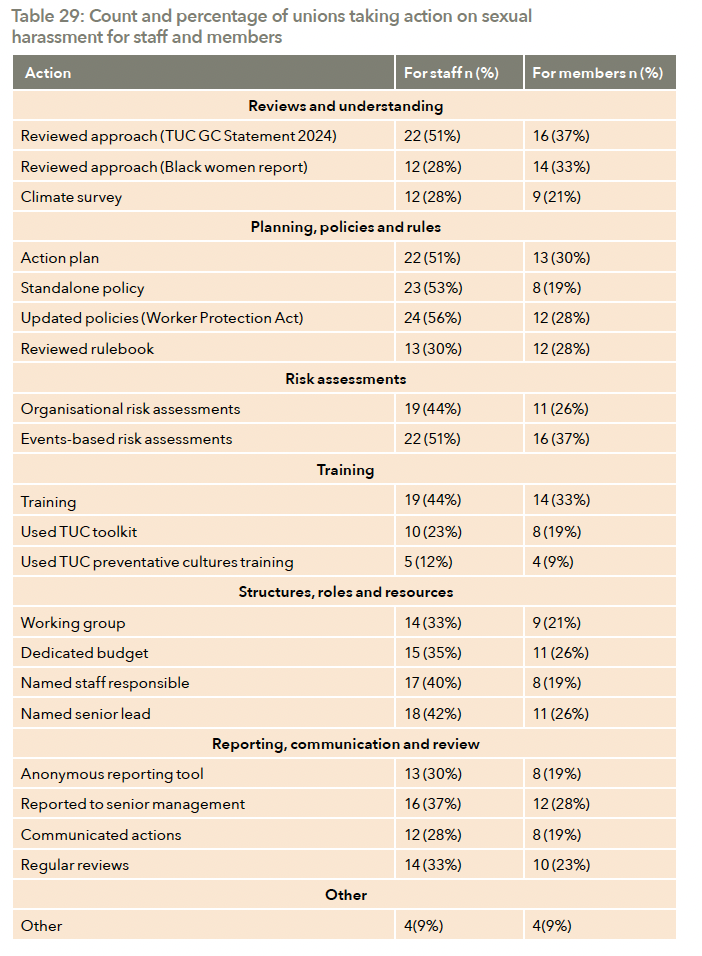
Overall, more unions tended to undertake work on this issue for staff than for members.
This is particularly evident in policy development where over half of unions report updating policies (56 per cent) and developing standalone policies (53 per cent) for staff that are likely workplace-based, compared to 28 per cent and 19 per cent respectively for members.
Encouragingly, unions also appear to be undertaking reviews, furthering their understanding of the issue and its impact and undertaking more risk assessments. Just over half of unions report reviewing their approach in line with the TUC General Council statement for staff (51 per cent), compared to 37 per cent for members, while those reviewing the Black women and sexual harassment report is reported at similar levels for both staff (28 per cent) and members (33 per cent).
When the results are broken down by union size, large unions report consistently high levels of activity for staff, with most actions undertaken by a majority and several reaching near-universal coverage. Activity for members is also higher than in smaller unions, but more uneven.
Medium-sized unions report relatively strong activity for staff across several areas (71 per cent had updated their workplace policies), though typically at lower levels than large unions. For members, activity is more mixed. Training, risk assessments, policies and planning are relatively common (43 per cent), but fewer unions report standalone policies (21 per cent), dedicated budgets or formal reporting mechanisms.
Small unions were less well represented in this question and no activity had been undertaken by a majority of those who answered. While several report core actions for staff, such as reviewing approaches and developing standalone policies (39 per cent), activity is more limited and inconsistent for members.
Encouragingly, unions also appear to be undertaking reviews, furthering their understanding of the issue and its impact and undertaking more risk assessments.
Successes and improvements
Unions report early successes and improvements arising from their work to prevent sexual harassment, although several unions note that it is still too early in their process to fully assess impact. Successes mentioned included:
- Increased awareness and understanding of sexual harassment
Unions report greater clarity about “what sexual harassment is and how it can show up in the workplace”, alongside improved understanding of expectations, boundaries and behaviours. This is reflected in both staff and member awareness, as well as among reps and managers.
- Greater confidence in reporting and handling cases
For example, ASLEF notes that it has received official complaints, and whilst this is “not good”, they demonstrate that members feel able to report and have complaints “investigated properly”. Similarly, NASUWT reports that the introduction of Dedicated Support Officers and an independent advice line has “empowered greater reporting”.
- Clearer and more supportive processes
Unions also report clearer reporting structures, with staff and members more confident about “who to report incidents to” and how cases will be handled. The GMB describes “more consistent outcomes in processes” and the CWU highlights that clear guidance and toolkits have improved confidence in handling cases and ensured a “more consistent and supportive approach”, alongside earlier reporting and intervention.
“Managers feel confident in the application of the policy, awareness of sexual harassment issues has increased and staff know how to report harassment and are clear on how NAHT would deal with these issues.” NAHT
- Positive cultural change
A number of unions report positive cultural shifts as a result of their work, including “significantly safer environments at national and regional events”. The AEP mentions no additional cases arising since introducing the alcohol ban. In some cases, training in the area has also contributed to broader organisational change, including in the POA and FBU, where it has increased discussion around the representation and inclusion of women on committees and at conferences. The NEU says completing the TUC checklist has enhanced work of its equality working group.
Remaining challenges
Despite the successes, unions also note that there are challenges involved in implementing the work to prevent sexual harassment, including:
- Difficulties around implementing cultural change
Several unions reported resistance to new policies, training, and behavioural expectations. For example, BFAWU noted push back against introducing a code of conduct for reps. The CSP has faced “what about men” questions from members who feel excluded from the campaign, while the POA has experienced resistance to attending and engaging positively with training, a challenge also highlighted by Prospect.
- Difficulties in getting people to report
Another significant challenge is encouraging people to come forward and report experiences of sexual harassment. UCU highlighted an ongoing perception that unions may protect perpetrators rather than victims, which can undermine trust in reporting processes. NASUWT also noted that a “level of apprehension” remains around reporting incidents. Similarly, the NEU reported that some employees do not want to formally report the sexual harassment they experience and, even when they do report it, they may not want the issue to be formally investigated.
- Resources and capacity are a concern for unions of all sizes
The scale of the work needed is mentioned as another core challenge. The NUJ and NAHT both mention this, whilst a large union, Unite, has found the initial scoping stage of the work needed to be a challenge. Smaller unions such as NSEAD mentioned capacity and budgeting is hard, as did the Artists’ Union.
- Finding appropriate trainers and resources
The GMB mentions challenges around the availability of resource for training delivery and would like to use TUC provision more. The POA echo this, asking for more stand-alone preventative culture training as part of their education offer for lay officials, as well as more “train the trainer” events to ensure that there are accredited trainers throughout the UK, especially Northern Ireland. The NEU mentions uncertain about which third party suppliers to use for training.
“One of the main challenges has been the limited availability of meaningful data, as the structures and processes are still relatively new. This has made it difficult to monitor progress and measure impact effectively. Another challenge is ensuring consistent engagement across all branches, given the varying levels of resources and awareness. Finally, balancing this work alongside other priorities has been demanding, particularly in ensuring that equality initiatives receive the attention and support they need.” CWU
- Sensitivity around the issue
A couple of union also mention that focus on a topic that many staff find distressing can be difficult and requires extra care.
Union equality audits
Five more unions than in 2022 said they had carried out their own equality audit since the TUC commenced conducting equality audits in 2003.
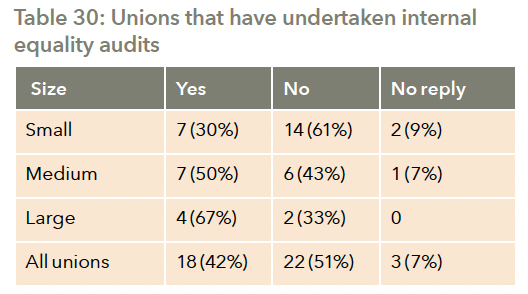
Examples of equality audits included:
- Community produces monthly reports on membership equality data and representative equality data, suggesting a regular monitoring cycle rather than full audits. As a result, the union has introduced strategic measures to increase the number of women and young worker reps.
- UNISON’s audits were linked directly to its Years of Different Equality Groups activities and informed measures to increase diversity in leadership roles for young, women, migrant, LGBT+, disabled and Black members.
- The RMT recently surveyed the engagement of Black and ethnic minority members (B&EMM) within the union.
- The PCS used equality statistics to inform gender pay gap reporting, gain Disability Confident employer status and establish an anti-racism taskforce.
- NAHT used audit findings to develop its EDI plan, improve data collection, create a discrimination protocol for officials, run a membership culture survey and launch an equality rep pilot.
Equality action plans
Twenty-two unions (54 per cent) said they have an equality action plan in place – no change on 2022. These included all six large unions (up from four in 2022), eight medium unions (up from seven) and eight small unions (down from 11).
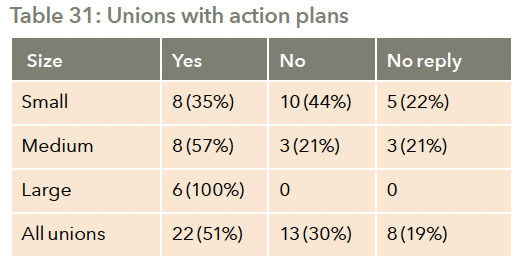
Unions generally mentioned overseeing the progress of plans rather than formal evaluation. Most rely on committee oversight and regular reporting. A smaller group, particularly UNISON, The NUJ, CSP, NAHT and the Musicians’ Union, have begun to use metrics or trend data to assess whether equality action plans are actually delivering change. The NUJ describes three parts to its work: outputs (reports, policies, training), impacts (surveys and participation rates) and outcomes (statistical monitoring and casework data).
Community produces monthly reports on membership equality data and representative equality data, suggesting a regular monitoring cycle rather than full audits. As a result, the union has introduced strategic measures to increase the number of women and young worker reps.
Unions were asked about their successes in the equalities field and offered a wide range of achievements in their answers. As mentioned elsewhere in the report, many unions identified significant progress in tackling sexual harassment, discrimination and the far right.
Several unions also highlighted improvements in equality monitoring and data collection:
- Community reported that “data collection is improved”.
- The NAHT described moving from “not collecting any equality data on members, to having information on 12 per cent of our membership”.
- The NEU reported gathering detailed information on conference delegates and using this to measure improvements in representation over time.
- The CWU also highlighted improvements in proportionality monitoring and data collection to support targeted action.
Many unions reported creating new equality structures and networks including bringing together strands and ‘pan-equality’ groups. Examples included:
- UCU’s establishment of a Migrant Members Committee
- Napo’s new LGBT+ and Young Members Networks
- Artists’ Union England’s Black Members Network.
A number of unions highlighted progress in improving representation and participation.
- Unite reported increased representation of women, Black members, disabled members, LGBT+ members and young members in elected leadership positions and committees.
- Community reported a 50 per cent increase in equality rep roles and increased activity involving women, young workers, Black workers and “LGBTQIA+” workers.
- WGGB reported increased engagement in elections, increased diversity of committee members and increased diversity of its National Executive.
- NEU reported that its lay structures are now “more reflective of the membership as a whole”.
Leadership development programmes were also identified as important successes.
- Usdaw highlighted the continuing development of its Breaking Down Barriers Programme to address the under-representation of Black members in lay roles and events.
- The Musicians’ Union highlighted its Future Leaders scheme for members underrepresented on regional and executive committees.
- EIS reported its Our Voices in Union Leadership Programme.
- PFA highlighted positive action programmes, peer-to-peer networks and dedicated development opportunities for underrepresented members.
At the same time, unions identified continuing barriers to progress in equalities work. Common challenges included limited data (data collection is very uneven among unions), difficulties measuring impact, varied engagement across branches and the ongoing challenge of increasing participation among underrepresented groups.
Smaller unions in particular were less likely to have dedicated equality staff, formal equality structures, monitoring systems or specialist services. Several unions also noted that building representative structures and improving participation is a long-term process requiring sustained commitment and resources.
The TUC Equality Audit has been monitoring progress the trade union movement has been making to eliminate all forms of harassment, discrimination and prejudice, both within our structures and in workplaces since 2003. This audit, focusing on trade union membership and our representative structures, highlights the progress that has been made since the 2022 evaluation.
We have seen from responses that affiliated unions are making good progress when it comes to preventing sexual harassment, encouraging reporting and building confidence in union responses to complaints. However, there is still more work to be done when it comes to building preventative cultures, particularly considering the new requirements in the Worker Protection Act 2023.
It is clear from the findings of this report, based on the additional questions introduced on work unions are taking to tackle the rise of the far and populist right, that this is a priority area for affiliates. Adoption of the TUC’s model equality clause – or bespoke wording specific for each union – is high, and most union members are subject to rules regarding membership of far right or racist political parties.
Affiliates are investing in training, resources and support for representatives in tackling far right narratives; this is crucial as we cannot talk about our work to combat the far right without acknowledging the racist, misogynistic, homophobic, transphobic, ableist and anti-migrant sentiment that underpins their messaging.
While there has been some improvement in terms of the data trade unions collect on different protected characteristics, for staff and for members, there is still a long way. Having up to date, accurate data is one of the best ways to ensure our movement is representative of the workers we support and affiliated unions should consider investing in accurate data collection and maintenance to allow for targeted campaigns and to ensure the work they do to tackle inequality is reaching the workers who most need our support.
Stay Updated
Want to hear about our latest news and blogs?
Sign up now to get it straight to your inbox