TUC Equality Audit 2026
This section examines the presence of formal lay structures and/or informal networks focussed on overall equalities work or work on individual strands.
Formal equalities structures
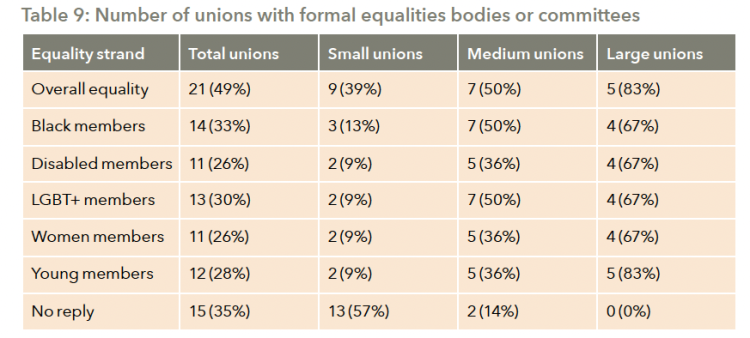
Twenty-one unions responding to the audit reported having a formal national body or committee for overall equality (this is up on 18 in 2022). As in previous audits, overall equality committees are considerably more common than strand-specific structures.
Compared with the previous audit, there appears to have been some modest growth in formal structures for certain equality strands, particularly for LGBT+ members and young members. The number of unions reporting national committees for LGBT+ members increased from the relatively low levels seen in earlier audits to 13 unions in 2026, while 12 unions now report formal structures for young members. There has also been some expansion in structures for Black members, although formal committees for disabled members and women members remain comparatively limited.
Large unions are more likely than small unions to have national committees covering equality overall and specific equality strands. Five of the six large unions responding to the audit reported having a formal national equality body overall, and large unions were particularly likely to report dedicated structures for young members, Black members and LGBT+ members.
Informal equalities structures
Informal networks tend to be more widespread than formal committees for individual equality strands. For example, while only 11 unions reported formal national committees for disabled members, 13 reported informal disabled members’ networks. Likewise, 16 unions reported informal LGBT+ networks compared with 13 reporting formal LGBT+ committees. Whilst larger unions have both formal and informal strand-specific committees in equal numbers, medium-sized unions are slightly more likely to use informal structures.
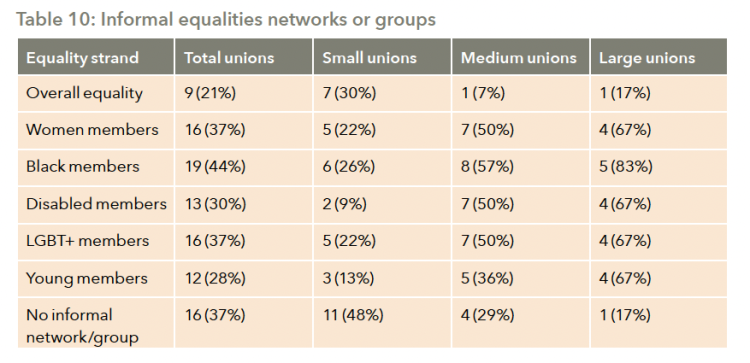
Compared with the 2022 audit, the 2026 findings suggest some growth in the use of informal equality networks and groups, particularly for Black members, LGBT+ members and young members.
The strongest growth appears to be in networks for Black members. In 2026, 19 unions reported having an informal network or group for Black members, making this the most common type of strand-specific informal structure. There were also 16 unions with informal women’s and LGBT+ networks, 13 with disabled members’ networks and 12 with young members’ networks.
As in 2022, larger unions remain much more likely to have informal equality networks than small unions. Five out of six large unions reported networks for Black members, women members, LGBT+ members and young members, while four out of six reported disabled members’ networks. Medium-sized unions also reported relatively high levels of informal equality structures, especially for Black, women’s and LGBT+ networks. Small unions were much less likely to report informal networks of any kind, with almost half reporting no informal equality networks or groups at all.
Changes since the last audit
Several unions reported developments in their equality committee and network structures over the last four years, including expanding participation and creating new networks.
- Unite reported regional and national joint equality networks, women’s industrial networks in construction, energy, chemicals and passenger transport sectors, a Black women’s network and young members regional WhatsApp groups.
- NASUWT described advisory committees for under-represented groups linked to its Equal Opportunities Committee (EOC). It reported changes to the election mechanism for the LGBTI Members’ Advisory Committee to protect privacy, more Black members’ network groups in the regions, recommencement of joint advisory committee meetings “to allow for a more intersectional approach”, and caucus meetings for women, Black, disabled, LGBTI and young members at annual conferences.
- PCS reported the re-establishment of “Equality networks in each region and nation supported by targeted communication to members”.
- The CWU described “significant changes” to its equality structures, including a dedicated half day equality day at annual conference, “sub regional equality committees” linking branches into national and equality networks. The union said these changes were intended to ensure equality was “not siloed but embedded in the union’s core work”.
- NAHT reported launching its Women’s Network in late 2024 following the creation of leaders for race equality, LGBT+ and disabled members’ networks. It said the Women’s network had already grown to “nearly 90 members” and that across all networks it now had “over 400 members”.
- Community reported the “Introduction of the executive equality committee” in early 2025.
- PFA described networks for “Players who are mothers, South Asian heritage players, Black players and coaches, LGBT players”.
- ASLEF said it had “introduced networks for women and Black members in the last four years”. Napo reported that “LGBT and young members networks have been established”.
- Aegis said it had established “a national D&I working group” in January 2025.
- Artists’ Union England reported “establishing the Black members network and the LGBTQ+ members network across 2024 and 2025”.
- WGGB stated that “all its networks were established in the past four years”.
A smaller number of unions reported limited developments or difficulties maintaining networks. Accord said its equality network “has been disbanded due to difficulty in maintaining engagement” and that a women’s network “didn’t take hold”, leading the union towards “more regular and tailored communications” instead.
Stay Updated
Want to hear about our latest news and blogs?
Sign up now to get it straight to your inbox