
TUC Equality Audit 2026
To ascertain whether it truly represents the full diversity of its membership, a union needs to monitor the composition of both its members and its various representative structures. This means keeping disaggregated statistics – that is, statistics broken down by equality strand – for their membership, in their activist ranks and in their democratic structures.
Not all unions that collect data are able to state confidently how many of each equality strand there are at a given time because the data often comes from a sample of members or activists rather than the entire membership. This is generally either because not all members have provided the union with the information, or because the information is collected through application processes devised only after a certain date. We would therefore urge caution when using the figures in this section.
Monitoring equalities in membership
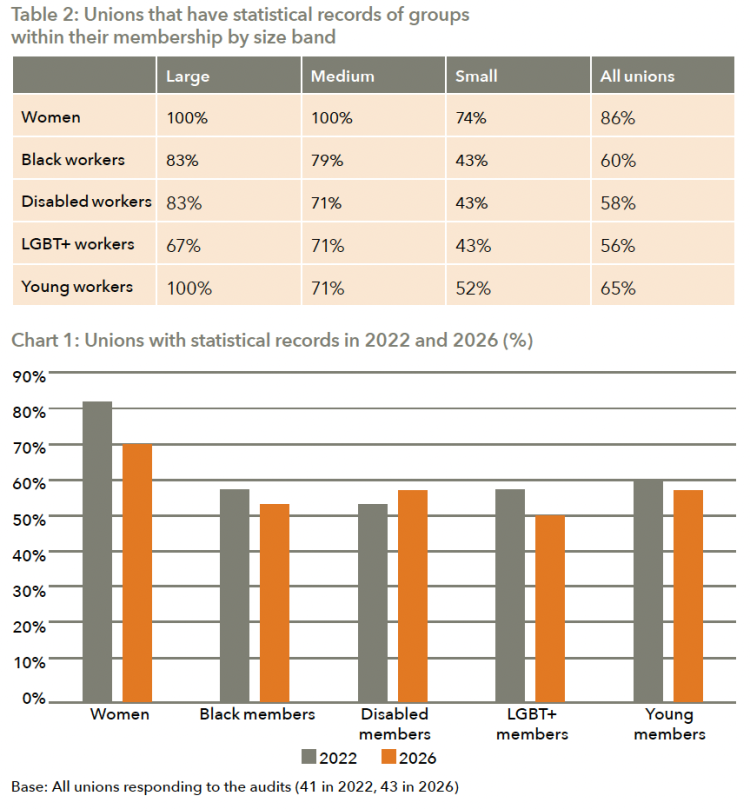
The first part of this section looks at the number of unions who attempt to keep statistics on the diversity of their membership. The tables below show the percentage of unions that undertake equalities monitoring of their membership broken down by union size.
They show that larger unions are consistently more likely than smaller unions to monitor equality characteristics. While the monitoring of women is widespread, the monitoring of Black, disabled and LGBT+ members drops substantially, especially among small unions.
Compared with 2022, there has been a slight drop-off in the amount of monitoring except in the case of disabled members.
Monitoring of activists and union roles
Unions are generally more likely to monitor the representation of equalities groups at conferences and in their national executives than of workplace or branch-level roles such as equality reps and learning reps. Monitoring of equality reps is particularly limited, with only around half of unions collecting this information.
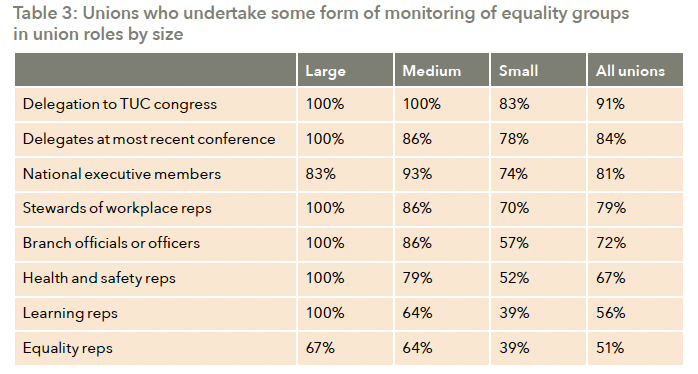
Although gender monitoring is more established than monitoring for other equality strands, a significant minority of unions are still not collecting data across all rep roles.
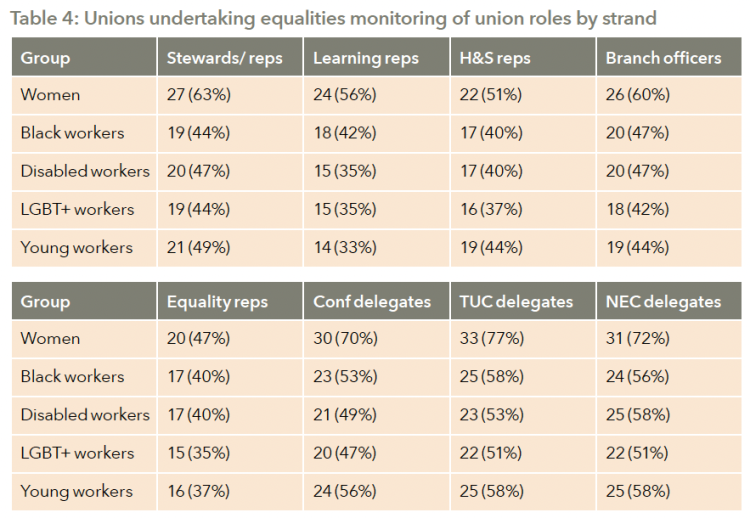
In terms of the monitoring of activists at workplace or branch level, there appears to have been some improvement since 2022. Although the only group which is consistently monitored by the majority of unions is still ‘women’, the table below shows that most now do this across all roles, apart from equality reps (it was only two in 2022).
Women
A small number of unions have rules or targets for equality training, such as Unite’s Women make up a majority of members in 20 unions responding to the audit, particularly in education, health and public sector and civil service unions. Several unions report memberships that are more than 70 per cent women, including the NEU, UNISON, RCM and NASUWT. By contrast, some transport and manufacturing unions continue to report predominantly male memberships, including ASLEF, the PFA, RMT and the Fire Brigades Union. Although gender monitoring is more established than monitoring for other equality strands, a significant minority of unions are still not collecting data across all rep roles.
Black workers
The number of Black and Minority Ethnic workers has risen considerably since the last audit. Official statistics show that in 2025 they made up 18.4 per cent of all employees (13.1 in 2021) and 15.6 per cent of union members (11.8 in 2021). In the audit data, the PFA (40 per cent), RMT (26 per cent) and BFAWU (24 per cent) have the highest proportion of Black workers. Fewer unions have disaggregated figures for Black activists, with under half doing so for most roles, although this is slightly up on 2022. Just 19 unions responding to the audit (44 per cent) do so for stewards/workplace reps, 18 (42 per cent) for learning reps, 17 (40 per cent) for health and safety reps, 20 (47 per cent) for branch officers and 17 (40 per cent) for equality reps. Monitoring is more common for conference roles.
Disabled workers
Fewer than half of unions responding to the audit monitor disability across most activist and rep roles. The most monitored roles are stewards/workplace reps and branch officers (twenty unions or 47 per cent have data on these).
LGBT+ workers
Monitoring of LGBT+ status among activists and reps remains limited across most unions and roles. However, 19 unions (44 per cent) collect LGBT+ data for stewards/ workplace reps, the same as for Black workers. As with other equality strands, monitoring is more common for conference delegates but fewer unions monitor this strand than the others.
Young workers
Monitoring of young workers among activists and reps is also inconsistent across unions. Twenty-one unions responding to the audit (49 per cent) collect agerelated data for stewards/workplace reps, but only 14 (33 per cent) for learning reps.
Fewer than half of unions responding to the audit monitor disability across most activist and rep roles. The most monitored roles are stewards/workplace reps and branch officers,
How unions collect equalities data
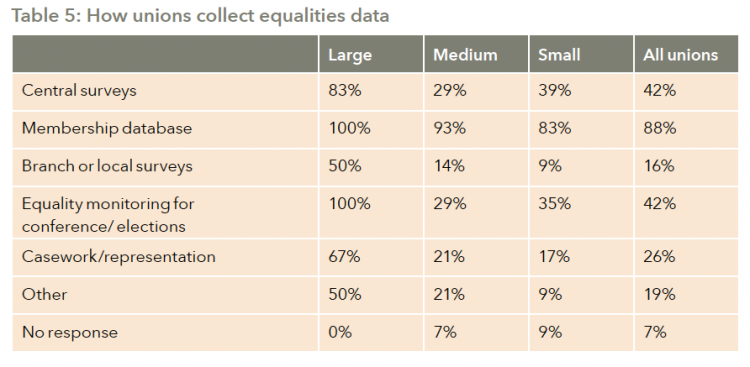
The most common way that unions collect equality data is when a member first joins, often via application forms on paper, online or via apps. This data is then added into membership databases or CRM systems. 88 per cent of all unions collect their data this way. However, as unions such as BFAWU and the Artists’ Union of England note, filling these sections out is often voluntary and therefore the data is not necessarily complete. To try and overcome this issue, unions use other strategies, for example the FBU uses an app via which members can update their details at any time.
After members join, unions use other ‘contact points’ to fill any gaps in their data.
The second most common way unions collect equalities data is through central surveys and equality monitoring during conferences, elections, and training (although the latter was not included as a tick-box option in the audit). Collecting data in this way means obtaining information from a sample of the membership. Interestingly, a higher proportion of smaller unions do this than medium-sized unions. Casework is another opportunity to collect equalities data, and it is used by a quarter of unions.
Unions commenting on the use of these methods include:
- Usdaw collects age and sex data when members join, other characteristics are captured via monitoring forms at events, training, and surveys.
- UNISON monitors members at events using proportional and fair representation forms.
- NASUWT members are encouraged to submit information at multiple engagement points including casework, advice line, courses, and conferences.
- The Chartered Society of Physiotherapy (CSP) conducts equality monitoring for attending events and wants to capture data on trans members.
- Aegis uses surveys delivered by its diversity and inclusion working group.
- Equity: Members are asked to update regularly. A census is planned in the next year.
- Prospect: Their CRM collects gender and age; equalities data are also gathered via surveys every two years.
- The CWU monitors reps’ equalities data on its reps database, a separate part within its membership system.
Actions taken to recruit members from equalities groups
Over half of the unions had taken specific actions to recruit new members from various equalities groups, often linking these recruitment efforts to organising campaigns aimed at encouraging members from those groups to become more active in their union.
Women
Unions reported using a combination of women’s networks, leadership development initiatives and campaigning on issues such as equal pay, maternity rights, menopause and sexual harassment to recruit and engage women members.
- The FDA partners with Total Events on Women into Leadership events and runs recruitment and breakout sessions.
- RMT reported that “specific efforts were made to encourage women members to be H&S reps.”
Black workers
Recruitment activity often combined Black members’ networks and conferences with leadership development programmes, anti-racism organising and targeted outreach.
- GMB highlighted its recruitment of gig economy workers and GRASP - GMB Race Achievement Scholarship Programme which has “brought through new Black and global majority leaders from every region in the union.”
- CWU says that in Scotland “holding workplace surgeries for BAME members has increased membership by four per cent.”
Disabled workers
Responses emphasised accessibility, disability equality campaigning, dedicated disabled members’ structures and targeted recruitment activity.
- Unite described a programme including a “disabled members survey open to non-members”, a “disabled leadership development programme” and measures to “ensure all union meetings and events are fully accessible”. It promotes the social model of disability, has raised awareness of neurodiversity and ran a public campaign against welfare cuts.
LGBT+ workers
Many unions sought to recruit LGBT+ workers through networks and safe spaces, Pride and LGBT+ History Month activity, targeted recruitment materials and leadership opportunities.
- The FBU says it holds an annual AGM and regular meetings of LGBTQ+ members and uses it as an opportunity to organise and reach out to the wider workplace.
- NASUWT hold an Annual LGBT Teachers’ Consultation Conference - free to members, with expenses covered. Members/attendees are encouraged to “recruit and bring a friend”. Promoting LGBTI equality in schools and colleges and lobbying for Trans equality, and for Relationships and Sex Education to include LGBTI equality, attracts new LGBTI members to the Union. The provision of safe spaces for LGBTI members to discuss and share their experiences helps recruitment.
Young workers
Recruitment strategies focused on students, trainees and early-career workers, alongside leadership development, activism and organising opportunities.
- The Chartered Society of Physiotherapy (CSP) said that it had “re-instated student reps” so that it was “recruiting more students at university level who then go onto remain members into the workplace”.
- RMT reported that young members are “spearheading the RMT apprenticeship organising campaign” and were involved in the Young Safety Reps campaign.
Migrant workers
Recruitment activity frequently centred on providing practical support and advice, and campaigning on issues affecting migrant workers.
- PCS used its Learning Fund to provide ESOL classes for members where English is their second or even third language to improve accessibility and participation.
- The NEU has been actively involved in work around the treatment of overseas trained teachers, including taking action across a multi-academy trust that saw a general increase in membership.
- The CSP has partnered the Health and Care Professions Council for outreach and offered three months free membership to new internationally educated members which has seen the membership base increase.
Other groups
A small number of unions reported initiatives aimed at engaging groups beyond the main equality strands, including faith groups, workers from working-class backgrounds and returning workers.
- GMB launched a Jewish faith workers’ branch in its London region.
- WGGB established Challenging class privilege, Challenging ageism and Returning workers networks.
Stay Updated
Want to hear about our latest news and blogs?
Sign up now to get it straight to your inbox