TUC Equality Audit 2026
Unions were asked if they held regular conferences or seminars either for overall equality or for specific strands of members.
National events
The number of unions holding national equalities events can be seen in the table below:
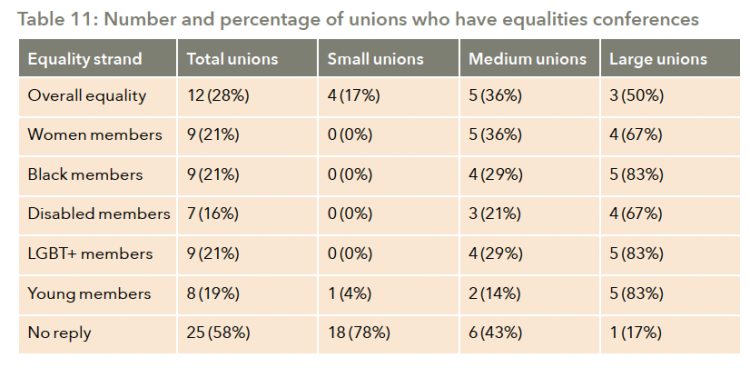
Since 2022, there has been an increase in the number of unions holding national equality conferences. Twelve or 28 per cent of respondent unions hold national conferences or seminars for overall equality (it was eight unions (20 per cent in 2022).
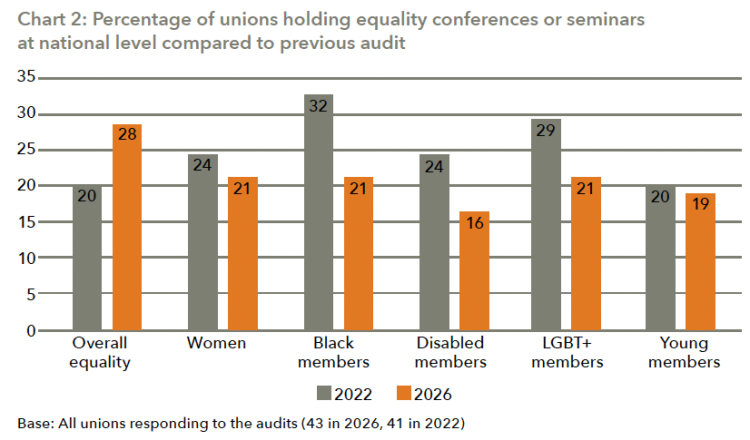
However, there has been a decline across the board in the individual equality strands, continuing a trend that has been seen for most of the last decade (see Chart 2).
Holding national conferences for specific equalities groups is much more common for larger unions – although they have also seen a decline. Unlike in 2022, not all large unions responded, however, amongst those that did, all held events for Black, LGBT+ and young members.
Small numbers of other unions do still hold national equality events. Conferences for overall equality, and women members are held by five medium-sized unions (36 per cent) and 17 per cent of small unions also hold equality conferences.
There has been a decline across the board in the individual equality strands, continuing a trend that has been seen for most of the last decade.
Sub-national events The following table shows the numbers and percentages of unions that hold equalities events at the sub-national level. Of the 39 unions completing the main questionnaire, 12 or 31 per cent (down from 16 in 2022) hold conferences or seminars on overall equality at sub-national level. (This question was not asked of those completing the abridged questionnaire.)
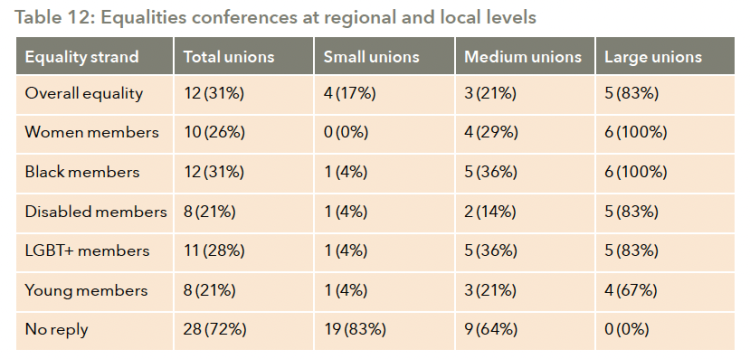
Out of the 39 unions answering this question, a small number of unions held sub-national events for individual equality strands: 26 per cent of unions held conferences for women; 31 per cent for Black members (both roughly equal to 2022); there has been a slight drop in the number of events for disabled members 21 per cent (down from 27); and also for LGBT+ members 28 per cent (down from 32 per cent in 2022); and 19 per cent for young members.
UCU highlighted work in Scotland on challenging and organising against the far right, including support for STUC anti-racism events.
Developments in Wales and Scotland
Wales
A number of unions reported developments aimed at strengthening equality work in Wales over the last four years. Examples included:
- GMB reported a Wales TUC equality committee sub-group as well as other regional equality committees.
- PCS reported that a conference motion established Devolved Nations within PCS for both Wales and Scotland. Each nation now has its own annual conference, committees and constitution. The union stated that both nations are working towards establishing fully functioning equality committees focused on issues within their own nation.
- RCM highlighted a range of Wales-specific conferences, networks and projects, including an Inclusive Maternity themed St David’s Day Conference, the Maternity Inclusive Network, work with Diverse Cymru, a Maternity Leadership and Development Group, Queer Birth Club and Birthrights training, and neurodiversity and Welsh language projects.
- UCAC reported establishing an Adran Cydraddoldeb (Equality Department).
Scotland
Several unions also reported developments specific to Scotland.
- NASUWT reported establishing a Scotland Neurodiverse Network and a Scotland Women’s Conference Skills event.
- The EIS, a Scottish union, created two new posts: Equality Related Learning and Development Co-ordinator, and National Officer (Education and Equality), with responsibility for poverty-related work.
- UCU highlighted work in Scotland on challenging and organising against the far right, including support for STUC anti-racism events. The union also reported that one of its members, Gina Gwenfrewi, received the STUC Equality Reps Award in 2025 for work on trans and non-binary equality.
- Other developments with relevance across the devolved nations included the establishment by NSEAD of an anti-racist art education group, anti-ableist pedagogies group and gender and transformative education group.
Reported changes to equalities events in the last four years
Unions that commented described an expansion of equality-focused conferences, seminars, and networking events, alongside a growing emphasis on intersectional or ‘pan-equality’ approaches. At the same time, a small number of unions reported scaling back or restructuring their equality conference arrangements.
- Community reported that a bi-annual equality conference was established in 2023.
- The NEU reported that its 2025 annual conference voted to establish a women’s conference, with the first conference scheduled for October 2026.
- Usdaw reported increased support for regional equality activity, including Black activists events linked to the Breaking Down Barriers Programme and regional LGBT+ member events, often linked to local Pride activities.
- PCS reported a move towards pan-equality seminars, bringing together members with different protected characteristics to work collaboratively and recognise the intersection of inequalities.
- CWU highlighted its Annual Equality Day, regional seminars, workshops and networking activities, alongside an Annual Young Workers Conference and networking events for women, BAME and LGBT+ members.
- Napo reported that “funding restrictions have prevented us from holding conferences as we used to”.
Unions that commented described an expansion of equality-focused conferences, seminars, and networking events, alongside a growing emphasis on intersectional or 'pan-equality' approaches.
TUC Congress monitoring
At the 2025 TUC Congress, equality monitoring of delegates was carried out. Any comparisons are to 2021 (held online due to Covid-19). All 524 delegates completed the monitoring form, though delegates were able to select ‘no answer’ or ‘prefer not to say’ for questions.
TUC data showed that 49 per cent of delegates were women, compared to 52 per cent in 2021. 50.2 per cent of delegate speakers were women, compared to 57.6 per cent of delegate speakers in 2021 – although worth noting Congress in 2021 was held online, making it difficult to make direct comparisons.
In 2025, 17.4 per cent of delegates identified as BME compared to 12.6 per cent in 2021. 23.7 per cent of delegates identified as disabled, up from 19 per cent in 2021, and 11.6 per cent of delegates identified as LGB or another term relating to sexual orientation, again an increase from 10 per cent in 2021. 1.5 per cent of delegates identified as trans. The proportion of delegates under 35 increased to 8.6 per cent (7.5 per cent in 2021 and 7.4 per cent in 2019).
Stay Updated
Want to hear about our latest news and blogs?
Sign up now to get it straight to your inbox