TUC Equality Audit 2026
In this year’s Equality Audit, unions were asked more detailed questions about the policies and procedures they have in place to prevent and respond to sexual harassment involving staff and members. New questions were included to reflect the Worker Protection Act 2023 (Amendment of Equality Act 2010), which came into effect in October 2024 and introduced a duty on employers to take reasonable steps to prevent sexual harassment of workers.
Preventing sexual harassment of staff
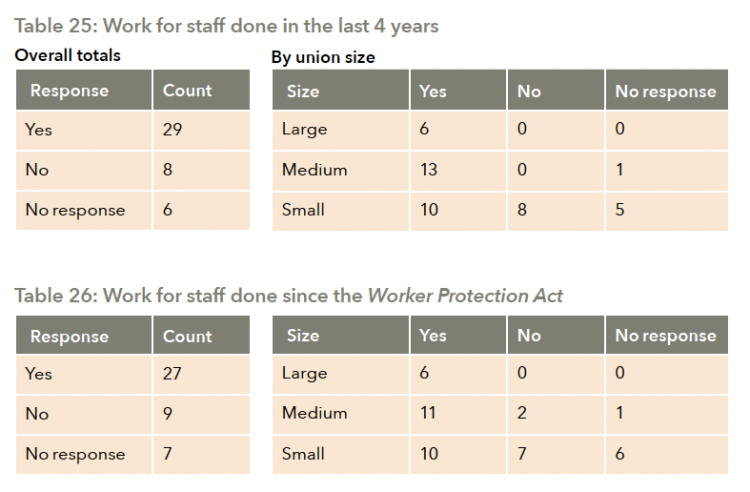
Unions were asked about work done to prevent sexual harassment amongst staff since the last audit in 2022 and since the introduction of the Worker Protection Act. The tables below show the number of unions that indicated they had carried out work – the overall numbers and by union size. Twenty-nine said they had undertaken new work, including all large unions, nearly all medium-sized unions but less than half of smaller unions.
Preventing sexual harassment of members and activists
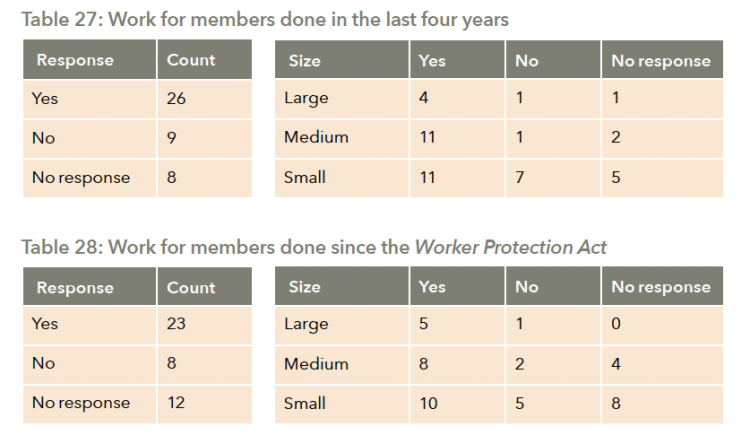
Unions were also asked about work done to prevent sexual harassment within their membership. Fewer unions answered this question overall, with slightly fewer large and medium-sized unions reporting that they had done work on this area for members. In contrast, the smaller unions were just as likely to have done work with their membership as with their staff, but less than half of them reported that they had done any.
Actions taken around sexual harassment
When asked about what specific actions they had taken, most unions reported a range of activity. The table below shows the numbers taking each action.
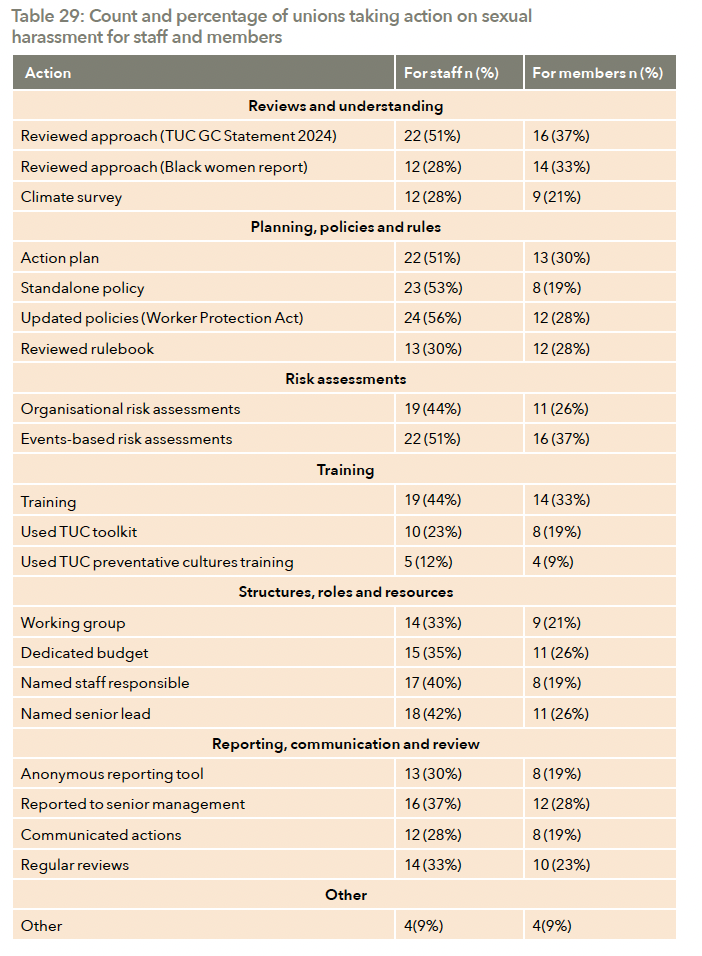
Overall, more unions tended to undertake work on this issue for staff than for members.
This is particularly evident in policy development where over half of unions report updating policies (56 per cent) and developing standalone policies (53 per cent) for staff that are likely workplace-based, compared to 28 per cent and 19 per cent respectively for members.
Encouragingly, unions also appear to be undertaking reviews, furthering their understanding of the issue and its impact and undertaking more risk assessments. Just over half of unions report reviewing their approach in line with the TUC General Council statement for staff (51 per cent), compared to 37 per cent for members, while those reviewing the Black women and sexual harassment report is reported at similar levels for both staff (28 per cent) and members (33 per cent).
When the results are broken down by union size, large unions report consistently high levels of activity for staff, with most actions undertaken by a majority and several reaching near-universal coverage. Activity for members is also higher than in smaller unions, but more uneven.
Medium-sized unions report relatively strong activity for staff across several areas (71 per cent had updated their workplace policies), though typically at lower levels than large unions. For members, activity is more mixed. Training, risk assessments, policies and planning are relatively common (43 per cent), but fewer unions report standalone policies (21 per cent), dedicated budgets or formal reporting mechanisms.
Small unions were less well represented in this question and no activity had been undertaken by a majority of those who answered. While several report core actions for staff, such as reviewing approaches and developing standalone policies (39 per cent), activity is more limited and inconsistent for members.
Encouragingly, unions also appear to be undertaking reviews, furthering their understanding of the issue and its impact and undertaking more risk assessments.
Successes and improvements
Unions report early successes and improvements arising from their work to prevent sexual harassment, although several unions note that it is still too early in their process to fully assess impact. Successes mentioned included:
- Increased awareness and understanding of sexual harassment
Unions report greater clarity about “what sexual harassment is and how it can show up in the workplace”, alongside improved understanding of expectations, boundaries and behaviours. This is reflected in both staff and member awareness, as well as among reps and managers.
- Greater confidence in reporting and handling cases
For example, ASLEF notes that it has received official complaints, and whilst this is “not good”, they demonstrate that members feel able to report and have complaints “investigated properly”. Similarly, NASUWT reports that the introduction of Dedicated Support Officers and an independent advice line has “empowered greater reporting”.
- Clearer and more supportive processes
Unions also report clearer reporting structures, with staff and members more confident about “who to report incidents to” and how cases will be handled. The GMB describes “more consistent outcomes in processes” and the CWU highlights that clear guidance and toolkits have improved confidence in handling cases and ensured a “more consistent and supportive approach”, alongside earlier reporting and intervention.
“Managers feel confident in the application of the policy, awareness of sexual harassment issues has increased and staff know how to report harassment and are clear on how NAHT would deal with these issues.” NAHT
- Positive cultural change
A number of unions report positive cultural shifts as a result of their work, including “significantly safer environments at national and regional events”. The AEP mentions no additional cases arising since introducing the alcohol ban. In some cases, training in the area has also contributed to broader organisational change, including in the POA and FBU, where it has increased discussion around the representation and inclusion of women on committees and at conferences. The NEU says completing the TUC checklist has enhanced work of its equality working group.
Remaining challenges
Despite the successes, unions also note that there are challenges involved in implementing the work to prevent sexual harassment, including:
- Difficulties around implementing cultural change
Several unions reported resistance to new policies, training, and behavioural expectations. For example, BFAWU noted push back against introducing a code of conduct for reps. The CSP has faced “what about men” questions from members who feel excluded from the campaign, while the POA has experienced resistance to attending and engaging positively with training, a challenge also highlighted by Prospect.
- Difficulties in getting people to report
Another significant challenge is encouraging people to come forward and report experiences of sexual harassment. UCU highlighted an ongoing perception that unions may protect perpetrators rather than victims, which can undermine trust in reporting processes. NASUWT also noted that a “level of apprehension” remains around reporting incidents. Similarly, the NEU reported that some employees do not want to formally report the sexual harassment they experience and, even when they do report it, they may not want the issue to be formally investigated.
- Resources and capacity are a concern for unions of all sizes
The scale of the work needed is mentioned as another core challenge. The NUJ and NAHT both mention this, whilst a large union, Unite, has found the initial scoping stage of the work needed to be a challenge. Smaller unions such as NSEAD mentioned capacity and budgeting is hard, as did the Artists’ Union.
- Finding appropriate trainers and resources
The GMB mentions challenges around the availability of resource for training delivery and would like to use TUC provision more. The POA echo this, asking for more stand-alone preventative culture training as part of their education offer for lay officials, as well as more “train the trainer” events to ensure that there are accredited trainers throughout the UK, especially Northern Ireland. The NEU mentions uncertain about which third party suppliers to use for training.
“One of the main challenges has been the limited availability of meaningful data, as the structures and processes are still relatively new. This has made it difficult to monitor progress and measure impact effectively. Another challenge is ensuring consistent engagement across all branches, given the varying levels of resources and awareness. Finally, balancing this work alongside other priorities has been demanding, particularly in ensuring that equality initiatives receive the attention and support they need.” CWU
- Sensitivity around the issue
A couple of union also mention that focus on a topic that many staff find distressing can be difficult and requires extra care.
Stay Updated
Want to hear about our latest news and blogs?
Sign up now to get it straight to your inbox