
TUC Equality Audit 2026
One way in which unions can support different equality groups is by providing targeted services. These may include dedicated publications, online resources, telephone helplines, training, and other learning opportunities. This section examines the extent to which unions provide services specifically aimed at women, Black, disabled, LGBT+, and age-related groups of members.
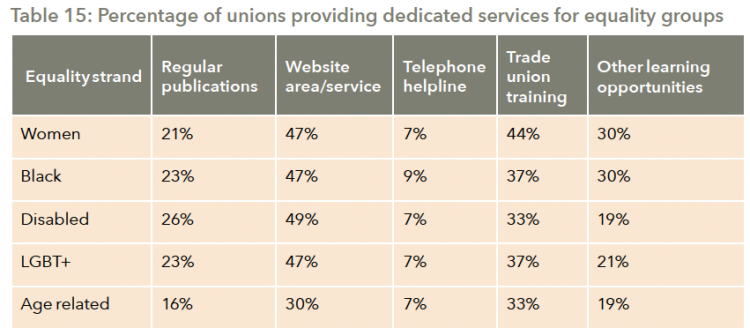
Dedicated website content is the most common form of support across all union sizes, closely followed by training – although still under 50 per cent of unions provide this, see table above. Overall, age-related provision is generally less developed than provision for other equality groups.
Large unions are consistently much more likely to provide dedicated equality services. All six large unions reported dedicated website areas or services for women, Black, disabled and LGBT+ members, while the majority of large unions reported dedicated trade union training and regular publications for most of these groups. Large unions were also the most likely to offer other learning opportunities.
Among medium-sized unions, around 70 per cent provide dedicated website areas for women, disabled members and other equality groups. Small unions are much less likely to do so, with only 13-22 per cent reporting dedicated website provision. With regards to training, forty-four per cent of unions provide dedicated trade union training for women members, while around a third do so for other equality groups.
Regular publications remain relatively uncommon, especially in smaller unions. Fewer than a quarter of unions overall produce dedicated publications for most equality groups. Among small unions, fewer than one in seven do so for any strand, compared with around four-fifths of large unions for Black, disabled and LGBT+ members.
Around 30 per cent of unions provide additional learning opportunities for women and Black members, but fewer than one in five do so for disabled and age-related groups. Again, provision is concentrated in medium and large unions.
Dedicated telephone helplines are rare across the movement. Fewer than one in ten unions overall provide strand-specific helplines, and no small union reported doing so. Even among large unions, only two reported dedicated helplines.
Finally, unions were asked whether they monitor equality of access to the services they provide to all members. Just six unions (14 per cent) reported monitoring their general service provision to assess whether it delivers equality of access, although this rises to half of large unions. This suggests that, while many unions provide targeted services for particular groups, relatively few systematically assess whether their wider services are equally accessible across their membership.
All six large unions reported dedicated website areas or services for women, Black, disabled and LGBT+ members, while the majority of large unions reported dedicated trade union training and regular publications for most of these groups.
Discrimination cases
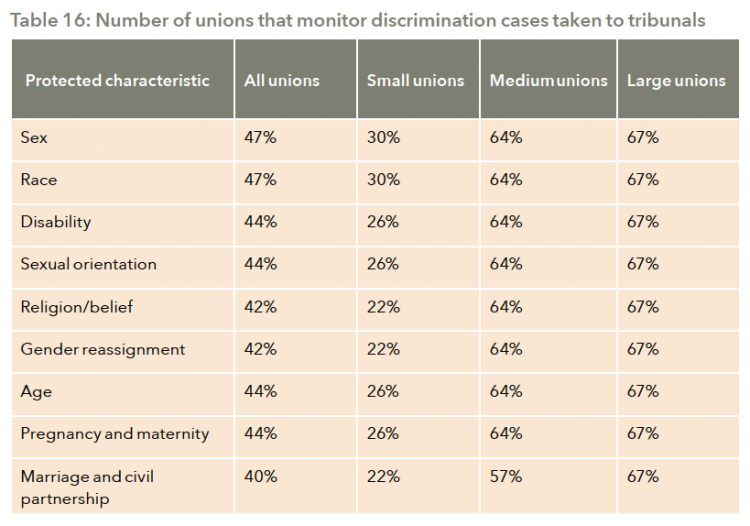
Equality issues frequently come to the attention of unions through discrimination cases brought by members. The extent to which unions monitor such cases and train reps to handle them well provides an indication of how equalities approaches are embedded in union services. The audit therefore examines whether unions monitor discrimination cases taken to tribunals on behalf of members and whether they provide training for paid officials and lay reps involved in handling such cases.
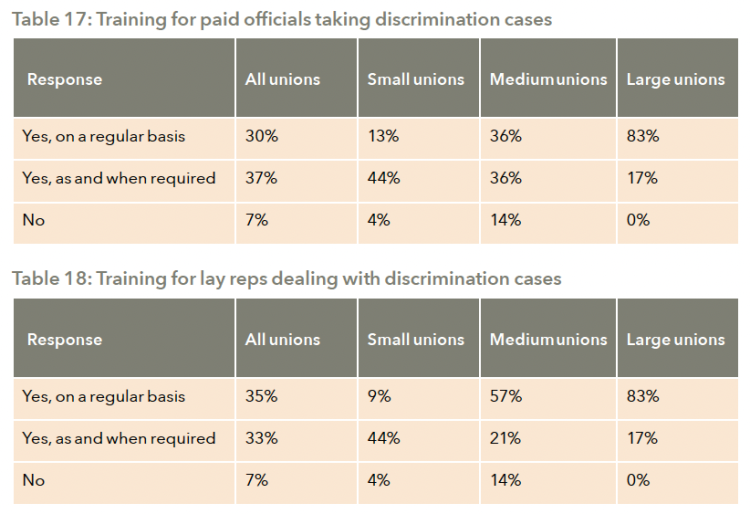
In terms of training, unions are slightly more likely to provide regular training for lay reps (35 per cent) than for paid officials (30 per cent). Large unions are much more likely to provide regular training, with 83 per cent doing so for both officials and lay reps. Small unions are more likely to rely on ad hoc training, with 44 per cent providing training “as and when required” for both officials and lay reps. The pattern for officials and lay reps is remarkably similar, suggesting that unions tend to adopt a consistent approach to discrimination case training across both groups.
Equality issues frequently come to the attention of unions through discrimination cases brought by members. The extent to which unions monitor such cases and train reps to handle them well provides an indication of how equalities approaches are embedded in union services.
Trade union training
Unions were asked about how they encourage participation in education and training by equality groups. Based on the comparison with 2022, there appears to have been a noticeable increase in the proportion of unions taking action in this area. In 2022, 34 per cent of unions reported taking such steps for women members, 27 per cent for Black members, and 22 per cent for disabled and LGBT+ members. By 2026, the equivalent figures had risen to 40 per cent for women, 42 per cent for Black members, 37 per cent for disabled members and 40 per cent for LGBT+ members. Unions commented that doing online training and better monitoring helped to increase participation:
- NEU reported that “many courses are held on-line which has increased participation.”
- NASUWT reported that development courses for underrepresented members have been “reviewed and updated” and that the union has moved to hybrid delivery for some courses “to make them more accessible for those with carer needs or mobility issues”.
- BFAWU reported using equality monitoring data from its education provider and working “to encourage more of the categories to attend through targeted emailing and the equality network meetings”.
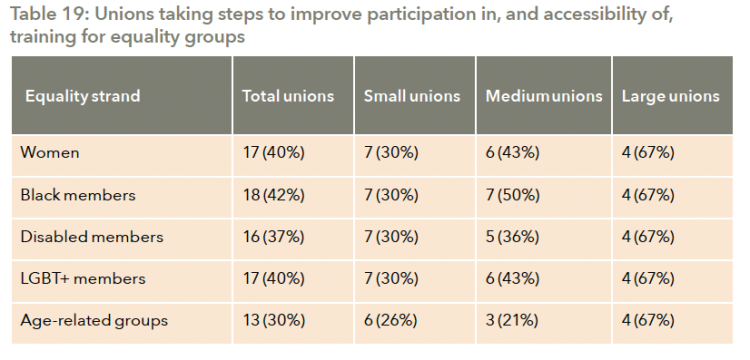
Unions completing the main questionnaire were also asked if they conduct monitoring of attendance by particular groups at union courses. This only occurs in a minority of unions. The highest notable proportions are in monitoring women’s attendance (44 per cent of unions) and the attendance of Black members (41 per cent of unions). This is an improvement since 2022.
Stay Updated
Want to hear about our latest news and blogs?
Sign up now to get it straight to your inbox