
TUC Equality Audit 2026
This section of the audit focusses on unions as employers. It covers whether unions undertake equalities monitoring of employees, promote pay equality and have policies to protect staff and members from any kind of discrimination and harassment, including sexual harassment.
Monitoring of staff diversity
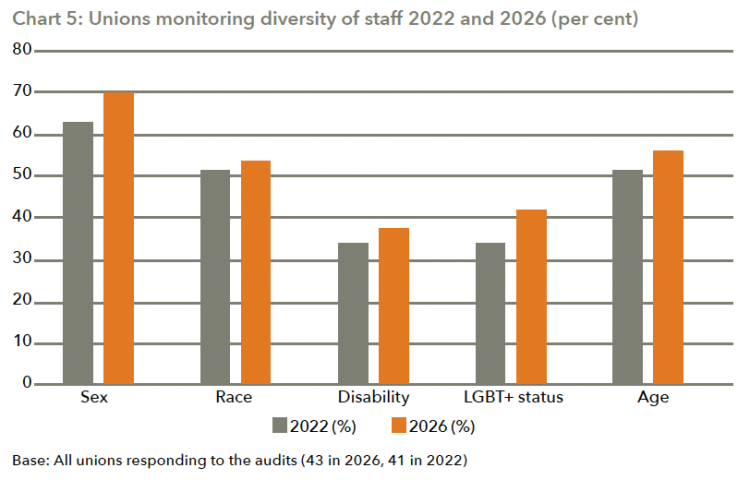
Monitoring of staff diversity has improved across the board since 2022, a reversal of trend in decline seen since 2014. As the table shows, 70 per cent of unions have statistical records of the number of staff who are women up on 63 per cent in 2022. The latest figures include 100 per cent of large unions (up from 83 per cent), 86 per cent of medium unions (up from 64 per cent) and 52 per cent of small unions which is slightly down on the 57 per cent during the last audit.
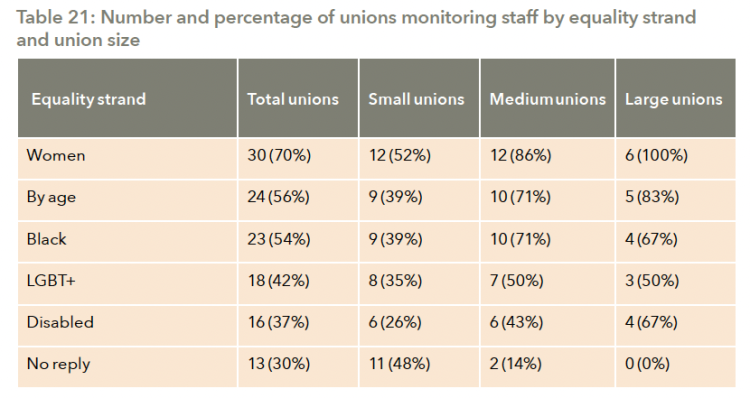
Over half of unions (54 per cent) have records of Black staff compared with 51 per cent in 2022, while 37 per cent do so for disabled staff (up from 34 per cent four years ago). Forty-two per cent have records for LGBT+ staff (up from 34 per cent). In all cases, the likelihood of a union keeping these statistics is lower the smaller the size band of the union.
Workplace policies
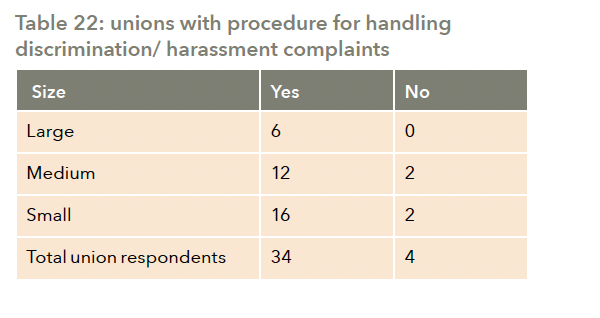
The Chapter on Rules showed that in 2026, 36 unions had a general equal opportunities or non-discrimination policy. This number dropped when asked if they had separate policies referring to individual equality strands. Five out of the six large unions had a general policy, but all also had a policy referring explicitly to Black members. The answers were roughly consistent with 2022 figures.
The vast majority of unions had a complaints procedure for staff affected by breaches of the equalities/non-discrimination policy – 7 out of 39 did. Nearly the same number had an explicit reference to dealing with harassment/discrimination within their internal complaints, disciplinary or grievance procedures. 79 per cent of the total (again slightly down on 83 per cent in 2022).
Staff pay and conditions
Unions were asked if staff pay and conditions have been reviewed in the last four years to ensure they do not discriminate against any strands. There has been a significant increase in the number of unions undertaking pay audits since 2022.
Twenty-one have done audits to ensure they don’t discriminate on grounds of sex (up from 13 in 2022), 18 for ethnicity (up from 12), 17 for disability (up for 9), eight for LGBT+ status and 10 for age.
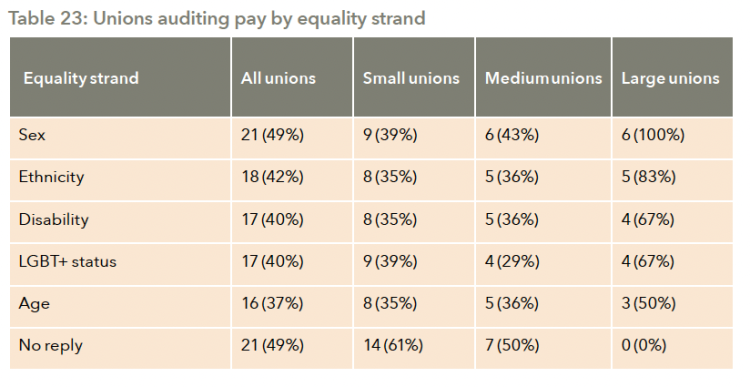
Unions were asked if staff pay and conditions have been reviewed in the last four years to ensure they do not discriminated against any strands. There has been a significant increase in the number of unions undertaking pay audits since 2022.
Several unions review their pay and grading on an annual basis:
- NEU reported that it undertakes an annual pay gap report covering gender, race, disability and LGBT+ staff.
- NASUWT reported annual gender and race pay gap reporting, with reviews each year to identify trends and disparities. It also publishes reports on both sex and gender pay gaps, as well as race pay gaps, even though race pay gap reporting is not a legal requirement.
- Aegis reported that its Remuneration Committee, elected by the National Executive, reviews pay annually.
- WGGB reported carrying out an annual review as part of the pay claim process and stated that salary levels and increases have been adjusted to ensure fairness.
- Others had undertaken substantive processes in the last four years:
- Community undertook a full pay review and benchmarking exercise in 2023.
- NSEAD reported that its most recent review took place in August 2024 and that “no positive action [was] required”.
- GMB completed a whole-organisation equal pay audit in 2024-25. The audit concluded that the union benefits from high levels of pay transparency and could be confident that it pays equally for like work, work rated as equivalent and work of equal value. The audit also identified some areas of risk, leading to updates to HR systems and the implementation of a revised internal job evaluation scheme. GMB also reported collecting qualitative information on barriers to progression and engagement for staff with protected characteristics and stated that introducing staff equality monitoring is a goal for 2026.
- Advance Union reported carrying out a full audit and review at the end of 2024.
- Association of Educational Psychologists reported reviewing and creating a new pay and reward policy, with a further review due in 2026.
Pay reporting
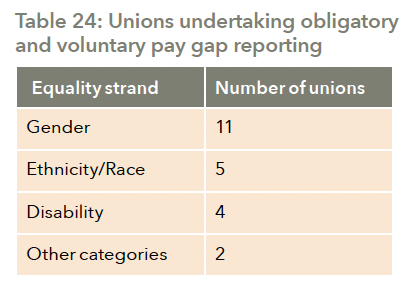
UNISON, Unite, GMB, NEU, Usdaw, NASUWT and Prospect are all legally obliged to undertake gender pay reporting. Some unions voluntarily undertake other types of reporting shown in the table below. A couple of unions mention that these are for internal use only and at least one monitors the pay of LGBT+ staff.
Stay Updated
Want to hear about our latest news and blogs?
Sign up now to get it straight to your inbox