TUC Equality Audit 2026
This section looks at the officials and lay reps dedicated to delivering equalities work within unions.
National officers
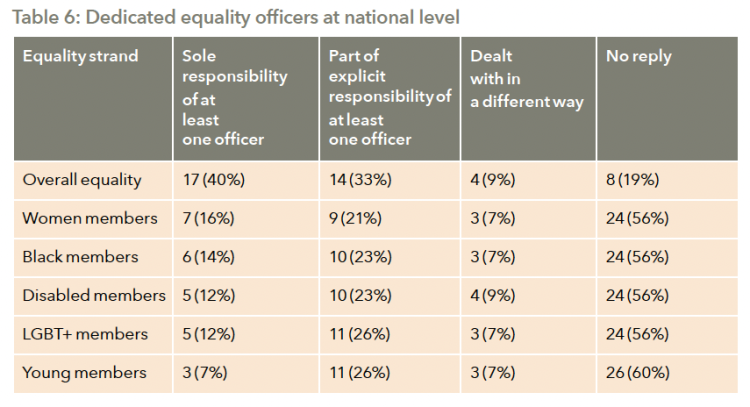
Full-time equality officers can play an important role in leading on equality. Some unions approach this with an officer for overall equality, while others have officers responsible for one or more strands. Some unions have both. The table below shows the breakdown by responsibility and equality strand.
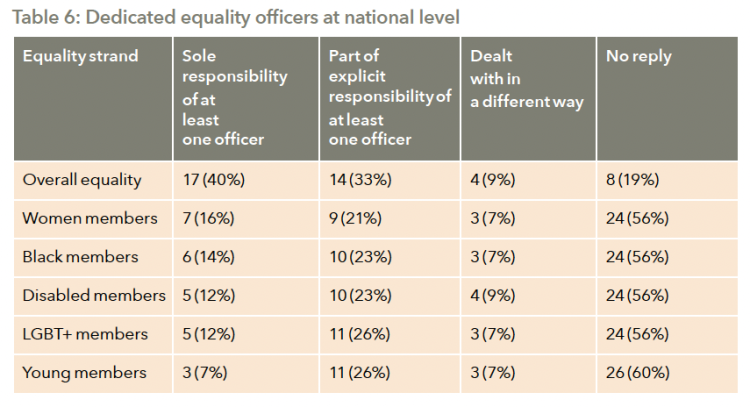
The audit shows that 17 unions (40 per cent), down slightly from 18 in 2022, have at least one officer at national level whose sole responsibility is for equality overall.
In addition, a number of unions employ officers dedicated to specific equality strands, including women, Black members, disabled members, LGBT+ members and young members.
A further 14 unions (33 per cent), down from 15 in 2022, do not have dedicated equality officers but do have officers at national level for whom equality work forms part of their explicit responsibilities. Four unions (9 per cent) said equality issues are dealt with in other ways, including through committees, shared staff responsibilities or elected lay structures.
All six large unions have dedicated equality officers or staff with clear equality responsibilities of one sort or another. Some, such as UNISON, have officers whose only responsibility is equality across all strands, while others combine dedicated overall equality posts with strand-specific responsibilities. The National Education Union, for example, does not have a single officer solely responsible for equality overall, but does have officers dedicated to individual equality strands.
Among medium-sized unions, the picture is mixed. Several unions, including the CWU, RMT and Musicians’ Union, have dedicated officers responsible for equality overall, while others allocate equality work as part of broader officer roles.
Among small unions, dedicated equality staffing is less common, although several unions reported having officers with explicit equality responsibilities. Others indicated that equality work is carried out collectively by senior staff, committees or elected reps because of limited organisational size and resources. Several small unions specifically noted that they were too small to justify separate equality posts.
Full-time equality officers can play an important role in leading on equality. Some unions approach this with an officer for overall equality, while others have officers responsible for one or more strands. Some unions have both.
Coverage at regional level is considerably more limited than at national level. Only three unions (7 per cent), down from four in 2022, reported having a dedicated regional officer whose only responsibility is for equality overall (although we do not know if that is across all regions), while eight unions (down from seven in 2022), said equality formed part of the explicit responsibilities of regional staff. Five unions (12 per cent) said equality issues were dealt with through other arrangements.
Dedicated regional officers for specific equality strands are uncommon. Only two unions (5 per cent) reported dedicated regional officers for women members, while no unions reported dedicated regional officers solely for Black, disabled, LGBT+ or young members.
Equality reps in the workplace or branch raise awareness of equality concerns, help ensure equality is built into workplace consultation and bargaining, and support members who may face discrimination or harassment.
Workplace and branch reps
Equality reps in the workplace or branch raise awareness of equality concerns, help ensure equality is built into workplace consultation and bargaining, and support members who may face discrimination or harassment. The table below shows the number and percentage of unions whose rules provide for or in practice have local equality reps broken down by the equality strand they cover.
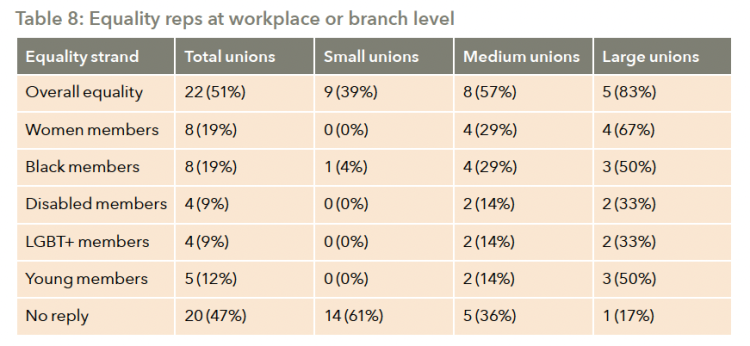
In 2026, over half of unions (22) responding to the audit (51 per cent) have a rule or practice to elect or appoint workplace or branch reps for overall equality, up slightly from 20 unions (49 per cent) in 2022. Fewer unions have rules or practices for reps covering specific equality strands: eight unions (19 per cent) for women members, eight (19 per cent) for Black members, four (9 per cent) for disabled members, four (9 per cent) for LGBT+ members and five (12 per cent) for young members.
The system of local equality reps remains much more common in larger unions. Five out of six large unions (83 per cent) have overall equality reps, compared with eight of 14 medium-sized unions (57 per cent) and nine of 23 small unions (39 per cent). The same pattern is seen for strand-specific equality reps, which are rare among small unions.
Because larger unions are more likely to have these roles, a much higher proportion of members are covered than the union-count figures alone suggest. Around 85 per cent of members in unions responding to the audit are in unions with a rule or practice on overall equality reps. Coverage is also relatively high for women’s equality reps, at around 73 per cent of members, but lower for Black members (around 53 per cent), young members (around 50 per cent), and disabled and LGBT+ members (both around 36 per cent).
Developments since the last audit
Several unions highlighted expansion of equality rep networks, new training initiatives and attempts to formalise equality roles within union structures. Examples included:
- Community reported a “50 per cent increase in number of equality reps”, alongside the introduction of “advanced equality representative training” and equality training “designed for all reps”.
- PCS reported that it had “initiated a new Young Members Officer role” intended to increase participation by young members and encourage them to become members of branch executives.
- The CWU said that although Branch Disability and LGBT+ Champions “are not formal positions recognised under CWU rules”, there had been “a noticeable increase” in branches introducing the roles. The union reported that 13 per cent of branches now have a Disability Champion and 25 per cent have an LGBT+ Champion.
- The Chartered Society of Physiotherapy (CSP) does not have branches but described significant growth in its equality rep network. Following an initial pilot involving eight equality reps in 2021, the union reported that by 2025 there were 72 equality reps across the UK supported by a permanent equality officer working full time on network development.
- The NAHT said it was “currently running a pilot to implement equality reps at a regional level”, running from October 2024 to October 2026, after which a decision would be made through its 2027 AGM on whether to adopt the model permanently.
Stay Updated
Want to hear about our latest news and blogs?
Sign up now to get it straight to your inbox