
TUC Equality Audit 2026
One of the most fundamental ways unions can show their commitment to equalities is by adopting the TUC model equality clause into their rulebooks (see box) and creating other rules covering equalities issues.
TUC model equality clause
TUC rules require unions to show a clear commitment to equality for all and to eliminate all forms of harassment and discrimination within their own union structures and through all activities. One way to do this is adopting the clause in the box below.
TUC model equality clause
The objects of the union shall include:
(a) The promotion of equality for all including through:
(i) collective bargaining, publicity material and campaigning, representation, union organisation and structures, education and training, organising and recruitment, the provision of all other services and benefits and all other activities;
(ii) the union’s own employment practices.
(b) To oppose actively all forms of harassment, prejudice and unfair discrimination whether on the grounds of sex, race, ethnic or national origin, religion, colour, class, caring responsibilities, marital status, sexuality, disability, age, or other status or personal characteristic.
Sixty-seven per cent of unions answering the audit said they had adopted the TUC model equality clause. This is slightly down from 2022 due to more smaller unions responding and a slight change in the composition. Ten unions or 23 per cent say they do not use the clause and a further four (9 per cent) did not answer this question.¹ Excluding unions that did not provide a response, 78 per cent of members are in unions that reported adopting the TUC recommended model equality clause, compared with 22 per cent in unions that reported not adopting it.
Since 2022, two unions have adopted the clause. These are:
- Musicians’ Union
- Royal College of Midwives
¹ All percentages are rounded to the nearest integer.
New national rules on equality issues
The context for union action on equality is evolving and more than two fifths of unions answering the audit had introduced new national rules on equality since 2022.
The most common theme was the creation of new equality structures and measures to improve representation. For example:
- GMB reported that it had “introduced reserved seats for women within the five national race reserved seats on the Central Executive Council” and “widened eligibility for race, young, LGBT+ and disabled members’ reserved seats on regional councils.”
- ASLEF reported that it had “established a National Disabled Members Committee” and increased joint meetings of equality committees.
Several unions reported rule changes aimed at clarifying expected standards of behaviour and strengthening the process for dealing with harassment, discrimination and bullying. For example:
- NASUWT updated its National Code of Conduct to include “a new section on expected behaviour at meetings, conferences and events, and sanctions for the use of discriminatory language.”
- Accord updated its rules to “strengthen protections against harassment, abuse, assault and discrimination” and introduced “new rules for handling sexual harassment and discrimination allegations, including use of external investigators and safeguards for those involved”.
Finally, some unions reported more substantive changes. For example:
- NAHT undertook a “complete rewrite of constitution and rules” including “new equality, diversity and inclusion statements and a Code of Conduct for meetings.”
Rules or objectives related to membership of far-right or racist political parties
During a period of growing visibility of the far right and rising hate crimes, unions were asked if they had any rules or objectives related to the membership of far-right or racist political parties. Forty-four per cent of unions did, whilst 47 per cent did not, although most of these were smaller unions. However, due to the size of the unions that have a rule/policy, the majority of members are covered, 79 per cent (down slightly from 81 per cent in 2022). Large unions are much more likely to have such a rule than smaller and medium-sized unions.
Challenging the far right
Since 2022, the far right has risen in prominence in Britain. Unions were asked to give details of developments regarding formal rules and objectives relating to far-right or racist political parties. The majority of examples submitted concerned rules on the racist behaviour of members, or on equality, representation and inclusion within the union, which are covered in different sections of this report. However, some unions reported explicit rules against the far right:
- UCAC’s National Executive have directed that the union must have no contact with far-right parties, including Reform. However, nothing has been ruled regarding membership.
- The GMB has had rule ‘4a’ on far-right/racist parties for over four years. According to it, “The Central Executive Council or a regional council or regional committee may […] take action […] where they determine that a member has [...] encouraged or taken part in the activities of, or communicated with, any organisation or group whose policies or aims are racist or promote racist beliefs”.
- UCU has a rule to “refuse membership to, or expel from existing membership, any person who is a known member or activist of any extreme right wing political organisation”.
Alongside formal rules, unions reported a range of educational, campaigning and organising activity aimed at challenging racism and far-right narratives.
- PCS worked with the TUC to launch its Challenging conversations - shifting the narrative course, designed to help reps challenge scapegoating narratives and engage confidently in discussions about migration, asylum and the far right.
- CWU has a Tackling the far right campaign which recognises intersections between racial justice, extremism, sexism, homophobia and transphobia and discrimination, linking multiple equality strands. It is starting a new workshop for reps.
- RMT piloted a Challenging the rise of the far right course in 2025, which has now become part of its 2026 education programme.
- Equity reported training for committee chairs on countering the far right alongside political education weekends for activists.
- The EIS has a programme of work on anti-far right which is intersectional - the EIS received funding from the STUC’s United Workplaces Fund for a project titled Disrupting Disinformation - Let’s change the story, short scenario based social media videos that seek to disseminate EIS’s advice on best practice social dialogue to tackle prejudicial narratives.
- The FBU have instigated a specific group to develop polices, guidance and support to officials regarding taking the arguments against right wing populism into the wider membership.
- The Musicians’ Union Executive Council have recently signed off a new anti-far-right strategy to focus their efforts on tackling the rise of the far right and have plans to launch an anti-far-right hub with education resources and briefings.
- The RCM delivered bespoke far-right training facilitated by the TUC.
Many unions also reported broader anti-racism initiatives:
- GMB is rolling out its No Place for Racism campaign and toolkit.
- UNISON highlighted its Challenging Racism in the Workplace toolkit, support for Stand Up To Racism activities and affiliation to the Together Against the Far Right campaign.
- Unite reported expanded ‘Unity over Division’ materials and education courses, alongside its ‘Union towns’ initiative.
- Usdaw published and debated a policy paper at its 2025 annual conference, produced a short film, is developing an anti-racism online learning course, and has worked with organisations including Migrant Voice, Show Racism the Red Card and Hope not Hate. The union also reported activity aimed at countering myths and disinformation by promoting the lived experiences of members and workers.
Other unions said they had provided webinars, workshops, political education events and dedicated resources:
- NASUWT delivered webinars and targeted sessions through its equalities training and development days.
- NAHT ran a Promoting Equality and Anti-Racism workshop to all paid staff run by Show Racism the Red Card. This was followed by the introduction, in May 2024, of mandatory e-learning for all staff (and new joiners), which included an EDI module Unconscious bias for employees and Unconscious bias for managers. They have also created a member webpage on countering hatred and division.
- CSP will implement anti-racism training Countering hate in 2026 as well as roots of racism training.
The law on unions and members of far-right parties
In February 2007, the European Court of Human Rights held that UK law, which prevented ASLEF from expelling a member of the British National Party (BNP), violated the union’s right to freedom of association. The Trade Union and Labour Relations Act 1992 was subsequently amended to allow a union to expel a member of a political party if membership of that party is contrary to a rule or an objective of the trade union.
Discrimination and harassment rules and procedures
Another important marker of unions’ equalities work is whether they have rules and procedures around allegations of discrimination or harassment made against its lay activists, officers and full-time officials.
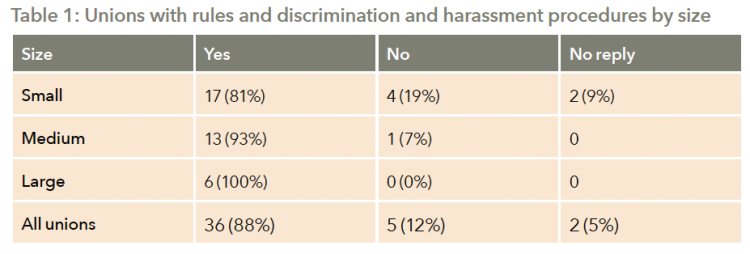
All six of the large unions responding to the audit had such rules, as well as 13 (93 per cent) of the medium unions and 17 (81 per cent) of the small unions. This is broader coverage than in 2022, and well over 95 per cent of union members are covered by rules or procedures concerning discrimination or harassment.
Unions that have made recent major revisions to these policies include:
- CWU (2024)
- Accord (updated 2024)
- Advance (2024)
- ASLEF (2024)
- Usdaw (2025)
- Nautilus International (2025)
- BDA (2025)
- RMT (2023)
- EIS (2023)
Others such as the NUJ and Royal College of Podiatry undertake regular revisions or have a process ongoing.
There is much more on the type of policies covering discrimination and harassment and particularly sexual harassment and the work unions are doing in this area in the section ‘Unions as employers’ (see page 50).
Stay Updated
Want to hear about our latest news and blogs?
Sign up now to get it straight to your inbox