
TUC Equality Audit 2026
Some unions have rules on reserving or guaranteeing seats on elected union structures and delegations to ensure a certain level of representation for groups that have traditionally been under-represented.
All unions responding to the survey were asked about reserved seats on national executives, conference delegations and TUC Congress delegations. Those who answered the main survey were also asked about sectoral executives, conferences and branch committees. The number answering and the groups they reserve seats for can be seen in the table below.
National conferences and structures
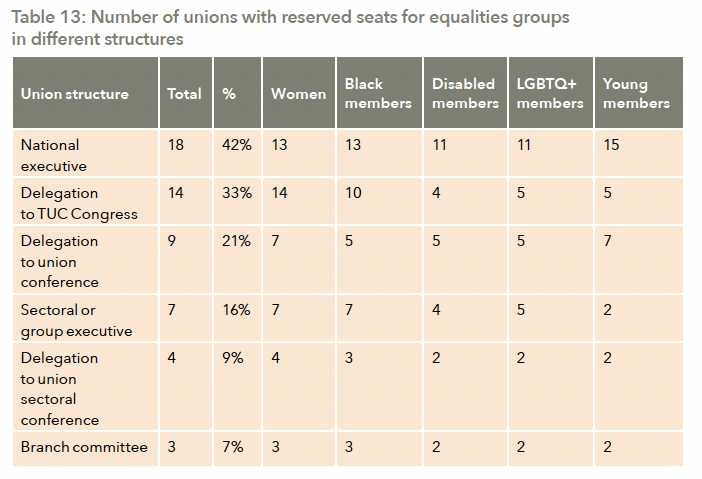
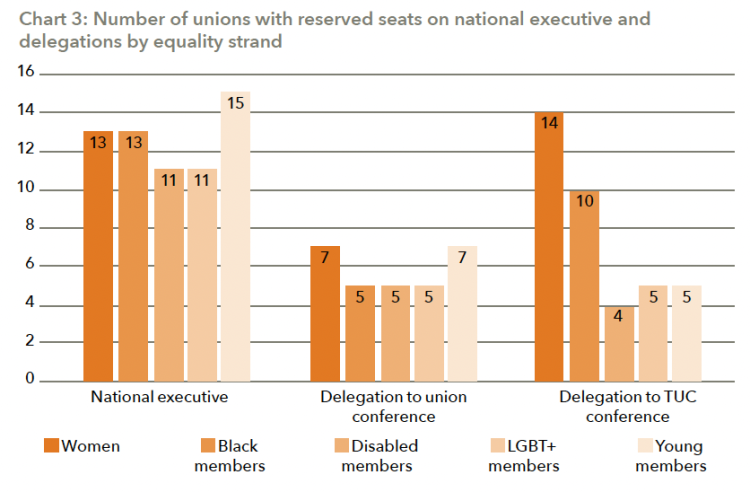
The large unions are more likely than medium and small unions to have reserved seats on these bodies and delegations, although 50 per cent of medium-sized unions reserve seats on their NECs.
Changes since the last audit
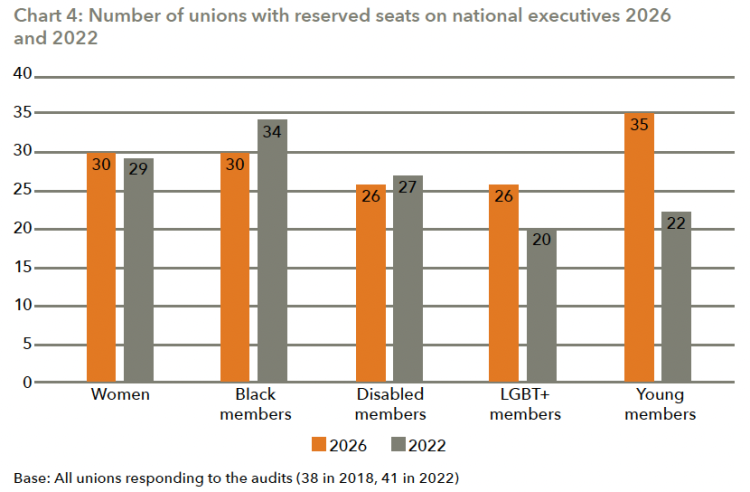
The following chart shows the changes in unions with reserved seats within their democratic structures since 2022. While there are more reserved seats overall for women, LGBT+ and young members, there has been a slight fall in numbers for the other equality strands (see chart 4).
The FDA noted that one branch operates two Convenor positions, with one position reserved for 'a member who is either a woman, trans, or non-binary.
A small number of unions reported significant changes to reserved seat arrangements:
- Equity reported the most significant change. Following consultation in 2022, including with equalities activists, “most” reserved seats were removed because they were “seen as not improving representation”, although reserved seats were retained on the National Executive. The union stated that it has “seen significant improvements in representation since we removed reserved seats”.
- Musicians’ Union moved in the opposite direction. A rule change at the 2025 Delegate Conference introduced reserved Executive Committee seats, with two seats each reserved for Disabled Members, Members from the Global Majority, LGBT+ Members, Women Members and Young Members.
- GMB reported changes to its TUC Congress delegation arrangements. Since 2024, four “equality top up” seats have been allocated according to which groups have been most underrepresented in recent delegations. In 2024 and 2025 the seats were open to women, Black members and young members, with 50 per cent reserved for women.
- NAHT reported that its EDI Committee includes “one seat per equality network” to ensure each network has a representative voice feeding into the National Executive. It also now draws representation for TUC Equality Conferences from its equality networks.
- The FDA noted that one branch operates two Convenor positions, with one position reserved for “a member who is either a woman, trans, or non-binary”.
Representation at TUC statutory conferences
Unions were asked whether they had rules governing representation at the TUC’s statutory equality conferences. Fewer than half of the unions have such rules, although most large unions and several medium-sized unions do. Several smaller unions commented that, while they do not have formal rules, they take an informal approach to ensuring that their members are represented at the conferences.
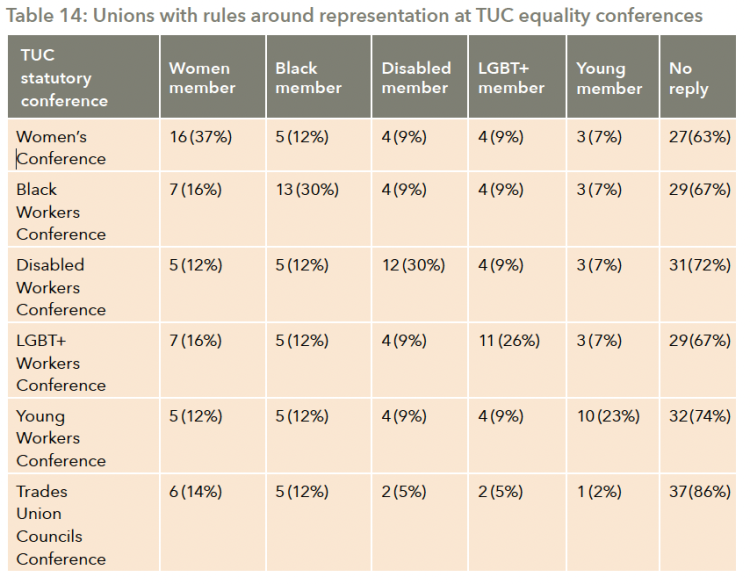
Many unions commented that it was their rule or policy to send delegates that identify with the relevant equality strand to TUC conferences, although this is not always done via formal rules. Some examples of the types of practices used were:
- GMB reported that all delegates to statutory equality conferences “must belong to the relevant strand”. While there are no formal diversity rules for delegations, the union said it seeks to achieve this “organically” and that it would be “very unusual” for delegations to be all-white or all-men.
- RMT reported that there are two seats reserved for women in its TUC LGBT+ Workers Conference delegation. Since 2024, branch circulars have encouraged branches to take account of “the diversity of our membership, including women and Black and ethnic minority members”. The union has also introduced reserved seats for women and B&EM members in its LESE delegation.
- NAHT reported that delegations to TUC Equality Conferences are drawn from self-nominating members of the relevant equality networks and are then ratified by its EDI Committee.
- Among smaller unions, Accord reported that it has no formal rules but reviews attendance and has “consistently sent appropriate delegations” to the Women’s, Black Workers, Disabled Workers and LGBT+ Workers Conferences, while noting that small delegation sizes can make wider representation difficult. BFAWU requires delegates to comply with TUC eligibility requirements, the Association of Educational Psychologists said it does its best to ensure members are represented at all TUC conferences, Aegis reported that representation arrangements are under review, and WGGB has introduced a rule requiring all conferences to be advertised to the membership.
Since 2024, branch circulars have encouraged branches to take account of the 'diversity of our membership, including women and Black and ethnic minority members.
Stay Updated
Want to hear about our latest news and blogs?
Sign up now to get it straight to your inbox