
TUC Equality Audit 2024
Labour’s victory in the general election gives real hope to working people. Its New Deal has the potential to improve employment rights for all and create a more positive climate for winning equality.
It’s over 20 years since we published our first equality audit in 2003. Over the last two decades, the audit has shown the difference that unions make to millions of people and our collective struggle for equality.
The 2024 audit looks at equality bargaining and covers a difficult yet inspiring time for our movement. It comes after the Covid-19 pandemic which exposed structural disadvantage and discrimination in our society and a cost-of-living crisis that disproportionately impacted Black workers, disabled workers and women. We’ve also had hostile attacks from the Conservative government on migrants, disabled people, trans people and other marginalised groups to deflect from the economic chaos they caused.
Our movement has fought back. We’ve protected jobs, lives and livelihoods during the pandemic and won pay rise after pay rise in both the public and private sector. And we’ve defended our brothers, sisters and siblings across the movement including establishing our Anti-Racism Task Force and launching our Trade Union Alliance for Trans and Non-Binary Rights.
It’s evident from the audit that this external environment has created challenges for collective bargaining. Four in ten reps told us it had got more difficult to get employers to address equality issues in the last couple of years. But despite all of this, there are still examples of unions advancing equality at work. We’re winning recognition rights for equality reps, improved parental leave and pay, and support for those who experience miscarriage. We’re securing changes to discriminatory redundancy processes alongside improved bullying and harassment policies, so people are treated with dignity and respect at work.
It’s also encouraging to see that several unions are offering new and updated training on sexual harassment. With three in five women having experienced harassment at work, ending the scourge of sexual harassment must be a key priority for our movement.
For the first time in this audit, we asked specific questions to track the progress our movement is making following our Anti-Racism Task Force. Unions told us about wins that impact Black workers from the insourcing of low-paid outsourced workers to fairer pay structures that don’t discriminate.
When I became general secretary in 2023, I said I wanted to build a stronger, more inclusive, more diverse movement. To achieve this, we must ensure equality is at the heart of collective bargaining. This audit is full of examples of this, and I hope it inspires and supports all affiliates to build on these wins.
Paul Nowak, TUC General Secretary
Overview
The TUC and our affiliates are committed to promoting equality in all aspects of our work. In 2003, we changed our rules to reflect this goal and the biennial TUC Equality Audit is a key part of delivering on that commitment and tracking our progress. The audits alternate between looking at collective bargaining for equality, and union efforts to improve representation and participation. The 2024 audit focuses on collective bargaining and was conducted for the TUC by the Labour Research Department (LRD).
This audit considers the huge range of issues unions address in their search for improved equality for all workers. It also examines the processes by which unions work to achieve it. As in the earlier audits, this one was carried out through a survey of national TUC affiliates. 43 of the TUC’s 48 affiliates replied. This response rate of 90 per cent is an improvement on 75 per cent in 2020 and represents 99.7 per cent of the TUC’s membership. The survey was completed by unions at the end of 2023.
The national union survey was supplemented by two other pieces of research:
1. A survey of workplace reps to find out what equality issues they have been facing in their workplace and the training, information and support they use to help them deal with those issues.
2. Analysis of parental leave and pay agreements on LRD’s Payline database of collective agreements. This is aimed at obtaining local information not always held nationally.
Reports of these are included as annexes.
Bargaining climate
The improved climate for equality bargaining reported in the 2020 audit does not appear to have continued. The 2020 survey was done just before the Covid-19 pandemic, suggesting that events in the intervening years have made bargaining for equality more challenging.
Unions presented a mixed picture, but slightly skewed towards a negative view. Nine unions (21 per cent) felt it had got easier to get employers to address equality issues, 11 (26 per cent) said it had become more difficult, and 21 (49 per cent) thought it had stayed about the same. The slightly negative feeling among national unions is amplified by the survey of union reps. 42 per cent of reps responding said it had got more difficult to get employers to address equality issues in the last couple of years.
Those unions who said it had got easier cited greater awareness of equality by employers, but other responses showed this did not always lead to tangible outcomes. Unions who said it had become more difficult said equality was often used as a box ticking exercise or for winning contracts, but that greater awareness had not led to changes on the ground.
Other unions said the hostile political narrative on equality, the cost-of-living crisis and staffing shortages in the public sector had made it harder to bargain on equality.
In this environment, one in four unions felt that either employers’ equality policies, or their implementation, had been diluted in the last two years. The removal of flexible working arrangements agreed as part of employer responses to Covid-19 was mentioned by unions from a range of sectors.
At the same time, more union reps are dealing with equality issues in the workplace. Three quarters (76 per cent) of them had dealt with one or more equality issues in the workplace from 2022-24 compared to two-thirds (65 per cent) in 2018-2020. There has been a significant jump in the percentage of union reps dealing with issues related to disability (42 per cent to 56 per cent) and sex (9 per cent to 31 per cent).
The bargaining process
The audit looked at ways unions set their equality agendas and what they focus on. The survey found:
national policy making conferences are the most common way to set priorities.
58 per cent said there had been changes to the union’s bargaining priorities in the last four years. The most common areas for new or renewed emphasis are menopause, sexual harassment, domestic abuse, support for disabled workers, equal pay and pay audits to identify ethnicity and disability pay gaps.
44 per cent of unions monitor their collective agreements to gain a picture of equality impact up from 36 per cent in 2020.
Support for negotiators
Unions provide guidance, briefing materials and training to negotiators on a huge range of equality topics. Unions were more likely to have training for lay reps compared to national and regional officials. General equalities and pay and employment are among the most common training topics provided for officials and lay negotiators, with training on issues for Black and disabled workers and LGBT+ workers also widespread for all.
Several unions had either newly introduced training in sexual harassment or substantially upgraded their previous content. For small unions, sexual harassment is now the
most common topic for lay reps training. Training on AI/digitalisation had been newly introduced by a number of unions in the last two years and 19 per cent now provide equality guidance in relation to this topic.
In terms of policies or guidance on equality topics, the most common area for such materials is bargaining for women, flexible working/work-life balance and pay. The proportion of unions with guidance on Black workers, disabled workers, women, working parents, parents-to-be and carers and general equalities have all increased. There has been significant growth in unions with guidance on disabled workers (from 44 per cent to 56 per cent) and Black workers (from 39 per cent to 51 per cent).
Negotiating success
Despite a challenging bargaining climate, unions have had success in negotiating improvements on a variety of equality related topics in the last four years.
The most successful areas have been pay (51 per cent) and flexible working (47 per cent of unions achieved wins). Looking at wins by equality groups, there has been a significant increase in the percentage of unions with wins related to women, increasing from 11 unions (31 per cent) in 2020 to 22 unions (51 per cent) in 2024. Gains for women came top of the list for large, medium and small unions. This is reflected in the examples given.
Unions reported wins on the menopause, pregnancy loss, domestic abuse and the Payline analysis showed improvements in maternity pay and leave. Unions were also likely to report wins for working parents, parents-to-be and carers (44 per cent of unions).
For the first time, we asked reps about equality practices in their workplace. The majority of reps said they had clear reporting routes for bullying and harassment (67 per cent), had local or national agreements on flexible working (60 per cent) and had equality reps in their workplace (52 per cent). Payline analysis also showed improvements in offers on maternity leave, paternity leave and parental leave compared to 2016 and an increasing number of policies including provision for ante-natal appointments, miscarriage, fertility treatment and premature births and neonatal care.
TUC Anti-Racism Task Force
The TUC Anti-Racism Task Force is now in its implementation and oversight phase. As part of the monitoring of this work, specific questions were included in the Audit on unions collective bargaining on race.
30 per cent of unions said they had wins in relation to Black workers and 30 per cent of reps said they had dealt with issues connect to the protected characteristic of race in their workplace. The most common collective bargaining priority for Black members was pay, including career progression, monitoring and closing pay gaps, and fighting low pay.
Examples of wins from unions included insourcing of low-paid outsourced workers, saving training and language support for migrant workers and scrapping discriminatory pay structures.
Areas of action
We have seen an increase in percentage of unions providing training and guidance on issues affecting Black workers. However, only three in ten unions are achieving equality wins in this area and the percentage of reps dealing with issues connected to race has fallen. Less than a third of reps told us their employers had employment requirements for outsourced workers, for example to not use zero-hours contracts or pay a living wage,
a key ask in tackling race discrimination at work. Anti-racism and bargaining for race equality will be central to union work in the coming period. This work has already started with the TUC Anti-Racism Task Force from 2020 to 2022 and now the implementation and oversight phase. Through this work the movement is determined to organise, bargain and campaign for racial equality.
There have been positive improvements in areas of training and guidance but materials and support on religion and belief, on younger and older workers and migrant workers were identified as areas with the least training and guidance. Flexible working/work-life balance, disabled workers, and reasonable adjustments were the topics that reps were most likely to say there was a shortage of guidance on. They were also the areas that reps had come across the most in the workplace. We also expect to see the use of technology and AI in workplaces grow so this may also be an area where reps and members seek further support from their union.
A minority of union reps told us that their employer collects equality monitoring data in relation to workplace practices and a large proportion of reps did not know if their employer does this. Equality monitoring data can be an important tool in exposing institutional discrimination. Looking at whether reps are equipped to use data in collective bargaining is an important area of focus.
Finally, in this survey we break down the differences between large, medium-sized and small unions. We recognise the difference in resources that unions face and therefore commit to working with smaller unions to support their development of equality materials.
The TUC Equality Audit 2024 sets out TUC affiliate unions’ activity in the area of collective bargaining on equalities issues in the four years leading up to the end of 2023. It follows similar audits covering equality bargaining published in 2003, 2005, 2009, 2012, 2016 and 2020/21. 1
The audit was carried out by the Labour Research Department (LRD) through an online questionnaire sent to all TUC affiliates in late September 2023, with responses requested by late December 2023.
The response rate was considerably higher than in 2020, with 43 of the TUC’s 48 affiliated unions replying, or 90 per cent. This compares with 75 per cent four years earlier and represents the highest ever response rate for the collective bargaining TUC Equality Audits.
As the five unions that didn’t respond were smaller affiliates (all with fewer than 6,000 members), the proportion of total TUC membership represented in the survey was very high, at 99.7 per cent. This compares with 97.9 per cent in 2020.
The affiliates that responded are listed in Appendix A and more information on TUC affiliated unions including full names and sectors can be found on the TUC website. In addition to completing the questionnaire, unions were asked to supply examples of:
particularly important guidance they had produced for negotiators in the last four years on the bargaining topics covered by the audit.
particularly important agreements or policies on these topics they had achieved with employers in the last four years.
The figures throughout the report can only give a broad indication as the categories used in the questions have some overlap and unions will categorise training, guidance and wins differently. In some cases, analysis has also been carried out according to union size. The aim of this approach is to acknowledge that different-sized unions have different capacities to collectively bargain, produce guidance and training, and focus on different areas.
- 1The last one covered the period 2016-2020 but was not published until 2021 because of the disruption caused by the Covid-19 pandemic.
The 2024 TUC Equality Audit indicates that during 2022 and 2023 the climate for equality bargaining has not continued to improve as seen four years earlier. While awareness of equality among some employers has increased in the last two years, this has often failed to result in real improvements on the ground.
As in previous collective bargaining TUC Equality Audits, unions were asked whether they had found it more or less difficult to get employers to address equality issues in the last two years.
The questionnaire was answered in late 2023/early 2024, so responses relate to a period between the start of 2022 and end of 2023.
Unfortunately, the experiences of Covid-19 and its equality impacts do not seem to have improved the climate for equality collective bargaining.

Of the 43 unions participating in the Audit, 41 responded to the question. They present a mixed picture, but with the balance of responses tilted slightly towards a negative view and certainly not indicative of good progress. Nine unions (21 per cent) felt it had got easier to get employers to address equality issues, 11 (26 per cent) said it had become more difficult, and 21 (49 per cent) thought it had stayed about the same, some of whom suggested there were pluses and minuses in different sectors.
This is a deterioration from the rather more positive scenario indicated in the 2020 Equality Audit, when 33 per cent said it had become easier (in the two years prior to the pandemic) and 22 per cent said it had become more difficult.
The slightly negative feeling among national unions is amplified by the separate survey of workplace union reps whose results are set out in Appendix A to this report. 42 per cent of reps responding to the survey said it had got more difficult to get employers to address equality issues in the last couple of years. Among national unions there is a fairly widespread feeling that there is more awareness among employers of the legal requirements and/ or of a reputational need to engage with equality, diversity and inclusion (EDI). However, many unions said that awareness and understanding did not match up to policies made at the top or improvements on the ground. This lack of improvement on the ground, which reps are more likely to see, may be why reps were more likely than officers to report the bargaining environment becoming more difficult.
Among those that felt it had become easier to engage employers on equality issues, the NAHT said there “appears to be a greater awareness of equality legislation and wider societal expectations around support for those with protected characteristics.” The union also cited its own role in empowering and supporting its members to raise the profile of equality issues. PFA said the football industry “understands the importance of EDI more now than ever.”
Greater awareness was also used by NSEAD and by Prospect, but they felt that equality policies are sometimes used by employers as tick boxes for accreditation. Box-ticking was also a complaint from other unions. Unite spoke of ‘well washing’, in which employers, particularly in the engineering sector, feel they have to “extol the virtues of equalities as it’s important for hiring and winning contracts.” RMT noted that train operating companies must show how they support diversity as part of their franchising contract. While this makes them more amenable to talk about equality, “so often EDI discussions can feel like tick box exercises.”
Community felt there was “greater understanding of the benefits of addressing equality issues and reducing business risk,” though it frequently gets overtaken by other priorities.
The UK government's hostile narratives have also made it more difficult for unions to engage civil service employers on equality issues
A number of unions organising in the health sector, including SoR, RCP and BDA, also suggested the NHS had become more aware of the need to address disparities but that there was a lack of speed and energy in progressing the issues on the ground. The SoR said that some regions had moved “from data collection into proactive work” to improve disparities, while the CSP had noticed that, while the NHS generally was more open to discussing equality, there are “systemic problems on a local basis”. CSP’s comments were echoed by Unite, whose NHS reps say local managers are not knowledgeable about their equality obligations, in particular the requirements to provide reasonable adjustments.
The divergence between awareness of equality issues in organisations but lack of action on the ground is also seen in other sectors. Usdaw noted that equality policies or practices are still agreed by companies as they “are often perceived to be a cheaper option” than any subsequent legal challenges from failure to act, but that this frequently fails to filter down to the shop floor, and members’ experience depends very much on the attitude of their store/site manager.
This trend was also witnessed amongst the AUE and WGGB, who represent self-employed or freelance workers who do not have the same employment rights as employees and are also often excluded from workplace agreements and polices. The WGGB said: “There are no statutory obligations for engagers to report the diversity statistics of those they engage on a freelance basis. While engagers are aware of the need to engage writers from diverse backgrounds, there is a lack of effective monitoring or regulation that can hold them to account.” It added that there are some employer initiatives to improve representation, but the data collected is not shared in a transparent way and the schemes “rarely result in actual paid work.”
Some education unions felt the wider political climate had made it more difficult to get employers to engage on equality issues. The NEU put this down to funding cuts, recruitment and retention issues and the loss of teaching assistants, and the NASUWT cited the Westminster government’s hostile political narratives on equality 2 and downgrading of the equality agenda, “resulting in employers sidelining equalities/ deeming equality policies unimportant.”
The UK government’s hostile narratives have also made it more difficult for unions to engage civil service employers on equality issues. Both the PCS and the FDA noted that the government’s plan to review/cut the EDI spend is already having a negative impact.
Looking at unions who operate exclusively in certain nations, UCAC, which organises in Wales, says there are no problems regarding support from its government or local authorities. In the Scottish education sector, the EIS said the 2020 resurgence of the Black Lives Matter movement had made employers more willing to engage on anti-racism, but that flexible working for disabled workers brought in during the Covid-19 pandemic largely “appears to have been forgotten.
The cost-of-living crisis, recruitment and retention problems and pay battles are cited by several unions for a lack of engagement by employers with equality issues. Napo mentioned pressures of work, amplified by a staffing crisis and the NUJ said, “the cost-of- living crisis has discouraged employers from proactively looking at equality issues and instead the focus has been on cost-cutting.” The TSSA said there is greater awareness among employers, but “the challenging economic circumstances have made employers reluctant or resistant to implementing policies and practices that incur any additional costs or expenses.”
UNISON’s response highlighted contradictions in the situation, saying “in a challenging economic environment, where employers may not be able to agree meaningful pay increases, equality agreements may be the only way to achieve positive improvements in working conditions. However, employers’ actions do not bear this out.”
- 2In this report we use the term hostile political narratives to describe the behaviours, narratives and actions that would usually be described under the phrase ‘culture wars’.
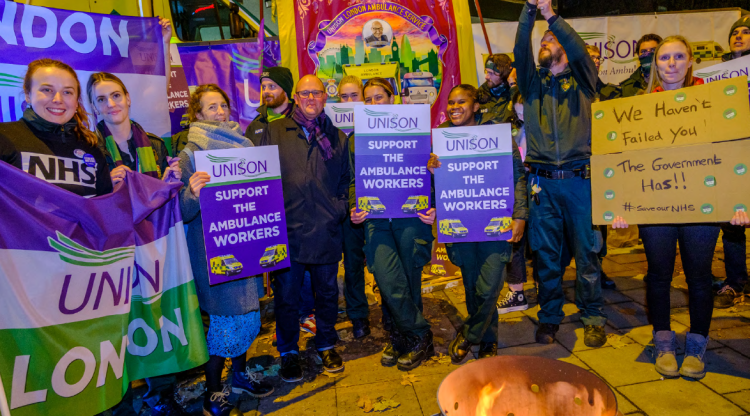
The findings from the audit may indicate that the combination of difficult economic circumstances and hostile political narratives on equality is creating a harder environment to bargain in for many. This is to the point in some case where equality agreements, which were previously seen as a way to maintain or improve workplace relations during tough economic times, are being eased out.
One in four unions even said there had been instances of equality policies being diluted or practices worsened in the last two years. The loss of flexible working arrangements agreed due to Covid-19 was mentioned by unions from a range of sectors. Accord said they had been “replaced by a dictatorial approach”, while PCS said that civil servants are being forced to attend the workplace for 60 per cent of working time, and Community reported flexible working agreements being scrapped or diluted and some members had been forced to return to the workplace.
The equality bargaining climate does not currently appear to be on an expansionary path as far as employers are concerned and it is to be hoped that, by the next Audit in four years’ time, the change of government will have created a more conducive environment.
How unions identify their key collective bargaining priorities
While unions’ national policy making conferences are generally supreme for setting priorities in collective bargaining, most unions have a range of mechanisms for proposing equality priorities and/or ensuring that equality issue are embedded within the overall bargaining agenda.
These include equality or specific-strand committees and conferences, industrial sector committees and conferences, informal discussions between equality and industrial officers, consultations with branch, workplace and equality reps and membership surveys.
In terms of the national bargaining agenda, these mechanisms are not usually decisive in themselves but feed into national conference debates and decisions. However, where there is local bargaining, priorities are often decided and put into practice at that level.
The response from the NUJ sums up the situation in a small multi-employer union. Its equality bargaining priorities are “defined through our bi-annual delegate meeting as well as through the work of our equality reps within workplace chapels/branches, officials and equality councils, with overarching equality planning responsibility residing with an appointed lead Equality Officer.” It also runs surveys, seminars discussion networks and workshops and encourages chapels 3 to consider equality issues when conducting annual pay bargaining.
In Unite, a larger multi-employer union, there is a whole range of structures and means for getting equality issues on the bargaining agenda, including discussions with union reps and industrial officers, combined with motions from the union’s equalities and industrial sector conferences and its equality/single strand committees. This is helped by the equality representation present on its industrial structures, while every agreed industrial plan must include bargaining targets for equalities. However, “the final decision is with the lay membership in the bargaining area covered”.
- 3NUJ term for workplace or employer level union structures
The most common areas for new or renewed emphasis are menopause, sexual harassment, domestic abuse, support for disabled workers, equal pay and pay audits.
Changes to equality priorities
The Audit asked if there had been any changes in unions’ bargaining priorities in the last four years. A majority (58 per cent) said there had, including all large unions. The most common areas for new or renewed emphasis are menopause, sexual harassment, domestic abuse, support for disabled workers, equal pay and pay audits to identify ethnicity and disability pay gaps.
There are also some new priorities related to the specific sectors in which unions organise. For example, Equity has been working on the provision of hair and make support for Black artists as well as the right to consent for scenes involving intimacy or nudity, while the NUJ has pushed the issue of programmed bias in artificial intelligence.
Monitoring and reporting on equality gains in collective agreements
A growing proportion of unions monitor their collective agreements to gain a picture of equality gains or other impacts, 44 per cent saying they do this compared with 36 per cent in 2020. Medium sized unions were more likely than large or small ones to say they do.
The CWU is aided in this by an agreement with one of its employers to be provided with ‘in confidence’ breakdowns of disciplinary, attendance, performance and NDA cases and outcomes broken down by gender, age, ethnicity and disability. This data enables the union to monitor, with the employer, the impacts of practices on protected groups. The union’s departments use this data to report to the senior structures on any collective bargaining achievements, which are then communicated to the rest of the membership.
The NUJ has a quarterly reporting system in which collective bargaining achievements on equalities issues are reported to the national executive by equality councils, equality servicing officers, equality reps and the equality lead, as well as an overarching report to its delegate conference.
Prospect’s research team conducts monitoring based on review and evaluation of agreements by industrial officers.
Action in response to the TUC Equality Audit
A number of unions said they had taken action directly in response to previous TUC Equality Audits on collective bargaining. For example, following the 2020 Audit, the NAHT started developing a process for collecting demographic data for its membership and linking it through to its casework analysis.
The CWU has a draft collective bargaining guidance booklet for its national officers and negotiators in promoting equality best practice. It has also produced model polices on specific equality issues.
The section looks at how unions support their paid and lay negotiators in their equality collective bargaining through the provision of training and the issuing of policies, guidance and briefing materials on equalities topics.
Training on equality bargaining
An important way in which unions help their negotiators to advance equality at the workplace is through the provision of training. The Equality Audit questionnaire asked unions to indicate which equality bargaining issues they provide training on to three groups in the union: their national paid officials, their local/regional paid officials, and their lay negotiators (Table 1).
Table 1: Unions providing training for negotiators on equality bargaining issues (per cent)
| National paid officials | Local/ regional paid officials | Lay negotiators |
Pay and employment equality | 35 | 21 | 40 |
General equalities bargaining | 33 | 26 | 49 |
Black workers | 26 | 16 | 40 |
LGBT+ workers | 26 | 19 | 37 |
Disabled workers | 26 | 19 | 40 |
Sexual harassment in the workplace | 26 | 21 | 33 |
Flexible working/work-life balance | 23 | 14 | 33 |
Gender and/or other pay gaps | 23 | 16 | 26 |
Pregnancy and maternity discrimination | 23 | 19 | 33 |
Harassment and bullying policies | 21 | 12 | 37 |
Women’s health | 21 | 12 | 35 |
Religion or belief | 19 | 7 | 21 |
Automation/AI/digitalisation and equality | 19 | 14 | 19 |
Pregnancy loss and miscarriage | 19 | 12 | 19 |
Working parents, parents-to-be and carers | 16 | 9 | 21 |
Equality and health and safety | 16 | 21 | 40 |
Young workers | 14 | 12 | 19 |
Hate crime | 12 | 5 | 14 |
Older workers | 9 | 7 | 12 |
Migrant workers | 9 | 9 | 16 |
Note: Caution should be exercised in comparing these percentage figures with those presented in the 2020 TUC Equality Audit because the overall sample of unions is small, and the sample size is substantially changed (43 respondents unions in 2024 compared with 36 in 2020).
Other equality related training topics mentioned by unions include the gender pensions gap, equality impact assessments, modern day slavery, andropause awareness and making collective agreements neurodivergent friendly.
More unions provide equality bargaining training to lay negotiators than provide them to paid officials. This may be because there is a higher turnover of personnel among lay representatives than among paid officers, resulting in a more frequent need for training.
General equalities and pay and employment are among the most common training topics provided for all three groups of negotiators, with training on issues for Black and disabled workers and LGBT+ workers also widespread for all. One notable variation is that equality and health and safety is high on the list for lay negotiators and local/regional officials but less so for national officials.
There are also some variations in the training priorities among unions of different size bands. While large unions will tend to provide more training in all areas than others, Tables 2 to 4 look at which are the most commonly provided training topics for unions of different sizes. Each table lists the three most common training topics provided by large, medium and small unions, and the tables are split into training run for national paid officials, local/ regional paid officials and lay negotiators.
Table 2: Top three training topics for national paid officials by union size band
Large | Medium | Small |
Pay and employment equality (67 per cent) | General equalities bargaining (40 per cent) | Pay and employment equality, sexual harassment (both 32 per cent) |
Black workers, LGBT+ workers (both 50 per cent) | Gender and/or other pay gaps, disabled workers (both 33 per cent) | General equalities bargaining, flexible working/work-life balance, women’s health (all 27 per cent) |
As Table 3 shows, unions’ top priorities for local and regional officials’ training vary quite a lot between the size bands.
Table 3: Top three training topics for local/regional paid officials by union size band
Large | Medium | Small |
LGBT+ workers (67 per cent) | General equalities bargaining (40 per cent) | Sexual harassment (18 per cent) |
Pay and employment equality, Black workers, general equalities bargaining, equality and health and safety (all 50 per cent) | Gender and/or other pay gaps, disabled workers, pregnancy and maternity discrimination, automation/ AI/digitalisation and equality, sexual harassment, equality and health and safety (all 27 per cent) | Pay and employment equality, flexible working/work-life balance (both 14 per cent) |
Table 4: Top three training topics for lay negotiators by union size band
Large | Medium | Small |
Pay and employment equality, general equalities bargaining, equality and health and safety (all 83 per cent) | General equalities bargaining (67 per cent) | Sexual harassment (32 per cent) |
| Equality and health and safety (60 per cent) | General equalities bargaining, bullying and harassment policies (both 27 per cent) |
| Disabled workers, Black workers, LGBT+ workers, women’s health (all 53 per cent) |
|
Several unions had recently either newly introduced training in sexual harassment or substantially upgraded their previous content. For small unions, sexual harassment is now the most common topic for lay reps training, whereas it didn’t make the top three in 2020.
The CWU said it had recognised that it should go beyond general harassment training and also that the training needed to be tailored for different groups, such as reps, NEC members and sexual harassment investigators. It has also agreed that all national officers and all Industrial Executive members must undertake mandatory sexual harassment training, to be completed within six months of being elected into post.
Some of the training courses, such as on AI/digitalisation, had been newly introduced by a number of unions in the last two years.
A small number of unions have rules or targets for equality training, such as Unite’s mandatory dignity at work courses for all officers, organisers and staff. UNISON’s reps’ accreditation scheme requires reps of all types to attend equality training within two years of completing their induction training. Those who undertake representation and negotiation must attend UNISON’s Challenging Racism in the Workplace course within three years of their appointment. And NASUWT has a number of requirements, including requiring all caseworkers to undergo discrimination training.
Guidance on equality bargaining
Support provided by unions to their negotiators often comes in the form of guidance, policy advice or model agreements. This section looks at the equality topics on which unions have current material of this type. Some unions negotiate with a very small number of employers and may not produce this type of material so were asked to point to where they have recently included these topics in their claims.
The topics are in two parts. First unions were asked if they had included equality considerations in guidance on a range of general bargaining topics, such as pay and benefits. Second, they were asked if they have negotiating guidance on specific stand- alone equality bargaining topics, such as issues relating to women, Black workers or LGBT+ workers.
Equality elements of general bargaining topics
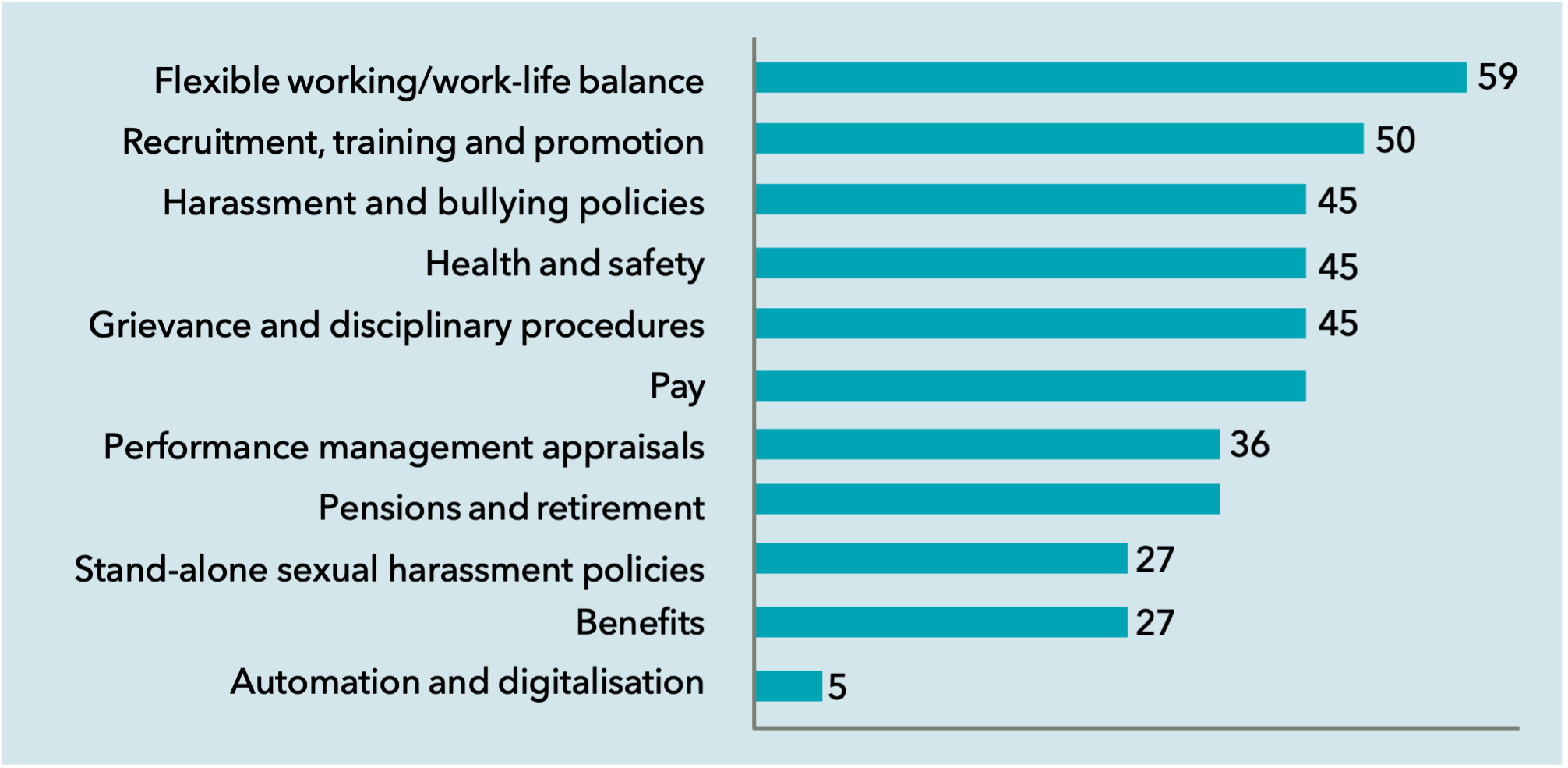
Figure 1 shows the percentage of unions who said they had current up-to-date policies or guidelines on general bargaining topics that includes equality elements (or, in the case of unions who deal with only a small number of employers, have included equality elements in their claims on general bargaining topics). The figures are only an approximate measure as different unions may categorise their guidance differently.
Figure 1: Unions including equality guidance in general bargaining topics (per cent)
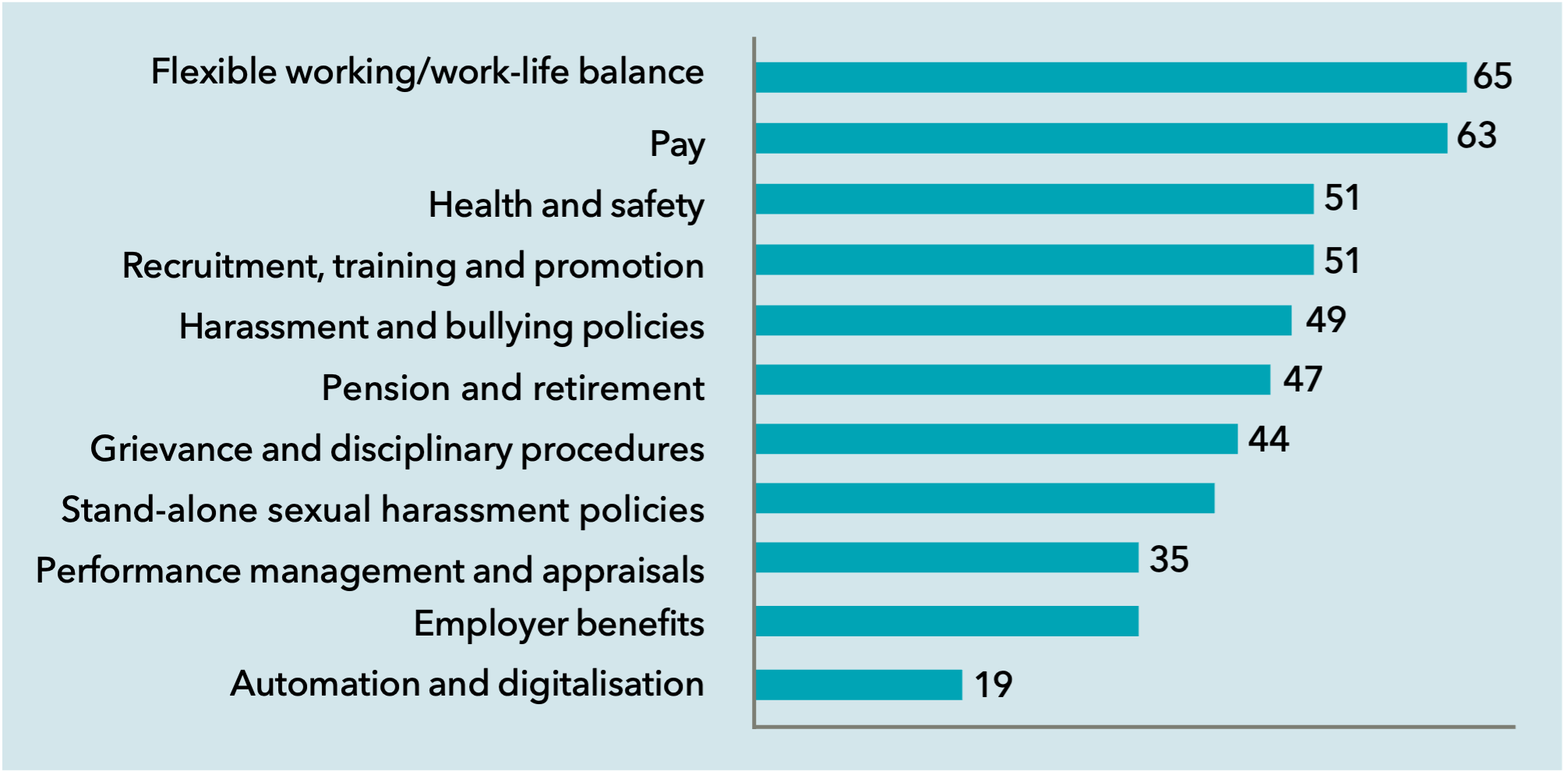
Across all unions participating in the Audit, the general bargaining topics on which they are most likely to have produced equality guidance are flexible working/work-life
balance and pay, followed by health and safety and recruitment, training and promotion. Automation and digitalisation is the least likely topic for guidelines or policies, produced by one in five (19 per cent) unions.
Compared with the 2020 TUC Equality Audit, the most common area is still flexible working/work-life balance but otherwise there is a changing round of priorities. Guidance on equality aspects of pay and of recruitment, training and promotion are higher on the list than four years ago, overtaking materials on health and safety, harassment and bullying policies, pensions and retirement, employer benefits, and performance management and appraisals.
The comparison between 2020 and 2024 is used to demonstrate changing priorities rather than historical comparisons. It is difficult to make direct comparisons between audits due to the small sample size and different unions completing each audit. In addition, the sample size of the audit in 2024 is substantially changed compared to 2020 therefore a decline in percentage of unions does not necessarily mean a decrease in the number of unions. However, where there has been a percentage increase, this does mean an increase in the number of unions providing certain guidance. In addition, there has been a growth in the number of small unions completing the audit who may be less likely to produce their own guidance on a variety of issues.
Table 5: Unions with equality guidance on general bargaining topics 2024 and 2020 (per cent)
| 2024 | 2020 |
Flexible working/work-life balance | 65 | 67 |
Pay | 63 | 58 |
Recruitment, training and promotion | 51 | 47 |
Health and safety | 51 | 61 |
Harassment and bullying policies | 49 | 64 |
Pensions and retirement | 47 | 56 |
Grievance and disciplinary procedures | 44 | 47 |
Stand-alone sexual harassment policies | 42 | 42 |
Employer benefits | 35 | 53 |
Performance management and appraisals | 35 | 56 |
Automation and digitalisation | 19 | 17 |
Looking at guidance issued by unions in the different size bands, it can be seen that, not surprisingly, large unions are more likely to have guidance on equality issues in all the general bargaining topics listed. But there are also some differences in current ‘priorities’ between the different union size groups.
For large unions, the most common general bargaining issues for equality guidance are pay and pensions and retirement, cited by all six unions in that band. For medium-sized unions, pay is also at the top, but the second most likely area for guidance is flexible working/work-life balance, with pensions much further down the list. And for small unions, flexible working/work-life balance is the top ‘priority’, followed by guidance
on recruitment, training and promotion and we have a seen a rise in the number with guidance on sexual harassment policies since 2020.
Guidance on harassment and bullying polices, which was issued by 100 per cent of large unions in the 2020 Audit, has now been overtaken by other issues, but it is higher up the list for small unions than it was four years ago.
Figure 2: Large unions with equality guidance on general bargaining topics (per cent)
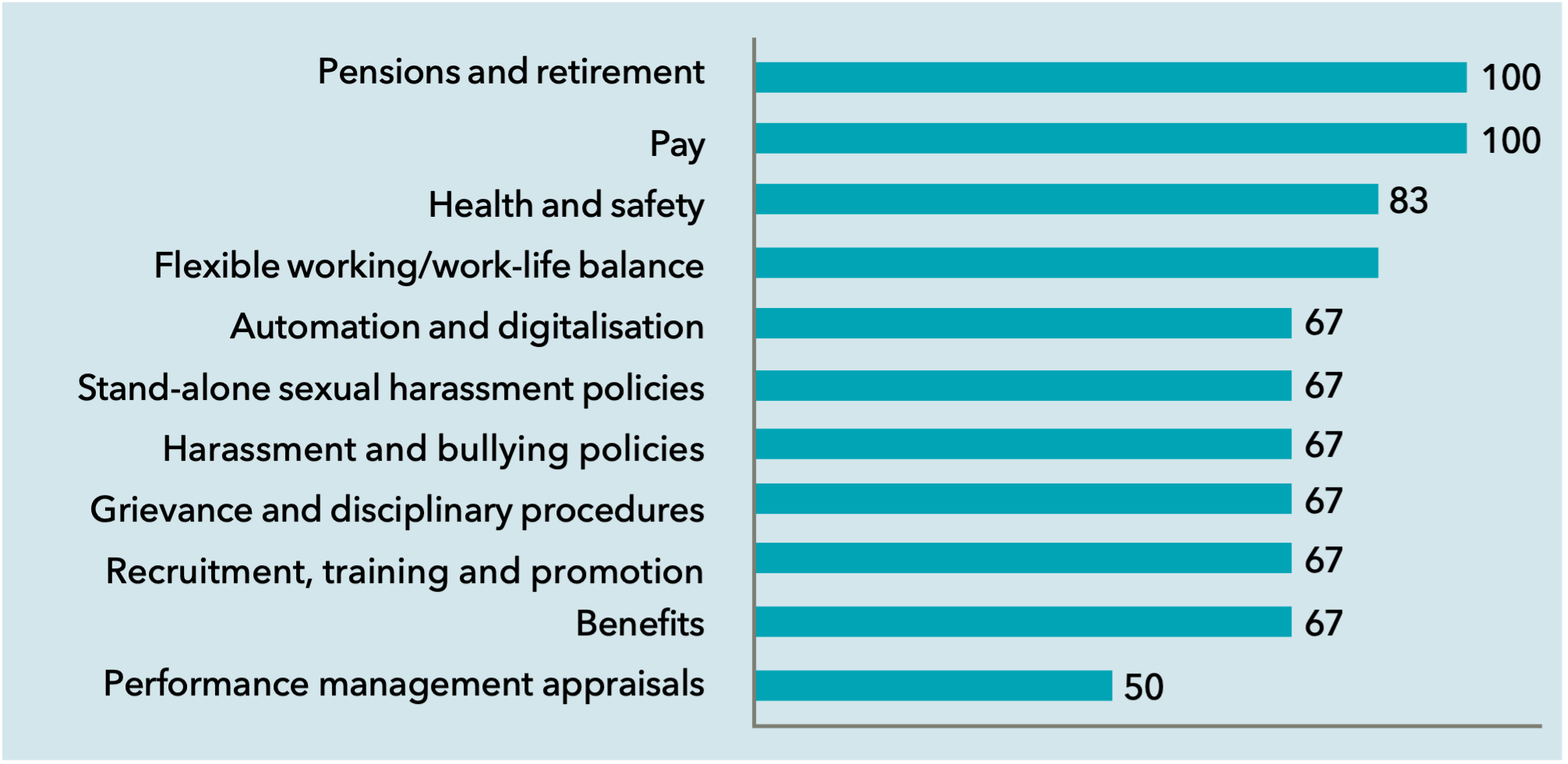
Figure 3: Medium unions with equality guidance on general bargaining topics (per cent)
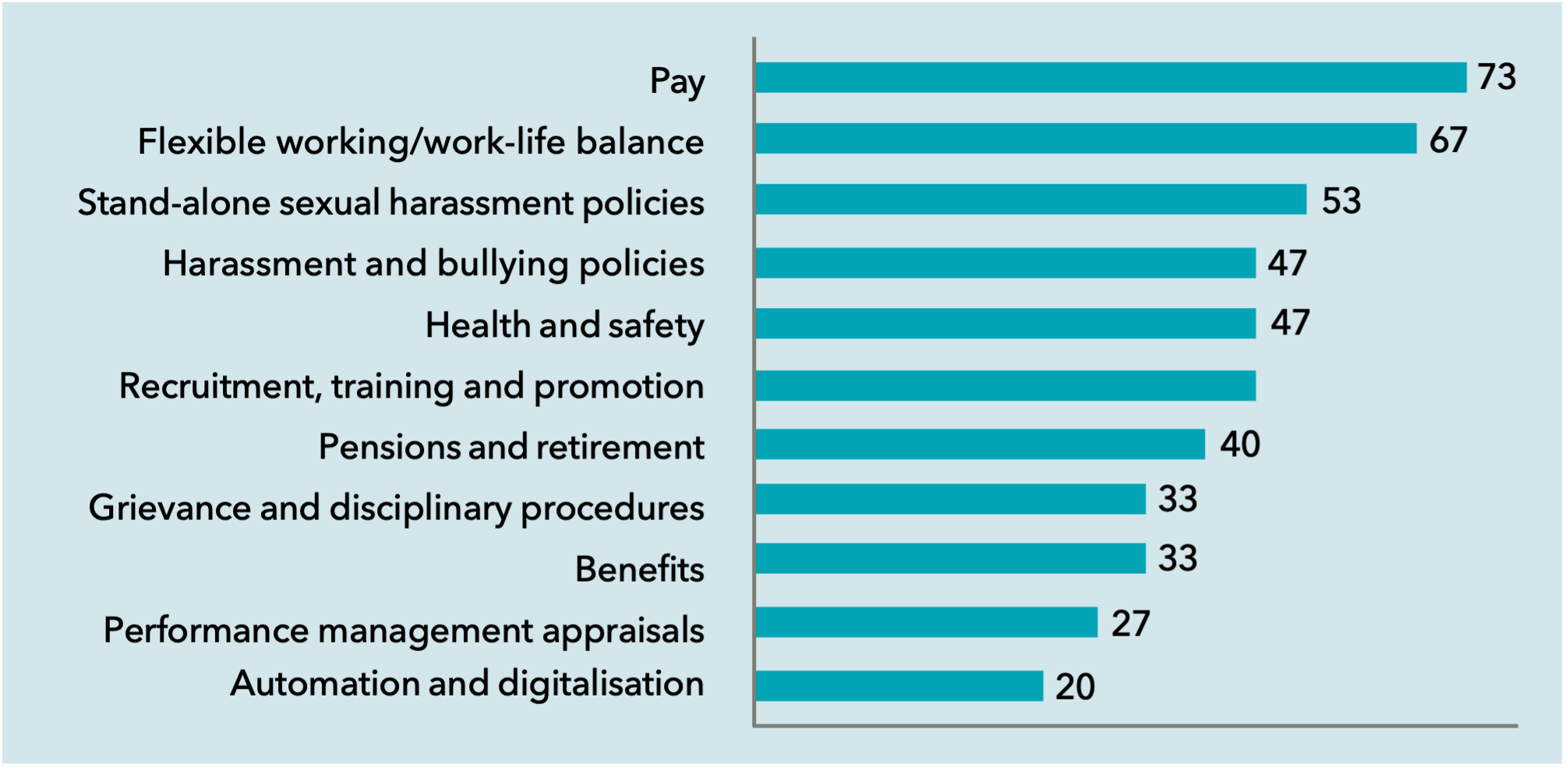
Figure 4: Small unions with equality guidance on general bargaining topics (per cent)
Examples of guidance on equality aspects of general bargaining topics
Unions were asked to provide some examples of the most important negotiating guidance or policies they had produced on equality aspects of general bargaining topics in the last four years.
Pay
The NAHT, with the help of equality experts from other unions and organisations, has published a very comprehensive toolkit called Achieving Equal Pay in the Workplace. It is aimed at individual workers as well as union reps and negotiators. It suggests ways of engaging members about the issue of potential pay inequalities in their workplace. It provides ideas and tips on negotiating with employers around a range of workplace practices such as pay, recruitment, family leave and flexible working. And there is detailed guidance on equal pay audits, improving workplace culture and making an equal pay claim.
In the absence of legislation on ethnicity pay gap reporting, Unite provided its negotiators with a guide on how employers can address it. It sets out the key reasons for the pay gap and what type of data employers should be asked to collect in order to develop an action plan.
Flexible working/work-life balance
UNISON’S bargaining guide to working from home and hybrid working covers all aspects of this increasingly widespread area of negotiation. It includes the different types of flexible working and existing statutory rights, the pros and cons of various flexible work options, guidance on a good workplace policy and how to negotiate it with management, and a specific chapter looks at homeworking expenses and allowances.
The FDA’s guidance on this topic makes eight recommendations for a workplace policy to improve work-life balance for staff based on member experiences of flexible working. Recommendations include training for line managers to ensure they do not give poorer performance ratings to staff working part time or flexibly.
Recruitment, training and promotion
The EIS produced guidance for its local association (branch) secretaries on getting their employers (local authorities) to improve the recruitment of Black, Asian and Minority Ethnic (BAME) educators.
Based on the union’s research into local authority practices in relation to recruitment of BAME staff, it suggests pro-active measures employers can take, including promoting teaching
as an attractive profession to BAME pupils, reviewing recruitment process to ensure they do not discriminate, considering sponsorships of BAME educators, including for leadership opportunities, and implementing anti-racist recruitment practices, such as training BAME staff to be on recruitment panels and scoring and weighting applicants by criteria set prior to interview.
Meanwhile, UNISON has produced a model policy for the recruitment, support and retention of migrant workers. It includes information on migrant workers’ rights and checklists for ensuring workers are not discriminated against in pre-employment vetting.
Health and safety
ASLEF and Usdaw have sought to put support for staff facing domestic abuse on the negotiating agenda. ASLEF’s guidance sets out the types of behaviour that constitutes domestic abuse, why it is a trade union issue and employers’ responsibilities. Usdaw developed a model policy which it included as an item in its 2020-21 pay review negotiations with a range of large employers. Some of its successes in this area are set out on page 36.
Sexual harassment
Usdaw’s statement on ending sexual harassment in the workplace sets out the scope of the problem in the places where its members work. For reps and negotiators, it clarifies the law, provides ways in which they can help improve the workplace culture and suggests actions they should urge their employers to take, including establishing stand-alone policies for preventing sexual harassment and supporting ‘victim-survivors’.
Equalities bargaining topics
Figure 5 shows the percentage of unions that said they had current up-to-date policies, guidelines or briefing materials for their negotiators on equalities bargaining issues or, for those dealing with few employers, had put these as items in claims to employers.
The most common topics for negotiating guidance were issues for women, followed by working parents, and parents-to-be and carers, as well as disabled workers and general equalities bargaining. Less common is guidance on younger and older workers, religion and belief and, in particular, migrant workers. However, it is worth noting that the category, Migrant workers, was newly introduced into the list of equality guidance topics in 2024, and some relevant issues are included in the Black workers category.
Figure 5: Unions with guidance on equality bargaining topics (per cent)
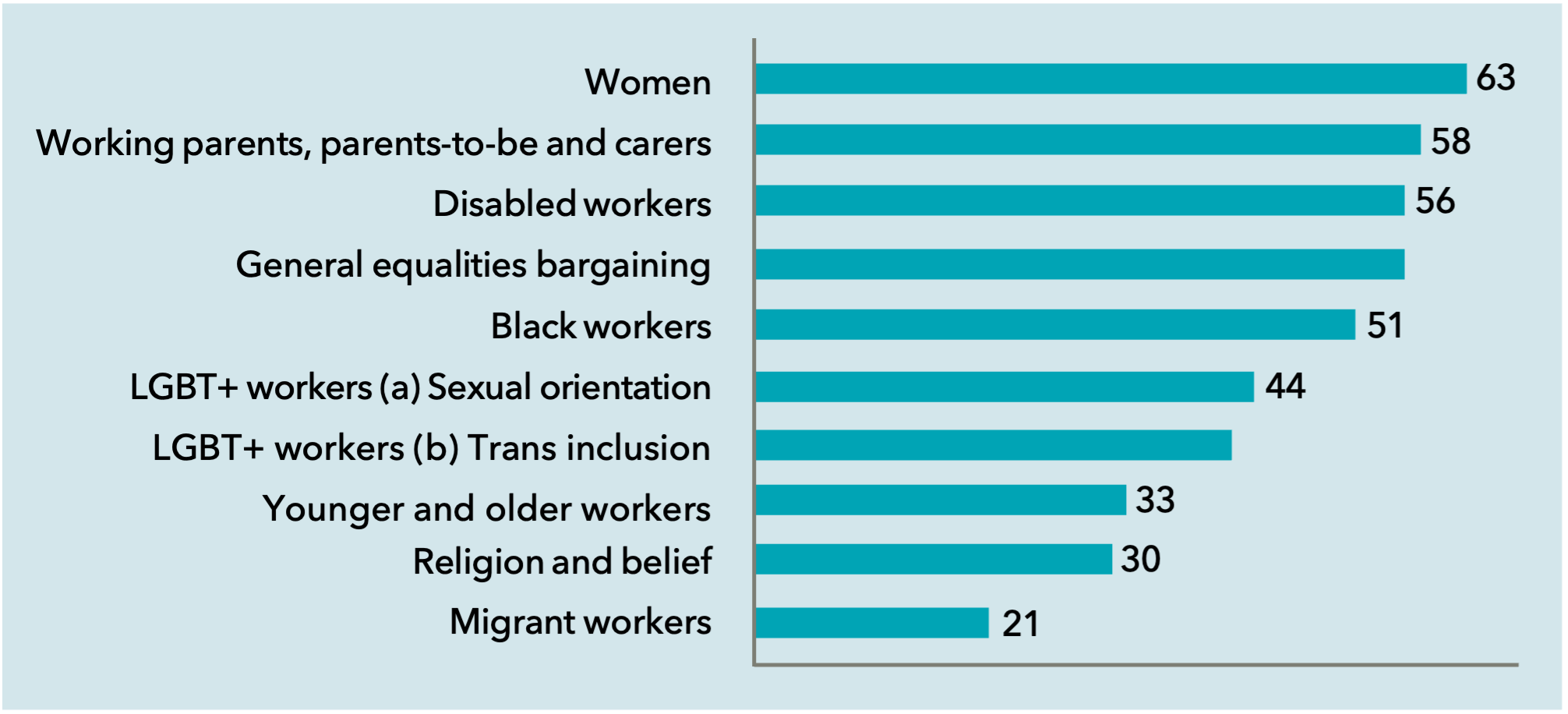
Table 6 shows the changes in these figures since the 2020 TUC Equality Audit. The proportion of unions with guidance in some areas has increased substantially. This is particularly true for guidance on Black and disabled workers’ issues but also for guidance on women, working parents, parents-to-be and carers and general equalities bargaining. Where there have been decreases, please see the note in the section on guidance on general bargaining topics on page 20.
Table 6: Unions with guidance on equality bargaining topics (per cent)
| 2024 | 2020 |
Women | 63 | 58 |
Working parents, parents-to-be and carers | 58 | 50 |
General equalities bargaining | 56 | 50 |
Disabled workers | 56 | 44 |
Black workers | 51 | 39 |
LGBT+ workers (a) Sexual orientation | 44 | 50 |
LGBT+ workers (b) Trans inclusion | 42 | 44 |
Younger/older workers | 33 | 33 |
Religion and belief | 30 | 33 |
Migrant workers | 21 | -* |
*New equality category in 2024
Looking at variations between different union size bands, large unions are more likely to have guidance in most of these equality areas than medium-sized or small unions, although not in the case of general equalities and religion and belief, where a higher proportion of middle-sized unions have materials.
Current top priorities vary between the groups. The most common areas for guidance in large unions are on bargaining issues for trans inclusion and for women, produced by all six of those unions. In medium-sized unions the key area currently is working parents, parents-to-be and carers, while in small unions it is bargaining issues for women.
Figure 6: Large unions with guidance on equality bargaining topics (per cent)
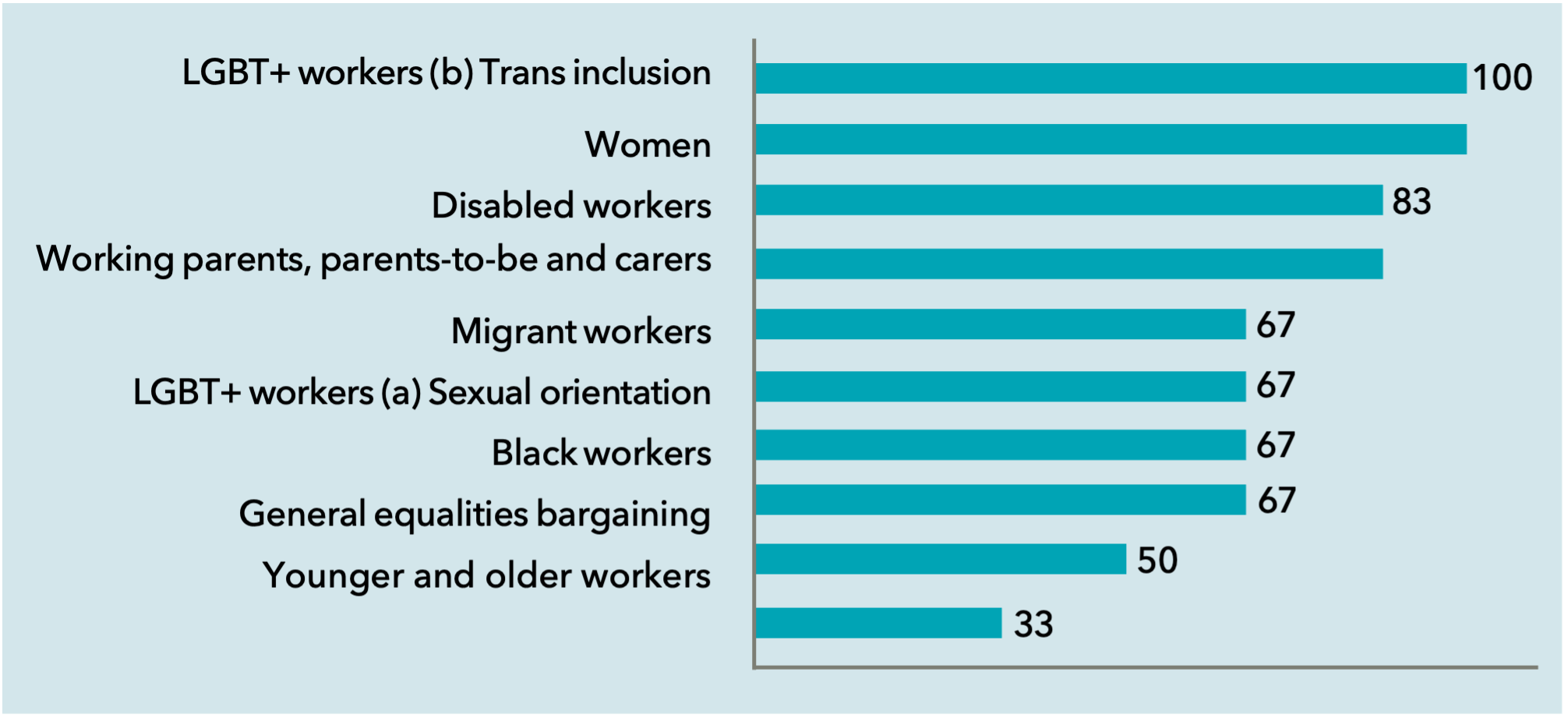
Figure 7: Medium-sized unions with guidance on equality bargaining topics (per cent)
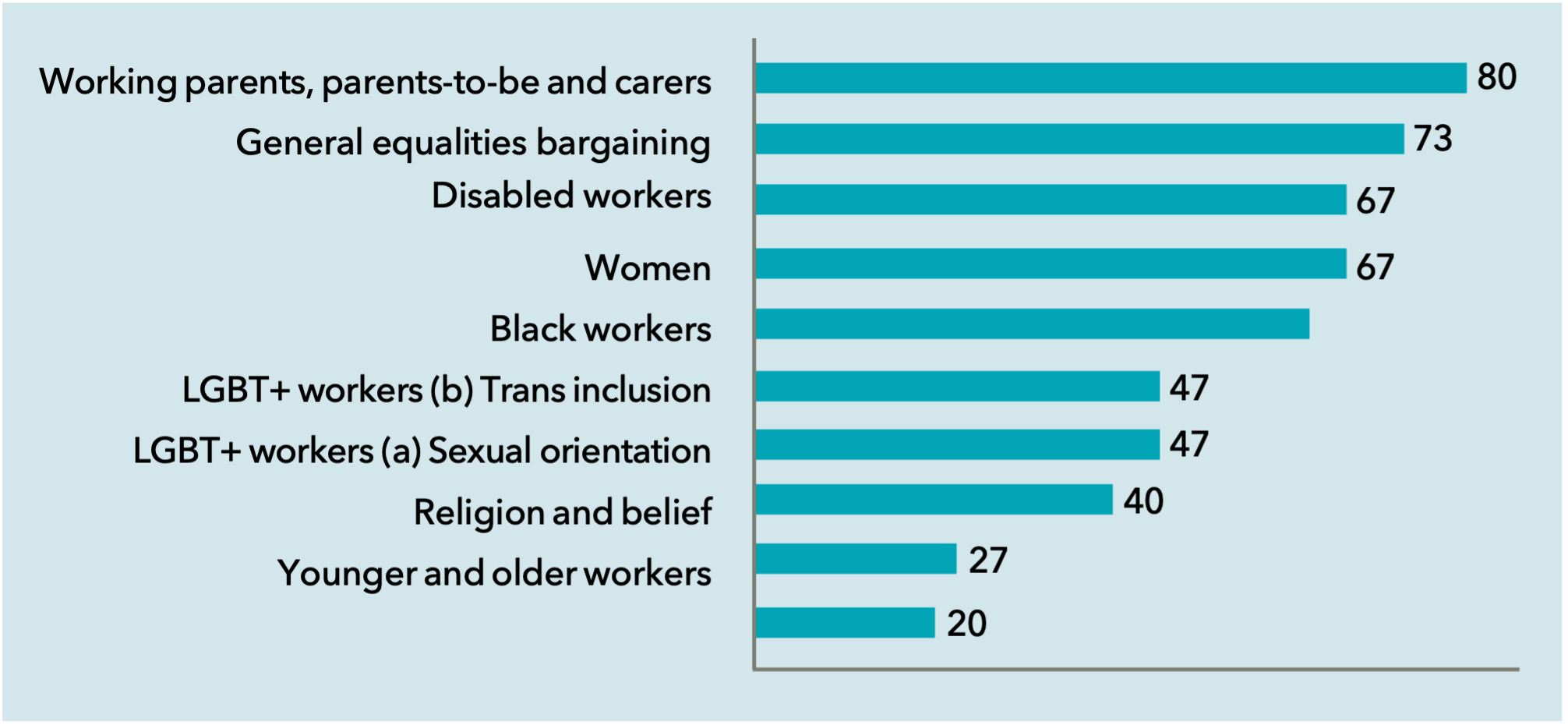
Figure 8: Small unions with guidance on equality bargaining topics (per cent)
Examples of guidance on equality bargaining topics
Unions were asked to provide some important examples of bargaining policies and guidance they had produced for their negotiators on equality bargaining topics.
General equalities
The PFA has produced a guide on equality, diversity and inclusion (EDI) to help its representatives running the EDI workshop which the union delivers to all professional footballer members. It outlines the game’s commitment to combating discrimination and covers relevant law, acceptable language as a professional footballer, guidance on FA rules, the protocols for reporting discrimination and details of sanctions.
Women
The increased priority many unions have been giving to bargaining over menopause policies is reflected in the number who supplied examples of guidance or polices for their negotiators. Examples sent to the Audit are from unions both with majority women memberships, such as Usdaw and the FDA, and those with majority men memberships, including Unite, Community and ASLEF.
Common advice is for negotiators to aim for stand-alone menopause agreements and risk assessments to take account of potential adverse effects of menopause on women at work.
Usdaw, who says 100,000 of its members are women aged 45 or over, is urging negotiators to push for a stand-alone menopause policy developed with the union. It says this should cover training for managers and staff, a confidential, named point of contact for women, risk assessments, examples of common reasonable adjustments that can help (for example providing access to water, providing portable fans, additional rest breaks, access to a
quiet room, changes to hours or days of work and changes to job role/duties), menopause absence to be counted separately to other absence, natural fibre uniforms or relaxing uniform policies, establishing a peer support group, and signposting to further support.
Black workers
Community has a guide for members and reps on tackling racism and discrimination in the workplace. The guide, produced in conjunction with Community member Baroness Doreen Lawrence, includes tips on making the case to the employer, 12 steps that employers should be taking, and other workplace advice.
UNISON has a comprehensive model policy to be negotiated with employer.
Disabled workers
ASLEF’S Best Practice Guide for Disabled Workers advises reps and branches on what it calls “the absolute minimum that train operators need to adhere to”, which goes beyond legal minimums. It covers the relevant law, disability and sick leave, reasonable adjustments, risk assessment and disability, Access to Work, disability discrimination, confidentiality and signposting to further information. RMT has produced a disabled transport workers’ charter setting out its demands to support disabled workers.
Unite has produced detailed negotiators’ guidance specifically on reasonable adjustment passports in addition to its guide, Disability Equality at Work. It includes a reasonable adjustment passports model policy with tips and checklists for reps.
Other guidance for reps negotiating around disability include the PFA’s guidance on neurodiversity and mental health and Unite’s Long Covid negotiators’ guide. This sets out what Long Covid is and how people can be supported, along with checklists of issues for reps to take up with their employers.
LGBT+ workers
The EIS guidance on trans rights was updated following the Scottish Government’s publishing of the Gender Recognition Reform Bill in March 2022. The union issued the new guidance because of the “rise in toxic debate and misinformation around the
proposed changes” with many members unsure of the Bill’s implications. Although it is aimed at its members as teaching professionals, it is also useful to reps and members generally in addressing some the questions many have about the issue.
ASLEF’s Best Practice Guide for Transgender Workers details the key areas that reps need to consider in supporting and negotiating on behalf of transgender members. Their guide includes information on the process of gender reassignment, advice on how to inform colleagues and others about transition, the use of pronouns, inappropriate questions, changing facilities and toilets, uniforms and dress codes, records and confidentiality, redeployment and retirement, medical treatment during employment and health and safety considerations.
Meanwhile, Community’s guide for all LGBT+ members and allies sets out the relevant legal rights and covers wide-ranging issues such as bullying and harassment, collecting data and checking internet firewalls and filters, such as ensuring words such as gay are not blocked as adult content.
Religion and belief
Community’s guide on faith and belief for members and reps covers everyday practicalities of someone querying to what extent their faith needs should be accommodated by employers.
PFA’s guide, Muslim Player Considerations: understanding and embracing differences in football, provides educational information for non-Muslims and details on what issues employers (clubs) should address. These include provision of prayer facilities, dietary requirements, citing of player accommodation and issues during overnight stays. It also provides an understanding of Ramadan, which has a particular impact for those PFA members who will be fasting while training and playing.
Working parents and parents-to-be
The RCM has produced comprehensive guidance on maternity pay and rights, including in situations of miscarriage and pregnancy loss. Whilst statutory rights for those who suffer pregnancy loss before 24 weeks are minimal, some unions are attempting to get improvements through collective bargaining.
UNISON has produced a model pregnancy loss policy to get employers to support workers. It says employers should provide sympathetic treatment in cases of pregnancy loss before 24 weeks as well as additional leave where necessary. Any resulting sick leave should be counted outside the normal procedures that can lead to disciplinary action. The policy also calls for training for line managers and union reps.
The FDA has also taken up this issue by writing to one of its large employers, the Department for Environment, Food and Rural Affairs (Defra), asking for rights for parents suffering pregnancy loss before 24 weeks to be granted specific leave. It also proposes a peer support system, signposting to professional help, and robust training for line managers.
The NEU has taken up the issue of breastfeeding and expressing milk at work, issuing a checklist for reps and a model policy. The policy covers access to suitable facilities,
including access to cool drinking water, appropriate space and time to rest and express, and adjustments to the working day, including rest breaks.
Carers
The FDA has recommended changes to improve the Carer’s Passport system in the civil service. The passport enables carers and their managers to discuss and document the flexibilities needed to combine caring and work.
How union guidance supports and promotes equality
The Equality Audit asked unions what role their bargaining guidance had played in supporting and promoting equality.
Several unions shared examples of where guidance had led to improved terms and conditions.
There has been particular success in turning guidance on menopause policies into success at the workplace. The CWU says negotiations based on its menopause guidance resulted in the first ever Royal Mail Group Menopause Guide for Managers, and Unite’s materials led to menopause polices being agreed in workplaces including Greencore, Ford, Nestlé and Arriva. ASLEF also ran a menopause campaign, including producing a draft workplace policy, and subsequently either agreed policies or were in negotiations in 25 of the 36 train and freight companies. This follows on from the menopause being
a substantial area of growth in the 2020 audit and the increase in high-profile public campaigning around the menopause, including by unions.
Other direct impacts of union guidance materials include UNISON’s guidance on women and pensions, which it says has helped members to negotiate better contributions from employers to auto-enrolment schemes.
Unite’s Period Dignity campaign persuaded multiple employers to sign a charter to improve facilities, while the NHBCSA’s campaign on the same topic won free sanitary products across its (sole) employer’s network.
The PFA considers that its work to promote equal prize money for female professional footballers was a key part of the success in achieving it at the Women’s World Cup.
Section D gives more details about the successful results of equality bargaining, but unions also pointed to other ways in which guidance has promoted equality. These include the following examples:
The NUJ says guidance and training has been fundamental in building negotiators’ confidence to address equality matters in the workplace and negotiate policies with employers and identify areas for improvement.
NSEAD, AUE and Community are among a number of unions whose guidance helps inform individual members on equality issues in sectors where there is little collective bargaining.
Equality guidance produced by UCU and NASUWT is embedded in their reps’ and negotiators’ training and briefings to ensure they are informed and encouraged to use the information in their negotiating and campaigning.
The GMB’s materials on equal pay are being used to build its capacity for identifying and fighting equal pay campaigns – a current major focus for the union.
A number of professional unions say their equalities guidance is not only aimed at improving conditions for groups who are under-represented or face discrimination, but also for use in members’ professional role as educators (EIS) or as health workers treating patients from such groups (SoR).
This section looks at the extent to which unions have achieved successful outcomes to their equality bargaining for example reaching agreements or policies with employers. Again, the results are split into two parts: equality gains made in general bargaining topics, such as pay and benefits; and gains on specific stand-alone equality topics.
Equality elements of general bargaining topics
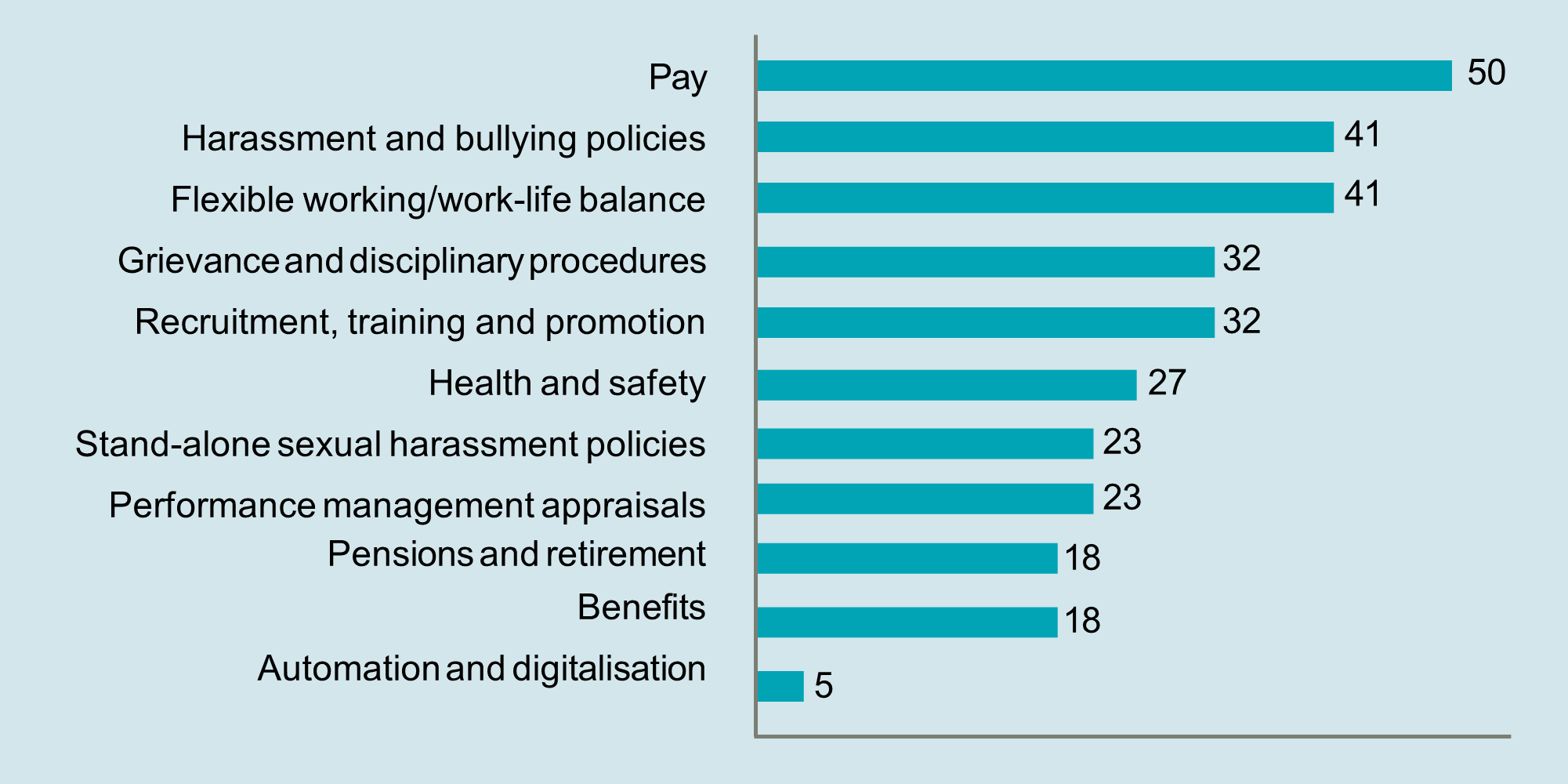
Figure 9 shows the percentage of unions that said they had achieved successful outcomes on equality aspects in general bargaining topics in the previous four years.
The figures indicate which areas have most commonly resulted in success. They suggest that unions are most likely to have made equality gains in the areas of pay, flexible working/work-life balance, health and safety and harassment and bullying policies.
Figure 9: Unions achieving equality gains in general bargaining topics (per cent)
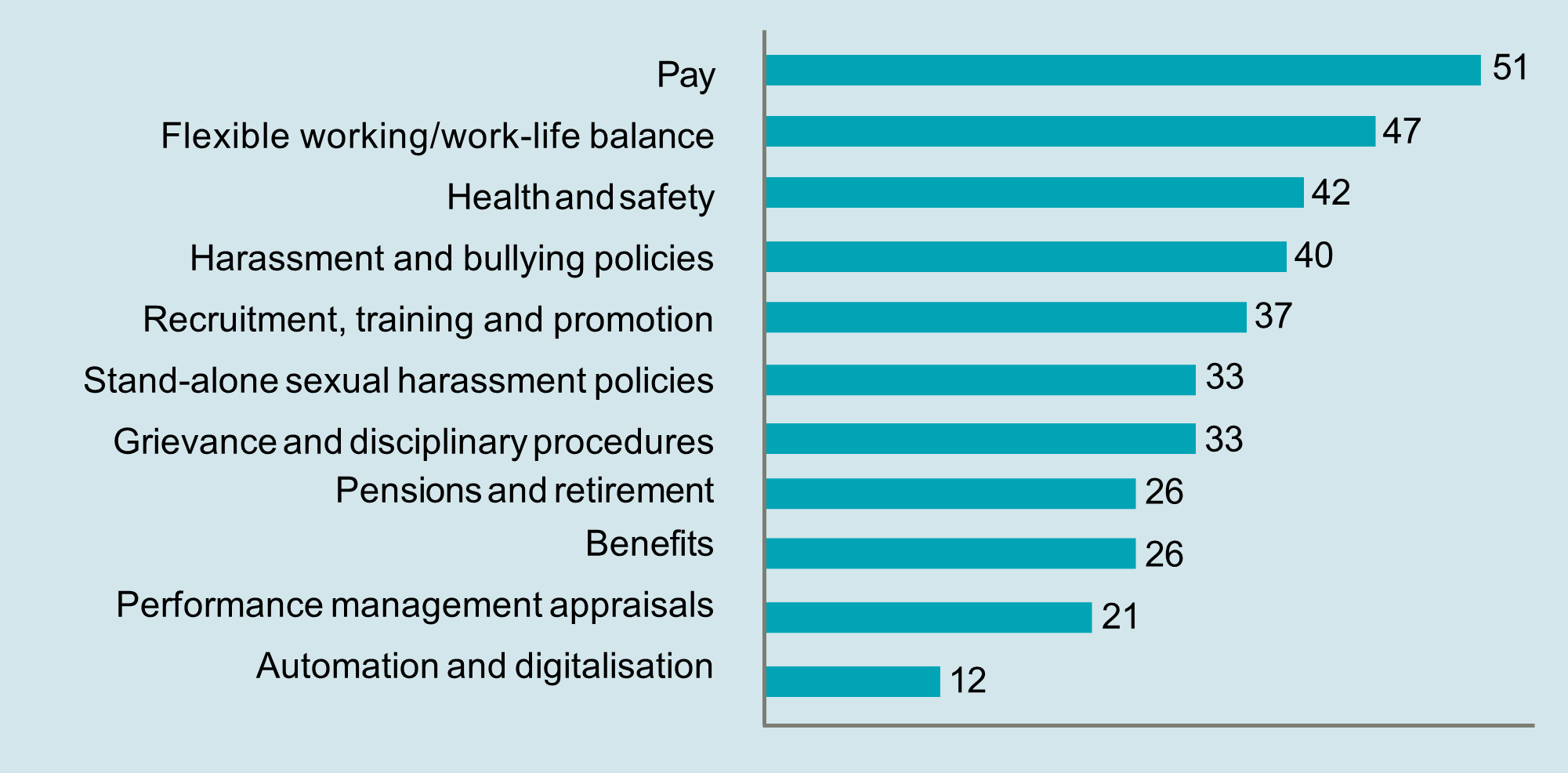
A comparison with the 2020 Equality Audit (Table 7) would appear to indicate that fewer unions have achieved bargaining gains in many of these areas. However, this is not a correct assumption, as more unions took part in the 2024 Audit (43 compared with 36), affecting the percentage figures. For example, the number of unions saying they had made gains on equality in pay this time is 22, whereas in 2020 it was 21.
However, the figures do allow a comparison of the topics where unions are most and least likely to have made gains. In 2024 the two areas with most success – pay and flexible working/work-life balance – are the same as in 2020. On the other hand, gains in recruitment, training and promotion and performance management and appraisals are further down the list than they were four years ago. The area where unions are least likely to have made gains in both years is automation and digitalisation policies.
Table 7: Unions achieving equality gains in general bargaining topics, 2024 and 2020 (per cent)
2024 2020
Pay 51 58
Flexible working/work-life balance 47 58
Health and safety 42 44
Harassment and bullying policies 40 39
Recruitment, training and promotion 37 47
Grievance and disciplinary procedures 33 28
Stand-alone sexual harassment policies 33 39
Benefits 26 22
Pensions and retirement 26 33
Performance management and appraisals 21 36
Automation and digitalisation 12 14
Looking at gains by unions in different size bands (see Figures 10, 11 and 12), large unions were more likely to have reached equality bargaining gains in all these areas than medium-sized and small unions.
For small unions, pay is the standout topic for gains, while in the other size bands the areas of success are more evenly spread.
Figure 10: Large unions achieving equality gains in general bargaining topics (per cent)
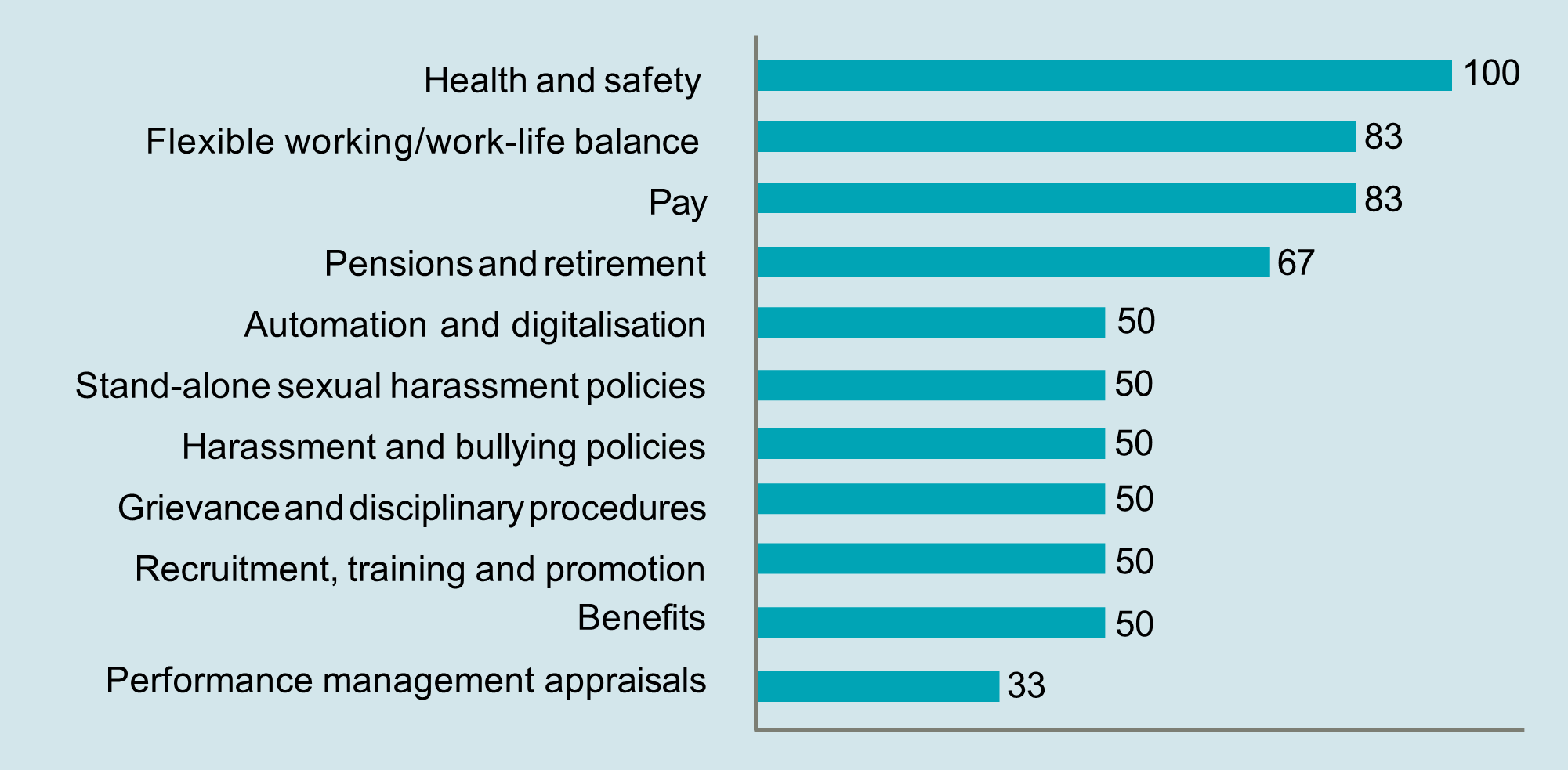
Figure 11: Medium-sized unions achieving equality gains in general bargaining topics (per cent)
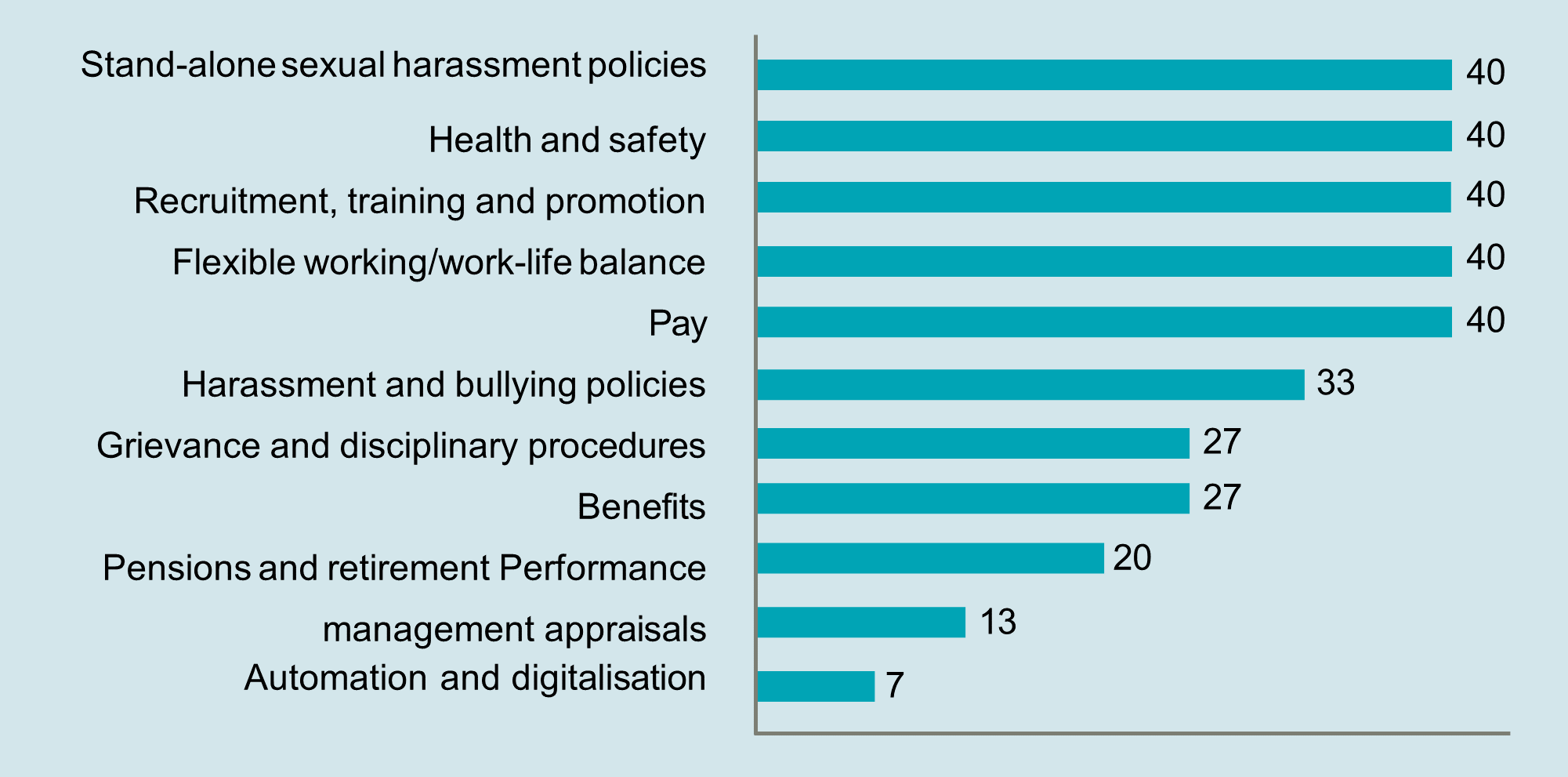
Figure 12: Small unions achieving equality gains in general bargaining topics (per cent)
Examples of negotiated gains on equality aspects of general bargaining topics
Unions were asked to provide some examples of the most important agreements they had reached with employers on equality aspects of general bargaining topics.
Pay, pensions and benefits
There has been further implementation of the CWU’s 2018 Four Pillars national pay agreement including action on part-timers’ holiday pay and the inclusion of low-paid staff in the collective defined contribution pension scheme.
In the 2023 Royal Mail agreement, in which the sick pay agreement was under threat due to rising levels of sickness absence, it was agreed that the causes of sickness absence would be investigated including bullying and harassment, grievance, mental health and neurodiversity. It would look at the role of the Equality Act 2010 and occupational health.
The NASUWT has been negotiating the implementation of the government’s remedy for unlawful age discrimination in the England and Wales Teachers Pension Scheme. It continues to negotiate with all three UK Teachers’ Pension Schemes and the relevant government departments over the implementation of the remedy and has trained its staff and lay activists in key aspects of the remedy.
Bullying and harassment
The policy on bullying and harassment at the National House Building Council, negotiated by the NHBCSA, notes that where such behaviour is exhibited towards people because of a protected characteristic it could be a breach of the Equality Act. The policy spells out a wide range of examples, including refusing to accept or use someone’s preferred pronouns, refusing to use someone’s correct name, denying non-binary identities and obstructing someone’s use of facilities aligned with their gender.
Performance management
The CWU’s Business Recovery, Growth and Transformation agreement with Royal Mail includes agreement to jointly design and implement a new performance procedure based on, among other things, “fairness and consistency”.
And the NASUWT notes that, over the last two years, it has reached agreement with an increasing number of academy trusts to replace Performance Related Pay Progression, which is a significant driver of discriminatory pay outcomes, with automatic time-served progression.
Health and safety
There has been headway for some unions in the area of support for staff facing domestic abuse. Unite reached an agreement with the University of Bath, which offers a range of support including allowing affected staff to seek support from external organisations, including legal support, in work time. Usdaw has reached agreements with several large employers including Sainsbury’s, Argos, Poundland and food manufacturer pladis. The pladis agreement includes five days’ paid support to enable affected staff to address issues such as attending court, medical or legal appointments or to seek safer accommodation.
Flexible working/work-life balance
In the Oasis Community Learning flexible working policy agreed with the NEU, the company actively encourages flexible working applications and “is committed to supporting requests for flexible working, where these are reasonable and operationally practical.” It also states that it wants its practice “to secure equity and fairness of both treatment and outcome for all.
The policy allows applications from day one and allows one formal request every six months 4 and offers a very wide range of flexible working options. CWU and Santander’s major 2021 agreement on new ways of working, in which large numbers of staff were shifted to home working, ensured protection for those with mental health conditions which might be worsened by home working.
Equalities bargaining topics
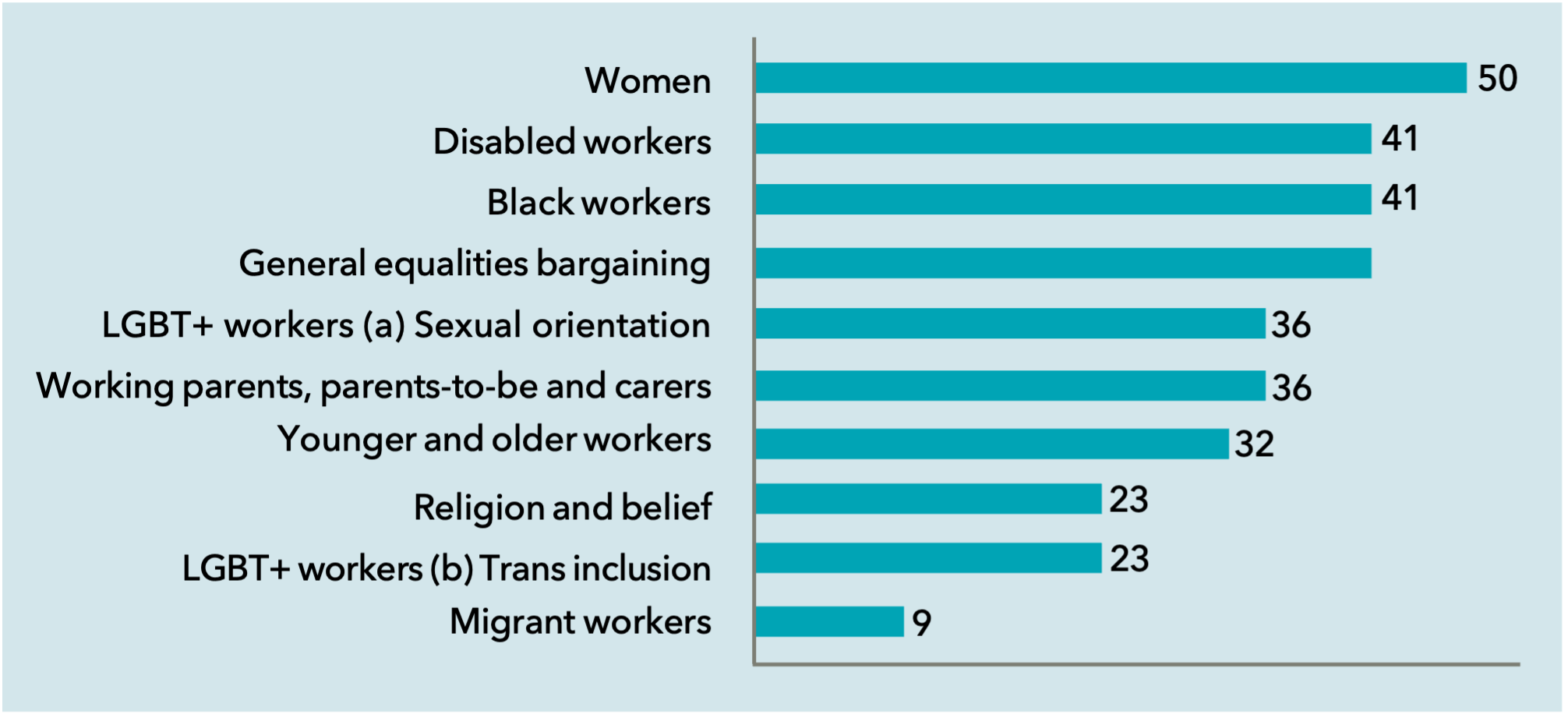
Figure 13 shows the percentage of unions who said they had achieved successful outcomes in equality bargaining topics in the last four years.
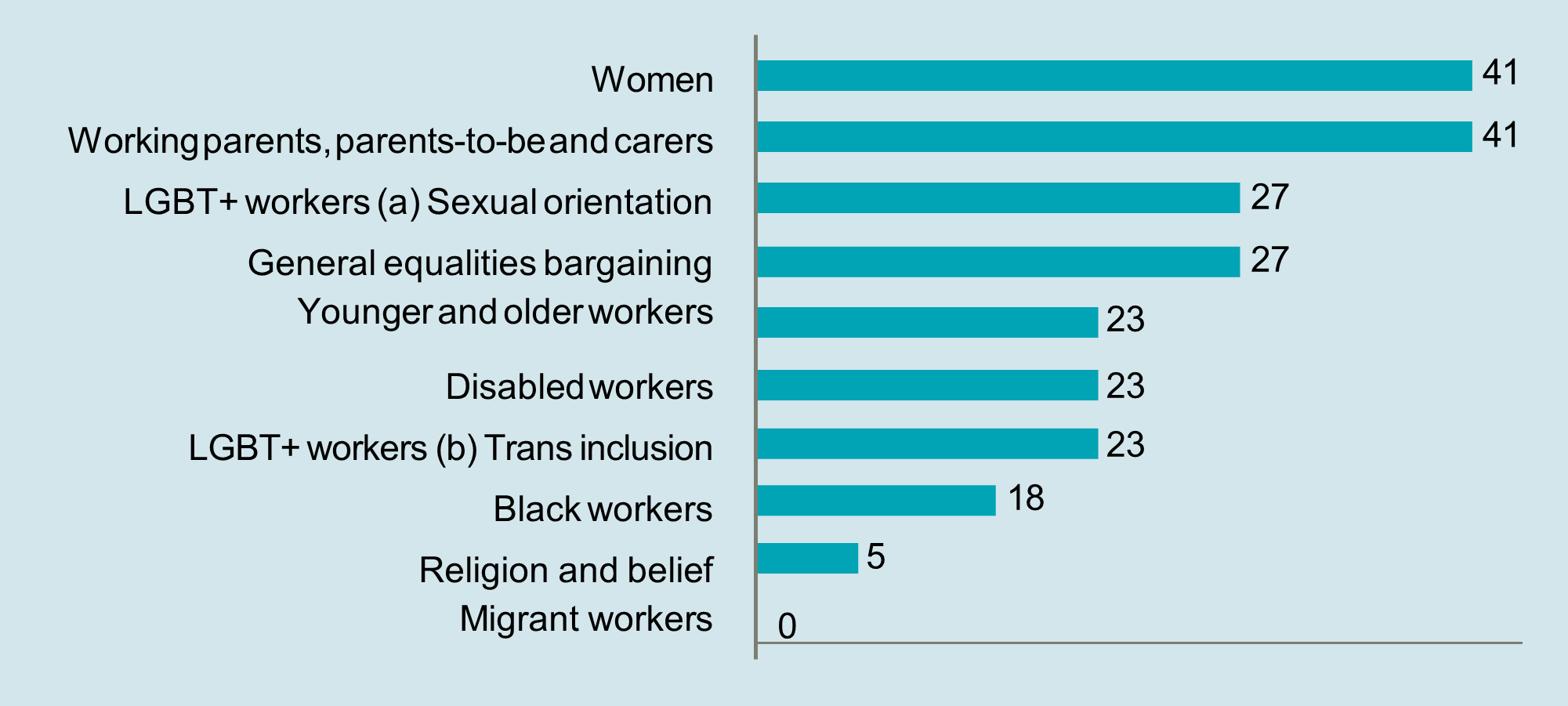
It suggests that unions are most likely to have made gains in connection to women workers followed by working parents, parents-to-be and disabled workers.
Figure 13: Unions making gains in equality bargaining areas in the previous four years (per cent)
- 4This was introduced ahead of new legislation in April 2024 that gave all employees a day one right to request and right to make two requests every 12 months.
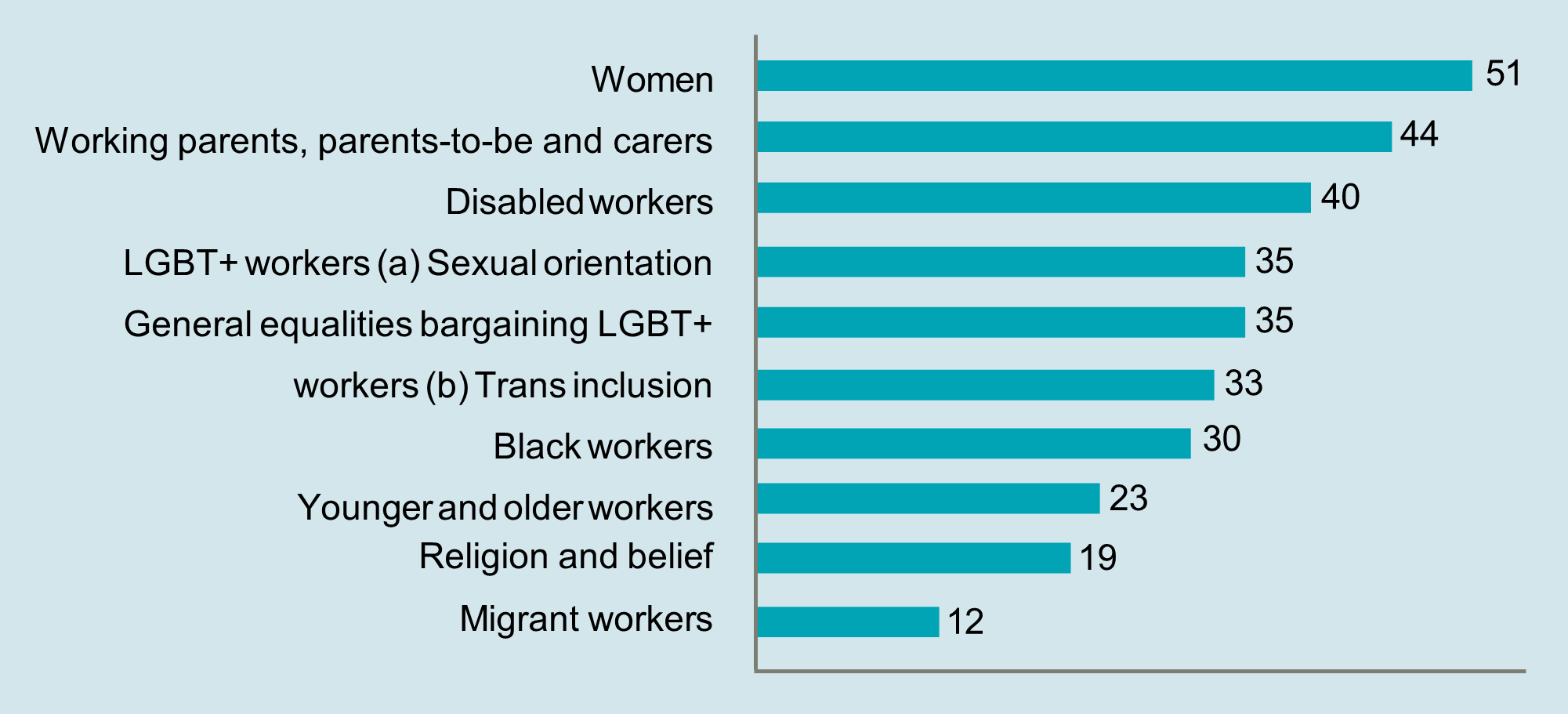
Comparing the picture with the 2020 TUC Equality Audit shows there have been some changes in the areas in which unions are most likely to have had bargaining success in the last four years (Table 8).
Most notably, agreements reached on women’s equality issues has soared to the top of the list, whereas it was only the sixth most successful area out of nine equality topics in 2020.
The change is more dramatic than the percentage figures suggest as the number of unions who have made gains for women has doubled between 2020 and 2024 – from 11 to 22.
Table 8: Unions achieving equality bargaining gains in the previous four years, 2024 and 2020 (per cent)
2024 2020
Women 51 31
Working parents, parents-to-be and carers 44 47
Disabled workers 40 47
General equalities bargaining 35 50
LGBT+ workers (a) Sexual orientation 35 36
LGBT+ workers (b) Trans inclusion 33 39
Black workers 30 31
Younger and older workers 23 25
Religion and belief 19 19
Migrant workers 12 -*
*New equality category in 2024
Looking at gains by unions in different size bands (see Figures 14, 15 and 16), large unions were, unsurprisingly, more likely to have reached equality bargaining agreements in these areas than smaller unions.
Gains for women have seen the most success in all size bands, but there are some differences between the groups for other equality topics. Medium-sized unions are more likely to have negotiated agreements on disabled workers than on working parents, parents-to-be and carers, while the reverse is true for the other bands.
Figure 14: Large unions achieving equality bargaining gains in the last four years (per cent)
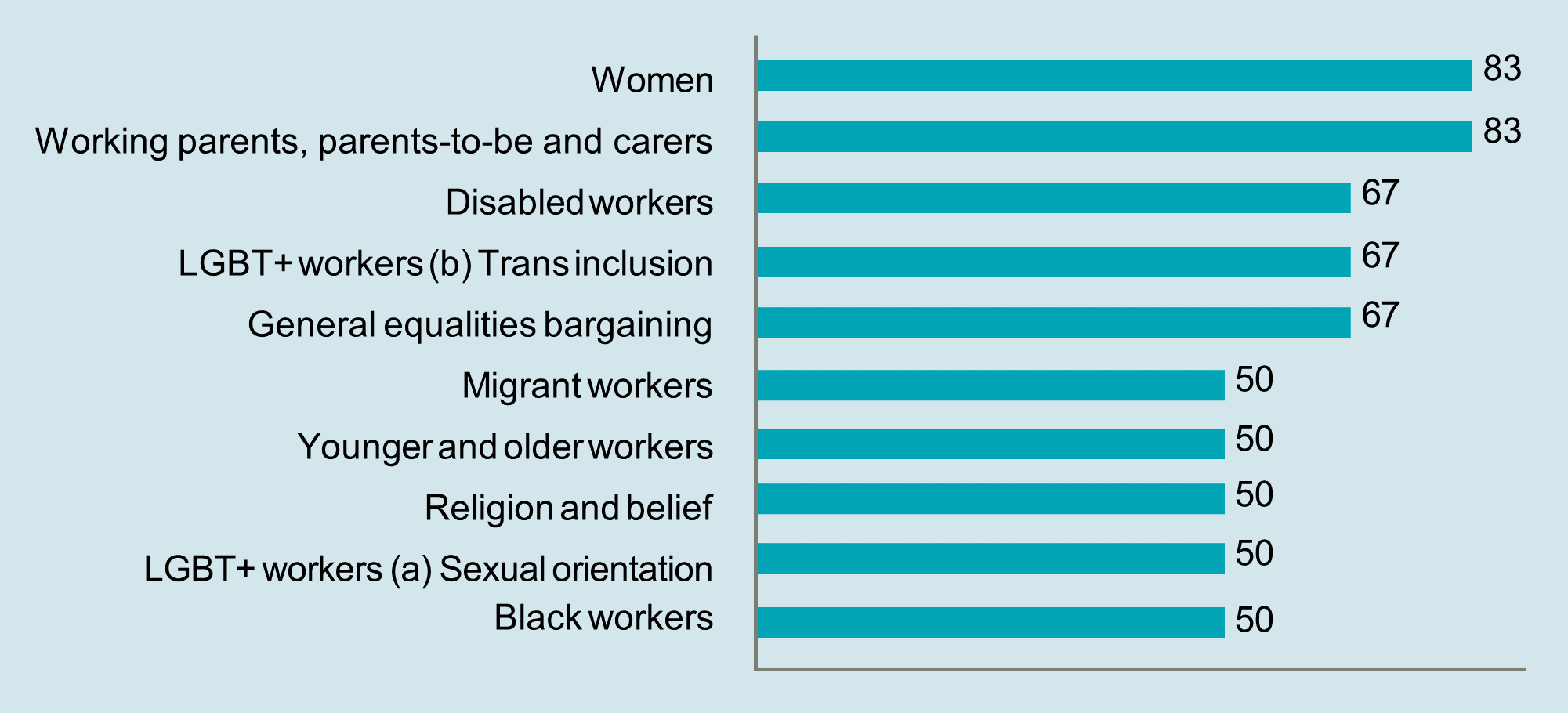
Figure 15: Medium-sized unions achieving equality bargaining gains in the last four years (per cent)
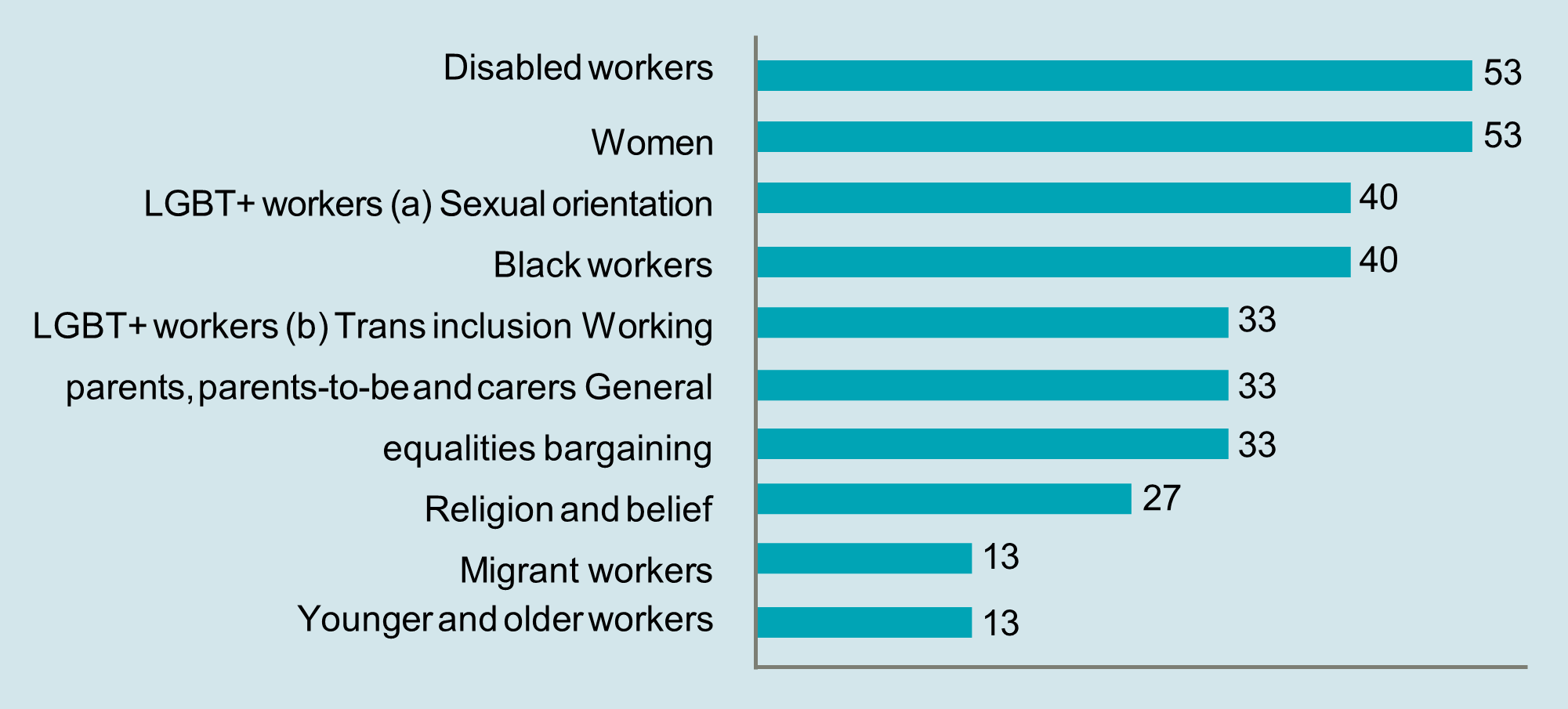
Figure 16: Small unions achieving equality bargaining gains in the last four years (per cent)
Examples of negotiated gains on equality topics
Unions were asked to provide some examples of the most important agreements they had reached with employers on equality bargaining topics.
General equalities
The NHBCSA has negotiated a far-reaching equality policy with its sole employer, the National House Building Council. It goes beyond the requirements of the Equality Act 2010 by stating that its processes will not discriminate on the basis of socio-economic background and fixed-term or part-time status, and pledges to produce and monitor diversity data to ensure fair access to opportunities. It also has networks for people sharing particular characteristics or interests and encourages those not from minority groups to become ‘allies’ and to join learning and training activities to help them understand different people’s experiences.
In an important win for equality reps’ status, Unite reps at National Express succeeded in including union equality reps with the same rights as other reps in their recognition agreement.
Women
As with the results on guidance produced, a big win here is in menopause agreements, where several unions have reached agreements. RMT says it is now a ‘standard ask’ and the union has achieved agreements with Greater Anglia and C2C.
Most policies, such as that agreed by Unite at Turbine Surface Technologies, aim to open up the topic by educating staff and in particular line managers, who are expected to understand the symptoms and respond sympathetically to requests for adjustments to the workplace or to working patterns. At Babcock International Group, a Unite reps’ campaign won the provision of free sanitary products in all toilets.
Usdaw has also successfully negotiated menopause policies with a number of companies, including Ocado, whose agreement includes up to five days’ menopause leave every 12 months. Ocado also encourages affected staff to speak to their line manager or people partner/advisor about options such as reasonable adjustments to their working environment or work pattern. It also points to a range of support services it provides, including a menopause hub.
The NEU’s agreement with Oasis Community Learning also instructs line managers to consider adjustments and to “make allowances for potential additional need for sickness absence.” The policy notably takes account of trans and non-binary staff, who may go through actual or ‘pseudo’ menopause depending on whether they have been through any hormone treatment. It acknowledges that such workers may feel particularly uncomfortable about discussing their symptoms.
Black workers
The Nottingham Community Housing Association, which was the first organisation to sign up to Unite’s Unity Over Division Charter, monitoring their pay gap and has committed to work with unions to reduce the ethnicity pay gap in its workforce.
UNISON has similarly got several employers to sign up to its Anti-Racism Charter, which it sees as a crucial starting point for improving race equality. It has achieved success in four London boroughs and six public service employers in the Northern region.
Usdaw has secured 20 days’ paid release for Black members (18 so far) participating in the union’s education and skills programme for Black members with a range of national employers in retail, warehousing and distribution.
The PFA has reported progress in relation to the third year of its five-year strategy for helping more South Asian football players into the professional game. Based on data up to 31 March 2023 and covering clubs in the Premier League and English Football Leagues for the 2022/23 season, the union reported for example a 12.6 per cent increase in players at all levels of elite football identifying themselves of South Asian heritage, with 134 players in 2022/23 compared to 119 players in 2021/22.
Further gains in this area, set out by unions in response to questions from the TUC’s Anti- Racism Task Force, are set out in Section E.
Disabled workers
Unite reports that North Bristol NHS Trust has developed a toolkit aimed at raising awareness and providing relevant information to promote what it says are positive policies at NBT for neurodiverse staff. In particular it provides guidance for team managers in managing staff with ADHD, autism, dyslexia, dyspraxia, and other forms of neurodiversity.
UNISON notes that more than 150 employers have signed up to its Disability Employment Charter.
LGBT+ workers
Unite shared Unilever’s Transition/Change of gender expression policy, developed in conjunction with the staff Proud network. It proposes that those undergoing transition have regular review meetings with relevant managers to manage the process, agree actions and maintain respect. It says the company will agree flexibility where possible for ad-hoc medical appointments. It agrees to change employee records at a point the employee wishes and will support the employee’s right to use the facilities of their acquired gender and, where appropriate, may develop gender neutral facilities.
RMT has negotiated a confidential means of reporting medication with Eurostar so that LGBT+ workers taking PrEP (medication to prevent HIV) do not have to ‘out’ themselves at work.
Working parents, parents-to-be and carers
A ground-breaking kinship carers’ agreement between Usdaw and Tesco launched in 2023 provides 26 weeks’ leave on full pay for employees who have a Special Guardianship Order to care for relatives’ children. This equalises their rights with employees who adopt. If two eligible partners both work for Tesco, they are entitled to 52 weeks’ leave, which can be shared between them. Primary kinship carers are also entitled to up to five days’ paid leave to attend pre-adoption kinship assessment meetings and court hearings.
In the last four years there have also been a number of agreements reached that go beyond the statutory rights for staff who suffer the death of a child or pregnancy loss. Similar to the menopause, we have seen an increase in campaigning on the issue of pregnancy loss in the media5.
By law those experiencing the loss of a child or a pregnancy from 24 weeks are entitled to two weeks’ statutory bereavement pay and, if they are on maternity leave, to the remainder of that leave. The NEU has reached agreement with Oasis Community Learning that goes beyond this by providing anyone who loses a child under the age of 18 with 10 days’ leave on full pay and a further 15 days’ unpaid.
Employees suffering miscarriage before 24 weeks have little in the way of rights. However, Usdaw has reached agreement with Tesco that staff suffering miscarriage before 24 weeks are entitled to two weeks’ leave at full pay.
And, thanks to campaigning by the FDA and others, there is now civil service-wide agreement that staff suffering miscarriage are formally entitled to support from Employee Assistance Programmes, civil service special leave provisions, flexible working hours and arrangements for supporting partners.
Separately, the CWU and Santander have agreed additional entitlements for parents of babies born prematurely (before 37 weeks). Women employees in that situation will be entitled to an additional amount of leave equal to the difference between the number of weeks’ gestation and 40 weeks. The aim is to ‘give back’ maternity leave that would otherwise have effectively been lost so it can be taken after the birth.
The agreement also provides for a period of compassionate leave (normally up to two weeks’ paid leave) for employees whose partner has had a premature birth and whose baby requires a period of hospitalisation.
More information on how collective bargaining has improved the rights of working parents, parents-to-be and carers are set out in Appendix B to this report.
The TUC Anti-Racism Task Force was established by the TUC General Council in 2020 and ran for a two-year cycle. The aim of the Task Force was to run a rapid review on the progress affiliates had made on racial equality and justice since the last race task group, the Stephen Lawrence Task Group which was launched in 2000.
The Task Force is now in its implementation and oversight phase. This is to ensure that the commitments and recommendations of the Task Force are actioned, and we progress these commitments for the next five years. As part of the monitoring of this work specific questions were included in the Audit on unions collective bargaining priorities for race, how they were established and taken forward and what success has been achieved.
33 unions responded to the question on what their collective bargaining priorities were for their Black members. The most commonly mentioned was pay, including career progression, monitoring and closing pay gaps and fighting low pay. Another key area was fair recruitment into the workforce – as the CWU put it: “The agreement and implementation of fair and equal recruitment policies that support BAME workers and reach out to BAME communities.” Other issues mentioned by several unions were combating casualisation, under-representation at senior levels, bullying and harassment, and discrimination in processes including performance appraisals and disciplinaries.
32 unions responded to how these priorities were established. There was a range of different ways that unions gathered this information and most unions had a number of ways they did this, so it is hard to draw conclusions. However, the three most frequently mentioned were via Black members networks or committees or broader equality committees (these were more common for smaller unions), union conferences, and from gathering information directly from members including surveys and case work. Four unions said they analysed employer and union data to inform their priorities for example the RCM said they used “analysis of NHS Workforce Race Equality Data” and three unions said they used the TUC work on race to inform their priorities for example BFAWU said “through our affiliation with the TUC and the executive adopting the trade union anti- racism manifesto."
33 unions responded to the question on what their collective bargaining priorities were for their black members. The most commonly mentioned was pay, including career progression, monitoring and closing pay gaps and fighting low pay.
23 unions provided information on how collective bargaining priorities were taken forward with employers once established. Again, there were different ways unions did this, examples are below.
Many public sector unions said they took priorities forward through employer bodies they sat on for example CSP, RCP, SoR and BDA mentioned the NHS Staff Council Equality, Diversity and Inclusion Group and ASLEF the Rail Delivery Group Diversity and Inclusion Board. NASUWT and NAHT also mentioned they highlight issues in their annual submissions to the School Teacher’ Review Body.
Other unions mentioned developing new guidance, training or rep roles to support bargaining, for example NUJ said they had “partnered with tech firm to deliver training for the purpose of upskilling and professional development specifically aimed at underrepresented groups and challenged racism in the workplace.” CSP shared that “all workplace representatives have been trained on a course ‘recognising discrimination in the workplace’ which took a deep dive in equality law, discrimination and the impact on members with protected characteristics” and they had “implemented its first ever equality reps” and now have “60 in workplaces across England, Scotland and Wales.” TSSA shared they had developed “bargaining standards with Investing in ethnicity that will be applied to employers.”
Napo and POA both mentioned they had developed action plans with certain employers.
UCU, shared that along with other HE unions, they had “embedded the demands to tackle equality pay gaps and casualisation within our national HE pay dispute.” And Unite said as part of negotiations they put pressure on employers “to carry out race equality audits particularly around on grievance, disciplinaries, recruitment, selection and promotion” and are “pursuing employers that jump on the bandwagon of equality but do not act accordingly. There are a number of corporate companies exploiting equality campaigns for profit.”
Finally, 18 unions provided examples on bargaining successes they had of specific benefit to Black workers.
The TSSA, for example, won agreement with both Network Rail and TfL to release internal data on ethnicity. It has also negotiated with Network Rail to establish a race matters initiative with TSSA involvement, which the union says has allowed some Black members to “advance through the glass ceiling.”
Unite forced Mitie at Heathrow airport to reintroduce scrapped training and language support for cleaners who do not have English as a first language but who need to pass certain courses to move beyond the lowest paid roles.
In professional-specific areas, Equity negotiated the provision of hair and make- up support for Black artists, and the PFA achieved specific programmes to support developing Black players.
A number of unions, including Unite, EIS and ASLEF, pointed to their success in getting employers to provide specific risk assessments for Black workers during the Covid pandemic.
Some unions’ successes came as a result of efforts to improve pay, terms and conditions that inherently particularly benefited Black workers.
RMT, for example, highlighted its campaigning, including in some cases strike action, to win improved pay and conditions and insourcing of low-paid outsourced cleaning workers, among whom women, Black and migrant workers were disproportionately
represented. These efforts resulted in pay rises for outsourced cleaners at Churchill on the Eurostar contract and the Govia Thameslink Railways stations and trains contracts. It also won travelcards for sub-contracted cleaners working at Transport for London for travel on TfL’s network, which the employer estimates covers 5,800 people.
Similarly, Unite won agreement with Barts NHS Trust to bring back in-house the mainly Black cleaners, porters, security guards, and domestic staff who were previously outsourced and employed by Serco. The agreement, which also followed strike action against inequality and pay disparity between Serco staff, meant they were immediately transferred on to the superior Agenda for Change terms and conditions.
Other responses included successes that unions achieved in ways other than directly through collective bargaining. For example, the NUJ worked to retain roles occupied by Black workers in redundancy situations, while Unite used equality impact assessments to expose the disproportionate impact of job losses on Black members to bring about changes from certain employers.
The NASUWT and NEU pointed to their successful campaign to eliminate the performance-related pay system in schools, which had been shown to inherently discriminate. This resulted in the Department for Education (DfE) agreeing to abolish it, and it has also been scrapped in a number of multi-academy trusts.
Introduction
To supplement the information received from national unions as part of the 2024 TUC Equality Audit, the Labour Research Department carried out a survey of trade union workplace reps to investigate their experience of dealing with equality issues at work. This followed similar surveys carried out in 2016 and 2021.6
The latest survey ran for three months – between 14 November 2023 and 15 February 2024, with participants asked about their experiences over the past couple of years.
A total of 1,607 responses were received from reps, all of whom had held a post in their workplace union at some point during the years covered. They came from 36 different TUC affiliate unions (plus four UK-based non-TUC unions). 70 per cent worked in the public sector, 22 per cent in the private sector and four per cent in the voluntary or third sector.
Equality issues in the workplace
The reps were asked if, in the last couple of years, they had dealt with any equality/ inequality issues related to a range of strands (Table 9). More than three quarters (76 per cent) of them had dealt with one or more of these broad areas. This is higher than in 20182020, when just under two-thirds said they had dealt with such issues.
The results show that the most common equality/inequality area faced by workplace reps in the more recent period was issues related to disability, with 56 per cent of them citing this.
The area next most likely to require reps’ attention was issues related to the protected characteristic of sex, cited by 31 per cent of respondents, followed by race, at 30 per cent. Reps are much more likely to have dealt with issues related to older workers (28 per cent citing this) than to younger workers (12 per cent).
- 6The 2021 survey covered two separate periods – before the Covid-19 pandemic (2018-20) and during the pandemic (2020-21)
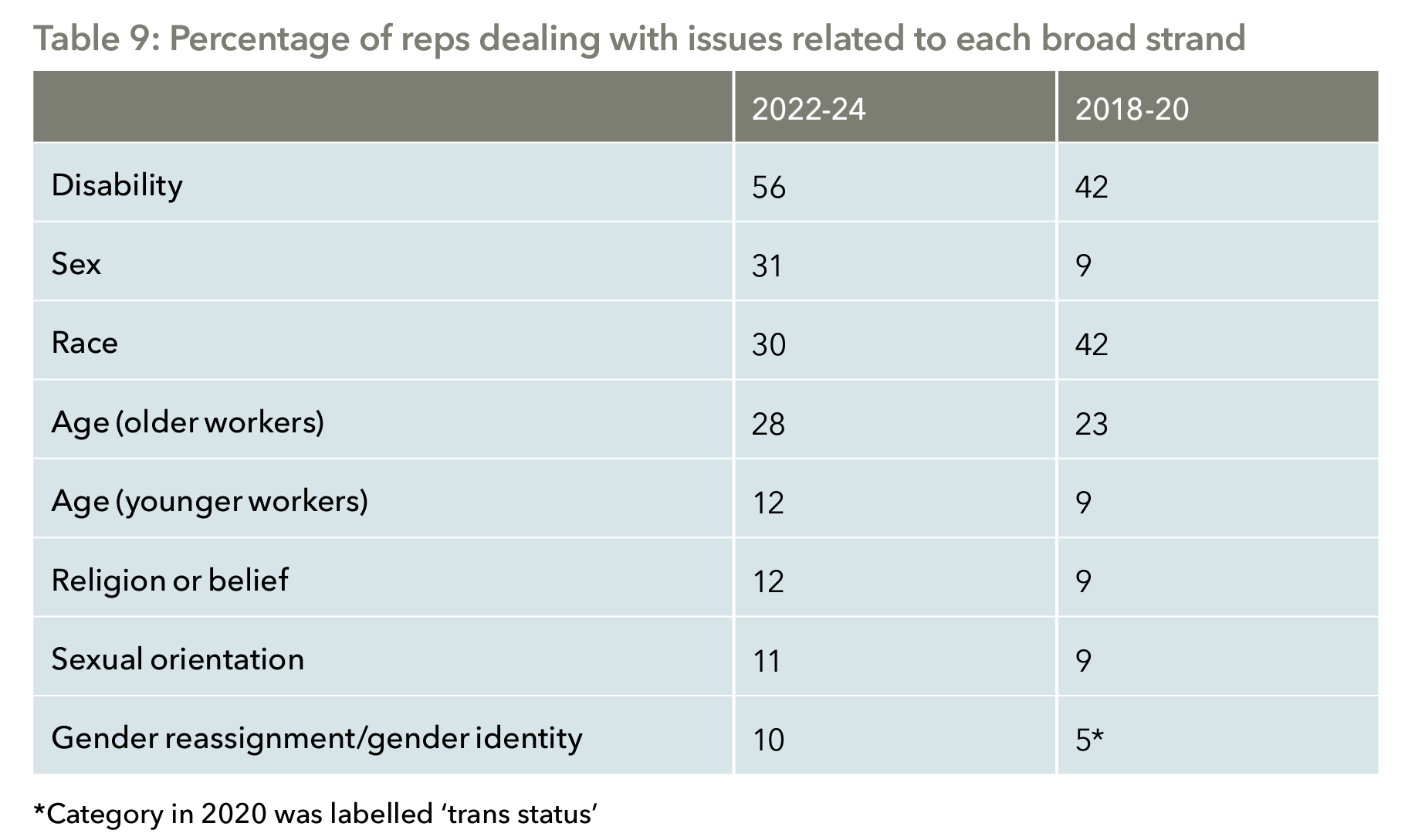
When these responses are compared with those of the ‘pre-Covid period’ (2018-20), there have been major changes in the relative prominence of issues over the past four years. While disability was already the most common area in the last survey, it has soared even higher as an area that reps have dealt with. The 2018-20 survey had already seen a doubling of the proportion of respondents dealing with disability-related issues compared with 2016, and now more than half of survey participants say they have dealt with this.
There is also a three-and-a-half-fold increase in the proportion of reps saying they had dealt with issues related to workers’ sex, from just nine per cent in 2020 to 31 per cent in 2024.
On the other hand, the proportion dealing with race-related issues fell from a high of 42 per cent in 2018-20 to 30 per cent four years later. However, reps responding to questions about the period 2018-20 – that is before the murder of George Floyd and the increased prominence of the Black Lives Matter movement – were submitting their responses in 2021, so it is possible that their recollections were somewhat distorted by what were then recent events.
Slightly higher proportions of respondents had dealt with issues relating to younger workers, religion or belief, sexual orientation and gender reassignment/gender identity than had four years earlier.
Specific equality topics reps have dealt with
The survey drilled down further into the specific equality/inequality topics reps had dealt with in the last couple of years. Nine in 10 (90 per cent) reps had dealt with one or more of the specific areas listed compared to 86 per cent in 2018-20. Table 10 shows the percentage of respondents who said they had dealt with each of the specific issues presented.
The most commonly addressed of these specific issues were flexible working/work-life balance, reasonable adjustments and sickness absence and disability. These would seem to echo findings above that issues relating to disability were by far the most widespread broad areas that reps had dealt with.
After those the next most common issue cited by a majority of reps was ‘bullying and/or harassment other than sexual harassment’.
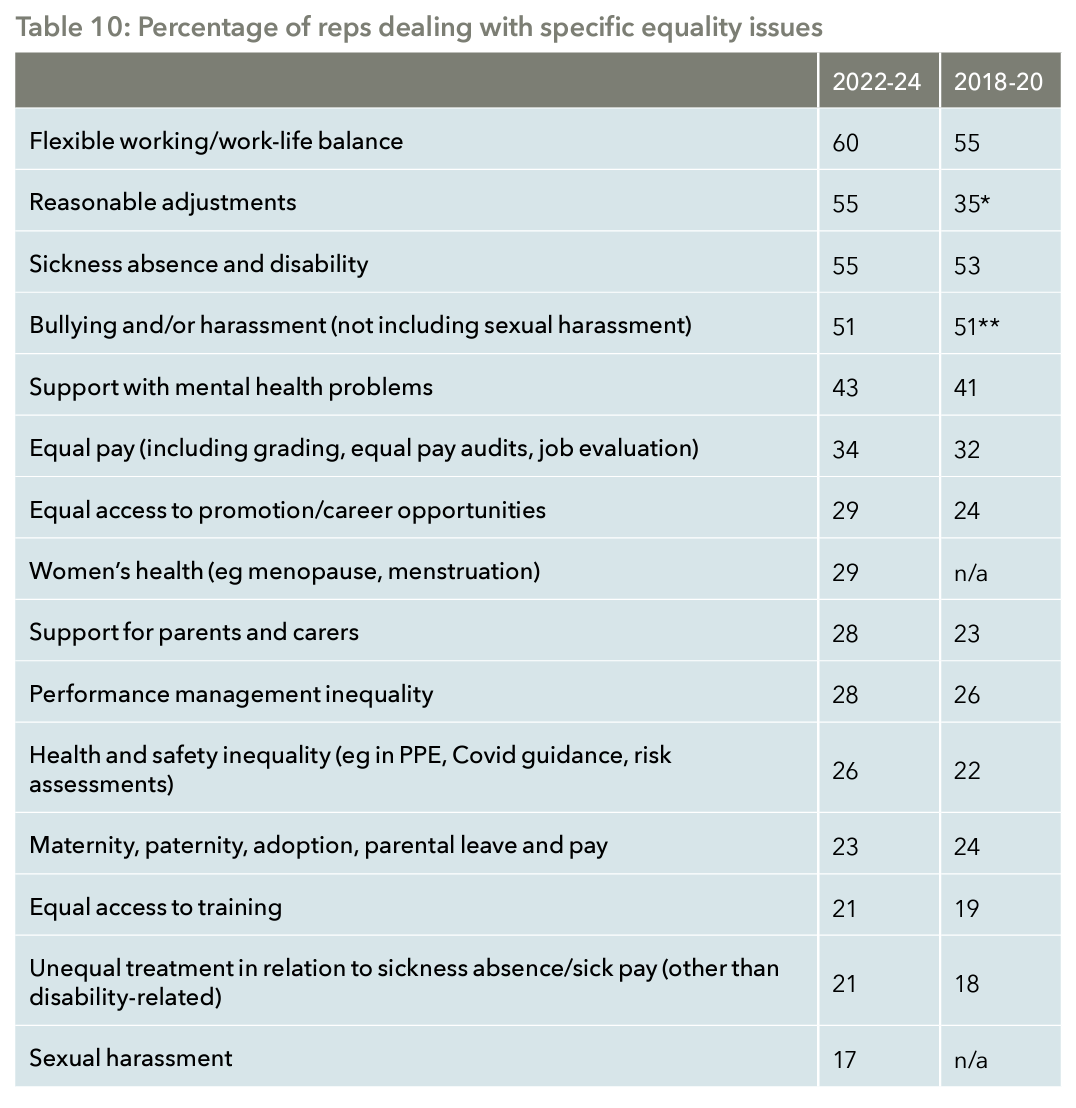
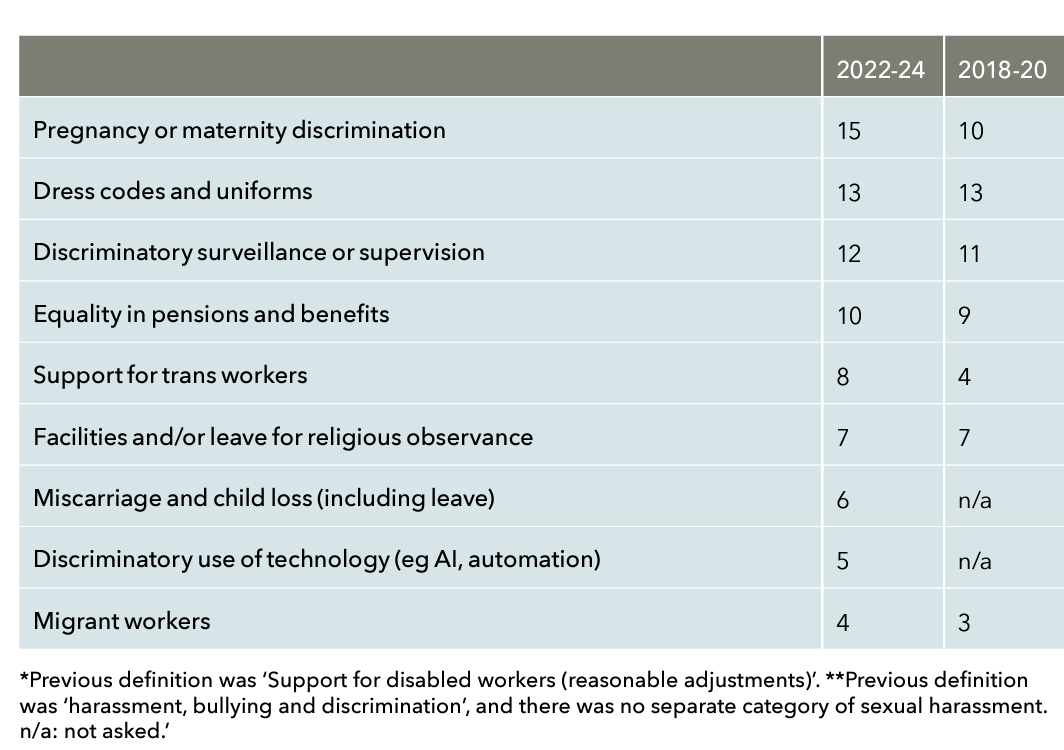
The table also gives an indication of how the prevalence of these topics compares with the immediate period before the Covid-19 pandemic of 2018-20.
There are virtually no areas where the call on reps has gone down. For nearly all topics, an equal or higher proportion of reps in the current survey said they had dealt with them compared with four years ago.
The most common issue addressed by reps – flexible working/work-life balance – was also the most common topic four years ago. It is a more widespread an issue now, with 60 per cent of reps saying they had dealt with it compared with 55 per cent in 2018-20.
The need to support people who require reasonable adjustments has become even more common, the proportion of reps dealing with this jumping from 35 per cent fours ago to 55 per cent now. The proportion dealing with sickness absence and disability issues is also higher.
Although the figures on bullying and harassment don’t seem to have changed (cited by 51 per cent in both surveys), it should be noted that the definition has changed. In the latest survey it now excludes sexual harassment. This is now a separate category which has been dealt with by one in six (17 per cent) reps in the last couple of years.
Other topics that have become noticeably more widespread since 2018-20 include equal access to promotion/career opportunities (29 per cent of reps now dealing with this compared with 24 per cent four years ago), support for parents and carers (28 per cent compared with 23 per cent) and pregnancy or maternity discrimination (15 per cent up from 10 per cent).
How topics arose as issues to be dealt with
Reps were also asked about the routes through which the issues had arisen. Figure 17 shows the proportions indicating each route, and also displays the equivalent results from 2018-20.
The most common route, mentioned by two thirds (67 per cent) of all reps who had dealt with equality issues, is through cases from individual members. This was also the most common way for issues to arise in 2018-20, but the proportion indicating this has increased from just over half of reps (51 per cent) in the earlier survey.7 This suggests a higher proportion of workplace reps have been dealing with individual cases of inequality/ discrimination.
Proportions citing the other routes have not changed substantially compared with four years ago.
- 7Note, however, that the wording in the earlier survey was narrower, presented as member ‘grievances’, rather than ‘cases’.
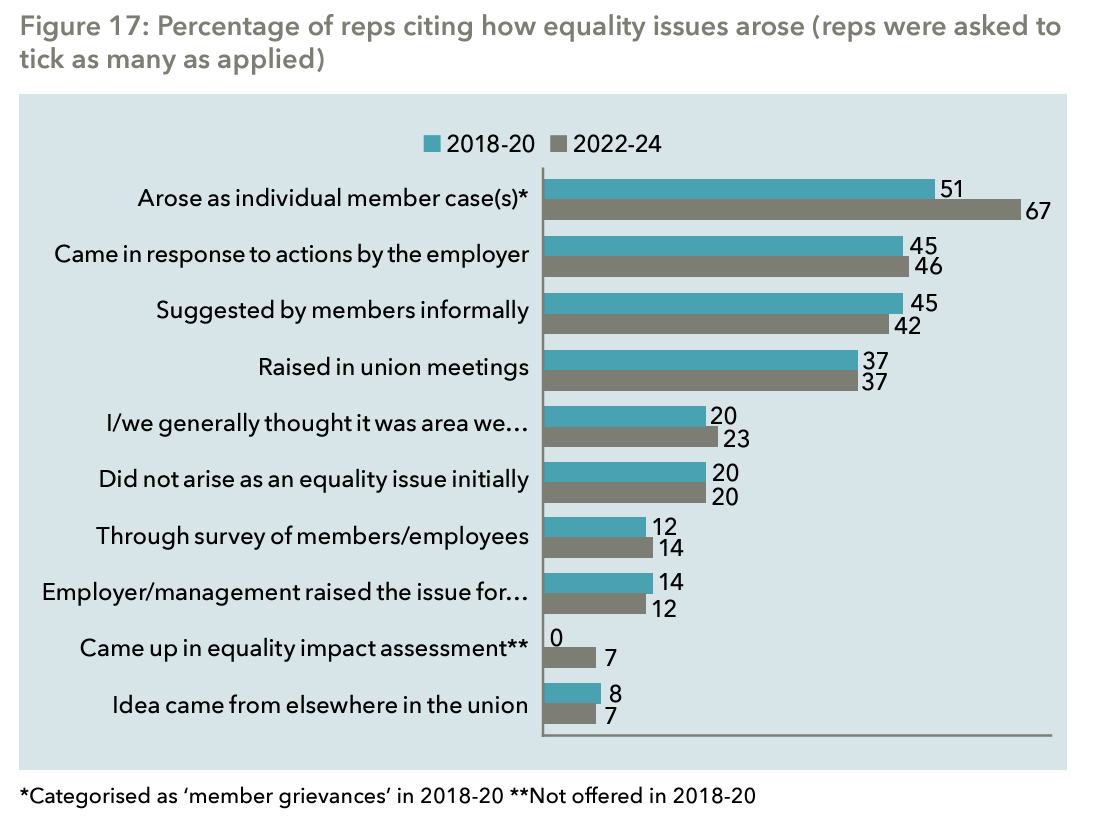
Guidance and information on equality/inequality topics
The survey sought to examine whether reps felt they had sufficient guidance and information on the equality topics they had faced at the workplace. More than two in three respondents (69 per cent) cited topics on which they had found a shortage of guidance or information available. Table 11 shows the proportion of reps who said they had found a shortage of guidance or information to help them for each specific topic.
The topics where guidance seemed to be in shortest supply were flexible working/worklife balance (25 per cent of all reps citing this), disability (24 per cent) and the related issue of reasonable adjustments (24 per cent).
Flexible working also came top of this list in the 2021 survey carried out during the Covid-19 pandemic. At that time, 21 per cent of reps said there was a shortage of guidance on flexible working/work-life balance. It is notable that an even higher proportion in the latest survey said there was a shortage of guidance, suggesting the post-pandemic landscape might have thrown up a need for even more help in negotiating such working arrangements.
Around one in five reps cited a shortage of guidance when tackling issues around each of the following topics: older workers; bullying and harassment (excluding sexual harassment); sickness absence and disability; support with mental health problems; women’s health; equal pay; and equal access to promotion/career opportunities.
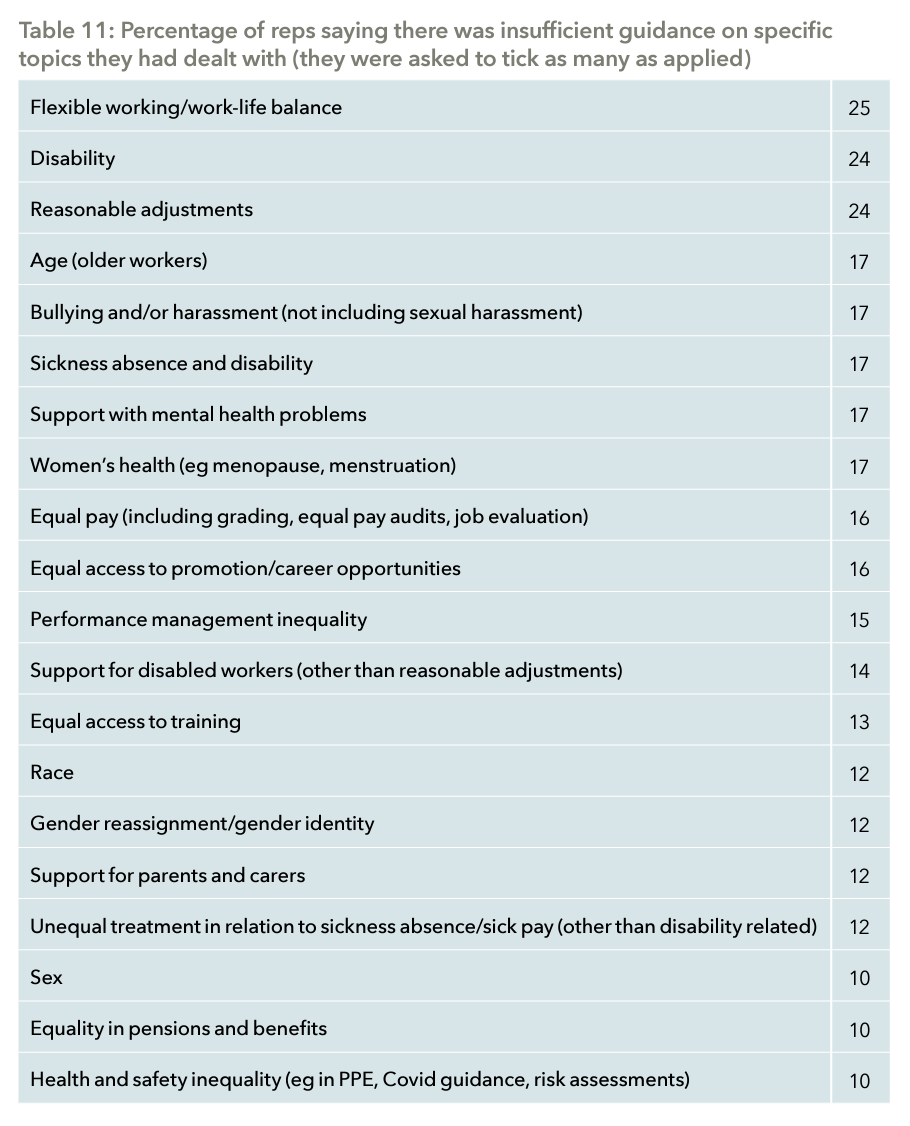
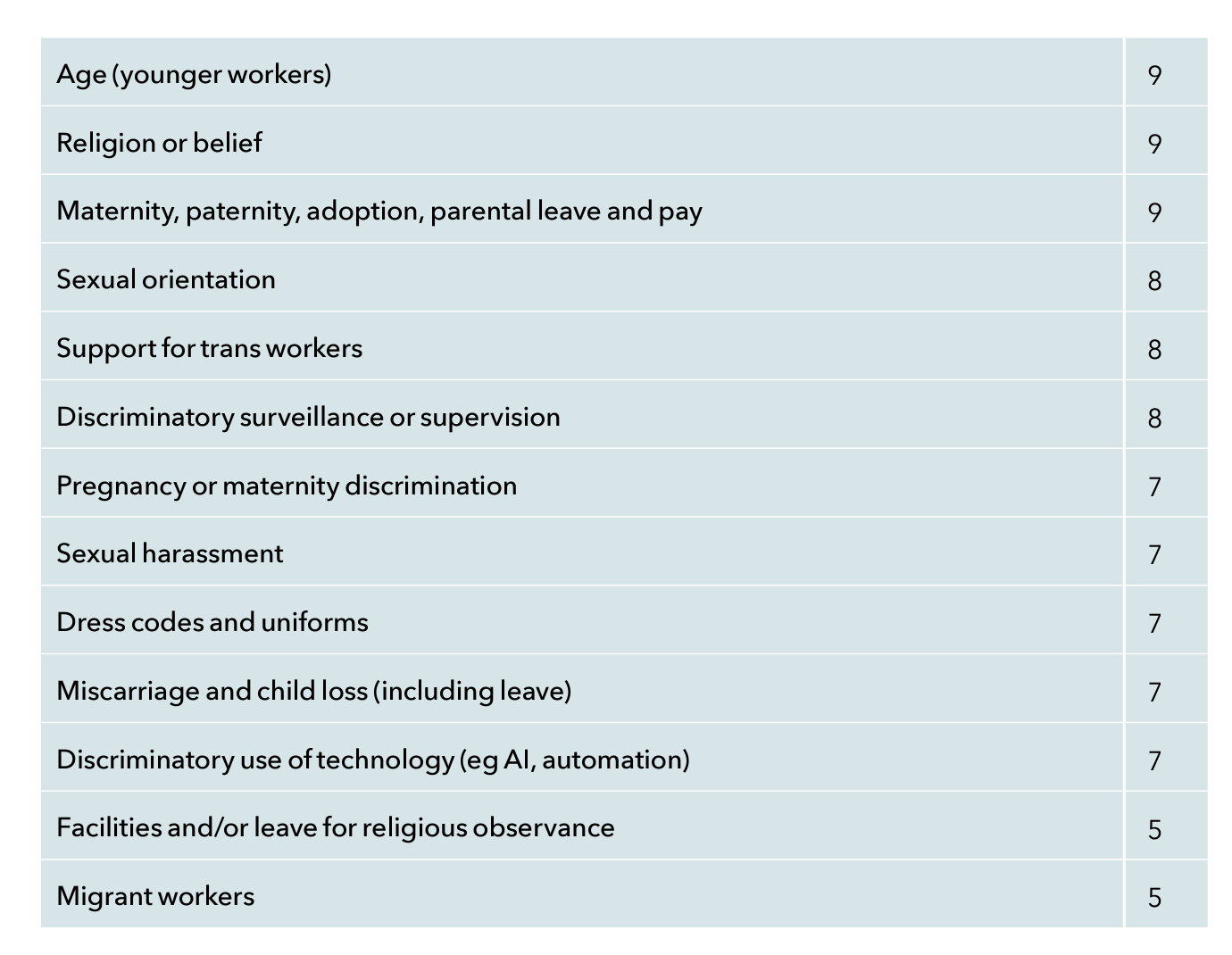
Trade union training
A majority of reps – seven in 10 survey respondents (70 per cent) – had taken part in some form of trade union training or learning on workplace equality issues in the last couple of years.
The most common type was union-run or TUC-run talks, workshops or webinars, attended by more than half (55 per cent) of respondents who had received any training or learning on equality issues (and 31 per cent of all reps in the survey).
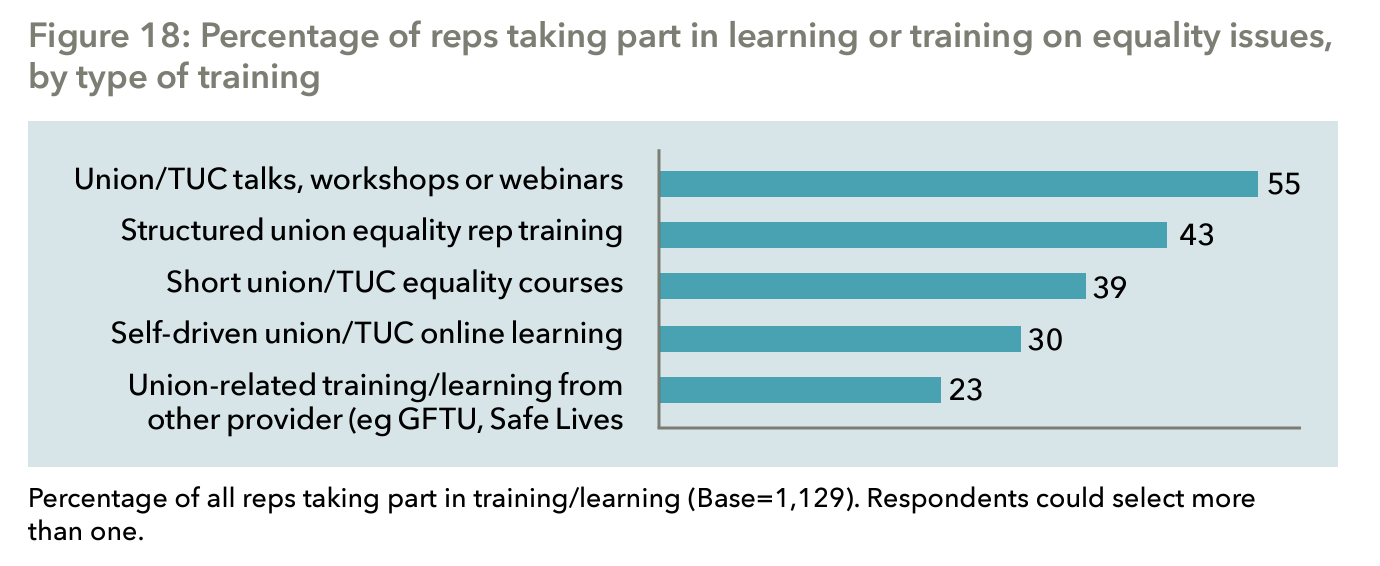
The most common topics for training or learning, apart from general equalities, were health and safety and equality, cited by 46 per cent of the reps who had undergone training or learning, and disability (not including reasonable adjustments), cited by 45 per cent.
Four years ago, the most common topic other than general equalities was ‘harassment and bullying’, though this had been a wider category, including sexual harassment.
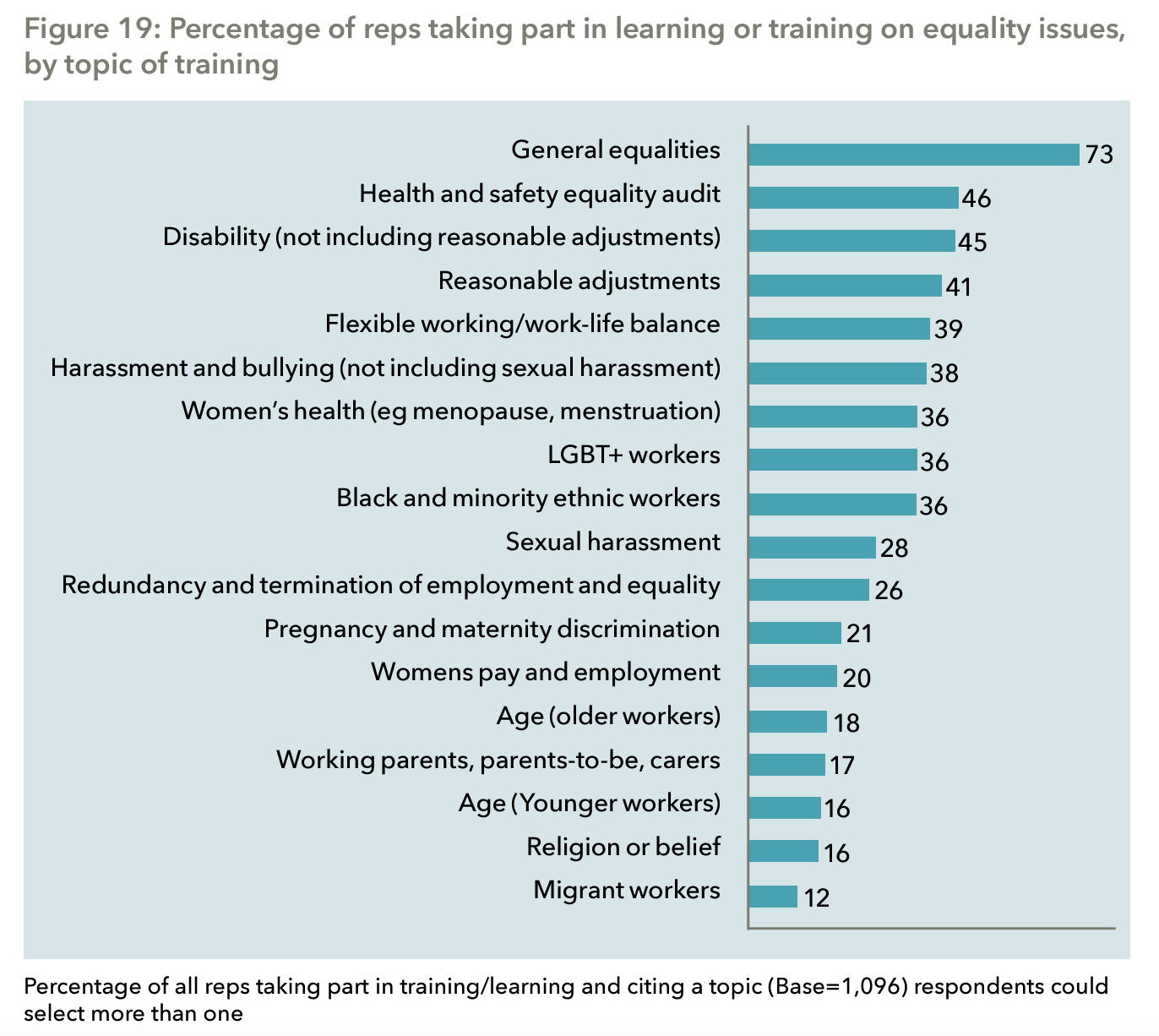
Equality reps and facility time
A new set of questions was introduced in the 2024 survey asking reps about their employers’ equality practices.
First, they were asked about the existence of and arrangements for union equality reps. Just over half of the survey respondents (52 per cent) said their union had equality reps in place at their workplace.37 per cent of respondents said they did not, while 10 per cent did not know.
Those saying there were equality reps in place included 54 per cent of respondents from the public sector and 47 per cent of those from the private sector.
Just under half (47 per cent) said their employer provided facility time for equality reps, 28 per cent saying they did not and 24 per cent saying they did not know. Again, this was more likely among reps in the public sector (51 per cent saying their employer provided facility time) than those in the private sector (38 per cent).
The availability of both the provision of facility time and equality reps’ presence in the workplace varies by industry (Figure 20).
Central government workplaces were the most likely to provide facility time for equality reps (71 per cent), but it was energy and water where equality reps were most likely to actually be present, with 70 per cent of reps in that industry saying their union had them in place.
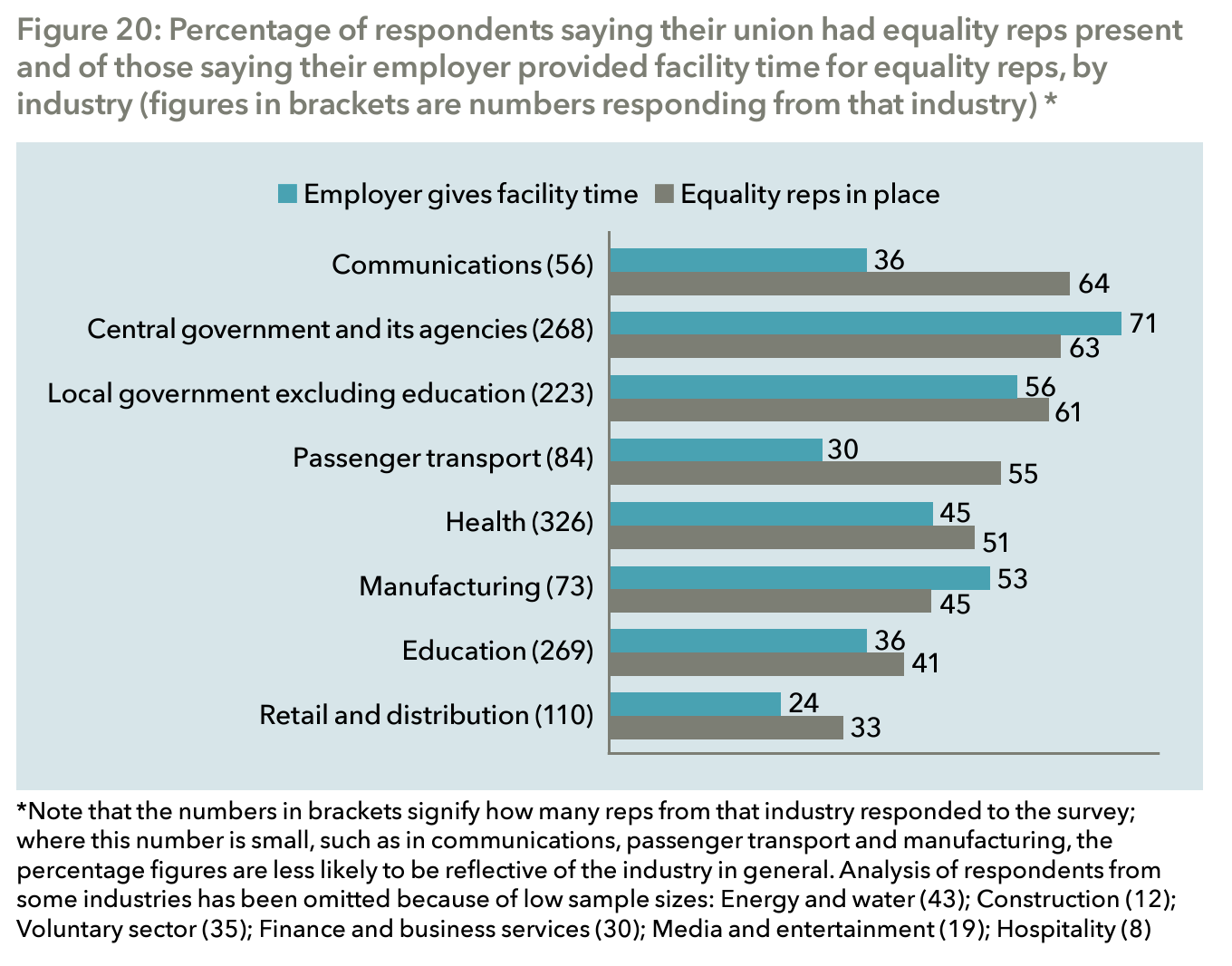
The presence of equality reps, not surprisingly, varies by the size of the workplace, with 64 per cent of respondents from workplaces with 1,000 or more employees saying their union had equality reps in place. However, this pattern is not entirely matched by the likelihood that the employer gives them facility time: workplaces with 1,000 or more workers are less likely than those with 500-999 to provide facility time for equality reps (Figure 21).
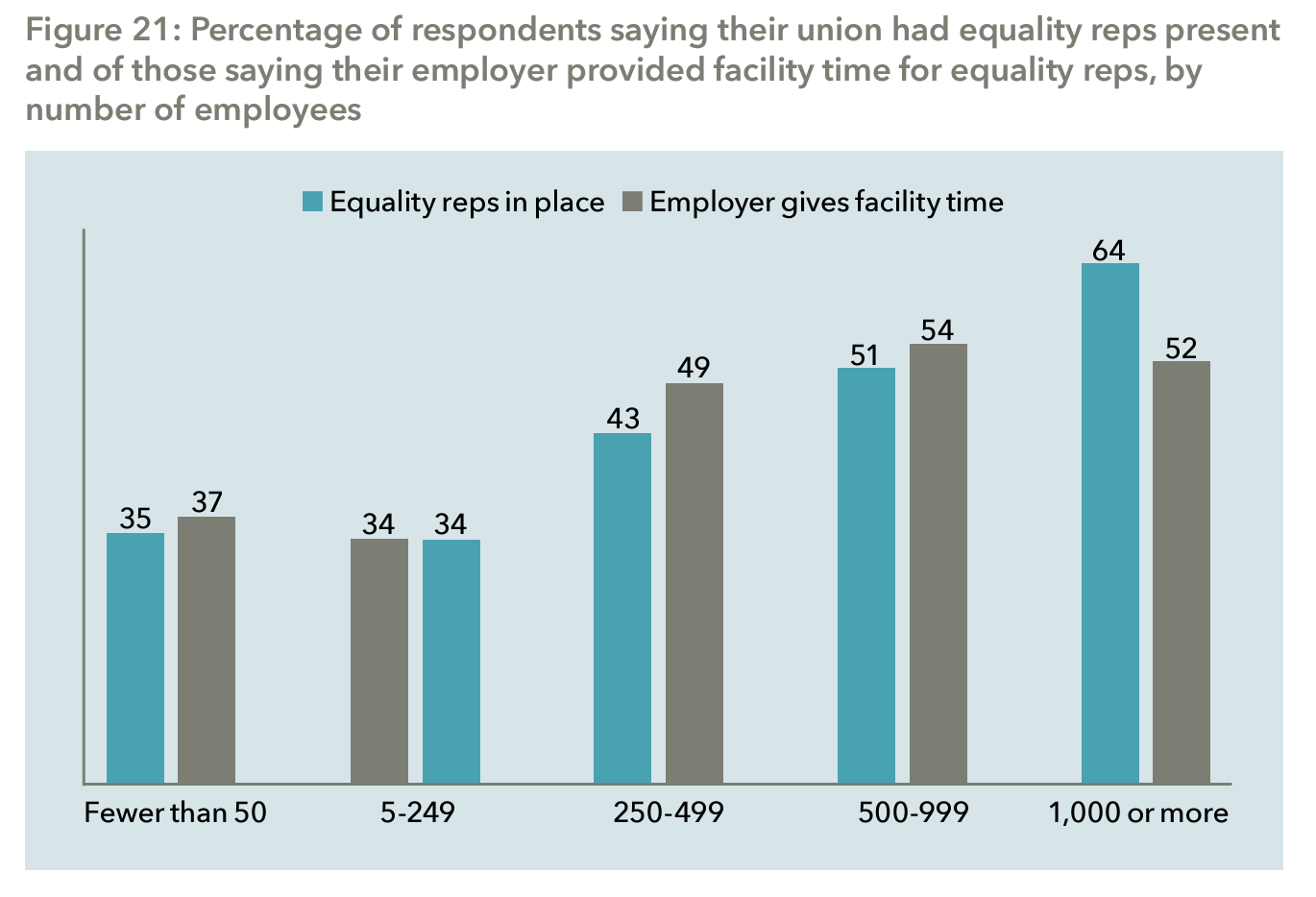
Perhaps less predictable is that both the likely presence of equality reps and the provision of facility time vary considerably by region/nation (Figure 22).
The reps most likely to say yes to both those questions are those whose workplace is sited in more than one region/nation, which would perhaps tend to indicate larger organisations.
In terms of single regions/nations, reps in Cymru/Wales are most likely to say their union has equality reps present (63 per cent saying they were). At the other end, reps in the East Midlands (38 per cent) were least likely to report having equality reps. Those in the South East are the most likely to say their employer gives equality reps facility time (55 per cent) and those in the East Midlands the least likely to (29 per cent).
These variations are likely linked to different concentration of certain sectors and industries in the different regions and nations.
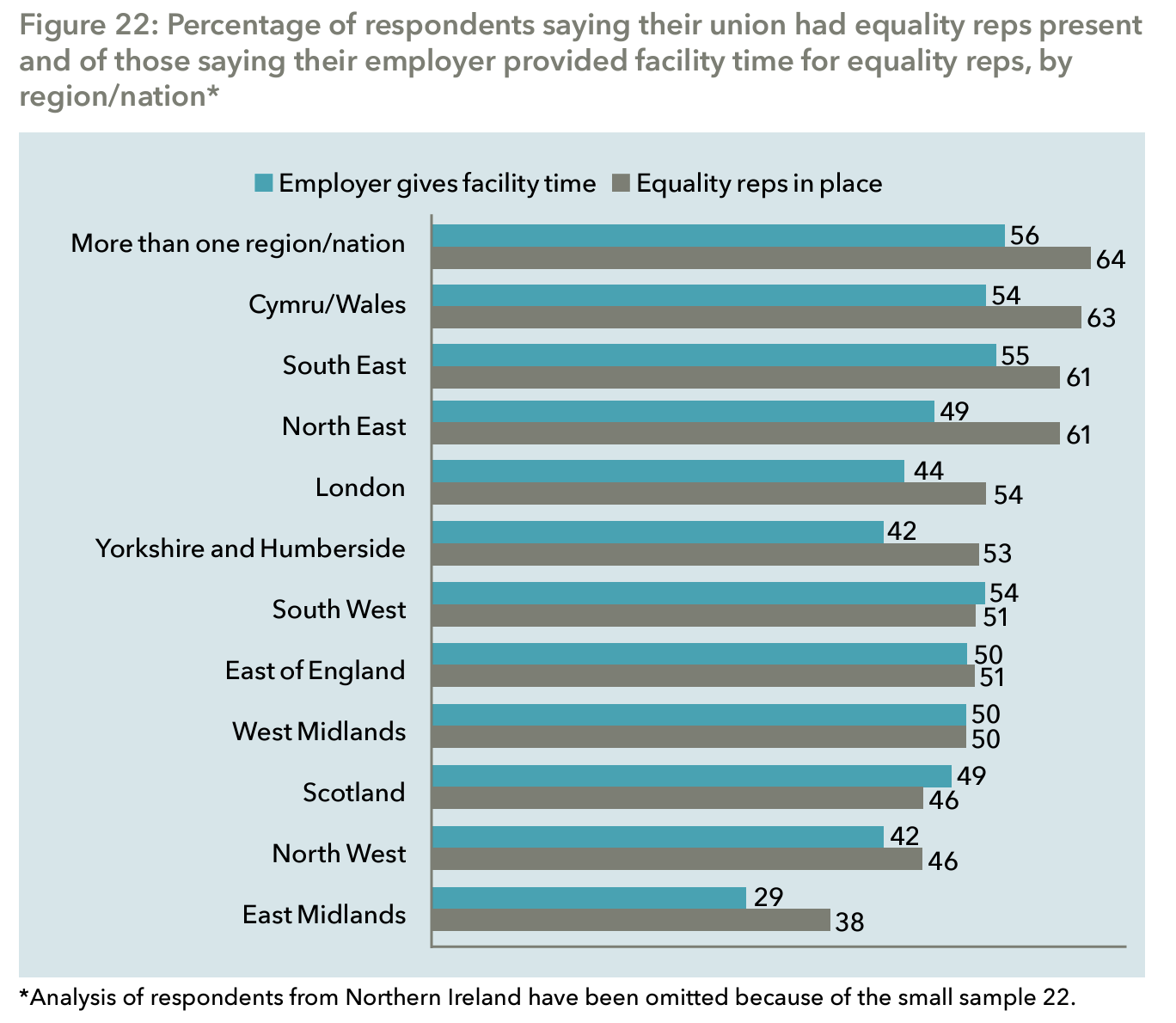
Employers’ equality practices
Union reps were asked if their employer carries out a number of practices aimed at identifying or tackling inequalities in their organisations.
They were asked if the employer conducts equality impact assessments on workplace decisions. Just 11 per cent said they always did, and 41 per cent said sometimes. One in six (17 per cent) said they never did, while the other 31 per cent did not know.
Those in the public sector were more likely to say their employer always or sometimes conducted equality impact assessments than those in the private sector, though still only 13 per cent said they always did (Table 12). Public sector employers will have to meet the Public Sector Equality Duty, which is one of the reasons we may see higher percentages of public sector reps stating their employer carry out impact assessments.
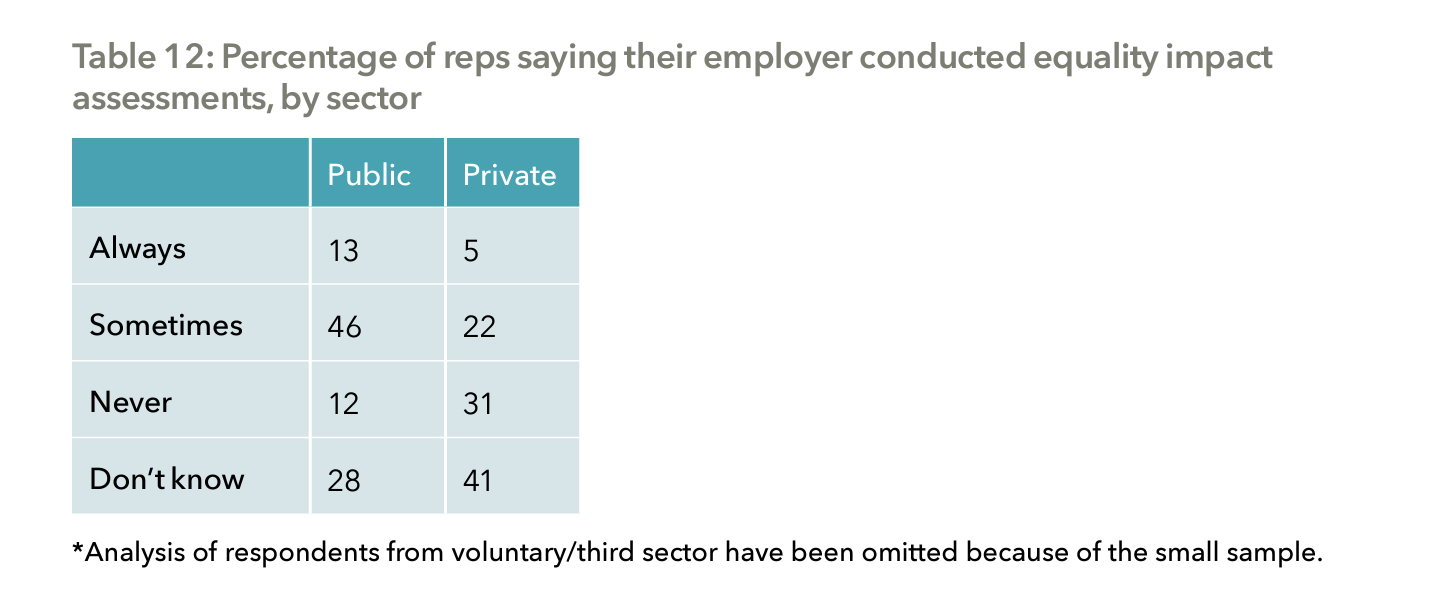
The survey also asked about employers investigating and taking action on equality pay gaps. Overall, 42 per cent of respondents said their employer collected pay gap data on gender, 27 per cent did so on ethnicity, 23 per cent did on disability and 18 per cent did on LGBT+.
Of those reps in organisations with fewer than 250 employers, 23 per cent collected gender pay gap data. Of those reps whose employer did collect the data, fewer than a third (31 per cent) said the employer had an action plan on how to tackle their pay gaps. 45 per cent did not know. Where they did have an action plan, just under three quarters (72 per cent) said the employer published their progress on their action plan.
Employers in the public sector were more likely than those in the private sector to collect data for all types of pay gaps, according to reps’ responses. But of those who said their employer collected the data, those in the private sector were more likely to say there was an action plan to tackle the issue (Table 13).
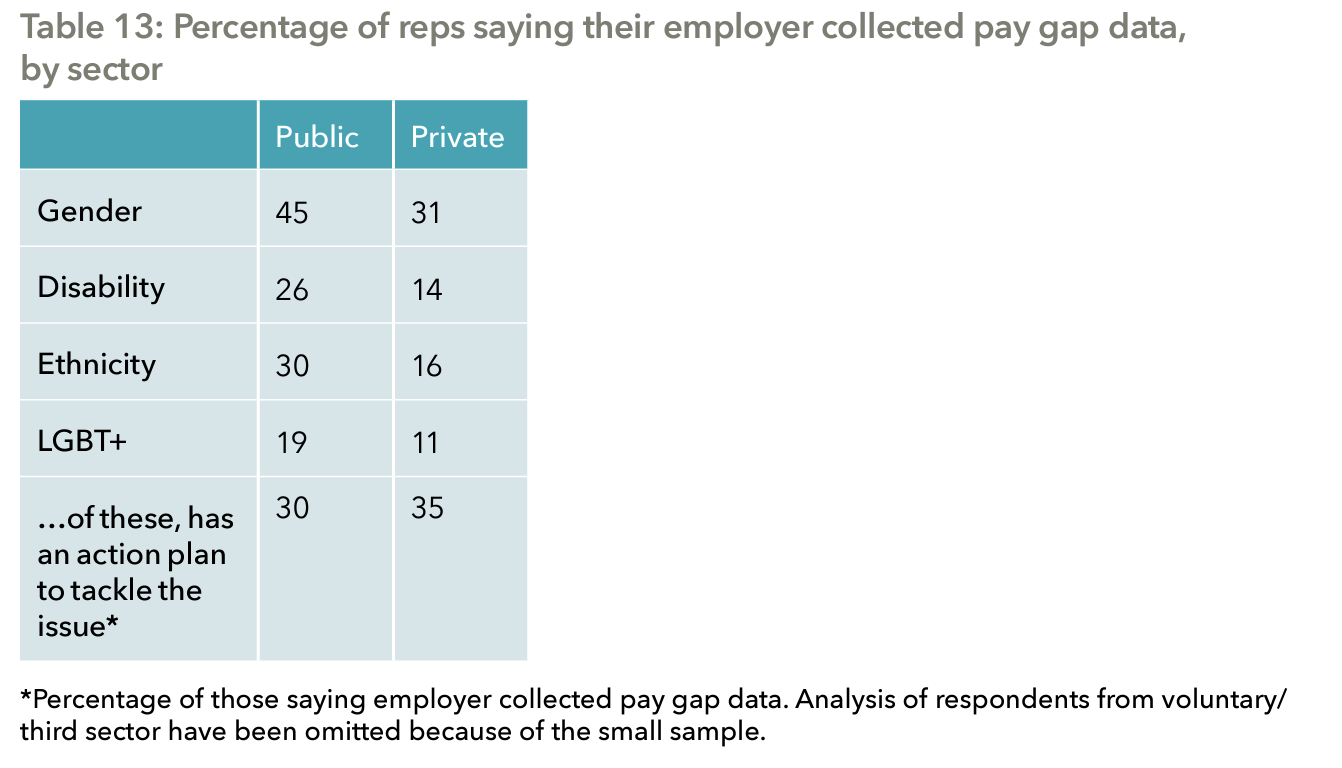
Reps were asked whether their employer collected data to monitor a range of workplace practices and procedures to ensure they operate on an equal basis and are not discriminatory. Table 14 shows how many said their employer did or did not, with only minorities of reps answering positively in each case. It is also worth noting that a large proportion of reps did not know whether their employer collected any of this data, suggesting such issues may not always be discussed with union reps or seen as information that is available for collective bargaining.
The area where employers are most likely to collect equality data is recruitment, with 47 per cent of reps saying their employer did so and only 8 per cent saying they did not.
The area where equality data is least likely to be collected is contract types – to monitor whether insecure contracts are disproportionately held by people from certain equality groups. Only 14 per cent of reps said their employer did this, despite this being an egregious form of employment inequality.
Fewer than one in four employers are known to collect equality data in the areas of performance management (just 22 per cent of reps saying they do so), progression (22 per cent) and flexible working (23 per cent).
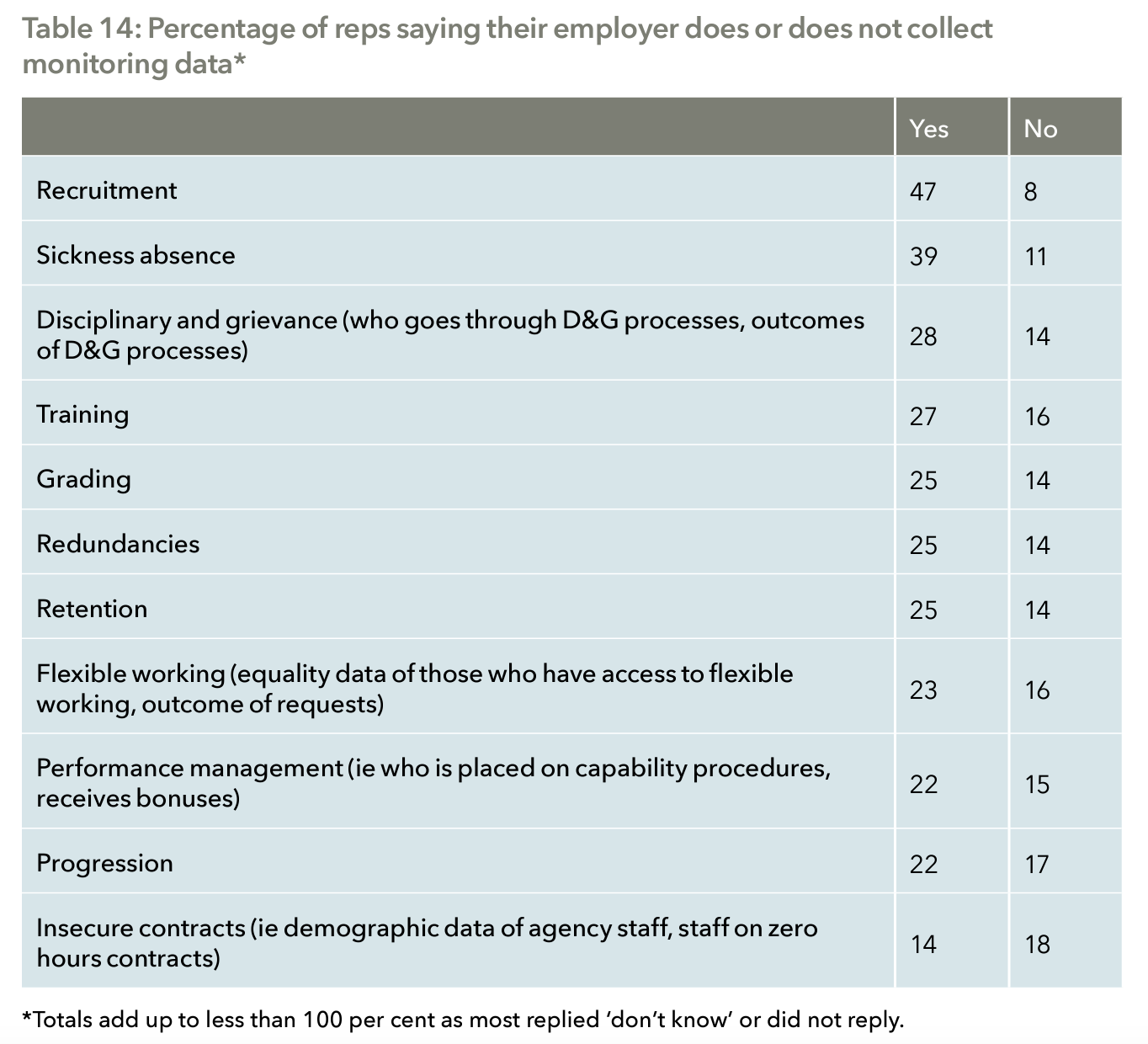
The survey investigated the extent to which the reps’ employers had certain policies and procedures in place to foster equality and reduce inequality in the workplace. The polices listed are those which attempt to address some current widespread concerns among unions, their members and workers (Table 15).
It shows that, while two in three reps (67 per cent) say their employer has clear reporting routes for bullying and harassment, only four in 10 (40 per cent) say they have stand-alone sexual harassment policies. In most of the areas listed, fewer than half of reps said their employers had policies in place.
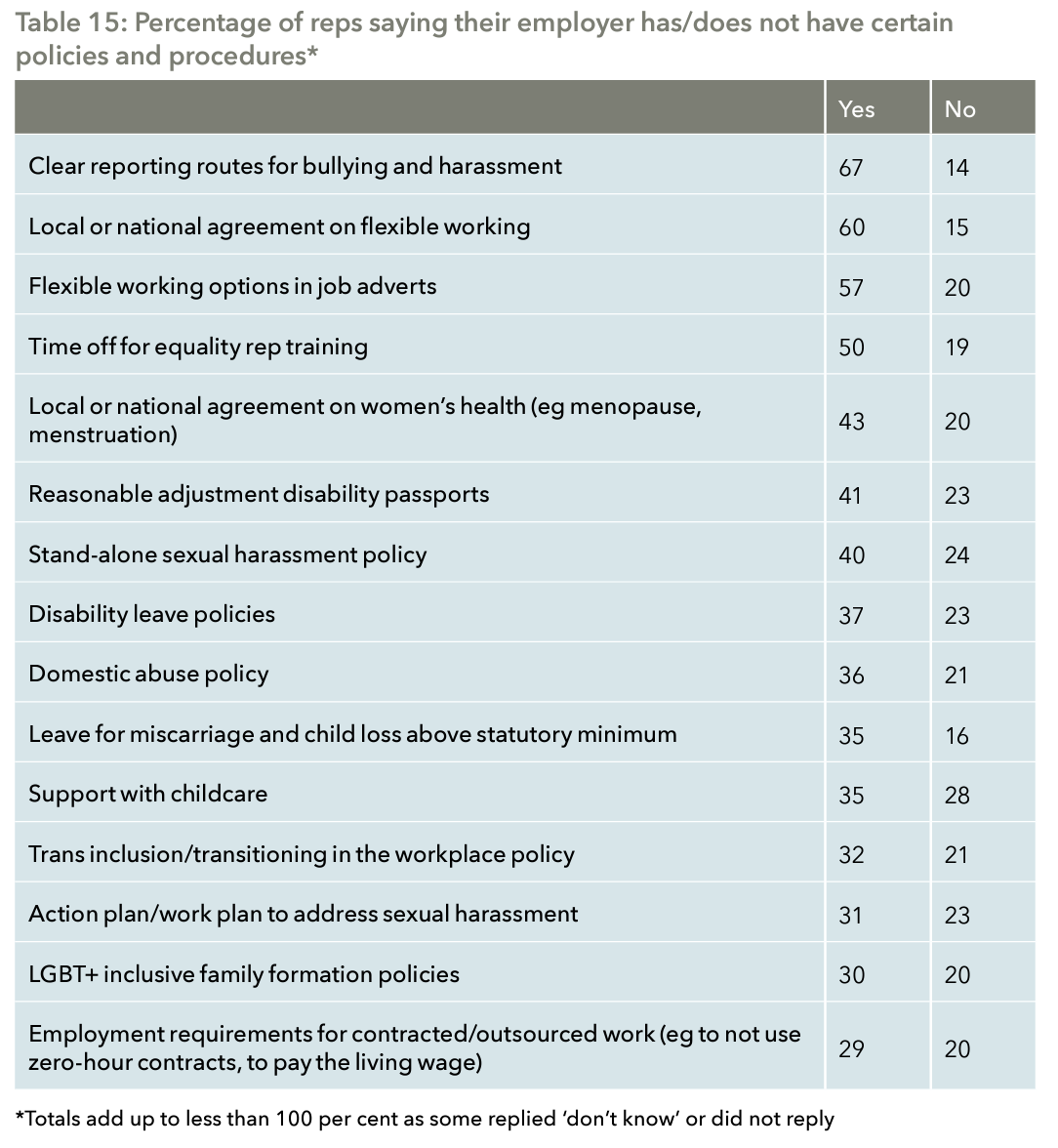
Figure 23 shows how the prevalence of these policies and procedures varies between public and private sectors. On most issues, the private sector lags behind the public sector
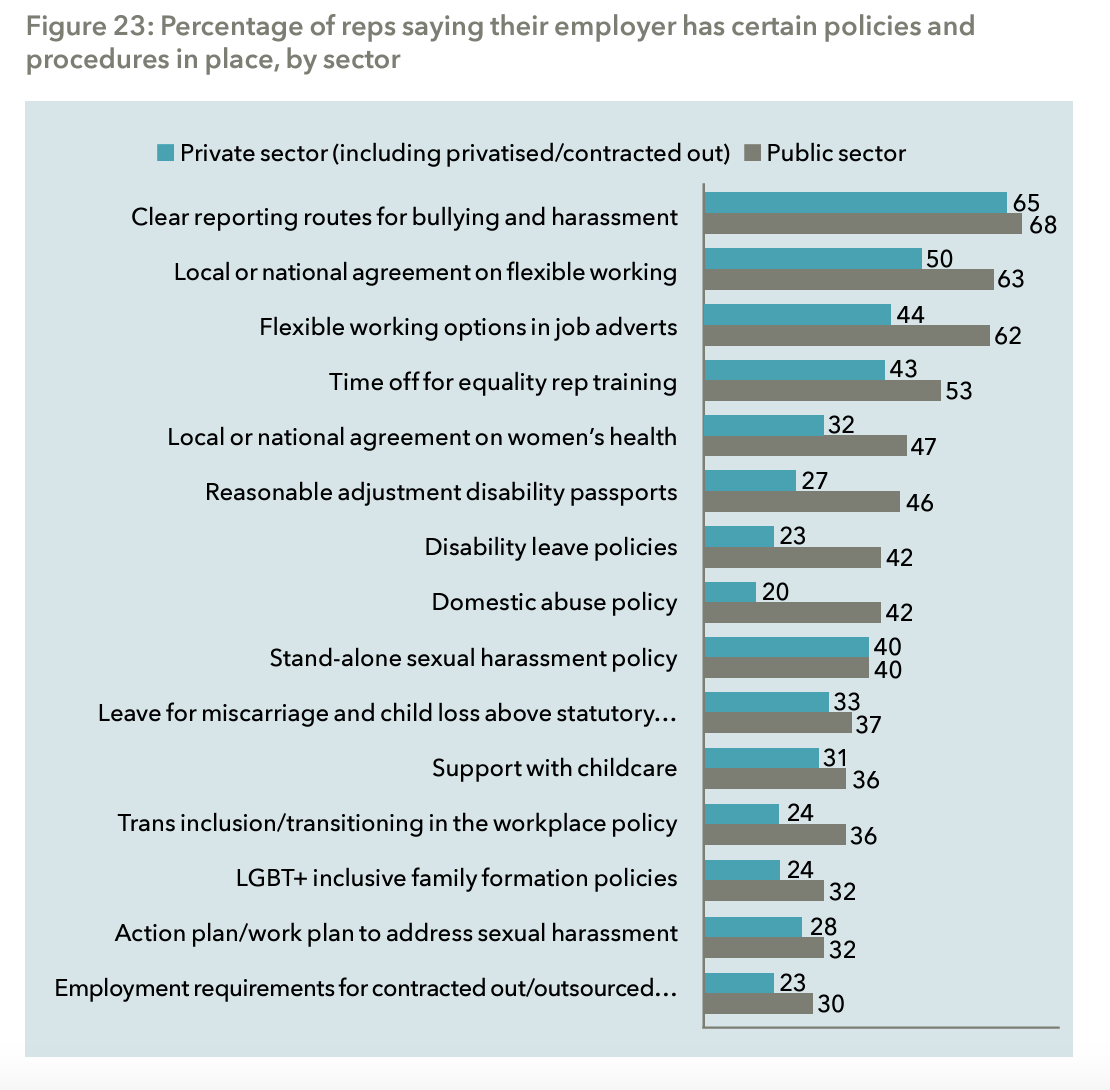
The bargaining climate
Reps were asked whether they thought it had become more or less difficult to get employers to address equality issues in the workplace in the last couple of years. The results were not very hopeful, with 42 per cent saying it had got more difficult and just 19 per cent saying less difficult, with 37 per cent answering “about the same”.
While there was not a significant difference in this pattern between reps from public, private and voluntary/third sectors, there were some variations between industries (Figure 24). The industries where there the highest proportions of reps said it had become more difficult were communications, and central government and its agencies. This mirrors what public sector unions have said about government departments approach to equality in the main audit report. Those most likely to say it has become less difficult are from manufacturing.
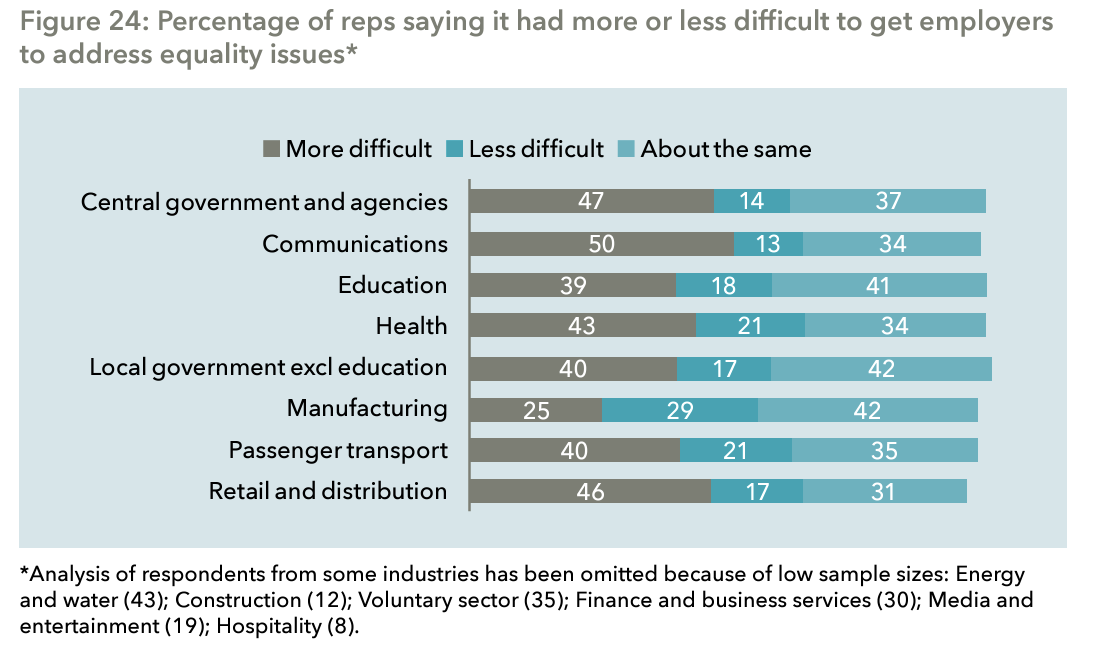
In addition, the LRD conducted research to see how collective bargaining impacts leave and pay arrangements for parents and parents-to-be.
LRD analysed collective agreements on parental leave and pay supplied by unions and recorded on the LRD’s Payline database, which holds over 2,400 pay agreements. The terms in these agreements on maternity, paternity, adoption, shared parental and parental leave are compared with the minimum required by law.
This follows similar analysis carried out for the 2016 TUC Equality Audit, which allows for an approximate comparison of the current situation compared with eight years ago.
Since the 2016 TUC Equality Audit was published there has been no legislative change in basic maternity, adoption, paternity or shared parental leave. This analysis was conducted before the small changes that came into effect from April 2024. The most important legislative change has been the introduction of statutory paid parental bereavement leave in 2020 (in England, Scotland and Wales) and in 2022 (in Northern Ireland).8
Maternity pay and leave
LRD’s analysis shows that a high proportion of collective agreements improve on the statutory minimum entitlements for maternity pay and leave. Payline records 449 maternity collective agreements in total, of which 92 per cent (412) are in some way better than the statutory entitlement. This proportion is higher than in 2016, when 86 per cent of collective agreements were better than the statutory regime, indicating the importance of collective bargaining in this area.
The key way in which agreements enhance parents’ rights on maternity leave are by providing for higher rates of pay for more weeks or full pay for part of the period. A common regime is to provide for a number of weeks on full pay, followed by further weeks on half pay, sometimes with the addition of statutory maternity pay.
West Midlands Fire & Rescue Service, which provides for 52 weeks’ maternity at full pay. This was a win for localised bargaining by the FBU to improve on the conditions of the fire service national agreement (the ‘Grey Book’).
The union had been pushing on the issue of maternity pay at the Midlands-based service for some years but told LRD it was the union’s Fight for 52 campaign that helped keep it regularly raised at the negotiating table.
Other top maternity pay agreements include Eurostar International, where rail unions have negotiated for 40 weeks’ maternity leave at full pay. Several agreements provide for 39 weeks at full pay, including Avanti West Coast (Drivers), CrossCountry (Drivers), Department for Culture, Media and Sport (DCMS), Government Actuary’s Department, Hull Trains, Lipton Teas (Trafford Park) (Manufacturing, Engineering & Technical), MTR Elizabeth Line (Station & Revenue Grades), Northern Lighthouse Board (Marine Staff), Northern Trains Ltd (East and Ex-TPE) Drivers and Northern Trains Ltd (West) Drivers.
A few agreements offer more than the statutory 52 weeks’ leave. The Police (England and Wales) national agreement allows 15 months of maternity leave, irrespective of length of service, taken any time from six months before the expected week of confinement to 12 months after the birth. Police officers with 63 weeks’ service receive full pay for 26 weeks.
Another way in which agreements improve on the statutory regime, and is an increasing trend, is through reducing the service requirement to receive paid maternity leave from 26 weeks. In 23 agreements there is no service requirement, and this includes several where a number of weeks are paid at full pay as a day one entitlement. Historic England, for example, provides for full pay for 28 weeks. And 26 weeks’ full pay is provided from day one at Aviva, Cambridge University Press and Assessment (CUPA), Diageo (Scotland), UK Research & Innovation (UKRI), University of Exeter, University of Liverpool and University of Oxford.
Agreements in the public sector are more likely than the private sector to beat statutory entitlements, with 97 per cent doing so compared with 82 per cent. However, the private sector has been ‘catching up’ in the last eight years, as just 74 per cent were better than statutory in 2016. The proportion in the public sector has remained stable.
There is variation amongst industry and agreements from manufacturing sector are the least likely to be better than statutory. However, the Payline data here is less reliable as it contains only a small number of agreements in some industrial sectors.
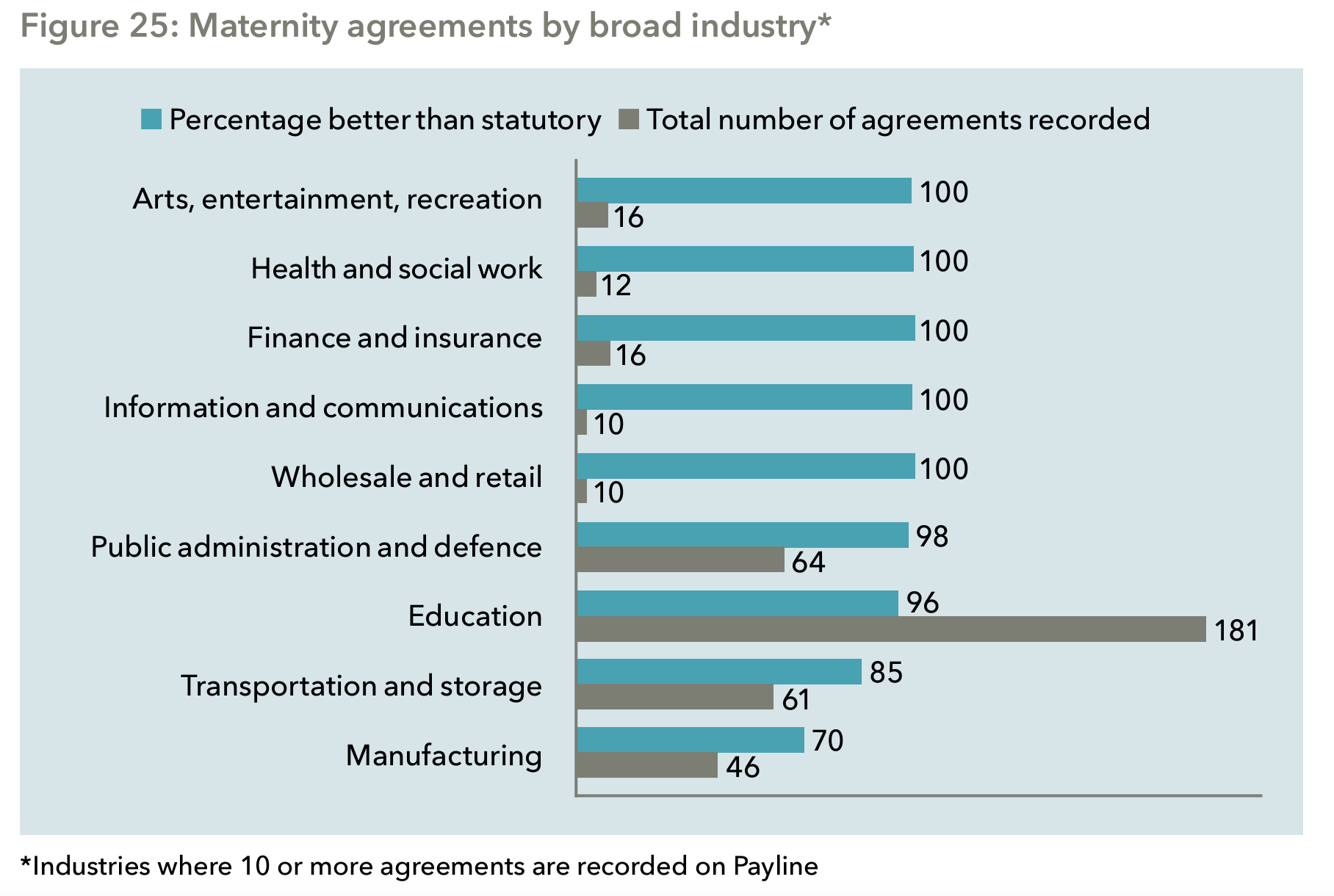
Paternity pay and leave
LRD’s analysis shows that a high proportion of collective agreements improve on the statutory minimum. Payline records 436 paternity collective agreements in total, of which 373 (86 per cent) are in some way better than the statutory entitlement. This proportion is a little higher than was found in 2016, when 81 per cent of collective agreements were better than the statutory regime.
The main ways in which they are better are through provision of extra days’ leave, some of the days being on full pay, reducing or eliminating the service requirement (an increasing trend) or a combination of these enhancements. Other improvements include increasing the flexibility of how it can be taken and making policies more explicitly family and LGBT+ friendly. This analysis was carried out before the introduction of the Paternity Leave Amendment Regulations 2024 in April 2024, which brought in some small flexibilities in how the leave can be taken.
Some of the paternity deals in unionised workplaces are vastly better than the statutory provisions. For example, the ‘equal parental leave’ policy introduced in 2017 in place at both Aviva and Diageo (Scotland) provide for 52 weeks’ paternity leave, with six months at full basic pay and a further six months unpaid.
NatWest provides 24 weeks’ leave at full pay, followed by 15 weeks at equivalent of statutory maternity/adoption pay with up to 13 further weeks unpaid. TSB and Virgin Money also provide 20 weeks at full pay with further leave available unpaid. And the agreements at Solway (Oldbury) and Zurich Insurance provide for 16 weeks on full pay and at Virgin Media O2 14 weeks on full pay.
The deals at Aviva, Diageo (Scotland) and Virgin Money are available from day one. There are many other agreements providing full pay for some part of the leave and where no service is required.
Despite many of the best examples of paternity pay being in the private sector, overall, the deals in the private sector are less likely to improve on statutory regime than the public sector, with 81 per cent of those recorded on Payline being superior, compared with 88 per cent of those in the public sector. Again, however, the private sector has being catching up, as in 2016 just 73 per cent provided enhancements while the proportion in the public sector has not changed.
There is some variation across industries as to the proportion of agreements which improve upon statutory arrangements. However, the Payline data here is again less reliable as it contains only a small number of agreements in some industrial sectors
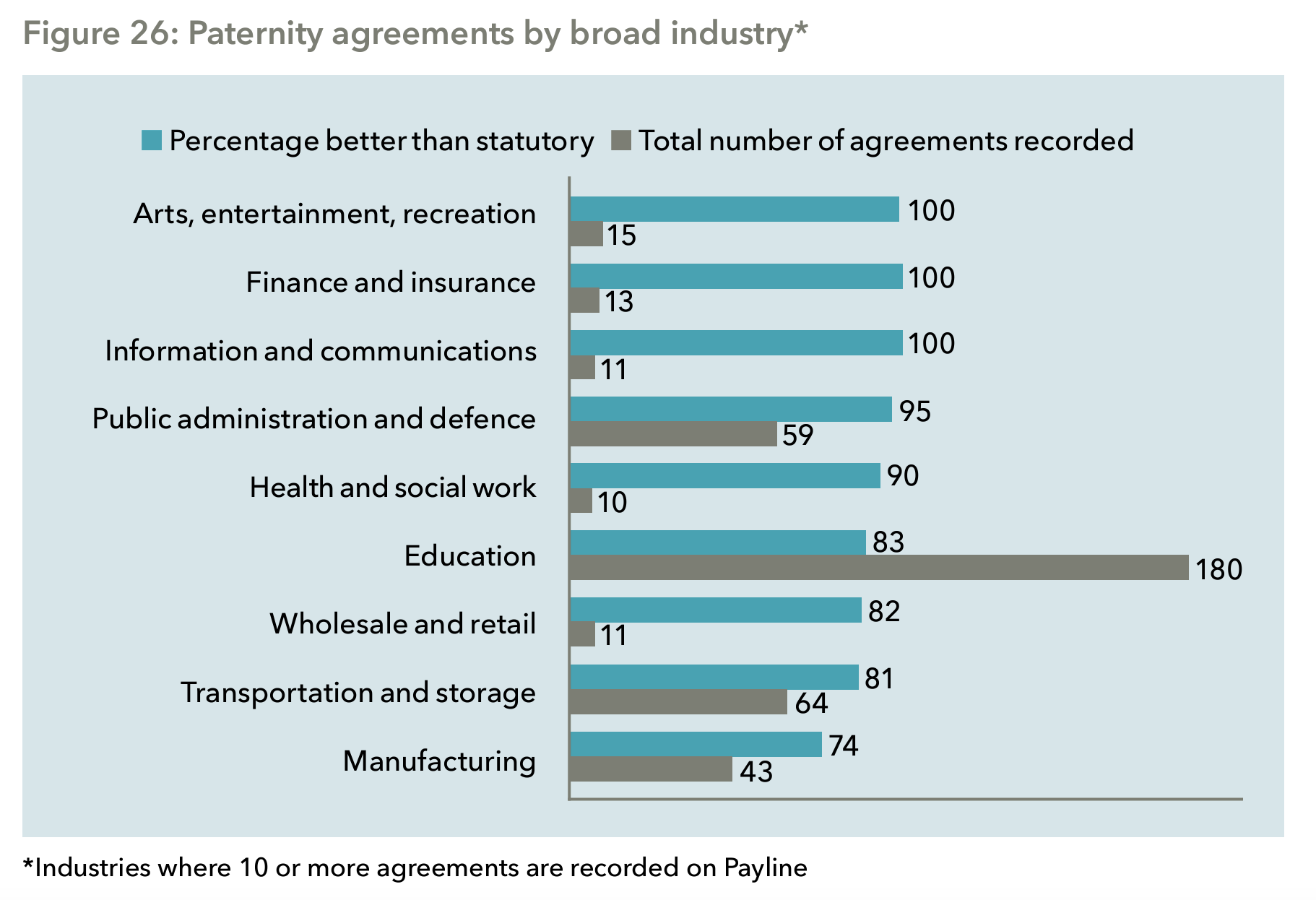
Adoption pay and leave
Employers providing enhanced occupational maternity leave and pay are not obliged to do the same for adoptive parents. However, the LRD Payline data suggests that, where a collective agreement provides for better than statutory maternity leave and pay, most also provide enhanced adoption leave and pay. Of the 371 adoption agreements recorded, 321 (87 per cent) improve on the statutory minimum.
Shared parental pay and leave
This complex and rarely used statutory right allows parents to share most of the statutory maternity leave and pay following their child’s birth or adoption. The eligibility rules and the fact that it is a transfer scheme – not an independent right – means take up is very low.9
LRD Payline records 346 collective agreements on Shared Parental Leave (ShPL), of which half are in some way better than the statutory scheme, indicating that many employers who provide enhanced maternity arrangements fail to extend that to ShPL.
Of those who do improve on the statutory minimum, around 82 per cent provide the same amount of paid leave as if it were maternity leave being taken. That means couples do not lose out if they take advantage of ShPL.
The agreement with the best occupational maternity leave scheme that is extended to ShPL is at the Northern Lighthouse Board (Marine Staff), which provides for full pay for any maternity leave not taken in the first 39 weeks. For example, if the mother only takes 26 weeks’ maternity pay, her partner would be entitled to her 13 weeks’ full pay.
Another good agreement is at Lipton Teas, whose ShPL agreement mirrors the occupational maternity scheme, although that scheme has complicated conditions. It provides for up to 39 weeks’ paid leave for those with three years’ service, the first 26 weeks being at normal pay, followed by 13 weeks where pay will depend on hours of work on return from leave.
Other good agreements are at Astra Zeneca’s ShPL, which copies its maternity arrangements, providing 29 weeks on full pay for those with 26 weeks’ service, while the Department for Education scheme, as with its maternity provisions, allows for 28 weeks on full pay for those with a year’s service.
Parental leave
Of the 166 collective agreements in this area stored on LRD Payline, just 40 (24 per cent) provide any enhancement. This is rather more than in 2016, when just 15 per cent did so.
Most of these enhancements provide for varying improvements to the flexibility in how the leave can be taken, but there are a small number of examples where an element of parental leave is paid.
The Police Staff (Scotland) agreement provides for four weeks’ paid parental leave for each child born or adopted from 1 April 2022, while the NHS Scotland Agenda for Change policy (as noted in the 2016 TUC Equality Audit) allows for some payment. The current policy is that the first four of the 18 weeks of parental leave is paid, but this must be taken before the child’s 14th birthday, or 18th birthday for an adopted child or a disabled child. The remaining 14 weeks are unpaid.
Verso Books entitles those with a year’s service to have full pay for their first week of parental leave, while the National Lottery Community Fund agreement provides for one week’s parental leave on full pay per year for staff with one year’s service and one or more children under the age of eight. 9
Emerging trends in collective agreements.
LRD Payline has observed some other improvements for working parents and prospective parents increasingly being incorporated into collective bargaining agreements, as summarised below.
Ante-natal appointments
The start of a trend has been observed on LRD Payline in the last few years of agreements allowing some paid time off for ante-natal appointments for workers whose partners are pregnant, or for non-primary adoptive parents to attend pre-placement appointments. The statutory entitlement is for two unpaid days or pre-placement appointments.
There are currently 21 of these agreements recorded on the LRD Payline database, the majority of which allow for two days’ paid leave, although a few leave it more open, allowing “reasonable time off.” The RSPCA agreement tops the list, providing five paid days off for partners to attend ante-natal appointments and five days for adoption appointments for non-primary adopters.
The Astra Zeneca affords partners or non-primary parents paid time off to attend up to two ante-natal or pre-placement adoption appointments and, in a surrogacy arrangement, a parent who is genetically related to the baby can have paid time off to attend up to two antenatal appointments along with the surrogate.
Miscarriage
Another recent trend is for agreements to provide some above-statutory entitlement for employees suffering miscarriage, that is, the loss of their pregnancy before 24 weeks. Such employees have no statutory provisions in terms of leave and pay, unlike those losing a baby from 24 weeks’ pregnancy.
There are growing moves towards provision in collective agreements for employees to receive full pay for a number of days following miscarriage.
While in some cases this is covered by general compassionate leave arrangements, increasingly there is a more clearly defined miscarriage clause, or a clause stating that employees suffering miscarriage are entitled to occupational sick pay.
The highest number of days’ at full pay offered specifically in a miscarriage agreement recorded by LRD Payline is at Virgin Money, which provides for 10 days plus another 10 days at the manager’s discretion. Other agreements providing for 10 days’ nondiscretionary paid leave include Dover Fuelling Solutions, Leicestershire County Council, RSA Insurance Group (UK), RSPCA, Stagecoach Cambus (at Cambridge, Fenstanton and Peterborough), Suffolk Fire & Rescue Service, Tesco (retail), TSB and Virgin Media O2. Another recent trend is for agreements to provide some above-statutory entitlement for employees suffering miscarriage.
Fertility treatment
There is no legal right to time off for fertility treatment, but collective agreements are increasingly addressing this issue.
Payline records 30 agreements providing for some paid time off for fertility treatment, with the majority of those being on a non-discretionary basis.
The highest number of non-discretionary paid days for fertility treatment are to be found at Zurich Insurance, which provides for up to 16 days in total in any 12-month period, which it says typically supports two cycles of IVF at eight days per cycle. The partner of someone undergoing IVF is given support through flexible working.
The RSA Insurance Group agreement also provides for 16 days’ paid IVF/fertility leave per year.
Premature births and neonatal care
Another entitlement starting to appear in collective agreements is extra paid leave – beyond maternity or paternity leave – for employees whose babies are premature and/or require neonatal care.
Some specify a specific amount of paid leave in these circumstances. The best examples include the Virgin Media O2 agreement, which says that, in the case of serious neonatal complications, an entitlement of up to 12 weeks’ paid leave is extended to all employees, with no qualifying service requirement.
Other agreements, such as those at Essex County Fire & Rescue and Nationwide Building Society, state that full pay is provided for the number of weeks that the baby is premature.
Some agreements make clear the entitlement is available to either parent. For example, the MTR Elizabeth Line agreement allows both parents one extra day of leave on full pay for each day their premature baby spends in hospital up to what would have been the 37th week of pregnancy. At Suffolk Fire & Rescue service both parents get extra leave on full pay for the difference between the actual term and 40 weeks, with no cap on the maximum amount.
The following unions participated in the 2024 TUC Equality Audit. Membership figures are as at January 2023 and as supplied to the TUC.
More information on TUC affiliated unions including the full names and sectors is on our website.
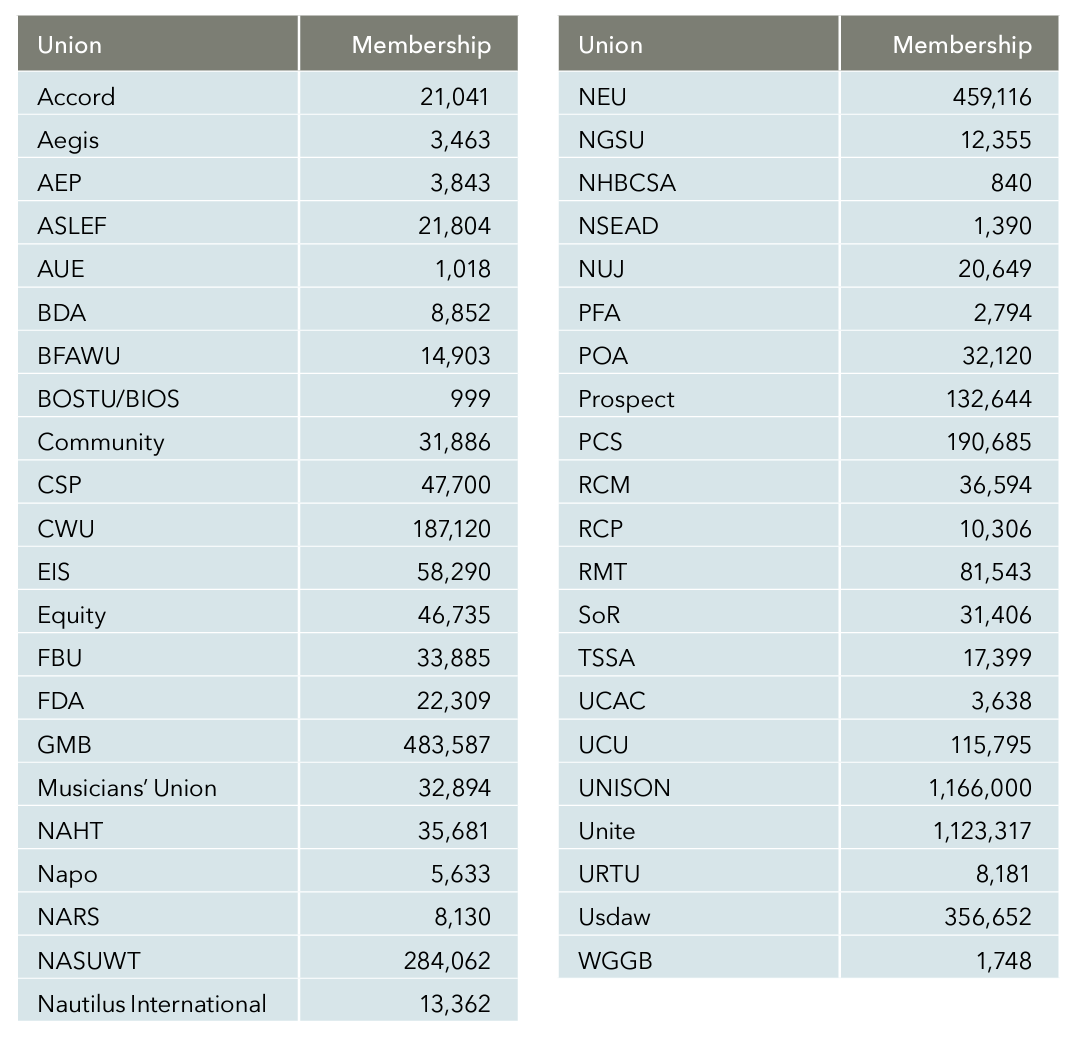
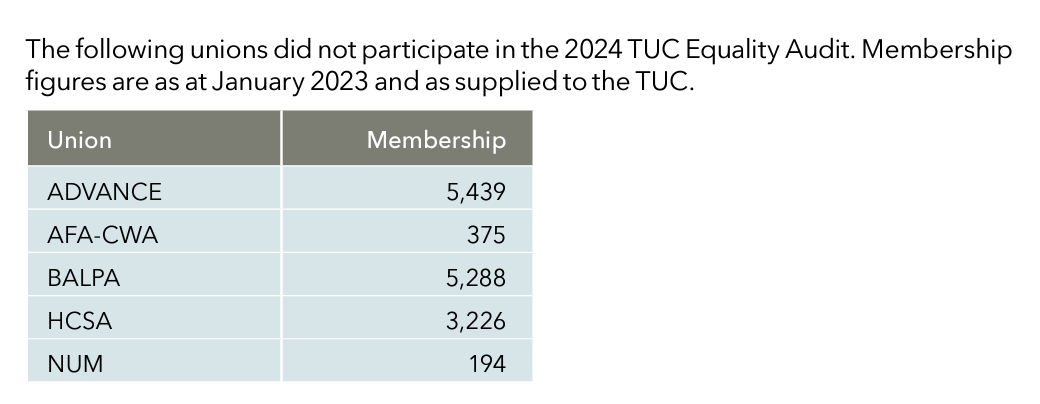
Notes
There have been no changes to TUC-affiliated unions since the 2020 Audit.
The percentages of unions quoted in this report are generally of the total number of unions responding to the audit. In some cases, analysis has also been carried out according to union size. The aim of this approach is to acknowledge that different-sized unions have different capacities to collectively bargain, produce guidance and training and focus on different areas.
For such analysis, the unions responding have been grouped into three size categories corresponding to the TUC rules on the composition of the General Council.10
In this report they are described as either ‘large’ (section A unions), ‘medium-sized’ (section B unions) or ‘small’ (section C unions).
The large unions that responded to the audit are: GMB, NASUWT, NEU, UNISON, Unite and Usdaw.
The medium-sized unions that responded to the audit are: Community, CSP, CWU, EIS, Equity, FBU, Musicians’ Union, NAHT, PCS, POA, Prospect, SoR, RCM, RMT and UCU.
The small unions that responded to the audit are: Accord, Aegis, AEP, ASLEF, AUE, BDA, BFAWU, BOSTU/BIOS, FDA, Napo, NARS, Nautilus International, NGSU, NHBC Staff Association, NSEAD, NUJ, PFA, RCP, TSSA, UCAC, URTU and WGGB.
- 10Section A shall consist of members from those organisations with a full numerical membership of 200,000 or more members. Each such organisation shall be entitled to nominate one or more of its members to be a member or members of the General Council and the number of members to which the organisations comprising Section A shall be entitled shall be determined by their full numerical membership on the basis of one per 200,000 members or part thereof provided that where the total number of women members of any organisation in Section A is 100,000 or more that organisation shall nominate at least one woman. Section B shall consist of members from those organisations with a full numerical membership of 30,000 up to 199,999 members. Each such organisation shall be entitled to nominate one of its members to be a member of Section B of the General Council. Section C shall consist of seven members of unions with fewer than 30,000 members.”
Stay Updated
Want to hear about our latest news and blogs?
Sign up now to get it straight to your inbox