
TUC Equality Audit 2024
In addition, the LRD conducted research to see how collective bargaining impacts leave and pay arrangements for parents and parents-to-be.
LRD analysed collective agreements on parental leave and pay supplied by unions and recorded on the LRD’s Payline database, which holds over 2,400 pay agreements. The terms in these agreements on maternity, paternity, adoption, shared parental and parental leave are compared with the minimum required by law.
This follows similar analysis carried out for the 2016 TUC Equality Audit, which allows for an approximate comparison of the current situation compared with eight years ago.
Since the 2016 TUC Equality Audit was published there has been no legislative change in basic maternity, adoption, paternity or shared parental leave. This analysis was conducted before the small changes that came into effect from April 2024. The most important legislative change has been the introduction of statutory paid parental bereavement leave in 2020 (in England, Scotland and Wales) and in 2022 (in Northern Ireland).8
Maternity pay and leave
LRD’s analysis shows that a high proportion of collective agreements improve on the statutory minimum entitlements for maternity pay and leave. Payline records 449 maternity collective agreements in total, of which 92 per cent (412) are in some way better than the statutory entitlement. This proportion is higher than in 2016, when 86 per cent of collective agreements were better than the statutory regime, indicating the importance of collective bargaining in this area.
The key way in which agreements enhance parents’ rights on maternity leave are by providing for higher rates of pay for more weeks or full pay for part of the period. A common regime is to provide for a number of weeks on full pay, followed by further weeks on half pay, sometimes with the addition of statutory maternity pay.
West Midlands Fire & Rescue Service, which provides for 52 weeks’ maternity at full pay. This was a win for localised bargaining by the FBU to improve on the conditions of the fire service national agreement (the ‘Grey Book’).
The union had been pushing on the issue of maternity pay at the Midlands-based service for some years but told LRD it was the union’s Fight for 52 campaign that helped keep it regularly raised at the negotiating table.
Other top maternity pay agreements include Eurostar International, where rail unions have negotiated for 40 weeks’ maternity leave at full pay. Several agreements provide for 39 weeks at full pay, including Avanti West Coast (Drivers), CrossCountry (Drivers), Department for Culture, Media and Sport (DCMS), Government Actuary’s Department, Hull Trains, Lipton Teas (Trafford Park) (Manufacturing, Engineering & Technical), MTR Elizabeth Line (Station & Revenue Grades), Northern Lighthouse Board (Marine Staff), Northern Trains Ltd (East and Ex-TPE) Drivers and Northern Trains Ltd (West) Drivers.
A few agreements offer more than the statutory 52 weeks’ leave. The Police (England and Wales) national agreement allows 15 months of maternity leave, irrespective of length of service, taken any time from six months before the expected week of confinement to 12 months after the birth. Police officers with 63 weeks’ service receive full pay for 26 weeks.
Another way in which agreements improve on the statutory regime, and is an increasing trend, is through reducing the service requirement to receive paid maternity leave from 26 weeks. In 23 agreements there is no service requirement, and this includes several where a number of weeks are paid at full pay as a day one entitlement. Historic England, for example, provides for full pay for 28 weeks. And 26 weeks’ full pay is provided from day one at Aviva, Cambridge University Press and Assessment (CUPA), Diageo (Scotland), UK Research & Innovation (UKRI), University of Exeter, University of Liverpool and University of Oxford.
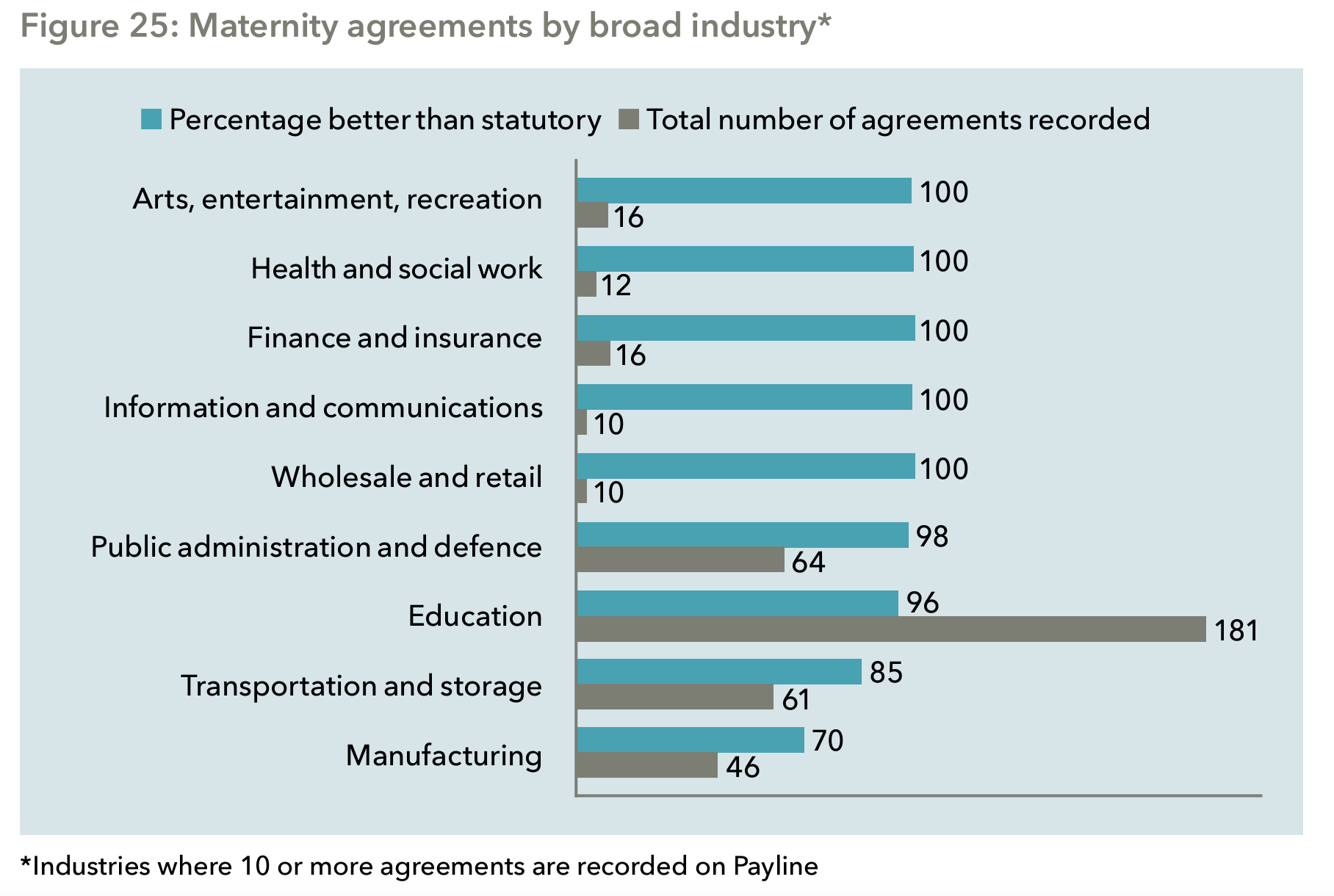
Agreements in the public sector are more likely than the private sector to beat statutory entitlements, with 97 per cent doing so compared with 82 per cent. However, the private sector has been ‘catching up’ in the last eight years, as just 74 per cent were better than statutory in 2016. The proportion in the public sector has remained stable.
There is variation amongst industry and agreements from manufacturing sector are the least likely to be better than statutory. However, the Payline data here is less reliable as it contains only a small number of agreements in some industrial sectors.
Paternity pay and leave
LRD’s analysis shows that a high proportion of collective agreements improve on the statutory minimum. Payline records 436 paternity collective agreements in total, of which 373 (86 per cent) are in some way better than the statutory entitlement. This proportion is a little higher than was found in 2016, when 81 per cent of collective agreements were better than the statutory regime.
The main ways in which they are better are through provision of extra days’ leave, some of the days being on full pay, reducing or eliminating the service requirement (an increasing trend) or a combination of these enhancements. Other improvements include increasing the flexibility of how it can be taken and making policies more explicitly family and LGBT+ friendly. This analysis was carried out before the introduction of the Paternity Leave Amendment Regulations 2024 in April 2024, which brought in some small flexibilities in how the leave can be taken.
Some of the paternity deals in unionised workplaces are vastly better than the statutory provisions. For example, the ‘equal parental leave’ policy introduced in 2017 in place at both Aviva and Diageo (Scotland) provide for 52 weeks’ paternity leave, with six months at full basic pay and a further six months unpaid.
NatWest provides 24 weeks’ leave at full pay, followed by 15 weeks at equivalent of statutory maternity/adoption pay with up to 13 further weeks unpaid. TSB and Virgin Money also provide 20 weeks at full pay with further leave available unpaid. And the agreements at Solway (Oldbury) and Zurich Insurance provide for 16 weeks on full pay and at Virgin Media O2 14 weeks on full pay.
The deals at Aviva, Diageo (Scotland) and Virgin Money are available from day one. There are many other agreements providing full pay for some part of the leave and where no service is required.
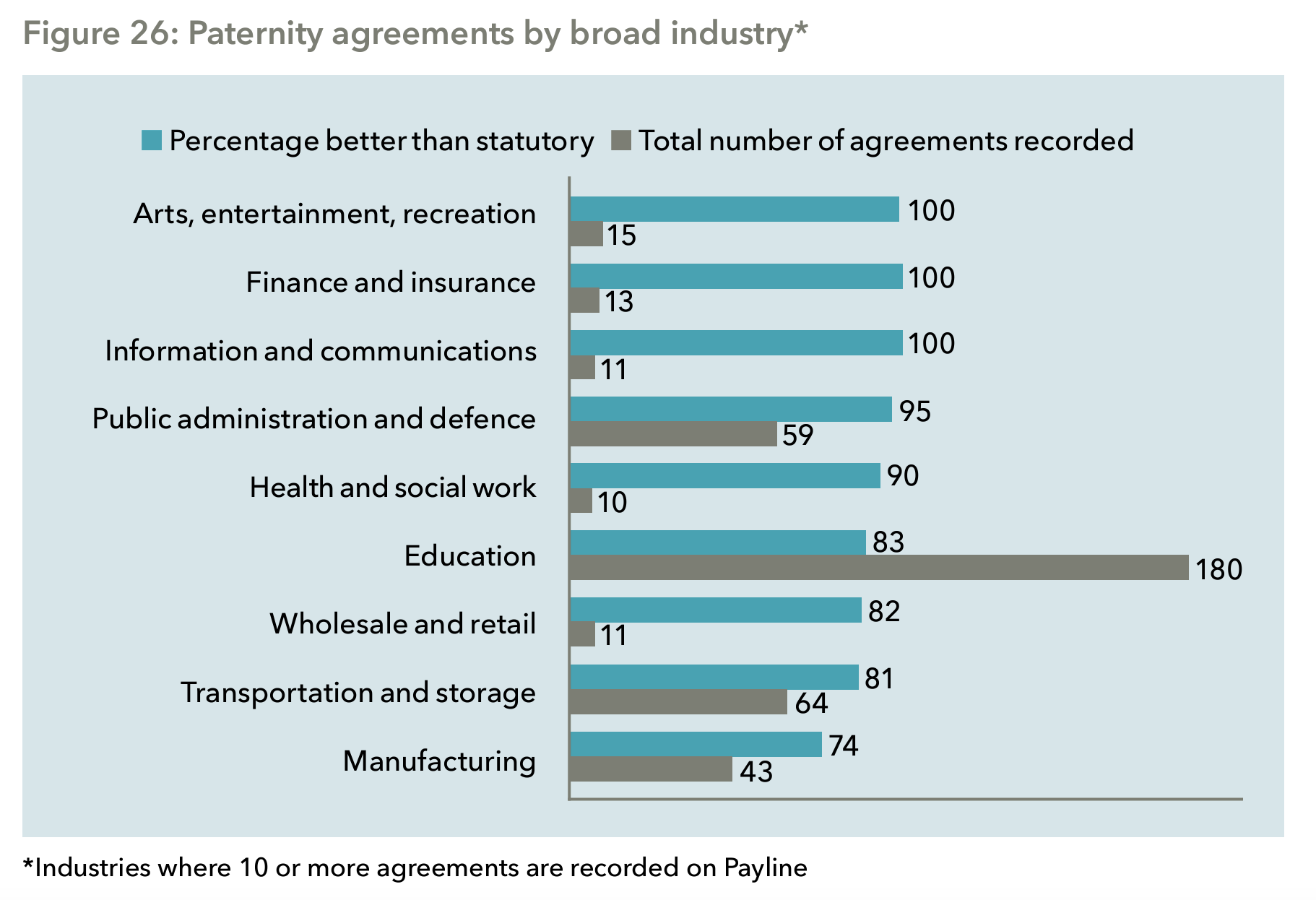
Despite many of the best examples of paternity pay being in the private sector, overall, the deals in the private sector are less likely to improve on statutory regime than the public sector, with 81 per cent of those recorded on Payline being superior, compared with 88 per cent of those in the public sector. Again, however, the private sector has being catching up, as in 2016 just 73 per cent provided enhancements while the proportion in the public sector has not changed.
There is some variation across industries as to the proportion of agreements which improve upon statutory arrangements. However, the Payline data here is again less reliable as it contains only a small number of agreements in some industrial sectors
Adoption pay and leave
Employers providing enhanced occupational maternity leave and pay are not obliged to do the same for adoptive parents. However, the LRD Payline data suggests that, where a collective agreement provides for better than statutory maternity leave and pay, most also provide enhanced adoption leave and pay. Of the 371 adoption agreements recorded, 321 (87 per cent) improve on the statutory minimum.
Shared parental pay and leave
This complex and rarely used statutory right allows parents to share most of the statutory maternity leave and pay following their child’s birth or adoption. The eligibility rules and the fact that it is a transfer scheme – not an independent right – means take up is very low.9
LRD Payline records 346 collective agreements on Shared Parental Leave (ShPL), of which half are in some way better than the statutory scheme, indicating that many employers who provide enhanced maternity arrangements fail to extend that to ShPL.
Of those who do improve on the statutory minimum, around 82 per cent provide the same amount of paid leave as if it were maternity leave being taken. That means couples do not lose out if they take advantage of ShPL.
The agreement with the best occupational maternity leave scheme that is extended to ShPL is at the Northern Lighthouse Board (Marine Staff), which provides for full pay for any maternity leave not taken in the first 39 weeks. For example, if the mother only takes 26 weeks’ maternity pay, her partner would be entitled to her 13 weeks’ full pay.
Another good agreement is at Lipton Teas, whose ShPL agreement mirrors the occupational maternity scheme, although that scheme has complicated conditions. It provides for up to 39 weeks’ paid leave for those with three years’ service, the first 26 weeks being at normal pay, followed by 13 weeks where pay will depend on hours of work on return from leave.
Other good agreements are at Astra Zeneca’s ShPL, which copies its maternity arrangements, providing 29 weeks on full pay for those with 26 weeks’ service, while the Department for Education scheme, as with its maternity provisions, allows for 28 weeks on full pay for those with a year’s service.
Parental leave
Of the 166 collective agreements in this area stored on LRD Payline, just 40 (24 per cent) provide any enhancement. This is rather more than in 2016, when just 15 per cent did so.
Most of these enhancements provide for varying improvements to the flexibility in how the leave can be taken, but there are a small number of examples where an element of parental leave is paid.
The Police Staff (Scotland) agreement provides for four weeks’ paid parental leave for each child born or adopted from 1 April 2022, while the NHS Scotland Agenda for Change policy (as noted in the 2016 TUC Equality Audit) allows for some payment. The current policy is that the first four of the 18 weeks of parental leave is paid, but this must be taken before the child’s 14th birthday, or 18th birthday for an adopted child or a disabled child. The remaining 14 weeks are unpaid.
Verso Books entitles those with a year’s service to have full pay for their first week of parental leave, while the National Lottery Community Fund agreement provides for one week’s parental leave on full pay per year for staff with one year’s service and one or more children under the age of eight. 9
Emerging trends in collective agreements.
LRD Payline has observed some other improvements for working parents and prospective parents increasingly being incorporated into collective bargaining agreements, as summarised below.
Ante-natal appointments
The start of a trend has been observed on LRD Payline in the last few years of agreements allowing some paid time off for ante-natal appointments for workers whose partners are pregnant, or for non-primary adoptive parents to attend pre-placement appointments. The statutory entitlement is for two unpaid days or pre-placement appointments.
There are currently 21 of these agreements recorded on the LRD Payline database, the majority of which allow for two days’ paid leave, although a few leave it more open, allowing “reasonable time off.” The RSPCA agreement tops the list, providing five paid days off for partners to attend ante-natal appointments and five days for adoption appointments for non-primary adopters.
The Astra Zeneca affords partners or non-primary parents paid time off to attend up to two ante-natal or pre-placement adoption appointments and, in a surrogacy arrangement, a parent who is genetically related to the baby can have paid time off to attend up to two antenatal appointments along with the surrogate.
Miscarriage
Another recent trend is for agreements to provide some above-statutory entitlement for employees suffering miscarriage, that is, the loss of their pregnancy before 24 weeks. Such employees have no statutory provisions in terms of leave and pay, unlike those losing a baby from 24 weeks’ pregnancy.
There are growing moves towards provision in collective agreements for employees to receive full pay for a number of days following miscarriage.
While in some cases this is covered by general compassionate leave arrangements, increasingly there is a more clearly defined miscarriage clause, or a clause stating that employees suffering miscarriage are entitled to occupational sick pay.
The highest number of days’ at full pay offered specifically in a miscarriage agreement recorded by LRD Payline is at Virgin Money, which provides for 10 days plus another 10 days at the manager’s discretion. Other agreements providing for 10 days’ nondiscretionary paid leave include Dover Fuelling Solutions, Leicestershire County Council, RSA Insurance Group (UK), RSPCA, Stagecoach Cambus (at Cambridge, Fenstanton and Peterborough), Suffolk Fire & Rescue Service, Tesco (retail), TSB and Virgin Media O2. Another recent trend is for agreements to provide some above-statutory entitlement for employees suffering miscarriage.
Fertility treatment
There is no legal right to time off for fertility treatment, but collective agreements are increasingly addressing this issue.
Payline records 30 agreements providing for some paid time off for fertility treatment, with the majority of those being on a non-discretionary basis.
The highest number of non-discretionary paid days for fertility treatment are to be found at Zurich Insurance, which provides for up to 16 days in total in any 12-month period, which it says typically supports two cycles of IVF at eight days per cycle. The partner of someone undergoing IVF is given support through flexible working.
The RSA Insurance Group agreement also provides for 16 days’ paid IVF/fertility leave per year.
Premature births and neonatal care
Another entitlement starting to appear in collective agreements is extra paid leave – beyond maternity or paternity leave – for employees whose babies are premature and/or require neonatal care.
Some specify a specific amount of paid leave in these circumstances. The best examples include the Virgin Media O2 agreement, which says that, in the case of serious neonatal complications, an entitlement of up to 12 weeks’ paid leave is extended to all employees, with no qualifying service requirement.
Other agreements, such as those at Essex County Fire & Rescue and Nationwide Building Society, state that full pay is provided for the number of weeks that the baby is premature.
Some agreements make clear the entitlement is available to either parent. For example, the MTR Elizabeth Line agreement allows both parents one extra day of leave on full pay for each day their premature baby spends in hospital up to what would have been the 37th week of pregnancy. At Suffolk Fire & Rescue service both parents get extra leave on full pay for the difference between the actual term and 40 weeks, with no cap on the maximum amount.
Stay Updated
Want to hear about our latest news and blogs?
Sign up now to get it straight to your inbox