
TUC Equality Audit 2024
The section looks at how unions support their paid and lay negotiators in their equality collective bargaining through the provision of training and the issuing of policies, guidance and briefing materials on equalities topics.
Training on equality bargaining
An important way in which unions help their negotiators to advance equality at the workplace is through the provision of training. The Equality Audit questionnaire asked unions to indicate which equality bargaining issues they provide training on to three groups in the union: their national paid officials, their local/regional paid officials, and their lay negotiators (Table 1).
Table 1: Unions providing training for negotiators on equality bargaining issues (per cent)
| National paid officials | Local/ regional paid officials | Lay negotiators |
Pay and employment equality | 35 | 21 | 40 |
General equalities bargaining | 33 | 26 | 49 |
Black workers | 26 | 16 | 40 |
LGBT+ workers | 26 | 19 | 37 |
Disabled workers | 26 | 19 | 40 |
Sexual harassment in the workplace | 26 | 21 | 33 |
Flexible working/work-life balance | 23 | 14 | 33 |
Gender and/or other pay gaps | 23 | 16 | 26 |
Pregnancy and maternity discrimination | 23 | 19 | 33 |
Harassment and bullying policies | 21 | 12 | 37 |
Women’s health | 21 | 12 | 35 |
Religion or belief | 19 | 7 | 21 |
Automation/AI/digitalisation and equality | 19 | 14 | 19 |
Pregnancy loss and miscarriage | 19 | 12 | 19 |
Working parents, parents-to-be and carers | 16 | 9 | 21 |
Equality and health and safety | 16 | 21 | 40 |
Young workers | 14 | 12 | 19 |
Hate crime | 12 | 5 | 14 |
Older workers | 9 | 7 | 12 |
Migrant workers | 9 | 9 | 16 |
Note: Caution should be exercised in comparing these percentage figures with those presented in the 2020 TUC Equality Audit because the overall sample of unions is small, and the sample size is substantially changed (43 respondents unions in 2024 compared with 36 in 2020).
Other equality related training topics mentioned by unions include the gender pensions gap, equality impact assessments, modern day slavery, andropause awareness and making collective agreements neurodivergent friendly.
More unions provide equality bargaining training to lay negotiators than provide them to paid officials. This may be because there is a higher turnover of personnel among lay representatives than among paid officers, resulting in a more frequent need for training.
General equalities and pay and employment are among the most common training topics provided for all three groups of negotiators, with training on issues for Black and disabled workers and LGBT+ workers also widespread for all. One notable variation is that equality and health and safety is high on the list for lay negotiators and local/regional officials but less so for national officials.
There are also some variations in the training priorities among unions of different size bands. While large unions will tend to provide more training in all areas than others, Tables 2 to 4 look at which are the most commonly provided training topics for unions of different sizes. Each table lists the three most common training topics provided by large, medium and small unions, and the tables are split into training run for national paid officials, local/ regional paid officials and lay negotiators.
Table 2: Top three training topics for national paid officials by union size band
Large | Medium | Small |
Pay and employment equality (67 per cent) | General equalities bargaining (40 per cent) | Pay and employment equality, sexual harassment (both 32 per cent) |
Black workers, LGBT+ workers (both 50 per cent) | Gender and/or other pay gaps, disabled workers (both 33 per cent) | General equalities bargaining, flexible working/work-life balance, women’s health (all 27 per cent) |
As Table 3 shows, unions’ top priorities for local and regional officials’ training vary quite a lot between the size bands.
Table 3: Top three training topics for local/regional paid officials by union size band
Large | Medium | Small |
LGBT+ workers (67 per cent) | General equalities bargaining (40 per cent) | Sexual harassment (18 per cent) |
Pay and employment equality, Black workers, general equalities bargaining, equality and health and safety (all 50 per cent) | Gender and/or other pay gaps, disabled workers, pregnancy and maternity discrimination, automation/ AI/digitalisation and equality, sexual harassment, equality and health and safety (all 27 per cent) | Pay and employment equality, flexible working/work-life balance (both 14 per cent) |
Table 4: Top three training topics for lay negotiators by union size band
Large | Medium | Small |
Pay and employment equality, general equalities bargaining, equality and health and safety (all 83 per cent) | General equalities bargaining (67 per cent) | Sexual harassment (32 per cent) |
| Equality and health and safety (60 per cent) | General equalities bargaining, bullying and harassment policies (both 27 per cent) |
| Disabled workers, Black workers, LGBT+ workers, women’s health (all 53 per cent) |
|
Several unions had recently either newly introduced training in sexual harassment or substantially upgraded their previous content. For small unions, sexual harassment is now the most common topic for lay reps training, whereas it didn’t make the top three in 2020.
The CWU said it had recognised that it should go beyond general harassment training and also that the training needed to be tailored for different groups, such as reps, NEC members and sexual harassment investigators. It has also agreed that all national officers and all Industrial Executive members must undertake mandatory sexual harassment training, to be completed within six months of being elected into post.
Some of the training courses, such as on AI/digitalisation, had been newly introduced by a number of unions in the last two years.
A small number of unions have rules or targets for equality training, such as Unite’s mandatory dignity at work courses for all officers, organisers and staff. UNISON’s reps’ accreditation scheme requires reps of all types to attend equality training within two years of completing their induction training. Those who undertake representation and negotiation must attend UNISON’s Challenging Racism in the Workplace course within three years of their appointment. And NASUWT has a number of requirements, including requiring all caseworkers to undergo discrimination training.
Guidance on equality bargaining
Support provided by unions to their negotiators often comes in the form of guidance, policy advice or model agreements. This section looks at the equality topics on which unions have current material of this type. Some unions negotiate with a very small number of employers and may not produce this type of material so were asked to point to where they have recently included these topics in their claims.
The topics are in two parts. First unions were asked if they had included equality considerations in guidance on a range of general bargaining topics, such as pay and benefits. Second, they were asked if they have negotiating guidance on specific stand- alone equality bargaining topics, such as issues relating to women, Black workers or LGBT+ workers.
Equality elements of general bargaining topics
Figure 1 shows the percentage of unions who said they had current up-to-date policies or guidelines on general bargaining topics that includes equality elements (or, in the case of unions who deal with only a small number of employers, have included equality elements in their claims on general bargaining topics). The figures are only an approximate measure as different unions may categorise their guidance differently.
Figure 1: Unions including equality guidance in general bargaining topics (per cent)
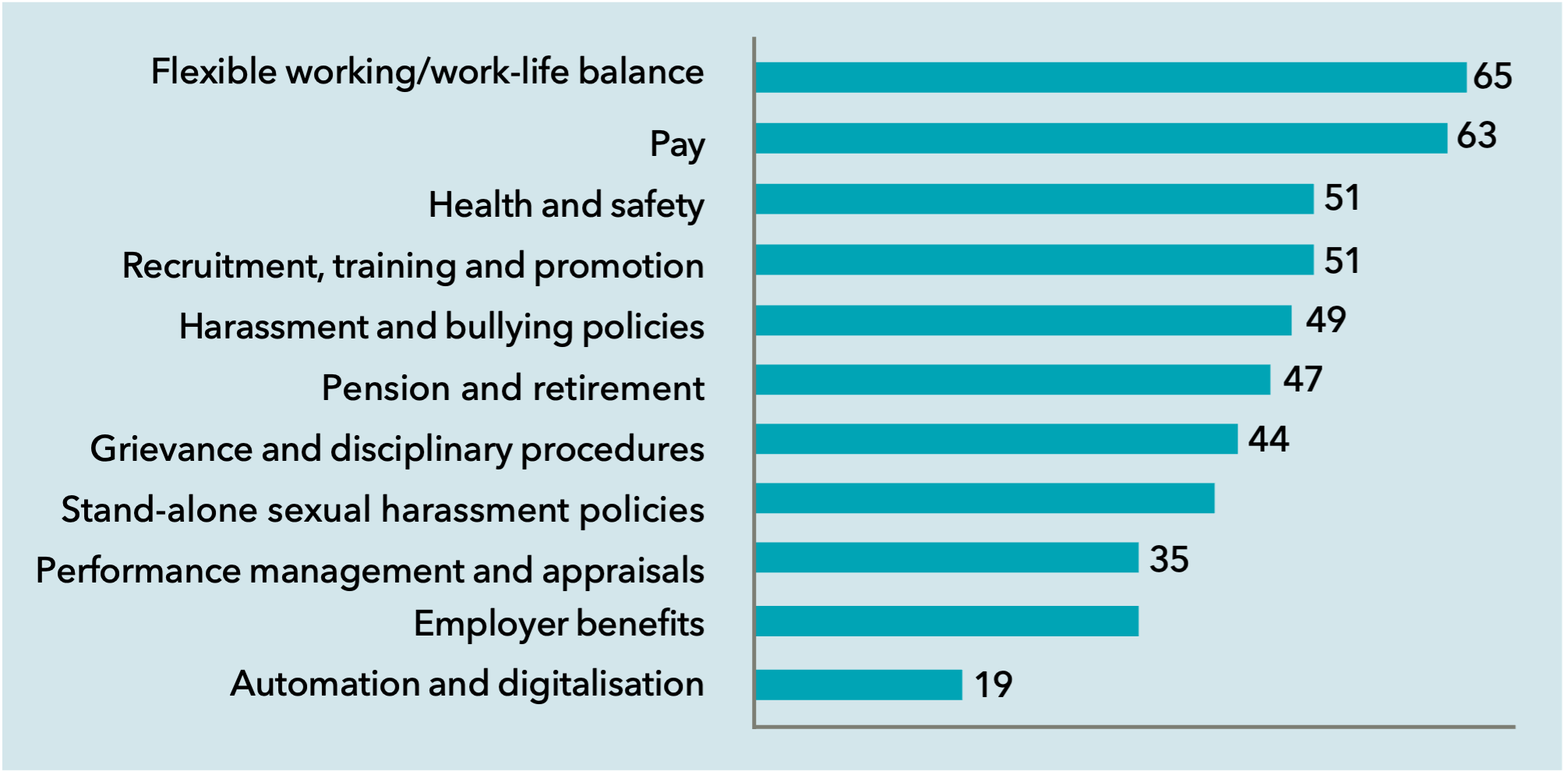
Across all unions participating in the Audit, the general bargaining topics on which they are most likely to have produced equality guidance are flexible working/work-life
balance and pay, followed by health and safety and recruitment, training and promotion. Automation and digitalisation is the least likely topic for guidelines or policies, produced by one in five (19 per cent) unions.
Compared with the 2020 TUC Equality Audit, the most common area is still flexible working/work-life balance but otherwise there is a changing round of priorities. Guidance on equality aspects of pay and of recruitment, training and promotion are higher on the list than four years ago, overtaking materials on health and safety, harassment and bullying policies, pensions and retirement, employer benefits, and performance management and appraisals.
The comparison between 2020 and 2024 is used to demonstrate changing priorities rather than historical comparisons. It is difficult to make direct comparisons between audits due to the small sample size and different unions completing each audit. In addition, the sample size of the audit in 2024 is substantially changed compared to 2020 therefore a decline in percentage of unions does not necessarily mean a decrease in the number of unions. However, where there has been a percentage increase, this does mean an increase in the number of unions providing certain guidance. In addition, there has been a growth in the number of small unions completing the audit who may be less likely to produce their own guidance on a variety of issues.
Table 5: Unions with equality guidance on general bargaining topics 2024 and 2020 (per cent)
| 2024 | 2020 |
Flexible working/work-life balance | 65 | 67 |
Pay | 63 | 58 |
Recruitment, training and promotion | 51 | 47 |
Health and safety | 51 | 61 |
Harassment and bullying policies | 49 | 64 |
Pensions and retirement | 47 | 56 |
Grievance and disciplinary procedures | 44 | 47 |
Stand-alone sexual harassment policies | 42 | 42 |
Employer benefits | 35 | 53 |
Performance management and appraisals | 35 | 56 |
Automation and digitalisation | 19 | 17 |
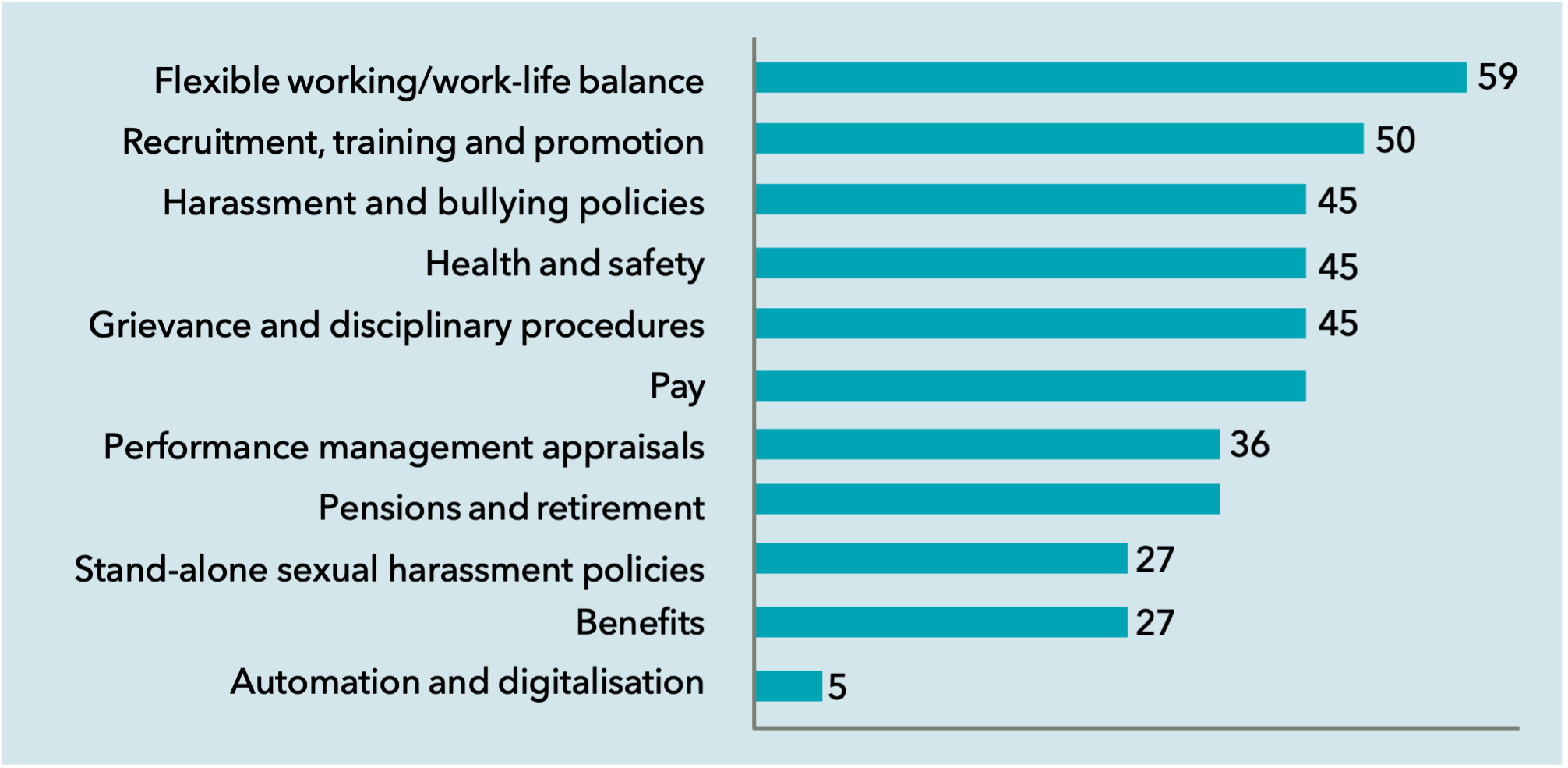
Looking at guidance issued by unions in the different size bands, it can be seen that, not surprisingly, large unions are more likely to have guidance on equality issues in all the general bargaining topics listed. But there are also some differences in current ‘priorities’ between the different union size groups.
For large unions, the most common general bargaining issues for equality guidance are pay and pensions and retirement, cited by all six unions in that band. For medium-sized unions, pay is also at the top, but the second most likely area for guidance is flexible working/work-life balance, with pensions much further down the list. And for small unions, flexible working/work-life balance is the top ‘priority’, followed by guidance
on recruitment, training and promotion and we have a seen a rise in the number with guidance on sexual harassment policies since 2020.
Guidance on harassment and bullying polices, which was issued by 100 per cent of large unions in the 2020 Audit, has now been overtaken by other issues, but it is higher up the list for small unions than it was four years ago.
Figure 2: Large unions with equality guidance on general bargaining topics (per cent)
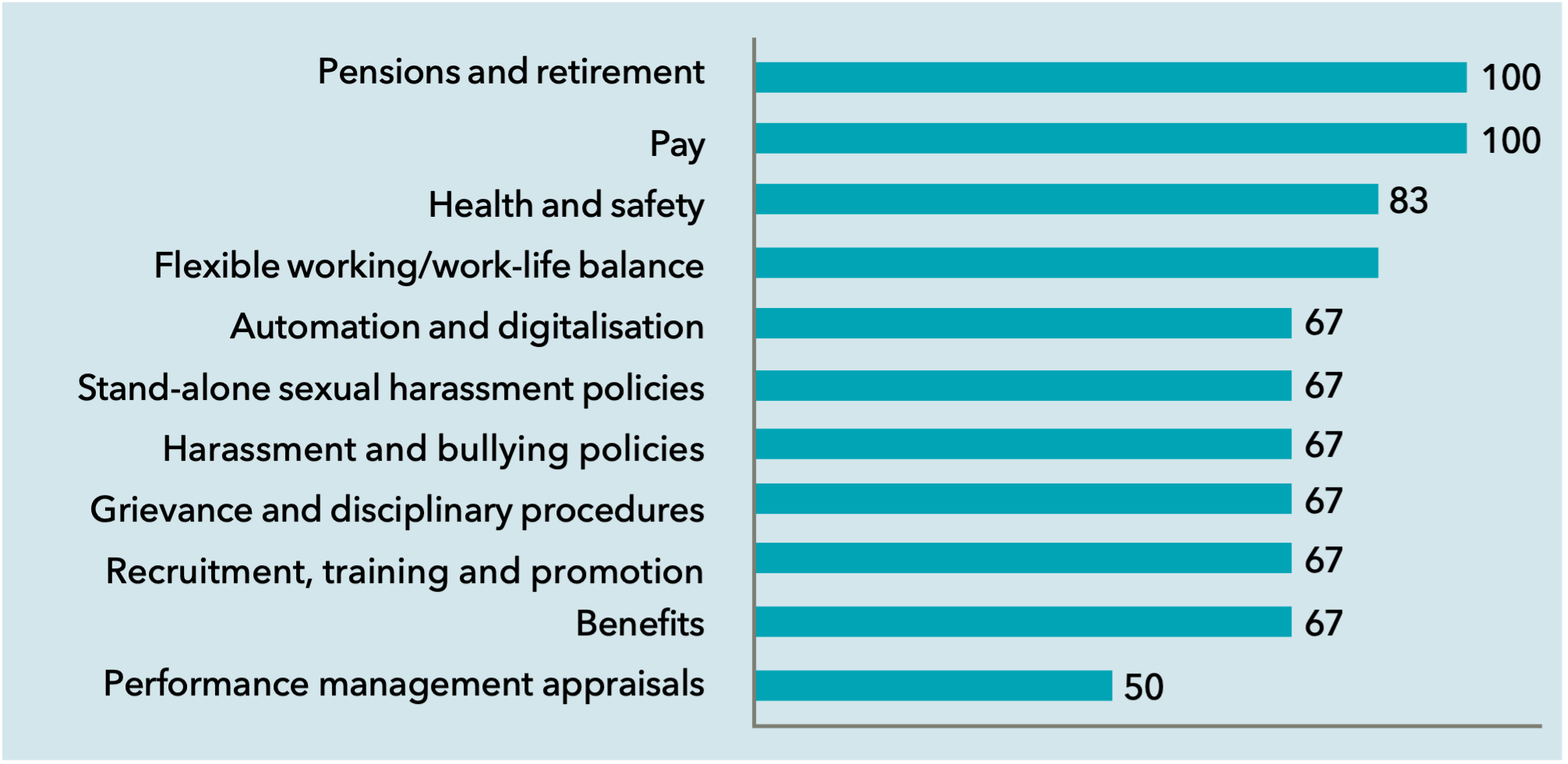
Figure 3: Medium unions with equality guidance on general bargaining topics (per cent)
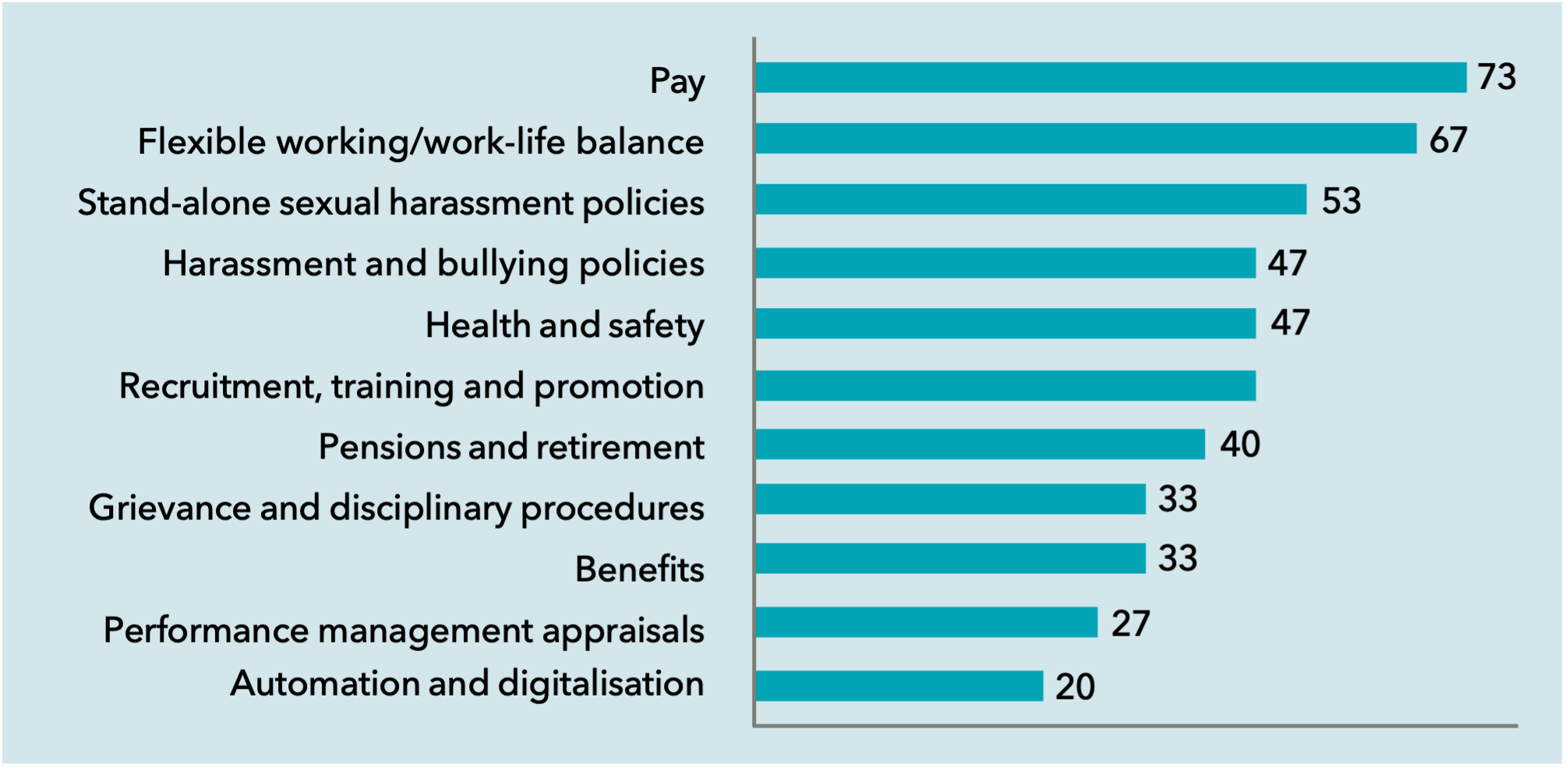
Figure 4: Small unions with equality guidance on general bargaining topics (per cent)
Examples of guidance on equality aspects of general bargaining topics
Unions were asked to provide some examples of the most important negotiating guidance or policies they had produced on equality aspects of general bargaining topics in the last four years.
Pay
The NAHT, with the help of equality experts from other unions and organisations, has published a very comprehensive toolkit called Achieving Equal Pay in the Workplace. It is aimed at individual workers as well as union reps and negotiators. It suggests ways of engaging members about the issue of potential pay inequalities in their workplace. It provides ideas and tips on negotiating with employers around a range of workplace practices such as pay, recruitment, family leave and flexible working. And there is detailed guidance on equal pay audits, improving workplace culture and making an equal pay claim.
In the absence of legislation on ethnicity pay gap reporting, Unite provided its negotiators with a guide on how employers can address it. It sets out the key reasons for the pay gap and what type of data employers should be asked to collect in order to develop an action plan.
Flexible working/work-life balance
UNISON’S bargaining guide to working from home and hybrid working covers all aspects of this increasingly widespread area of negotiation. It includes the different types of flexible working and existing statutory rights, the pros and cons of various flexible work options, guidance on a good workplace policy and how to negotiate it with management, and a specific chapter looks at homeworking expenses and allowances.
The FDA’s guidance on this topic makes eight recommendations for a workplace policy to improve work-life balance for staff based on member experiences of flexible working. Recommendations include training for line managers to ensure they do not give poorer performance ratings to staff working part time or flexibly.
Recruitment, training and promotion
The EIS produced guidance for its local association (branch) secretaries on getting their employers (local authorities) to improve the recruitment of Black, Asian and Minority Ethnic (BAME) educators.
Based on the union’s research into local authority practices in relation to recruitment of BAME staff, it suggests pro-active measures employers can take, including promoting teaching
as an attractive profession to BAME pupils, reviewing recruitment process to ensure they do not discriminate, considering sponsorships of BAME educators, including for leadership opportunities, and implementing anti-racist recruitment practices, such as training BAME staff to be on recruitment panels and scoring and weighting applicants by criteria set prior to interview.
Meanwhile, UNISON has produced a model policy for the recruitment, support and retention of migrant workers. It includes information on migrant workers’ rights and checklists for ensuring workers are not discriminated against in pre-employment vetting.
Health and safety
ASLEF and Usdaw have sought to put support for staff facing domestic abuse on the negotiating agenda. ASLEF’s guidance sets out the types of behaviour that constitutes domestic abuse, why it is a trade union issue and employers’ responsibilities. Usdaw developed a model policy which it included as an item in its 2020-21 pay review negotiations with a range of large employers. Some of its successes in this area are set out on page 36.
Sexual harassment
Usdaw’s statement on ending sexual harassment in the workplace sets out the scope of the problem in the places where its members work. For reps and negotiators, it clarifies the law, provides ways in which they can help improve the workplace culture and suggests actions they should urge their employers to take, including establishing stand-alone policies for preventing sexual harassment and supporting ‘victim-survivors’.
Equalities bargaining topics
Figure 5 shows the percentage of unions that said they had current up-to-date policies, guidelines or briefing materials for their negotiators on equalities bargaining issues or, for those dealing with few employers, had put these as items in claims to employers.
The most common topics for negotiating guidance were issues for women, followed by working parents, and parents-to-be and carers, as well as disabled workers and general equalities bargaining. Less common is guidance on younger and older workers, religion and belief and, in particular, migrant workers. However, it is worth noting that the category, Migrant workers, was newly introduced into the list of equality guidance topics in 2024, and some relevant issues are included in the Black workers category.
Figure 5: Unions with guidance on equality bargaining topics (per cent)
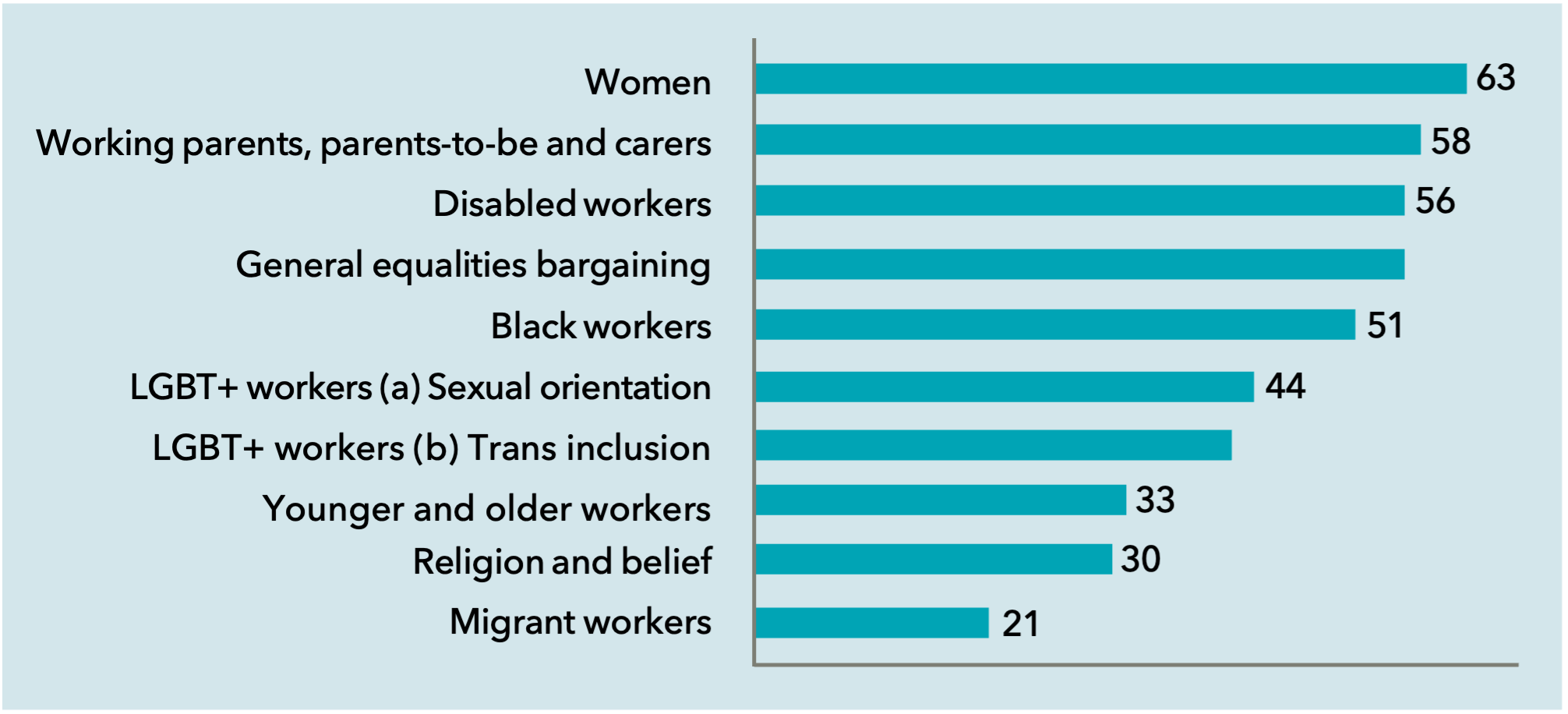
Table 6 shows the changes in these figures since the 2020 TUC Equality Audit. The proportion of unions with guidance in some areas has increased substantially. This is particularly true for guidance on Black and disabled workers’ issues but also for guidance on women, working parents, parents-to-be and carers and general equalities bargaining. Where there have been decreases, please see the note in the section on guidance on general bargaining topics on page 20.
Table 6: Unions with guidance on equality bargaining topics (per cent)
| 2024 | 2020 |
Women | 63 | 58 |
Working parents, parents-to-be and carers | 58 | 50 |
General equalities bargaining | 56 | 50 |
Disabled workers | 56 | 44 |
Black workers | 51 | 39 |
LGBT+ workers (a) Sexual orientation | 44 | 50 |
LGBT+ workers (b) Trans inclusion | 42 | 44 |
Younger/older workers | 33 | 33 |
Religion and belief | 30 | 33 |
Migrant workers | 21 | -* |
*New equality category in 2024
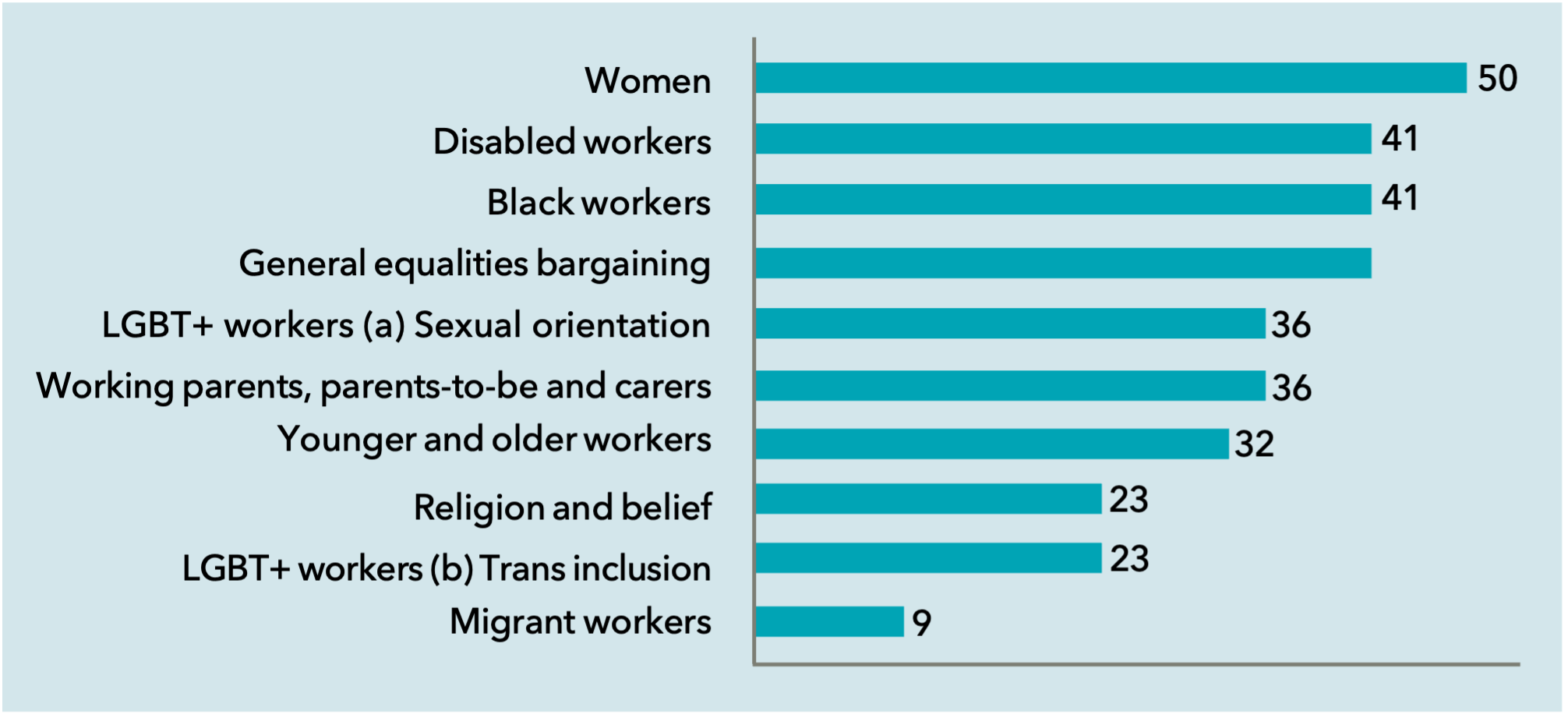
Looking at variations between different union size bands, large unions are more likely to have guidance in most of these equality areas than medium-sized or small unions, although not in the case of general equalities and religion and belief, where a higher proportion of middle-sized unions have materials.
Current top priorities vary between the groups. The most common areas for guidance in large unions are on bargaining issues for trans inclusion and for women, produced by all six of those unions. In medium-sized unions the key area currently is working parents, parents-to-be and carers, while in small unions it is bargaining issues for women.
Figure 6: Large unions with guidance on equality bargaining topics (per cent)
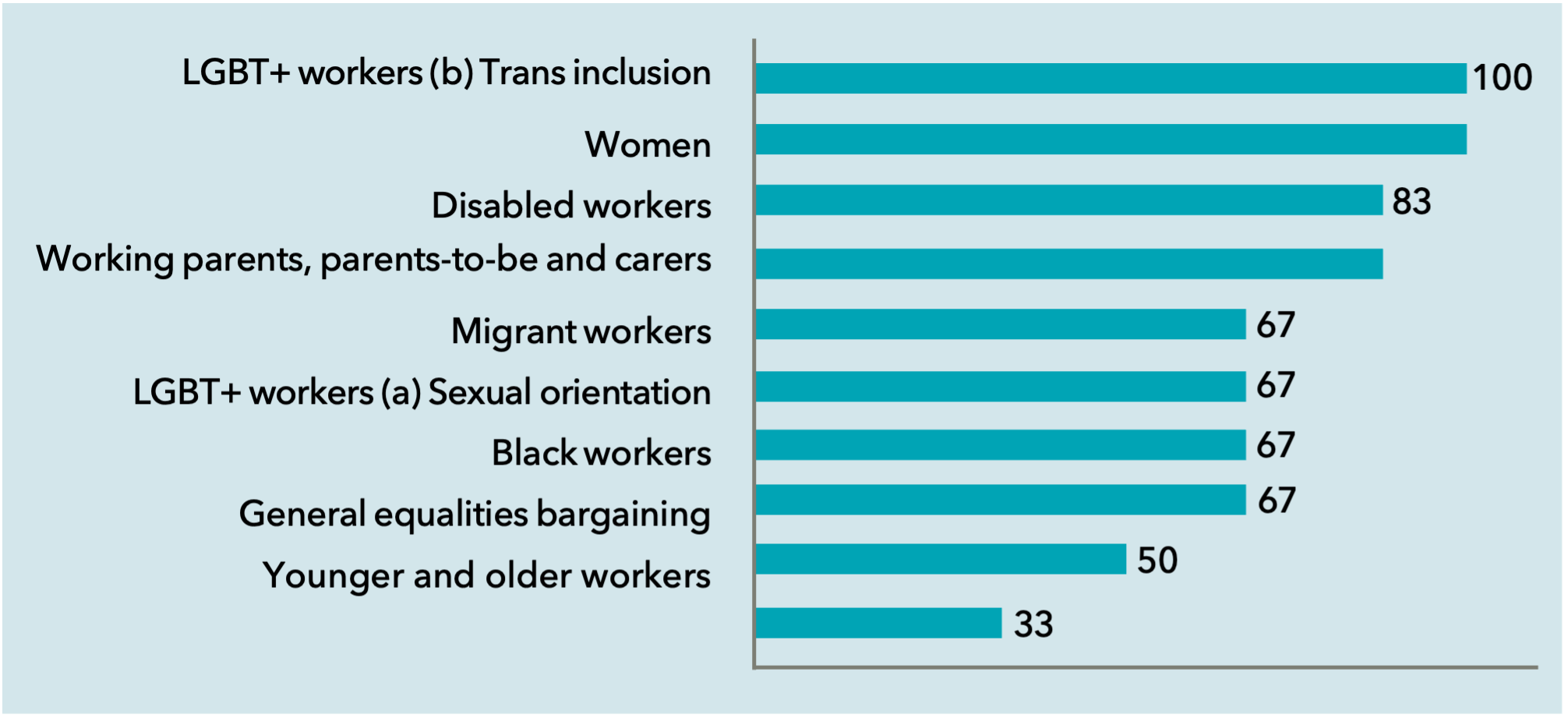
Figure 7: Medium-sized unions with guidance on equality bargaining topics (per cent)
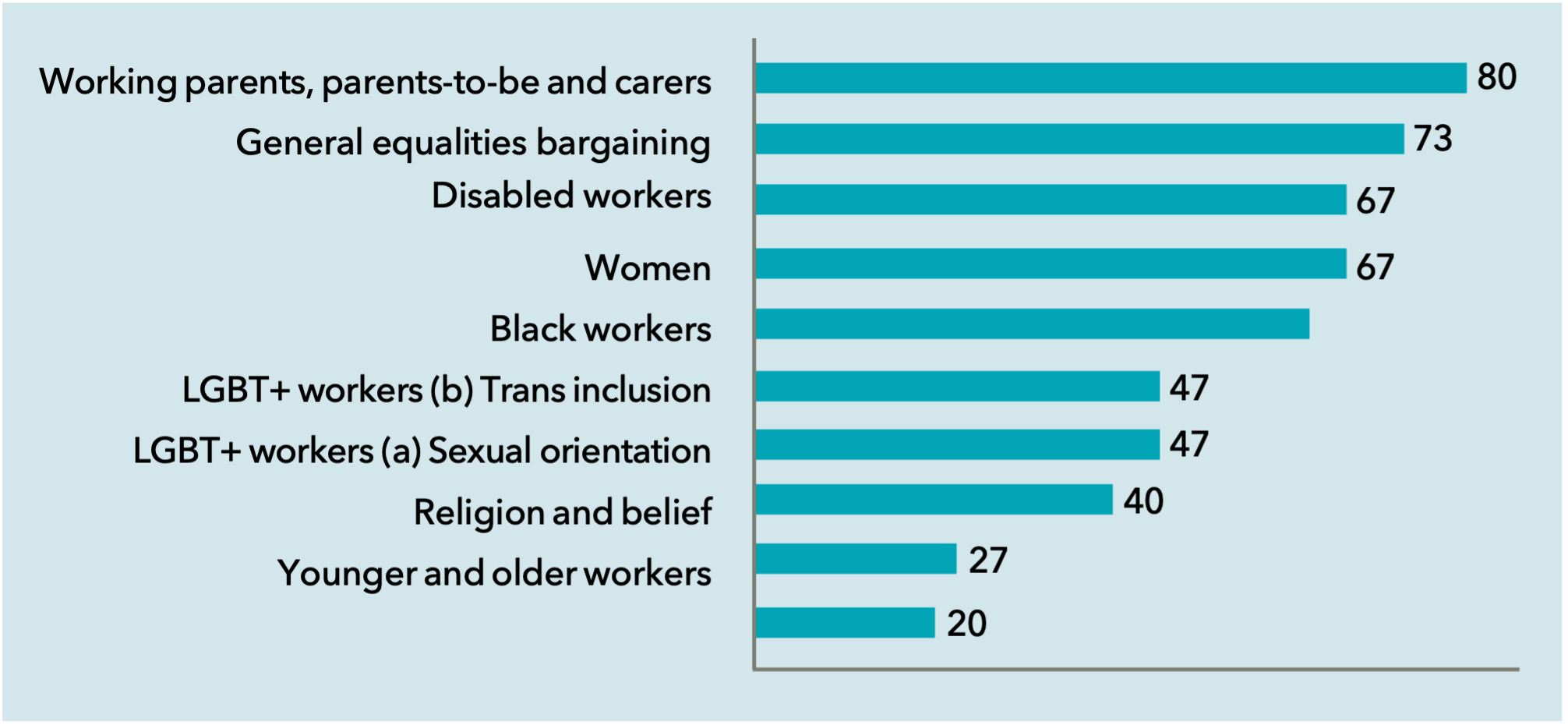
Figure 8: Small unions with guidance on equality bargaining topics (per cent)
Examples of guidance on equality bargaining topics
Unions were asked to provide some important examples of bargaining policies and guidance they had produced for their negotiators on equality bargaining topics.
General equalities
The PFA has produced a guide on equality, diversity and inclusion (EDI) to help its representatives running the EDI workshop which the union delivers to all professional footballer members. It outlines the game’s commitment to combating discrimination and covers relevant law, acceptable language as a professional footballer, guidance on FA rules, the protocols for reporting discrimination and details of sanctions.
Women
The increased priority many unions have been giving to bargaining over menopause policies is reflected in the number who supplied examples of guidance or polices for their negotiators. Examples sent to the Audit are from unions both with majority women memberships, such as Usdaw and the FDA, and those with majority men memberships, including Unite, Community and ASLEF.
Common advice is for negotiators to aim for stand-alone menopause agreements and risk assessments to take account of potential adverse effects of menopause on women at work.
Usdaw, who says 100,000 of its members are women aged 45 or over, is urging negotiators to push for a stand-alone menopause policy developed with the union. It says this should cover training for managers and staff, a confidential, named point of contact for women, risk assessments, examples of common reasonable adjustments that can help (for example providing access to water, providing portable fans, additional rest breaks, access to a
quiet room, changes to hours or days of work and changes to job role/duties), menopause absence to be counted separately to other absence, natural fibre uniforms or relaxing uniform policies, establishing a peer support group, and signposting to further support.
Black workers
Community has a guide for members and reps on tackling racism and discrimination in the workplace. The guide, produced in conjunction with Community member Baroness Doreen Lawrence, includes tips on making the case to the employer, 12 steps that employers should be taking, and other workplace advice.
UNISON has a comprehensive model policy to be negotiated with employer.
Disabled workers
ASLEF’S Best Practice Guide for Disabled Workers advises reps and branches on what it calls “the absolute minimum that train operators need to adhere to”, which goes beyond legal minimums. It covers the relevant law, disability and sick leave, reasonable adjustments, risk assessment and disability, Access to Work, disability discrimination, confidentiality and signposting to further information. RMT has produced a disabled transport workers’ charter setting out its demands to support disabled workers.
Unite has produced detailed negotiators’ guidance specifically on reasonable adjustment passports in addition to its guide, Disability Equality at Work. It includes a reasonable adjustment passports model policy with tips and checklists for reps.
Other guidance for reps negotiating around disability include the PFA’s guidance on neurodiversity and mental health and Unite’s Long Covid negotiators’ guide. This sets out what Long Covid is and how people can be supported, along with checklists of issues for reps to take up with their employers.
LGBT+ workers
The EIS guidance on trans rights was updated following the Scottish Government’s publishing of the Gender Recognition Reform Bill in March 2022. The union issued the new guidance because of the “rise in toxic debate and misinformation around the
proposed changes” with many members unsure of the Bill’s implications. Although it is aimed at its members as teaching professionals, it is also useful to reps and members generally in addressing some the questions many have about the issue.
ASLEF’s Best Practice Guide for Transgender Workers details the key areas that reps need to consider in supporting and negotiating on behalf of transgender members. Their guide includes information on the process of gender reassignment, advice on how to inform colleagues and others about transition, the use of pronouns, inappropriate questions, changing facilities and toilets, uniforms and dress codes, records and confidentiality, redeployment and retirement, medical treatment during employment and health and safety considerations.
Meanwhile, Community’s guide for all LGBT+ members and allies sets out the relevant legal rights and covers wide-ranging issues such as bullying and harassment, collecting data and checking internet firewalls and filters, such as ensuring words such as gay are not blocked as adult content.
Religion and belief
Community’s guide on faith and belief for members and reps covers everyday practicalities of someone querying to what extent their faith needs should be accommodated by employers.
PFA’s guide, Muslim Player Considerations: understanding and embracing differences in football, provides educational information for non-Muslims and details on what issues employers (clubs) should address. These include provision of prayer facilities, dietary requirements, citing of player accommodation and issues during overnight stays. It also provides an understanding of Ramadan, which has a particular impact for those PFA members who will be fasting while training and playing.
Working parents and parents-to-be
The RCM has produced comprehensive guidance on maternity pay and rights, including in situations of miscarriage and pregnancy loss. Whilst statutory rights for those who suffer pregnancy loss before 24 weeks are minimal, some unions are attempting to get improvements through collective bargaining.
UNISON has produced a model pregnancy loss policy to get employers to support workers. It says employers should provide sympathetic treatment in cases of pregnancy loss before 24 weeks as well as additional leave where necessary. Any resulting sick leave should be counted outside the normal procedures that can lead to disciplinary action. The policy also calls for training for line managers and union reps.
The FDA has also taken up this issue by writing to one of its large employers, the Department for Environment, Food and Rural Affairs (Defra), asking for rights for parents suffering pregnancy loss before 24 weeks to be granted specific leave. It also proposes a peer support system, signposting to professional help, and robust training for line managers.
The NEU has taken up the issue of breastfeeding and expressing milk at work, issuing a checklist for reps and a model policy. The policy covers access to suitable facilities,
including access to cool drinking water, appropriate space and time to rest and express, and adjustments to the working day, including rest breaks.
Carers
The FDA has recommended changes to improve the Carer’s Passport system in the civil service. The passport enables carers and their managers to discuss and document the flexibilities needed to combine caring and work.
How union guidance supports and promotes equality
The Equality Audit asked unions what role their bargaining guidance had played in supporting and promoting equality.
Several unions shared examples of where guidance had led to improved terms and conditions.
There has been particular success in turning guidance on menopause policies into success at the workplace. The CWU says negotiations based on its menopause guidance resulted in the first ever Royal Mail Group Menopause Guide for Managers, and Unite’s materials led to menopause polices being agreed in workplaces including Greencore, Ford, Nestlé and Arriva. ASLEF also ran a menopause campaign, including producing a draft workplace policy, and subsequently either agreed policies or were in negotiations in 25 of the 36 train and freight companies. This follows on from the menopause being
a substantial area of growth in the 2020 audit and the increase in high-profile public campaigning around the menopause, including by unions.
Other direct impacts of union guidance materials include UNISON’s guidance on women and pensions, which it says has helped members to negotiate better contributions from employers to auto-enrolment schemes.
Unite’s Period Dignity campaign persuaded multiple employers to sign a charter to improve facilities, while the NHBCSA’s campaign on the same topic won free sanitary products across its (sole) employer’s network.
The PFA considers that its work to promote equal prize money for female professional footballers was a key part of the success in achieving it at the Women’s World Cup.
Section D gives more details about the successful results of equality bargaining, but unions also pointed to other ways in which guidance has promoted equality. These include the following examples:
The NUJ says guidance and training has been fundamental in building negotiators’ confidence to address equality matters in the workplace and negotiate policies with employers and identify areas for improvement.
NSEAD, AUE and Community are among a number of unions whose guidance helps inform individual members on equality issues in sectors where there is little collective bargaining.
Equality guidance produced by UCU and NASUWT is embedded in their reps’ and negotiators’ training and briefings to ensure they are informed and encouraged to use the information in their negotiating and campaigning.
The GMB’s materials on equal pay are being used to build its capacity for identifying and fighting equal pay campaigns – a current major focus for the union.
A number of professional unions say their equalities guidance is not only aimed at improving conditions for groups who are under-represented or face discrimination, but also for use in members’ professional role as educators (EIS) or as health workers treating patients from such groups (SoR).
Stay Updated
Want to hear about our latest news and blogs?
Sign up now to get it straight to your inbox