
TUC Equality Audit 2024
Introduction
To supplement the information received from national unions as part of the 2024 TUC Equality Audit, the Labour Research Department carried out a survey of trade union workplace reps to investigate their experience of dealing with equality issues at work. This followed similar surveys carried out in 2016 and 2021.6
The latest survey ran for three months – between 14 November 2023 and 15 February 2024, with participants asked about their experiences over the past couple of years.
A total of 1,607 responses were received from reps, all of whom had held a post in their workplace union at some point during the years covered. They came from 36 different TUC affiliate unions (plus four UK-based non-TUC unions). 70 per cent worked in the public sector, 22 per cent in the private sector and four per cent in the voluntary or third sector.
Equality issues in the workplace
The reps were asked if, in the last couple of years, they had dealt with any equality/ inequality issues related to a range of strands (Table 9). More than three quarters (76 per cent) of them had dealt with one or more of these broad areas. This is higher than in 20182020, when just under two-thirds said they had dealt with such issues.
The results show that the most common equality/inequality area faced by workplace reps in the more recent period was issues related to disability, with 56 per cent of them citing this.
The area next most likely to require reps’ attention was issues related to the protected characteristic of sex, cited by 31 per cent of respondents, followed by race, at 30 per cent. Reps are much more likely to have dealt with issues related to older workers (28 per cent citing this) than to younger workers (12 per cent).
- 6The 2021 survey covered two separate periods – before the Covid-19 pandemic (2018-20) and during the pandemic (2020-21)
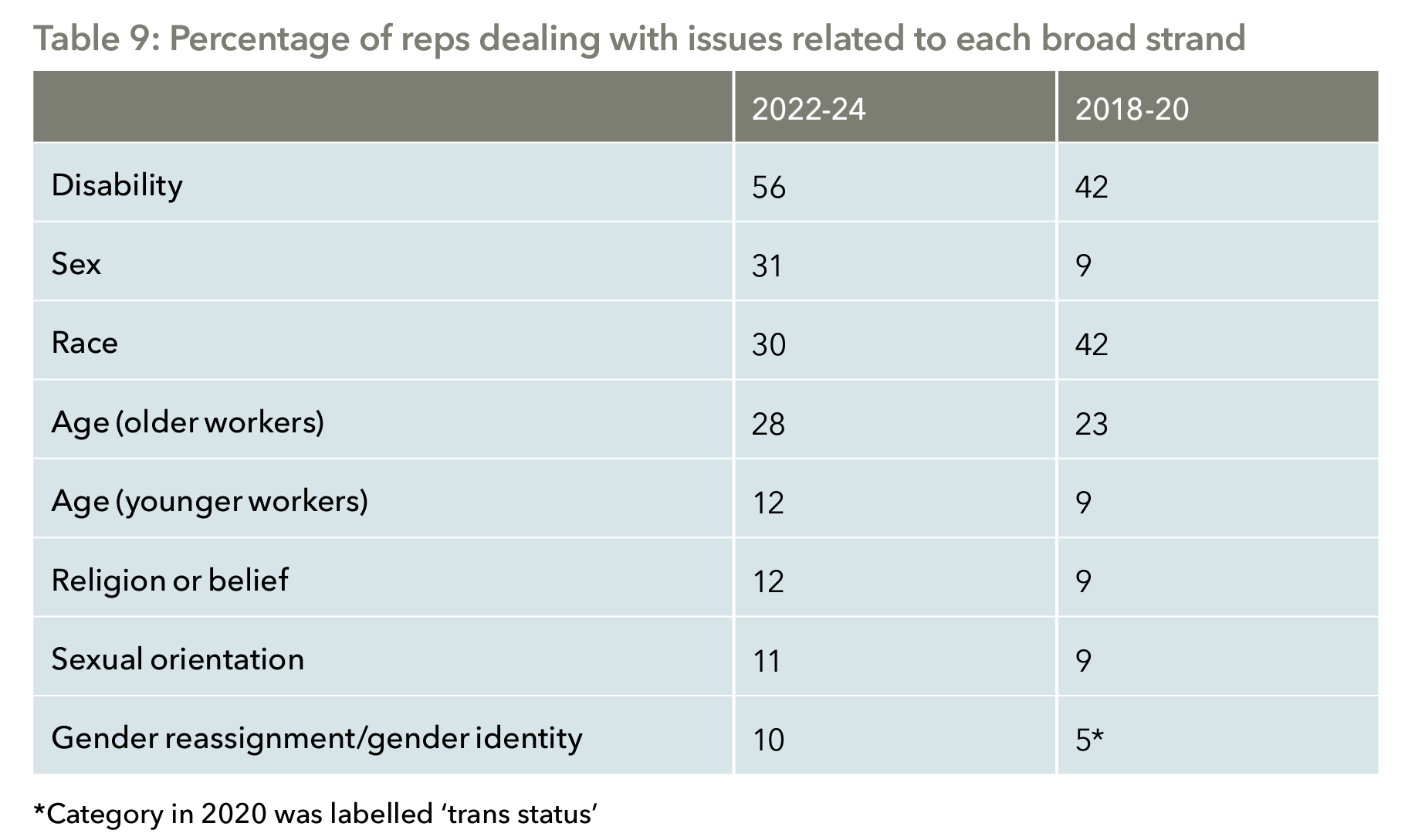
When these responses are compared with those of the ‘pre-Covid period’ (2018-20), there have been major changes in the relative prominence of issues over the past four years. While disability was already the most common area in the last survey, it has soared even higher as an area that reps have dealt with. The 2018-20 survey had already seen a doubling of the proportion of respondents dealing with disability-related issues compared with 2016, and now more than half of survey participants say they have dealt with this.
There is also a three-and-a-half-fold increase in the proportion of reps saying they had dealt with issues related to workers’ sex, from just nine per cent in 2020 to 31 per cent in 2024.
On the other hand, the proportion dealing with race-related issues fell from a high of 42 per cent in 2018-20 to 30 per cent four years later. However, reps responding to questions about the period 2018-20 – that is before the murder of George Floyd and the increased prominence of the Black Lives Matter movement – were submitting their responses in 2021, so it is possible that their recollections were somewhat distorted by what were then recent events.
Slightly higher proportions of respondents had dealt with issues relating to younger workers, religion or belief, sexual orientation and gender reassignment/gender identity than had four years earlier.
Specific equality topics reps have dealt with
The survey drilled down further into the specific equality/inequality topics reps had dealt with in the last couple of years. Nine in 10 (90 per cent) reps had dealt with one or more of the specific areas listed compared to 86 per cent in 2018-20. Table 10 shows the percentage of respondents who said they had dealt with each of the specific issues presented.
The most commonly addressed of these specific issues were flexible working/work-life balance, reasonable adjustments and sickness absence and disability. These would seem to echo findings above that issues relating to disability were by far the most widespread broad areas that reps had dealt with.
After those the next most common issue cited by a majority of reps was ‘bullying and/or harassment other than sexual harassment’.
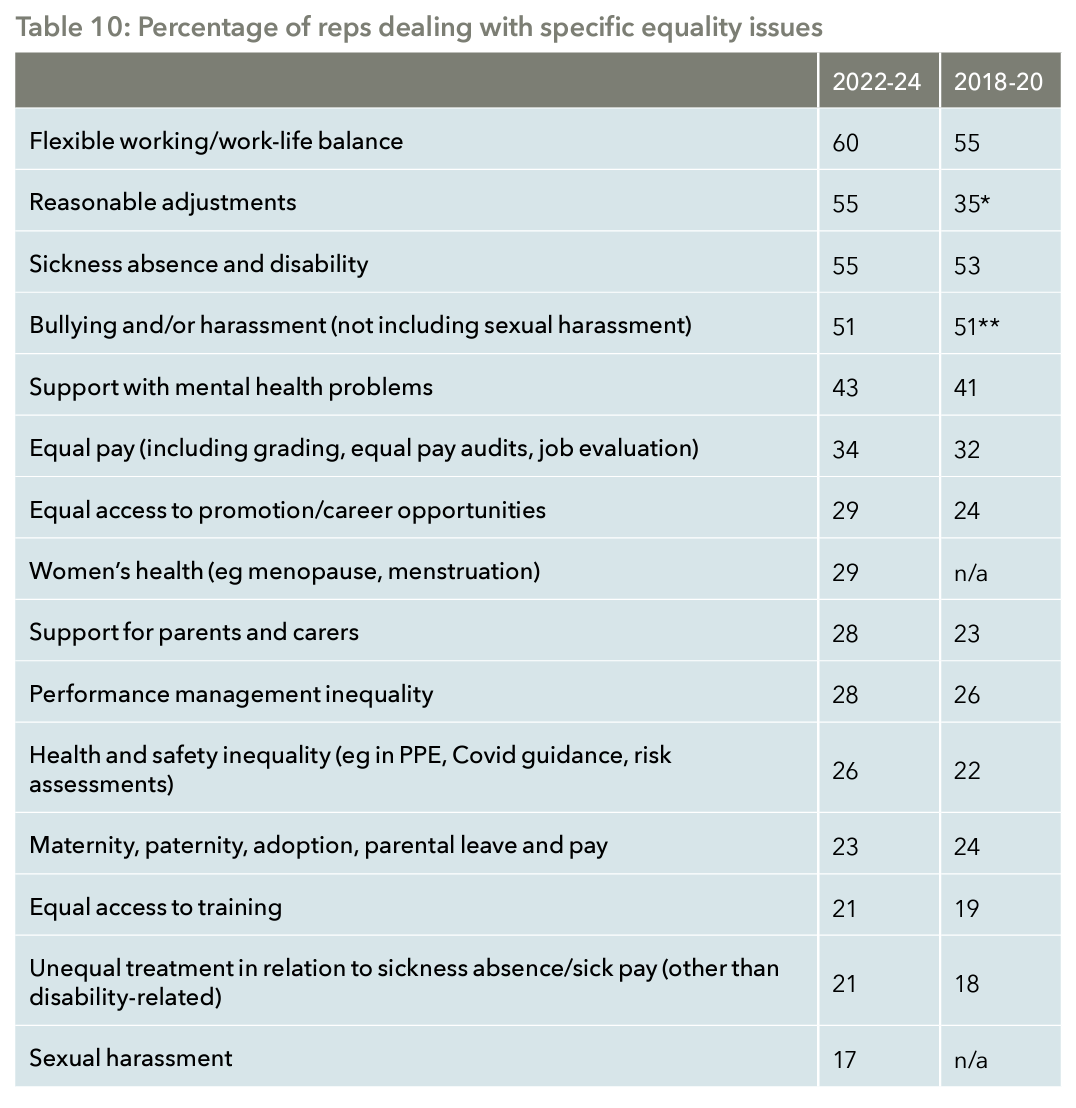
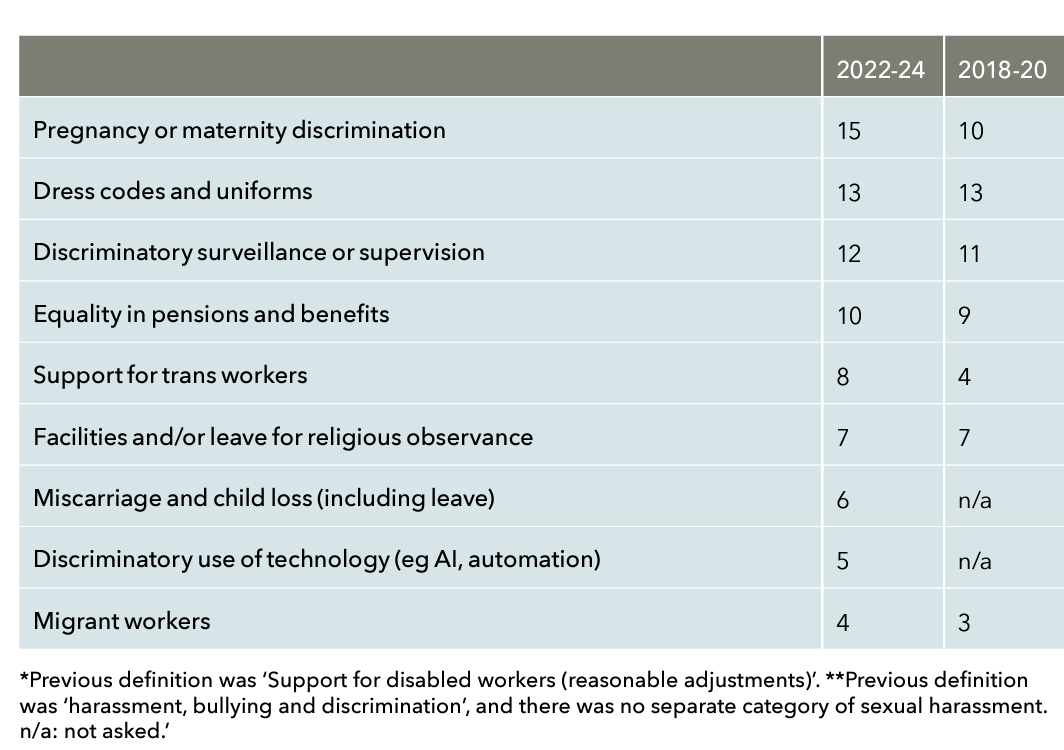
The table also gives an indication of how the prevalence of these topics compares with the immediate period before the Covid-19 pandemic of 2018-20.
There are virtually no areas where the call on reps has gone down. For nearly all topics, an equal or higher proportion of reps in the current survey said they had dealt with them compared with four years ago.
The most common issue addressed by reps – flexible working/work-life balance – was also the most common topic four years ago. It is a more widespread an issue now, with 60 per cent of reps saying they had dealt with it compared with 55 per cent in 2018-20.
The need to support people who require reasonable adjustments has become even more common, the proportion of reps dealing with this jumping from 35 per cent fours ago to 55 per cent now. The proportion dealing with sickness absence and disability issues is also higher.
Although the figures on bullying and harassment don’t seem to have changed (cited by 51 per cent in both surveys), it should be noted that the definition has changed. In the latest survey it now excludes sexual harassment. This is now a separate category which has been dealt with by one in six (17 per cent) reps in the last couple of years.
Other topics that have become noticeably more widespread since 2018-20 include equal access to promotion/career opportunities (29 per cent of reps now dealing with this compared with 24 per cent four years ago), support for parents and carers (28 per cent compared with 23 per cent) and pregnancy or maternity discrimination (15 per cent up from 10 per cent).
How topics arose as issues to be dealt with
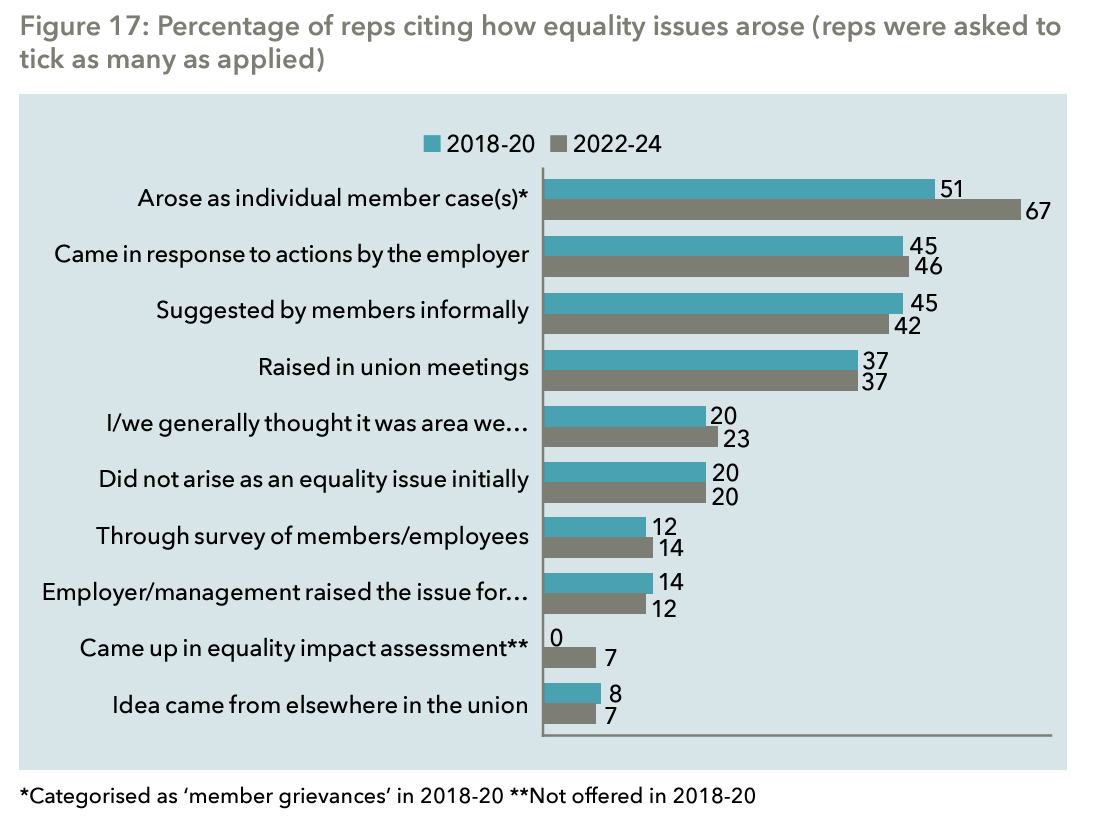
Reps were also asked about the routes through which the issues had arisen. Figure 17 shows the proportions indicating each route, and also displays the equivalent results from 2018-20.
The most common route, mentioned by two thirds (67 per cent) of all reps who had dealt with equality issues, is through cases from individual members. This was also the most common way for issues to arise in 2018-20, but the proportion indicating this has increased from just over half of reps (51 per cent) in the earlier survey.7 This suggests a higher proportion of workplace reps have been dealing with individual cases of inequality/ discrimination.
Proportions citing the other routes have not changed substantially compared with four years ago.
- 7Note, however, that the wording in the earlier survey was narrower, presented as member ‘grievances’, rather than ‘cases’.
Guidance and information on equality/inequality topics
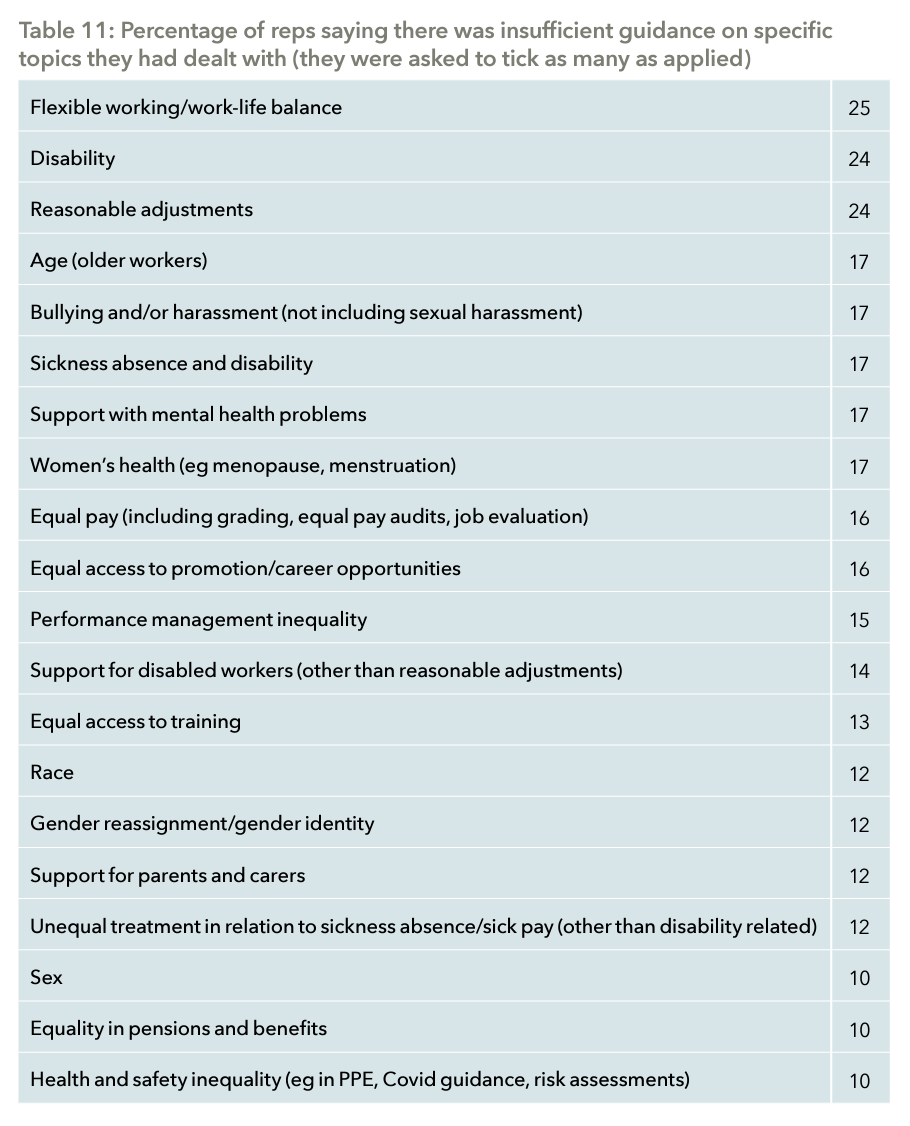
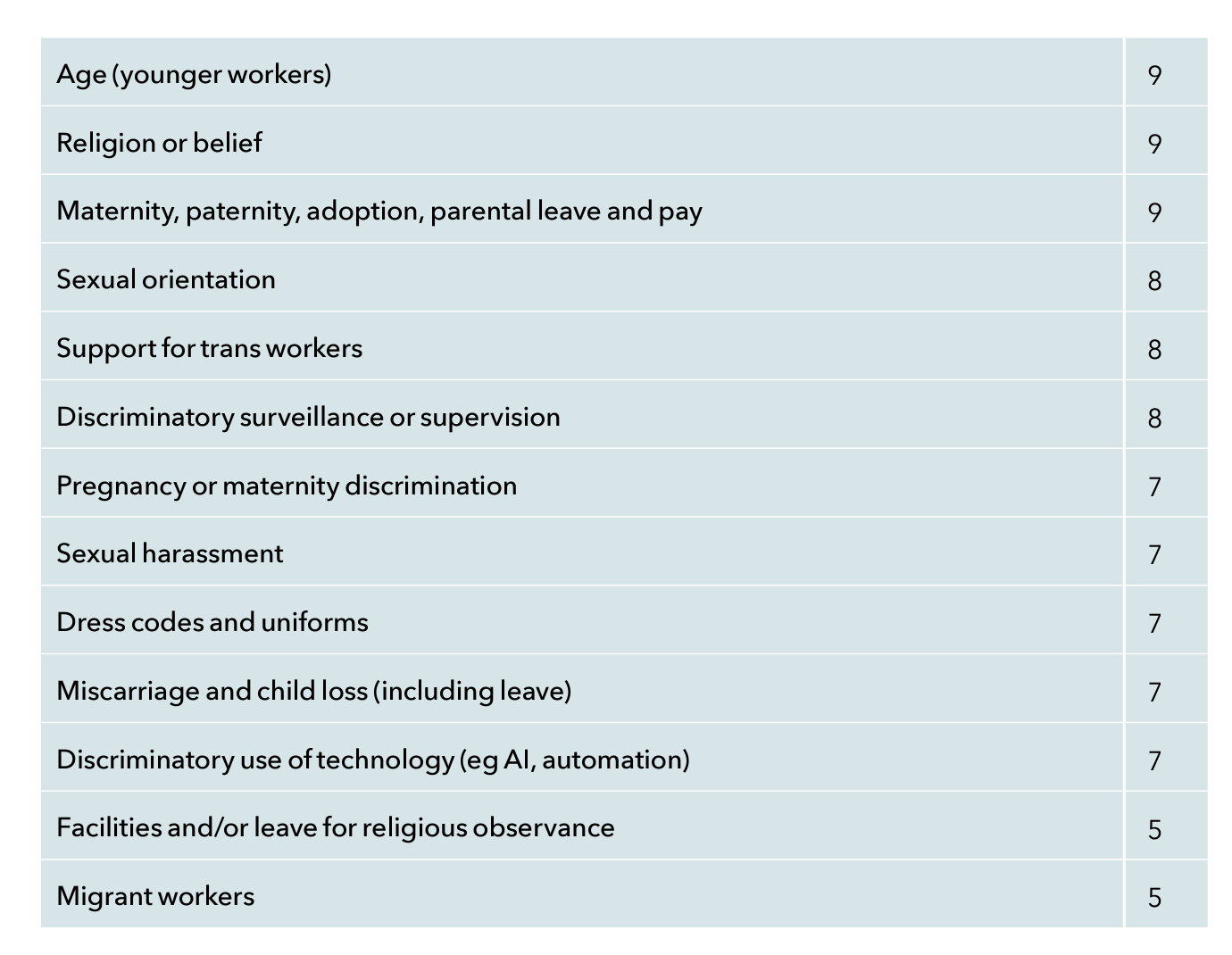
The survey sought to examine whether reps felt they had sufficient guidance and information on the equality topics they had faced at the workplace. More than two in three respondents (69 per cent) cited topics on which they had found a shortage of guidance or information available. Table 11 shows the proportion of reps who said they had found a shortage of guidance or information to help them for each specific topic.
The topics where guidance seemed to be in shortest supply were flexible working/worklife balance (25 per cent of all reps citing this), disability (24 per cent) and the related issue of reasonable adjustments (24 per cent).
Flexible working also came top of this list in the 2021 survey carried out during the Covid-19 pandemic. At that time, 21 per cent of reps said there was a shortage of guidance on flexible working/work-life balance. It is notable that an even higher proportion in the latest survey said there was a shortage of guidance, suggesting the post-pandemic landscape might have thrown up a need for even more help in negotiating such working arrangements.
Around one in five reps cited a shortage of guidance when tackling issues around each of the following topics: older workers; bullying and harassment (excluding sexual harassment); sickness absence and disability; support with mental health problems; women’s health; equal pay; and equal access to promotion/career opportunities.
Trade union training
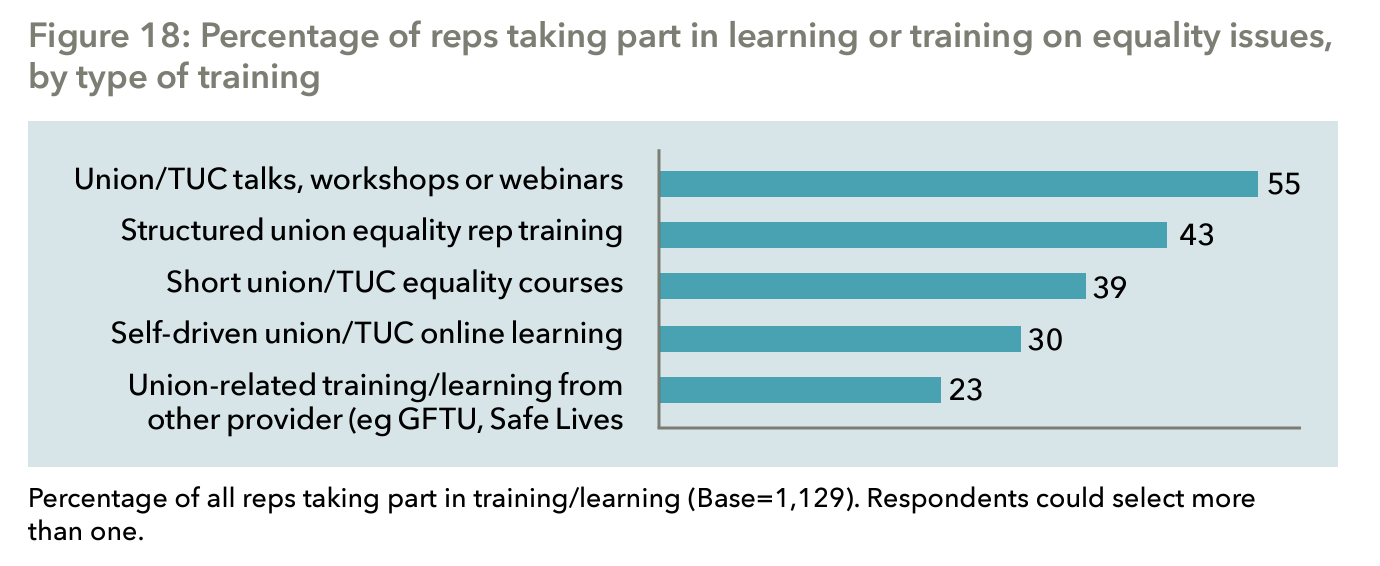
A majority of reps – seven in 10 survey respondents (70 per cent) – had taken part in some form of trade union training or learning on workplace equality issues in the last couple of years.
The most common type was union-run or TUC-run talks, workshops or webinars, attended by more than half (55 per cent) of respondents who had received any training or learning on equality issues (and 31 per cent of all reps in the survey).
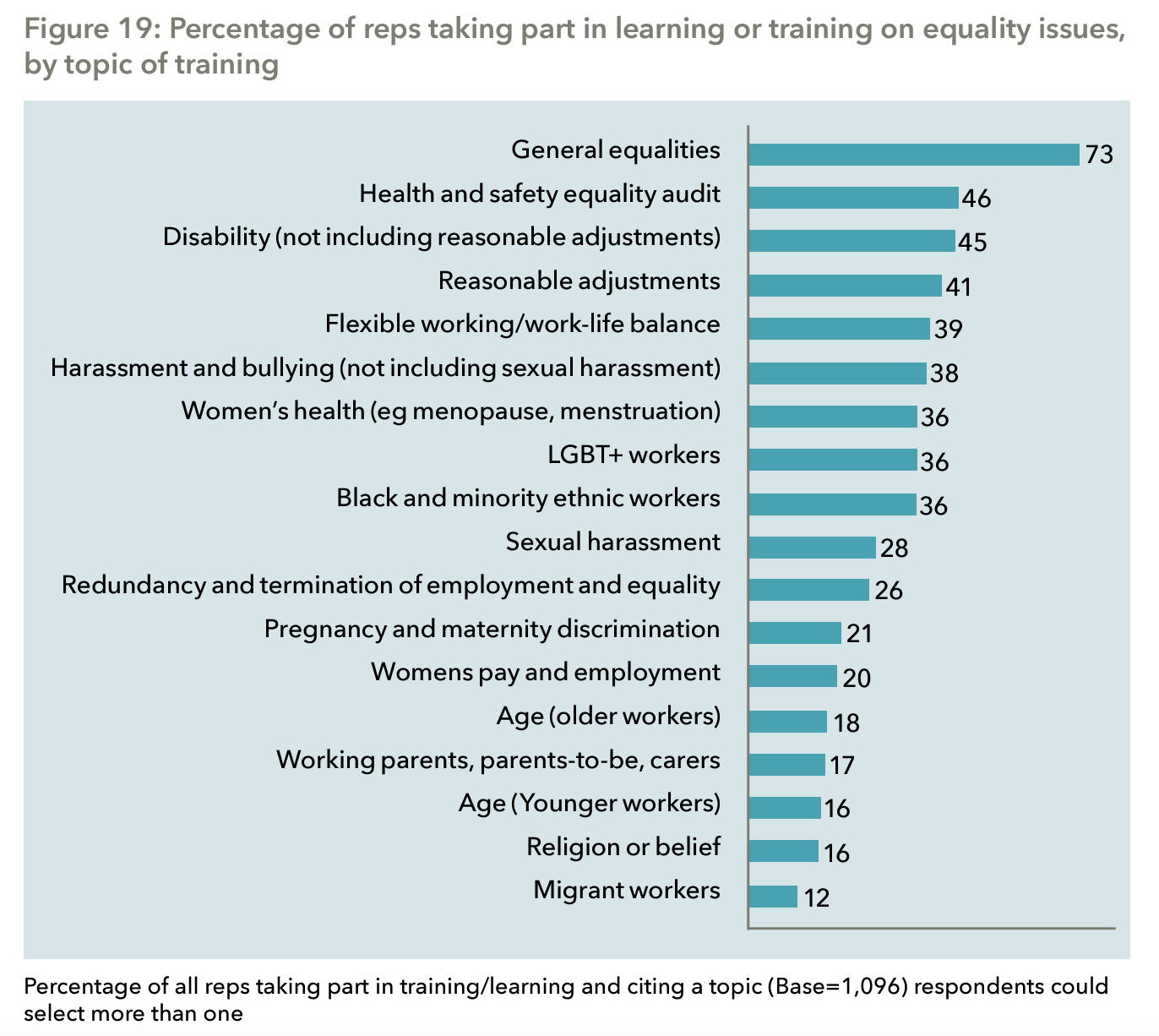
The most common topics for training or learning, apart from general equalities, were health and safety and equality, cited by 46 per cent of the reps who had undergone training or learning, and disability (not including reasonable adjustments), cited by 45 per cent.
Four years ago, the most common topic other than general equalities was ‘harassment and bullying’, though this had been a wider category, including sexual harassment.
Equality reps and facility time
A new set of questions was introduced in the 2024 survey asking reps about their employers’ equality practices.
First, they were asked about the existence of and arrangements for union equality reps. Just over half of the survey respondents (52 per cent) said their union had equality reps in place at their workplace.37 per cent of respondents said they did not, while 10 per cent did not know.
Those saying there were equality reps in place included 54 per cent of respondents from the public sector and 47 per cent of those from the private sector.
Just under half (47 per cent) said their employer provided facility time for equality reps, 28 per cent saying they did not and 24 per cent saying they did not know. Again, this was more likely among reps in the public sector (51 per cent saying their employer provided facility time) than those in the private sector (38 per cent).
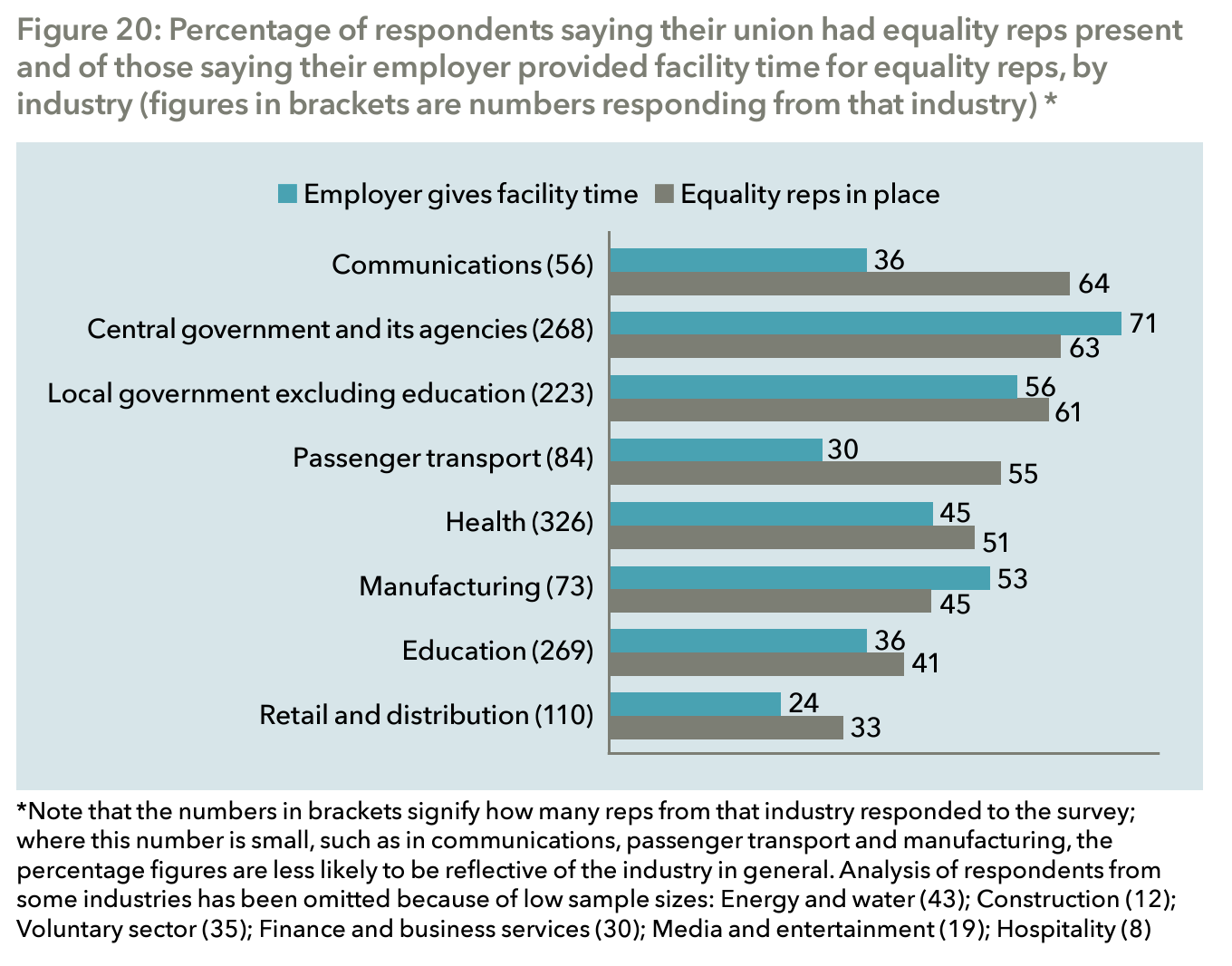
The availability of both the provision of facility time and equality reps’ presence in the workplace varies by industry (Figure 20).
Central government workplaces were the most likely to provide facility time for equality reps (71 per cent), but it was energy and water where equality reps were most likely to actually be present, with 70 per cent of reps in that industry saying their union had them in place.
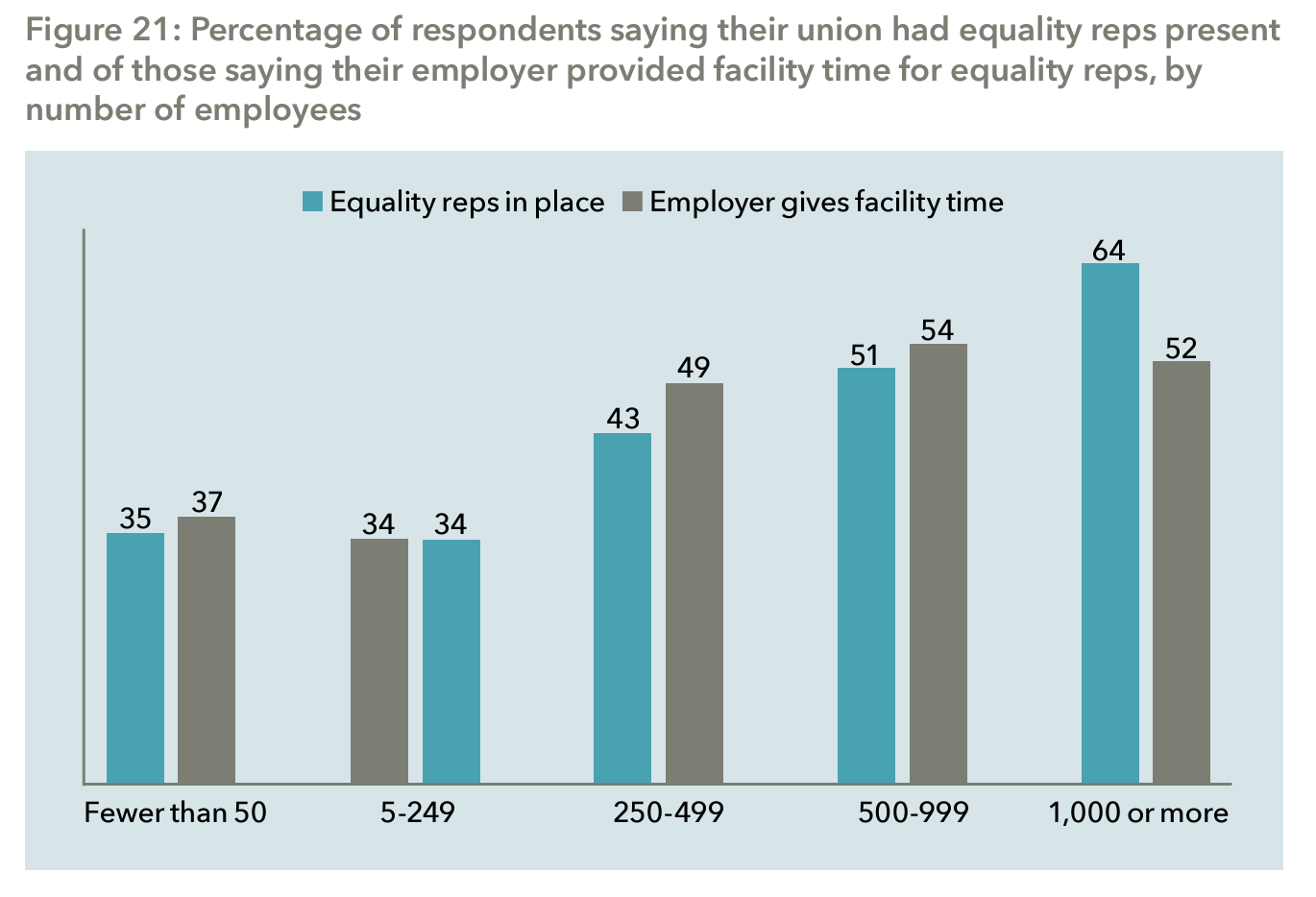
The presence of equality reps, not surprisingly, varies by the size of the workplace, with 64 per cent of respondents from workplaces with 1,000 or more employees saying their union had equality reps in place. However, this pattern is not entirely matched by the likelihood that the employer gives them facility time: workplaces with 1,000 or more workers are less likely than those with 500-999 to provide facility time for equality reps (Figure 21).
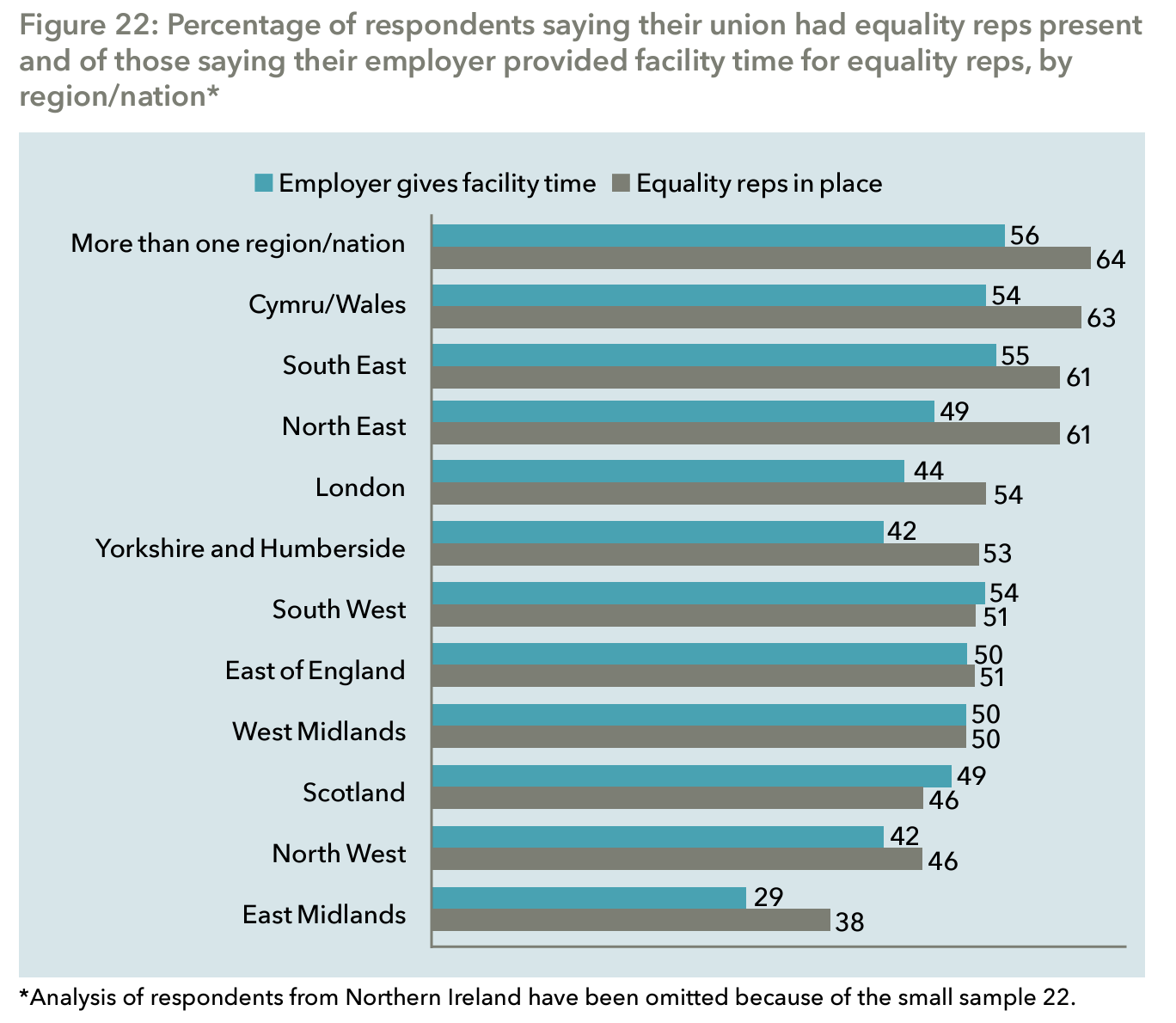
Perhaps less predictable is that both the likely presence of equality reps and the provision of facility time vary considerably by region/nation (Figure 22).
The reps most likely to say yes to both those questions are those whose workplace is sited in more than one region/nation, which would perhaps tend to indicate larger organisations.
In terms of single regions/nations, reps in Cymru/Wales are most likely to say their union has equality reps present (63 per cent saying they were). At the other end, reps in the East Midlands (38 per cent) were least likely to report having equality reps. Those in the South East are the most likely to say their employer gives equality reps facility time (55 per cent) and those in the East Midlands the least likely to (29 per cent).
These variations are likely linked to different concentration of certain sectors and industries in the different regions and nations.
Employers’ equality practices
Union reps were asked if their employer carries out a number of practices aimed at identifying or tackling inequalities in their organisations.
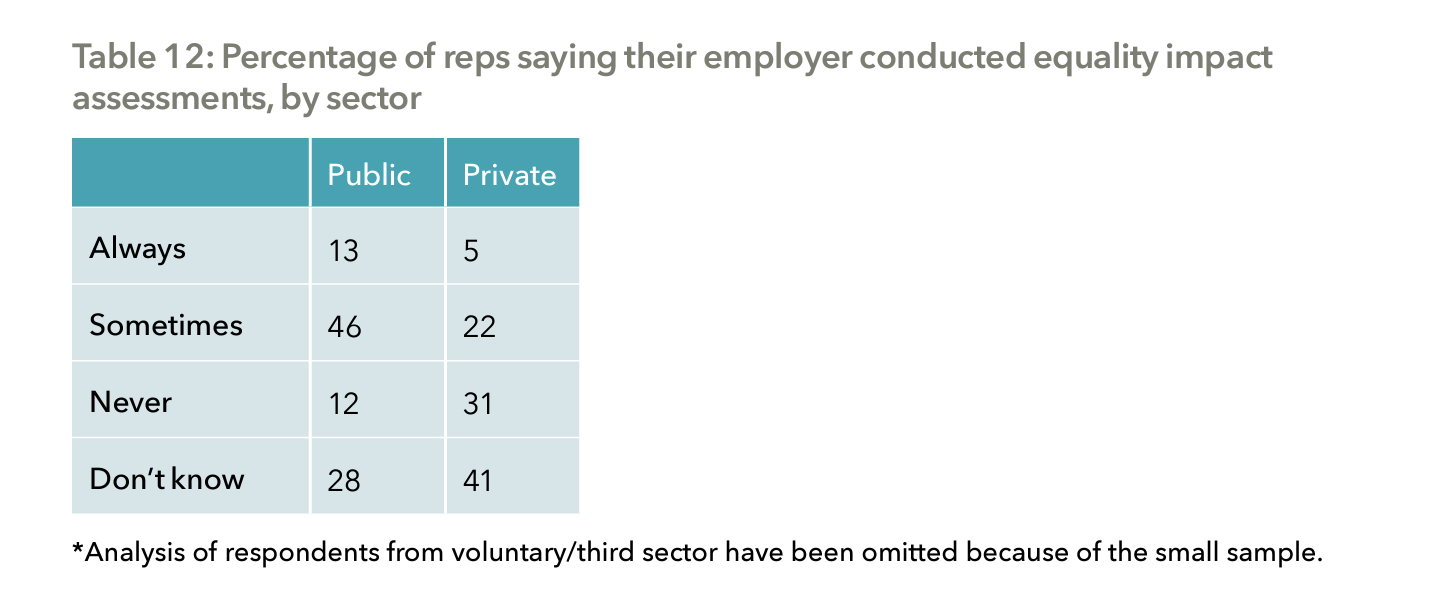
They were asked if the employer conducts equality impact assessments on workplace decisions. Just 11 per cent said they always did, and 41 per cent said sometimes. One in six (17 per cent) said they never did, while the other 31 per cent did not know.
Those in the public sector were more likely to say their employer always or sometimes conducted equality impact assessments than those in the private sector, though still only 13 per cent said they always did (Table 12). Public sector employers will have to meet the Public Sector Equality Duty, which is one of the reasons we may see higher percentages of public sector reps stating their employer carry out impact assessments.
The survey also asked about employers investigating and taking action on equality pay gaps. Overall, 42 per cent of respondents said their employer collected pay gap data on gender, 27 per cent did so on ethnicity, 23 per cent did on disability and 18 per cent did on LGBT+.
Of those reps in organisations with fewer than 250 employers, 23 per cent collected gender pay gap data. Of those reps whose employer did collect the data, fewer than a third (31 per cent) said the employer had an action plan on how to tackle their pay gaps. 45 per cent did not know. Where they did have an action plan, just under three quarters (72 per cent) said the employer published their progress on their action plan.
Employers in the public sector were more likely than those in the private sector to collect data for all types of pay gaps, according to reps’ responses. But of those who said their employer collected the data, those in the private sector were more likely to say there was an action plan to tackle the issue (Table 13).
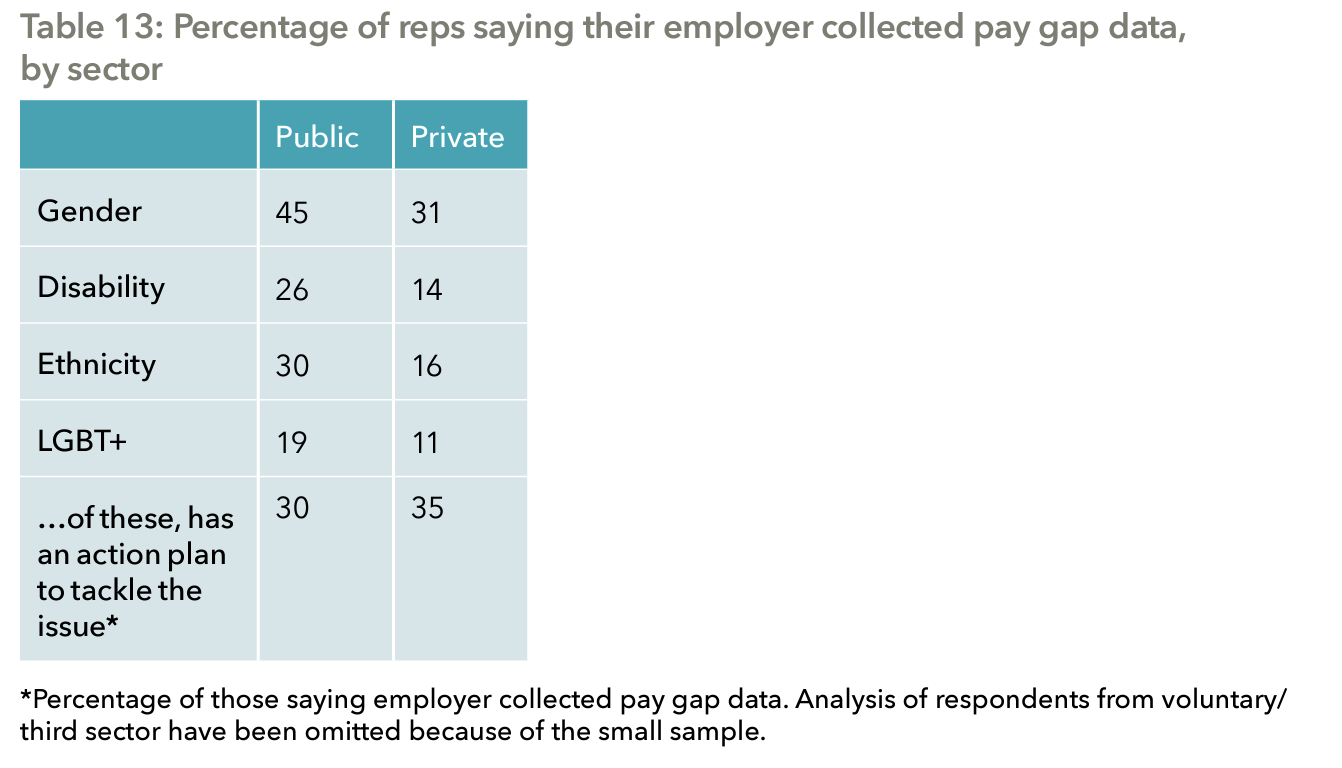
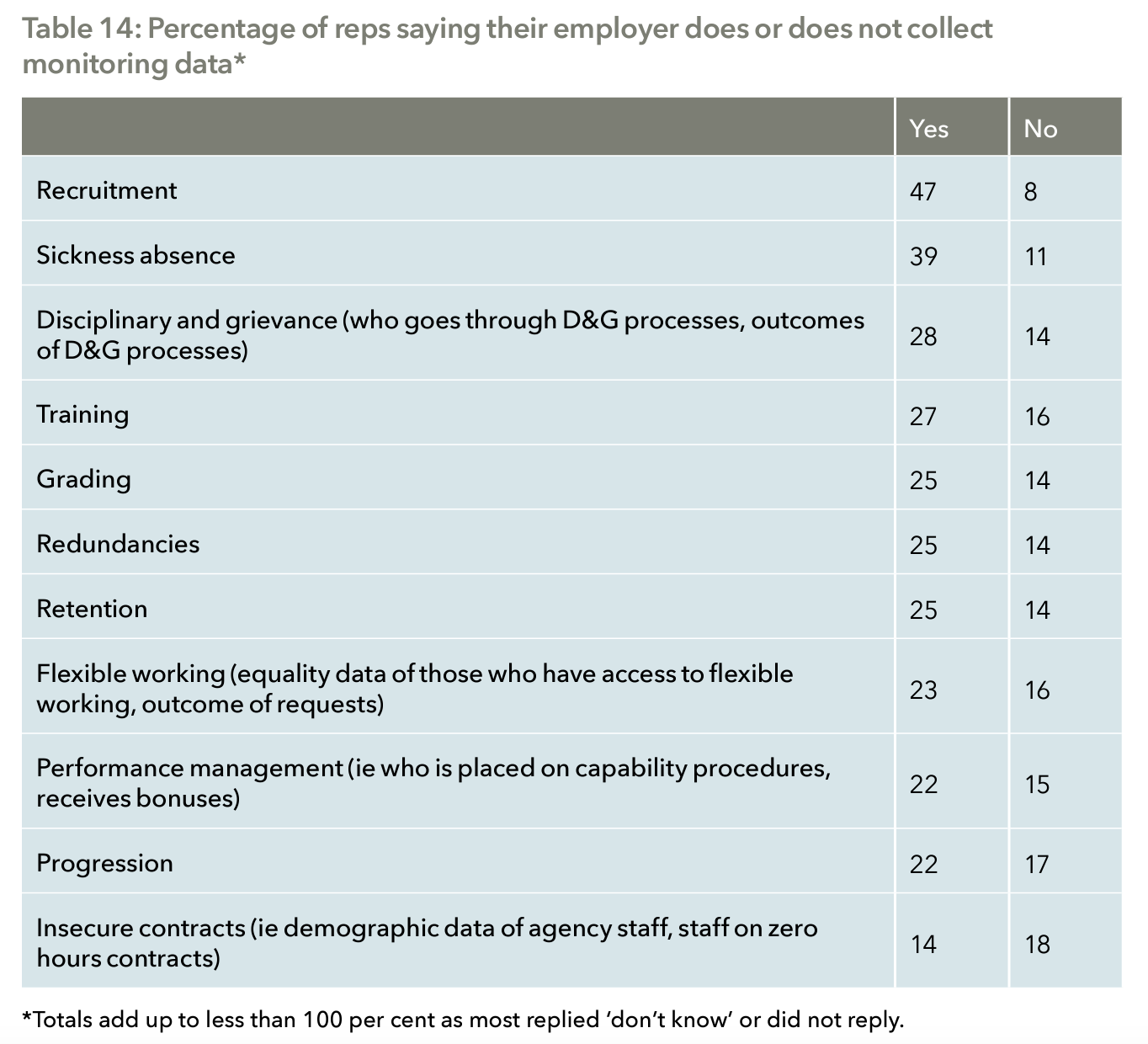
Reps were asked whether their employer collected data to monitor a range of workplace practices and procedures to ensure they operate on an equal basis and are not discriminatory. Table 14 shows how many said their employer did or did not, with only minorities of reps answering positively in each case. It is also worth noting that a large proportion of reps did not know whether their employer collected any of this data, suggesting such issues may not always be discussed with union reps or seen as information that is available for collective bargaining.
The area where employers are most likely to collect equality data is recruitment, with 47 per cent of reps saying their employer did so and only 8 per cent saying they did not.
The area where equality data is least likely to be collected is contract types – to monitor whether insecure contracts are disproportionately held by people from certain equality groups. Only 14 per cent of reps said their employer did this, despite this being an egregious form of employment inequality.
Fewer than one in four employers are known to collect equality data in the areas of performance management (just 22 per cent of reps saying they do so), progression (22 per cent) and flexible working (23 per cent).
The survey investigated the extent to which the reps’ employers had certain policies and procedures in place to foster equality and reduce inequality in the workplace. The polices listed are those which attempt to address some current widespread concerns among unions, their members and workers (Table 15).
It shows that, while two in three reps (67 per cent) say their employer has clear reporting routes for bullying and harassment, only four in 10 (40 per cent) say they have stand-alone sexual harassment policies. In most of the areas listed, fewer than half of reps said their employers had policies in place.
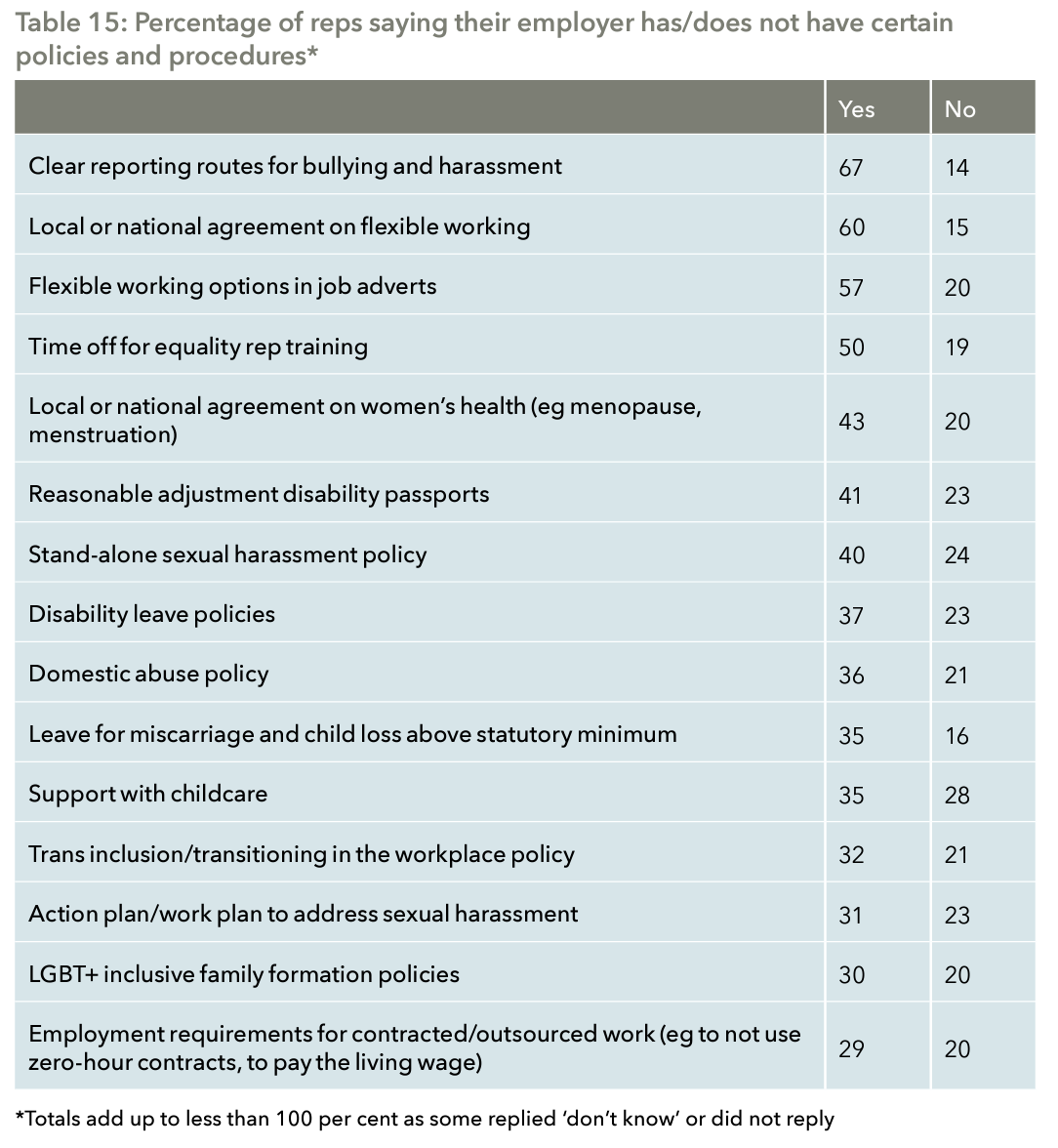
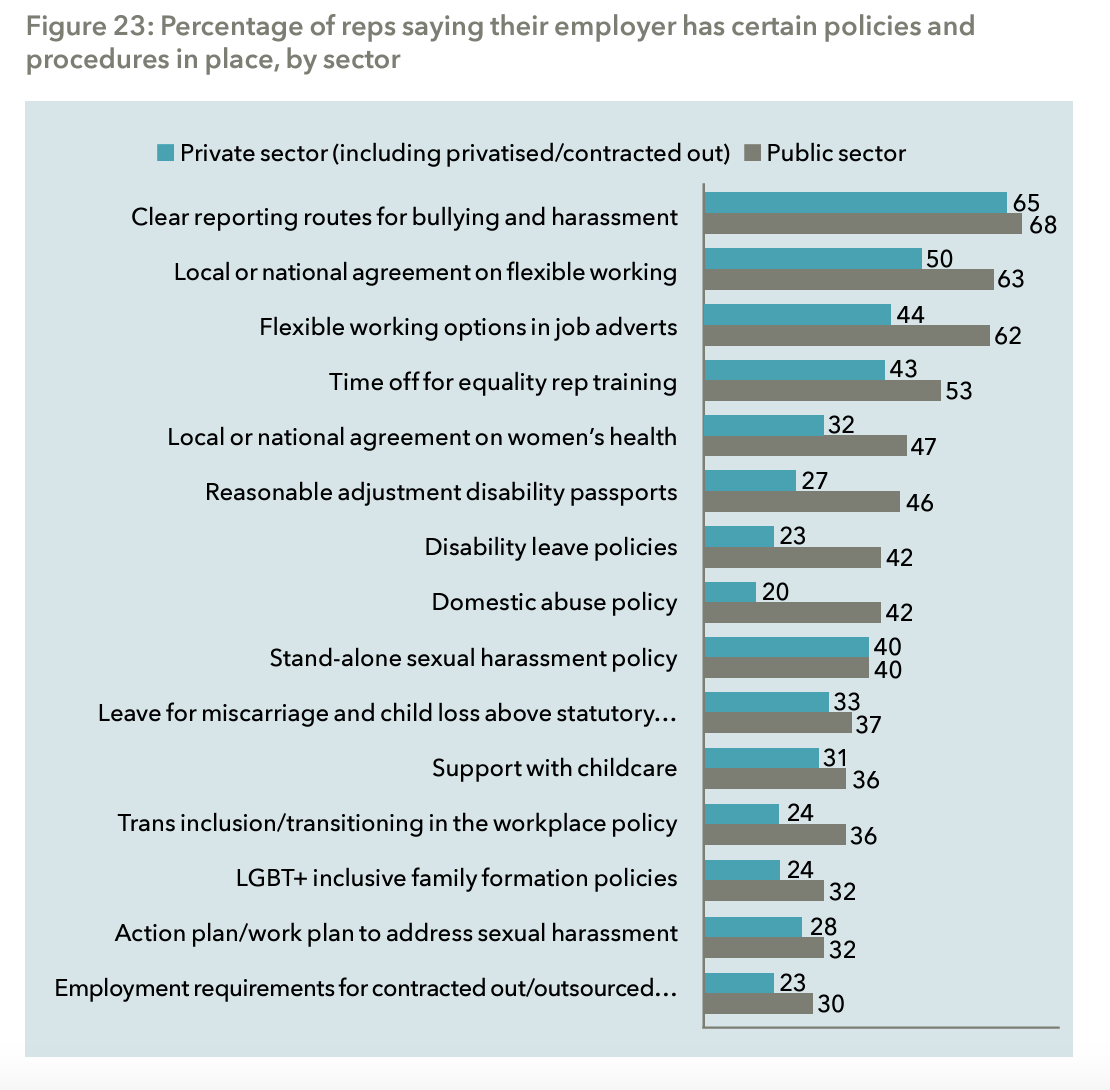
Figure 23 shows how the prevalence of these policies and procedures varies between public and private sectors. On most issues, the private sector lags behind the public sector
The bargaining climate
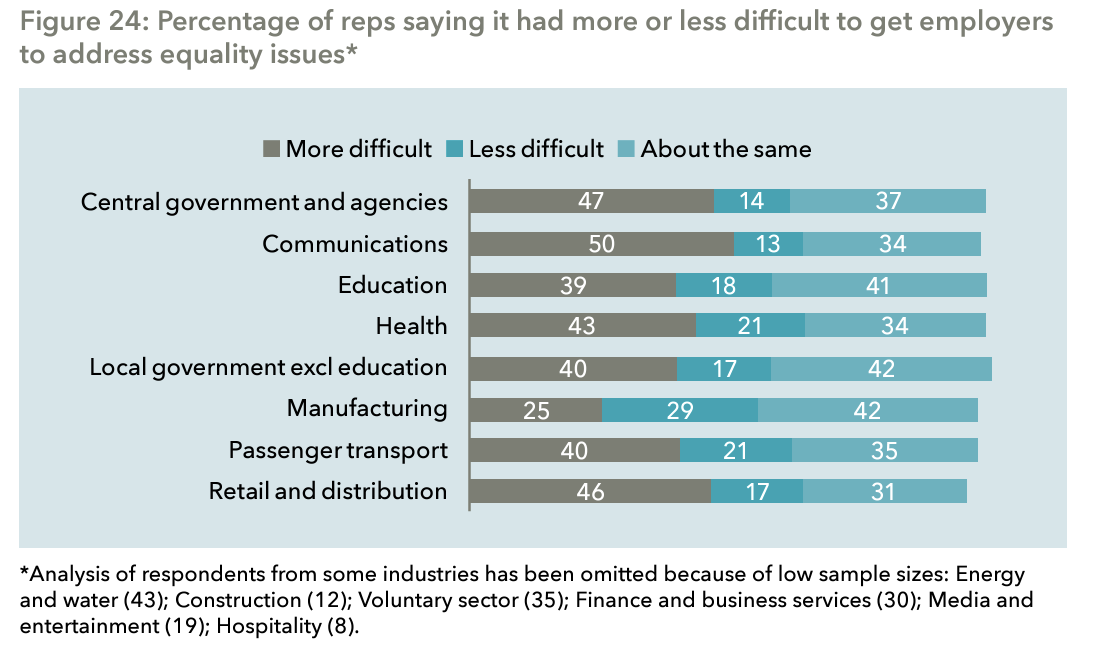
Reps were asked whether they thought it had become more or less difficult to get employers to address equality issues in the workplace in the last couple of years. The results were not very hopeful, with 42 per cent saying it had got more difficult and just 19 per cent saying less difficult, with 37 per cent answering “about the same”.
While there was not a significant difference in this pattern between reps from public, private and voluntary/third sectors, there were some variations between industries (Figure 24). The industries where there the highest proportions of reps said it had become more difficult were communications, and central government and its agencies. This mirrors what public sector unions have said about government departments approach to equality in the main audit report. Those most likely to say it has become less difficult are from manufacturing.
Stay Updated
Want to hear about our latest news and blogs?
Sign up now to get it straight to your inbox