
General Council Report 2026
Introduction
Welcome to the 158th TUC Congress in Brighton.
As always, this is a wonderful opportunity for trade unionists to come together to discuss our priorities for the year ahead. And this year we meet with a real sense of optimism, with the latest figures showing trade union membership up by almost 200,000. As the landmark Employment Rights Act comes into force, including new rights for unions to access workplaces, we have a unique opportunity to go for growth.

And there’s never been more need for strong, effective, growing trade unions than now. These are profoundly turbulent times for working people, with the cost-of-living crisis continuing to hammer families and a record number of young people not in employment, education or training. Meanwhile, the threat posed by overseas actors using donations to buy political influence in the UK and the Mandelson scandal has left trust in mainstream politics hanging by a thread – with right-wing populists and extremists waiting in the wings.
As the landmark Employment Rights Act comes into force, including new rights for unions to access workplaces, we have a unique opportunity to go for growth
This complex, volatile and dangerous environment extends around the world. As I write, devastating conflicts continue to rage in Ukraine and Sudan, while the people of Gaza labour under a deeply flawed and unjust peace. As feared, Donald Trump has unleashed chaos around the world, acting with impunity in Venezuela, threatening Greenland and Cuba, ripping up long-standing global alliances, and imposing punitive tariffs. His illegal war in Iran with Benjamin Netanyahu has killed thousands of innocent civilians and sent economic shockwaves around the world. While the TUC has no truck with the brutal and repressive regime in Tehran, Trump’s illegal and senseless conflict has been disastrous for Iran, the wider region and the global economy.
With the UK still facing a hit from ‘Trumpflation’, the government must pull out all the stops to protect workers, get living standards rising and rebuild our economy and public services. I have repeatedly urged Labour to deliver the change the British people voted for back in July 2024 by implementing the manifesto pledges on which it was elected. And I have urged the new leadership team in Downing Street to put the interests of workers, families and pensioners first.
That’s why the TUC continues to call for ministers to make good on their promise to Make Work Pay. Last December, our movement won a historic victory when the Employment Rights Bill became the Employment Rights Act (ERA), delivering a raft of advances for workers and unions. But, while the ERA is important, it’s not the end of the story: from parental leave to public sector insourcing and a new right to disconnect, there’s still a huge amount for the government to do to deliver on its broader Make Work Pay commitments.

Better work for all must be the cornerstone of an ambitious, far-reaching package of social and economic reform. While the government has done many good things – investing in public services and bringing down NHS waiting lists; renationalising our railways and British Steel; abolishing the two-child benefit cap and lifting hundreds of thousands of children out of poverty – far too little of its agenda has cut through to a public hungry for change. Following May’s disastrous election results, the Labour government must now show working-class people clearly and unequivocally that it’s on their side. From new taxes on obscene wealth and bank profits to a closer relationship with Europe to kickstart growth, trade and jobs, nothing should be off limits.
In the spring, we launched our Unity Works campaign, engaging our members around a message of hope and showing that together we can change
Fail to act, and the alternative is clear: the populist and far right are gaining ground with millions of voters. That’s why the TUC is working with unions to train reps to have difficult conversations at work, why we’ve set out our vision of a fair, managed, values-based migration system and why we’re exposing the vast gulf between what Reform says and what it would do. Despite stronger rights at work being overwhelmingly popular with Reform voters, Nigel Farage’s party would repeal the ERA alongside the Equality Act and Renters’ Rights Act. And this would be accompanied by attacks on public sector pay and pensions and another round of eye-watering austerity Britain can scarcely afford.
In the spring, we launched our Unity Works campaign, engaging our members around a message of hope and showing that together we can win change. Our asks are straightforward: better jobs, rights and services; fair taxes; and cleaner politics. On the latter, we want more transparency and accountability in our politics and political funding, so overseas wealth, power and money cannot subvert our democracy.
When overseas-based crypto magnates can make huge donations to Reform and billionaire-owned social media platforms can profit from amplifying racist, misogynistic and homophobic voices, it’s clear our political debate is being poisoned. It’s time to clean up our politics and time to ensure politics delivers for working people.
Our job as trade unionists will always be to give working people hope, the sense that together we can win a better future. And we must do so amid a world that is changing at breakneck speed. AI is already transforming many of our industries and the jobs millions of us do. The climate emergency underlines the need invest in the cleaner, greener technologies that will power future growth while securing the livelihoods of workers in the North Sea.
And the intensification of global competition demands we support good, unionised jobs in sectors from chemicals to ceramics, steel, automotive, defence and energy.
But while we have a massive job of work on our hands, I’m convinced we can win the change working people crave. Throughout our history, unions have harnessed the power of collective action to secure huge social advances, from shorter working hours to health and safety, from workplace pensions to the minimum wage. With union membership on an upward trajectory and important new rights on the statute book, we have a real opportunity to shape a better future. Let’s seize it.
Here’s to a brilliant Congress.
Solidarity!
Paul Nowak
Strengthening the trade union movement is at the heart of the Trades Union Congress’s (TUC) work, supporting affiliated unions to grow, organise and secure high-quality, unionised employment across the UK economy. By providing practical coordination, modern digital infrastructure and comprehensive educational frameworks, the TUC adds capacity to individual union strategies while building collective strength across the entire workforce.
1.1 Organising and collective bargaining
We continue to implement the TUC strategy to support union growth, agreed by the Executive Committee in May 2025. This strategy, developed through extensive consultation with affiliated unions, reinforces the principle that while affiliates lead on individual workplace targets and organising campaigns, the TUC provides the shared learning, capacity and coordination needed to maximise growth and avoid duplication.
Following the agreement of composite 1, the TUC has advanced a comprehensive collective bargaining strategy. This initiative explores options for sectoral-level working between affiliates, guided by a working group of senior union representatives. These developments culminated in a set of core proposals discussed at the TUC Collective Bargaining Summit in May 2026.
Strengthening the trade union movement is at the heart of the Trades Union Congress’s (TUC) work, supporting affiliated unions to grow, organise and secure high-quality, unionised employment across the UK economy.
This collaborative work focuses on utilising the legislative framework of the Employment Rights Act (ERA) to expand union access, workplace recognition and collective bargaining coverage – particularly within the private sector. By coordinating access arrangements and strengthening governance processes, affiliated unions can protect resources, recruit new members and build industrial strength in multi-union environments.
To ensure growth is sustainable and representative of the wider workforce, the TUC has expanded its Black Activist Development Programme. Regional Black Activist Weekends held in the south-west and the Midlands were heavily oversubscribed, with each course offering 20 places. These events build skills, confidence and networks among Black members, diversifying the activist base and increasing long-term participation in union structures.
The Our Work Matters (OWM) campaign provides dedicated support to unions organising outsourced workers, aiding both direct disputes and insourcing campaigns. In line with resolution 40, the TUC supported a successful UNISON campaign in the south-west, halting the transfer of 1,700 NHS facilities staff to a subsidiary company and securing a reversal of NHS England guidance to Trusts.
To build movement-wide capacity, the OWM campaign delivered targeted webinars and training sessions covering:
organising within wholly owned subsidiary companies
building union membership in multi-lingual workplaces
deploying digital tools and tactics for distributed workforces.
In-person training included a pilot one-day course for outsourced representatives, strategic sessions on investigating outsourced employers, and the Outsourced Organisers Connect skill-sharing event. Political engagement formed a key pillar of this work and we supported a delegation of outsourced representatives from seven unions to meet with parliamentary secretary in the Cabinet Office, Chris Ward MP. The delegation presented an official record of support signed by 28,000 people advocating for public sector insourcing.
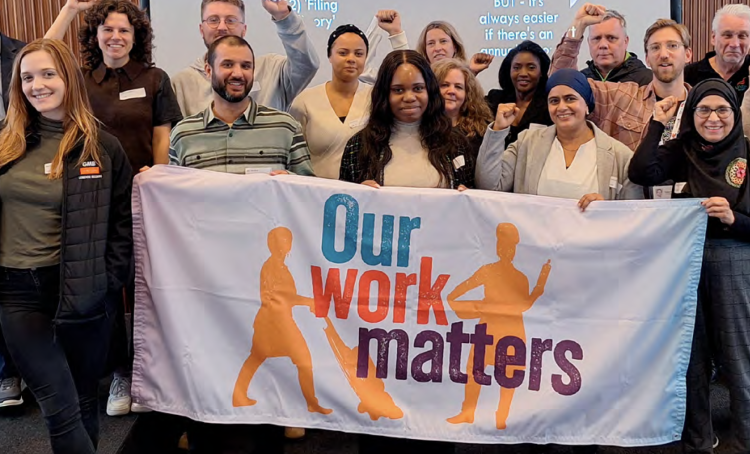
The Our Work Matters (OWM) campaign provides dedicated support to unions organising outsourced workers, aiding both direct disputes and insourcing campaigns.
Direct digital organising assistance has provided affiliates with measurable advantages during critical ballots. The TUC has helped unions integrate peer-to-peer texting tools to manage structured, one-to-one conversations with members. A notable application of this support assisted Equity during its indicative ballot on artificial intelligence (AI) protections. The TUC provided script development and activist training, contributing to a 99 per cent ‘yes’ vote on a 75 per cent turnout, demonstrating the value of modern communication methods in driving member engagement.
1.2 Industrial action and solidarity support
Rising living costs, disputes over pay and changing working conditions led to industrial action across both the public and the private sectors this year. We provided practical, logistical and financial support to ensure these actions resulted in positive outcomes for members.
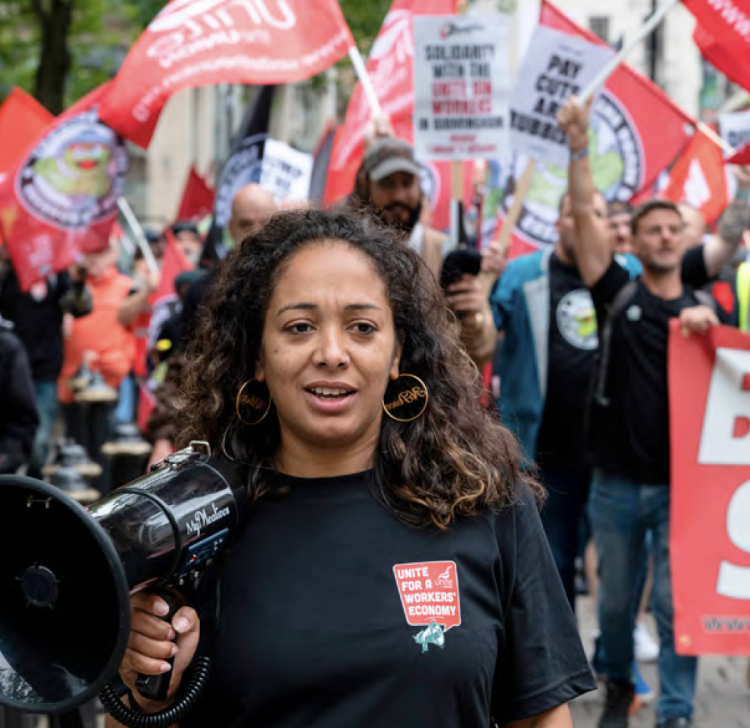
Our dispute intelligence database has now tracked more than 2,400 distinct industrial disputes, recording over 1,200 union victories across 34 affiliates. The data has played a crucial role in identifying where the TUC can add support to unions in dispute, including more than 140 picket line visits from TUC representatives in the last year.
Through our Solidarity Hub platform, we have managed 92 requests for support over the past year, both locally and nationally, across 21 unions engaged in industrial action.
Megaphone continues to support unions running online petitions and digital actions. This year more than 70 campaigns were launched on the platform by 14 unions. Over 1.2 million people have now acted in support of a union campaign, with the Megaphone solidarity email list a vital resource for the movement. Over the last year our StrikeFunder project raised £20,000 for striking workers, including GMB outsourced workers at the Airedale Hospital and Sellafield, PCS members at MyCSP, and UNISON members at the National Coal Mining Museum.
Our Growth Hub has developed into a comprehensive platform to support union organising and growth. Since launching the recognition tracker, we’ve recorded more than 300 recognition agreements, achieved voluntarily and through the statutory process. The evidence collected from each unique campaign has helped shape our How to Win Recognition Guide as well as sharing best practice to help prepare unions effectively for a new organising environment.
1.3 Promoting trade unionism, Union Finder and social media
We use various channels to promote strategic priorities, support active disputes and introduce trade unionism to a wider audience, including young workers. Our social media channels reached 800,000 followers this year, supported by a nine per cent increase in YouTube subscribers. High-performing content included anti-far right video campaigns featuring manufacturing workers in Luton, which received more than six million views, and informational clips on wealth taxation, which secured more than two million views. Our first post on the Threads platform reached a million views, while a documented account of a workplace confrontation achieved eight million views on X (formerly Twitter).
Complementing this digital outreach, the online Union Finder tool remains a primary pathway for non-unionised workers to find unions, seek advice and secure representation. The tool was utilised more than 47,000 times over the year. Significant increases in traffic occurred when the Employment Rights Bill cleared the House of Lords in December, and during the social media campaigns of HeartUnions week, when coordinated online activity directed users to the tool.
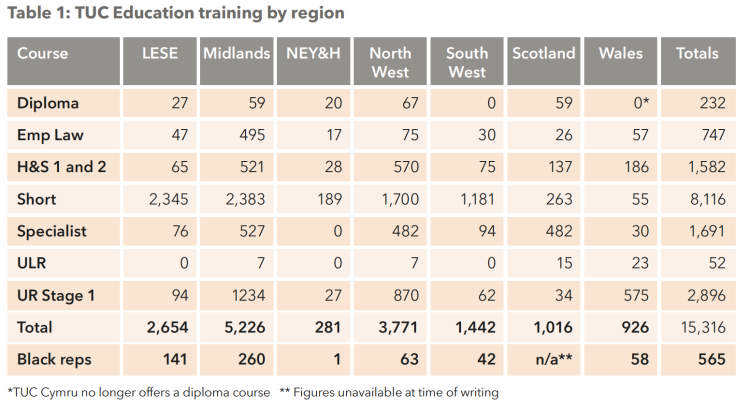
1.4 TUC Education
TUC Education provides reps with the skills, collective knowledge and confidence required to negotiate and organise effectively. Despite funding challenges within further education, we maintained stable delivery across its 13 education centres in England and Scotland.
In response to composite 1 and the subsequent review of TUC Education, we have engaged with mayoral combined authorities to secure new funding models. This approach achieved full funding for reps training within the Greater London Authority area, while discussions are progressing toward a prospective ‘White Rose’ partnership with three combined authorities in Yorkshire and plans for learning across the north-west. To guide local implementation, Trade Union Education Strategy and Delivery Groups are now established and active across every TUC region.
Online provision has expanded to support our anti-far right and Unity Works strategies, alongside guidance on the ERA. We launched a six-part online guide for workplace reps and hosted an in-person briefing event for union officers. For the Unity Works campaign, regional briefings, courses, and updated digital resources, such as the Talking Solidarity online guide, were provided to embed campaign objectives into everyday workplace organising.
Flexible training programmes were expanded to support bespoke learning requirements for affiliates including BALPA, the Society of Radiographers, Nautilus International, Unite, UNISON, NASUWT and the CWU. While funding and capacity constraints led to a decline in Stage 2 and Diploma enrolments, standard online Stage 1 participation remained strong, with 688 representatives completing courses.
Online webinars attracted more than 7,800 union reps. The largest attended single webinar focused on the ERA, featuring employment rights minister Kate Dearden MP, and drew more than 3,700 live registrations.
The in-person Union Reps Connect 2025 conference in Leeds, focusing on knowledge sharing and workplace representation, attracted more than 350 participants. Planning for the 2026 conference is underway, with an emphasis on equality bargaining ahead of new statutory rights for union equality reps.
The TUC Educational Trust provided essential funding throughout the year to support anti-far-right initiatives, diversify the representative base, deliver young workers’ organising schools, and upgrade training materials for full-time officers. The eighteenth Leading Change programme concluded with attendance from 18 senior union officers representing 11 affiliates, supporting leadership development across the movement.
In 2026, we launched our updated Organising Academy materials, adapting campaign strategies to address technical advancements in AI, digital tracking and the new provisions of the ERA. The flagship 16-day Diploma in Organising equips organisers and officers with the practical skills needed to drive membership growth.

1.5 Digital Lab
The TUC Digital Lab convenes affiliates to share best practice in digital transformation, aiming to lower project risks, reduce deployment costs and accelerate delivery times across the movement.
Key priorities this year focused on aligning digital systems with new statutory union rights. This included preparing unions for upcoming online balloting regulations and running a dedicated project to improve membership retention and onboarding through automated communication frameworks. These digital workflows are designed to help unions retain members effectively as new digital access rights come into effect.
The Digital Lab also addressed growing technological risks, facilitating peer-to-peer support for union IT specialists managing sophisticated cyber-attacks, updating membership databases, or assessing AI a implementation. To assist with strategic planning, the Digital Lab launched an updated version of its Digital Healthcheck interactive benchmarking tool, allowing affiliates to assess their technical capacity and map out clear operational strategies.
1.6 Anti-Racism Taskforce implementation
The Anti-Racism Taskforce (ARTF) continues to advance work to fight racism and promote equality across the trade union movement. The ARTF is supporting affiliated unions to implement the ARTF manifesto commitments that seek to diversify union membership, strengthen Black activism, work with affinity organisations and community groups, and support affiliates to take forward anti-racism as a core campaign. This work is organised across four core areas: collective bargaining; organising; public policy; and supporting affiliates as employers.
Led by its Implementation and Oversight Group, the ARTF focused on three specific priorities this year:
Representation and engagement: increasing direct outreach to Black workers and building workplace confidence to challenge discriminatory practices.
Evidence-based strategy: improving the collection and practical application of ethnicity data to inform policy and negotiation. The publication of the No Worker Left Behind report provided updated evidence of the specific workplace challenges and deteriorating conditions faced by Black workers since 2020.
Institutional reform: campaigning for statutory ethnicity pay gap reporting while driving voluntary compliance within the movement. This includes advancing the manifesto commitment for 50 per cent of affiliated unions to formally report their own ethnicity pay gaps as employers.
The Anti-Racism Taskforce (ARTF) continues to advance work to fight racism and promote equality across the trade union movement
1.7 Make Work Pay and collective rights
In line with composite 4, we have been pressing for robust and swift implementation of the collective rights set out in the government’s Plan to Make Work Pay document. Briefings for MPs and peers on the introduction of new rights of access, an employer duty to inform workers of their right to join a union and simplification and reform of the statutory recognition process set out why these rights are needed to boost union organising and collective bargaining.
The ERA gained parliamentary assent in December. Since April, the requirements for submitting a statutory recognition request have been simplified and unions need a simple majority in a ballot to gain recognition, with the previous turnout threshold removed.
Most measures in the ERA require further secondary legislation, often after consultation. In November, the TUC coordinated union input to roundtables with the Department for Business and Trade to discuss secondary legislation on access rights and the employer duty to inform workers of their right to join a union. We submitted consultation responses on both, agreed by the December Executive Committee.
Key points in the TUC’s response to the consultation on access regulations included:
weekly access to all workers covered in an access agreement should be a model term
access rights should apply to all employers, with no size threshold
fines must be sufficient to deter hostile employers with deep pockets from blocking access.
The government’s response confirmed that weekly access would be a model term; set out that employers with fewer than 21 workers would be exempt from access rights, but this would not apply to those covered by national statutory bargaining arrangements such as the Social Care Fair Pay Agreement and the School Support Staff Negotiating Body; and introduced a new level of fine at £500,000 for the most serious breaches of access – with powers for fines to be applied to multiple individual breaches of the code.
The TUC has coordinated further union roundtables and submitted responses to government consultation on codes of practice: in March on access and unfair practices during recognition and unfair practices in electronic ballots; and in May on access rights. We have coordinated union comments on the draft statement employers will be required to use telling workers of their right to join a union and the government landing page it will link to.
Regulations and the code of practice on access and regulations implementing the employer duty were laid in parliament in July, in preparation for the rights coming into force in October 2026.
1.8 Fair pay agreements and SSSNB
We have continued to work with and coordinate social care affiliates to support the introduction of a fair pay agreement in adult social care (ASCFPA).
In January, we responded to the government’s consultation on regulations to implement the ASCFPA. Key points included that the negotiating body should comprise only equal numbers of trade union and employer representatives and an independent chair and that the scope of the workers and the employment conditions covered should be as broad as possible.
In February, we took part in a ministerial roundtable with unions, employers and other sector stakeholders to promote positive industrial relations in the social care sector and support the introduction of the ASCFPA.
In line with resolution 27, we have supported NJC unions to secure the reinstatement of the School Support Staff Negotiating Body (SSSNB).
1.9 HeartUnions
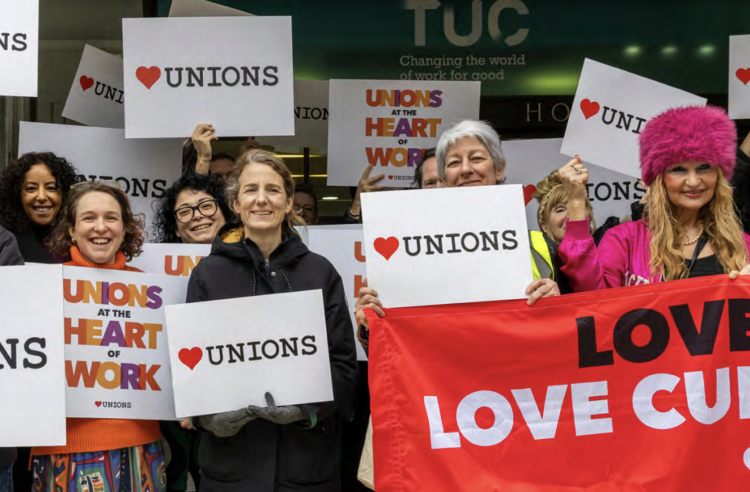
During HeartUnions week, we coordinated a range of national activities to celebrate the trade union movement and boost member recruitment. We provided practical coordination, merchandise and informational materials to support dozens of workplace and public events run by members across the UK.
Strategic political engagement with MPs and the Mayor of London’s office resulted in widespread, high-profile promotion across social media alongside politician attendance at local events. Public outreach was further extended through traditional media coverage, mass-email campaigns and targeted social media posts, which included a successful trial of paid digital advertisements to reach non-unionised workforces.
1.10 Young Workers Organising Strategy
In line with resolution 4, we launched the Organising Young Workers strategy at the TUC Young Workers Conference. Developed in partnership with the TUC Young Workers Committee, the strategy responds to comprehensive insights commissioned by the TUC regarding young people’s awareness of trade unions, barriers to joining and primary information channels.
The strategy focuses on four core strategic objectives:
Skills and confidence: increasing the knowledge and capacity of young members to support them to become active organisers within the movement.
Digital capacity: enhancing digital tools and platforms to modernise how unions engage and organise younger workforces.
Targeted outreach: reaching non-unionised young people through clear, accessible communications to build awareness of trade union values.
Policy lobbying: pressing the government to expand high-quality, unionised employment and training opportunities for young workers.
Delivery of the strategy is well underway, aligned with the objectives of resolution 5. In June 2026, the TUC hosted a national organising weekend, equipping young workers with the fundamental skills required to lead workplace campaigns.
Regional networks have reinforced this through targeted local events and community organising patrols, which are directly informing the ongoing rollout of the national strategy.
We established the first cohort of the Worker Voice Network, ensuring 50 per cent of applicants were aged under 35 to help develop highly relevant, relevant, relatable, digital content.
To improve peer-to-peer communication, we established the first cohort of the Worker Voice Network, ensuring 50 per cent of participants were aged under 35 to help develop highly relevant, relatable digital content. New educational guidance has also been commissioned, focusing specifically on how young members can become effective workplace organisers. Age-profile membership statistics will be published in the forthcoming TUC Equality Audit 2026.
In response to resolution 4 and broader concerns regarding age-related redundancy pay, the TUC has lobbied for stronger collective redundancy consultation rights. These legal protections would provide significant security in smaller workplaces, such as retail and hospitality, where young workers are statistically overrepresented and face higher risks of insecure employment.
2.1 Make Work Pay and employment rights
As noted in composite 4, the Employment Rights Act (ERA) delivers real improvements to workers’ rights and conditions. And we have been pressing for robust and swift implementation of all the government’s commitments in its Plan to Make Work Pay.
The passage of the Employment Rights Bill was repeatedly delayed by a combination of Conservatives, Liberal Democrats and crossbenchers in the House of Lords. We were active in briefing peers on the merits of the legislation, which has made paternity leave and parental leave a day one right, implemented sick pay from the first day of absence and introduced whistleblowing protections for sexual harassment.
In line with emergency resolution 6, we supported a Lords amendment that would have prevented the imposition of upfront fees for work.
The ERA finally received royal assent in December, bringing Great Britain more in line with the global mainstream and paving the way for a stronger economy.
We were active in briefing peers on the merits of the legislation, which has made paternity leave and parental leave a day one right, implemented sick pay from the first day of absence and introduced whistleblowing protections for sexual harassment
Most measures in the Act require further secondary legislation, often after consultation. In recent months, we have responded to consultations on issues including fire and rehire, parental leave, unpaid internships, bereavement leave - including pregnancy loss - the threshold for collective redundancy, improved access to flexible working and modernising the agency work regulatory framework. Consultations on zero- and short-hours legislation and non-disclosure agreements and a call for evidence on the Transfer of Undertakings (Protection of Employment) Regulations remain open at the point of writing.
In line with resolution 25, we have called for nursing parents to be better supported at work in our response to the enhanced dismissal protections for pregnant women and new mothers consultation response highlighting the need for flexible working, effective risk assessments and protections from discrimination.
Following composite 4, we have engaged with ministers and civil servants to ensure that loopholes on areas such as fire and rehire practices and the use of zero-hour and short-hour contracts are closed and the legislation is as effective as possible.
The new Fair Work Agency came into operation on 7 April, with three trade union appointees to its advisory board. We have been pressing for rapid implementation of new powers to enforce statutory sick pay and holiday pay and recover enforcement costs from employers who do not cooperate.
Significant parts of the Plan to Make Work Pay have yet to be legislated for. The TUC has continued to press the government on employment status reform, publishing reports including Behind the App: Bogus self-employment and the rise of talent platforms and The Human Price of Dynamic Pay to illustrate the gaps in existing employment law that allow employers to deny workers their rights.

2.2 Health and safety
We continued to play a leading role in supporting affiliates and strengthening the voice of health and safety reps, ensuring that workers’ health, safety and wellbeing remain at the heart of the trade union agenda.
The Safety Reps Connect event in November was a major success, bringing together 300 health and safety reps from across the movement to share experience, build confidence and strengthen practical networks. A programme of webinars further extended this support, helping reps stay informed and equipped to meet emerging workplace challenges, in line with resolutions 5 and 26.
The TUC Health and Safety Reps Survey 2024-25 was published, drawing on responses from reps across 36 affiliates. The findings provided valuable insight into the changing profile of health and safety reps and highlighted the continuing importance of tackling workplace stress, excessive workloads and high temperatures. Reps also identified concerns about the quality of employer risk assessments and responses to enforcement action, underlining the vital role unions play in holding employers to account.
In line with resolution 20, we hosted a well-attended event on preventing violence at work, bringing together more than 100 union officers and reps. The event demonstrated the movement’s shared commitment to safer workplaces and to practical action that protects workers from abuse, harassment and violence.
The TUC continued to work closely with unions on the campaign to remove asbestos from workplaces and highlighting Zane’s Law, in line with resolution 50. The general secretary met Stephen Timms MP, minister of state for social security and disability, to press the case for urgent action, including a ban on silica and the establishment of a national asbestos taskforce.
On Workers’ Memorial Day, the All-Party Parliamentary Group (APPG) on Occupational Safety and Health held a reception bringing together parliamentarians, trade unionists and bereaved families. The APPG also held a public evidence session and published a report on violence at work, helping to maintain pressure for stronger protections and safer workplaces for all.
In June, we convened a meeting of health and safety officers from a dozen affiliates with officials from the Health and Safety Executive (HSE) and the Department for Business and Trade to inform the government’s review of health and safety regulations. We set out our concerns that the review may undermine safety legislation, given the government’s stated ambition to reduce the regulatory ‘burden’ on business by 25 per cent.
2.3 Tackling the far right and Unity Works
We have continued to deliver alongside our strategy to tackle the far and populist right and to support affiliates with their efforts in workplaces and communities. We have built an active and effective network of trade union officials, to help us coordinate and respond to demands of affiliates. We’ve also focused on supporting local activities, working with regional secretaries and TUC Education to roll out comprehensive training and briefings across the country.
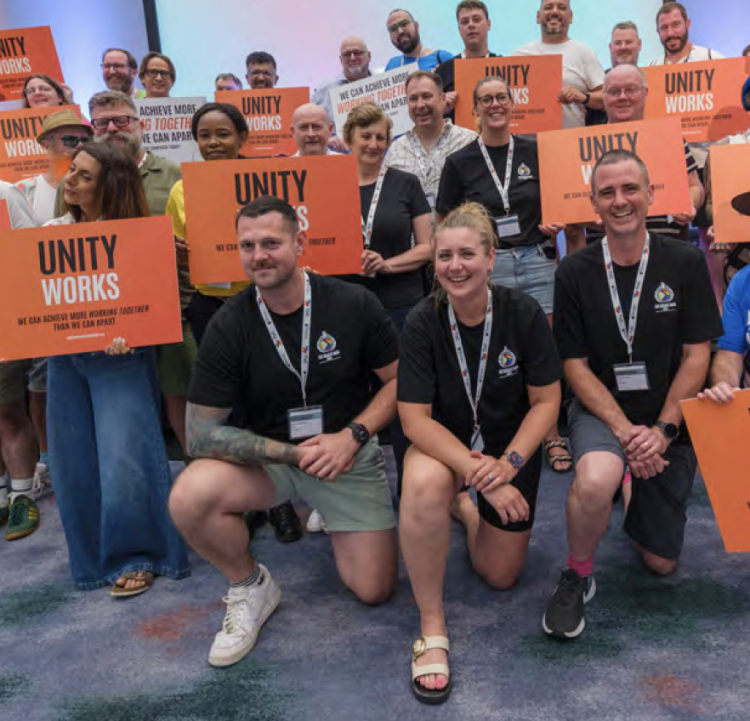
In line with composite 2, the TUC launched the Unity Works campaign to provide affiliates with materials, training and resources to support workplace representatives. This ongoing, evidence-based campaign outlines our positive vision for hope, which cuts through the divisive narratives of the far right. As part of our Unity Works campaign, we have briefed MPs, produced promotional materials for affiliates and rolled out a new training course for workplace representatives and activists.
In line with resolution 12, we worked with the University of Bath to undertake a literature review considering the tactics of online influencers in the far-right space, particularly focusing on young men, misogyny and the online ecosystem. The report highlighted the widespread prevalence of misogynistic content online, as well as the diversity of narratives that exist and the real-world
We also commissioned research on disrupting digital pathways to provide a comprehensive overview for the union movement of how far-right and Reform UK-adjacent narratives spread across major digital platforms in 2025.
consequences of the growth of misogynistic beliefs online. The analysis informed training to be rolled out in the autumn supporting workplace reps to tackle misogyny and misogynoir.
We have also commissioned research looking at the ways in which the far right uses transphobic narratives to spread division. We’ll use the findings to shape guidance for reps and members to use in workplaces and communities when encountering transphobic far-right narratives and engage members on issues such as pay, job security and public services.
We also commissioned research on disrupting digital pathways to provide a comprehensive overview for the union movement of how far-right and Reform UK-adjacent narratives spread across major digital platforms in 2025. As part of this work, we also tested social media content to reduce the levels of trust in far-right content creators on YouTube. Findings were shared with affiliates to ensure the messages we share online are targeted and impactful.
In line with emergency resolution 2, the TUC continued to support the Together Alliance, and work with anti-racist organisations and Hope not Hate on their Million Acts of Hope initiative. We will continue to support this work, particularly regional interventions aimed at supporting communities to build resilience against far-right organising.
2.4 Anti-racism
In April, at the TUC Black Workers Conference, we launched the No Worker Left Behind report, a follow-up to the TUC’s seminal 2020 report Dying on the Job. The report highlights that racism remains a significant concern for Black workers. 37 per cent of Black workers report not being offered overtime and 41 per cent being kept on temporary or fixed-term contracts. These findings reiterate the importance of our priority on delivering the ERA in full, and the government’s commitment to Make Work Pay as a key industrial priority for Black workers.
No worker left behind also articulates that discrimination in the workplace takes a number of forms that impact the health, safety and wellbeing of Black workers. Black workers report that perpetrators of unfair treatment are more likely to be direct managers or other managers and that bullying is carried out by managers and colleagues and that explicit racism is received from colleagues and customers, clients and patients. The report contains key recommendations for employers, government and unions themselves.
Supporting affiliates to deliver the key recommendations in this report and the ongoing work of the Anti-Racism Taskforce (ARTF) manifesto and action plan, remains a priority for the TUC. Since its launch at the TUC Black Workers Conference 2026, we have delivered a number of briefings to affiliate unions and stakeholders about the recommendations in the report and the ARTF manifesto and action plan. Working with unions to highlight a number of key actions they can take internally, as well as areas for prioritisation in an industrial setting, alongside lobbying asks for government We also continue to drive greater participation and representation of Black members within trade unions through regional Black Activist Development Programmes and support for affiliated unions to develop structures that enable members to influence decision-making and progress into leadership roles. As set out further in the section on sexual harassment, we have continued to highlight Black women’s experiences.
2.5 Migration
In line with composite 3, we are standing up for migrant workers, advocating for a compassionate, fair and managed approach to migration. We continue to strongly oppose the government’s planned ‘earned settlement’ reforms, higher visa salary thresholds and the expansion of the hostile environment measure – the ‘right to work’ scheme – to other working arrangements, which risk increasing exploitation.
In doing so, we have worked extensively with affiliated unions in producing evidence submissions and meeting with the government. We are pressing for the new Fair Work Agency, through engagement with ministers, officials and evidence submissions, to protect migrant workers and remain separate from immigration enforcement so people can report abuse safely.
We are also calling for reforms to the visa sponsorship system, including sectoral sponsorship in adult social care and changes to the Overseas Domestic Worker visa, to reduce workers being trapped in poor conditions. We back the right of people seeking asylum to work and campaigns for safe routes to rebuild their lives. We have also begun new research to understand public attitudes to migration and equip unions with practical tools, training and resources to support reps in handling difficult workplace conversations and championing progressive values.
We have also begun new research to understand public attitudes to migration and equip unions with practical tools, training and resources to support reps in handling difficult workplace conversations and championing progressive values.
2.6 Protecting and promoting equalities
In line with our strategic aim to ensure workplaces where every worker has strong rights and is protected from discrimination, we continue to campaign for equality across the movement. We continue to engage with members from our affiliated unions through the delivery of our statutory conferences, with the support of our committees, and have engaged with government through a number of consultations, including on carer’s leave, parental leave and bereavement leave.
2.7 Tackling sexual harassment
Tackling and preventing sexual harassment in all workplaces, including our own, remains a priority for the TUC and is key to our aim of growing and diversifying our movement. In March 2021, the TUC Executive Committee Working Group was established to provide strategic oversight of this important strand of work. The working group provides a space for affiliates to oversee progress being made by leaders across the movement, to ensure cultural change and embed the preventative approach to sexual harassment.

The ERA has introduced requirements for employers to take all reasonable steps to prevent sexual harassment. From October 2026 there will be an obligation on employers not to permit the harassment of their employers by third parties. We have been working with affiliates to shape the technical guidance produced by the Equality and Human Rights Commission (EHRC) on how this is implemented and enforced. We are continuing to work with affiliates and external groups, including the Workers Policy Project, to give workplace representatives practical advice on considering sexual harassment in risk assessments, as well as providing guidance on negotiating standalone sexual harassment policies with employers. The TUC is also responding to the government consultation on the use of non-disclosure agreements (NDAs).
We have continued to support affiliated unions to undertake our preventative cultures training, encouraging unions to make the training available at all levels of their organisations – from senior leadership team and executive structures to lay representatives. We added new questions on sexual harassment for the TUC Equality Audit 2026. Findings suggests that, while feedback on the training is positive, take up among affiliates is low, so we are working with union equality officers to understand the barriers and encourage affiliates to roll out the training.
In line with resolution 13, following on from the launch of And Then it Clicked... – our report into Black women’s experiences of sexual harassment in the workplace – we have continued to support affiliates in creating spaces for Black women in their unions. The report considered the intersectionality of gender and race and called on affiliates, employers and the government to take action to tackle sexual harassment, misogynoir and the cultures that allow Black women to encounter systemic barriers.
In accordance with resolution 11, the TUC has continued to build a network of ambassadors who can amplify the findings of our report into Black women’s experiences of sexual harassment. We have run a series of roundtable discussions, focusing on why trade unions need Black women, as well as engaging with the Black Women and Sexual Harassment Working Group to shape the interventions.

2.8 Working time and flexible working
We continue to campaign and lobby for greater access to flexible working including for an advertising duty and for the commitments in Make Work Pay to be delivered in full.
We coordinated two roundtables with union officers and union reps with the Department for Business and Trade to influence their access to flexible-working consultation. In May, we submitted further evidence to the government’s consultation on flexible working, highlighting insight from affiliates on how a lack of flexibility can force people out of the workforce. We continued to reiterate our calls for members to have the right to be accompanied to any meeting regarding flexible working and have highlighted our calls for an advertising duty. This would require employers to outline the flexible-working options available in a role when it is advertised, ensuring that applicants are able to take up those options once appointed to a role.
We conducted new research which demonstrated that a third of workers still have some or all of their flexible-working requests rejected and that flexible working would support people to move into and around the labour market. The research also found that too many employers are still not following the Acas Code of Practice on requests for flexible working.
As part of our work on influencing the Get Britain Working White Paper, we have continued to highlight the importance of access to good-quality flexible working to keep people in the labour market, particularly disabled workers.
We also highlighted working-time issues throughout the year, publishing new analysis on night working and unpaid overtime.
2.9 Pay gap reporting
Experience of gender pay gap reporting demonstrates that publication of data alone does not drive structural change. Without mandated action planning, regulatory scrutiny and integration into collective bargaining, reporting risks becoming a compliance exercise rather than a tool for equality.
The ERA will introduce mandatory gender pay gap action plans for in-scope employers. But we are continuing to campaign for more robust requirements to be included – calling for additional powers for the EHRC to ensure action is taken beyond public submission of an action plan.
In line with resolution 8, we continue to push for disability and ethnicity pay gap reporting and support implementation of the Equality (Race and Disability) Bill. We are providing additional guidance and support to affiliates, encouraging them to take action to voluntarily publish their ethnicity and disability pay gaps.
We also support the recommendations made in the McGregor-Smith Review that the requirement to report on the gender, ethnicity and disability pay gaps should apply to companies with 50 or more employees and will continue to campaign for this ask.
2.10 Supreme Court ruling and EHRC Code of Practice
In support of resolution 7, and in accordance with the principles agreed between our LGBT+ and Women’s Committees, we have continued to actively pursue our mandate that trans, non-binary and gender-diverse workers should be able to live full and meaningful lives, based on and including the principle of self-declaration.
We have led sustained engagement with government departments, civil servants, ministers and the chair of the EHRC, consistently reiterating the movement’s position: that equality law and practice must protect dignity, safety and inclusion for trans and non-binary workers.
In June, the TUC responded to the EHRC consultation on its code of practice for service delivery. The submission raised practical concerns about inclusion and emphasised the need for clear, workplace-based examples grounded in real experiences.
When the EHRC laid its updated code before parliament in May, we responded publicly, highlighting that it failed to address key issues previously raised. In particular, we raised concerns about the lack of clarity on applying the April 2025 Supreme Court judgment and the risks this poses to ensuring workers are treated with dignity and respect.
We made clear that “we must build a world in which trans lives are not only legally recognised, but fully liveable in practice – including self-declaration, rooted in longstanding TUC Congress commitments”.
We have also strengthened coordination across the movement, convening two meetings of the Trade Unions for Trans and Non-Binary Alliance, with strong participation. In response to growing risks, including harassment and doxing, the TUC has produced guidance to support trans workers and allies to stay safe online and in person.
We have continued direct engagement with Bridget Phillipson MP, minister for women and equalities, through correspondence and meetings, including with LGBT+ Committee members sharing lived experience.
We will continue to advance Congress policy, champion self-declaration, and ensure trans workers’ rights are upheld in law and practice.
Alongside our work lobbying government, meeting with key stakeholders and supporting affiliates to understand the implications of the Services Code of Conduct, we have provided practical guidance. The guidance focuses on how individuals can remain safe online and at events, while supporting trans, non-binary and gender-diverse workers’ rights. We know union representatives and members play a vital role in challenging all forms of discrimination and are focused on providing guidance and support.
2.11 Personal independence payments
In accordance with resolutions 38 and 39, we have opposed the government’s proposed changes to personal independence payments (PIP) and universal credit (UC).
In the period directly before the motion carried at the TUC Disabled Workers Conference and TUC Congress, the TUC publicly oppose the changes to PIP.
We led a high-profile campaign against the proposed PIP changes. This included issuing a press release, amplifying opposition through social media, and publishing an opinion piece in The Mirror. These interventions gained significant attention, helping to build pressure on the government.
On 1 July 2025, the government announced it would not proceed with the proposed changes to PIP. This reversal reflects the impact of coordinated lobbying led by the TUC, working alongside the wider trade union movement and disabled people’s organisations.
Following this decision, the government committed to a co-designed review of PIP. We have played an active role in shaping this process. Senior civil servants engaged directly with the TUC to understand our approach to co-design with disabled members, recognising our expertise in inclusive policy development.
While Congress policy called for the TUC to coordinate protests, these were not required due to the effectiveness of our early lobbying.
We continue to actively influence the ongoing review. The general secretary met with Stephen Timms MP, minister of state for social security and disability, in March to discuss progress and next steps. The TUC Disabled Workers Committee co-chairs have also engaged directly with the review leadership.
We led a high-profile campaign against the proposed PIP changes. This included issuing a press release, amplifying opposion through social media, and publishing an opinion piece in The Mirror.
In addition, we submitted detailed evidence to the review, informed by a member survey on experiences of accessing PIP. Its recommendations include reforming the assessment process, improving decision-making, reducing reassessments, increasing accessibility, aligning PIP with employment support, recognising fluctuating conditions, and ensuring PIP reflects the real cost of disability.
2.12 Support for neurodivergent workers
In support of composite 6, we continued to advocate for stronger equality legislation that explicitly protects neurodivergent workers through written and oral consultation responses to government, parliamentary inquiry submissions, and engagement with the civil service and non-departmental public bodies (NDPBs).
The EHRC’s recently updated Code of Practice for Services, Public Functions and Associations now explicitly recognises the barriers that people with hidden impairments, fluctuating conditions and neurodiverse conditions may face. It also provides clearer guidance on the duty to make reasonable adjustments to remove or reduce those barriers and support equal participation. We will work to ensure these clarifications are also reflected in the Code of Practice for Employment when it is updated.

2.13 Supporting young people into work
Recent figures show that an estimated 957,000 people under the age of 24 are not in education, employment or training (NEET). More than half of the respondents to our post-election poll thought that opportunities for young workers were deteriorating and two-thirds thought that government action is needed to expand training and apprenticeships and to secure entry level jobs so that young workers get a fair start to their careers.
In response to the review of NEETs by Alan Millburn, we called for an expansion of the jobs guarantee for young people, ensuring the quality of jobs through the full implementation of the ERA and Make Work Pay, reform of apprenticeships improving quality and expanding provision, and for more funding for tertiary education. We will continue to campaign on this as a priority issue.
Recent figures show that an estimated 957,000 people under the age of 24 are not in education, employment or training (NEET).
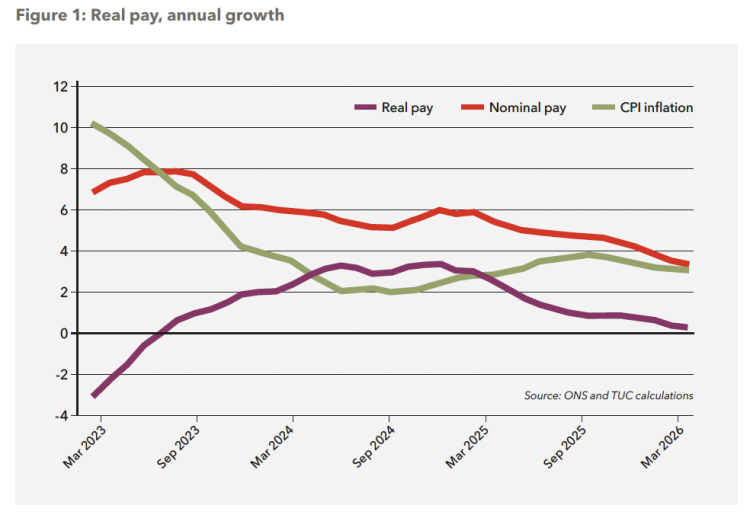
Workers continue to face difficult economic conditions. At the start of 2025, United States’ tariffs meant disorderly trading relations, and in 2026 illegal wars, including in Iran, led to steeply increased energy prices and threatened shortages of other commodities. Prices in the UK remain greatly elevated and recent real wage gains short lived.
GDP growth was up to 1.4 per cent in 2025 (from 1.0 in 2024) but overall remains subdued. The TUC argued the weakness was predominantly the result of subdued consumer demand, because of the relentless cost-of-living squeeze and higher interest rates. Analysis showed UK consumer demand growth 32nd out of 36 OECD countries.
The labour market is fragile. While the employment rate has been static at around 75 per cent, unemployment has risen by around 0.5 per cent over the past year and the inactivity rate fell by the same. Payroll figures show a loss of 210,000 employee jobs in the year to April 2026.
The cost of living is the number one issue facing people. Pay has not kept up with costs and people are struggling to get by or falling short of their aspirations for their quality of life.
Real pay rose for the first half of 2025 but renewed inflation has undermined these gains into 2026. Nominal pay growth has slowed from 6 per cent in 2024Q1 to 5.5 per cent in 2025Q1 and to 3.4 per cent in 2026Q1. Having peaked at 11.2 per cent in October 2022, rather than returning to target energy shocks mean inflation at the end of this year is expected to rise to 3.5 per cent on CPI and 4.6 per cent on RPI. Now near zero, real pay is likely to fall back into negative territory.
Yet the Monetary Policy Committee has continued to judge that the risk of excessive pay growth is greater than the risk to economic growth and has therefore been slow to cut interest rates. In contrast, TUC analysis showed countries prioritising economic growth are not penalised with higher inflation.
As well as household spending, high interest rates have severely constrained government finances. While the government has acted to support public services and investment, more is needed. In line with composite 7, we have called for higher taxes on wealth, showing a higher bank surcharge could raise up to £50bn over the next four years. In our submission to the autumn 2025 budget, as well as fairer taxation, we called for further scrutiny of the Office for Budget Responsibility.
The cost of living is the number one issue facing working people. Pay has not kept up with costs and people are struggling to get by or falling short of their aspirations for their quality of life. Three-quarters of respondents to our post-election poll said their personal financial circumstances were getting worse. The long-term deterioration in family finances has been compounded by a succession of price shocks. The cost-of-living crisis started in 2022, the result of sharp price rises caused by the Ukraine war and pandemic-related shortages. Prices did not go back down – energy costs in March 2026 were 80 per cent higher than they were in January 2021. Food prices have risen 40 per cent across the same period. High interest rates are compounding this picture, with direct costs to households and a dampened economy.
We have called for urgent action from the government, including:
a permanent social tariff to support families with energy bills, and an energy crisis social tariff that kicks in during periods of crisis
reducing the universal credit taper rate so that those on the lowest incomes keep more of what they earn
fully leveraging its infrastructure and procurement spending to deliver good jobs.
3.2 Industrial strategy
Through our Futureproofing Industry project, we have supported union officers and workplace reps in sectors including steel, ceramics, glass and automotive to push employers to invest into site upgrades to boost competitiveness and futureproof jobs. This included helping reps win investment commitments, pilot projects and upgrade plans.
Our policy interventions included:
calling on government to deepen its industrial strategy support for target sectors and increase investment
pushing government to commit to jobs plans for all industrial strategy sectors, aiming to replicate the leadership shown in the Clean Energy Jobs Plan, to win and protect good jobs including trade union recognition and collective bargaining
engaging with the Treasury and the National Infrastructure and Service Transformation Authority (NISTA) about delivering quality jobs through new infrastructure projects
encouraging the National Wealth Fund to deliver on its investment commitments to automotive, hydrogen, steel and ports
publishing our Save British Ceramics briefing together with GMB and the Green Alliance, calling for policy interventions to upgrade and protect the ceramics sector. This was followed by advocacy – and helped secure £120m in public investment to modernise ceramics sites.
In support of resolutions 60 and 61, we campaigned for backing for British industry, including specific calls to support ceramics and steel. Our campaign interventions included:
making the case for more action to ensure UK industrial electricity prices become competitive, including by bringing down wholesale prices. This included media coverage, lobbying, a Megaphone petition and presenting policy solutions to government.
launching Save Welsh Industry and Save British Industry, with local and national media coverage, training for reps and a national poster campaign.
We launched our Industrial Voices Programme, training industrial sector reps to communicate through videos in digital spaces. This added to our regular production of videos on industrial issues for TUC social media channels.

3.3 Pay and the national minimum wage
The TUC has campaigned to keep real pay growing. We made regular media interventions that highlighted the ongoing pay crisis and its impact on living standards.
We made the case for a £15 minimum wage for all workers regardless of age. In 2025, we presented evidence to the Low Pay Commission (LPC) through a written submission and by leading a delegation of unions to give oral evidence. Following submissions by the TUC and affiliates, the government announced an increase in the National Living Wage to £12.71 an hour from April 2026. It also increased youth rates to £10.85 for 18- to 20-year olds and £8.00 for under-18s. A submission for the 2026 LPC consultation was in preparation at the time of writing.
We have intervened on the public debate around youth rates highlighting that the youth rates are discriminatory and are largely unused, with 85 per cent of 18- to 20-year-olds already paid above the youth minimum wage and 63 per cent paid at or above the national minimum wage. This evidence was cited in the Milburn Review on young people and work.
The TUC Minimum Wage Enforcement Group has continued to meet, bringing together unions, advice agencies and relevant government departments and enforcement bodies.
We continue to push for a strong and robust living wage through our work with the Living Wage Foundation. We are influencing the work of the foundation through seats on the Living Wage Commission and the Living Wage Advisory Council.
The TUC has campaigned to keep real pay growing. We made regular media interventions that highlighted the ongoing pay crisis and its impact on living standards.
3.4 Corporate governance, workers’ capital, due diligence and executive pay
We have been advocating for new mandatory human and labour rights and environmental due diligence legislation as part of our work on corporate governance reform and responsible business conduct. Along with TUC Cymru, UNISON, STUC and ICTU/NI, we sat on the Foreign, Commonwealth and Development Office’s Expert Advisory Group for research into the UK’s implementation of the UN Guiding Principles on Business and Human Rights, facilitating input from affiliates and sister centres. We provided evidence to the government’s review of responsible business conduct.
In November, we co-hosted a seminar for investors on the Employment Rights Bill, setting out the new rights and why they are needed.
3.5 Social security and sick pay
The TUC campaigned for the removal of the two-child limit in universal credit, and the government scrapped the policy in the November 2025 budget. And we continue to emphasise the importance of social security in reducing child poverty. While higher employment, more secure work and rising pay can boost household incomes, in-work benefits also remain vital to improving living standards.
Following the long-running TUC campaign on improving access to statutory sick pay (SSP), the government extended SSP to all employees in April 2026 through the Employment Rights Act (ERA). The changes are expected to benefit up to 9.6 million UK workers. The Act also removed the three-day waiting period, guaranteeing sick pay from day one, and extended eligibility to 1.2 million workers who previously earned below the £125-a-week qualification threshold.
The government’s 2025 green paper Pathways to Work proposed cutting the health element of universal credit for under-22s. We highlighted the impact these cuts would have on young people, arguing that reducing entitlements would push those most in need of support even further from the labour market. We made this case in our submissions to the Milburn Inquiry and to the Work and Pensions Select Committee’s inquiry on youth employment, education and training.
The government committed to a co-designed review of PIP. We have played an active role in shaping this process. Senior civil servants engaged directly with us to understand our approach to co-design with disabled members, recognising our expertise in inclusive policy development. We also submitted evidence to the Timms Review based on a survey of PIP recipients. The submission outlined reforms to improve outcomes for disabled people and workers, including changes to the assessment process, better decision-making, fewer reassessments, increased accessibility, alignment with employment support, recognition of fluctuating conditions, and ensuring PIP reflects the real cost of disability.
3.6 Pensions
The TUC has been a leading advocate for the interests of working people in occupational pensions, and for retired workers.
We have coordinated trade union involvement with the government’s Pension Commission, which is developing proposals for long-term reform of the pension system. To do this, we established a Trade Union Liaison Group, which has met regularly with the commission and provided written evidence to it.
We also worked to influence the Pension Schemes Act as it passed through parliament. The main focus of our briefings and lobbying was on strengthening member protections.
We have continued to make the case for a stronger voice for workers in pension scheme governance. We published a report, Member Voice in Pension Scheme Governance, at this year’s TUC Pensions Conference. We used the evidence gathered in this report to lobby the Department for Work and Pensions to extend and strengthen requirements for schemes to include members on trustee boards.
In the public sector, we have supported the launch of a campaign to bring the administration of public service schemes in-house, following the severe administrative failures after Capita took over the Civil Service Pension Scheme (CSPS) in December 2025. The transition immediately collapsed, resulting in delayed retirement and bereavement payments, lost data, and an overwhelming backlog of over 100,000 cases that left thousands of retired civil servants in financial hardship.
We have coordinated trade union involvement with the government's Pension Commission, which is developing proposals for long-term reform of the pensions system.
3.7 Transport
This year saw the passage through parliament of the Bus Services Act, landmark legislation that reverses 40 years of deregulation and returns control over services to local leaders. We have worked with the Department for Transport throughout the year on the implementation of the act and on the design of guidance for commissioners. Alongside affiliated unions, we have strengthened worker voice in the guidance and guaranteed a role for unions in the enhanced partnership bodies that oversee service delivery.
We have continued to make the link between greater rail investment – and transport investment more broadly – and the government’s economic growth plans through briefings to MPs and directly with officials.

Informed by composite 12, we lobbied the secretary of state directly on the need for clarity and effective union engagement on the plans for the establishing of Great British Railways (GBR), the protection of pensions in the rail sector, on the necessity of insourcing cleaning and security staff and, in line with resolution 69, the need for greater support for rail freight.
We convened roundtable meetings bringing affiliates together variously with ministers, officials and special advisers on rail, aviation and maritime issues, including new pilot training routes, the future for rail freight and train drivers’ welfare in accordance with resolution 21, the government’s airport expansion programme, maritime skills and training funding in line with resolution 68, and the strengthening of protections for seafarers. In line with emergency resolution 3, we have engaged in detail with the Mayor of London’s Office on the ongoing industrial challenges at TfL.
We have continued to coordinate the framework agreement between HS2 Ltd and unions in the sector. A new direct route has been established via this group so that union concerns about access, health and safety, and contractor relationship can be raised directly with senior HS2 leadership. We expect to agree an updated and revised framework agreement by the end of the year.
3.8 Arts and the creative sector
The arts and creative sector is vital to the economy. Creative workers are key contributors to the UK’s success but face economic vulnerability. The TUC has represented the interests of creative workers, including through membership of the Industrial Strategy Advisory Council. We have advocated for self-employed creative workers in line with resolution 6. The TUC also attends regular meetings of the Broadcasting, Entertainment and Arts Unions (BEAU) grouping of unions.
Workers in the broadcasting, arts and entertainment sectors are seeing their intellectual property rights infringed by artificial intelligence (AI) models. We have convened a working group of creative and education unions to coordinate a joint trade union response. We continue to promote the manifesto on AI for creative workers, which outlines recommendations to address the impact of AI on creative work and workers.

3.9 Public services
Strong public services are vital to the government’s plans for economic growth, and they are key to pushing back against the far and populist right. When public services thrive, so do communities.
In line with resolution 30, we continued to call for fully funded fair pay rises for public sector workers and investment in public services, including in our submissions to the autumn 2025 budget and spring 2026 statement. And we continued to support union campaigns, including the FBU campaign against cuts to fire and rescue services, in line with resolution 49.
Through convening our Public Sector Liaison Group (PSLG), we continued to work with affiliates to understand and address shared challenges across the public sector including workload, AI and public sector reform, reflecting resolutions 32 and 33.
Recognising that lifelong learning in not only valuable in and of itself but also crucial to achieving government ambitions on economic growth, world-leading industries, tackling inequality and enabling opportunity.
Finally, after many years of campaigning we secured the reestablishment of the Public Services Forum (PSF), chaired by the Cabinet Office, ensuring meaningful engagement and a joint approach with trades unions on key issues affecting the public sector workforce.
3.10 National Health Service
The TUC has continued to advocate for an approach to public services based on long-term funding and workforce planning, in line with composite 8.
We have supported affiliates’ engagement with the government to deliver sustained investment in the NHS workforce to support its 10-Year Plan. We made the case for increased funding, fair pay and long-term workforce planning.
Through the PSLG, we convened cross-union discussions on pay review bodies to develop shared approaches to pay and workforce challenges.
At Congress 2025, the TUC brought together health unions and the secretary of state for health and social care to discuss the NHS workforce plan and the actions needed to retain staff and improve working conditions.
As part of the Our Work Matters campaign, we challenged the use of subsidiary companies (SubCos) and outsourcing models, as directed by resolution 40, supporting union campaigns for insourcing and better employment standards.
The priorities set out in resolutions 41, 45 and 46 have informed our wider work on health inequalities and patient safety.
3.11 Education
The education system and the workforce that delivers it are crucial to delivering many of the government’s ambitions for growth and opportunity. From navigating a rapidly changing world of work and adapting to AI and industrial transition to dealing with the crisis of young people not in education, employment or training and tackling child poverty, our educators must be at the heart of solutions.
In line with resolutions 53 and 54 and composite 9, we continued to work with our affiliates and government to call for an inclusive cradle-to-grave education and skills system. Recognising that lifelong learning is not only valuable in and of itself but also crucial to achieving government ambitions on economic growth, world-leading industries, tackling inequality and enabling opportunity.
Through our work with affiliates and the Early Education and Childcare Coalition (EECC), we secured clear recognition of the importance of early-years education and the early-years workforce, as set out in the government’s Best Start in Life and Child Poverty strategies. Working with affiliates and the EECC, we secured commitments to developing a workforce strategy for the early-years and childcare workforce, reforms to special educational needs and disabilities (SEND) and a formal consultation on the funding formula for early years.
In June we launched our Skills 2050 project, bringing together unions, employer representatives and skills experts to work with us to develop a comprehensive strategy for a skills system that empowers and protects the workers of today and tomorrow. A core strand of this first phase of work focuses on the post- 16 system and the importance of properly funding and supporting the further education and vocational training workforce to ensure they are enabled to deliver accessible learning to all workers.
In line with resolution 27, we have supported NJC unions to secure the reinstatement of the School Support Staff Negotiating Body (SSSNB) through the ERA. We continue to facilitate and support unions and government to ensure trade unions are meaningfully involved in all decision-making processes relating to secondary regulations and any future framework for the SSSNB.
In line with resolutions 55 and 56, we continue to amplify and support education unions’ inclusivity campaigns and priorities in a range of forums including through our seat on the government’s Opportunity Mission Board.
3.12 Social care
The TUC has worked with affiliates and government to develop a social care fair pay agreement.
We have built understanding among the government and other stakeholders around how an ambitious fair pay agreement can pave the way towards the development of a comprehensive pay and conditions framework within a National Care Service. Alongside this, we have made a strong case for a national social care workforce strategy.
We have worked with affiliates to spotlight the insecurity faced by migrant social care workers and made the case that the government’s plans to improve pay and standards in social care risk being undermined if migrant workers are forced into prolonged insecurity. The TUC continues to convene a working group on international recruitment in social care with the DHSC, which is regularly attended by Home Office officials. We highlighted the exploitation of international recruits with the Home Office and raised concerns around the impact on migrant care workers and the social care system related to proposed changes to earned settlement, aligning with composite 3.
The TUC and affiliates have engaged closely with the Independent Commission on Adult Social Care chaired by Baroness Casey. We have advocated for care workers’ voices, experiences and priorities to inform the commission’s work, and called for alignment between the commission’s focus areas and current government policy aimed at supporting the care workforce, notably the fair pay agreement.
We have also participated in the International Labour Organization (ILO) working group on care economy statistics and provided expert input into several academic studies.

3.13 Local government
The reforms underway in local government represent the biggest upheaval in over fifty years and are happening alongside major changes to England’s devolution settlement.
Further to resolutions 47 and 48, we undertook a series of discussions in regions across the country to better understand the frontline impact of the funding crisis and the measures necessary to correct it.
The government has provided some welcome steps this year – multi-year settlements, greater weighting towards deprivation in funding, some extra central investment – but we know more needs to be done to address the damage done by over a decade of austerity.
Through meetings with ministers for local government, and also with departmental officials, we directly made the case for bolder action on funding. In addition, we have set out the necessity for strong union voice within the new devolved landscape. We have emphasised central government’s role in ensuring that councils that are shifting from county and district models to unitary authorities adhere to their responsibilities to fully consult the workforce at all points during the transition.
We have also sought to highlight the opportunities presented for the government’s insourcing agenda through the reorganisation process.
3.14 Justice and the civil service
The TUC’s work in this area has been guided by resolutions 57, 58 and 59.
We have continued to advocate for workers’ health and wellbeing, safe and sustainable workloads and fair treatment across the justice sector.
We have worked closely with affiliates in prisons, probation and the Children and Family Court Advisory and Support Service (Cafcass), holding discussions to build a detailed understanding of frontline pressures. We used these insights to amplify union evidence in policy discussions and campaigning, ensuring affiliates’ priorities are communicated to government through direct ministerial engagement. In response to resolution 57, we collaborated with the Joint Unions in Prisons Alliance to raise workplace violence issues through a seminar for health and safety reps.
There has been significant pressure across the civil service this year as the government looks to make savings. In line with resolution 32, we have sought, via meetings at both ministerial and departmental levels, to combat misconceptions around public sector productivity and to emphasise the need for workers to be brought along and supported throughout any reforms.
In support of this work, we have commissioned in-depth survey research to understand how the government’s reforms are impacting the workforce, the sufficiency of the training offer, and the extent to which workers are being brought into the decision-making processes.
3.15 Public procurement and insourcing
Under the banner of the TUC’s Our Work Matters campaign, and in line with resolution 40, we have continued our work this year to ensure ambitious delivery of the government’s Make Work Pay insourcing and procurement commitments. This focused on ensuring that public ownership and in-house delivery becomes the default setting for all public services, and insourcing of services and outsourced workers take place when contracts end. We secured several meetings with the lead Cabinet Office minister, including a roundtable with outsourced union members, continued regular dialogue with senior civil servants, and worked with the government to establish a trade union reference group to support development of the new public interest test. We also raised awareness within government around the importance of a new Procurement Bill to ensure good work.
We worked with government to establish a union working group to inform the design of the new two-tier workforce regulations and code and facilitated trade union input into the design of the government’s social value model, including the good work pillar.
We continue to convene affiliates in the Procurement and Outsourcing Working Group, which has provided a forum for engagement with government policy as well as wider learning, information sharing and identification of good practices around insourcing and procurement, including in relation to wholly owned subsidiaries such as NHS SubCos. As part of the Our Work Matters campaign, we have supported affiliate organising and outsourced workers’ industrial action, held several webinars and run digital campaigning training for full-time officers.
This has led to the government announcing an end to ‘outsourcing as the default’ in public services, and a new commitment to work with trade unions on insourcing. Government departments are also required to develop insourcing strategies and implement a public interest test to look beyond short-term pricing to focus on long-term service quality and public value for contracts over £1m. All central government departments with over £100m in annual contract are also required to develop insourcing roadmaps to rebuild their in-house capabilities, and the government is developing a new social value model with a strengthened good work pillar. And in June the chancellor announced the insourcing of over 2,000 facilities workers currently under contract within a range of government departments.
3.16 Regional update
Across all five TUC regions, we have focused on delivering the core priorities of our unions by protecting workers, countering divisive narratives and supporting industrial campaigns at local, regional and national levels.
In the Midlands, we delivered critical workplace protections by securing a significant number of new employers for the Dying to Work campaign, including coverage across the entire civil service, while establishing an extensive anti-far right network and running the Silk Mill and Women Chainmakers festivals.
Our North East, Yorkshire & the Humber region focused on strategic economic interventions, establishing a regional Steel Combine, helping to secure £57m for Doncaster Sheffield Airport, protecting Durham Pride from funding cuts, and embedding formal union voices on to the management boards of devolved regional centres.
In London, Eastern & South East, the central focus was on supporting the organising of outsourced workers and expanding the Black Activists Programme by linking past participants with senior regional officers, alongside escalating anti-racism work through the Unity Works initiative.
Meanwhile, the South West prioritised movement growth, diversity and education by launching new networks to diversify membership and organising specialised training for affiliates, branches and trades councils to challenge divisive narratives.
Finally, the North West coordinated direct workplace and union briefings for reps to counter the populist right, maintained active support for industrial action and local insourcing campaigns, and continuously engaged with metro mayors to embed union priorities, including trade union education, into devolved political agendas.
Across all five TUC regions, we have focused on delivering the core priorities of our unions by protecting workers, countering divisive narratives and supporting industrial campaigns.
3.17 TUC Cymru
We have focused on strengthening workers’ voices in Wales during a pivotal political period, while advancing our United Cymru campaign to promote solidarity, fairness and a positive vision for the future of Wales.
A central strand of activity has been engagement around the Senedd election. We worked closely with affiliated unions to ensure that workers’ priorities – fair pay, secure jobs, strong public services and a just transition to a greener economy – were clearly reflected in the political debate. This included publishing our policy asks, engaging directly with parties and candidates, and talking about the issues that matter to workers. We emphasised the need for long-term investment in public services and workforce planning, particularly in health, social care and education, while advocating for further commitment to the Wales Union Learning Fund, which remains the only training fund targeted at working people in Wales.
Alongside the election work, the United Cymru campaign was a flagship initiative. Launched to counter division and promote unity, it has brought together unions, community groups and partners around shared values of solidarity, inclusion and respect. The campaign has highlighted the contribution of all workers in Wales, challenged narratives that divide communities, and provided practical resources for workplaces and branches to foster inclusive organising, have difficult conversations, and ensure workers who are campaigning for a progressive Wales feel that they are not alone.
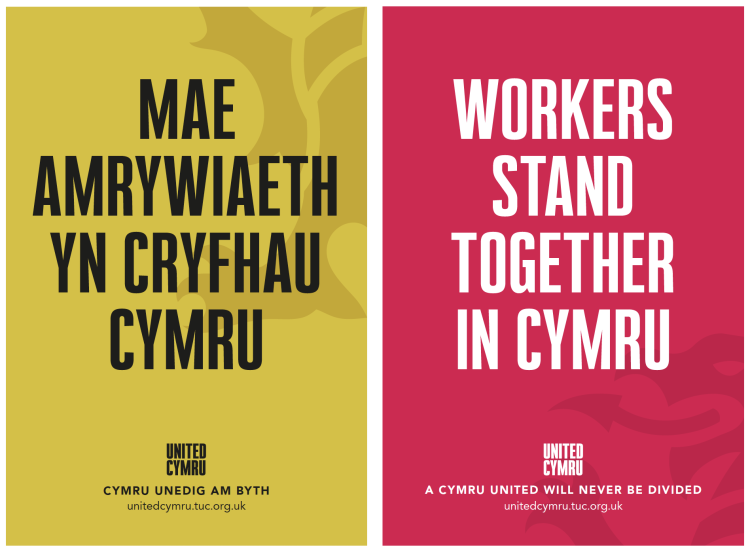
We have also engaged with the Welsh Government on green transition and skills, ensuring that workers are central to decisions about decarbonisation and industrial change. This has included advocating for strong social partnership structures and reinforcing the role of unions in shaping policy outcomes. We were pleased that the new first minister chose TUC Cymru Congress for his first public engagement, where he reiterated the importance of social partnership.
We have been working with the Aneurin Bevan University Health Board, which has been actively changing how it reduces harm by improving the way it conducts its disciplinary procedures. We have been engaged with the health board in seeking to share best practice with our affiliates, particularly in the public sector, with the focus on how social partnership can act as a vehicle for change in reducing harm.
Overall, we have combined political influence, campaigning and coalition building, using the election to amplify workers’ voices, while embedding the longer-term message of United Cymru: that Wales is strongest when it stands together
4.1 AI and rights at work
As artificial intelligence (AI) rises up the agenda, we have worked with unions in two ways to develop a strategy. First, we have worked to build union capacity to understand, negotiate and advocate on AI. This year we have worked with hundreds of reps, officers and senior leaders to demystify AI, rooting responses in workplaces. We also hosted a Collective Bargaining on AI forum, with trade unionists, lawyers and policy specialists to accelerate negotiations on AI. Recognising the need for sectoral responses, the TUC and nine unions in education delivered a pilot ‘action learning’ project to develop union strategies, helping to catalyse a cross-sectoral response. We also launched Workers and Machines, a newsletter of authoritative, accessible and actionable insights on AI for the movement.
The second part of our strategy is building a pro-worker policy agenda, based on our 2025 policy platform. We are promoting the essential role of workers and unions in shaping AI at work, confronting abuses by tech companies and employers. This included the TUC and CWU bringing together leading online safety campaigners to hold TikTok accountable for mass redundancies of over 400 workers, in line with emergency resolution 4. Weak AI adoption and growing public concern around its application has given us leverage.
This year progress has been made, with the government naming ‘pro-worker AI’ as a key theme in its plans to make the UK the fastest AI adopter in the G7. Unions have been participating in the new AI and Economics Institute and the AI Early Careers Alliance – including finance unions, as called for in composite 11. We have actively participated in the public sector-focused Responsible AI Adoption Panel, the Women in Tech Taskforce and the Mayor of London’s AI and Jobs Taskforce. We are clear that robust action is now needed.
This year we have worked with hundreds of reps, officers and senior leaders to demystify AI, rooting responses in workplaces.
The government has dropped its intention to weaken copyright protections; however, Labour’s manifesto commitment to bring forward an AI Bill, as noted in composite 10, has not materialised. We are pushing for full delivery of the Make Work Pay commitment on workplace surveillance, tackling exploitative ‘dynamic pricing’ as evidenced in our report, The human price of dynamic pay, and a wider pro-worker AI agenda – including extending collective bargaining to technology, using public procurement to confront the entrenched power of big tech in public services and comprehensive skills and training for workers impacted by AI.
4.2 Skills
Over the past year, we worked with affiliated unions to advance skills policy and workforce development, building on resolution 9, which identified an unprecedented crisis in education. This included recruitment and retention challenges, course closures, and too many young people and adult learners being denied access to high-quality, inclusive education – undermining social mobility, regional growth and economic transition. The crisis reflects excessive marketisation, particularly in higher education, alongside sustained underfunding despite the sector’s vital role in national renewal.

In response, we have been working with affiliates to develop a bold vision for a National Education Service, alongside an ambitious, worker-led approach to skills and lifelong learning.
A key strand of this work is the TUC Skills Project 2050, which is shaping a long term, worker-led vision for an inclusive, high-quality skills system that responds to technological change, decarbonisation and labour market shifts. Launched in June, the project brings together unions, policy makers and experts to ensure reform is rooted in the realities of working people.
We continue to champion unions and union learning representatives (ULRs) as essential partners in widening participation, improving progression and supporting workplace learning.
We have engaged closely with government departments and Skills England to ensure workers’ voices are central to policy development.
We have submitted evidence highlighting:
the essential role of unions in supporting millions of workers
persistent employer underinvestment in skills and training
the long-term impact of government disinvestment
concerns about the quality and accessibility of employer-led training and apprenticeships.
This has informed our wider influencing work, including submissions to the autumn 2025 budget and spring 2026 statement, calling for the reinstatement of the Union Learning Fund (ULF) and sustained public investment in skills.
TUC representatives continue to shape national policy through senior roles in Skills England and the Industrial Strategy Advisory Council, ensuring that skills reform delivers good jobs, fair access and economic growth in every region.
4.3 Climate change and just transition
We have expanded our proactive approach to delivering a rapid and just climate transition that protects jobs and workers’ rights.
We coordinated policy advocacy and engagement with national government, including:
setting up a co-chaired taskforce with government on the Warm Homes Workforce, to deliver good jobs and a skilled workforce for the retrofit of the nation’s homes
coordinating the union side of negotiations for the initial Fair Work Charter for Offshore Wind
winning commitment by government to creating the North Sea Jobs Service
advocating for a plan for the North Sea oil and gas supply chain
coordinating the Trade Union Advisory Council for GB Energy, helping win commitments to invest millions into upgrading the supply chain.
In line with resolution 75, we developed a series of activities and interventions for the Year of Trade Union Climate Action 2025–26.
Our events during the Year of Trade Union Climate action included:
the All to Play For: Building a positive future for energy supply chains conference in Durham, bringing together unions, cabinet members, industry and climate campaigners to plan a future with good energy jobs in the North-East
the On Fire and Under Fire: Climate, backlash and winning with working-class communities event during London Climate Action Week in Congress House
Energy Shockwaves: What Trump’s war on Iran means for UK manufacturing jobs held online.
We worked with our unions and supported organising of events throughout the year, promoting these through our revamped and relaunched TUC Climate webpage, as well as including resources and case studies for green reps.
Case studies of successful transition in the UK and internationally were also collated on our Futureproofing Manufacturing page.
TUC staff produced videos on the urgency of protecting and expanding climate investment, including a video of a teacher supporting solar panels on his school roof.
We pushed for trade union objectives in the government’s ongoing negotiations to build a closer economic and political relationship with the EU.
4.4 Trade and the EU
In line with resolution 13, we pushed for trade union objectives in the government’s ongoing negotiations to build a closer economic and political relationship with the EU.
We met with the foreign secretary Yvette Cooper MP, minister for the constitution and European Union relations Nick Thomas-Symonds MP, Cabinet Office and DBT officials to feed into these negotiations. And we continued to chair the UK-EU Domestic Advisory Group, represented by Mike Clancy (Prospect). This group enabled us to join with business groups to advocate for commitments to protect the highest standards of workers’ rights and good jobs in UK-EU negotiations.
To influence EU decision-makers in negotiations, we released a joint statement with the European Trade Union Confederation (ETUC) in June on the shared objectives workers have on both sides of the Channel. The TUC also held meetings with representatives of the German and French governments with sister trade union centres in these countries.
In January, we met trade minister Sir Chris Bryant MP to call for protections for manufacturing from unfair competition, express concern about the impact of the Trump administration’s tariffs – particularly on steel and automotive sectors – and welcome the government’s commitment that UK trade agreements would ensure respect for labour rights.
However, in May we raised concerns that this commitment was not aligned with the government’s trade negotiations with the Gulf Cooperation Council states, where there are widespread labour rights abuses. The TUC raised this at a roundtable with minister Chris Bryant as well as criticising the Investor-State Dispute Settlement provisions included in the agreement.
We took part in the International Trade Union Confederation (ITUC) delegation to the World Trade Organisation (WTO) ministerial conference in Cameroon in March, where we again met minister Chris Bryant and pushed for reforms to the WTO to protect workers’ rights and governments’ ability to protect domestic industries and promote good jobs.
4.5 International
We have continued to participate in the ITUC General Council, taking a delegation to its meeting in Addis Ababa in December, the first time it has met in an African nation. This meeting passed a resolution demanding actions for peace in Sudan.
The TUC is represented on the ETUC Executive Committee. In May this Committee agreed a joint TUC-ETUC statement on objectives for UK-EU negotiations.
Our General Council issued a statement in January condemning the US’ illegal attack of Venezuela and abduction of President Maduro and his wife as violations of international law and sovereignty, raising these concerns with minister for Latin America Chris Elmore MP.
In March, we also issued a statement through our General Council condemning the US and Israel’s attacks on Iran as violating the UN Charter and international law, raising this with minister for the Middle East Hamish Falconer MP. The TUC continued to work closely with the Arab Trade Union Confederation to raise concerns of workers in Iran and the Middle East region.
We have continued to participate in the ITUC General Council, taking a delegation to its meeting in Addis Ababa in December, the first time it has met in an African nation.
In line with composite 14, resolution 72 and emergency resolution 5, TUC and union advocacy contributed to the UK government’s decision to recognise the State of Palestine in September 2025. At the General Council meeting in January, unions pressed minister Hamish Falconer on policy priorities, including: the UK’s obligations under the Genocide Convention and the impacts of the genocide on workers, including journalists; banning settlement trade and suspending the UK-Israel Trade and Partnership Agreement; IDF raids on the offices of the Palestinian General Federation of Trade Unions; arms sales to Israel; lack of Palestinian representation on President Trump’s Board of Peace; and respect for international law and the right to self-determination.
In June, the TUC organised a delegation to the UK with Shaher Sae’d, General Secretary of the Palestinian General Federation of Trade Unions, and Dr Hind Benammar, Executive Secretary of the Arab Trade Union Confederation. The delegation took part in a joint TUC-Labour Friends of Palestine and the Middle East parliamentary briefing and met with several MPs and ministers. We continued to promote the workplace days of action for Palestine, which took place in February and May, and supported equality conferences where Palestine was raised in motions. We maintain a constructive relationship with the Palestinian ambassador, Dr Husam Zomlot, and met with him in March.
Supporting emergency resolution 1, the TUC signed a joint letter with several affiliates, and in March our president joined the lobby of parliament organised by the Palestinian Solidarity Campaign.
We engaged with the UK government to protect the mandate of the ILO from threats by the Trump administration to undermine the organisation by seeking to appoint its nominee for deputy director-general while withholding $200m in membership fees.
At the 114th International Labour Conference, TUC delegates played leading roles across committees. Our representative on the ILO Governing Body, Amanda Brown, served as vice-chair of the Platform Committee, supported by Peter Wieltschnig (TUC) and Lola Brittain (Equity).
Former TUC General Council member Diana Holland and Abigail Hunt (TUC) took leadership roles on gender and social dialogue committees respectively, while Stephen Russell (TUC) participated in 10 cases in the Committee on the Application of Standards, including challenging Nigeria over the arrest of NLC President Joe Ajaero that prevented his attendance at TUC Congress 2024.
Following TUC and global union advocacy, the Ethical Trading Initiative (ETI) adopted a new four-year strategy placing freedom of association at its core and strengthening alignment with ILO standards. Trade unions remain represented on the ETI Board via the TUC, ITUC and the International Transport Federation (ITF).
The TUC continued to support trade unions and the defence of labour rights in Ukraine, including a statement with affiliated unions on the third anniversary of Putin’s illegal invasion of the country and through ongoing engagement at the ILO.
We backed the ITUC campaign to free former Hong Kong CTU president Lee Cheuk-yan, with our president participating in international action and advocacy pressing the UK government to intervene.
In May, our general secretary addressed the L7 in Paris, celebrating the Make Work Pay Agenda but warning of the need for effective enforcement of employment rights and the need for governments to support multilateralism based on human rights and respect for international law.
The TUC continues to work with international partners to build global campaigns against the far right.
The TUC signed the Cuba Solidarity Campaign coordinated statement in January expressing concerns about US threats to Cuba’s sovereignty and increased penalties on the country. We are seeking a meeting with the Foreign, Commonwealth and Development Office (FCDO) minister for Latin America Chris Elmore MP raising these concerns and members of the TUC Executive Committee met the Cuban ambassador in March.
We supported the Justice for Colombia May/June delegation from Britain, Ireland and Spain to coincide with the first round of the Colombian presidential election. TUC president Steve Gillan joined a group of trade unionists and politicians to meet with Colombian trade unions, human rights defenders and leading political and peace process figures, observe the electoral process and continue to support labour rights and the peace process.
4.6 Trade union support for peace
In line with resolution 37, the TUC has continued to call for peace and to respect international humanitarian law, issuing statements on Gaza, Venezuela, Iran and Cuba. We were a key organiser and driver of the ETUC’s Trade Unions for Peace initiative launched in Dublin in June to build trade union capacity in conflict resolution and peacebuilding, drawing on trade union experiences of peace processes and to discuss building the economic conditions for peace, social justice and individual and collective rights – calling on governments to engage in multilateralism and dialogue to end conflict.
The TUC has continued to call for peace and to respect international humanitarian law, issuing statements on Gaza, Venezuela, Iran and Cuba.
4.7 Covid-19 Public Inquiry
Starting in June 2023, the Covid-19 Public Inquiry completed its final public hearings this year. Over the course of the inquiry, we have participated in eight of the ten modules looking at the impact of the pandemic and the government’s response – with witness from the TUC, GMB, UNISON, NEU, NASUWT, RMT and Usdaw as well as colleagues from TUC Cymru, the Scottish Trades Union Congress (STUC) and the Irish Congress of Trade Unions: Northern Ireland Committee (ICTU-NI). In addition, we received over 7,500 responses to our members’ survey, covering a wide range of sectors. The voice of our members was heard loud and clear in the inquiry – reflected in many of the recommendations. The full range of TUC interventions in the inquiry, from our witnesses and legal team, can be found on the TUC’s covid-19 inquiry web page.
Further thematic and sectoral reports will be published over the next 18 months and we will be keeping the pressure on government to act on the recommendations, learning the lessons for when we face similar threats in the future and working to inform the UK government’s resilience action plan, in line with resolution 31. In March, the TUC held a day of reflection as part of a nationwide series of events commemorating those who lost their lives in the pandemic, where we heard moving testimonies from those who worked on the front lines in those terrible days.
5.1 Developing the TUC
We continued to implement our 2024–26 strategy, working under our five agreed aims of:
a growing union movement that reflects the diversity of today’s working class and has the power to intervene effectively for workers
workplaces where every worker has strong rights and is protected from discrimination
a fairer economy that delivers secure jobs and rising wages and supports strong public services
an economy where workers can shape and are prepared for the challenges of the future
a strong TUC that is sustainable, effective and a great place to work.
We have identified priority projects within these aims and introduced a system of monitoring and evaluation of our work. We have also implemented a new planning process as we begin our work on the strategy for 2027–29.
Operationally, we have implemented a new performance management system to improve our annual review and line management processes. Following a review in 2025 of our existing disciplinary and grievance procedures, these have been updated and are now being embedded into working practice. Our new finance system continues to provide efficiencies and greater security, and we have restructured the finance team to provide additional support and enhance the service provided. The IT infrastructure was successfully upgraded to provide improved flexibility in the workplace, and we have successfully achieved cyber essentials accreditation.
Our new finance system continues to provide efficiencies and greater security, and we have restructured the finance team to provide additional support and enhance the service provided.
5.2 Sale of Congress House
As previously reported, the General Council took the difficult decision to sell Congress House and seek a new-fit-for-purpose home for the trade union movement in 2024.
We appointed Newmark property consultancy to assist with project managing the sale and subsequent purchase. Following a commercial process that saw over 100 viewings, the TUC agreed, with trustee approval, heads of terms with a potential purchaser in June 2025. As a result of substantial delays on the buyer’s side, the trustees agreed to withdraw from this transaction and return to market in March 2026. At the time of writing, we have successfully obtained a pre-app planning document that supports possible development options for interested parties and are engaging with the market with a view to securing a new purchaser for the property.
In preparation for the sale, our internal project group has successfully undertaken extensive financial and legal due diligence, cleared the basement areas of the building, disposing of tonnes of waste, recycling materials and transferring significant quantities of documentation to the TUC archives in Warwick. We’ve also considered plans to preserve the history of Congress House for the movement.

5.3 Congress Awards
At Congress 2025, the Health and Safety Award winner was Abigail Young from GMB and the Organising Award went to Robert Smalley from Unite. The winner of the Youth Award was Adam Birks from Usdaw. The joint winners of the union learning rep (ULR) award were Sofia Anysiadou and Lisa Simpson from UNISON. The Women’s Gold Badge recipient was Sonya Pickford from UNISON.
5.4 Comms Awards
The Trade Union Comms Awards are a highlight of the year – celebrating the creativity, skill and impact of union communications.
From powerful member storytelling and standout campaigns to organising workers and holding employers and politicians to account they showcase how we make working people’s voices heard.
Congratulations to last year’s winners: Best Union Journal, The Journalist (NUJ); Best Recruitment and Organising Communication, Awesome Teacher (NASUWT); Best Campaign Communication, Health and Safety Matters (Usdaw); Best Megaphone Petition, Save Bethnal Green Working Men’s Club (Equity); Best Use of Social Media, New video first social media strategy (NASUWT); and Best Communication from a Smaller Union, Nautilus TV (Nautilus International).
5.5 Women’s Conference
The theme of the TUC Women’s Conference 2026 was ‘Resisters: smashing the status quo’. Over 300 women from across the movement debated key issues, including tackling violence against women and girls, the far and populist right, the impact of AI and women’s workplace rights.
We hosted a panel discussing the rise of misogyny and the far right, and the TUC Women’s Committee issued several statements on peace, AI and rights for self-employed workers. In line with resolution 12, HOPE not hate spoke on the panel.
5.6 LGBT+ Conference
The theme for the LGBT+ Workers Conference was, ‘Looking Back, Moving Forward with Unity.’ More than 250 people attended the conference in Brighton, with delegates debating key issues including hate crime and the far right, access to health care and services, inclusive education, international LGBT+ rights, Pride, and government’s LGBT+ policies, with a focus on trans, non-binary and gender-diverse rights and the Equality and Human Rights Commission (EHRC) updated code of practice on services, public functions and associations.
We hosted a panel discussion entitled ‘Beyond Fear: self-declaration, solidarity and the future of trans rights’ and received a keynote speech from equalities minister Olivia Bailey MP.
5.7 Disabled Workers Conference
The theme of our Disabled Workers Conference was ‘United: breaking barriers, defending rights’. More than 250 people attended the conference, held in the Bournemouth International Centre, debating a range of issues including government influencing access to work, personal independence payments (PIP), changes to the law and government reviews, reasonable adjustments, hate crime and the far right, and access and representation.
We hosted a panel discussion entitled ‘Government, Employers and Barriers to Work: From access to work to PIP’. Our range of keynote speakers included minister of state for employment Diana Johnson DBE MP.
5.8 Black Workers Conference
Under the theme ‘Equity to Action: Transforming work for Black workers’, the Black Workers Conference 2026 debated 25 motions covering workplace racism, health inequalities, migration, media narratives, AI, maternity injustice, and strategies to counter far-right organising. Emergency motions also addressed war, international solidarity and the cost-of-living crisis. With 346 attendees, the conference reaffirmed commitment to collective action, solidarity and democratic participation.
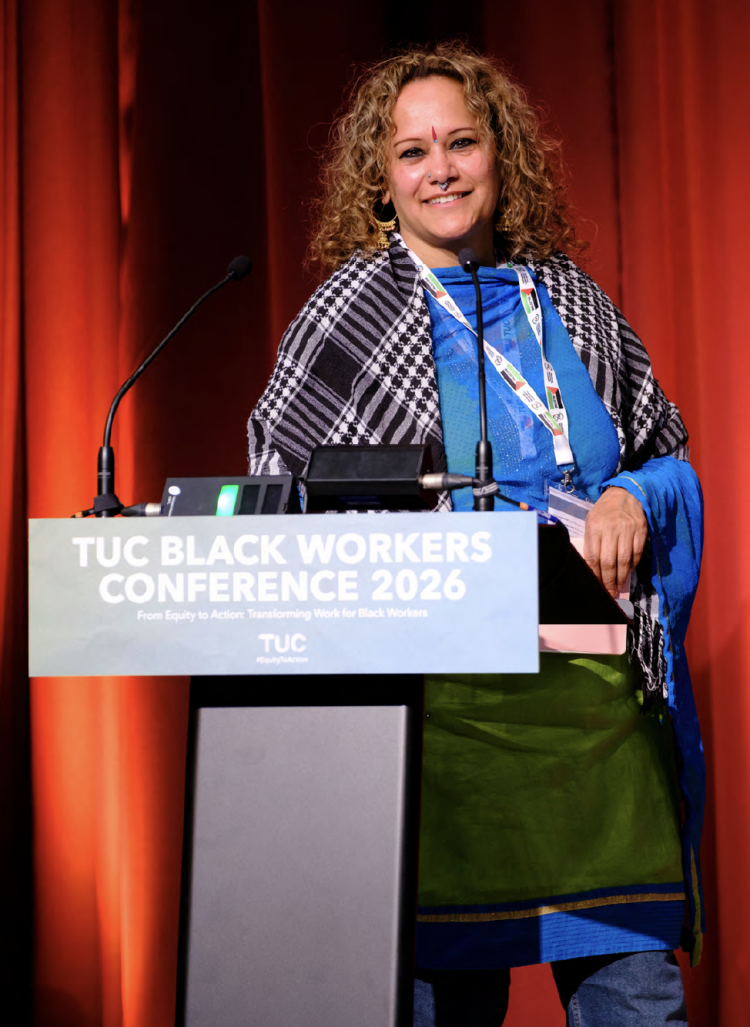
5.9 Young Workers Conference
More than 150 delegates debated 29 motions, including organising young workers, affordable housing, ending sexual harassment and protecting migrant workers. Workshops, speakers and fringe meetings covered topics such as having one-to-one conversations, navigating trade unions, defying the narrative on migration, the housing crisis, international solidarity, the Employment Rights Act (ERA) and tackling workplace violence and abuse.
5.10 Trades Councils Conference
Held in Leeds at the end of May, the conference drew more than 70 delegates – the highest attendance for some years – to debate resolutions on a range of issues, including employment rights, the far right, AI, access to health care, the war in the Middle East and housing. It agreed to allow the Trades Union Councils’ Joint Consultative Committee (TUCJCC) to co-opt a TUC Young Workers Committee member to improve links between trades councils and young workers. The conference was addressed by Richard Burgon, MP for Leeds East.
5.11 TUC finances
The full statutory financial statements for the year ended 31 December 2025 are included in Appendix 3. It shows a total deficit and reduction in assets of £29.6m, reducing total funds from £71.8m to £42.2m. This was made up of tangible fixed assets and investments of £38.7m, with net current assets of £4.5m being offset by long-term tax and employee liabilities of £1.0m. The deficit was driven by changes in the value of assets and liabilities, including a reassessment of the recoverability of the pension surplus (-£26m impact) and continuing difficulty in the London commercial property market, which led to a significant fall in property values (-£2.6m impact). The operating deficit on ordinary activities of £1,548,000 also contributed to the deficit. It was made up of a deficit of £1,717,000 on the administration fund being partially offset by surpluses of £40,000 and £129,000 on the development and external grants funds respectively.
5.12 Administration fund
The administration fund (covering day-to-day office running expenses and staff costs) deficit of £1,717,000 was due to ordinary income of £19.3m not covering expenditure of almost £21m. Ordinary income of £19.3m was £778,000 above budgeted income primarily because membership numbers increased above the 2024 figure and exceeded our estimated number for 2025. Additionally, sales and grant income surpassed expectations. Expenditure of £21m included an additional £1.78m due to planned costs of restructuring not included in our ordinary administration fund.
Additional relocation costs were also borne by the administration fund, as were the tax costs associated with the successful disposal of investments.
Without these additional costs, ordinary expenditure against ordinary income would have resulted in an administration fund surplus of £100,000.
5.13 Development and external grants funds
In 2025, 10 per cent of the affiliation fee was allocated to the development fund, plus additional contributions from affiliates and grants for projects, and was used to promote new work and General Council initiatives in the following priority focus areas:
building and diversifying our movement
strengthening workplace rights and protections
getting wages rising and transforming public services
preparing for future economic challenges
the Covid-19 Public Inquiry.
The development fund showed an operating surplus of £40,000, made up of just under £1.767m of income offset by £1.727m of expenditure. £1.5m of affiliation fees were set aside to fund this work, with additional income of just under £267,000 received from external sources such as contributions to the cost of the Covid-19 Public Inquiry legal fees, and sponsorship for other work. The operating surplus of £40,000 was caused by underspends across numerous projects.
The external grants fund is made up of grants and payments from external funders, such as devolved and local governments, for specific programmes of work. The £129,000 surplus was made up of just over £2.623m of income mostly offset by expenditure of £2.494m, with the difference due to the timing of income and expenditure flows.
5.14 Prospects and developments
A budget for the 2026 administration fund has been agreed by General Council. This showed a projected surplus of £9,203, which was based on the sale of Congress House early in 2026. The sale has not progressed, and the projected administration fund deficit stands at £653,000, based on the additional costs associated with the building remaining unsold throughout the year. General Council approved an affiliation fee increase of five per cent for 2026.
The TUC holds the freehold of Congress House, Bainbridge House, Great Russell Street, London WC1B 3LS and a charge of £9m was granted to the society in March 2006 which was released by a deed of agreement dated 11 June 2025. The deed also made provisions for a charge to be agreed, on substantially the same basis as the released charge, on the building that TUC acquires after the sale of Congress House, Bainbridge House.
The TUC has retained its Fair Tax accreditation.
5.15 TUC Finance Committee
The Finance Committee met in October, December, March, May and July of this Congress year. It approved the TUC’s budget for its administration, development, external grants and relocation funds in December, and received regular updates on each of these budgets throughout the year. It also received updates at each meeting on the sale of Congress House, risks, and associated mitigations. It discussed the balance of funding between the TUC and STUC, and discussions on this are expected to conclude this year. In March it approved a car policy for the general secretary, and in May it received a report from the TUC’s auditors on the annual accounts.
5.16 TUC Library collection
This year, the TUC Library marked the 50th anniversary of the Grunwick Strike with its exhibition Grunwick 50: Workers, rights and resistance. Currently on display on the ground floor of the Learning Centre at London Metropolitan University, it will remain open until 1 December.
The library commemorated the centenary of the 1926 General Strike through a series of public events and displays. These included hosting a webinar on the anniversary and contributing a showcase of materials from the collections during our event at Congress House – The General Strike 100 years on: In conversation with John Monks and Jonathan Schneer.
We have made progress in improving digital access to the library. The TUC project website, unionhistory.info, has been integrated into London Metropolitan University’s special collections catalogue, https://collections.londonmet.ac.uk This offers enhanced functionality for digitised materials, making the collections more accessible and easier to explore.
Enquiries and visits can be arranged through the TUC librarian, via email at specialcollections@londonmet.ac.uk
The library commemorated the centenary of the 1926 General Strike through a series of public events and displays. These included hosting a webinar on the anniversary and contributing a showcase of materials from the collections.
Nigel de Gruchy, who died in November, was general secretary of the NASUWT from 1990 to 2002. A member of the TUC General Council from 1989 to 2002, he also served as TUC President in 2002-03. He served on the NASUWT executive, before becoming assistant secretary, and subsequently being elected as deputy general secretary and general secretary. One of the most prominent trade unionists of his generation, Nigel de Gruchy was a tireless champion of teachers and education. A shrewd user of ‘pupil-friendly’ industrial action to win disputes, he oversaw a significant increase in NASUWT membership during his time as general secretary.
Dr Paul Donaldson, who died in November, was general secretary of the Hospital Consultants and Specialists Association (HCSA) from 2020 until his retirement in 2025. Prior to this, he worked as a consultant microbiologist for over two decades. Respected by members and staff, as well as the wider medical profession, he was a principled and determined champion of the NHS and everyone who worked in it. A firm advocate for better terms and conditions for hospital doctors, under his leadership HCSA members took industrial action over pay during the national NHS disputes in 2022/23. A regular speaker at Congress and participant at TUC events, including our right to strike demonstration in Cheltenham, he provided invaluable advice to unions during the Covid-19 pandemic.
Bob Purkiss, who died in June, was a pioneering trade unionist who led the movement’s fight against racism. A TGWU full-time official for over 25 years, he served on the TUC General Council from 1994 to 1999 as the first black members’ representative. After working as TGWU regional education officer for southern England, he became the union’s national secretary for race equality, serving as a trade union commissioner on the Commission for Racial Equality before being appointed chair of the European Monitoring Centre Against Racism and Xenophobia. He was a member of the TUC’s Stephen Lawrence Task Group and undertook groundbreaking anti-racism work with a range of institutions.
Barbara Taylor, who died in June, was an administrative officer for the North West TUC for over 20 years until her retirement in 2007. A popular and enthusiastic member of the team in our Bootle and Liverpool offices, she made a significant contribution to the TUC’s work in the region, including TUC Education and our pioneering work on learning and skills.
Stay Updated
Want to hear about our latest news and blogs?
Sign up now to get it straight to your inbox
