
General Council Report 2026
2.1 Make Work Pay and employment rights
As noted in composite 4, the Employment Rights Act (ERA) delivers real improvements to workers’ rights and conditions. And we have been pressing for robust and swift implementation of all the government’s commitments in its Plan to Make Work Pay.
The passage of the Employment Rights Bill was repeatedly delayed by a combination of Conservatives, Liberal Democrats and crossbenchers in the House of Lords. We were active in briefing peers on the merits of the legislation, which has made paternity leave and parental leave a day one right, implemented sick pay from the first day of absence and introduced whistleblowing protections for sexual harassment.
In line with emergency resolution 6, we supported a Lords amendment that would have prevented the imposition of upfront fees for work.
The ERA finally received royal assent in December, bringing Great Britain more in line with the global mainstream and paving the way for a stronger economy.
We were active in briefing peers on the merits of the legislation, which has made paternity leave and parental leave a day one right, implemented sick pay from the first day of absence and introduced whistleblowing protections for sexual harassment
Most measures in the Act require further secondary legislation, often after consultation. In recent months, we have responded to consultations on issues including fire and rehire, parental leave, unpaid internships, bereavement leave - including pregnancy loss - the threshold for collective redundancy, improved access to flexible working and modernising the agency work regulatory framework. Consultations on zero- and short-hours legislation and non-disclosure agreements and a call for evidence on the Transfer of Undertakings (Protection of Employment) Regulations remain open at the point of writing.
In line with resolution 25, we have called for nursing parents to be better supported at work in our response to the enhanced dismissal protections for pregnant women and new mothers consultation response highlighting the need for flexible working, effective risk assessments and protections from discrimination.
Following composite 4, we have engaged with ministers and civil servants to ensure that loopholes on areas such as fire and rehire practices and the use of zero-hour and short-hour contracts are closed and the legislation is as effective as possible.
The new Fair Work Agency came into operation on 7 April, with three trade union appointees to its advisory board. We have been pressing for rapid implementation of new powers to enforce statutory sick pay and holiday pay and recover enforcement costs from employers who do not cooperate.
Significant parts of the Plan to Make Work Pay have yet to be legislated for. The TUC has continued to press the government on employment status reform, publishing reports including Behind the App: Bogus self-employment and the rise of talent platforms and The Human Price of Dynamic Pay to illustrate the gaps in existing employment law that allow employers to deny workers their rights.

2.2 Health and safety
We continued to play a leading role in supporting affiliates and strengthening the voice of health and safety reps, ensuring that workers’ health, safety and wellbeing remain at the heart of the trade union agenda.
The Safety Reps Connect event in November was a major success, bringing together 300 health and safety reps from across the movement to share experience, build confidence and strengthen practical networks. A programme of webinars further extended this support, helping reps stay informed and equipped to meet emerging workplace challenges, in line with resolutions 5 and 26.
The TUC Health and Safety Reps Survey 2024-25 was published, drawing on responses from reps across 36 affiliates. The findings provided valuable insight into the changing profile of health and safety reps and highlighted the continuing importance of tackling workplace stress, excessive workloads and high temperatures. Reps also identified concerns about the quality of employer risk assessments and responses to enforcement action, underlining the vital role unions play in holding employers to account.
In line with resolution 20, we hosted a well-attended event on preventing violence at work, bringing together more than 100 union officers and reps. The event demonstrated the movement’s shared commitment to safer workplaces and to practical action that protects workers from abuse, harassment and violence.
The TUC continued to work closely with unions on the campaign to remove asbestos from workplaces and highlighting Zane’s Law, in line with resolution 50. The general secretary met Stephen Timms MP, minister of state for social security and disability, to press the case for urgent action, including a ban on silica and the establishment of a national asbestos taskforce.
On Workers’ Memorial Day, the All-Party Parliamentary Group (APPG) on Occupational Safety and Health held a reception bringing together parliamentarians, trade unionists and bereaved families. The APPG also held a public evidence session and published a report on violence at work, helping to maintain pressure for stronger protections and safer workplaces for all.
In June, we convened a meeting of health and safety officers from a dozen affiliates with officials from the Health and Safety Executive (HSE) and the Department for Business and Trade to inform the government’s review of health and safety regulations. We set out our concerns that the review may undermine safety legislation, given the government’s stated ambition to reduce the regulatory ‘burden’ on business by 25 per cent.
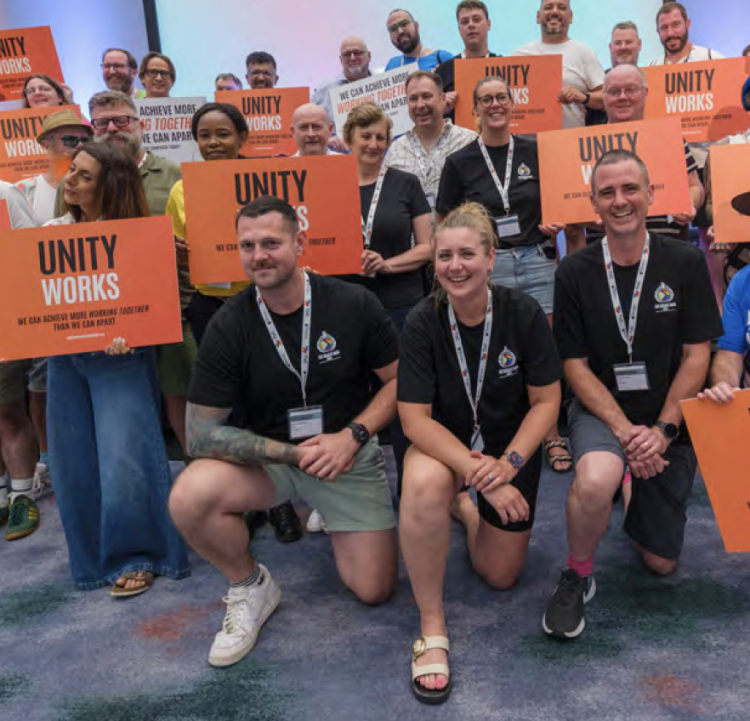
2.3 Tackling the far right and Unity Works
We have continued to deliver alongside our strategy to tackle the far and populist right and to support affiliates with their efforts in workplaces and communities. We have built an active and effective network of trade union officials, to help us coordinate and respond to demands of affiliates. We’ve also focused on supporting local activities, working with regional secretaries and TUC Education to roll out comprehensive training and briefings across the country.
In line with composite 2, the TUC launched the Unity Works campaign to provide affiliates with materials, training and resources to support workplace representatives. This ongoing, evidence-based campaign outlines our positive vision for hope, which cuts through the divisive narratives of the far right. As part of our Unity Works campaign, we have briefed MPs, produced promotional materials for affiliates and rolled out a new training course for workplace representatives and activists.
In line with resolution 12, we worked with the University of Bath to undertake a literature review considering the tactics of online influencers in the far-right space, particularly focusing on young men, misogyny and the online ecosystem. The report highlighted the widespread prevalence of misogynistic content online, as well as the diversity of narratives that exist and the real-world
We also commissioned research on disrupting digital pathways to provide a comprehensive overview for the union movement of how far-right and Reform UK-adjacent narratives spread across major digital platforms in 2025.
consequences of the growth of misogynistic beliefs online. The analysis informed training to be rolled out in the autumn supporting workplace reps to tackle misogyny and misogynoir.
We have also commissioned research looking at the ways in which the far right uses transphobic narratives to spread division. We’ll use the findings to shape guidance for reps and members to use in workplaces and communities when encountering transphobic far-right narratives and engage members on issues such as pay, job security and public services.
We also commissioned research on disrupting digital pathways to provide a comprehensive overview for the union movement of how far-right and Reform UK-adjacent narratives spread across major digital platforms in 2025. As part of this work, we also tested social media content to reduce the levels of trust in far-right content creators on YouTube. Findings were shared with affiliates to ensure the messages we share online are targeted and impactful.
In line with emergency resolution 2, the TUC continued to support the Together Alliance, and work with anti-racist organisations and Hope not Hate on their Million Acts of Hope initiative. We will continue to support this work, particularly regional interventions aimed at supporting communities to build resilience against far-right organising.
2.4 Anti-racism
In April, at the TUC Black Workers Conference, we launched the No Worker Left Behind report, a follow-up to the TUC’s seminal 2020 report Dying on the Job. The report highlights that racism remains a significant concern for Black workers. 37 per cent of Black workers report not being offered overtime and 41 per cent being kept on temporary or fixed-term contracts. These findings reiterate the importance of our priority on delivering the ERA in full, and the government’s commitment to Make Work Pay as a key industrial priority for Black workers.
No worker left behind also articulates that discrimination in the workplace takes a number of forms that impact the health, safety and wellbeing of Black workers. Black workers report that perpetrators of unfair treatment are more likely to be direct managers or other managers and that bullying is carried out by managers and colleagues and that explicit racism is received from colleagues and customers, clients and patients. The report contains key recommendations for employers, government and unions themselves.
Supporting affiliates to deliver the key recommendations in this report and the ongoing work of the Anti-Racism Taskforce (ARTF) manifesto and action plan, remains a priority for the TUC. Since its launch at the TUC Black Workers Conference 2026, we have delivered a number of briefings to affiliate unions and stakeholders about the recommendations in the report and the ARTF manifesto and action plan. Working with unions to highlight a number of key actions they can take internally, as well as areas for prioritisation in an industrial setting, alongside lobbying asks for government We also continue to drive greater participation and representation of Black members within trade unions through regional Black Activist Development Programmes and support for affiliated unions to develop structures that enable members to influence decision-making and progress into leadership roles. As set out further in the section on sexual harassment, we have continued to highlight Black women’s experiences.
2.5 Migration
In line with composite 3, we are standing up for migrant workers, advocating for a compassionate, fair and managed approach to migration. We continue to strongly oppose the government’s planned ‘earned settlement’ reforms, higher visa salary thresholds and the expansion of the hostile environment measure – the ‘right to work’ scheme – to other working arrangements, which risk increasing exploitation.
In doing so, we have worked extensively with affiliated unions in producing evidence submissions and meeting with the government. We are pressing for the new Fair Work Agency, through engagement with ministers, officials and evidence submissions, to protect migrant workers and remain separate from immigration enforcement so people can report abuse safely.
We are also calling for reforms to the visa sponsorship system, including sectoral sponsorship in adult social care and changes to the Overseas Domestic Worker visa, to reduce workers being trapped in poor conditions. We back the right of people seeking asylum to work and campaigns for safe routes to rebuild their lives. We have also begun new research to understand public attitudes to migration and equip unions with practical tools, training and resources to support reps in handling difficult workplace conversations and championing progressive values.
We have also begun new research to understand public attitudes to migration and equip unions with practical tools, training and resources to support reps in handling difficult workplace conversations and championing progressive values.
2.6 Protecting and promoting equalities
In line with our strategic aim to ensure workplaces where every worker has strong rights and is protected from discrimination, we continue to campaign for equality across the movement. We continue to engage with members from our affiliated unions through the delivery of our statutory conferences, with the support of our committees, and have engaged with government through a number of consultations, including on carer’s leave, parental leave and bereavement leave.
2.7 Tackling sexual harassment
Tackling and preventing sexual harassment in all workplaces, including our own, remains a priority for the TUC and is key to our aim of growing and diversifying our movement. In March 2021, the TUC Executive Committee Working Group was established to provide strategic oversight of this important strand of work. The working group provides a space for affiliates to oversee progress being made by leaders across the movement, to ensure cultural change and embed the preventative approach to sexual harassment.

The ERA has introduced requirements for employers to take all reasonable steps to prevent sexual harassment. From October 2026 there will be an obligation on employers not to permit the harassment of their employers by third parties. We have been working with affiliates to shape the technical guidance produced by the Equality and Human Rights Commission (EHRC) on how this is implemented and enforced. We are continuing to work with affiliates and external groups, including the Workers Policy Project, to give workplace representatives practical advice on considering sexual harassment in risk assessments, as well as providing guidance on negotiating standalone sexual harassment policies with employers. The TUC is also responding to the government consultation on the use of non-disclosure agreements (NDAs).
We have continued to support affiliated unions to undertake our preventative cultures training, encouraging unions to make the training available at all levels of their organisations – from senior leadership team and executive structures to lay representatives. We added new questions on sexual harassment for the TUC Equality Audit 2026. Findings suggests that, while feedback on the training is positive, take up among affiliates is low, so we are working with union equality officers to understand the barriers and encourage affiliates to roll out the training.
In line with resolution 13, following on from the launch of And Then it Clicked... – our report into Black women’s experiences of sexual harassment in the workplace – we have continued to support affiliates in creating spaces for Black women in their unions. The report considered the intersectionality of gender and race and called on affiliates, employers and the government to take action to tackle sexual harassment, misogynoir and the cultures that allow Black women to encounter systemic barriers.
In accordance with resolution 11, the TUC has continued to build a network of ambassadors who can amplify the findings of our report into Black women’s experiences of sexual harassment. We have run a series of roundtable discussions, focusing on why trade unions need Black women, as well as engaging with the Black Women and Sexual Harassment Working Group to shape the interventions.

2.8 Working time and flexible working
We continue to campaign and lobby for greater access to flexible working including for an advertising duty and for the commitments in Make Work Pay to be delivered in full.
We coordinated two roundtables with union officers and union reps with the Department for Business and Trade to influence their access to flexible-working consultation. In May, we submitted further evidence to the government’s consultation on flexible working, highlighting insight from affiliates on how a lack of flexibility can force people out of the workforce. We continued to reiterate our calls for members to have the right to be accompanied to any meeting regarding flexible working and have highlighted our calls for an advertising duty. This would require employers to outline the flexible-working options available in a role when it is advertised, ensuring that applicants are able to take up those options once appointed to a role.
We conducted new research which demonstrated that a third of workers still have some or all of their flexible-working requests rejected and that flexible working would support people to move into and around the labour market. The research also found that too many employers are still not following the Acas Code of Practice on requests for flexible working.
As part of our work on influencing the Get Britain Working White Paper, we have continued to highlight the importance of access to good-quality flexible working to keep people in the labour market, particularly disabled workers.
We also highlighted working-time issues throughout the year, publishing new analysis on night working and unpaid overtime.
2.9 Pay gap reporting
Experience of gender pay gap reporting demonstrates that publication of data alone does not drive structural change. Without mandated action planning, regulatory scrutiny and integration into collective bargaining, reporting risks becoming a compliance exercise rather than a tool for equality.
The ERA will introduce mandatory gender pay gap action plans for in-scope employers. But we are continuing to campaign for more robust requirements to be included – calling for additional powers for the EHRC to ensure action is taken beyond public submission of an action plan.
In line with resolution 8, we continue to push for disability and ethnicity pay gap reporting and support implementation of the Equality (Race and Disability) Bill. We are providing additional guidance and support to affiliates, encouraging them to take action to voluntarily publish their ethnicity and disability pay gaps.
We also support the recommendations made in the McGregor-Smith Review that the requirement to report on the gender, ethnicity and disability pay gaps should apply to companies with 50 or more employees and will continue to campaign for this ask.
2.10 Supreme Court ruling and EHRC Code of Practice
In support of resolution 7, and in accordance with the principles agreed between our LGBT+ and Women’s Committees, we have continued to actively pursue our mandate that trans, non-binary and gender-diverse workers should be able to live full and meaningful lives, based on and including the principle of self-declaration.
We have led sustained engagement with government departments, civil servants, ministers and the chair of the EHRC, consistently reiterating the movement’s position: that equality law and practice must protect dignity, safety and inclusion for trans and non-binary workers.
In June, the TUC responded to the EHRC consultation on its code of practice for service delivery. The submission raised practical concerns about inclusion and emphasised the need for clear, workplace-based examples grounded in real experiences.
When the EHRC laid its updated code before parliament in May, we responded publicly, highlighting that it failed to address key issues previously raised. In particular, we raised concerns about the lack of clarity on applying the April 2025 Supreme Court judgment and the risks this poses to ensuring workers are treated with dignity and respect.
We made clear that “we must build a world in which trans lives are not only legally recognised, but fully liveable in practice – including self-declaration, rooted in longstanding TUC Congress commitments”.
We have also strengthened coordination across the movement, convening two meetings of the Trade Unions for Trans and Non-Binary Alliance, with strong participation. In response to growing risks, including harassment and doxing, the TUC has produced guidance to support trans workers and allies to stay safe online and in person.
We have continued direct engagement with Bridget Phillipson MP, minister for women and equalities, through correspondence and meetings, including with LGBT+ Committee members sharing lived experience.
We will continue to advance Congress policy, champion self-declaration, and ensure trans workers’ rights are upheld in law and practice.
Alongside our work lobbying government, meeting with key stakeholders and supporting affiliates to understand the implications of the Services Code of Conduct, we have provided practical guidance. The guidance focuses on how individuals can remain safe online and at events, while supporting trans, non-binary and gender-diverse workers’ rights. We know union representatives and members play a vital role in challenging all forms of discrimination and are focused on providing guidance and support.
2.11 Personal independence payments
In accordance with resolutions 38 and 39, we have opposed the government’s proposed changes to personal independence payments (PIP) and universal credit (UC).
In the period directly before the motion carried at the TUC Disabled Workers Conference and TUC Congress, the TUC publicly oppose the changes to PIP.
We led a high-profile campaign against the proposed PIP changes. This included issuing a press release, amplifying opposition through social media, and publishing an opinion piece in The Mirror. These interventions gained significant attention, helping to build pressure on the government.
On 1 July 2025, the government announced it would not proceed with the proposed changes to PIP. This reversal reflects the impact of coordinated lobbying led by the TUC, working alongside the wider trade union movement and disabled people’s organisations.
Following this decision, the government committed to a co-designed review of PIP. We have played an active role in shaping this process. Senior civil servants engaged directly with the TUC to understand our approach to co-design with disabled members, recognising our expertise in inclusive policy development.
While Congress policy called for the TUC to coordinate protests, these were not required due to the effectiveness of our early lobbying.
We continue to actively influence the ongoing review. The general secretary met with Stephen Timms MP, minister of state for social security and disability, in March to discuss progress and next steps. The TUC Disabled Workers Committee co-chairs have also engaged directly with the review leadership.
We led a high-profile campaign against the proposed PIP changes. This included issuing a press release, amplifying opposion through social media, and publishing an opinion piece in The Mirror.
In addition, we submitted detailed evidence to the review, informed by a member survey on experiences of accessing PIP. Its recommendations include reforming the assessment process, improving decision-making, reducing reassessments, increasing accessibility, aligning PIP with employment support, recognising fluctuating conditions, and ensuring PIP reflects the real cost of disability.
2.12 Support for neurodivergent workers
In support of composite 6, we continued to advocate for stronger equality legislation that explicitly protects neurodivergent workers through written and oral consultation responses to government, parliamentary inquiry submissions, and engagement with the civil service and non-departmental public bodies (NDPBs).
The EHRC’s recently updated Code of Practice for Services, Public Functions and Associations now explicitly recognises the barriers that people with hidden impairments, fluctuating conditions and neurodiverse conditions may face. It also provides clearer guidance on the duty to make reasonable adjustments to remove or reduce those barriers and support equal participation. We will work to ensure these clarifications are also reflected in the Code of Practice for Employment when it is updated.

2.13 Supporting young people into work
Recent figures show that an estimated 957,000 people under the age of 24 are not in education, employment or training (NEET). More than half of the respondents to our post-election poll thought that opportunities for young workers were deteriorating and two-thirds thought that government action is needed to expand training and apprenticeships and to secure entry level jobs so that young workers get a fair start to their careers.
In response to the review of NEETs by Alan Millburn, we called for an expansion of the jobs guarantee for young people, ensuring the quality of jobs through the full implementation of the ERA and Make Work Pay, reform of apprenticeships improving quality and expanding provision, and for more funding for tertiary education. We will continue to campaign on this as a priority issue.
Recent figures show that an estimated 957,000 people under the age of 24 are not in education, employment or training (NEET).
Stay Updated
Want to hear about our latest news and blogs?
Sign up now to get it straight to your inbox
