General Council Report 2026
Workers continue to face difficult economic conditions. At the start of 2025, United States’ tariffs meant disorderly trading relations, and in 2026 illegal wars, including in Iran, led to steeply increased energy prices and threatened shortages of other commodities. Prices in the UK remain greatly elevated and recent real wage gains short lived.
GDP growth was up to 1.4 per cent in 2025 (from 1.0 in 2024) but overall remains subdued. The TUC argued the weakness was predominantly the result of subdued consumer demand, because of the relentless cost-of-living squeeze and higher interest rates. Analysis showed UK consumer demand growth 32nd out of 36 OECD countries.
The labour market is fragile. While the employment rate has been static at around 75 per cent, unemployment has risen by around 0.5 per cent over the past year and the inactivity rate fell by the same. Payroll figures show a loss of 210,000 employee jobs in the year to April 2026.
The cost of living is the number one issue facing people. Pay has not kept up with costs and people are struggling to get by or falling short of their aspirations for their quality of life.
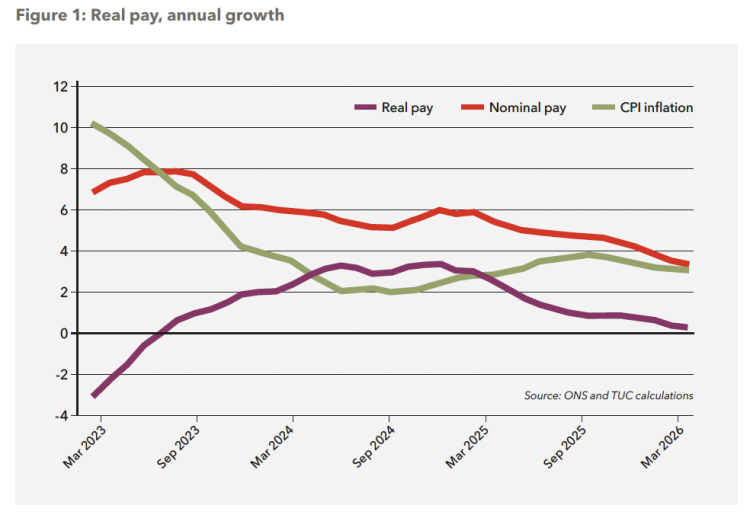
Real pay rose for the first half of 2025 but renewed inflation has undermined these gains into 2026. Nominal pay growth has slowed from 6 per cent in 2024Q1 to 5.5 per cent in 2025Q1 and to 3.4 per cent in 2026Q1. Having peaked at 11.2 per cent in October 2022, rather than returning to target energy shocks mean inflation at the end of this year is expected to rise to 3.5 per cent on CPI and 4.6 per cent on RPI. Now near zero, real pay is likely to fall back into negative territory.
Yet the Monetary Policy Committee has continued to judge that the risk of excessive pay growth is greater than the risk to economic growth and has therefore been slow to cut interest rates. In contrast, TUC analysis showed countries prioritising economic growth are not penalised with higher inflation.
As well as household spending, high interest rates have severely constrained government finances. While the government has acted to support public services and investment, more is needed. In line with composite 7, we have called for higher taxes on wealth, showing a higher bank surcharge could raise up to £50bn over the next four years. In our submission to the autumn 2025 budget, as well as fairer taxation, we called for further scrutiny of the Office for Budget Responsibility.
The cost of living is the number one issue facing working people. Pay has not kept up with costs and people are struggling to get by or falling short of their aspirations for their quality of life. Three-quarters of respondents to our post-election poll said their personal financial circumstances were getting worse. The long-term deterioration in family finances has been compounded by a succession of price shocks. The cost-of-living crisis started in 2022, the result of sharp price rises caused by the Ukraine war and pandemic-related shortages. Prices did not go back down – energy costs in March 2026 were 80 per cent higher than they were in January 2021. Food prices have risen 40 per cent across the same period. High interest rates are compounding this picture, with direct costs to households and a dampened economy.
We have called for urgent action from the government, including:
a permanent social tariff to support families with energy bills, and an energy crisis social tariff that kicks in during periods of crisis
reducing the universal credit taper rate so that those on the lowest incomes keep more of what they earn
fully leveraging its infrastructure and procurement spending to deliver good jobs.
3.2 Industrial strategy
Through our Futureproofing Industry project, we have supported union officers and workplace reps in sectors including steel, ceramics, glass and automotive to push employers to invest into site upgrades to boost competitiveness and futureproof jobs. This included helping reps win investment commitments, pilot projects and upgrade plans.
Our policy interventions included:
calling on government to deepen its industrial strategy support for target sectors and increase investment
pushing government to commit to jobs plans for all industrial strategy sectors, aiming to replicate the leadership shown in the Clean Energy Jobs Plan, to win and protect good jobs including trade union recognition and collective bargaining
engaging with the Treasury and the National Infrastructure and Service Transformation Authority (NISTA) about delivering quality jobs through new infrastructure projects
encouraging the National Wealth Fund to deliver on its investment commitments to automotive, hydrogen, steel and ports
publishing our Save British Ceramics briefing together with GMB and the Green Alliance, calling for policy interventions to upgrade and protect the ceramics sector. This was followed by advocacy – and helped secure £120m in public investment to modernise ceramics sites.
In support of resolutions 60 and 61, we campaigned for backing for British industry, including specific calls to support ceramics and steel. Our campaign interventions included:
making the case for more action to ensure UK industrial electricity prices become competitive, including by bringing down wholesale prices. This included media coverage, lobbying, a Megaphone petition and presenting policy solutions to government.
launching Save Welsh Industry and Save British Industry, with local and national media coverage, training for reps and a national poster campaign.
We launched our Industrial Voices Programme, training industrial sector reps to communicate through videos in digital spaces. This added to our regular production of videos on industrial issues for TUC social media channels.

3.3 Pay and the national minimum wage
The TUC has campaigned to keep real pay growing. We made regular media interventions that highlighted the ongoing pay crisis and its impact on living standards.
We made the case for a £15 minimum wage for all workers regardless of age. In 2025, we presented evidence to the Low Pay Commission (LPC) through a written submission and by leading a delegation of unions to give oral evidence. Following submissions by the TUC and affiliates, the government announced an increase in the National Living Wage to £12.71 an hour from April 2026. It also increased youth rates to £10.85 for 18- to 20-year olds and £8.00 for under-18s. A submission for the 2026 LPC consultation was in preparation at the time of writing.
We have intervened on the public debate around youth rates highlighting that the youth rates are discriminatory and are largely unused, with 85 per cent of 18- to 20-year-olds already paid above the youth minimum wage and 63 per cent paid at or above the national minimum wage. This evidence was cited in the Milburn Review on young people and work.
The TUC Minimum Wage Enforcement Group has continued to meet, bringing together unions, advice agencies and relevant government departments and enforcement bodies.
We continue to push for a strong and robust living wage through our work with the Living Wage Foundation. We are influencing the work of the foundation through seats on the Living Wage Commission and the Living Wage Advisory Council.
The TUC has campaigned to keep real pay growing. We made regular media interventions that highlighted the ongoing pay crisis and its impact on living standards.
3.4 Corporate governance, workers’ capital, due diligence and executive pay
We have been advocating for new mandatory human and labour rights and environmental due diligence legislation as part of our work on corporate governance reform and responsible business conduct. Along with TUC Cymru, UNISON, STUC and ICTU/NI, we sat on the Foreign, Commonwealth and Development Office’s Expert Advisory Group for research into the UK’s implementation of the UN Guiding Principles on Business and Human Rights, facilitating input from affiliates and sister centres. We provided evidence to the government’s review of responsible business conduct.
In November, we co-hosted a seminar for investors on the Employment Rights Bill, setting out the new rights and why they are needed.
3.5 Social security and sick pay
The TUC campaigned for the removal of the two-child limit in universal credit, and the government scrapped the policy in the November 2025 budget. And we continue to emphasise the importance of social security in reducing child poverty. While higher employment, more secure work and rising pay can boost household incomes, in-work benefits also remain vital to improving living standards.
Following the long-running TUC campaign on improving access to statutory sick pay (SSP), the government extended SSP to all employees in April 2026 through the Employment Rights Act (ERA). The changes are expected to benefit up to 9.6 million UK workers. The Act also removed the three-day waiting period, guaranteeing sick pay from day one, and extended eligibility to 1.2 million workers who previously earned below the £125-a-week qualification threshold.
The government’s 2025 green paper Pathways to Work proposed cutting the health element of universal credit for under-22s. We highlighted the impact these cuts would have on young people, arguing that reducing entitlements would push those most in need of support even further from the labour market. We made this case in our submissions to the Milburn Inquiry and to the Work and Pensions Select Committee’s inquiry on youth employment, education and training.
The government committed to a co-designed review of PIP. We have played an active role in shaping this process. Senior civil servants engaged directly with us to understand our approach to co-design with disabled members, recognising our expertise in inclusive policy development. We also submitted evidence to the Timms Review based on a survey of PIP recipients. The submission outlined reforms to improve outcomes for disabled people and workers, including changes to the assessment process, better decision-making, fewer reassessments, increased accessibility, alignment with employment support, recognition of fluctuating conditions, and ensuring PIP reflects the real cost of disability.
3.6 Pensions
The TUC has been a leading advocate for the interests of working people in occupational pensions, and for retired workers.
We have coordinated trade union involvement with the government’s Pension Commission, which is developing proposals for long-term reform of the pension system. To do this, we established a Trade Union Liaison Group, which has met regularly with the commission and provided written evidence to it.
We also worked to influence the Pension Schemes Act as it passed through parliament. The main focus of our briefings and lobbying was on strengthening member protections.
We have continued to make the case for a stronger voice for workers in pension scheme governance. We published a report, Member Voice in Pension Scheme Governance, at this year’s TUC Pensions Conference. We used the evidence gathered in this report to lobby the Department for Work and Pensions to extend and strengthen requirements for schemes to include members on trustee boards.
In the public sector, we have supported the launch of a campaign to bring the administration of public service schemes in-house, following the severe administrative failures after Capita took over the Civil Service Pension Scheme (CSPS) in December 2025. The transition immediately collapsed, resulting in delayed retirement and bereavement payments, lost data, and an overwhelming backlog of over 100,000 cases that left thousands of retired civil servants in financial hardship.
We have coordinated trade union involvement with the government's Pension Commission, which is developing proposals for long-term reform of the pensions system.
3.7 Transport
This year saw the passage through parliament of the Bus Services Act, landmark legislation that reverses 40 years of deregulation and returns control over services to local leaders. We have worked with the Department for Transport throughout the year on the implementation of the act and on the design of guidance for commissioners. Alongside affiliated unions, we have strengthened worker voice in the guidance and guaranteed a role for unions in the enhanced partnership bodies that oversee service delivery.
We have continued to make the link between greater rail investment – and transport investment more broadly – and the government’s economic growth plans through briefings to MPs and directly with officials.

Informed by composite 12, we lobbied the secretary of state directly on the need for clarity and effective union engagement on the plans for the establishing of Great British Railways (GBR), the protection of pensions in the rail sector, on the necessity of insourcing cleaning and security staff and, in line with resolution 69, the need for greater support for rail freight.
We convened roundtable meetings bringing affiliates together variously with ministers, officials and special advisers on rail, aviation and maritime issues, including new pilot training routes, the future for rail freight and train drivers’ welfare in accordance with resolution 21, the government’s airport expansion programme, maritime skills and training funding in line with resolution 68, and the strengthening of protections for seafarers. In line with emergency resolution 3, we have engaged in detail with the Mayor of London’s Office on the ongoing industrial challenges at TfL.
We have continued to coordinate the framework agreement between HS2 Ltd and unions in the sector. A new direct route has been established via this group so that union concerns about access, health and safety, and contractor relationship can be raised directly with senior HS2 leadership. We expect to agree an updated and revised framework agreement by the end of the year.
3.8 Arts and the creative sector
The arts and creative sector is vital to the economy. Creative workers are key contributors to the UK’s success but face economic vulnerability. The TUC has represented the interests of creative workers, including through membership of the Industrial Strategy Advisory Council. We have advocated for self-employed creative workers in line with resolution 6. The TUC also attends regular meetings of the Broadcasting, Entertainment and Arts Unions (BEAU) grouping of unions.
Workers in the broadcasting, arts and entertainment sectors are seeing their intellectual property rights infringed by artificial intelligence (AI) models. We have convened a working group of creative and education unions to coordinate a joint trade union response. We continue to promote the manifesto on AI for creative workers, which outlines recommendations to address the impact of AI on creative work and workers.

3.9 Public services
Strong public services are vital to the government’s plans for economic growth, and they are key to pushing back against the far and populist right. When public services thrive, so do communities.
In line with resolution 30, we continued to call for fully funded fair pay rises for public sector workers and investment in public services, including in our submissions to the autumn 2025 budget and spring 2026 statement. And we continued to support union campaigns, including the FBU campaign against cuts to fire and rescue services, in line with resolution 49.
Through convening our Public Sector Liaison Group (PSLG), we continued to work with affiliates to understand and address shared challenges across the public sector including workload, AI and public sector reform, reflecting resolutions 32 and 33.
Recognising that lifelong learning in not only valuable in and of itself but also crucial to achieving government ambitions on economic growth, world-leading industries, tackling inequality and enabling opportunity.
Finally, after many years of campaigning we secured the reestablishment of the Public Services Forum (PSF), chaired by the Cabinet Office, ensuring meaningful engagement and a joint approach with trades unions on key issues affecting the public sector workforce.
3.10 National Health Service
The TUC has continued to advocate for an approach to public services based on long-term funding and workforce planning, in line with composite 8.
We have supported affiliates’ engagement with the government to deliver sustained investment in the NHS workforce to support its 10-Year Plan. We made the case for increased funding, fair pay and long-term workforce planning.
Through the PSLG, we convened cross-union discussions on pay review bodies to develop shared approaches to pay and workforce challenges.
At Congress 2025, the TUC brought together health unions and the secretary of state for health and social care to discuss the NHS workforce plan and the actions needed to retain staff and improve working conditions.
As part of the Our Work Matters campaign, we challenged the use of subsidiary companies (SubCos) and outsourcing models, as directed by resolution 40, supporting union campaigns for insourcing and better employment standards.
The priorities set out in resolutions 41, 45 and 46 have informed our wider work on health inequalities and patient safety.
3.11 Education
The education system and the workforce that delivers it are crucial to delivering many of the government’s ambitions for growth and opportunity. From navigating a rapidly changing world of work and adapting to AI and industrial transition to dealing with the crisis of young people not in education, employment or training and tackling child poverty, our educators must be at the heart of solutions.
In line with resolutions 53 and 54 and composite 9, we continued to work with our affiliates and government to call for an inclusive cradle-to-grave education and skills system. Recognising that lifelong learning is not only valuable in and of itself but also crucial to achieving government ambitions on economic growth, world-leading industries, tackling inequality and enabling opportunity.
Through our work with affiliates and the Early Education and Childcare Coalition (EECC), we secured clear recognition of the importance of early-years education and the early-years workforce, as set out in the government’s Best Start in Life and Child Poverty strategies. Working with affiliates and the EECC, we secured commitments to developing a workforce strategy for the early-years and childcare workforce, reforms to special educational needs and disabilities (SEND) and a formal consultation on the funding formula for early years.
In June we launched our Skills 2050 project, bringing together unions, employer representatives and skills experts to work with us to develop a comprehensive strategy for a skills system that empowers and protects the workers of today and tomorrow. A core strand of this first phase of work focuses on the post- 16 system and the importance of properly funding and supporting the further education and vocational training workforce to ensure they are enabled to deliver accessible learning to all workers.
In line with resolution 27, we have supported NJC unions to secure the reinstatement of the School Support Staff Negotiating Body (SSSNB) through the ERA. We continue to facilitate and support unions and government to ensure trade unions are meaningfully involved in all decision-making processes relating to secondary regulations and any future framework for the SSSNB.
In line with resolutions 55 and 56, we continue to amplify and support education unions’ inclusivity campaigns and priorities in a range of forums including through our seat on the government’s Opportunity Mission Board.
3.12 Social care
The TUC has worked with affiliates and government to develop a social care fair pay agreement.
We have built understanding among the government and other stakeholders around how an ambitious fair pay agreement can pave the way towards the development of a comprehensive pay and conditions framework within a National Care Service. Alongside this, we have made a strong case for a national social care workforce strategy.
We have worked with affiliates to spotlight the insecurity faced by migrant social care workers and made the case that the government’s plans to improve pay and standards in social care risk being undermined if migrant workers are forced into prolonged insecurity. The TUC continues to convene a working group on international recruitment in social care with the DHSC, which is regularly attended by Home Office officials. We highlighted the exploitation of international recruits with the Home Office and raised concerns around the impact on migrant care workers and the social care system related to proposed changes to earned settlement, aligning with composite 3.
The TUC and affiliates have engaged closely with the Independent Commission on Adult Social Care chaired by Baroness Casey. We have advocated for care workers’ voices, experiences and priorities to inform the commission’s work, and called for alignment between the commission’s focus areas and current government policy aimed at supporting the care workforce, notably the fair pay agreement.
We have also participated in the International Labour Organization (ILO) working group on care economy statistics and provided expert input into several academic studies.

3.13 Local government
The reforms underway in local government represent the biggest upheaval in over fifty years and are happening alongside major changes to England’s devolution settlement.
Further to resolutions 47 and 48, we undertook a series of discussions in regions across the country to better understand the frontline impact of the funding crisis and the measures necessary to correct it.
The government has provided some welcome steps this year – multi-year settlements, greater weighting towards deprivation in funding, some extra central investment – but we know more needs to be done to address the damage done by over a decade of austerity.
Through meetings with ministers for local government, and also with departmental officials, we directly made the case for bolder action on funding. In addition, we have set out the necessity for strong union voice within the new devolved landscape. We have emphasised central government’s role in ensuring that councils that are shifting from county and district models to unitary authorities adhere to their responsibilities to fully consult the workforce at all points during the transition.
We have also sought to highlight the opportunities presented for the government’s insourcing agenda through the reorganisation process.
3.14 Justice and the civil service
The TUC’s work in this area has been guided by resolutions 57, 58 and 59.
We have continued to advocate for workers’ health and wellbeing, safe and sustainable workloads and fair treatment across the justice sector.
We have worked closely with affiliates in prisons, probation and the Children and Family Court Advisory and Support Service (Cafcass), holding discussions to build a detailed understanding of frontline pressures. We used these insights to amplify union evidence in policy discussions and campaigning, ensuring affiliates’ priorities are communicated to government through direct ministerial engagement. In response to resolution 57, we collaborated with the Joint Unions in Prisons Alliance to raise workplace violence issues through a seminar for health and safety reps.
There has been significant pressure across the civil service this year as the government looks to make savings. In line with resolution 32, we have sought, via meetings at both ministerial and departmental levels, to combat misconceptions around public sector productivity and to emphasise the need for workers to be brought along and supported throughout any reforms.
In support of this work, we have commissioned in-depth survey research to understand how the government’s reforms are impacting the workforce, the sufficiency of the training offer, and the extent to which workers are being brought into the decision-making processes.
3.15 Public procurement and insourcing
Under the banner of the TUC’s Our Work Matters campaign, and in line with resolution 40, we have continued our work this year to ensure ambitious delivery of the government’s Make Work Pay insourcing and procurement commitments. This focused on ensuring that public ownership and in-house delivery becomes the default setting for all public services, and insourcing of services and outsourced workers take place when contracts end. We secured several meetings with the lead Cabinet Office minister, including a roundtable with outsourced union members, continued regular dialogue with senior civil servants, and worked with the government to establish a trade union reference group to support development of the new public interest test. We also raised awareness within government around the importance of a new Procurement Bill to ensure good work.
We worked with government to establish a union working group to inform the design of the new two-tier workforce regulations and code and facilitated trade union input into the design of the government’s social value model, including the good work pillar.
We continue to convene affiliates in the Procurement and Outsourcing Working Group, which has provided a forum for engagement with government policy as well as wider learning, information sharing and identification of good practices around insourcing and procurement, including in relation to wholly owned subsidiaries such as NHS SubCos. As part of the Our Work Matters campaign, we have supported affiliate organising and outsourced workers’ industrial action, held several webinars and run digital campaigning training for full-time officers.
This has led to the government announcing an end to ‘outsourcing as the default’ in public services, and a new commitment to work with trade unions on insourcing. Government departments are also required to develop insourcing strategies and implement a public interest test to look beyond short-term pricing to focus on long-term service quality and public value for contracts over £1m. All central government departments with over £100m in annual contract are also required to develop insourcing roadmaps to rebuild their in-house capabilities, and the government is developing a new social value model with a strengthened good work pillar. And in June the chancellor announced the insourcing of over 2,000 facilities workers currently under contract within a range of government departments.
3.16 Regional update
Across all five TUC regions, we have focused on delivering the core priorities of our unions by protecting workers, countering divisive narratives and supporting industrial campaigns at local, regional and national levels.
In the Midlands, we delivered critical workplace protections by securing a significant number of new employers for the Dying to Work campaign, including coverage across the entire civil service, while establishing an extensive anti-far right network and running the Silk Mill and Women Chainmakers festivals.
Our North East, Yorkshire & the Humber region focused on strategic economic interventions, establishing a regional Steel Combine, helping to secure £57m for Doncaster Sheffield Airport, protecting Durham Pride from funding cuts, and embedding formal union voices on to the management boards of devolved regional centres.
In London, Eastern & South East, the central focus was on supporting the organising of outsourced workers and expanding the Black Activists Programme by linking past participants with senior regional officers, alongside escalating anti-racism work through the Unity Works initiative.
Meanwhile, the South West prioritised movement growth, diversity and education by launching new networks to diversify membership and organising specialised training for affiliates, branches and trades councils to challenge divisive narratives.
Finally, the North West coordinated direct workplace and union briefings for reps to counter the populist right, maintained active support for industrial action and local insourcing campaigns, and continuously engaged with metro mayors to embed union priorities, including trade union education, into devolved political agendas.
Across all five TUC regions, we have focused on delivering the core priorities of our unions by protecting workers, countering divisive narratives and supporting industrial campaigns.
3.17 TUC Cymru
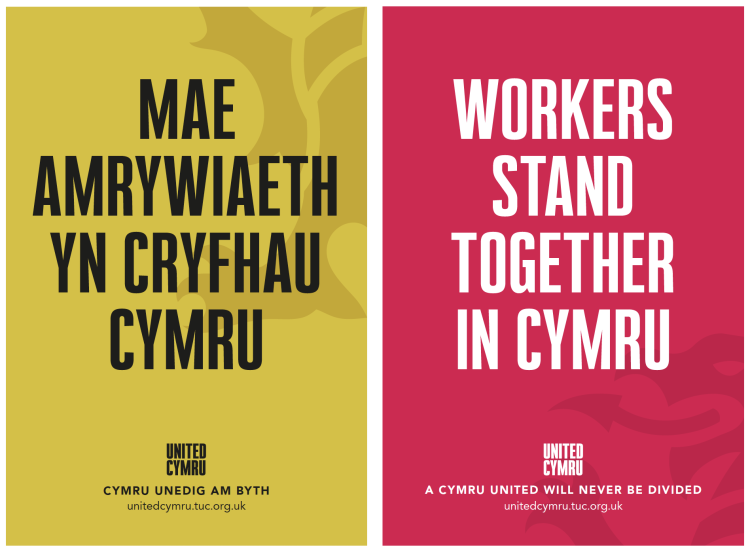
We have focused on strengthening workers’ voices in Wales during a pivotal political period, while advancing our United Cymru campaign to promote solidarity, fairness and a positive vision for the future of Wales.
A central strand of activity has been engagement around the Senedd election. We worked closely with affiliated unions to ensure that workers’ priorities – fair pay, secure jobs, strong public services and a just transition to a greener economy – were clearly reflected in the political debate. This included publishing our policy asks, engaging directly with parties and candidates, and talking about the issues that matter to workers. We emphasised the need for long-term investment in public services and workforce planning, particularly in health, social care and education, while advocating for further commitment to the Wales Union Learning Fund, which remains the only training fund targeted at working people in Wales.
Alongside the election work, the United Cymru campaign was a flagship initiative. Launched to counter division and promote unity, it has brought together unions, community groups and partners around shared values of solidarity, inclusion and respect. The campaign has highlighted the contribution of all workers in Wales, challenged narratives that divide communities, and provided practical resources for workplaces and branches to foster inclusive organising, have difficult conversations, and ensure workers who are campaigning for a progressive Wales feel that they are not alone.
We have also engaged with the Welsh Government on green transition and skills, ensuring that workers are central to decisions about decarbonisation and industrial change. This has included advocating for strong social partnership structures and reinforcing the role of unions in shaping policy outcomes. We were pleased that the new first minister chose TUC Cymru Congress for his first public engagement, where he reiterated the importance of social partnership.
We have been working with the Aneurin Bevan University Health Board, which has been actively changing how it reduces harm by improving the way it conducts its disciplinary procedures. We have been engaged with the health board in seeking to share best practice with our affiliates, particularly in the public sector, with the focus on how social partnership can act as a vehicle for change in reducing harm.
Overall, we have combined political influence, campaigning and coalition building, using the election to amplify workers’ voices, while embedding the longer-term message of United Cymru: that Wales is strongest when it stands together
Stay Updated
Want to hear about our latest news and blogs?
Sign up now to get it straight to your inbox
