General Council Report 2026
Introduction
Welcome to the 158th TUC Congress in Brighton.
As always, this is a wonderful opportunity for trade unionists to come together to discuss our priorities for the year ahead. And this year we meet with a real sense of optimism, with the latest figures showing trade union membership up by almost 200,000. As the landmark Employment Rights Act comes into force, including new rights for unions to access workplaces, we have a unique opportunity to go for growth.

And there’s never been more need for strong, effective, growing trade unions than now. These are profoundly turbulent times for working people, with the cost-of-living crisis continuing to hammer families and a record number of young people not in employment, education or training. Meanwhile, the threat posed by overseas actors using donations to buy political influence in the UK and the Mandelson scandal has left trust in mainstream politics hanging by a thread – with right-wing populists and extremists waiting in the wings.
As the landmark Employment Rights Act comes into force, including new rights for unions to access workplaces, we have a unique opportunity to go for growth
This complex, volatile and dangerous environment extends around the world. As I write, devastating conflicts continue to rage in Ukraine and Sudan, while the people of Gaza labour under a deeply flawed and unjust peace. As feared, Donald Trump has unleashed chaos around the world, acting with impunity in Venezuela, threatening Greenland and Cuba, ripping up long-standing global alliances, and imposing punitive tariffs. His illegal war in Iran with Benjamin Netanyahu has killed thousands of innocent civilians and sent economic shockwaves around the world. While the TUC has no truck with the brutal and repressive regime in Tehran, Trump’s illegal and senseless conflict has been disastrous for Iran, the wider region and the global economy.
With the UK still facing a hit from ‘Trumpflation’, the government must pull out all the stops to protect workers, get living standards rising and rebuild our economy and public services. I have repeatedly urged Labour to deliver the change the British people voted for back in July 2024 by implementing the manifesto pledges on which it was elected. And I have urged the new leadership team in Downing Street to put the interests of workers, families and pensioners first.
That’s why the TUC continues to call for ministers to make good on their promise to Make Work Pay. Last December, our movement won a historic victory when the Employment Rights Bill became the Employment Rights Act (ERA), delivering a raft of advances for workers and unions. But, while the ERA is important, it’s not the end of the story: from parental leave to public sector insourcing and a new right to disconnect, there’s still a huge amount for the government to do to deliver on its broader Make Work Pay commitments.

Better work for all must be the cornerstone of an ambitious, far-reaching package of social and economic reform. While the government has done many good things – investing in public services and bringing down NHS waiting lists; renationalising our railways and British Steel; abolishing the two-child benefit cap and lifting hundreds of thousands of children out of poverty – far too little of its agenda has cut through to a public hungry for change. Following May’s disastrous election results, the Labour government must now show working-class people clearly and unequivocally that it’s on their side. From new taxes on obscene wealth and bank profits to a closer relationship with Europe to kickstart growth, trade and jobs, nothing should be off limits.
In the spring, we launched our Unity Works campaign, engaging our members around a message of hope and showing that together we can change
Fail to act, and the alternative is clear: the populist and far right are gaining ground with millions of voters. That’s why the TUC is working with unions to train reps to have difficult conversations at work, why we’ve set out our vision of a fair, managed, values-based migration system and why we’re exposing the vast gulf between what Reform says and what it would do. Despite stronger rights at work being overwhelmingly popular with Reform voters, Nigel Farage’s party would repeal the ERA alongside the Equality Act and Renters’ Rights Act. And this would be accompanied by attacks on public sector pay and pensions and another round of eye-watering austerity Britain can scarcely afford.
In the spring, we launched our Unity Works campaign, engaging our members around a message of hope and showing that together we can win change. Our asks are straightforward: better jobs, rights and services; fair taxes; and cleaner politics. On the latter, we want more transparency and accountability in our politics and political funding, so overseas wealth, power and money cannot subvert our democracy.
When overseas-based crypto magnates can make huge donations to Reform and billionaire-owned social media platforms can profit from amplifying racist, misogynistic and homophobic voices, it’s clear our political debate is being poisoned. It’s time to clean up our politics and time to ensure politics delivers for working people.
Our job as trade unionists will always be to give working people hope, the sense that together we can win a better future. And we must do so amid a world that is changing at breakneck speed. AI is already transforming many of our industries and the jobs millions of us do. The climate emergency underlines the need invest in the cleaner, greener technologies that will power future growth while securing the livelihoods of workers in the North Sea.
And the intensification of global competition demands we support good, unionised jobs in sectors from chemicals to ceramics, steel, automotive, defence and energy.
But while we have a massive job of work on our hands, I’m convinced we can win the change working people crave. Throughout our history, unions have harnessed the power of collective action to secure huge social advances, from shorter working hours to health and safety, from workplace pensions to the minimum wage. With union membership on an upward trajectory and important new rights on the statute book, we have a real opportunity to shape a better future. Let’s seize it.
Here’s to a brilliant Congress.
Solidarity!
Paul Nowak
Strengthening the trade union movement is at the heart of the Trades Union Congress’s (TUC) work, supporting affiliated unions to grow, organise and secure high-quality, unionised employment across the UK economy. By providing practical coordination, modern digital infrastructure and comprehensive educational frameworks, the TUC adds capacity to individual union strategies while building collective strength across the entire workforce.
1.1 Organising and collective bargaining
We continue to implement the TUC strategy to support union growth, agreed by the Executive Committee in May 2025. This strategy, developed through extensive consultation with affiliated unions, reinforces the principle that while affiliates lead on individual workplace targets and organising campaigns, the TUC provides the shared learning, capacity and coordination needed to maximise growth and avoid duplication.
Following the agreement of composite 1, the TUC has advanced a comprehensive collective bargaining strategy. This initiative explores options for sectoral-level working between affiliates, guided by a working group of senior union representatives. These developments culminated in a set of core proposals discussed at the TUC Collective Bargaining Summit in May 2026.
Strengthening the trade union movement is at the heart of the Trades Union Congress’s (TUC) work, supporting affiliated unions to grow, organise and secure high-quality, unionised employment across the UK economy.
This collaborative work focuses on utilising the legislative framework of the Employment Rights Act (ERA) to expand union access, workplace recognition and collective bargaining coverage – particularly within the private sector. By coordinating access arrangements and strengthening governance processes, affiliated unions can protect resources, recruit new members and build industrial strength in multi-union environments.
To ensure growth is sustainable and representative of the wider workforce, the TUC has expanded its Black Activist Development Programme. Regional Black Activist Weekends held in the south-west and the Midlands were heavily oversubscribed, with each course offering 20 places. These events build skills, confidence and networks among Black members, diversifying the activist base and increasing long-term participation in union structures.
The Our Work Matters (OWM) campaign provides dedicated support to unions organising outsourced workers, aiding both direct disputes and insourcing campaigns. In line with resolution 40, the TUC supported a successful UNISON campaign in the south-west, halting the transfer of 1,700 NHS facilities staff to a subsidiary company and securing a reversal of NHS England guidance to Trusts.
To build movement-wide capacity, the OWM campaign delivered targeted webinars and training sessions covering:
organising within wholly owned subsidiary companies
building union membership in multi-lingual workplaces
deploying digital tools and tactics for distributed workforces.
In-person training included a pilot one-day course for outsourced representatives, strategic sessions on investigating outsourced employers, and the Outsourced Organisers Connect skill-sharing event. Political engagement formed a key pillar of this work and we supported a delegation of outsourced representatives from seven unions to meet with parliamentary secretary in the Cabinet Office, Chris Ward MP. The delegation presented an official record of support signed by 28,000 people advocating for public sector insourcing.
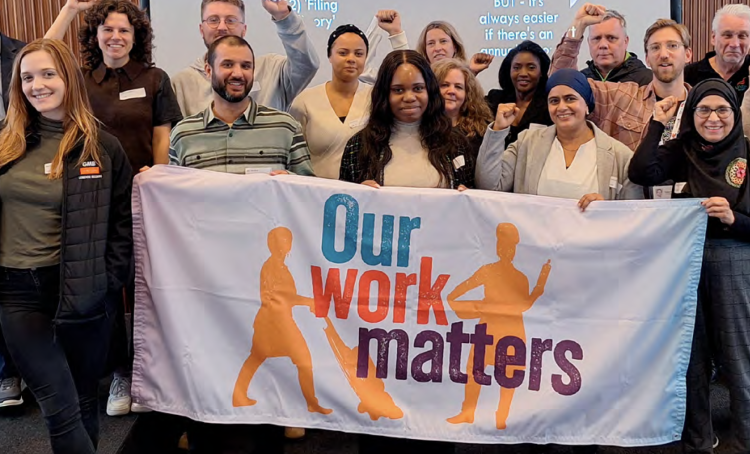
The Our Work Matters (OWM) campaign provides dedicated support to unions organising outsourced workers, aiding both direct disputes and insourcing campaigns.
Direct digital organising assistance has provided affiliates with measurable advantages during critical ballots. The TUC has helped unions integrate peer-to-peer texting tools to manage structured, one-to-one conversations with members. A notable application of this support assisted Equity during its indicative ballot on artificial intelligence (AI) protections. The TUC provided script development and activist training, contributing to a 99 per cent ‘yes’ vote on a 75 per cent turnout, demonstrating the value of modern communication methods in driving member engagement.
1.2 Industrial action and solidarity support
Rising living costs, disputes over pay and changing working conditions led to industrial action across both the public and the private sectors this year. We provided practical, logistical and financial support to ensure these actions resulted in positive outcomes for members.
Our dispute intelligence database has now tracked more than 2,400 distinct industrial disputes, recording over 1,200 union victories across 34 affiliates. The data has played a crucial role in identifying where the TUC can add support to unions in dispute, including more than 140 picket line visits from TUC representatives in the last year.
Through our Solidarity Hub platform, we have managed 92 requests for support over the past year, both locally and nationally, across 21 unions engaged in industrial action.
Megaphone continues to support unions running online petitions and digital actions. This year more than 70 campaigns were launched on the platform by 14 unions. Over 1.2 million people have now acted in support of a union campaign, with the Megaphone solidarity email list a vital resource for the movement. Over the last year our StrikeFunder project raised £20,000 for striking workers, including GMB outsourced workers at the Airedale Hospital and Sellafield, PCS members at MyCSP, and UNISON members at the National Coal Mining Museum.
Our Growth Hub has developed into a comprehensive platform to support union organising and growth. Since launching the recognition tracker, we’ve recorded more than 300 recognition agreements, achieved voluntarily and through the statutory process. The evidence collected from each unique campaign has helped shape our How to Win Recognition Guide as well as sharing best practice to help prepare unions effectively for a new organising environment.

1.3 Promoting trade unionism, Union Finder and social media
We use various channels to promote strategic priorities, support active disputes and introduce trade unionism to a wider audience, including young workers. Our social media channels reached 800,000 followers this year, supported by a nine per cent increase in YouTube subscribers. High-performing content included anti-far right video campaigns featuring manufacturing workers in Luton, which received more than six million views, and informational clips on wealth taxation, which secured more than two million views. Our first post on the Threads platform reached a million views, while a documented account of a workplace confrontation achieved eight million views on X (formerly Twitter).
Complementing this digital outreach, the online Union Finder tool remains a primary pathway for non-unionised workers to find unions, seek advice and secure representation. The tool was utilised more than 47,000 times over the year. Significant increases in traffic occurred when the Employment Rights Bill cleared the House of Lords in December, and during the social media campaigns of HeartUnions week, when coordinated online activity directed users to the tool.
1.4 TUC Education
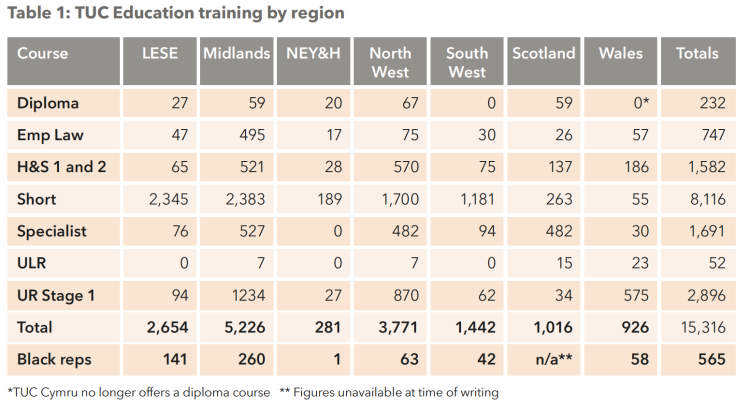
TUC Education provides reps with the skills, collective knowledge and confidence required to negotiate and organise effectively. Despite funding challenges within further education, we maintained stable delivery across its 13 education centres in England and Scotland.
In response to composite 1 and the subsequent review of TUC Education, we have engaged with mayoral combined authorities to secure new funding models. This approach achieved full funding for reps training within the Greater London Authority area, while discussions are progressing toward a prospective ‘White Rose’ partnership with three combined authorities in Yorkshire and plans for learning across the north-west. To guide local implementation, Trade Union Education Strategy and Delivery Groups are now established and active across every TUC region.
Online provision has expanded to support our anti-far right and Unity Works strategies, alongside guidance on the ERA. We launched a six-part online guide for workplace reps and hosted an in-person briefing event for union officers. For the Unity Works campaign, regional briefings, courses, and updated digital resources, such as the Talking Solidarity online guide, were provided to embed campaign objectives into everyday workplace organising.
Flexible training programmes were expanded to support bespoke learning requirements for affiliates including BALPA, the Society of Radiographers, Nautilus International, Unite, UNISON, NASUWT and the CWU. While funding and capacity constraints led to a decline in Stage 2 and Diploma enrolments, standard online Stage 1 participation remained strong, with 688 representatives completing courses.
Online webinars attracted more than 7,800 union reps. The largest attended single webinar focused on the ERA, featuring employment rights minister Kate Dearden MP, and drew more than 3,700 live registrations.
The in-person Union Reps Connect 2025 conference in Leeds, focusing on knowledge sharing and workplace representation, attracted more than 350 participants. Planning for the 2026 conference is underway, with an emphasis on equality bargaining ahead of new statutory rights for union equality reps.
The TUC Educational Trust provided essential funding throughout the year to support anti-far-right initiatives, diversify the representative base, deliver young workers’ organising schools, and upgrade training materials for full-time officers. The eighteenth Leading Change programme concluded with attendance from 18 senior union officers representing 11 affiliates, supporting leadership development across the movement.
In 2026, we launched our updated Organising Academy materials, adapting campaign strategies to address technical advancements in AI, digital tracking and the new provisions of the ERA. The flagship 16-day Diploma in Organising equips organisers and officers with the practical skills needed to drive membership growth.

1.5 Digital Lab
The TUC Digital Lab convenes affiliates to share best practice in digital transformation, aiming to lower project risks, reduce deployment costs and accelerate delivery times across the movement.
Key priorities this year focused on aligning digital systems with new statutory union rights. This included preparing unions for upcoming online balloting regulations and running a dedicated project to improve membership retention and onboarding through automated communication frameworks. These digital workflows are designed to help unions retain members effectively as new digital access rights come into effect.
The Digital Lab also addressed growing technological risks, facilitating peer-to-peer support for union IT specialists managing sophisticated cyber-attacks, updating membership databases, or assessing AI a implementation. To assist with strategic planning, the Digital Lab launched an updated version of its Digital Healthcheck interactive benchmarking tool, allowing affiliates to assess their technical capacity and map out clear operational strategies.
1.6 Anti-Racism Taskforce implementation
The Anti-Racism Taskforce (ARTF) continues to advance work to fight racism and promote equality across the trade union movement. The ARTF is supporting affiliated unions to implement the ARTF manifesto commitments that seek to diversify union membership, strengthen Black activism, work with affinity organisations and community groups, and support affiliates to take forward anti-racism as a core campaign. This work is organised across four core areas: collective bargaining; organising; public policy; and supporting affiliates as employers.
Led by its Implementation and Oversight Group, the ARTF focused on three specific priorities this year:
Representation and engagement: increasing direct outreach to Black workers and building workplace confidence to challenge discriminatory practices.
Evidence-based strategy: improving the collection and practical application of ethnicity data to inform policy and negotiation. The publication of the No Worker Left Behind report provided updated evidence of the specific workplace challenges and deteriorating conditions faced by Black workers since 2020.
Institutional reform: campaigning for statutory ethnicity pay gap reporting while driving voluntary compliance within the movement. This includes advancing the manifesto commitment for 50 per cent of affiliated unions to formally report their own ethnicity pay gaps as employers.
The Anti-Racism Taskforce (ARTF) continues to advance work to fight racism and promote equality across the trade union movement
1.7 Make Work Pay and collective rights
In line with composite 4, we have been pressing for robust and swift implementation of the collective rights set out in the government’s Plan to Make Work Pay document. Briefings for MPs and peers on the introduction of new rights of access, an employer duty to inform workers of their right to join a union and simplification and reform of the statutory recognition process set out why these rights are needed to boost union organising and collective bargaining.
The ERA gained parliamentary assent in December. Since April, the requirements for submitting a statutory recognition request have been simplified and unions need a simple majority in a ballot to gain recognition, with the previous turnout threshold removed.
Most measures in the ERA require further secondary legislation, often after consultation. In November, the TUC coordinated union input to roundtables with the Department for Business and Trade to discuss secondary legislation on access rights and the employer duty to inform workers of their right to join a union. We submitted consultation responses on both, agreed by the December Executive Committee.
Key points in the TUC’s response to the consultation on access regulations included:
weekly access to all workers covered in an access agreement should be a model term
access rights should apply to all employers, with no size threshold
fines must be sufficient to deter hostile employers with deep pockets from blocking access.
The government’s response confirmed that weekly access would be a model term; set out that employers with fewer than 21 workers would be exempt from access rights, but this would not apply to those covered by national statutory bargaining arrangements such as the Social Care Fair Pay Agreement and the School Support Staff Negotiating Body; and introduced a new level of fine at £500,000 for the most serious breaches of access – with powers for fines to be applied to multiple individual breaches of the code.
The TUC has coordinated further union roundtables and submitted responses to government consultation on codes of practice: in March on access and unfair practices during recognition and unfair practices in electronic ballots; and in May on access rights. We have coordinated union comments on the draft statement employers will be required to use telling workers of their right to join a union and the government landing page it will link to.
Regulations and the code of practice on access and regulations implementing the employer duty were laid in parliament in July, in preparation for the rights coming into force in October 2026.
1.8 Fair pay agreements and SSSNB
We have continued to work with and coordinate social care affiliates to support the introduction of a fair pay agreement in adult social care (ASCFPA).
In January, we responded to the government’s consultation on regulations to implement the ASCFPA. Key points included that the negotiating body should comprise only equal numbers of trade union and employer representatives and an independent chair and that the scope of the workers and the employment conditions covered should be as broad as possible.
In February, we took part in a ministerial roundtable with unions, employers and other sector stakeholders to promote positive industrial relations in the social care sector and support the introduction of the ASCFPA.
In line with resolution 27, we have supported NJC unions to secure the reinstatement of the School Support Staff Negotiating Body (SSSNB).
1.9 HeartUnions
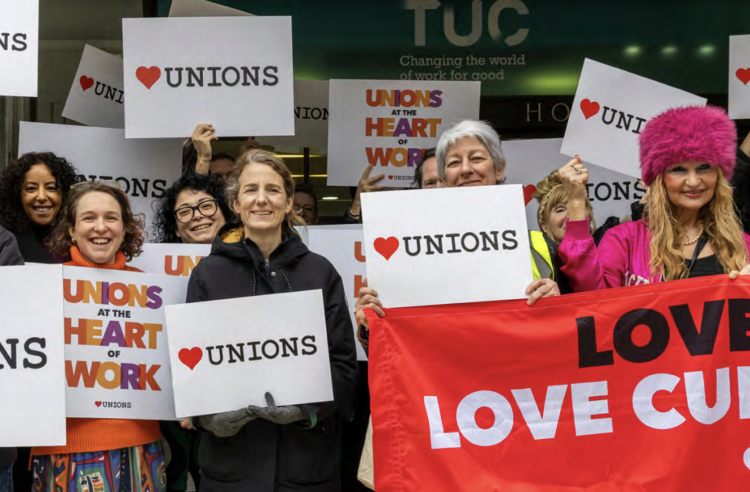
During HeartUnions week, we coordinated a range of national activities to celebrate the trade union movement and boost member recruitment. We provided practical coordination, merchandise and informational materials to support dozens of workplace and public events run by members across the UK.
Strategic political engagement with MPs and the Mayor of London’s office resulted in widespread, high-profile promotion across social media alongside politician attendance at local events. Public outreach was further extended through traditional media coverage, mass-email campaigns and targeted social media posts, which included a successful trial of paid digital advertisements to reach non-unionised workforces.
1.10 Young Workers Organising Strategy
In line with resolution 4, we launched the Organising Young Workers strategy at the TUC Young Workers Conference. Developed in partnership with the TUC Young Workers Committee, the strategy responds to comprehensive insights commissioned by the TUC regarding young people’s awareness of trade unions, barriers to joining and primary information channels.
The strategy focuses on four core strategic objectives:
Skills and confidence: increasing the knowledge and capacity of young members to support them to become active organisers within the movement.
Digital capacity: enhancing digital tools and platforms to modernise how unions engage and organise younger workforces.
Targeted outreach: reaching non-unionised young people through clear, accessible communications to build awareness of trade union values.
Policy lobbying: pressing the government to expand high-quality, unionised employment and training opportunities for young workers.
Delivery of the strategy is well underway, aligned with the objectives of resolution 5. In June 2026, the TUC hosted a national organising weekend, equipping young workers with the fundamental skills required to lead workplace campaigns.
Regional networks have reinforced this through targeted local events and community organising patrols, which are directly informing the ongoing rollout of the national strategy.
We established the first cohort of the Worker Voice Network, ensuring 50 per cent of applicants were aged under 35 to help develop highly relevant, relevant, relatable, digital content.
To improve peer-to-peer communication, we established the first cohort of the Worker Voice Network, ensuring 50 per cent of participants were aged under 35 to help develop highly relevant, relatable digital content. New educational guidance has also been commissioned, focusing specifically on how young members can become effective workplace organisers. Age-profile membership statistics will be published in the forthcoming TUC Equality Audit 2026.
In response to resolution 4 and broader concerns regarding age-related redundancy pay, the TUC has lobbied for stronger collective redundancy consultation rights. These legal protections would provide significant security in smaller workplaces, such as retail and hospitality, where young workers are statistically overrepresented and face higher risks of insecure employment.
Stay Updated
Want to hear about our latest news and blogs?
Sign up now to get it straight to your inbox
