
General Council Report 2024
Introduction - Paul Nowak
Welcome to the 156th TUC Congress in Brighton.
As always, Congress is a chance for unions to come together, celebrate our achievements and democratically decide our priorities for the future. With 48 affiliates representing over five million members in every walk of working life, it’s a chance for working people across the country to make our collective voice heard.

And this year, we meet with genuine optimism. The election of a Labour government in July offers real hope to trade unions and working people. After 14 years of Conservative rule, we have a chance to rebuild Britain and shape a fairer, greener, more equal future.
At the heart of Labour’s agenda is its New Deal for working people – a plan to make work pay. This will deliver the biggest upgrade to workers’ rights in a generation, tackling the zero- hours contracts, fire and rehire and low pay that blight the lives of millions of workers.
At the heart of Labour’s agenda is its New Deal for working people – a plan to make work pay. This will deliver the biggest upgrade to workers’ rights in a generation, tackling the zero-hours contracts, fire and rehire and low pay that blight the lives of millions of workers.
Crucially, the New Deal will also level the playing field for unions. We can now look forward to new rights to access workplaces, both physically and digitally, turbocharging our organising efforts. We will also benefit from streamlined
recognition processes, boosting campaigns at the likes of Amazon. And we will see the repeal of the anti-trade union legislation, from the Trade Union Act to the unworkable, undemocratic minimum service levels introduced in last year’s Strikes Act.
Whereas the Tories attacked unions – and workers’ fundamental right to strike – Labour will work with us to tackle inequality, fight discrimination and rebuild our shattered public services. This political change is hugely welcome – and it presents real opportunities for our movement to grow. When Congress met in Liverpool last year, our focus was on defeating minimum service levels: this year, the Act that delivered them looks set to be removed from the statute book.
The past year has been another momentous period for us. Hundreds of thousands of workers have taken strike action for a fair deal right across the economy, with unions winning scores of industrial victories. In a year when we marked the 40th anniversaries of the miners’ strike and GCHQ, the TUC has been proud to stand shoulder to shoulder with all
workers and unions involved in industrial action.
As unions have stood up and won for workers, we have recorded a welcome rise in our net membership of 90,000. But there can be no room for complacency. Our membership is ageing and we’re not organising enough young workers. Union density in the private sector, where most people work, has been sliding for years. And we’re still not as diverse as the workers we represent – and aspire to represent.
That’s why we need to become a movement of all, and for all: women and men, Black and white, young and old, LGBT+ and non-LGBT+, disabled and non-disabled. We are on track to achieve the target of training 500 new Black reps and activists we set out last year – but more needs to be done. I am determined that we hardwire equality into every aspect of our organising, bargaining and campaigning work. And we must tackle the scourge of sexual harassment in our workplaces – and that includes within our own movement.
If we are to rebuild our collective strength, we must recruit workers right across the economy – private as well as public, services as well as manufacturing, rural as well as urban. With Labour in power, there should be no no-go zones for our movement.

If we are to rebuild our collective strength, we must recruit workers right across the economy – private as well as public, services as well as manufacturing, rural as well as urban. With Labour in power, there should be no no-go zones for our movement.
Unions must also adapt to a fast-evolving economy. Technological change and artificial intelligence are transforming whole industries and the jobs we do. Climate change and the transition to net zero are already reshaping key sectors such as transport, energy and manufacturing. And the explosive growth of insecure working makes it harder for us to organise the workers most in need of collective representation and a collective voice.
But we should face the future with confidence. Throughout our history, we’ve shown the value of workers joining together, organising together and fighting together. Times may change, the world of work may change, the economy may change, but the fundamental need for strong unions backed by strong collective bargaining rights remains. Unity really is strength.
In this country and around the world, working people share the same aspirations for decent jobs, fair pay, a voice at work, strong rights, good public services and affordable housing.
Our movement has always been proudly internationalist, and our 2024 Congress takes place against the backdrop of conflict, division and uncertainty across the world. Earlier this year, I visited Ukraine, where I saw the terrible realities facing its workers: surgeons working through air raids, rail workers striving to keep trains running, power workers under rocket attack. Those workers need our support and solidarity, alongside stronger rights, better wages and funds for economic reconstruction.
As I write, we also have wars in Yemen, Sudan and elsewhere, alongside the humanitarian catastrophe in Gaza. What we have seen there is appalling, with indiscriminate bombing, children starving, and civilians targeted. In April, the headquarters of our sister trade union centre the PGFTU was bombed by the IDF. As well as being a trade union building, it was also a bakery and a nursery for 380 children.
Throughout the conflict, the TUC has supported the calls of the global trade union movement. We have demanded the return of all hostages, an immediate ceasefire and respect for international law. Above all, we have said the only route to peace lies in a two-state solution built on a safe and secure Israel, and a safe, secure and free Palestine.
Our movement must also work internationally to address the far-right threat. Russia, China and other countries already have authoritarian governments. Italy and Hungary have far-right leaders, with the nationalist right prospering elsewhere in Europe. And in America, convicted criminal Donald Trump is the Republican Party’s candidate in November’s presidential election.
Despite all these challenges, I remain optimistic about the future. The election of a Labour government here in the UK shows that progressive change is possible – with the electorate emphatically rejecting the Tories’ culture wars and politics of division. In this country and around the world, working people share the same aspirations for decent jobs, fair pay, a voice at work, strong rights, good public services and affordable housing.
That's why the TUC will keep banging the drum for an economy that rewards work not wealth. With Labour in power and that New Deal on the horizon, we have a once-in-a-generation opportunity to go for growth and win fairness for working people. Let's take that chance.
Have a great Congress.
Solidarity to all.
Paul Nowak
1.1 Campaign to protect the right to strike
The General Council led a strong and high-profile campaign against the Conservative government’s attempt to undermine the right to strike using the Strikes (Minimum Service Levels) Act that became law in summer 2023.
Conservative ministers sought to impose minimum service levels (MSLs) on specific sectors by pushing regulations through Parliament paving the way for workers to be required to cross picket lines during disputes.
Initially regulations were passed for the ambulance service, passenger rail and border security services, with fire and rescue added later.
MSLs were also threatened for hospital services and schools, colleges and universities.
The legislation could lead to workers who lawfully voted to take strike action being told to attend work – and sacked if they didn’t comply.
It could also lead to unions facing huge damages for breaches of the complex and onerous rules.
In line with composite 1, a Special Congress was held in December to determine TUC strategy to resist MSLs.
Despite anti-union rhetoric from the Conservative government, in their first year the new laws failed to make any impact
A General Council statement set out how the TUC would support affected unions, resist the new laws, mobilise workers and seek the repeal of the legislation.
Despite anti-union rhetoric from the Conservative government, in their first year the new laws failed to make any impact. This is testament to the steadfast campaigning across our movement to defend our fundamental right to strike.
In line with resolution 5, the TUC has undertaken significant campaign activity to defend the right to strike, including:
- briefing MPs and peers to oppose the draconian regulations imposing MSLs in specific sectors and to continue to support repeal of the laws
- planning and mobilising for a demonstration in Cheltenham in January 2024 celebrating our history and recommitting the union movement to resist MSLs
- producing media interventions and providing TUC spokespeople for interviews to continue to state the case against this unworkable and undemocratic law
- publishing high-quality ‘protect the right to strike’ social media content, which has reached millions of people
- holding a webinar for reps – attended by 1,700 workers – updating them on the impact of the new law
- creating a guide for reps on dealing with MSLs in the workplace
- supporting PCS in its legal challenge against MSL regulations affecting border security workers and continuing our wider legal challenge to these undemocratic laws – leaving no stone unturned internationally and in UK courts
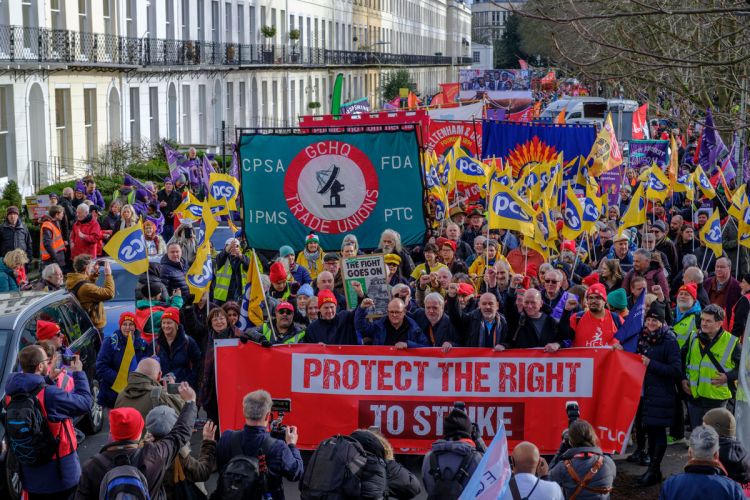
- calling on all employers and public bodies to oppose this counterproductive legislation, including by securing commitments from the Welsh and Scottish governments as well as city mayors and council leaders that they will not implement MSLs
- providing advice to unions at risk of being subject to work notices and sharing best practice responses across the movement
- preparing to provide support at short notice to any union or worker subjected to a work notice, including by holding an emergency demonstration of solidarity.
The TUC also made an extensive submission to the International Labour Organization’s (ILO) Committee of Experts on the Application of Conventions and Recommendations (CEACR) setting out the myriad ways the UK legislation contravened the UK’s international obligations.
Legal advice commissioned by the TUC allowed affiliates to determine their legal strategies to supplement ongoing political and industrial opposition
to MSLs.
The General Council will continue to robustly oppose MSLs and seek their repeal under the new government.
1.2 Industrial action
Industrial campaigns have delivered real gains for workers, across both public and private sector employers. Unions have deployed industrial campaigns to win significant pay rises for working people, with many double-digit pay settlements being secured, supporting workers to push back against the cost-of-living crisis.
Increasingly, unions are also winning recognition agreements across the private sector by deploying strong industrial campaigns.
The TUC has hosted two roundtables to support unions in their industrial campaigns. The first shared intelligence on maximising ballot turnout, to beat the current restrictive legislation on industrial action. The second roundtable focused on industrial campaigning to secure recognition for collective bargaining.
The TUC is currently undertaking some academic research to understand common characteristics of successful industrial campaigns, and will be sharing that intelligence with unions in due course.
While large-scale public-sector disputes have not featured as prominently in 2024 as in the previous year, there have nonetheless been some ongoing high-profile disputes despite the Conservative government’s attempts to stifle industrial campaigns by MSL legislation.
In rail and in the border force, in particular, union action was not prevented by the new Act. In fact, where employers threatened to restrict the impact of strike action by using the legislation, union responses meant this threat was quickly withdrawn.
Where employers threatened to restrict the impact of strike action by using the legislation, union responses meant this threat was quickly withdrawn
1.3 Employment rights
The General Council opposed several attempts from the former Conservative government to water down employment protections.
Conservative ministers launched another attempt to rescind the ban on agency workers being supplied to replace workers who are on strike.
A previous regulation was quashed by the High Court after unions joined together to successfully seek a judicial review.
The TUC made a strongly worded submission to the government consultation setting out our opposition to dropping the ban, to ensure that workers are able to robustly defend their pay and conditions.
The General Council also campaigned against the Conservative government’s proposals to reintroduce tribunal fees.
We warned that introducing fees in employment tribunals and employment appeal tribunals would price workers out of accessing justice.
Following UNISON’s legal challenge, in 2017 the Supreme Court ruled that employment tribunal fees were unlawful because they priced workers out of accessing justice and discriminated against women.
By planning their reintroduction, Conservative ministers failed to learn lessons from past mistakes and ignored clear legal principles set out in the Supreme Court judgment.
The TUC coordinated a joint statement with campaign groups including Citizens Advice, the Joseph Rowntree Foundation and the Fawcett Society and ensured that our opposition was reported in the media.
Employers continue to employ agency workers and independent contractors via umbrella companies.
This is driven by financial incentives paid to umbrella companies for being added to a preferred supplier list, which can even include fitted kitchens and holidays for recruitment agency directors. This then incentivises non-compliant umbrella providers (who because of non-compliance have higher margins) to offer large bonuses to gain access to potential clients.
The TUC has highlighted that workers working under these arrangements experience a multitude of problems ranging from a lack of transparency over core terms and conditions to unwittingly becoming embroiled in fraudulent tax arrangements with serious financial consequences.
We responded to a government consultation on regulating umbrella companies by calling for a ban on the use of umbrella companies, and recommended immediate steps that could be taken to clamp down on some of the worst behaviour.
The TUC has worked with Unite and frontline charities to develop a joint set of recommendations to improve conditions and prevent the exploitation of seasonal workers. Through engagement with the relevant government departments, we have been actively campaigning for reforms to the seasonal work visa. The TUC met with the then shadow immigration minister on several occasions to raise concerns about how the current immigration system is facilitating the exploitation of vulnerable migrant workers, with a view to securing key reforms under the new Labour government.
1.4 New deal for workers
A better deal for workers is desperately needed.
The UK has had a long experiment with an ultra-flexible labour market that benefits exploitative employers at the cost to working people.
The result has been a lacklustre economy and flatlining wages, but in response the Conservative government sought to tilt the balance even further against workers.
The Trade Union Act 2016 and the Strikes (Minimum Service Levels) Act 2023 are both vicious anti-union laws designed to hamper the ability of working people to defend their terms and conditions.
Labour's New Deal for working people offers a huge opportunity to repeal these anti-union measures, in line with resolution 1. It sets out a new framework giving workers much stronger individual and collective rights.
With more than four million workers in insecure working arrangements such as zero-hours contracts, reforms such as the right to a normal hours' contract and reasonable notice of shift changes will be transformative.
In line with resolution 6, the General Council focused on campaigning for the development and implementation of a comprehensive New Deal for workers.
In particular, the TUC established a working group of affiliates to refine and develop proposals to tackle one-sided flexibility and insecure work.
The General Council has worked closely with the Labour Party, trade unions affiliated to the Labour Party and our wider group of affiliates to develop our policies on key elements of the New Deal.
The TUC’s campaigning work has repeatedly highlighted the need for the New Deal and widespread support for the measures among voters. Even many bosses support the New Deal, with polling showing that 70 per cent of managers support Labour’s proposed changes to employment law.
In line with resolution 74, we have continued to push for implementation of the New Deal in full, as the best means of ensuring that working people can improve their pay and working conditions.
Fair pay agreements are a crucial part of the New Deal. Establishing sectoral bargaining is key to addressing the decline in collective bargaining coverage, especially in the private sector, and raising pay and working conditions.
The TUC has continued to work with unions to develop proposals for sectoral collective bargaining, focusing on sectors where unions are keen to establish fair pay agreements.
The TUC has convened a Social Care Fair Pay Agreements Working Group, comprising representatives from UNISON, GMB and Unite, to develop proposals for a fair pay agreement in social care. Final proposals, covering the aims, the process for developing a social care fair pay agreement and areas that should be covered in the negotiations, were agreed by the working group in May and endorsed by the executive committee in July.
The TUC has also been working with the RMT and Nautilus International to consider the best way to establish mandatory sectoral pay and employment standards for the short sea ferry sector.
2.1 The economy
Over the last year, as the Conservative government’s economic policy failed to deliver, working people have continued to experience huge pressures on their living standards. UK disposable income growth has been the weakest of all G7 economies. The UK is one of only three OECD economies with household/consumer demand below the position before the start of the pandemic.
In the three years to April 2024, prices were up 21.3 per cent on the consumer price index (CPI) measures and 27.9 per cent on the retail price index (RPI) measure. The disparity between official measures of inflation remains a concern and a new trade union inflation group has been to set up to progress resolution 19.
Despite very recent real wage growth, real average weekly earnings still remain slightly below their 2008 levels. This 16-year pay squeeze is the worst on record and, according to historical estimates, is the worst for two centuries. If wages had instead grown at the pre-financial crisis rate over the past 16 years, the average worker would now be earning £14,700 more a year. The worst inflation for 40 years has had nothing to do with workers, but by portraying workers’ pay as an inflationary threat, the Conservative government sought to unfairly blame working people for its own failure to deliver decent living standards.
UK disposable income growth has been the weakest of all G7 economies. The UK is one of only three OECD economies with household/consumer demand below the position before the start of the pandemic.
Alongside increased costs, households and businesses have faced the steepest rise in interest rates for more than 40 years, with the Bank of England base rate rising from 0.10 per cent to 5.25 per cent in under two years. Homeowners have on average faced mortgage interest payments that have more than doubled, increasing 115 per cent between April 2021 and April 2024. Households and businesses with loans have also faced steep rises in debt service payments.
Under the Conservative government, the labour market also showed signs of deterioration. Unemployment was rising, with the most recent data in June 2024, when the unemployment rate was 4.4 per cent. The number of people unemployed has risen by 157,000 across the same period. There has also been a drop in employment (down by 359,000 on a year ago), as well as a fall in vacancies (though they still remain relatively high). A particular concern is record high levels of people out of work due to long-term sickness – 2.83 million working-age people are now out of the labour market due to ill health, up from around 2 million in 2019.
Weak incomes and weak spending have been critical factors in the prolonged stagnation of gross domestic product (GDP). TUC analysis shows that the period from 2010 to 2024 was the worst for economic growth since modern records began after the Second World War.
The problem with the economy is not that workers have too much, but that they have too little. TUC work has set out that strong public services, improved rights at work and increased public investment will strengthen worker incomes, spending and growth. This includes investment in green infrastructure and affordable housing, in line with composite 7.
At the same time, it is right that those with the broadest shoulders should pay their fair share. In line with composite 6, the TUC has continued to campaign for a more progressive system on wealth and excess profits and, in line with resolution 28, for the restraint of profiteering, particularly by banks and energy companies. Our new research, including analysis with TaxWatch showing a £36bn tax gap, advocates for increased HMRC staffing. Our spring budget submission highlighted international evidence on the case for progressive taxation, while TUC analysis made the case against the Conservative government’s cuts to the bank surcharge.
2.2 Pay and the national minimum wage
The TUC has continued to campaign to get wages rising across the economy. Our regular interventions have maintained a strong media focus on the pay crisis facing workers.
Throughout the year, we made the case for a £15 minimum wage for all workers regardless of age, in line with resolution 41. This included submitting evidence to the Low Pay Commission calling on the government to set out a plan to rapidly reach a £15 minimum wage. We also led a delegation of unions to give oral evidence to the Low Pay Commission. Following submissions by the TUC and affiliates, the Conservative government announced an increase in the national living wage to £11.44 an hour from April 2024, and an expansion of headline minimum wage coverage to all workers aged 21 and over.
The TUC Minimum Wage Enforcement Group has continued to meet, bringing together unions, advice agencies and relevant government departments and enforcement bodies.
We continue to contribute to the work of the Living Wage Foundation, promoting the voluntary living wage as a minimum rate for the lowest- paid workers.
The TUC has also coordinated the Our Work Matters: justice for outsourced workers campaign. Organising low-paid workers is a key plank of the fight for £15, with this collaborative joint union campaign connecting low-paid outsourced workers including cleaners, security guards and other facilities management workers. Regional TUC campaigns have allowed workers to share organising tactics and undertake training. We have also supported workers to lobby politicians and create solidarity networks.
2.3 Industry and climate
Our work in this area has been guided by composites 3 and 5, and resolutions 17 and 18.
The TUC has campaigned for investment in a strong and sustainable domestic steel industry. We made the case for improved procurement rules to support domestic production and for a strategic government plan including transitioning to clean steel.
Our wider work has focused on securing a worker-led transition to net zero. Key activity included:
pushing the former government to invest in the climate and environmental workforce, including by future-proofing skills and making training fully accessible and funded
promoting collective bargaining processes with trade unions in net-zero industries
lobbying government to recommit to its climate commitments and for a Just Transition Commission
preparing an updated version of the handbook for green reps in the workplace, and pushing for facility time for green reps
supporting International Trade Union Confederation (ITUC) engagement with the United Nations Framework Convention on Climate Change (UNFCCC) negotiations, including the ITUC delegation at COP 28 in Dubai.
We published proposals (including the report Public Power: turning it into reality) for a new publicly owned national energy champion company to be set up. This would support good jobs, clean power and lower bills. TUC commentary on energy company profiteering regularly gained high-profile media coverage and contributed to Labour's manifesto commitment to set up Great British Energy. In line with all four resolutions and composites, the TUC expanded its work on future- proofing industry and jobs:
In the pilot year of our Worker-led Transition project, the TUC focused on automotive and steel, working with national trade union officers and convenors to provide research support, coalition- building with climate groups, and training to workplace reps. We secured funding to expand the project to cover additional high-carbon manufacturing sectors.
Our analysis showed that 660,000 to 834,000 jobs in UK steel, automotive and other manufacturing and supply chain industries could be offshored without rapid decarbonisation. Shifting these industries to net zero could future-proof jobs for current workers and future generations. Our Pulling All the Levers report called on government to implement a clean industrial strategy to defend jobs.
The TUC published the Invest in Our Future report calling for public investment in the first term of a new government to future- proof industrial jobs and infrastructure, keep homes warm, improve transport connections and meet climate targets.
The TUC’s TUSDAC committee met bimonthly, and we introduced a regular meeting of the TUC’s energy unions.
2.4 Workers' capital, corporate governance and executive pay
The TUC continued to coordinate Trade Union Share Owners (TUSO), an initiative bringing together union funds to collaborate over voting and engagement with companies. In November 2023, TUSO hosted a well-attended in-person investor seminar on freedom of association in collaboration with UNI Global. Speakers set out the benefits of freedom of association to both workers and sustainable businesses, including the union contribution to a just transition in the energy and automotive industries. An Amazon worker also described their experience of unionising the firm’s Coventry warehouse.
TUSO has also been working on a collective approach to asset managers to enable members to vote according to TUSO voting guidelines in pooled funds.
In June, the TUC responded to a government consultation on non-financial reporting, opposing the proposal to exempt medium-sized companies from the requirement to produce a strategic report and raise the employee threshold for medium-sized companies to 500.
The TUC was represented on the Institute of Chartered Accountants in England and Wales’s (ICAEW’s) corporate governance committee, the Wates Coalition responsible for corporate governance principles for large private companies, and the High Pay Centre’s board.
In line with emergency resolution 2, we continued to make the case for corporate governance reform to ensure the interests of workers are better prioritised.
2.5 Trade
The TUC retained the vice-chair of the UK-EU Domestic Advisory Group for the UK-EU Trade and Cooperation Agreement (TCA).
We used this position to raise concerns with business groups, the European Trade Union Confederation (ETUC), and EU unions and businesses that the Conservative government’s Retained EU Law Act and Strikes (Minimum Service Levels) Act contravened the UK’s commitments to maintain a level playing field on rights in the TCA.
As a result of these concerns being raised, in October the European Commission raised an official concern with the former government.
The TUC developed trade union objectives for the 2026 review of the UK-EU Agreement. We then secured support for these from the businesses and civil society groups on the Domestic Advisory Group, in its report released in April.
The TUC held meetings with Nick Thomas Symonds MP, then shadow cabinet minister responsible for the UK-EU agreement. He supported our objectives and spoke publicly about the need for the UK to follow EU standards on employment rights.
The TUC continued to highlight the failure of the UK's social security system to provide an adequate safety net
In March, the TUC wrote to the trade secretary asking for UK-Israel trade talks to be halted following the ruling of the International Court of Justice that it was ‘plausible’ Israel was committing genocide in the Gaza conflict. We also called for an end to both arms sales to Israel and trade in goods from the Occupied Palestinian Territories.
The TUC campaigned against trade talks between the UK and Gulf States, India and Turkey due to ongoing abuses of human and labour rights in these countries. We worked closely with then shadow trade ministers to raise concerns about these trade talks and about the UK acceding to the Comprehensive and Progressive Agreement for Trans-Pacific Partnership (CPTPP) trade agreement. This contains countries such as Vietnam and Brunei where independent unions are banned. Then shadow trade minister Gareth Thomas MP and shadow exports minister Tan Dhesi MP raised these concerns in parliament and the media.
2.6 Social security and sick pay
Our work in this area was informed by composites 8 and 9 and by resolution 79.
The TUC continued to highlight the failure of the UK’s social security system to provide an adequate safety net. We showed that the rising cost of living was making it even harder to survive on benefits.
We called on the former government to set a path to significant and permanent improvements in the levels of social security. We set out the need to stop policies that needlessly take money out of families’ pockets, including harsh benefit deductions, the arbitrary benefit cap and the five-week wait in universal credit. We also developed a proposal for how the new government could plan to address social security challenges.
We further developed our campaign for decent sick pay for all. We published a press story, responded to the Work and Pensions Select Committee inquiry into statutory sick pay, and gave oral evidence to the Work and Pensions Select Committee, setting out the case for change.
More widely, the TUC continued to highlight the problems with universal credit and make the case for its replacement, following on from our 2020 publication A Replacement for Universal Credit. This included raising the issues faced by self-employed people on universal credit, along with atypical workers and those on insecure contracts.
We also continued to work with affiliated unions to campaign for free school meals for children.
2.7 Pensions
The TUC continued to advocate for the interests of working people in the pension system. We engaged with government, select committees and regulators through consultation processes and roundtables.
We used these opportunities to argue for better funding regulation for defined benefit (DB) schemes, improvements to defined contribution (DC) schemes through consolidation of small pots, and better processes to turn savings into retirement incomes. We also sought to promote a wide range of collective defined contribution (CDC) schemes.
The TUC pensions conference in March focussed on our priorities in an election year and included an opening keynote from then shadow work and pensions secretary Liz Kendall MP.
Sessions focused on expanding auto-enrolment and increasing employer pension contributions, the state pension age, and the role of pension funds in investing in a just transition to a low-carbon economy.
The TUC also worked with the Committee on Workers’ Capital to jointly organise a seminar for trustees, encouraging investors to promote high employment standards and responsible corporate behaviour in companies they invest in.
In line with composite 10, we made a submission to the Women and Equalities Committee inquiry into the rights of older people, highlighting the issue of digital exclusion.
2.8 Transport
As set out in composite 4, the TUC continued to make the case for sustainable investment in transport services and infrastructure. We strongly and publicly opposed the decision to cancel phase two of HS2 and maintained constructive external engagement on the best way forward for rail investment.
In our response to the former government’s proposals on adapting the transport system to the realities of the climate emergency, we made a clear case for the importance of worker voice in the relevant decision-making processes, and for a more ambitious and interventionist role for government. This included providing both written and oral evidence to the independent Rail and Urban Transport Review, where we were also represented on the review panel.
We published new research – Fare Outcomes: understanding transport in Welsh cities – on the transformative impact that transport investment can have on the economic prospects of cities. We also set out options for funding that investment at a local level. Our public work highlighted the continued disgraceful cost of travel in the UK through media interventions demonstrating the vastly lower costs across Europe for equivalent journeys.
In line with emergency resolution 1 and resolution 14, the TUC supported the successful union campaign to prevent the Conservative government’s planned railway ticket office closures.
Two years on from the illegal mass sackings at P&O, we worked with affiliates in the UK and international partners to shine a light on the Conservative government’s inaction. In line with resolution 15, we made the case for a mandatory seafarers’ charter that takes account of the need for collectively bargained agreements. We progressed this work in the media, at demonstrations and in evidence sessions in parliament.
The TUC produced an AI Bill with the input of creative unions, setting out regulations on the use of AI in the workplace to enhance workers' rights.
2.9 Arts and creative sector
The arts and culture sector employs 700,000 people, of whom half are self-employed. The TUC has long campaigned for improved rights for self- employed workers, as well as for a crackdown on bogus self- employment. Across the year we continued to develop our policy in this area.
Pay in the sector is annually £6,000 lower than in other industries. The TUC policy of a £15 minimum wage would improve pay across industries, and our calls for strengthened labour market enforcement would ensure workers are paid at least the legal minimum. We have made this case to the Low Pay Commission, supporting resolution 9. We have also supported union campaigns for fairer pay, in line with resolution 10, and for a properly funded BBC, in line with composite 20.
There is a growing risk that artificial intelligence (AI) will infringe on the rights of workers in this sector. The TUC produced an AI Bill with the input of creative unions, setting out regulations on the use of AI in the workplace to enhance workers’ rights related to algorithmic management. We continue to engage with the creative unions to develop our response in the sector.
In line with composite 2, we have called for government funding for the arts to be brought up to the European average. The TUC is also campaigning on equitable arts funding for every region and nation across the UK. Our regional offices have produced local cultural manifestos and hosted events on organising in creative industries.
The TUC has also taken part in meetings of the Federation of Entertainment Unions throughout the year.
2.10 Working time and flexible working
After the Flexible Working Bill reached royal assent in July 2023, the TUC responded to the new Acas statutory code of practice and promoted the new legislation to union reps via webinars and online learning. We also responded to a call for evidence on non- statutory flexible working. We continue to call for further improvements to flexible working legislation, promoting our calls for a right to flexible working and an advertising duty, and continue to engage with Labour on the need for wider legislative changes.
We published research showing half of new fathers and partners don’t get the flexibility they ask for at work. This rises to two- thirds for those in lower-income households and demonstrates the limitations of a right-to- request system for flexible work.
We also produced a report – Making Hybrid Inclusive – on BME workers’ experiences of hybrid working following the Covid-19 pandemic, showing how workplace racism impacts on flexible working. Much of our work highlighted the importance of flexible working in the recruitment and retention of staff, supporting resolution 16.
2.11 Health and safety
Noting resolution 78, the TUC campaigned to ensure that the health, safety and welfare of workers is protected by strong union organisation and a growing network of health and safety reps with access to high- quality advice and guidance.
For the first time, we organised a national training event, bringing together hundreds of safety reps. This marked the 50th anniversary of the Health and Safety at Work Act and featured a series of introductory courses. These targeted women, Black workers and young members, who are underrepresented in the safety rep role.
In response to last year’s General Council statement on RAAC, TUC Education produced a range of resources to support workplace activists. These included webinars focused on inspections, working in extreme temperatures, and stress. We also launched a brand new reps’ course and produced supplementary education resources on safety in the built environment, preceded by an ‘inspections week of action’. This enabled hundreds of safety reps to take coordinated action inspecting their workplaces for structural risks including RAAC.
2.12 Covid-19 public inquiry
In line with composite 11, the TUC has been a core participant in inquiry modules examining government decision-making in Westminster, Scotland, Wales and Northern Ireland, as well as in the early stages of the module looking at the impacts on the NHS and healthcare workforce. Representatives from the TUC, TUC Cymru, STUC and ICTU-NI gave powerful testimony and, for the first time in the inquiry, some of our NHS frontline members gave evidence in the courtroom.
Our legal representatives from Doughty Street Chambers – supported by Thompsons Solicitors – put questions directly to former ministers. We held Boris Johnson, who was prime minister during the pandemic, to account about messages that showed the ‘no surrender’ attitude that he and other ministers took towards trade unions. We questioned Rishi Sunak, who was then chancellor, on his failure to provide financial support for working people to self-isolate, and pressed cabinet secretary Simon Case and former adviser Dominic Cummings to acknowledge that not enough support had been given to the poorest to isolate. We also asked then health secretary Matt Hancock MP to confirm his support for increasing statutory sick pay.
3.1 Introduction
The TUC continues to prioritise equality as we seek to build a more diverse, more inclusive and more representative movement. In line with resolution 31, the campaign for equal pay and equal treatment for all workers, regardless of background, remains at the heart of our work. And through our four core equality strands, we continue to challenge the structural inequalities facing Black workers, women, LGBT+ workers and disabled workers.
Building a stronger movement also demands we step up our work in the regions and Wales, and invest in our digital capabilities. Meanwhile, TUC Education continues to deliver innovative programmes to train and develop our movement’s greatest asset – our reps.
3.2 Anti-racism
The TUC’s Anti-Racism Task Force (ARTF) has launched the Anti-Racism Tracker, a resource designed to help affiliates implement the commitments from the anti-racism manifesto. Our Implementation and Oversight Group (IOG), which will operate for the next five years, is crucial for advancing anti-racism efforts within the trade union movement. The IOG met regularly throughout the year and launched an independent evaluation to assess the relevance, effectiveness, impact and sustainability of the task force’s work.
Through our four equality strands, we continue to challenge the structural inequalities facing Black workers, women, LGBT+ workers and disabled workers.
The TUC has established Black activist programmes nationwide to address barriers faced by Black activists in trade union structures. Completed by nearly a hundred Black members, these programmes aim to network Black activists with key figures in the movement.
Inequalities have been a central focus of the Covid-19 Inquiry. The TUC and other core participants successfully argued for a report on institutional racism for module one, which has since been used in all modules to understand decision-making during the pandemic.
The anti-racism activist network held its third event on the theme of survival and solidarity. This event addressed attacks on civil liberties, the impact of the cost-of-living crisis on BME communities, and the importance of international solidarity. Workshops were facilitated by migrant organisations, social justice groups, trade unionists and TUC staff.
In response to the persistent threat from the far right, the TUC has developed and begun delivering training to help reps and activists challenge divisive narratives in the workplace. This includes courses such as winning workplace unity, handling difficult conversations in the workplace, and building a trade union response to the international rise of the far right.
We also made a submission to the Independent Chief Inspector of Borders and Immigration’s (ICIBI) inquiry into the immigration system, particularly regarding the social care sector. The submission highlighted issues such as low pay, unlawful recruitment fees, debt bondage and lack of access to trade union support.
3.3 Tackling and preventing sexual harassment
Our work to tackle and prevent sexual harassment in workplaces and in our movement continues, in line with composite 12.
Following many months of uncertainty, the Worker Protection Bill finally received royal assent in October 2023, and the preventative duty will come into effect from October 2024. The new legislation will require employers to take reasonable steps to prevent sexual harassment of their employees. By taking a more proactive approach, the intention of the duty is to help shift the onus from victim- survivors on to employers to challenge the workplace cultures that enable sexual harassment and make their workplaces safer through a risk- based approach, supported by good policy and practice and safe reporting routes.
But there is still much more to be done and we will continue to campaign to win third-party protections, end the misuse of non-disclosure agreements (NDAs) and ensure Black women’s voices and experiences shape the discussion. These voices are critical to developing solutions to tackling workplace sexual harassment. Much-needed research in this area is being led by the Black Women’s Advisory Group, which has commissioned research working with Queen Mary University of London.
The TUC was also invited by the Bakers, Food and Allied Workers Union (BFAWU) to give evidence alongside them to the Business and Trade Select Committee in November 2023. This concentrated on investigations into McDonald’s, and its negative culture that has seen many workers – but particularly young women – experience bullying, harassment and sexual harassment.
Our work to ensure that the trade union movement is also a safe place for staff and members continues.
Following a report published in October 2022 by the TUC Executive Working Group, established in 2021 to help support the movement to tackle and prevent sexual harassment in our own ranks, the TUC focused on developing new training to support leaders of the movement to tackle sexual harassment and build preventative cultures. That training has now been successfully piloted and independently evaluated by the Child and Woman Abuse Studies Unit at London Metropolitan University. More information about the training and other resources can be found on our bespoke resource page Tackling and Preventing Sexual Harassment, which we also launched this year.
Following the completion of the pilot and in line with resolution 36, the Executive Working Group has been reconvened and has taken forward several actions this year to support culture change across our movement. Many of these actions are being launched at Congress, including surveying unions to understand the work they are doing to tackle and prevent sexual harassment within their own organisations. We are also developing a statement of commitment/ General Council statement on the actions needed to drive culture change, providing training on the misuse of non- disclosure agreements (NDAs) and settlement agreements for trade union professionals, and taking forwards work to develop our own safe and confidential reporting line. We hope that this will enable us to support affiliates in procuring their own safe and confidential reporting lines.
3.4 Protecting equalities
Women
At TUC Women’s Conference 2023, it was announced that former TUC general secretary Frances O’Grady would lead a review for the Labour Party of how to close the gender pay gap. The TUC has facilitated this work through participation in roundtables and submitting evidence, research and good practice into the review.
In line with resolution 37, the TUC has made a series of interventions on our Equal Pay Day, held on 21 February, marking the point at which women start getting paid in comparison to men. The gender pay gap currently stands at 14.3 per cent, and at current rates will take over two decades to close. But we know that the pay gap is wider in some sectors, with big variations by age. For disabled women, the pay gap is 30 per cent.
We know that the crisis facing the childcare and early years’ sector is having a disproportionate impact on women. When families do not have access to affordable childcare and early years’ education, it is typically women who are forced to leave the labour market or reduce their hours. And we know the childcare and early years’ workforce, which is underpaid and undervalued, is made up of predominantly young women workers.
In line with resolution 63, we have continued to highlight these issues and helped establish the Early Years and Childcare Coalition, working with affiliates and stakeholders to campaign for commitments to rescue and reform the childcare and early years’ sector, with the TUC sitting on the coalition’s steering group. We also submitted evidence to the Review of Childcare and Early Years carried out by the Labour Party, led by Sir David Bell.
Recognising the parallels between the crisis facing social care and the childcare early years' sector and the disproportionate impact this has on women, the TUC launched our Strategy for the Care Workforce in 2023. This sets out the building blocks for a fair deal for workers in those sectors that will lay the foundations for high-quality care and education.
The TUC was invited to submit evidence to the Women and Equalities Select Committee on the impact of the cost-of- living crisis on women. Our submission highlighted a range of areas from low pay, insecure work and universal credit to caring responsibilities that must be tackled to ensure that the structural inequalities faced by women are addressed. The TUC also gave oral evidence to the committee in January 2024.
Black workers
The TUC Race Relations Committee (RRC) has worked on a range of issues to advance racial equality in workplaces and the union movement.
The RRC held a fringe event at Congress 2023 discussing the current immigration system and its adverse effects on Black communities. This discussion highlighted the urgent need to investigate the full extent of the damage caused by creating a hostile environment on the lives of people who have a legitimate right to live in the UK and access public services.
In line with resolution 38, the TUC continues to highlight the immense damage caused by the Conservative government’s hostile environment narratives.
We held another fringe event at the TUC Black Workers Conference, focusing on the Windrush Compensation Scheme’s inadequacies, noting that only one per cent of appeals are successful. The TUC will continue to call for an official independent inquiry into the harmful immigration policies and practices that have gravely impacted the Windrush Generation.
This year’s International Day for the Elimination of Racial Discrimination took place on Saturday 21 March. The TUC supported the UK demonstration, which focused on challenging the Conservative government’s unlawful migration policy. In preparation for the march and rally, we collaborated with organisations such as Stand Up To Racism to organise a trade union conference. This conference focused on how reps and activists can fight structural racism in the workplace through organising, ethnic monitoring and addressing pay gap disparities, as well as combating far-right thinking in our workplaces and communities.

Addressing the ethnicity pay gap is a crucial step in tackling the structural racism faced by BME workers. Given the magnitude of this challenge, mandatory pay reporting would be a significant step towards addressing the £3.2bn pay penalty experienced by BME workers.
The Labour government’s commitment to introducing mandatory ethnicity pay gap reporting as part of a new Race Equality Act is a step in the right direction. This would extend the right to equal pay, currently enjoyed by women, to BME workers, and the TUC is working with Labour to shape these proposals.
The RRC will continue to campaign for additional measures such as ethnic monitoring and regular reporting, which are essential for employers to identify and address patterns of inequality in the workplace.
Pay gap reporting needs to be supported by a comprehensive approach to ethnic monitoring systems. It is crucial that recognised unions in workplaces work with employers to establish objectives and action plans. Unions must leverage workers’ power and voice, as well as collective bargaining, to advocate for race equality in the workplace.
LGBT+ workers
The TUC engaged with Labour ahead of the general election to highlight the priority areas we want the new government to address for LGBT+ people. Our key asks included:
introducing a full, no- loopholes, trans-inclusive ban on conversion therapy
strengthening and equalising the law on hate crime
requiring employers to create and maintain workplaces and working conditions free from
harassment, including by third parties
tackling health inequalities, taking account of the specific and intersectional disparities LGBT+ people face so that they can access treatment.
In line with resolution 40, the TUC has taken active steps to protect trans and non- binary rights, including the continuation of our Trade Unions for Trans and Non-Binary Rights Network. The second meeting of the network took place on 24 February at the Mechanics Institute in Manchester, with 70 delegates taking part.
The TUC marked Trans Awareness Week by promoting our guidance and materials on supporting trans and non- binary workers. For Trans Day of Remembrance, we remembered trans people killed around the world, specifically highlighting 16-year-old Brianna Ghey from Warrington, murdered in February 2023.
As well as calling for a fully inclusive ban on conversion therapy, we continue to call for action to tackle trans hate crime and for measures to promote trans-inclusive healthcare.
The TUC has also responded to government consultations on LGBT+ issues including the DfE consultation Guidance for Schools and Colleges: Gender Questioning Children. Working with affiliated unions with members in schools, the TUC submitted a response echoing their key concerns.
To better understand LGBT people’s experiences of bullying, harassment and discrimination at work, the TUC has conducted new quantitative research on these issues. This research will inform guidance on supporting young LGBT+ workers to flourish, in line with resolution 39.
Disabled workers
The Disabled Workers Conference motion to Congress 2013 highlighted the impact of the planned closure of railway ticket offices on disabled people and other disadvantaged groups.
In line with resolution 14, the TUC used its social media presence, petitions, parliamentary lobbying and other engagement strategies to campaign for ticket offices to stay open. Our petition on Megaphone received almost 70,000 signatures, while we promoted our video for social media to 126,000 followers on X (formerly Twitter).
Working with the RMT and other affiliated unions, we successfully stopped the ticket offices closing, with the Conservative government’s U-turn a major victory for our movement.
Over the year, the TUC has continued to campaign for disability pay gap reporting, marking Disability Pay Gap Day on 14 November 2023. Our new analysis found the pay gap is 14.6 per cent, with disabled women facing an even bigger pay penalty of 30 per cent, equivalent to £3.73 an hour.
Our analysis revealed the disability pay gap is now higher than it was a decade ago, when the first comparable pay data was recorded. It generated strong media coverage across a wide range of publications.
The TUC also produced a suite of social media graphics for trade unions to use to mark Disability Pay Gap Day on their channels.
The TUC continued to highlight the shocking treatment of disabled people in the UK under the Conservative government, in line with composite 8. We drew attention to changes to disability related benefits, highlighting the negative impact that conditionality and back-to-work narratives have had on disabled people. We also produced blogs and contributed to several consultations and inquires, including the Department for Work and Pensions consultation looking at work capability assessment (WCA) activities and descriptors, and the Work and Pensions Committee Disability Employment Inquiry.
The TUC continued to engage with the Labour Party ahead of the general election, highlighting priority areas for disabled workers including pay gap reporting, reasonable adjustments, the social model of disability and the integration of the UN Convention on the Rights of Persons with Disabilities (CRPD) into UK law.
3.5 Regional update
Midlands
The TUC Midlands region, as well as the wider TUC, continued to provide support to the GMB in its fight for recognition at Amazon in Coventry.
The region has received assurances that the newly established East Midlands Combined Authority (CA) will grant a board level seat for trade unions. The West and East Midlands CAs have now committed to introducing bus franchising, delivering a long- term TUC campaign goal. In addition, the West Midlands CA is adopting a memorandum of understanding to ensure union rates are respected in the cultural sector and has also committed to working with the TUC and unions to develop a wide-ranging industrial strategy for the region.
Our Dying to Work campaign continues to attract support, and TUC Midlands joined Usdaw to meet with Morrisons. We are hopeful that 100,000 Morrisons employees will soon be covered by the Dying to Work Charter.
In June, a successful Silk Mill Festival was held in Derby.
Northern, Yorkshire & the Humber
The TUC’s Northern, Yorkshire & the Humber region has been campaigning hard throughout the year protecting the right to strike, arguing for a just transition, and advancing worker’s rights in sectors such as healthcare, education, culture and retail. We continue to support workers involved in industrial action.
We participated in the Norwegian LO Youth Exchange, hosted an IG Metal trade unionist from Germany, and held an international discussion on protecting the right to strike with a delegation from IndustriAll Europe ahead of the Durham Miners’ Gala.
To capture devolution opportunities, we are holding Trade Union Liaison Group meetings with the mayors and leaders of three of the five devolved authorities in the region. We are calling for increased support for trade union education and lifelong learning, real fair work opportunities, and improved transport, health and social care provision.
London, East & South East
The region launched a regional Black activists’ programme in April, with a first intake of 20 reps from nine unions. We also established a regional planning group with representation from CWU, GMB, PCS, RMT, UNISON and Unite to support the national Our Work Matters campaign organising outsourced workers. Colleagues are now sharing information and materials about their organising work and helping to focus our support work.
In London we have supported the launch of the London Union Learning Project, funded by the devolved Greater London Authority adult education budget. We are hosting the three project staff members, with the expanding project already working directly with five unions. Our AGM in April saw the election of Kathy Mazur from RMT as our regional president. She is the first woman to fill this post, a step towards ensuring our structures reflect the diversity of the region.
South West
Alongside industrial disputes support, TUC South West has maintained pressure against the Strikes (Minimum Service Levels) Act, raising concerns with local and regional decision- making bodies and politicians. In January, the region also proudly hosted the national demonstration and rally to Defend the Right to Strike, while celebrating the long campaign to secure union rights at GCHQ.
TUC South West continue to develop regional solidarity networks for young, Black and women activists, providing bespoke training opportunities. These included sending a young workers’ delegation to participate in the Norwegian LO Youth Exchange.
The region is ramping up its anti-racism campaigning to coordinate workplace action days and produce campaigning materials with affiliates.
We continue to represent and coordinate unions affected by the Plymouth and South Devon Freeport, ensuring investment benefits local workers and boosts skills. We maintain a strong trade union voice in the West of England Combined Authority structures, and represent workers in the Bristol and Cornwall living wage committees and the One City Approach Board. A Gravity Site union working group is also being established.
We held a vibrant Tolpuddle Martyrs’ Festival just after the election, attracting thousands of trade unionists to discuss the key issues affecting workers, take part in lively workshops and celebrate the successes of the movement.
North West
Across the North West, the TUC has continued to support unions taking industrial action, helping them win for members. PCS took months of action at National Museums Liverpool to win a cost-of- living payment, UNISON won its long running rebanding dispute at Arrowe Park, and the RMT won a double-digit pay rise for members working for outsourcing firm Rail Gourmet. The general secretary made numerous picket line visits, backed with support from the TUC’s Solidarity Hub.
Our work supporting union learning reps (ULRs) has grown, with training delivered for new and existing reps to boost the network of ULRs across the North West.
We have supported the ongoing campaign for a Hillsborough Law Now, and brought together our unions to develop a regional response to the far-right and fascist threat.
TUC Cymru/Wales TUC
We have established a series of initiatives to ensure workers from all backgrounds have the skills and confidence to contribute to the work of unions. Our Black Activist Development Programme and Newid! – our scheme for young trade unionists – are producing a strong and visible cohort of keen and effective trade union campaigners. We are also set to launch a new Women’s Development Programme. Our work on tackling sexual harassment continues, as does our work on supporting the delivery of the Anti-Racist Wales, Disability and LGBTQI Welsh Government action plans, through the structures of the Workforce and Social Partnership Councils.
We have continued to support and coordinate unions taking industrial action in sectors including education, health, transport, the civil service and more. This industrial action has led to improved pay and conditions, demonstrating the value of collective power. Our Congress reaffirmed its commitment to save our steel industry by working with affiliated unions and the Welsh Government to support the workforce at Tata and surrounding communities, mapping the impact on the supply chain.
Since May 2022, we have placed an increased emphasis on preparing workers for the workplace of the future. The Wales Union Learning Fund is the bedrock of our offer to workers and unions across the country. Working with affiliates, we have trained thousands of workers – with a particular focus on those who may not have had previous opportunities for self- advancement.
We have produced reports on artificial intelligence (AI) and a just transition to a green future, while Professor Jean Jenkins produced a final report as part of the Commission on Devolution and the Future of Work. This work will continue through a TUC Cymru General Council subgroup focusing on the constitutional future of Wales, including the devolution of justice.
Our future work will take place in the context of a new Social Partnership Duty that falls on all public bodies in Wales and calls on them to ensure the voice of unions is heard clearly in their decision-making. The duty is part of the new Social Partnership and Public Procurement (Wales) Act. A huge amount of work has been prompted by the legislation and the work required to enact it, as well as the Welsh Government’s increased commitment to social partnership and trade unionism more broadly. For example, collective bargaining coverage is now a national indicator in Wales – one of the measures by which the nation’s progress to achieving its wellbeing goals is monitored.
3.6 Solidarity Hub
The TUC Solidarity Hub project continues to grow and develop, along with our range of support services for unions undertaking industrial action. We have now supported 25 unions in dispute, including balloting advice, media support, using new technologies to engage and organise, training, picket line support, sharing best practice, research, digital support and so much more.
The national dispute intelligence database has now captured over 1,000 industrial disputes across 34 different unions since its inception in early 2023. Over 400 union wins have been recorded as part of that process, with 40 wins now captured in detail through first-hand testimony from reps on the ground and published as part of our Solidarity Stories collection.
The Solidarity Stories section of our website features a wide range of unions winning across all sectors of the economy and demonstrates how unions are winning on pay, recognition, terms and conditions, fire and rehire and health and safety.
The data populates our weekly campaigners and communicators email, which includes a detailed industrial action list for the week ahead encouraging solidarity and support for unions taking action.
We hosted two roundtables through networks built through the Solidarity Hub project. In November, we brought together senior union officials with responsibility for ballots and industrial action strategies in their respective unions. Our second roundtable in March 2024 focused on winning union recognition and the barriers faced in growing the movement, which included a presentation from the Central Arbitration Committee (CAC).
Using our extensive and comprehensive data on industrial action, we are also in the process of producing research for the movement on industrial action. This will focus on dispute trends, organising lessons and factors that contribute to unions winning.
3.7 Helping the movement grow
The TUC continues to support the development of organising skills and strategies through our Organising Academy training and sharing of good practice in organising strategies.
On a sectoral level, the TUC has brought together unions, including UNISON, GMB, PCS, RMT, Unite and CWU, and activists to collaborate in campaigns to organise outsourced workers. The Our Work Matters campaign has held national events in Congress House and in parliament, making the case for insourcing and progressing union campaigns for improved pay, proper contracts and better sick pay arrangements.
This campaign is now being modelled at a local level, with regional TUCs taking forward actions to convene unions and workers in this sector.
Noting resolution 75, plans to hold a high-level roundtable on organising in the private sector were postponed due to the general election. We reconvened this discussion to ensure the TUC and trade unions are well equipped to make the most of the opportunities in Labour’s New Deal for working people.
3.8 TUC Education
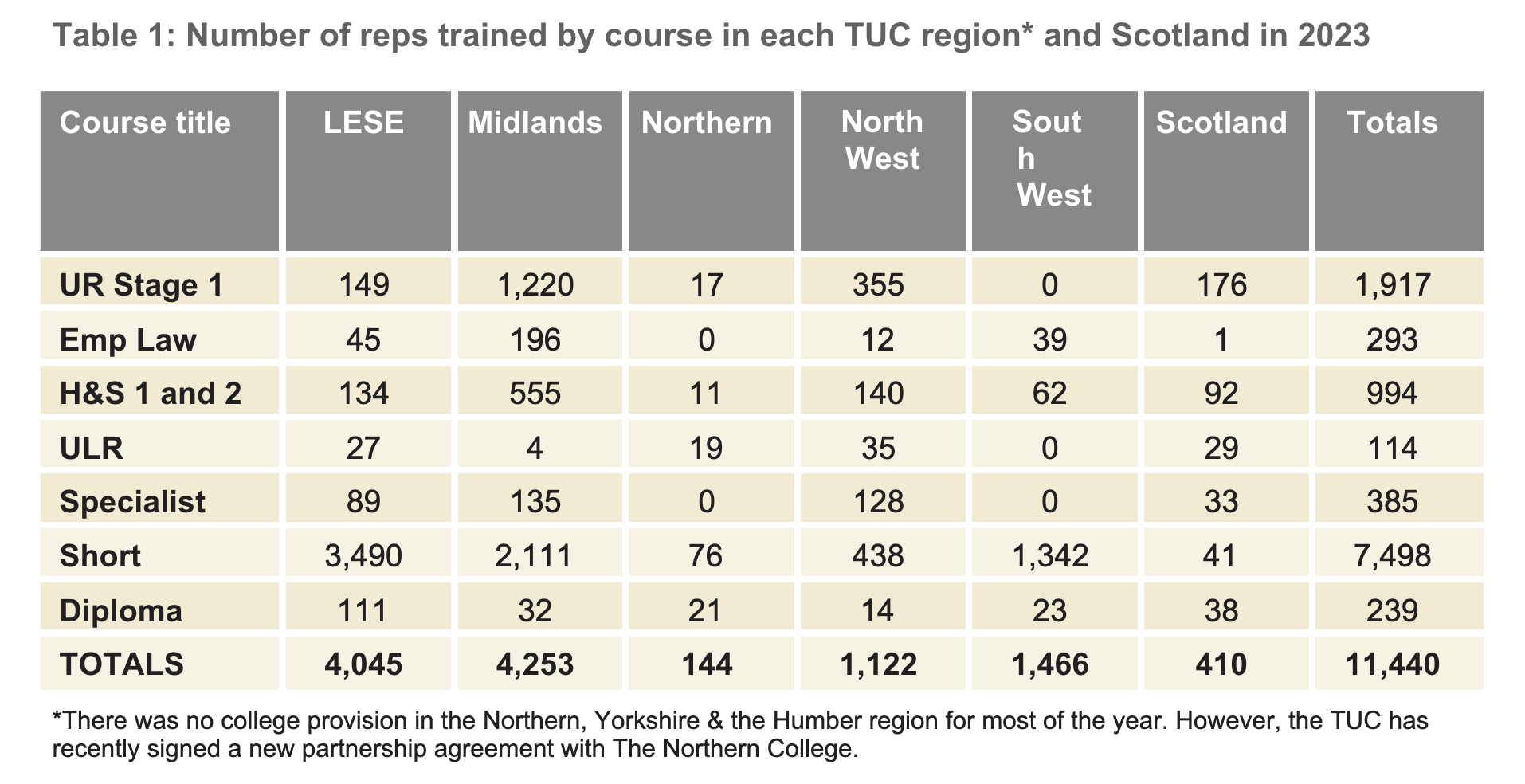
TUC Education provides unions and union reps with high-quality training that enables them to organise, campaign and represent members collectively and individually. Our training is delivered in classrooms via our partnerships with further education (FE) colleges in England and Scotland and also online via digital platforms and webinars. We want to deliver our training to reps in whatever way they find most accessible and useful, whether that is in a classroom, online or a combination of both.
In 2023/24, TUC Education had partnership agreements with 15 FE colleges in England and Scotland that ensure delivery of National Open College Network (NOCN) accredited training via the TUC’s core course programme, and union courses that are mapped to the TUC Passport to Progress accreditation framework.
TUC Education via FE colleges ensures that training for union reps is accredited through NOCN, but this form of provision has faced challenges over the year due to the fragmentation of the adult education budget and cuts to funding for Level 2 courses. The TUC continues to engage with both our partner colleges and combined authorities to ensure that all union reps can attend training as close as possible to where they work and live.
In 2024, the TUC commissioned Exeter University to conduct a review of trade union education provision in England and Wales. The report’s findings and recommendations were scheduled to be reported to the TUC executive committee after the general election.
Details of the full TUC Education offer to unions and reps can be found at tuc.org.uk/training
3.9 Online training and support for union reps
During 2023–24, the TUC Education digital learning team provided training support to CWU, NASUWT, RMT, SoR, Unite, UCU, UNISON, Nautilus International and BALPA. The team also worked with BALPA, SoR and Nautilus International on the development of bespoke courses for their workplace reps.
NASUWT and the CWU worked with the team to develop their own bespoke versions of the TUC’s digital credential programme.
During the year, a new flexible version of Union Reps was piloted. The training used innovative online tools and methods combined with tutor facilitated sessions to deliver the course, with extremely positive feedback. A full roll out of this version of reps’ core training covering Union Reps 1, Health & Safety 1 and ULR training will be rolled out later in 2024 and early 2025.
During 2023, TUC Education trained over 2,500 reps via its online learning platform. This figure does not include courses delivered by trade union studies centres in Wales and Scotland and by colleges that used non-TUC hosted learning platforms.
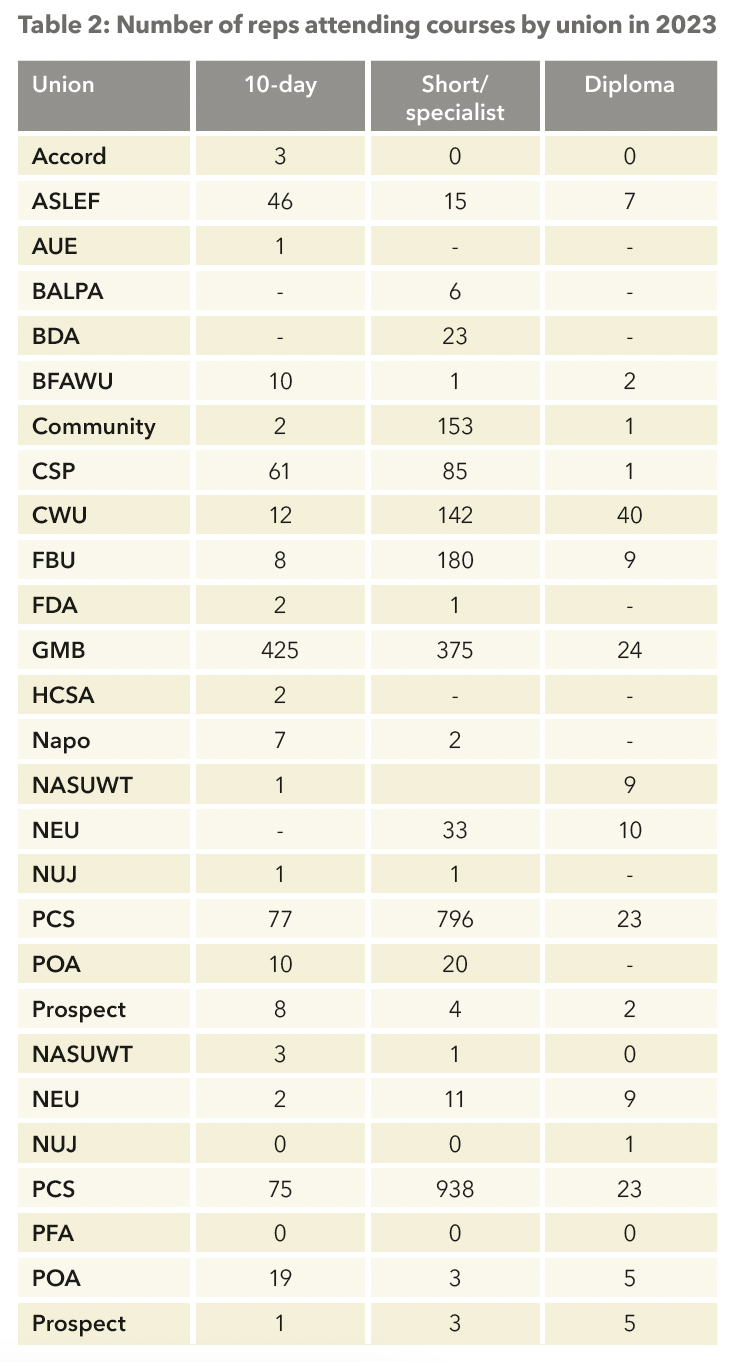
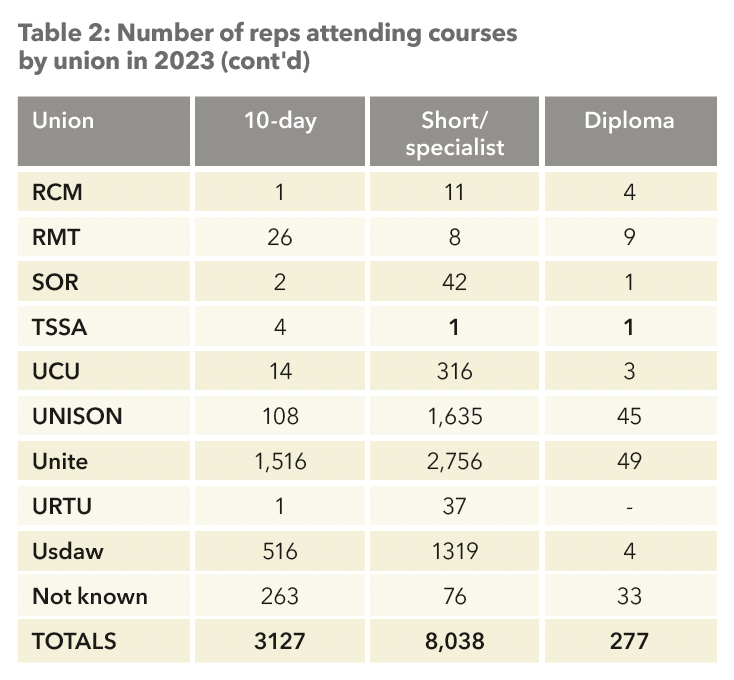

Our most popular courses were Union Reps and Health & Safety Reps Stage 1. In total 1,138 new reps were trained online, which represents a significant increase on the previous years' figures.
Plans are underway to create a fresh and comprehensive programme of Union Reps advanced courses. These courses aim to offer reps an enchanced and specialised training experience, focusing on key workplace issues. The intention is to provide reps with more extensive and in-depth knowledge and skills.
3.10 Webinars
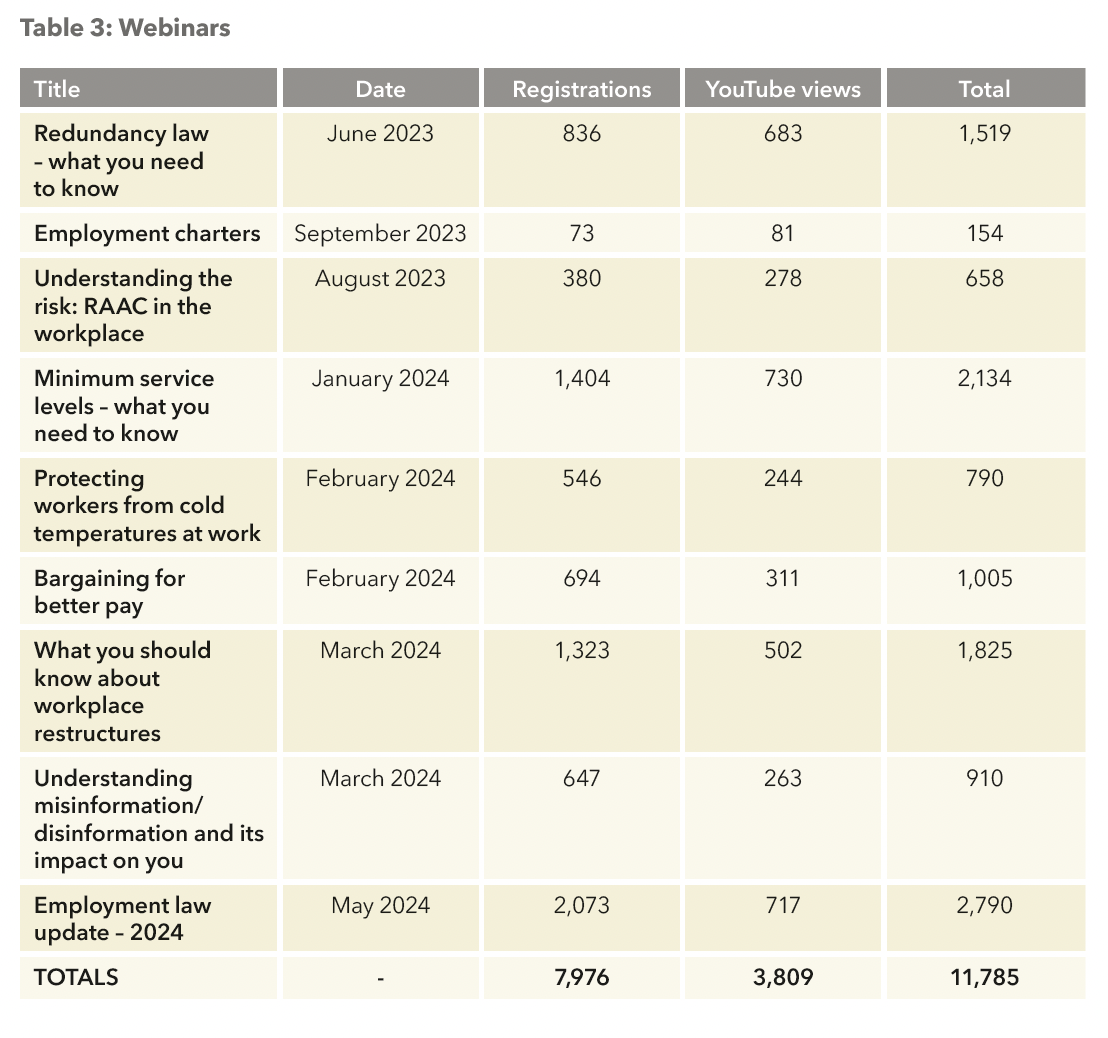
During the last year the TUC Education webinar series was attended or seen by over 11,500 union reps. Over 2,000 reps engaged with the webinar on minimum service levels and over 2,500 engaged with the employment law update.
3.11 Training 500 new Black reps
At Congress 2023, the general secretary committed the movement to training 500 new Black reps. Since then, the number of Black reps trained at TUC Education centres on either core course or bespoke union programmes was as follows:
- attending introductory courses for union reps of health and safety reps - 534
- attending TUC Education webinars - 1,334
3.12 TUC Union Reps Connect 2023
We held Union Reps Connect 2023 at Congress House in November, with 375 union reps from across the UK attending. Feedback showed that:
- those who attended gave the event 9/10 satisfaction rating
- 93 per cent said that they would recommend the event to other reps
- the most popular workshops covered disability and adjustments, bully proofing and building a health and safety culture
- the most popular plenary sessions were the employment law update and hearing from workplace reps
- 97 per cent of attendees agreed that the event increase their knowledge and skills
3.13 TUC Leading Change
Leading Change is a training and development programme for senior officers in trade unions. The 2023/24 Leading Change course had 24 participants representing 11 TUC affiliates.
The programme ran over five modules, covering the organising challenges facing unions, unions and digital, governance and equality, and winning political change. The final module saw Leading Change return to Harvard University and the Harvard Law School Center for Labor and a Just Economy.
3.14 TUC Organising Academy
The TUC Organising Academy provides organising training for union officers, organisers and support staff, covering the key skills and knowledge required to run and support successful organising campaigns. The Academy is run in partnership with The Manchester College.
In the academic year 2023/24, the Organising Academy trained 56 union officers on the Diploma Course and Supporting Award courses from unions including BDA, CSP, CWU, FBU, GMB, NASUWT, NEU, RCM, TSSA, UCU, UNISON, Unite and Usdaw.
The TUC has recently commissioned a review and rewrite of the TUC’s Organising Academy syllabus and training materials, to be introduced in 2025.
The Digital Lab has developed shared developed shared resources to help affiliates plan to keep their members' data safe and protect their operations from disruption
3.15 Digital Lab
The TUC’s Digital Lab programme is now in its fifth year. It networks leaders and digital practitioners across the TUC’s affiliate unions, to explore areas of best practice in digital change for unions.
The challenges unions face around digital have grown in the last year. Organised cyber attacks against trade unions internationally have become more common and more severe. In response, the Digital Lab has developed shared resources to help affiliates plan to keep their members’ data safe and protect their operations from disruption.
Other major themes over the year have included supporting unions in transitioning to a newer generation of membership technologies, and understanding the challenges and potential around artificial intelligence (AI).
The Digital Lab has produced events, training and reports, and coordinated with unions to share experiences across the movement. The aim is to help TUC affiliates’ digital projects to succeed – more quickly and with reduced risk or cost.
Particular work in this area has focused on methods for increasing member retention rates to help underpin unions’ efforts to grow membership, and improving the accuracy of member data, to enable more effective mobilisation in ballots.
3.16 Digital organising and Megaphone
Building a stronger union movement means using the best tech, tools and techniques at our disposal to recruit members, get them active and help win disputes and campaigns.
The TUC’s Megaphone platform enables unions to run online petitions and digital actions to build pressure on employers, recruit new members, engage existing members and build public support.
The platform has now been used by 25 different unions. More than 70 petitions were started by unions in 2023–24. Almost 1.1 million people have now taken action in support of a union campaign, and the Megaphone solidarity email list has become a vital resource for the movement.
Megaphone supporters are regularly asked to join a union, to recruit others to the union, to promote campaigns in their workplaces and communities, to donate to strike funds and to take other actions that strengthen the movement.
In 2024, the TUC has continued growing our offer to unions with expert advice on integrating digital tactics into campaigning and organising. This has included supporting the use of peer-to-peer text messaging during strike ballots, identifying new ways to find and engage workers online, running online calls to encourage member activism, and using WhatsApp effectively to reach members.
3.17 Promoting trade unionism, union finder and social media
Our social media promotes the TUC’s key campaigns, our affiliated unions’ disputes and trade unionism in general. We look to grow audiences of union members and the wider public, as well as key stakeholders including politicians, journalists and other decision-makers.
The general secretary's speech to Congress achieved 2.5 million views, and our support for the CWU's Royal Mail campaign secured 2 million views.
This year, our social media followers grew to a total of 570,000, up from 473,000. We had a large number of viral posts, including content breaking the news of attacks on the right to strike, policy calls to tax wealth, and criticism of the Conservatives’ record in government.
We achieved 140 million video views from a number of viral videos on a range of issues. The general secretary’s speech to Congress achieved 2.5 million views, and our support for the CWU’s Royal Mail campaign secured two million views.
The TUC’s union finder tool continues to be an invaluable online service designed to help users find and join a trade union. Over the past year, we have seen a consistent rise in users engaging with the tool, particularly during HeartUnions week, which saw a 39 per cent increase in usage.
3.18 Supporting union operations
Following the TUC review, we built our support to affiliates through a new programme of work supporting their backroom operations. We held the first Union Ops Connect event in November 2023, welcoming 71 staff from 31 TUC affiliates who work in internal services such as finance, HR and IT. This included sessions supporting professional development and learning, alongside sharing best practice and networking. We received good feedback and will be running the event again in 2024.
We launched a new collaborative procurement service to support affiliates to get the best deals from the purchases they make. And we are procuring a safe reporting harassment helpline to be available for all affiliates to take up.
3.19 TUC Comms Awards
Due to the general election, this year’s TUC Comms Awards will be held in October. Some 23 unions have entered across six categories, with a total of 63 entries. Categories to be judged are best union journal; best recruitment and organising communication; best campaign communication(s); best media story; best use of social media; and best communication from a smaller union.
4.1 Introduction
Workers continue to experience serious pressure in the workplace. Across the public sector workers are challenged by increasing demand and fewer staff, as the Conservative government persistently failed to tackle workforce recruitment and retention crisis in every sector.
In the private sector, while unions have won some significant pay victories, the continuing failure to secure any meaningful economic growth results in ongoing tensions with employers who seek to make workers pay the price.
Our economy continues to witness massive under- investment in all areas, including the crucial area of skills, at the same time as we begin to see the impact of artificial intelligence (AI) and associated technologies influencing workplaces and the nature of work.
4.2 AI and rights at work
In April the TUC launched our draft Artificial Intelligence (Employment and Regulation) Bill after extensive work with experts from unions and other stakeholders, including from politics and academia.
The Bill establishes concrete rights and obligations in key areas such as consultation, transparency, explainability and equality to ensure the responsible adoption of AI.
Baroness Dawn Primarolo chaired a high-profile launch event in Congress House, with worker testimony and contributions from barristers at Cloisters Chambers, then shadow employment rights minister Justin Madders MP and colleagues from AFL-CIO and Microsoft.
Responding to the Conservative government’s AI white paper, the TUC convened the AI Working Group, which, along with the Institute for the Future of Work, produced guidance for union reps on algorithmic impact assessments. Political interventions included an AI Summit open letter to then prime minister Rishi Sunak with Connected by Data and the Open Rights Group, and participation at five Labour Party conference AI fringe events.
The TUC also contributed to union training, presenting at union conferences, branch meetings, TUAC, Spanish union CCOO and TUC Reps Connect. Wales TUC undertook worker focus group research and in January 2024 published an AI research report.
Building further on composite 13, in May the TUC launched a creative sector AI working group and completed an AI project strategic review (with Connected by Data).
Our public sector workforce stands as a beacon of resilience, shouldering immense challenges from working in crumbling school buildings to understaffed hospitals
4.3 Public services
Our public sector workforce stands as a beacon of resilience, shouldering immense challenges from working in crumbling school buildings to understaffed hospitals. Chronic underfunding, rampant outsourcing and pay constraints have created critical staff shortages, putting huge strain on an already overstretched system.
Instead of recognising public sector workers’ dedication, the Conservative government attacked their right to strike and firefighters’ collective bargaining rights (condemned by the TUC in line with resolution 65), attempting to undermine their ability to advocate for themselves and for better public services. This anti- worker agenda extended to civil servants, who were subjected to unfair public criticism from ministers. In line with composite 14 and resolution 51, we have consistently advocated for fair funding for services and fair pay for the workforce, including submissions to both the autumn statement 2023 and spring budget 2024. Investment is vital to address:
record backlogs in health
the fragmented social care system
struggling councils
overcrowded classrooms and prisons
the public sector recruitment and retention crisis.
Investing in our workforce is essential – an empowered and well-paid public sector workforce is the foundation for rebuilding public services.
In line with composite 15 and resolution 68, the TUC consulted extensively with the Public Services Liaison Group on public sector pay review body reform. This consultation resulted in a number of high- level recommendations, agreed by the TUC’s executive committee in May 2024, aimed at rebuilding trust and delivering benefits for public sector workers.
4.4 Investing in the NHS workforce: a path forward
Despite continuing under immense strain to deliver vital healthcare to millions, NHS workers faced a challenge to their right to strike from the Conservative government. In the last year, the former government consulted on imposing minimum service levels in ambulance and hospital services. The TUC condemned the legislation as impractical, undemocratic and potentially unlawful.
In line with resolution 54, our submission to the spring budget 2024 highlighted the significant disparity in investment in our health system compared to the EU average. This underfunding has demonstrably led to record waiting times for hospital treatment and cancer care.
Additionally, target ambulance response times are routinely exceeded, putting patients’ lives at risk.
The TUC has continued to advocate for urgent action to tackle the record vacancy levels within the NHS workforce – the backbone of our healthcare system. We have argued that government policymaking should be focused on retaining the experienced and skilled staff the NHS already has, stemming the flow of workers leaving the sector. Expanding and widening participation routes into the NHS, such as through apprenticeships as set out in resolution 55, is also crucial. As emphasised in resolution 56, we must also maintain the quality of training and ensure sufficient capacity to properly onboard new recruits.
By addressing the root causes of industrial action – underfunding and inadequate pay – the new government can build solid foundations for a constructive relationship with NHS workers and unions. This, in turn, will allow the NHS to focus on what truly matters: delivering high- quality patient care. Investing in the NHS workforce through fair pay, improving retention with more flexible working options, and expanding recruitment routes is not just about boosting staff morale; it’s about ensuring a well-functioning healthcare system for all.
4.5 The education workforce: a year of mounting challenges
The education workforce across all sectors – early years, schools, universities and further education – also faces immense challenges, threatening the quality of education and workers’ wellbeing.
In line with composites 17 and 18, the TUC has highlighted how funding constraints in schools have limited resources for special educational needs (SEN) pupils and support staff, placing an extra burden on already stretched teachers and school leaders. Teacher shortages – particularly acute in STEM subjects – have exacerbated this pressure, leading to unsustainable workloads and less individual attention for the students who need it most. The TUC has also highlighted the deteriorating state of school buildings, following last year's General Council statement on RAAC.
The TUC convened a working group on international recruitment in social care with the Department of Health and Social Care, and became a founding member of the Unseen Care Hub
The Conservative government’s underfunded expansion of early years’ entitlements neglected to consider the workforce needed to deliver sufficient provision, with new TUC research underlining the realities facing undervalued and poorly paid early years’ educators. As a result, parents – especially those from low-income backgrounds – have experienced difficulties finding spaces. This impacts on children’s readiness for primary school and potentially widens development gaps.
In the TUC’s oral evidence to the House of Lords Industry and Regulators Committee, we highlighted evidence that funding cuts in further education colleges have restricted course offerings and resources, hindering quality and efforts to widen participation. In line with resolution 62, we highlighted how recruitment and retention challenges have been caused by low pay, heavy workloads and precarious contracts.
University workers have responded to attacks on pay, pensions and working conditions with industrial action. Increasingly precarious employment, combined with heavy workloads, creates a constant struggle, driving burnout and demoralisation.
The TUC has continued to make a strong case for a coherent, fully funded national workforce plan in education. It should focus on mitigating staff shortages through improved retention, manageable workloads, and better working hours. The plan should also consider the impact and implementation of technology, ensuring it is done in consultation with the workforce and their representatives. Without such a plan, delivering quality education to all students is significantly compromised.
4.6 Social care
This year the TUC coordinated action between unions and campaigned for proper funding, decent pay and consistent standards in social care, in line with composite 14.
We have worked with affiliates to spotlight the exploitation faced by social care workers. Together, we called for improved pay and conditions for care workers in a cross-sector roundtable convened by the then minister for social care and raised minimum wage breaches with HMRC and other agencies.
Responding to affiliates’ concerns, the TUC convened a working group on international recruitment in social care with the Department of Health and Social Care, and became a founding member of the Unseen Care Hub. We provided evidence to the Independent Chief Inspector of Borders and Immigration’s (ICIBI) inspection on social care and worked with the Gangmasters and Labour Abuse Authority (GLAA) on new proposals to extend licencing to the care sector.
The TUC also engaged with former shadow ministers on establishing a National Care Service with decent pay and conditions at its heart, and worked with affiliates on proposals for a Social Care Fair Pay Agreement. We also provided expert input into several major academic studies and participated in the International Labour Organization’s (ILO) conference discussion on decent work in the care economy.
4.7 Local government
The TUC has continued to advocate for a fair funding settlement for local government that provides the capacity for local authorities to meet their responsibilities while also addressing the unequal funding distribution between authorities across the country. More so than any other area, local government bore the brunt of Conservative public funding cuts, with around 20 per cent of local authorities at risk of financial failure in the next year. This number is projected to rise to 127 councils over the next five years if no substantial financial interventions are made. Sticking plaster funding announcements are no longer enough.
In support of our advocacy efforts, the TUC is conducting research with local authority leaders. This research aims to understand the real- world consequences of local government financial shortfalls. Additionally, we have commissioned work with the New Economics Foundation to build the social and economic case for preventative spending in local government. This research can inform and influence any future review of local government finance.
4.8 Civil service and justice
The TUC is committed to supporting unions’ efforts to reverse the huge damage that 14 years of Conservative austerity did to our civil service and justice system. This commitment extends to protecting standards upheld by those in public life, in line with resolution 64.
Following on from its consistent attempts to shrink and weaken the civil service, this year we saw a renewed attack from the Conservative government on the fundamental right to strike. As we stated in our response to the then government’s consultation on minimum service levels (MSLs) for the border force, its proposals would do nothing to address the consequences of underfunding the border force and wider civil service.
As stated in composite 19, the TUC recognises the urgent need for a root-and-branch review of the whole criminal justice system. We want the emphasis to be on creating a justice system that is fully funded, with improved terms and conditions so that we have a system that's fair, accessible and decent for all. We have advocated for this with all political parties.
4.9 UK skills system: investing in the future, today
Our skills system is in disarray. Over the course of 14 years of Conservative government, funding cuts, the abolition of the Union Learning Fund and the elimination of adult skills entitlements resulted in a significant decline in lifelong learning and training opportunities.
As part of our work furthering the priorities identified in resolution 62, the TUC has collaborated closely with affiliated unions to campaign for greater investment in skills. We advocate for the vital role trade unions and union learning reps play in supporting workers to pursue training and upskilling opportunities – vital in a highly dynamic and changeable labour market.
Responding to the House of Lords Industry and Regulators Committee’s call for evidence into the skills the UK economy needs for the future, the TUC provided oral and written evidence. Our response emphasised the crucial role unions play in supporting millions of workers across all sectors with training and development. We highlighted the negative impact of Conservative government funding cuts and employer deficits in employer-led upskilling and training, and the declining quality of apprenticeships. The TUC showcased how unions address this through collective bargaining and promoting lifelong learning. Concrete examples of unions’ positive impact in workplaces, alongside UK and international evidence, were provided.
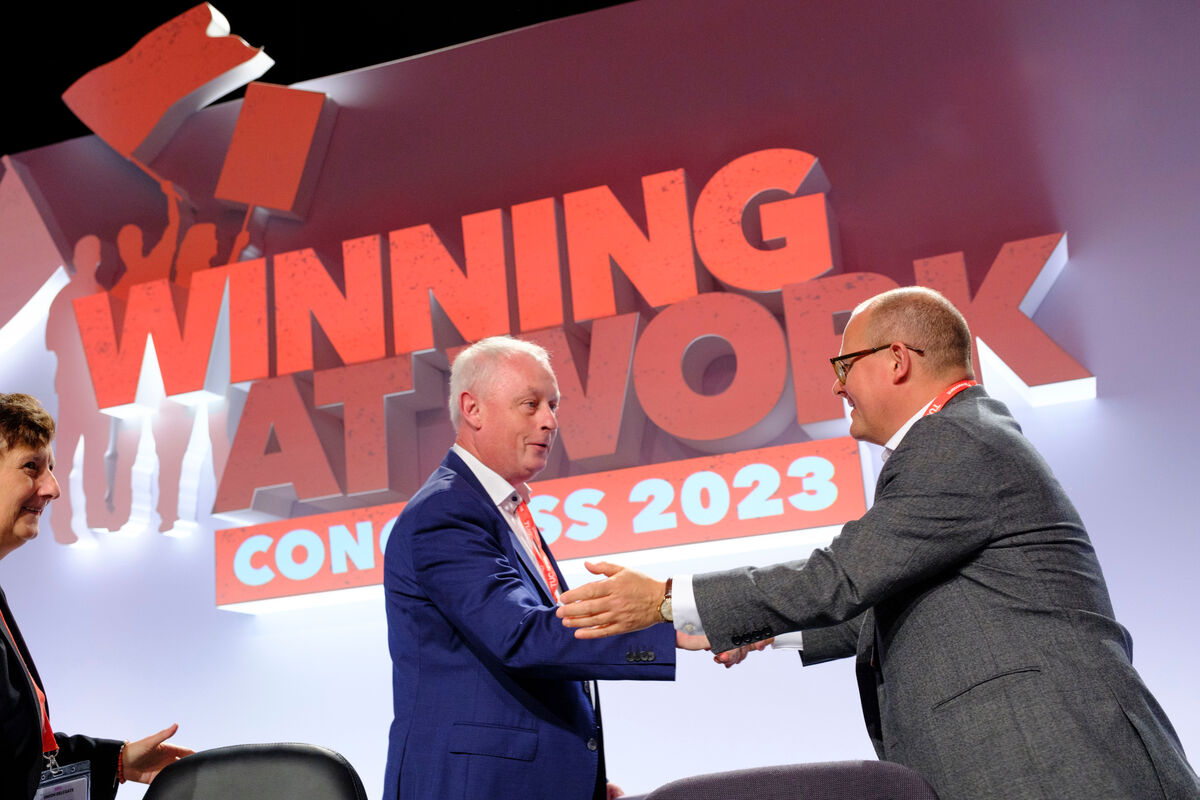
As part of the TUC’s commitment to skills development, we have pursued restoration of funding for the highly successful Union Learning Fund. We have commissioned a feasibility study that will explore how we can support unions’ vital work in member learning and development and revitalise our network of union learning reps. The report will identify the union advantage in the skills space, highlighting areas where trade union engagement in learning and skills adds value by enhancing skills participation and improving economic outcomes.
4.10 International
The TUC welcomed UNISON’s Liz Snape as the new General Council international spokesperson. Her first mission was representing the TUC at DISK’s Congress in Istanbul, helping prepare our work with it on supporting trade unionists in the textiles sector.
At the International Trade Union Confederation (ITUC), the TUC supported the candidature of Luc Triangle as the new general secretary. Luc addressed TUC Congress in Liverpool, and shortly after was confirmed as general secretary by a special ITUC Congress. Paul Nowak, Liz Snape and Stephen Russell represented the TUC at the ITUC General Council, with Kate Bell, Steve Turner (Unite), Rosa Crawford and Stephen Russell representing us on the European Trade Union Confederation (ETUC) executive committee, where we pushed for a resolution on Palestine.
At Congress, the other international speakers were Liz Shuler (president, AFL-CIO) and Eric Campos (general secretary, CUT Chile), who marked the 50th anniversary of the Pinochet coup.
In line with composite 21, the general secretary joined the ITUC-led delegation to Ukraine in May, the only national leader to do so. He met both the FPU and KVPU and with the energy and health workers, with the Mirror carrying his story in a guest editorial. With the NEU, we also financially supported the ETUC's first-ever solidarity summit on Ukraine, held in Lublin, Poland. Our report on labour rights in Ukraine Resistance and Reconstruction - with highlighted the lack of consultation with unions over plans to rebuild the country's infrastructure - was launched globally at a reconstruction event in Warsaw. Unions have since finally been invited to participate in formal reconstruction discussions.
The TUC continued to support the work of Justice for Colombia, and seconded our senior international officer, Mariela Kohon, to work for the progressive Colombian government and the UN on the peace process.
On Brazil, the TUC instituted regular contact meetings with CUT Brazil’s international department, focusing on trade, the far right, and the Lula-Biden initiative on workers’ rights.
On Turkey, the TUC visited both KESK and DISK and spoke in support of their case at the International Labour Organization (ILO).
The TUC delegation to the ILO annual conference (3–14 June) participated fully in its main committees. The UK worker delegate, Amanda Brown (RCM), was voted on to the top tier of the ILO’s governing body. The TUC’s Stephen Russell joined the Committee on the Application of Standards, speaking on worker cases on Australia, Belarus, Eswatini and Turkmenistan, and led the workers’ group on the Philippines case. The Care Economy Committee was supported by Abigail Hunt (TUC), while Rob Miguel (Unite) covered the two-year standard-setting discussion on a Convention on Biological Hazards.
Eliza Ampomah (TUC) led on Fundamental Principles and Rights at Work Committee. She was also our L7 delegate, helping to get TUC priorities into the L7 statement, including artificial intelligence (AI) ahead of the G7 leaders' meeting in Italy, which aimed to strengthen the rules-based international system.
The TUC campaigned against the Economic Activities of Public Bodies Bill, liaising with affiliates and the Right to Boycott coalition in line with composite 22. MPs and Lords drew on our briefings as the Bill was debated, and the Bill did not pass through parliament before the election.
The TUC campaigned against the Economic Activities of Public Bodies Bill, liaising with affiliates and the Right to Boycott coalition in line with composite 22
In response to the escalating violence in Palestine and Israel, the General Council issued two statements (October 2023 and May 2024). We unequivocally condemned the attacks on Israeli civilians by Hamas in October 2023, and we called for an immediate and permanent ceasefire, respect for international law, accountability, and unimpeded access to humanitarian aid in Gaza. The TUC has also called for an end to settler violence in the West Bank and de-escalation of hostilities in the region. In January, we held an event for General Council members, and in May the Palestinian ambassador, Dr Husam Zomlot, made a historic address to the General Council, followed by a joint press statement. We twice wrote to Lord Cameron, then secretary of state for the Foreign, Commonwealth and Development Office (FCDO), and met the FCDO. The TUC has also maintained a constructive relationship with the (then) shadow minister for North Africa and the Middle East, and maintains regular contact with unions and NGOs in the region.
We launched a new TUC Aid project, which aims to build the capacity of trade unions in Cameroon to influence the African Continental Free Trade Agreement, jointly funded by the Trade Union Unit Trust Charitable Trust and NASUWT. This is part of a wider project managed by ITUC Africa. The TUC is also developing a project in Palestine with the PGFTU and Arab TUC, and another with Tucoswa in Eswatini.
The TUC wrote to the new UK government, flagging serious human and labour rights violations in the Philippines that broke the terms of the UK’s trade deal. Kate Bell addressed the Hong Konger Labour Festival in May and pledged TUC support for its campaigns, and we supported the CTUM’s call for UK textiles firms to divest from junta-controlled areas of Myanmar.
4.11 Tackling the far right
Through the ETUC executive committee, TUC representatives advocated for increased European cooperation to challenge the far right, leading to ETUC action ahead of the EU elections and work to disseminate constitutional means for unions to exclude far right activists. Globally, we continued work with the REDES anti-fascist network, and sent our support to Argentine unions striking in opposition to new president Milei’s far-right policies.
In June, representatives from nine unions (BFAWU, Community, Equity, FBU, GMB, NEU, PCS, UNISON and Unite) attended a TUC-funded residential training course on tackling the far right. Titled The International Rise of the Far Right: building the trade union response, the level-three political education course has been developed in conjunction with Trademark Belfast. Sessions for unions who were not able to register are likely to run in 2025.
At our LGBT+ Workers Conference, we hosted a panel focused on tackling far-right narratives around homophobia and transphobia. We have continued to source case studies and workplace examples from affiliates as we curate our support, directing unions to a new online hub on our website. We will continue to develop this work, and the intersectional challenges posed by the far right, using examples internationally and in workplaces across the country.
5.1 Developing the TUC
After a period of consolidation we have continued to develop our backroom functions and prepared the ground for major change in the coming years.
In January 2024, the TUC agreed a new strategy to guide our work for the next three years.
Our overall priorities and policy are set by the TUC’s member unions, working through Congress, the executive committee and General Council. This strategy guides TUC staff in responding to those democratic priorities, meaning we can prioritise and make the most of our resources.
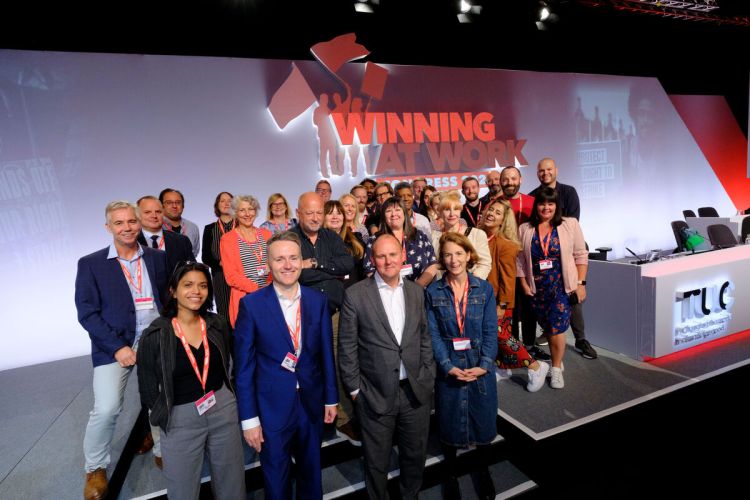
Over the coming three years, the TUC has five key aims:
- Aim 1 – A growing union movement that reflects the diversity of today’s working class and has the power to intervene effectively for workers.
- Aim 2 – Workplaces where every worker has strong rights and is protected
from discrimination. - Aim 3 – A fairer economy that delivers secure jobs and rising wages and supports
strong public services. - Aim 4 – An economy where workers can shape and are prepared for the challenges of the future.
- Aim 5 – A strong TUC that is sustainable, effective and a great place to work.
We have also developed a set of behaviours to guide us in how we go about delivering the strategy and how we conduct ourselves at work.
Our staff continue to raise the profile of the TUC in all aspects of their work, delivering on our aims, values and aspirations during a very challenging time for the TUC and the wider movements
5.3 Finance Committee
The Finance Committee was set up in May 2023 to provide the General Council with strategic oversight and assurance of TUC finances, by overseeing the development of an overarching longer-term financial direction and plan for the TUC. This included setting an affiliation fee rate that is sustainable to the TUC and affiliates. The committee is not responsible for operational matters. Membership comprises general secretary members of the executive committee or their named delegate, the president, general secretary and assistant general secretary.
In the current year, the committee has agreed a way forward for the TUC’s affiliation fee, agreed the budget for 2024 and scrutinised the accounts for 2023. It has considered the difficult decision to sell Congress House and purchase a new building, our approach to regions and nations, and our strategy for grant funding.
5.4 Congress House – managing our estates
Congress House was built as a monument to trade unionists who died during both world wars. It has served as a fantastic home for our movement.
Following notice that major work would be required to meet incoming environmental standards, we spent much of the year assessing the strategic and financial costs and benefits of Congress House, our main asset. After considering detailed analysis, the finance committee agreed that the TUC will seek a buyer for Congress House and look to purchase a fit-for-purpose building that will better support the TUC and our unions in the decades ahead. This decision was endorsed by the executive committee and General Council.
We consulted with our staff, affiliated and experts at every stage of this process to ensure we made the best decision for our movement.
The decision to look to move from Congress House was incredibly difficult. But it is in the best interests of the TUC – and the millions of working people we serve and represent – for us to find a new home for trade unionism. Our commercial and property activity has always existed to serve this greater purpose and we will always put the needs of unions and their members first.
5.5 Congress Centre – a valued venue
Demand has been building back strongly for the wide range of meetings, conferences and events hosted by Congress Centre. However, the decision to move from Congress House will also mean the eventual closure of Congress Centre. In the meantime, the team continues to provide a valued service for the TUC, our affiliates and external clients.
5.6 Our people, learning and development
Our staff continue to raise the profile of the TUC in all aspects of their work, delivering on our aims, values and aspirations during a very challenging time for the TUC and the wider movement.
Wales TUC/TUC Cymru was impacted by a review of its external funding. On a more positive note, the TUC successfully secured funding for work around the green agenda and appointed new staff to support workplace reps.
As part of our ongoing work and commitment to equality, diversity and inclusion we ran a well-received staff awareness programme. We developed a second talent and leadership programme for Black staff. We undertook a sexual harassment climate survey and drew up an action plan, leading to first responder training, mandatory sexual harassment and dignity at work training, and the commissioning of a reporting helpline service.
The TUC is reinvigorating staff learning and development with the election of additional union learning reps and the formation of a joint learning and development group. We are also exploring new ways of encouraging learning and development, including the offer of individual learning accounts.
5.7 Senior staff movements
Following a difficult budgetary round, we looked very carefully at vacancies and took some tough decisions to cancel, reshape or move posts. Matilda Quiney left her role as head of management service and administration at the end of August, and Kevin Rowan will be leaving his role as head of organisation services and skills later in 2024 with a view to a limited restructure of senior roles. Three other TUC staff were elected as Labour MPs at the general election on 4 July: Antonia Bance in Tipton and Wednesbury; Anneliese Midgley in Knowsley; and Lee Baron in Corby and East Northamptonshire. They have been fantastic colleagues, and we wish them and all leavers well for the future.
5.8 IT strategy and information services
The TUC was proud to achieve Cyber Security Essentials standard, building on improvements to our information and system security over the last few years, and spread this work to affiliates. We agreed a strategy towards internal use of artificial intelligence (AI). We transferred more data to our CRM system and strengthened our email marketing. And although progress was delayed on the implementation of a new finance system because of staff turnover, we are now working hard to build and implement the new system.
Our information line supported nearly 5,600 public enquiries in 2023. Of these, 80 per cent were from people who wanted to know how to join a trade union, encouraged by increased union activity and media presence.
5.9 Congress and Congress Awards
The TUC held a successful 2023 Congress in Liverpool. Delegates at our annual showcase event debated a wide range of issues including the pay crisis, industrial action and Conservative attacks on workers’ right to strike. Deputy Labour leader Angela Rayner addressed Congress and we delivered a full programme of fringes, events and speakers.
We were proud to present our Congress Awards in Liverpool. Charlie Gough from Usdaw won the Congress Award for Youth; Simon Wilde from GMB won the Health and Safety Rep Award; Sarita Healey from NEU won the Organising Award; Heather McKenzie from NEU received the Women’s Gold Badge; and Afshan Ali from RCM won the Union Learning Rep Award.
5.10 TUC Women’s Conference 2024
The theme of this year’s Women’s Conference was A New Deal for Women. More than 300 women from across the movement came together to debate key issues including preventing violence against women and girls, recognising the value of paid and unpaid care, and empowering women in trade unions.
We hosted panels discussing tackling and preventing sexual harassment in the trade union movement, and the situation facing women in Gaza, Israel and the Middle East. We also held several workshops, including focus groups to support our research into Black women’s experiences of sexual harassment.
5.11 TUC LGBT+ Workers Conference 2024
More than 250 people attended our LGBT+ Workers Conference in Congress House, with delegates debating key issues including international LGBT+ rights, the far right and hate speech/crime, LGBT+ health, trans rights, and LGBT+ representation within the media.
We hosted two panel discussions, on combating the far right and on advancing trans and non-binary rights after the general election.

5.12 TUC Disabled Workers Conference 2024
The theme of our Disabled Workers Conference was Nothing About Us Without Us. More than 250 people attended the conference, held in the ACC Liverpool Arena, debating a range of issues including the social model of disability, reasonable adjustments, political change, accessibility, benefits and the United Nations Convention on the Rights of Disabled People.
We hosted two panel discussions on pride in disability, and on ensuring disabled workers thrive after the general election.
5.13 TUC Black Workers Conference 2024
The conference theme was Here to Fight, Here to Stay. Delegates discussed racism in the labour market, focusing on issues such as outsourcing, precarious employment, health inequalities, pay disparity, minimum service levels legislation and employment practices.
Workshops and fringe sessions covered topics including the rise of the far right, trade union organising, and tackling the sexual harassment experienced by Black women.
5.14 TUC Young Workers Conference 2024
The theme of conference was The Present and The Future. More than 100 young trade unionists debated a New Deal for young workers, the impact of AI, minimum service levels (MSLs) and attacks on trade unions. Workshops and panels covered topics including tackling sexual harassment, promoting anti- racism, winning strike ballots, speaking to camera, organising young workers and advancing international solidarity.
5.15 Trades Councils Conference 2024
Held in Congress House at the beginning of June, delegates debated a range of issues from attacks on the right to strike to the need for international peace. Noting resolution 77, those present also reflected on the unique role played by trades councils in bringing unions and communities together, not least during industrial disputes. The conference was addressed by the general secretary and, in a year when we mark the 40th anniversary of the Miners’ Strike, by John Dunn from the Orgreave Truth & Justice campaign.
5.1 TUC Finances
The annual statement of accounts and balance sheet as at 31 December 2023 is set out in Appendix 3. It shows a total deficit across all funds of £11.0m, including asset revaluations and FRS102 pension accounting adjustments. Continuing difficulty in the central London commercial property market led to a significant fall in net assets and this was compounded by the decline in pension scheme asset value. The operating deficit on ordinary activities of £768,000 comprises deficits of £628,000 and £270,000 on the administration and Congress House dilapidations funds respectively, as well as surpluses of £94,000 and £36,000 on the development and external grants funds respectively.
5.17 Development Fund
In 2023, 10 per cent of the affiliation fee was allocated to the Development Fund, alongside some external funding, and this was used to promote new work and General Council priorities in the following areas:
- building and diversifying our movement
- getting wages rising and tackling the cost-of-living crisis
- defending rights at work and the right to strike
- the Covid-19 public inquiry.
The development fund showed an operating surplus of £94,000.
Of the £1,350,000 available to fund this work, £300,000 was ringfenced at the start of the year as a ‘reactive fund’ to provide additional funding for campaign requirements arising within the year. The 2023 operating surplus of £94,000 is the net unused balance of this reactive fund. £200,000 of the reactive fund was awarded to cover legal costs for the ongoing Covid-19 public inquiry.
5.1 Statement of accounts
The administration fund (covering day-to-day office running expenses and staff costs) produced a deficit on ordinary activities of £628,000. Ordinary income was marginally lower than budgeted, with a negative outturn on conferencing and property rental income being partially offset by a positive outturn on affiliation fees driven by higher member numbers than projected. Investment income was also much higher than anticipated. Ordinary expenditure was considerably lower than budgeted, primarily due to measures taken to reduce payroll costs. The development fund is shown above, while during the year £270,000 of expenditure was incurred on the dilapidations fund. The external grant fund produced a surplus of £36,000.
During 2023, our calculated FRS102 pension scheme position moved from a £23,571,000 surplus to a £20,160,000 surplus. This negative movement of £3,411,000, together with the operating deficit of £768,000, the gain of £2,609,000 on sale of investments, fixed asset sale and deferred tax, and the property revaluation loss of £9,430,000 has reduced the TUC’s funds from £84,264,000 to £73,264,000.
5.19 Prospects and developments
A budget for the 2024 administration fund has been agreed by the General Council. This showed a projected deficit of £413,800, with efforts being made to minimise this. The General Council approved an affiliation fee increase of 5 per cent for 2024.
The TUC has retained its Fair Tax accreditation.
5.20 TUC Library Collection
Located at London Metropolitan University, the TUC Library provides a wide range of resources on both the history and current activities of trade unions, industrial relations, labour history and adult education.
Six exhibitions are currently available to loan: The Life of Mary Macarthur; the History of Young Workers; 150 years of the TUC; the 1984/85 Miners’ Strike; the Russian Revolution; and American and British Labour Relations.
The TUC Library is also collaborating with the Coalition of Black Trade Unionists (UK) on a Black Trade Union Oral History Project, and is seeking volunteers to interview and be interviewed. To get involved please visit: https://tuclibrary. blogs.londonmet.ac.uk
Our educational history websites – The Union Makes Us Strong, Workers’ War, Winning Equal Pay and Britain at Work – contain image archives and oral history and can all be accessed from www.unionhistory.info
TUC Library can be found on social media at:
Enquiries, visits and inductions are very welcome and can be organised through Jeff Howarth at:
London Metropolitan University The Wash Houses Old Castle Street London E1 7NT tuclib@londonmet.ac.uk 020 7320 3516
Christine Esteve, who died last August, worked in a creative and marketing role in the TUC’s press department from 1980 to 1988. Subsequently, she became a project director with Unity Trust Bank before moving to France.
Charles Diver, who died last September, worked as a bar manager at the TUC’s National Education Centre in north London from 1992 to 2000.
Ken Jackson, who died in July, was general secretary of the Amalgamated Engineering and Electrical Union (AEEU) from 1995 to 2001, and joint general secretary of Amicus (now part of Unite) from 2001 until 2002. He also served on the TUC General Council from 1993 to 2001. After working as an electrician with the RAF, he joined the Electrical Trade Union (ETU), which
later became the Electrical, Electronic, Telecommunications and Plumbing Union (EETPU). He assumed responsibility for the union’s North West region in the 1980s, becoming general secretary of the merged AEEU in 1995. Knighted by Tony Blair’s government in 1999, he was also vice president of the Trade Union Committee for European and Transatlantic Understanding.
Jane Loftus, who died last November, was CWU president and chair of the union’s postal executive, and a member of the General Council from 2019 to 2023. She joined the Post Office in 1982, soon becoming a union rep, before moving to the Royal Mail, where she was a hugely effective representative of workers at local, divisional and national level. She was elected to the CWU’s executive in 2002, becoming national president in 2009. A passionate champion of women trade unionists, she was a proud internationalist, peace campaigner and activist with Stand Up To Racism.
Richard Rosser, who died in April, was general secretary of the TSSA from 1989 until his retirement in 2004, serving on the General Council from 2000 to 2004. A determined champion of transport and travel industry workers, his leadership of TSSA came at a turbulent time. This included the privatisation of Britain’s railways, during which he played a pivotal role securing union recognition and terms of service with the various companies that took over from British Rail. He started working full-time for the TSSA in his early twenties after the union spotted his skillful negotiating on behalf of London Underground workers. A Labour councillor during the 1970s, he was also chair of Labour’s NEC in 1997–98 and, upon his retirement, was created a
Labour peer as Baron Rosser of Ickenham. He served as shadow defence minister and shadow spokesperson for transport and home affairs in the Lords.
Stay Updated
Want to hear about our latest news and blogs?
Sign up now to get it straight to your inbox