
General Council Report 2024
5.1 Developing the TUC
After a period of consolidation we have continued to develop our backroom functions and prepared the ground for major change in the coming years.
In January 2024, the TUC agreed a new strategy to guide our work for the next three years.
Our overall priorities and policy are set by the TUC’s member unions, working through Congress, the executive committee and General Council. This strategy guides TUC staff in responding to those democratic priorities, meaning we can prioritise and make the most of our resources.
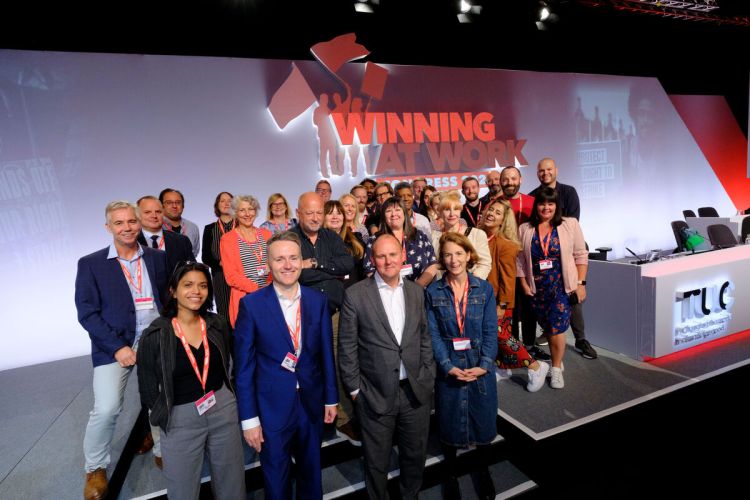
Over the coming three years, the TUC has five key aims:
- Aim 1 – A growing union movement that reflects the diversity of today’s working class and has the power to intervene effectively for workers.
- Aim 2 – Workplaces where every worker has strong rights and is protected
from discrimination. - Aim 3 – A fairer economy that delivers secure jobs and rising wages and supports
strong public services. - Aim 4 – An economy where workers can shape and are prepared for the challenges of the future.
- Aim 5 – A strong TUC that is sustainable, effective and a great place to work.
We have also developed a set of behaviours to guide us in how we go about delivering the strategy and how we conduct ourselves at work.
Our staff continue to raise the profile of the TUC in all aspects of their work, delivering on our aims, values and aspirations during a very challenging time for the TUC and the wider movements
5.3 Finance Committee
The Finance Committee was set up in May 2023 to provide the General Council with strategic oversight and assurance of TUC finances, by overseeing the development of an overarching longer-term financial direction and plan for the TUC. This included setting an affiliation fee rate that is sustainable to the TUC and affiliates. The committee is not responsible for operational matters. Membership comprises general secretary members of the executive committee or their named delegate, the president, general secretary and assistant general secretary.
In the current year, the committee has agreed a way forward for the TUC’s affiliation fee, agreed the budget for 2024 and scrutinised the accounts for 2023. It has considered the difficult decision to sell Congress House and purchase a new building, our approach to regions and nations, and our strategy for grant funding.
5.4 Congress House – managing our estates
Congress House was built as a monument to trade unionists who died during both world wars. It has served as a fantastic home for our movement.
Following notice that major work would be required to meet incoming environmental standards, we spent much of the year assessing the strategic and financial costs and benefits of Congress House, our main asset. After considering detailed analysis, the finance committee agreed that the TUC will seek a buyer for Congress House and look to purchase a fit-for-purpose building that will better support the TUC and our unions in the decades ahead. This decision was endorsed by the executive committee and General Council.
We consulted with our staff, affiliated and experts at every stage of this process to ensure we made the best decision for our movement.
The decision to look to move from Congress House was incredibly difficult. But it is in the best interests of the TUC – and the millions of working people we serve and represent – for us to find a new home for trade unionism. Our commercial and property activity has always existed to serve this greater purpose and we will always put the needs of unions and their members first.
5.5 Congress Centre – a valued venue
Demand has been building back strongly for the wide range of meetings, conferences and events hosted by Congress Centre. However, the decision to move from Congress House will also mean the eventual closure of Congress Centre. In the meantime, the team continues to provide a valued service for the TUC, our affiliates and external clients.
5.6 Our people, learning and development
Our staff continue to raise the profile of the TUC in all aspects of their work, delivering on our aims, values and aspirations during a very challenging time for the TUC and the wider movement.
Wales TUC/TUC Cymru was impacted by a review of its external funding. On a more positive note, the TUC successfully secured funding for work around the green agenda and appointed new staff to support workplace reps.
As part of our ongoing work and commitment to equality, diversity and inclusion we ran a well-received staff awareness programme. We developed a second talent and leadership programme for Black staff. We undertook a sexual harassment climate survey and drew up an action plan, leading to first responder training, mandatory sexual harassment and dignity at work training, and the commissioning of a reporting helpline service.
The TUC is reinvigorating staff learning and development with the election of additional union learning reps and the formation of a joint learning and development group. We are also exploring new ways of encouraging learning and development, including the offer of individual learning accounts.
5.7 Senior staff movements
Following a difficult budgetary round, we looked very carefully at vacancies and took some tough decisions to cancel, reshape or move posts. Matilda Quiney left her role as head of management service and administration at the end of August, and Kevin Rowan will be leaving his role as head of organisation services and skills later in 2024 with a view to a limited restructure of senior roles. Three other TUC staff were elected as Labour MPs at the general election on 4 July: Antonia Bance in Tipton and Wednesbury; Anneliese Midgley in Knowsley; and Lee Baron in Corby and East Northamptonshire. They have been fantastic colleagues, and we wish them and all leavers well for the future.
5.8 IT strategy and information services
The TUC was proud to achieve Cyber Security Essentials standard, building on improvements to our information and system security over the last few years, and spread this work to affiliates. We agreed a strategy towards internal use of artificial intelligence (AI). We transferred more data to our CRM system and strengthened our email marketing. And although progress was delayed on the implementation of a new finance system because of staff turnover, we are now working hard to build and implement the new system.
Our information line supported nearly 5,600 public enquiries in 2023. Of these, 80 per cent were from people who wanted to know how to join a trade union, encouraged by increased union activity and media presence.
5.9 Congress and Congress Awards
The TUC held a successful 2023 Congress in Liverpool. Delegates at our annual showcase event debated a wide range of issues including the pay crisis, industrial action and Conservative attacks on workers’ right to strike. Deputy Labour leader Angela Rayner addressed Congress and we delivered a full programme of fringes, events and speakers.
We were proud to present our Congress Awards in Liverpool. Charlie Gough from Usdaw won the Congress Award for Youth; Simon Wilde from GMB won the Health and Safety Rep Award; Sarita Healey from NEU won the Organising Award; Heather McKenzie from NEU received the Women’s Gold Badge; and Afshan Ali from RCM won the Union Learning Rep Award.
5.10 TUC Women’s Conference 2024
The theme of this year’s Women’s Conference was A New Deal for Women. More than 300 women from across the movement came together to debate key issues including preventing violence against women and girls, recognising the value of paid and unpaid care, and empowering women in trade unions.
We hosted panels discussing tackling and preventing sexual harassment in the trade union movement, and the situation facing women in Gaza, Israel and the Middle East. We also held several workshops, including focus groups to support our research into Black women’s experiences of sexual harassment.
5.11 TUC LGBT+ Workers Conference 2024
More than 250 people attended our LGBT+ Workers Conference in Congress House, with delegates debating key issues including international LGBT+ rights, the far right and hate speech/crime, LGBT+ health, trans rights, and LGBT+ representation within the media.
We hosted two panel discussions, on combating the far right and on advancing trans and non-binary rights after the general election.

5.12 TUC Disabled Workers Conference 2024
The theme of our Disabled Workers Conference was Nothing About Us Without Us. More than 250 people attended the conference, held in the ACC Liverpool Arena, debating a range of issues including the social model of disability, reasonable adjustments, political change, accessibility, benefits and the United Nations Convention on the Rights of Disabled People.
We hosted two panel discussions on pride in disability, and on ensuring disabled workers thrive after the general election.
5.13 TUC Black Workers Conference 2024
The conference theme was Here to Fight, Here to Stay. Delegates discussed racism in the labour market, focusing on issues such as outsourcing, precarious employment, health inequalities, pay disparity, minimum service levels legislation and employment practices.
Workshops and fringe sessions covered topics including the rise of the far right, trade union organising, and tackling the sexual harassment experienced by Black women.
5.14 TUC Young Workers Conference 2024
The theme of conference was The Present and The Future. More than 100 young trade unionists debated a New Deal for young workers, the impact of AI, minimum service levels (MSLs) and attacks on trade unions. Workshops and panels covered topics including tackling sexual harassment, promoting anti- racism, winning strike ballots, speaking to camera, organising young workers and advancing international solidarity.
5.15 Trades Councils Conference 2024
Held in Congress House at the beginning of June, delegates debated a range of issues from attacks on the right to strike to the need for international peace. Noting resolution 77, those present also reflected on the unique role played by trades councils in bringing unions and communities together, not least during industrial disputes. The conference was addressed by the general secretary and, in a year when we mark the 40th anniversary of the Miners’ Strike, by John Dunn from the Orgreave Truth & Justice campaign.
5.1 TUC Finances
The annual statement of accounts and balance sheet as at 31 December 2023 is set out in Appendix 3. It shows a total deficit across all funds of £11.0m, including asset revaluations and FRS102 pension accounting adjustments. Continuing difficulty in the central London commercial property market led to a significant fall in net assets and this was compounded by the decline in pension scheme asset value. The operating deficit on ordinary activities of £768,000 comprises deficits of £628,000 and £270,000 on the administration and Congress House dilapidations funds respectively, as well as surpluses of £94,000 and £36,000 on the development and external grants funds respectively.
5.17 Development Fund
In 2023, 10 per cent of the affiliation fee was allocated to the Development Fund, alongside some external funding, and this was used to promote new work and General Council priorities in the following areas:
- building and diversifying our movement
- getting wages rising and tackling the cost-of-living crisis
- defending rights at work and the right to strike
- the Covid-19 public inquiry.
The development fund showed an operating surplus of £94,000.
Of the £1,350,000 available to fund this work, £300,000 was ringfenced at the start of the year as a ‘reactive fund’ to provide additional funding for campaign requirements arising within the year. The 2023 operating surplus of £94,000 is the net unused balance of this reactive fund. £200,000 of the reactive fund was awarded to cover legal costs for the ongoing Covid-19 public inquiry.
5.1 Statement of accounts
The administration fund (covering day-to-day office running expenses and staff costs) produced a deficit on ordinary activities of £628,000. Ordinary income was marginally lower than budgeted, with a negative outturn on conferencing and property rental income being partially offset by a positive outturn on affiliation fees driven by higher member numbers than projected. Investment income was also much higher than anticipated. Ordinary expenditure was considerably lower than budgeted, primarily due to measures taken to reduce payroll costs. The development fund is shown above, while during the year £270,000 of expenditure was incurred on the dilapidations fund. The external grant fund produced a surplus of £36,000.
During 2023, our calculated FRS102 pension scheme position moved from a £23,571,000 surplus to a £20,160,000 surplus. This negative movement of £3,411,000, together with the operating deficit of £768,000, the gain of £2,609,000 on sale of investments, fixed asset sale and deferred tax, and the property revaluation loss of £9,430,000 has reduced the TUC’s funds from £84,264,000 to £73,264,000.
5.19 Prospects and developments
A budget for the 2024 administration fund has been agreed by the General Council. This showed a projected deficit of £413,800, with efforts being made to minimise this. The General Council approved an affiliation fee increase of 5 per cent for 2024.
The TUC has retained its Fair Tax accreditation.
5.20 TUC Library Collection
Located at London Metropolitan University, the TUC Library provides a wide range of resources on both the history and current activities of trade unions, industrial relations, labour history and adult education.
Six exhibitions are currently available to loan: The Life of Mary Macarthur; the History of Young Workers; 150 years of the TUC; the 1984/85 Miners’ Strike; the Russian Revolution; and American and British Labour Relations.
The TUC Library is also collaborating with the Coalition of Black Trade Unionists (UK) on a Black Trade Union Oral History Project, and is seeking volunteers to interview and be interviewed. To get involved please visit: https://tuclibrary. blogs.londonmet.ac.uk
Our educational history websites – The Union Makes Us Strong, Workers’ War, Winning Equal Pay and Britain at Work – contain image archives and oral history and can all be accessed from www.unionhistory.info
TUC Library can be found on social media at:
Enquiries, visits and inductions are very welcome and can be organised through Jeff Howarth at:
London Metropolitan University The Wash Houses Old Castle Street London E1 7NT tuclib@londonmet.ac.uk 020 7320 3516
Stay Updated
Want to hear about our latest news and blogs?
Sign up now to get it straight to your inbox