
Artificial intelligence for creative workers
Labelling of machine-generated outputs
The transparent and clear labelling of machine-generated outputs is essential to maintain differentiation from human-created content and prevent the devaluation of human creativity.
To this end, the technology industry, the creative and education sectors must agree and adhere to consistent schemas and methods to label content generated by technology.
These labels should be both human- and machine-readable, accessible and sustainable to technology change.
Opt-in for commercial data mining and AI training
The use of human-generated materials protected by rights like copyright for commercial data mining and technology development should only be permitted if the relevant creative workers and rights holders have ‘opted in’ by granting express, informed and freely given consent to do so. Current UK laws are consistent with this proposal and should be upheld as such.
The UK should not adopt an ‘opt-out’ mechanism, similar to the regime introduced in the EU by the Copyright in the Digital Single Market Directive 2019 because:
- the regime likely breaches international intellectual property treaties binding on the UK 6
- the regime is unworkable in practice.
Experience of the EU ‘opt out’ regime reveals the mechanism to be practically unworkable because:
- the scope of the regime regarding AI training is unclear
- data mining restrictions communicated by creators according to the conditions prescribed by the regime are not consistently respected by third parties scraping data online
- the regime requires advanced knowledge of intellectual property law and data management systems to be implemented accurately by industry stakeholders.
Right to have content removed from training datasets
The UK government should recognise a right for creative workers and rights holders to request the removal of protected content from training datasets made available for commercial purposes. This right should be accompanied by clear enforcement measures (eg fines or pre-set damages), similar to those found in the context of data subject requests under the UK data protection laws.
The government should require that technology developers and organisations collecting rights-protected data make available user-friendly processes for creative workers or their unions to request the take- down and erasure of rights-protected content from their datasets.
Contracts
Most statutory rights currently protecting creative workers’ intellectual property, fair compensation, or privacy can be assigned, licensed, or waived by contract. Creative workers often lose rather than leverage their rights in their contracts with engagers, employers, technology or digital service providers, due to low bargaining power. This is especially true of creative workers without union representation or not engaged on the basis of a collective agreement negotiated by their union.
Without safeguards against unfair terms and practices, including regulation, the legal protection granted to creative workers by the law can often become meaningless in practice, leaving them exposed to exploitative and unconscionable bargains.
Creative workers should be recognised as vulnerable parties in contractual negotiations to acknowledge that:
- they are often bound by exploitative, predatory or unfair commercial agreements proposed to them on a take-it-or-leave-it basis by engagers, intermediaries or technology developers,
- they are often in precarious employment structures engaged in increasingly concentrated economic markets by large corporate groups which leaves them with low to no bargaining power to leverage their rights effectively.
Narrow interpretation of contracts, including ‘historic’ contracts
Contracts in which creative workers consent to broad transfers of rights should not be interpreted as a suitable legal basis for commercial data mining, technology development or digital imitations, unless the agreement explicitly references those activities and there is evidence of the worker’s free and informed consent. Here, ‘transfers of rights’ refer to assignments, licences, or waivers (sometimes known as ‘buy-outs’) of the creative workers’ rights.
Similarly, the interpretation of rights transfers should not be interpreted to include commercial activities or technological advances unknown to, or unforeseen by, creative workers, who therefore could not provide informed consent.
These interpretation principles should apply to past (or ‘historic’), present and future contracts made with creative workers. These interpretation principles should be:
- adopted and upheld immediately by the industry in their contractual practice, judges in in settling contractual disputes,
- safeguarded by the introduction of new legislation to this effect by the government.
Mandatory clauses on data mining, AI training and use
Any clauses seeking to obtain rights or permissions to use of workers’ content or likeness for data mining, technology
development or use must be stated explicitly and separately from other clauses as well as written in plain language.
This is particularly important in the context of contracts which seek to obtain workers’ consents and for services or commercial activities whose core objective is unrelated to data collection, processing, or technology development. There should be no risk of confusion or conflation in workers’ minds regarding the commercial activity to which they consent.
Onerous and abusive contractual clauses
Any contractual clauses placing an undue burden on creative workers, in the context of technology use or otherwise, should beclearly disclosed and explained to them before the formation of the contract.
Contractual clauses seeking to obtain from creative workers their permission to use and exploit all and any rights, present or future, in their work or likeness, irrevocably and perpetuity, in any media or technology including those unknown at the time the contract was formed, should be presumed unfair and declared unenforceable unless evidence reversing this presumption can be provided.
Preserved and increased intellectual property rights
It is essential to prevent the erosion of creative workers’ intellectual property rights arising in their work or likeness such as copyright, moral rights, performer’s rights, and other registered rights.
Erosion of intellectual property rights occurs due to:
- ongoing, widespread infringement of rights without meaningful sanctions,
- uncertainty in the application or infringement of rights,
- lack of clarity in the ownership of outputs generated by workers with technology.
Government intervention is required to:
- confirm that the act of data mining and training technology on rights-protected content for commercial purposes without the appropriate consent of the creators is an infringement of existing copyright, performers’ and other intellectual property rights
- clarify when and how authorship, performership and ownership arises in content generated with technology.
Government intervention is also required to increase intellectual property protection to:
- recognise algorithmic training and commercial data mining as individual acts restricted by copyright and performers’ rights, separately from the right of reproduction
- introduce rights to fair remuneration or compensation for the use of rights- protected content in the context of commercial data mining
- introduce or confirm that performers’ rights to consent to the recording of their performance and the reproduction of such recording is activated by the making of digital imitations with AI systems or other digital technologies
- ensure provisions for authors’ and performers’ moral rights are consistent with binding international treaties like the Beijing Treaty as well as enforceable
- introduce clear and comprehensive obligations of moderation or filtering by technology providers to limit the unauthorised use of protected content with their technology when ‘prompting’ or generating outputs.
If and when amending existing legislation, the government should take care to ensure no new change diminishes or erodes existing rights granted to creative workers.
New likeness rights
Many workers rely on their likeness (their name, face, voice or physical appearance) in their daily work. Our likeness is not well protected under UK law. Although criminal protection against image-based abuse online notably in relation to ‘deepfakes’ is undergoing legislative reform, there remains a gap in protection for non-criminal yet harmful uses of people’s likeness. This leaves workers vulnerable to unauthorised uses of their likeness in professional and commercial contexts.
New likeness rights similar to image or personality rights commonly found in other jurisdictions should be introduced to provide creative workers with a straight-forward, effective, and robust means to:
- protect all aspects of their likeness
- enable the dissemination or commercialisation of their likeness with control and consent.
These new rights will need to be balanced with others’ freedom of expression which may permit, under clear conditions, the use of protected likeness.
Any new likeness protection introduced should take care to ensure these rights vest in, and remain in the control of the identity- holder. Safeguards should be introduced to limit any transfer of likeness rights away from the identity-holder to strict conditions, and preserve the latter’s rights to work and trade, free speech and privacy.
- 6 Those include the Berne Convention, the Rome Convention, the Trade Related Intellectual Property Rights Agreement (or TRIPS) and World Intellectual Property Organization Copyright Treaty, the WIPO Performances and Phonograms Treaty, and the Beijing Treatyon Audiovisual Performances.
Many workers rely on their likeness (their name, face, voice or physical appearance) in their daily work.
Remuneration schemes and licensing agreements
Remuneration schemes in the form of licensing or compensation mechanisms should be implemented to ensure that new commercial activities such as data mining, AI training and other uses on rights-protected content are carried out legally, with the informed consent and fair remuneration of workers.
Such remuneration schemes should be voluntary. Creative workers should be free to join or abstain from participating in these schemes.
Remuneration schemes, including licensing agreements should be established in negotiations with creative workers’ unions.
These agreements and schemes should be both sector-specific and differentiated based on the context of application of the technology.
Remuneration schemes should take care to ensure that they benefit creative workers, rather than intermediaries, like studios, distributors, online platform services, who may have previously acquired other rights to control the commercial exploitation of workers’ content or likeness.
We envisage the need to establish two regimes to cover data mining, AI training and use:
- a scheme to compensate creative workers for past data mining, technology development and use of their work, which took place without appropriate consent or permissions
- a scheme to remunerate creative workers who consent to the future use of their work in this way.
Additionally, those remuneration schemes will need to cover different points of interaction between the technology and rights-protected content:
- the commercial data mining of rights-protected content
- the training of technology on rights-protected content
- the prompting or fine-tuning of technology with rights-protected content
- the generation of outputs of technology reproducing or imitating rights-protected content.
A differentiated approach rather than a one- size-fits model to remuneration schemes is preferrable. Remuneration schemes should be sector specific, and in some cases use specific, to perform well for creative workers, technology developers and users.
For example, text written by journalists, academics or novelists may be subject to different terms of use and remuneration rates depending on whether the text:
- is used by a company to train their all- purpose foundational model
- is used by a company to fine-tune their AI tool to perform a specific task
- is uploaded onto an AI tool to generate a short-form summary by an employee for internal use or by a student for educational purposes
- is reproduced in AI-generated outputs.
Industrial needs to be assessed comprehensively by the UK government and with the participation of creative workers’ unions and other industry stakeholders to inform industrial negotiations. The findings of this assessment should be made publicly available for transparency to inform negotiations between technology developers and creative workers’ unions.
Creative worker unions are best placed to negotiate the terms of remuneration schemes with technology developers, engagers and employers. Depending on the outcome of these negotiations, the intervention of the UK government may be required to support its implementation through legislation, administration or financing.
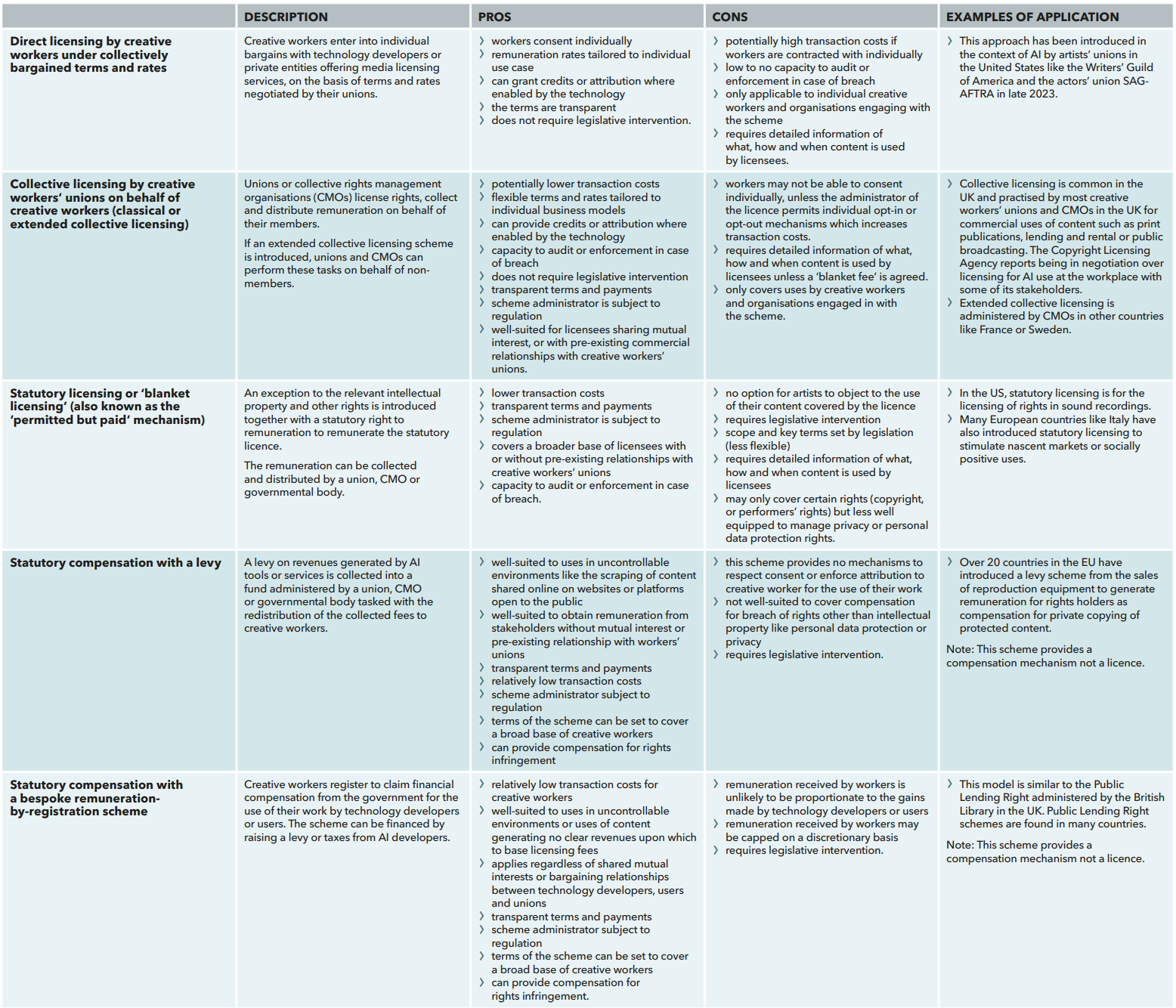
The table below describes different options remuneration schemes which may be adapted to uses of protected content with or for AI.
Credits and rights communication
Robust legal protection for the right of attribution
Creative workers should receive enhanced protection in relation to their moral right to be attributed as authors or performers of their work.
The moral right should not require assertion or any other formality to be completed by the author or performer, in accordance with international treaties on moral rights binding under UK law.
New legislation should be introduced to:
- ensure that authors’ and performers’ moral rights of attribution and objection to the derogatory treatment of their work cannot
be waived or transferred, - remove any requirements that the rights be asserted.
Standardised practises and tools to communicate credits, rights restrictions and permissions
The creative sector and technology industry also need to practice improved and consistent credit and attribution standards to ensure human creativity and creatorship are clearly communicated.
The creative sector and technology industry should establish standardised, user-friendly and machine-readable schemas and tools to communicate credits, rights restrictions and permissions to use human-created content, including for data mining and training purposes. These schemas and tools should be both human- and machine-readable.
Disclosures
Technology developers must disclose clearly: how the technology operates, and what resources were used to develop the technology, such as the content used to train technology.
Clear description of the technology and commercial terms
Technology developers should provide a description of how their technology operates in a clear manner, free of technical jargon.
This description should cover:
- the resources used to develop the technology
- core elements of the technology design
- tested performance levels of the technology:
- This information is particularly important with regards to technology’s rates of accuracy and bias, and other metrics relevant to the automated tasks or the context of application.
- whether and how the technology implements standards of ethical, responsible or human-centred AI relevant to the context of application
- the contractual terms upon which the technology is made available to users, including workers in the creative sector:
- This is especially important for terms related to: intellectual property and other rights transfer from the user to the service provider, rights to collecting and processing user data by the service provider, liability limitations for rights infringement, indemnity of the user for harm arising from using the technology, guarantees of technology or service availability, and any other commercial
terms which may be onerous to the user.
- This is especially important for terms related to: intellectual property and other rights transfer from the user to the service provider, rights to collecting and processing user data by the service provider, liability limitations for rights infringement, indemnity of the user for harm arising from using the technology, guarantees of technology or service availability, and any other commercial
This information should be made available to:
- the public wherever their technology is accessible for use
- creative workers prior to engaging with the technology or the technology developer for contractual purposes
- unions and regulators upon request.
This information is important to correct the information asymmetry existing between technology developers and stakeholders in the creative and education sectors.
This information is also crucial for creative workers and other stakeholders in those sectors to make an informed choice of technology aligned with their values.
Clear logs of training data
Technology developers should evidence that their activities comply with applicable laws to correct the information asymmetry existing between and rights holders with regards to how and for what purpose their work has been used.
Where human-generated content is used to create or improve technology like AI systems, technology developers should make available clear, user-friendly, and sufficiently detailed logs of such content.
The logs should be structured and shared to enable rights holders to exercise their rights, where appropriate.
These logs should include information about what and how data has been collected, stored and processed, and on what legal basis.
Technology developers should produce and maintain such logs whether they develop technology for commercial and non-commercial purposes.
Accessible legal redress and means of rights enforcement
Creative workers need access to user-friendly, accessible and timely legal redress and means of enforcement to defend their rights.
A user-friendly forum for legal claims
Existing legal procedures providing simplified and specialist venues like the Intellectual Property Enterprise Court (IPEC) remain too technical and expensive for creative workers to engage with in the defence of their rights. This is especially the case for workers who are not union members and cannot easily access legal representation or represent themselves due a lack of resources.
By contrast, the Information Commissioner’s complaint procedures for breach of the UK General Data Protection Regulations (UK GDPR) provides a more user-friendly approach to rights infringement, but its scope of application is limited. Similarly, the small claim track of the IPEC or the Intellectual Property Office’s mediation services may provide more affordable and flexible means to dispute resolution but remain under-used by stakeholders.
Taking on board lessons learnt from user- experiences in the dispute support services of the IPEC, ICO and IPO, the UK government should introduce a new and specialised forum for rights enforcement accessible to creative workers.
Any new forum for rights enforcement should have the means and authority to hear disputes involving a foreign party, or activities carried out abroad. This is particularly important as online services enable rights infringement on a global scale, and the majority of technology market leaders are currently headquartered abroad.
Additionally, the UK government should ensure unions are able to introduce legal proceedings in the collective interest of their members, and modify the law to this end where necessary.
Creative workers need access to user-friendly, accessible and timely legal redress and means of enforcement to defend their rights.
Sanctions for breach of restrictions on data mining
The UK government should introduce clear and enforceable sanctions, such as fines, for the breach of data mining restrictions communicated by creative workers and rights holders.
These sections should be enforceable in the UK through user-friendly and accessible processes.
Harmonised protection of creative workers
International and UK regulators should seek to harmonise without watering down the rights of creative workers across countries to prevent ‘jurisdiction shopping’ by technology developers and users. At present, while intellectual property rights are relatively well harmonised, it is not the case of likeness protection, contracts, or personal data protection. Significant differences in protection exist between the UK and key trading partners or technology market leaders, like the United States and the European Union. These differences are a barrier to cross-border innovation partnerships and worker protection due to legal and commercial uncertainty. These differences may also incentivise investors to outsource their activities to countries with clearer or lower regulatory standards, inadvertently encouraging a ‘race to the bottom’.
In particular, the UK should clarify its position in relation to recently introduced EU standards through the Digital Single Market Directive 2019, the Digital Services Act 2022, and the AI Act 2024. This is important because standards set by the EU may become global industry standards due to the economic weight of the EU, and to support the trading relations with EU countries.
Independent regulatory body for AI
The UK government should establish an independent body to oversee and regulate the integration of Artificial Intelligence into our lives, including the creative sector.
This body should have social partner representation and sufficient technical expertise to conduct sector-by-sector impact assessment and interventions to ensure a response tailored to the needs of individual industries.
This body should prioritise the collection and analysis of rigorous evidence on the impact of AI on the creative sector, both positive
and negative. There is currently a lack of empirical and rigorous evidence capturing the benefits and risks of the technology for the creative sector, which makes it impossible for leaders of the creative sector or the technology industry to make effective and informed interventions.
This body should also be granted meaningful means of sanction for rights and regulation infringement.
Policy focus and recognition
The UK government and regulatory bodies should adopt a comprehensive cultural lens on the impact of technology, such as AI, on the creative and education sectors. This means documenting, assessing and supporting with appropriate policies the multi-faceted relationship the technology industry, the creative and education sectors entertain with each other, on AI specifically.
Creative workers are the custodians and producers of key resources needed for AI innovation (like human-generated content or public trust) and may grow to co-develop technology if supported adequately.
National, regional and sector interventions on AI should seek to value and support the active role played by the creative workers in shaping AI innovation.
Support for sector-specific and rights-compliant AI
Creative workers are underserved by the technology market. The current offering of AI technologies targeting this sector is low, and not well aligned with their needs and interests. Noting this, the government should intervene to support collaboration between the technology industry and creative workers by fostering technology diplomacy.
Creative worker unions, technology leaders and the government should cooperate to increase technology diplomacy between them. This may take the form of regular roundtables held with these stakeholder groups, and the establishment of targeted fora to sustain ongoing discussion, collaboration and negotiations.
Such events must involve worker representation and should be designed to level power and resources inequalities amongst participants to ensure less-well- resourced participants feel equipped to engage on an equal footing. This may require upskilling participants on technical topics beforehand.
Specialised training and guidance
The government, further and higher education organisations, as well as unions should provide training opportunities for creative workers on data, technology and rights relevant to new technologies like artificial intelligence.
Training should be sector-specific, accessible by workers in different forms of employment (notably freelancers, self-employed or employees within SMEs structures), and the curriculum should be regularly updated.
Creative workers should have the opportunity to receive training in how to use AI in the context of their work before or after they’ve entered the workforce. Training prior to entering the workforce should cover both new and traditional skills, techniques
and tools to prevent deskilling and technology dependency.
Training opportunities can be provided by further education institutions, professional associations, unions, and employers. The UK government should support organisations and employers by funding training opportunities. In particular, funding should be made available by the UK government to ensure access to training by freelance workers, and employees in less-well- resourced organisations to prevent digital and innovation exclusions.
Further reading
For anyone who would like to read more about the impact of AI on creative work, see the resources and vision shared by TUC members.
› Equity (2023) AI Vision Statement
› Equity (2023) AI Toolkit
› Equity (2023) AI: Know Your Rights
› NAHT (2024) Artificial Intelligence (AI) in Education
› National Union of Journalists (2023) NUJ Briefing on Artificial Intelligence
› National Union of Journalists (2024) Artificial Intelligence: journalism before algorithms
› NASUWT (2023) Artificial Intelligence and Digital Technologies
› Public and Commercial Services Union (2024) Where We Stand on AI
› University and College Union (2021) Guidance on GDPR, Moral and Performance Rights and Accessibility in Recorded Lectures/Lessons
› Writers’ Guild of Great Britain (2024) WGGB Manifesto: putting writers at the heart of the story
› Writers’ Guild of Great Britain (2023) Writers and AI: a policy position statement
› Writers’ Guild of Great Britain (2024) Using Generative AI as a Research and Writing Tool: the
This manifesto builds our previous manifesto on Dignity at Work and the AI Revolution. If you are interested in discussing our work with us, or collaborating with us over any aspect of this manifesto, please contact us.
Stay Updated
Want to hear about our latest news and blogs?
Sign up now to get it straight to your inbox