
TUC submission Autumn Budget 2025
An inheritance of failure
The UK faces an unprecedented set of economic and social challenges: years of poor growth, falling living standards and decimated public services. The drivers include reckless reductions in public capital investment and public service spending; a bad Brexit deal; and a lack of any genuine industrial or labour market policy under the previous Conservative government.
As a result, the Conservatives presided over under-performing labour market, which is still holding back millions of people’s lives and opportunities – as well as depressing growth.
Workers endured the worst pay crisis for two centuries, accompanied by a damaging rise in highly insecure work. Chronic under-investment hollowed out Britain’s industrial communities and too many young people left school without a route to a decent job. Rising numbers of disabled people who could work found themselves without support to do so.
Significant public services cuts were regressive, with those on the lowest incomes seeing the most significant drops in their living standards as services fell away.
The Tories’ disastrous failure also meant a steep increase in public debt. Coupled with high interest rates, government interest payments have risen very steeply.
Investing in change
A commitment of £325bn on government capital spending and public services investment has started to repair damage the last government caused. But while these important improvements are welcome, they are not sufficient. More investment not less is needed to put the UK economy on a firmer footing and to repair our public services.
Capital investment commitments must be protected, and thought should now be given to how they can be further expanded – including ensuring the National Wealth Fund has powers to borrow.
It is welcome that our trading relationship with Europe has begun to improve, and the TUC supports government ambitions to secure commitments in the Common Understanding as soon as possible.
While policymakers continue to misjudge a failure of demand for a failure of supply, the operation of the fiscal institutions the government inherited, in an internationally volatile climate, does place real constraints on what can be borrowed to invest now. So significant action is needed to raise revenues.
Now is the time to address historic imbalances in how labour and capital are taxed. This should include a significant increase in the bank surcharge, further substantial capital gains tax reform and increased taxation on gambling companies. A fairer balance of taxation would raise significant revenues to support the investment and public services spending that will underpin future productivity gains, and protect the incomes of working people whose consumption is also essential for secure growth.
The government must also ensure that its approach to managing the public finances in the longer-term is conducive to securing strong, sustained output gains – an independent commission should now be established to consider how the processes for managing our public finances should continue to evolve, considering best international practice as well as recent UK outcomes.
Raising living standards
In this challenging context, faith in government’s capacity to deliver change is extremely low. After years of life getting harder, frustration with the pace of change is high.
The country is in desperate need of repair and renewal. And while the last 12 months have starkly shown that there are no quick fixes or easy answers an ambitious approach is now needed to securing change that is seen and felt in daily lives.
The living standards crisis has not gone away – it remains the most significant issue facing working people across the country. Real pay is still barely advanced on 2008, despite some small gains over the past year. While around 30 per cent of the public do now report that the pressure on their household budgets is easing, most (58 per cent) do not.1
After the most severe living standards pressures on historic record, it is no surprise that most people’s budgets feel much tighter than they used to. The government must now be relentless in showing working people it is on their side and that it is doing all it can to help families bring down their costs and increase their incomes.
Taking measures in the service of working people’s incomes is not just essential to delivering on a mandate for change, but the right way to rebuild our economy. A focus on stronger growth and rising living standards must go hand in hand.
The UK needs to break free from its persistent recent cycle of stagnant GDP and falling real household incomes. While higher GDP per head is needed to secure more better jobs and higher wages, rising consumer incomes and subsequent higher spending also make an important ongoing contribution to our economic health. Economic policy must simultaneously target both stronger output and rising living standards.
So immediate action must be taken to help working people with the cost of living, including introduction of measures to bring down domestic energy costs, an end to the two-child benefit cap and ongoing ambition on the minimum wage.
A joined-up labour market policy should also be central to the government’s approach - focusing consistently on more and better jobs.
Young people, taking their crucial first steps into paid work at the end of full-time education, have finally been promised a guarantee of quality training or a decent first job. This must be ambitious scheme, with early access for those who need it most. We also need to invest more in learning, prioritising expansion of the Growth and Skills Levy and a new union learning fund to boost union-employer partnerships.
Full implementation of the employment rights bill, and the wider plan to Make Work Pay, are an essential part of the job quality agenda and will also support stronger growth. Our assessment suggests that the employment rights bill alone will improve job security for millions of workers and delivering annual net economic gains of around £10bn a year. As the Bill gains Royal Assent it must now be delivered at pace, ensuring working people see real benefit from the changes it brings and that the economic gains it can deliver are fully felt.
The new industrial strategy has started to deliver investment and futureproof our manufacturing base, while boosting our capacity to compete for the new industries of tomorrow. More action can now be taken to ensure there are strong workforce strategies in place across each sector. This approach can be carried across to significant infrastructure investments, where employers and unions should be supported by government to secure framework agreements across significant infrastructure projects, promoting secure jobs and high labour standards.
Support is also needed across foundation industries to ensure competitive industrial electricity prices – this should include bringing forward the British Industrial Competitiveness Scheme or failing that introducing an interim support scheme to be available to industry on the brink of closure due to energy costs. Additional funding and investment is also needed to futureproof North Sea supply chain firms and deliver a successful workforce redeployment programme for jobs at risk.
Decent public services play a vital role in boosting productivity, growth and living standards – whether through improving the nation’s health, boosting educational performance or ensuring that people with caring responsibilities are able to work. It is therefore vital that investment in the world class public services we need is sustained, and that there is active dialogue with public service unions on a plan to restore public sector pay, recognising that more than a decade of pay restraint has exacerbated the recruitment and retention crises across much of the public sector and the financial hardship faced by many public services workers.
Investing in our infrastructure, skills and public services is not just the right thing to do for individual workers, but to deliver the environment in which growth can thrive. More and better jobs across our country, together with action to tackle the cost-of-living crisis, are the best way to deliver a more secure, productive economy. A government that delivers for working people will be one that can deliver the repair, renewal and growth the country desperately needs.
- 1TUC polling August 2025, undertaken by Hold-Sway, n=5024.
The urgent need for change
- The government took power amidst unprecedented economic and social challenges
- The country is facing simultaneous failures on growth, living standards, (across measures of job quality and employment rates as well as wages), post-Brexit trade, investment and public services.
- The living standards crisis has not gone away – it remains the most significant issue facing working people across the country.
- The government is right to target both stronger growth and rising living standards – both goals are mutually supportive.
- Chronic under-investment has hollowed out Britain’s industrial communities, and too many young people are leaving school without a route to a decent job or secure future.
- Public service performance went consistently backwards, and Tory failures on growth meant they also failed on public debt.
The UK faces an unprecedented set of economic and social challenges – years of poor growth, falling living standards and decimated public services.
We do know that stronger growth and rising living standards must go hand in hand. The UK needs to break free from its persistent recent cycle of stagnant GDP and falling real household incomes. While higher GDP per head is needed to secure more better jobs and higher wages, rising consumer incomes and subsequent higher spending also make an important ongoing contribution to our economic health. The government is right focus their growth mission on achieving both rising real household disposable incomes and higher GDP per head2 : economic policy must simultaneously target both stronger output and rising living standards.
Evidence shows us that change is possible, and that progress has already started. But the failures inherited from the Tories have been worsened by ongoing and strong headwinds from abroad and at home. Conservative failures to reduce public debt, coupled with high interest rates, are acting as a severe restraint to private and public sector activity.
A crisis of growth and living standards
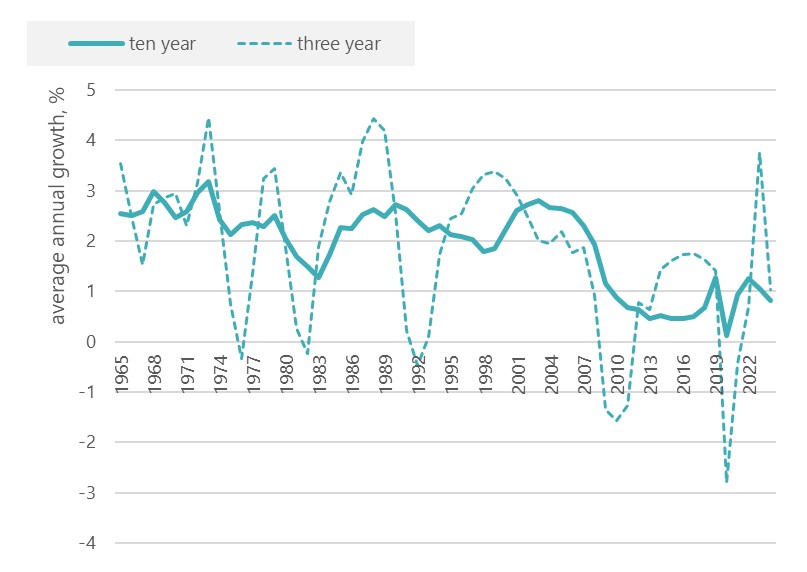
Following the financial crisis, output per head saw a dramatic fall. After a small improvement pre-pandemic, the post-covid period saw further falls. Average annual growth of GDP per head has only been one per cent over the last three years.
Chart 1: GDP per head growth, moving averages
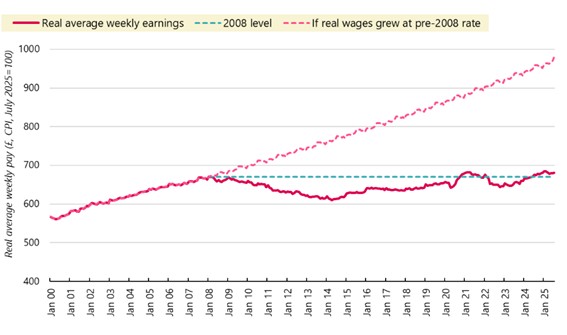
At the same time, under the Tories workers endured the worst pay crisis for two centuries.3 Average weekly earnings adjusted for inflation show that real pay grew by an average of just 0.04 per cent a year between May 2010 and April 2024. Overall, real pay growth averaged a welcome 3.1 percent over the last (financial) year, but it has fallen back more recently as inflation picked up with bills rising into the new financial year (discussed in more detail below). Real average weekly pay remains up by only £9 (1.4 per cent) on the 2008 peak. Had pay instead grown in line with the pre-global financial crisis trends since January 2008, average weekly earnings would now be £298 per week higher.
Chart 2: level of real pay, July 2025 (CPI) prices
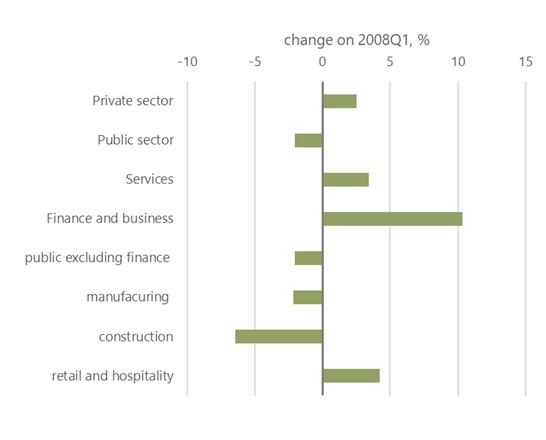
For many workers the reality is even worse, with real pay still below the 2008 level. While finance and business services are now seeing real pay 10 per cent above 2008, hospitality is up by a lower 4 per cent (and from a very low base). Workers’ standard of living in other vital industries has still gone backwards, not least those in manufacturing, construction and the public sector. The living standards crisis has not gone away – it remains the most significant issue facing working people across the country.
Chart 3: industry change in real pay since the global financial crisis (CPI basis)
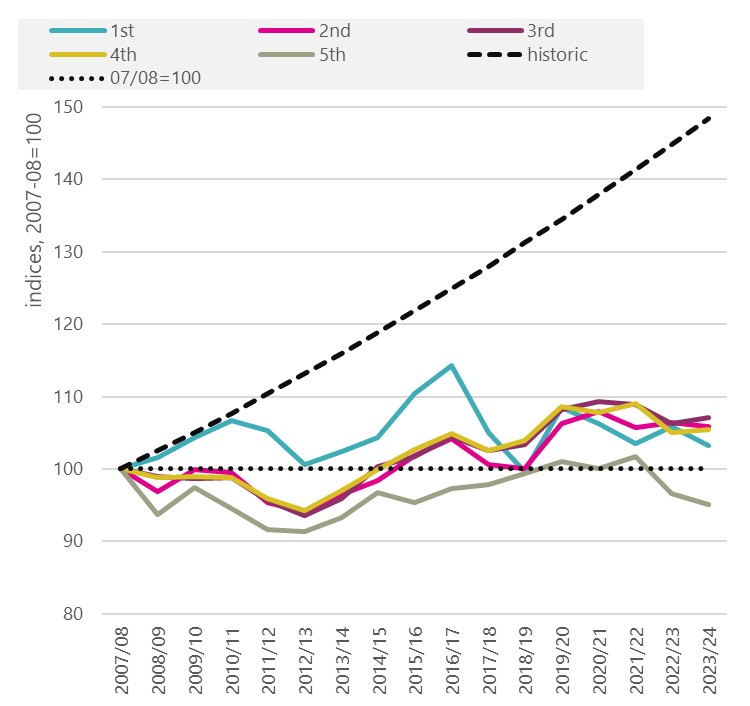
While of great importance, real pay figures also only provide a partial picture of incomes, and do not cover the whole population. ONS figures for the disposable income of individuals include self-employed and retired people and consider taxes and benefits. Chart 4 shows some gains ahead of the pandemic, but real incomes then falling for all quintiles over the last three years under the Tories (the data extend to 2023-24). As with pay, incomes have fallen disastrously short of the pre-financial crisis trend.
Chart 4: median real household disposable income by income quintile
Labour market underperformance
At the same time, the quality of work has deteriorated. TUC analysis has shown that in 2024 there were four million people in insecure work, up from 3.2 million in 2011. As a share of the workforce, insecure work grew to 11.7 from 10.7 per cent.
The increase in insecure work has been disproportionate to the rise in the employment level: insecure work grew by 25 percent compared to 15 percent employment growth (table 5).
Table 5: Insecure work 2011 and 2024
| 2011 | 2024 | Change from 2011-2024 | |
| Numbers in insecure work (16 +) | 3.2 million | 4 million | +25 percent |
| Employment Levels (16 +) | 29.4 million | 33.9 million | +15 percent |
Source: TUC analysis of Labour Force Survey and Family Resources Survey4
Insecure work has an enormous effect on people at work. The prospect of having work offered or cancelled at short notice makes it hard to budget household bills, plan wider life and meet caring responsibilities. Insecure work is also low paid in comparison to permanent employment, leaving many insecure workers struggling financially.
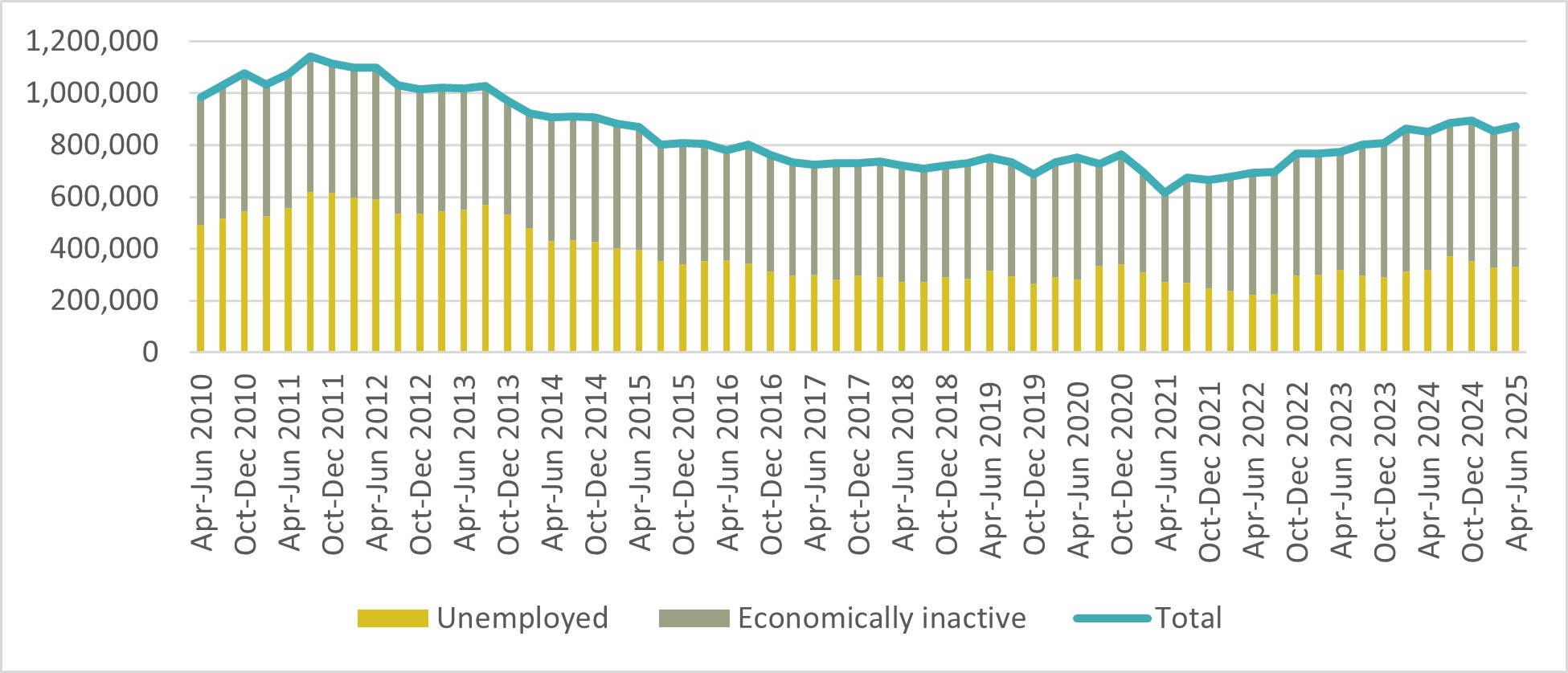
Another Tory legacy is the rising numbers of young people not in Education, Employment or Training (NEET). The latest NEET data shows 873,000 18–24-year-olds are NEET, 948,000 if 16-18 year olds are included. This total been rising since mid-2021 and peaked in October to December 2024, the highest it had ever been since the end of 2014.
Chart 6 shows, compared to the early 2010s where NEET numbers were driven more by young people who were unemployed, NEET young people are now increasingly economically inactive, reporting that they are both out of work and not seeking it. Of the 873,000 18–24-year-olds who are NEET; 330,000 are unemployed (38 per cent) and 543,000 (63 per cent) are economically inactive.
Chart 6: Neet composition of 18–24-year-olds, UK, by unemployment and inactivity.
- 4‘The scale of insecure work in the UK’: insecureworkbriefing2025.pdf
Economic inactivity has also risen for the working population as a whole. Ahead of the pandemic, 2.11 million were inactive due to long term sickness – a total that now stands at 2.79 million, down very slightly from a peak of 2.86 million at the end of 2023. Evidence shows that increased flows from work into inactivity are an important driver of this trend.5
Negative impacts of Brexit
Workers continue to suffer from the damage caused by the Conservatives’ bad Brexit deal which has had a severe negative impact on the UK economy and businesses. Between 2021 and 2023, exports to the EU were down 27 per cent and imported goods down 32 per cent.6 The National Audit Office reports that the annual estimated cost to business of completing customs declarations required by leaving the EU stands at £7.5 billion while it cost taxpayers £4.7 billion to set up new border and customs arrangements. 7
The Office for Budget Responsibility (OBR) has provided a detailed analysis of the potential growth impact of Brexit on the UK economy. They have concluded that Brexit will reduce long-run productivity by 4 percent relative to remaining in the EU. 8
Leaving the EU had a severe negative impact specifically on investment. Haskel and Martin (2023) estimate it lowered investment by 10 per cent9 while other studies suggest that with the current agreement with the EU investment will fall by 32 per cent by 2035.10 This has been driven in part by the loss of the European Investment Bank which, among other areas, supported investment in manufacturing and clean energy.
Investment failures
Growth has been further held back by Conservative failures on capital investment. Upon taking office, the Conservatives immediately cut public infrastructure spending, at a time when the recovery inherited from the Labour government was still fragile. In 2018, TUC analysis showed UK investment third from bottom of all OECD countries, and coming in the bottom half of OECD countries for all broad categories of investment.11 The IPPR has shown business investment “ranking a lowly 28th among 31 OECD countries”, and the lowest in the G7 for three years running to 2022. 12
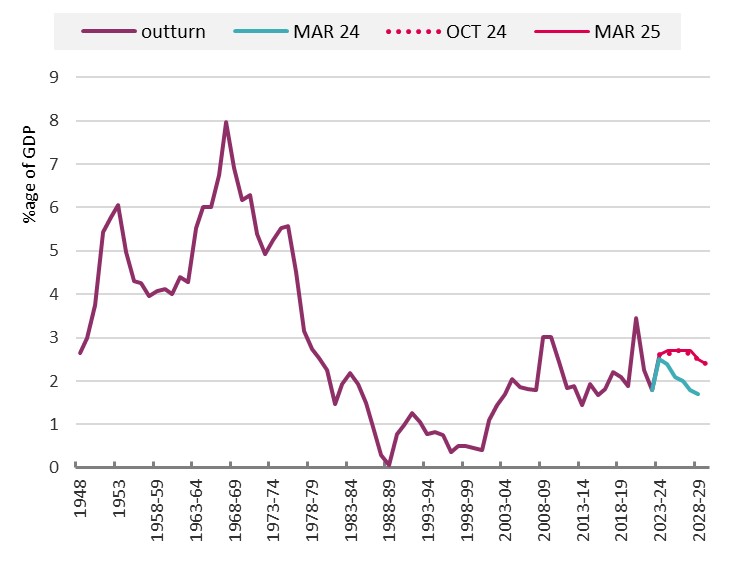
Public sector net investment averaged only 1.8 per cent of GDP over 2010-11 to 2014-15 (chart 7). The figures spiked momentarily during the pandemic at 3.4 per cent of GDP. But afterwards the Conservatives planned for a gradual fall to 1.7 per cent – the joint second lowest figure in 25 years.
Chart 7: Public sector net investment, % GDP
- 5Resolution Foundation, July 2025: Opening-doors.pdf
- 6‘Unbound: UK Trade post-Brexit', Jun Du, Xingyi Liu, Oleksandr Shepotylo and Yujie Shi, 2024:https://www.aston.ac.uk/sites/default/files/2024-09/Full%20Report.pdf
- 7National Audit Office, ‘The UK border: Implementing an effective trade border, 2024: https://www.nao.org.uk/wp-content/uploads/2024/05/the-uk-border-impleme…
- 8Brexit analysis - Office for Budget Responsibility; last updated July 2025.
- 9https://www.economicsobservatory.com/how-has-brexit-affected-business-i…
- 10Cambridge Economics, January 2024: https://www.camecon.com/case-studies/greater-london-authority-impacts-o…
- 11https://www.tuc.org.uk/blogs/uk-third-bottom-global-investment-league
- 12’Rock bottom: low investment in the UK economy’, June 2024: https://www.ippr.org/articles/rock-bottom
Capital investment is critical to economic capacity and to growth prospects into the future. Investment failures of the past 15 years have meant weaker economic growth, weaker revenues and so have further damaged the public finances. Moreover, the IPPR have recently argued there are critical synergies between the private and public sector: “the consensus on investment is shifting – public investment can crowd in business investment”. 13 At the Labour Party 2025 conference, the Chancellor reiterated the point:
- 13Rock bottom
I have never believed the Tory mantra that the best thing that a government can do is to get out of the way. A strategic state must use its power to support jobs and growth – and that includes public investment. Under the Tories, capital spending was always the first victim when the public finances came under pressure. So, in last autumn’s Budget, I changed those fiscal rules – to support and to protect investments.
We urgently need a reset that ensures strong and sustained growth in both public and private investment outcomes.
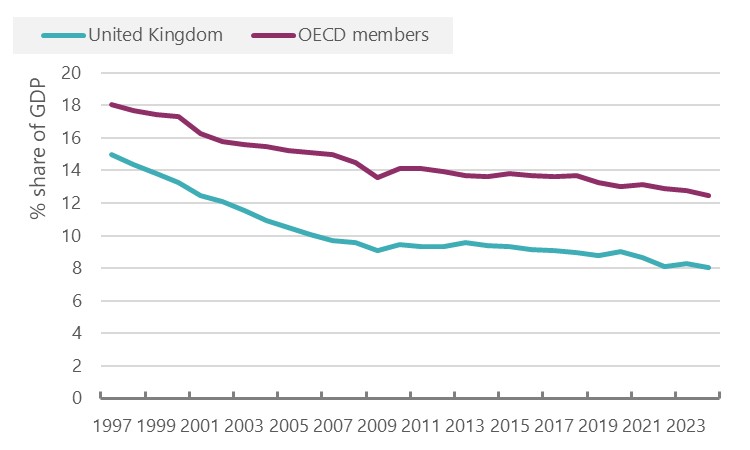
Chronic under-investment and chaotic industrial policy-making led to deindustrialisation. Foundation manufacturing sectors and supply chains were offshored, while the UK struggled to attract new high-tech, advanced manufacturing or clean power manufacturing operations. The overall and steep decline in manufacturing as a share of the economy continued; chart 8 compares the UK with the average for all advanced economies.
Chart 8: Manufacturing as a share of GDP
Under the Conservatives, the government’s policy aimed for a climate transition that prioritised public investment-backed technology development and manufacture in other countries, with the UK’s role as a consumer of technology. For example, in offshore wind the UK’s leadership in deployment was associated with a failure to deliver jobs and domestic economic benefit.
Public services failures
Spending on public services was also decimated under the Conservatives. These simultaneous cuts in infrastructure and wider public spending were disastrous for services in their own right, and also held back the economy and therefore created further pressure on public debt. By 2018-19 the widely used real terms per head measure showed departmental spending down 15 per cent from £6,700 to £5,745. After an increase during the pandemic, spending was cut back sharply again and for 2024-25 was projected still to be 5 per cent below the 2009-10 position.
These cuts were severely regressive. For example, analysis by Landman Economics of the impact of planned cuts for the 2015-2020 parliament showed “The average reduction in living standards as a result of all the modelled tax, transfer and public spending measures is around 13 percent for the bottom decile and around 11 percent for the second and third decile. Meanwhile, for the top decile the average change in living standards are close to zero”. 15
The cumulative loss over the past 15 years has been immense. In July 2024, as the Labour government took office, an Institute for Government report set out “...that the government’s inheritance on public services is extremely precarious. Most services are performing worse now than they were in 2010 or before the pandemic. The government’s status quo spending plans from April 2025 onwards will likely mean that all services other than general practice, hospitals and schools could be performing worse in 2027/28 than in 2010" 16
Public finance failures
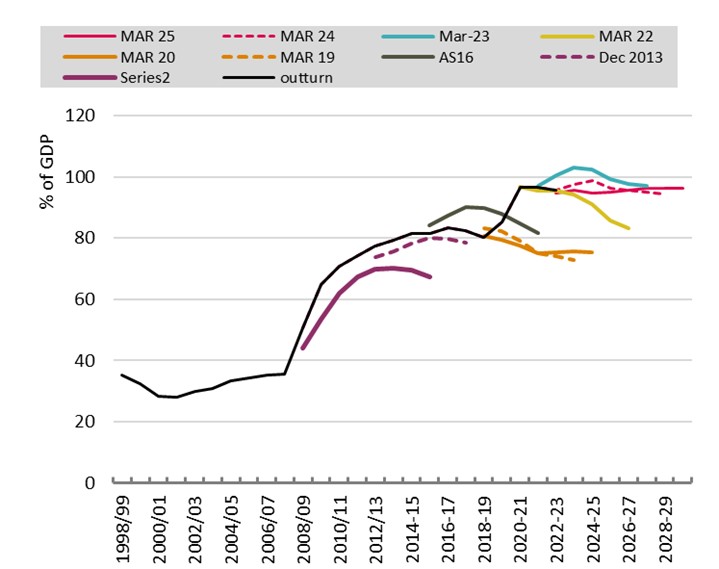
Sustained failures on growth have also had significant impacts for public debt. With our economy so much smaller than anticipated, government revenues have fallen below forecast and our debt has increased as a proportion of GDP. Chart 9 shows badly the Conservatives failed against meeting the targets they set themselves in June 2010.
The plan was to reduce public sector net debt as a share of GDP to 67 per cent by 2015-16. But instead in their March 2024 forecast the OBR reckoned the ratio to be 98.8 per cent of GDP in 2024-25. While the latter figure has obviously been affected by the pandemic, TUC analysis showed the failure on public debt ahead of the pandemic the worst in at least a hundred years.17 In March 2025 the OBR judged that public sector net debt will be at 96.1 per cent of GDP in 2029-30.
Chart 9: Public sector net debt
- 15March 2016: https://www.tuc.org.uk/sites/default/files/Spending-cuts-Report.pdf
- 16’Fixing public services: Priorities for the new Labour government’: Fixing public services | Institute for Government https://www.instituteforgovernment.org.uk/publication/fixing-public-ser…
- 17The Conservatives are presiding over the worst period of economic growth since the 1920s | TUC https://www.tuc.org.uk/news/tuc-conservatives-are-presiding-over-worst-…
This failure continues further to constrain the actions of the current government going forwards, with the position even more challenging given the steep rise in interest costs (discussed in further detail below).
Starting to rebuild Britain - in challenging times
- The country is in desperate need of change and national renewal – and the government has started to deliver change.
- Important commitments on government capital spending and public services investment have started to repair the damage of 14 years of Conservative failure.
- Public sector net investment is now set to rise to 2.7 per cent over 2024-25 to 27-2028. Real departmental spending per head is set to rise to 3.0 per cent above the 2009-10 level in 2029-30.
- Maintaining and building on these commitments in the years ahead will be vital to sustaining growth and boosting living standards.
- Our relationship with Europe has also begun to improve. But although government action is supporting growth, a challenging international context is holding our economy back.
- Consumer demand is depressed and is also pressing down on output.
- High interest rates are holding back growth, and the case for further cuts is strong.
- High interest rates are also impacting the public finances and holding back spending, as the higher Bank rate feeds through to the borrowing costs of government – which are significant given the debt burden inherited from the Tories.
The country is in desperate need of repair and renewal – and the government has started to deliver change. But the last 12 months have starkly shown that there are no quick fixes or easy answers. We still face significant challenges, the scale of which has become starkly clear over the last year. Budget 2025 must now take this formidable task on.
Capital spending boosted
At the 2024 Autumn Budget the government boosted public service and public investment by £326bn – the biggest real terms increase since the 2000 spending review. 18
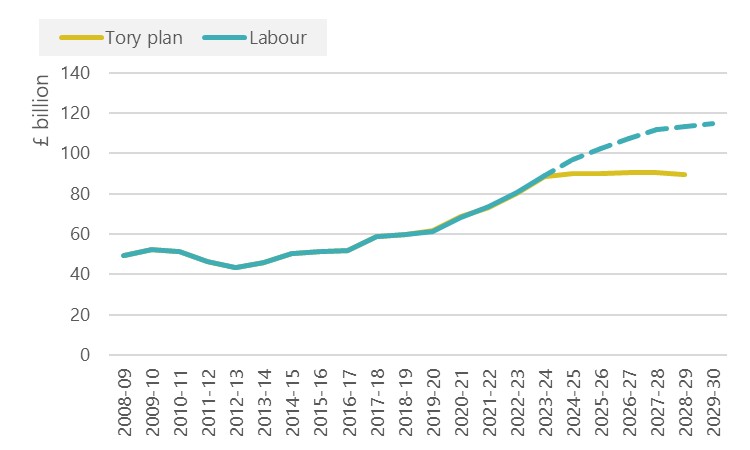
The increase in government investment spending is shown as a share of GDP on chart 7 above. Rather than falling to 1.7 per cent in 2029-30 (as the Conservatives planned), the latest assessments show public sector net investment is now set to rise to 2.7 per cent over 2024-25 to 27-2028. Chart 10 shows the OBR assessment in gross, cash terms – the rise in investment since 2023-24 totals a cumulative £110bn. The Institute for government pinpoints the beneficiaries: “... big increases in investment spending for energy and net zero, transport, and business – in support of [Reeves’s] missions to grow the economy and decarbonise the energy system – as well as defence”.19
Chart 10: General Government gross fixed capital formation, £ billion
- 18Chancellor provides £326 billion boost to public services and investment, funded by the biggest tax rises on record and higher borrowing • Resolution Foundation https://www.resolutionfoundation.org/press-releases/chancellor-provides…
- 19https://www.instituteforgovernment.org.uk/comment/spending-review-2025
Public service improvements, although more investment needed
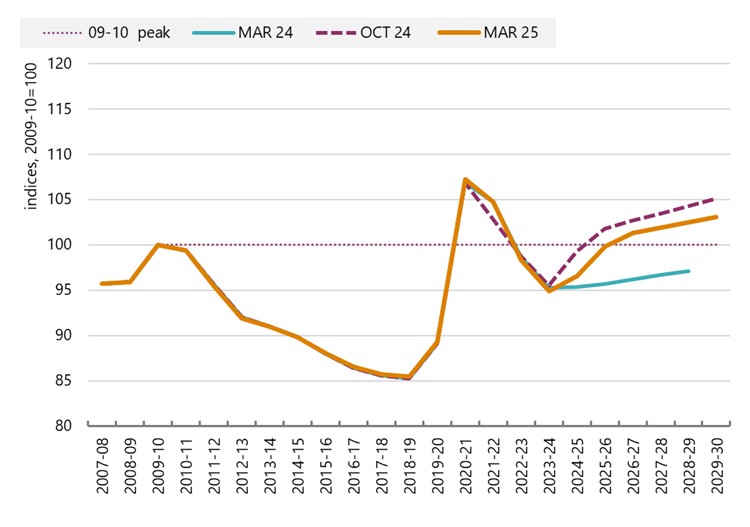
Public services spending was decimated under the Tories. Chart 11 shows a decline of 15 per cent on the real terms per head measure, and the further slump in spending the Conservatives planned following the pandemic. The latter meant a renewed decline to 5 per cent below the 2009-10 position.
Under the current government real departmental spending per head is set to rise to 3.0 per cent above the 2009-10 level in 2029-30. The International Monetary Fund has confirmed the government was right to raise revenues to support this investment.
The authorities’ fiscal plans strike a good balance between supporting growth and safeguarding fiscal sustainability. The new spending plans are credible and growth-friendly, taking account of pressures on public services and investment needs. They are expected to provide an economic boost over the medium term that outweighs the impact of higher taxation. As revenue is projected to increase, deficits are set to decline and stabilize net debt.
Chart 11: Real departmental spending per head, 2009-10=100
In the context of poor growth, public spending is also supporting jobs. Payrolls figures show private sector jobs falling from the start of 2024, but the declines offset by gains in public sector employment.
Current spending increases are also badly needed, but they do fall short of the full investment necessary to turn services around and drive improvements. Current spending has been focused on health, which has meant smaller real terms increase in education and other departments.21
After years of real terms falls and freezes, public sector pay awards in 2025 were broadly in line with inflation (when announced), building on the above-inflation pay awards in 2024 and helping to reduce the gap between public and private sector pay growth.22 Welcome steps have also been taken to put the Pay Review Body timetable back on track, so that many public service workers will start to receive their pay awards on time within this parliament. This will provide clarity and certainty to workers about the timings of pay awards, as well as minimising the risk of administrative issues and complications arising from interactions with social security payments and increases to the national minimum wage (NMW). The start of talks to negotiate structural changes to the Agenda for Change contract are also welcome, and NHS unions have been clear that the promised funding must cover the agreed outcomes in full.
But workforce recruitment and retention challenges remain endemic across much of the public sector, albeit with some evidence to show that high vacancy rates are abating. As of the end of June 2025, there were 102,576 vacancies in the NHS – almost 11,000 fewer than the previous year but still very high.23 The National Foundation for Education Research (NFER) annual Teacher Labour Market report found that the unfilled vacancy rate for teachers is six times higher than pre-pandemic, while 3.9% of teaching posts in further education were vacant at the end of the 23/24 academic year. 24 25
The impact of pay erosion has had severe cost of living consequences for many public sector workers. UNISON estimates that the average public sector worker saw the real value of their wage fall by over £11,000 in 2024 compared to 2009, with unions reporting that public sector workers feel that rises to their household costs - including mortgage repayments, energy bills, and childcare - significantly outpace pay increases.26 The effects on workers’ wellbeing should not be underestimated – for example, almost one in eight teachers have been forced to take a second job to supplement their income. 27
Improving relations with Europe offset by international headwinds
Importantly, relations with the European Union have started to be repaired. The government has placed a welcome priority on building a closer relationship with the EU, which is crucial to protecting good jobs, locking in the highest standards of workers’ rights and providing the UK with a powerful and reliable partner with which to face global instabilities and challenges.
The agreement of the Common Understanding in May was welcome, and while further rapid progress is needed, these commitments have potential to boost both growth and living standards. 28
In the first half of the year UK growth at 1.0 per cent was the fastest in the G7.29 But the wider economic context remains challenging. The USA’s economic policy has created turbulence and uncertainty around external demand and high UK interest rates continue to constrain internal demand. The Bank of England are also warning of threats to financial and economic stability, including from the “stretched” valuation of technology companies focused on AI.30
Stronger government current and capital expenditure are protecting the economy in the face of these risks but cannot fully migrate them. The latest monthly figures into July show quarterly GDP growth slowing to 0.2 per cent. The Bank of England judge the underlying rate of growth is around 0.25 per cent a quarter.
Consumer demand remains depressed by the living standards shock
The most significant challenge the UK economy faces remains depressed consumer demand, with the latest figures showing it stagnating for three years. Since the financial crisis, consumer spending has generally accounted for around two thirds of GDP growth, but over the last two years has made no contribution at all. Improving workers’ living standards is vital for driving improvements in economic performance.
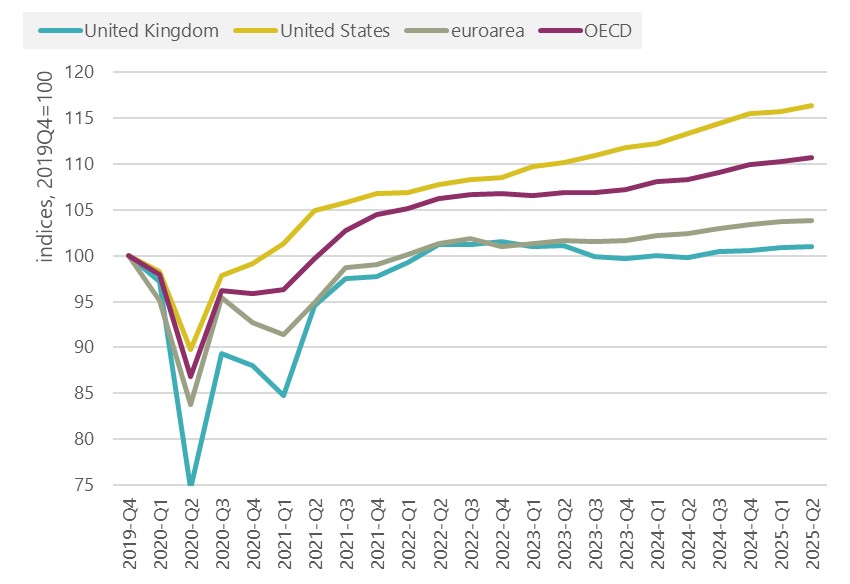
The situation in the UK is more challenging than in most advanced economies. Consumer spending in the UK is only up only 1 per cent on 2019 Q4, compared with 16 per cent in the US, 11 per cent across all advanced economies (OECD) and 4 per cent in the euroarea over the same period (chart 12).
Chart 12: Household expenditure, indices (2019Q4=100)
- 21https://www.resolutionfoundation.org/press-releases/britain-is-turning-…
- 22https://www.resolutionfoundation.org/press-releases/britain-is-turning-…
- 23NHS England, 2025: NHS Vacancy Statistics England, April 2015 - June 2025, Experimental Statistics https://digital.nhs.uk/data-and-information/publications/statistical/nh…
- 24Department for Education, 2025: Further Education Statistics https://explore-education-statistics.service.gov.uk/find-statistics/fur…
- 25Department for Education, 2025: Further Education Statistics https://explore-education-statistics.service.gov.uk/find-statistics/fur…
- 26’Bargaining on annual pay rises’, 2025: https://www.unison.org.uk/content/uploads/2024/11/Pay-claims-0125.pdf
- 27‘Supplementary Submission to the School Teachers’ Review Body‘, NASUWT, 17 January 2025
- 28https://www.gov.uk/government/publications/ukeu-summit-key-documentatio…‘, NASUWT, 17 January 2025
- 29GDP quarterly national accounts, UK - Office for National Statistics; table 5. https://www.ons.gov.uk/economy/grossdomesticproductgdp/bulletins/quarte…
- 30Record of the Financial Policy Committee meeting on 2 October 2025: https://www.bankofengland.co.uk/financial-policy-committee-record/2025/…
Flat spending indicates that workers remain under significant pressure. ONS polling shows that the cost of living (87%) remains the most important issue facing the UK (along with the NHS (82%) and the economy (70%)). 31 Survey data from the middle of the year show around one in four (24%) of adults reported that they had found it very or fairly difficult to get by financially in the past month; and two in five (40%) adults reported spending less on food shopping and essentials; this increased to 71% for those who were more likely to be financially vulnerable.32
Interest rates are unnecessarily high and are holding the economy back
While the Office for Budget Responsibility is reportedly revising its assessment of future potential productivity growth, our analysis suggests that the weakness of the UK economy follows from the weakness of aggregate demand. Attributing demand-driven weakness to the supply-side of the economy has been a constant and greatly problematic feature of policymaking since the start of austerity in 2010. 33
This is exacerbated by the Bank of England’s assessment of the position on inflation. Ongoing high interest rates are pressing down on growth, but making little impact on inflation. At 4 per cent interest rates in the UK are double those in the EU and on a less definitive trajectory to the USA (at the start of September the Federal Reserve reduced their 'target range' to 4-4¼% and signalled further reductions).34
While higher prices have meant that wages held up over the last year, as workers tired to stay afloat, spending is flatlining. Lower interest rates are urgently needed to boost demand.
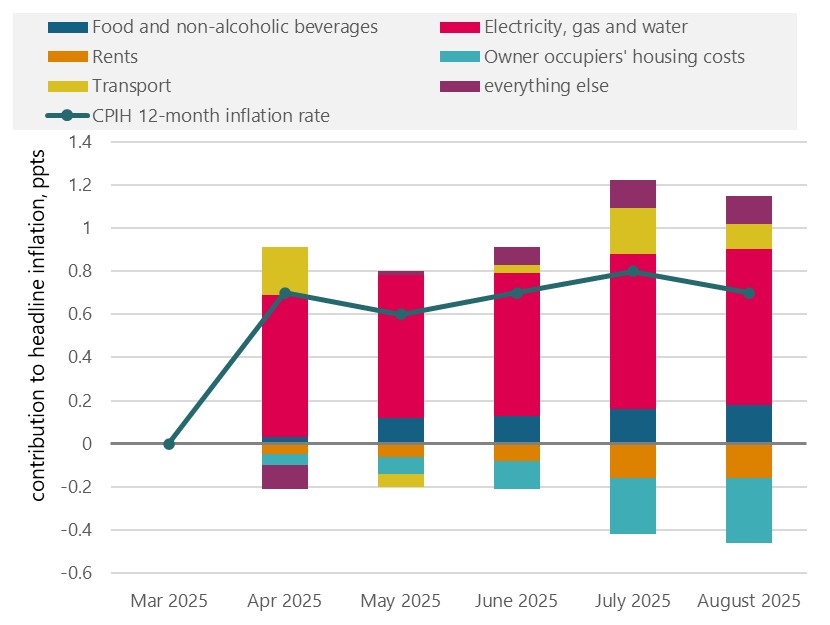
Those who maintain that higher rates are needed focus on higher inflation in the UK than our international competitors. But this assessment does not take account of the fact that most of the higher inflation rises in the UK are due to utility prices.35 Chart 13 shows that the contribution of electricity, gas and water at 0.72 ppts outstrips the rise in overall (CPIH) inflation between March and August 2025. The other key upward pressures are from food, which is driven by international commodity markets (notably coffee, chocolate and beef), a little on transport, though significantly reduced from July with the upward impact from air fares reversing, and only a small contribution from everything else. This latter category might include employer NICs, showing that while the costs are of course real for employers they are not significant factor driving higher inflation.
Chart 13: Contributions to change from March 2025 in CPIH inflation, ppts
- 31Public opinions and social trends, Great Britain - Office for National Statistics; 19 September 2025. https://www.ons.gov.uk/peoplepopulationandcommunity/wellbeing/bulletins…
- 32https://www.ons.gov.uk/peoplepopulationandcommunity/wellbeing/bulletins…
- 33’Productivity: no puzzle about it’, TUC, February 2025: https://www.tuc.org.uk/sites/default/files/productivitypuzzle.pdf
- 34’Federal Reserve issues FOMC statement’, 17 September 2025: https://www.federalreserve.gov/newsevents/pressreleases/monetary2025091…
- 35The relevant level of detail is only available for CPIH, where the overall increase in inflation between March and August is lower at 0.7 ppts, given a large downward effect from owner occupiers‘ housing (which is not included in CPI).
In a recent speech Sarah Breeden (Deputy Governor, Financial Stability at the Bank of England) deployed a similar chart, and concluded that “the current “hump” has been driven by external shocks that are not a reflection of domestic inflationary pressures”. 36 Given there is little evidence of domestic inflationary pressure, along with significant falls in consumer demand, the case for keeping interest rates high seems highly questionable. We judge these high rates are severely damaging economic growth, to no obvious gain in terms of the inflation picture.
High interest rates are also impacting the public finances, as the higher Bank rate feeds through to the borrowing costs of government. The OBR shows payments up £75bn a year or trebling since before the pandemic. Over 2025-26 to 2029-30 government interest payments are expected to average £113bn a year; in the five years to 2019-20 interest payments averaged £38bn. 37
Chart 14 shows the UK along with the US having the steepest increase in the share of GDP allocated to interest payments (with figures only to 2023).
Chart 14: Government debt interest payments, % GDP
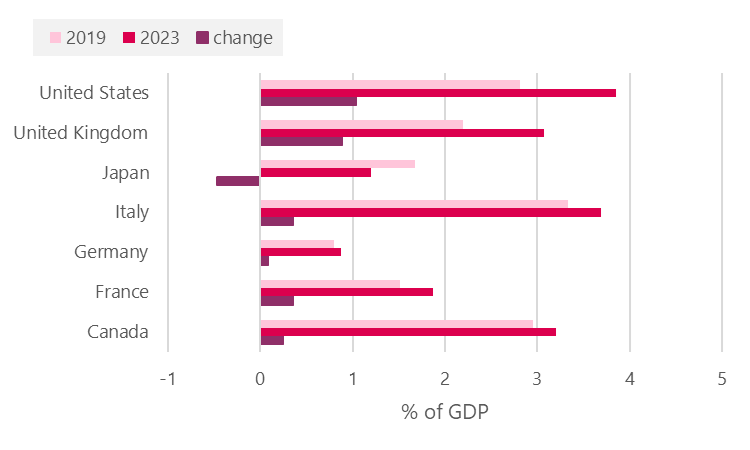
High interest rates have had significant implications for the debt burden inherited from the Tories. Overall debt interest payments depend on both the stock of government debt and the rate of interest on that debt. The relationship between the two quantities is complex. Government borrowing costs rocketed when the Bank of England raised interest rates, and projected future interest payments have further repercussions on the level of public debt going forward. But there is a vicious circle, to the extent that higher debt servicing costs mean that higher public debt is then regarded (not least by financial markets) as a bigger problem.
High interest rates also depress both private and public expenditure, and further damage economic growth. In the past the TUC has referred to a doom loop, when policy actions with the stated purpose of improving the public finances prove counterproductive. 36
- 36’From the doom loop to an economy for work not wealth’, TUC, 2023: https://www.tuc.org.uk/research-analysis/reports/doom-loop-economy-work…
- Last year’s Budget set a new course in motion, but more is now needed to sustain change and secure stronger growth and higher living standards.
- The country needs significant sustained investment. This must include ensuring decent public services can fully play their role in boosting productivity, growth and living standards.
- To deliver effectively, action is needed to boost growth (and reduce costs of government borrowing) and to raise revenues.
- Existing capital investment commitments should be at least protected and should be expanded – including by ensuring the National Wealth Fund has powers to borrow.
- Faster progress is needed on closer EU trade.
- Now is the time to address historic imbalances in how labour and capital are taxed, and to raise urgently needed revenues.
- This should include a significant increase in the bank surcharge, CGT reform and increased taxation on gambling companies.
- The government must also ensure that its approach to managing the public finances in the longer-term is conducive with securing strong, sustained growth – an independent commission should be established to consider how the management of our public finances should continue to evolve.
- It is vital that we oversee our public finances using credible fiscal rules, but also that these rules are grounded in the evidence of recent years and promote economic stability.
Last year’s Budget set a new course in motion, but more is needed to sustain change and secure stronger growth and higher living standards. This will need higher public spending, and therefore action to both raise new revenues and bring down the costs of government borrowing.
Capital investment must be sustained and increased
The increase in public investment to 2.7 per cent of GDP, and associated infrastructure initiatives, is vital to growth going forwards. It is imperative that this approach is maintained in the years ahead. Without government action, the default trajectory would have seen UK industry remaining starved of long-term investment and shrinking further. Without continued public investment to drive industrial upgrades and boosts to productivity, UK manufacturing risks becoming increasingly uncompetitive, with domestic production offshored to countries with move active states.
Likewise action in last year’s Budget to free up further borrowing by changing the target measure to public sector net financial liabilities (PSNFL) was welcome. Government borrowing is now based on a more complete picture of the government's financial position than the traditional Public Sector Net Debt (PSND) measure. By including the value of financial assets like student loans and other government investments alongside liabilities, PSNFL allows the government to fund investments that build assets, which can then be used to pay off the debt over time. This increases the scope to increase public investment without violating borrowing rules.
The Treasury should now take full advantage of these new freedoms and empower the National Wealth Fund to borrow directly from capital markets to increase its capital pool – an approach that would be in line with our current fiscal rules.
Stronger EU trade should be secured as soon as possible
With UK exports to the US now facing additional tariffs, it is more important than ever that the UK can improve trade and investment with the EU, our closest and most integrated trading partner.
The TUC welcomes the priority the government has placed on building a closer UK-EU relationship and the achievement of the Common Understanding in May between the UK and EU. It is critical that the government secures as soon as possible the commitments outlined in the UK-EU Common Understanding to remove barriers to trade in agrifood products, EU carbon border tariffs for steel exports, enable young workers more opportunities to work and study in the EU and allow UK defence companies to bid for contracts from the EU SAFE fund - which will promote jobs across the country.
The TUC and our sister trade unions in countries across the EU have common objectives a closer UK-EU relationship as affirmed in the joint statement the TUC released with the European Trade Union Confederation in March.39 We would like to see the government build on the Common Understanding to:
- remove barriers to trade in chemicals and pharmaceuticals which have faced significant additional costs since Brexit which have put jobs and conditions at risk.
- see barriers for touring artists removed.
- strengthen Level Playing Field commitments in the UK-EU Trade and Cooperation Agreement by agreeing to implement improvements to workers’ rights made in the EU, so UK workers do not fall behind.
We look forward to continuing to engage with the government on the UK-EU reset negotiations, including through our role chairing the UK-EU Domestic Advisory Group.
Fairer, better taxes
Given the imperative to support and increase public investment, the TUC supports a wealth tax package with higher taxes on wealth, banks and gambling companies. Decent public services play a vital role in boosting productivity, growth and living standards – whether through improving the nation’s health, boosting educational performance or ensuring that people with caring responsibilities are able to work. In polling undertaken before the election, 81% of business leaders said that public services were important to the success of their business, and 89% said that public service improvements should be a government priority.40 The Resolution Foundation has set out the huge ‘in-kind’ benefit that public services make to the living standards of low and middle income households. 41
As well as raising vital revenues, fair taxes can also address wider policy challenges. The director of the Institute for Fiscal Studies has recently warned that the UK tax system is characterised by “a large, unjustified and problematic bias against employment and labour incomes and in favour of business ownership and capital”.42 This can create wider distortions – with the incomes of low and middle earners taxed at rates that are much higher than those who make many times more from their investments. As workers spend a larger share of their incomes than the wealthy, the current design of our tax system is holding back wider spending (particularly important given the role of consumer spending in boosting growth).
While some have suggested that it is not falling real incomes but high savings rates holding back consumers, there is widespread evidence that savings may be concentrated among better off households.43 44 The Budget provides an important opportunity to start to correct this imbalance, while also raising some of the revenues needed to boost growth and rebuild our public services.
Our polling has also shown that there is significant support for a package of wealth taxes and taxes on financial institutions to fund better public services, and that this support comes from across the political spectrum.V More than two-thirds of adults support a package of measures to tax wealth, banks and gambling companies, while just 23 per cent oppose. This rises to 84 per cent supporting among Conservative to Labour switchers from the 2024 general election. And three-quarters (74 per cent) of 2024 Labour voters who are now learning towards Reform support the measures.
The public understand the need to act. Our polling also found widespread support for a modernised and simplified system, with three-quarters (73 per cent) supporting this. This rises to 83 per cent among Labour to Reform switchers.
Immediately, a package could include:
- A windfall tax on banks. In recent years, banks have made significant unexpected profits because of increased interest rates. This has led to higher returns both from net interest (the difference on interest charged to borrowers and paid to savers) and interest paid to banks on reserves they hold at the Bank of England. As a result, bank profits are now even higher than they were in the period before the financial crisis. But under the Conservatives, taxes on banks were slashed just as these excessive profits kicked in. An increase in the bank surcharge to 16 per cent, double what it was before the Conservative cuts, could raise £20bn over the next four years. A 35% surcharge, which would be the same level as the windfall tax the Conservatives imposed on energy companies,46 could deliver £50bn over the same time period.47
- Reforming the Capital Gains Tax (CGT) system by equalising CGT rates with income tax rates and closing loopholes. This would build upon the changes to CGT already announced in the October 2024 budget and could raise a further £12 billion a year. 48
- Increased taxes on gambling companies. Proposals for how to increase taxes on gambling have previously been put forward by the IPPR who have estimated that a package of taxes aimed at tobacco, gambling, vaping, alcohol and unhealthy foods could raise £10 billion by 2029/30. The changes to gambling taxes specifically could raise up to £3.4bn in 2029/30. 49
- A 2 per cent tax on assets over £10 million. This would affect only 0.04 per cent of the population and could raise up to £24 billion a year. This would have to be carefully designed and implemented, with learning from other countries that have put wealth taxes into place. Budget 2025 provides an opportunity to consider the first steps that could be taken towards ensuring such an approach can be established.
In the medium term, wider reform is also needed. For example, there is a strong case for a review of property taxation where existing approaches are both unfair and damaging to growth.
A new fiscal commission
The government must also ensure that its approach to managing the public finances is conducive to securing strong, sustained growth.
Under the Conservatives the rules were changed nine times,50 and the public finances still deteriorated to an unprecedented extent (as set out above). While the Chancellor’s recent statement on the country’s public spending inheritance rightly pointed to the disarray and negligence caused by previous governments, the lesson from past failure must also be that an overly restrictive household budgeting approach to the public finances risks being counterproductive. It is pro-growth policies that will permit our national revenues to improve, and in turn these must be enabled by our fiscal framework. 51
Fiscal rules and fiscal councils are now part of governments’ public finance processes across developed economies. In a recent overview, the IMF describe fiscal rules as “a long-lasting constraint on fiscal policy through numerical limits on budgetary aggregates. Fiscal rules typically aim at correcting distorted incentives and containing pressures to overspend, particularly in good times, so as to ensure fiscal responsibility and debt sustainability.” They describe fiscal councils as: “often non-partisan, technical bodies entrusted as a public finance watchdog to strengthen credibility of fiscal policies with a variety of mandates.” 52
The IMF also note that these frameworks have become particularly widespread over the last two decades. In the UK, fiscal rules started with the introduction of Gordon Brown’s ‘golden rule’ that over the economic cycle the government would only borrow to invest and not to fund current spending. Fiscal rules have been part of the UK public finance policy ever since.
The UK fiscal council, the Office for Budget Responsibility (OBR) was then set up under Conservative Chancellor George Osborne in 2010 with the stated purpose of increasing “the role of independent expert oversight over the UK fiscal process” and as one of “the post-financial crisis creation of increasing numbers of Independent Fiscal Institutions (IFIs) across advanced democracies”. 53
Since then, in the UK and many other economies, fiscal frameworks have continued to further evolve. The IMF notes that post financial crisis many frameworks were reviewed to enhance “flexibility, enforcement and the monitoring of fiscal rules”.54 They also draw an important distinction between the pre-and post-pandemic periods, and note that in many cases government needed to deviate from their fiscal rule limits to deliver support. They reference the post-pandemic policy challenge of “whether and how countries should return to the limits and the fiscal rules, while ensuring credibility of the fiscal framework.” There have been suggestions that many countries are now starting to think about the ‘second generation’ of fiscal frameworks.
The TUC view is that there is a compelling case for further evolution of the UK public finance processes. This should recognise, as the IMF say, the importance of strong fiscal frameworks but also of ensuring that they are fit for purpose and responsive to changes in the economic cycle - rather than reinforcing them (i.e. rules should ensure they are not driving austerity during periods of slow growth when spending is needed to boost demand).55 The National Institute of Economic and Social Research (NIESR) has warned of “self-imposed and arbitrary fiscal rules” and urged a “rethink of the fiscal framework“. 56
Both NIESR and Andrew Haldane, former Bank of England chief economist, have set out that our current approach is holding back growth:
- 39https://www.etuc.org/sites/default/files/press-release/file/2025-03/EN-…
- 40https://www.tuc.org.uk/news/more-half-business-leaders-59-say-they-are-….
- 41https://www.resolutionfoundation.org/events/public-services/
- 42'Clear visions for tax reform exist — Reeves just needs to back one‘, Helen Miller, 3 October 2025: https://www.ft.com/content/d425fc50-760c-4526-999d-5c9868a2fe81
- 43Distributional factors are likely at play here – not least given the severity of the real pay and incomes crisis set out above. NIESR work from three years ago suggested the first six income deciles were in deficit, with spending outstripping incomes (UK-Economic-Outlook-Spring-2022.pdf: table 2.6).
- 44’The Polarization of Personal Saving’, Bureau of Labor Statistics, June 2024: The Polarization of Personal Saving. Of note also is a fuller analysis for the US, which echoes these results and showed that the top decile accounted for virtually all of household saving. The restraint on consumption is less the high saving, and more the bad distribution of income. https://www.bls.gov/osmr/research-papers/2024/pdf/ec240050.pdf
- 46‘Taxation of North Sea oil and gas’, 2024: https://commonslibrary.parliament.uk/research-briefings/sn00341/
- 47’Bank taxation‘, TUC, 2025: https://www.tuc.org.uk/research-analysis/reports/bank-taxation-2025
- 48’Ten tax reforms and closed loopholes to raise over £60 billion in a single year’, Tax Justice UK, 2025: https://taxjustice.uk/wp-content/uploads/2025/03/Ten-tax-reforms-closed…. Estimate of money raised by a 2% tax on assets over £10 million also taken from this source.
- 49’Our greatest asset’, IPPR, 2024: https://ippr-org.files.svdcdn.com/production/Downloads/Our_greatest_ass…; ; estimate of money raised from taxes on harmful products can be found on page 29.
- 50https://www.theguardian.com/uk-news/2024/mar/05/uks-fiscal-rules-obr-tr…
- 51As Keynes put it, “There is no possibility of balancing the budget except by increasing the national income” (Collected Writings, Volume IX, p. 347).
- 52‘Fiscal Rules and Fiscal Councils: Recent Trends and Performance during the COVID-19 Pandemic’,
- 53The Office for Budget Responsibility and the Politics of Technocratic Government, Ben Clift, 2023: pp. 75-6.
- 54See n. 52
- 55TUC response to spending review consultation 2025.pdf (section 2). https://www.tuc.org.uk/sites/default/files/2025-03/TUC response to spending review consultation 2025.pdf
- 56Chancellor on track to miss fiscal rules, says economic forecaster | The Independent https://www.independent.co.uk/news/business/chancellor-on-track-to-miss…
Not only are these rules are not being met, but they are also inadvertently constraining the public investment needed to improve economic growth
... Existing fiscal rules risk starving the economy of the very investment needed to boost medium-term growth and, ultimately, pay down debt and lower taxes.
Commenting on New Economics Foundation proposals to replace the OBR with a new institution to work alongside the Treasury,59 Mehreen Khan, Economics Editor of The Times, is more direct: “In 2025, that noble aim has created a created a perverse system where three technocrats have an outsized say over what the government of the day can spend or tax”. 60
We need to ensure that our approach to the oversight of fiscal policy reflects the learning of the last 15 years and is fully aligned with the government’s growth ambitions.
In this context, the TUC believes the government must act. Recognising the need to ensure any reform is informed by evidence, we propose the government set up a formal review to consider how the UK’s fiscal framework needs to further evolve to ensure it provides both fiscal and social stability in post-pandemic Britain.
We propose the review could include consideration of:
- How the UK approach compares to best practice globally, both as countries respond to the experience of policy since 2010 and to the changing geopolitical context. Germany is only the most prominent country to refigure its approach to fiscal policy, with a ‘constitutional reform of its national fiscal framework’.61
- The advantages (and challenges) of expenditure targeting over the present fiscal mandate based on debt and deficit targets. Iain Begg of LSE has reported that “Many European countries with far healthier public finances have moved away from debt and balance rules in favour of what is known as an expenditure rule. The main reason is that the government directly controls expenditure and, especially if it plans it over a number of years, can set a stable path for the economy”. 62
- Institutional arrangements including the operation of fiscal councils globally, the roles of the Treasury and OBR, and the timing of fiscal events, and how to make more meaningful assessments of investment outcomes over a longer time horizon. This could include consideration of the OBR’s role in producing the economic forecast, and whether there are institutional arrangements in other countries which could inform a new approach to building on external expertise in forecasting the impacts of specific policy interventions (for example labour market policy).
- The role of modelling processes, and in particular the role of the controversial judgement that public expenditure ‘crowds out’ private expenditure, and, in the event of error, the implications for capacity and the output gap. This should keep uppermost the IMF conclusion: “On average, fiscal consolidations do not reduce [public] debt-to-GDP ratios”,63 which has certainly been the case in the UK. While all commentators including the OBR themselves recognise the role of uncertainty, existing mechanisms also have potential for bias. Ben Clift has set out that any such economic models are not politically neutral, “there is always a politics of economic ideas, and economic orthodoxy is always a social construction”.64 65
- The interplay between the OBR’s modelling processes and assumptions about policy at the Bank of England. Both institutions currently seem to take a closely aligned position on the output gap (the measure of spare capacity in the economy) and crowding out (the extent to which public spending displaces private investment). For instance, the OBR anticipated interest rates would have to stay higher for longer after the expansionary Autumn Budget 2024 as their modelling suggests limited spare capacity. In this assumed context they considered higher public investment would crowd out private investment. Separately Robert Chote (former Chairman of the OBR) wrote in 2024 about events in 2012/2013 when the OBR “show[ed] an extended period of spare capacity in the economy”, “… from which readers might have concluded that we felt the Bank needed more help from fiscal policy to bolster demand. That signal would have been clearer had we also forecast that inflation would persistently undershoot the target, but this would have had the Bank and Treasury straight on the phone”.66 The implication of his point is that the OBR was constrained in its ability to make the case for more demand stimulus in the economy, as it would have found itself in conflict with the Bank of England.
It is vital that we continue to manage our public finances using credible fiscal rules, but also that these rules are grounded in the evidence of recent years and promote secure growth and economic stability.
- 59'A democratic fiscal framework’: https://neweconomics.org/2025/08/a-democratic-fiscal-framework
- 60’OBR should be scrapped, Rachel Reeves told‘, 21 August 2025: https://www.thetimes.com/business-money/economics/article/new-economic-…
- 61https://economy-finance.ec.europa.eu/economic-forecast-and-surveys/econ…
- 62How Rachel Reeves should have changed the fiscal rules - British Politics and Policy at LSE https://blogs.lse.ac.uk/politicsandpolicy/how-rachel-reeves-should-have…
- 63World Economic Outlook, April 2023: https://www.imf.org/en/Publications/WEO/Issues/2023/04/11/world-economi…
- 64The OBR and the politics of technocratic economic governance, p. 20.
- 65While the OBR was recently (Feb.) reviewed, this was led by the former head of the Dutch independent fiscal institution (IFI). The review did warn that emphasis on “headroom” was increasingly problematic, and “[t]his focus on the short-term fiscal space has gone and-in-hand with very limited attention on long-term fiscal sustainability” The review was headed by Laura van Geest, former head of the Netherlands Bureau of Economic Policy Analysis (CPB). https://obr.uk/third-external-review-of-the-obr-published/
- 66‘Has the OBR experiment been worthwhile?’, August 2024: https://heywoodquarterly.com/has-the-obr-experiment-worked/
Below we set out both the key wider policies the country needs both to secure stronger growth and higher living standards.
Direct support to raise workers’ living standards
- Introduce a new domestic energy billing structure that provides a low and fixed rate for sufficient energy to cover essential needs (variable according to family size, property architype, receipt of benefits, and energy requirements for those with disabilities) along with several higher rates for high and luxury usage.
- Adjust VAT on domestic energy. Current flat 5% VAT rates could be replaced by a 0% assessment for essential usage levels along similar lines to the above, with higher usage being taxed at 10%, and luxury usage (for example for private swimming pools) taxed at 20% or more.
- Reverse the Conservative policy of the two-child benefit cap and repeal the wider benefit cap to ensure all children feel the full benefit of the change.
- Remove the five-week wait for Universal Credit payments and redesign the system to ensure more regular payments and longer assessment periods to reduce fluctuations in income.
- Recommend a minimum wage rise that takes the rate beyond two-thirds of median wages and ask the Low Pay Commission to chart a course towards a 75% bite target.
A consistent focus on more and better jobs
- Introduce a shared cross-government set of metrics for labour market policy including commitments to: secure progress towards an 80 per cent employment rate; return the number of young people NEET to pre-covid levels by the end of the parliament; and drive improvements in job quality, committing to a reduction in the number of people in insecure contracts and faster wage growth in deciles below the median.
- Establish a central labour market unit to oversee the development and implementation of these ambitions. This would help ensure job quality and quantity measures are consistently reinforced across policy and that those groups currently furthest from the jobs market are not left behind in policy design.
- Prioritise more resources for the employment tribunal system to ensure that cases can be resolved swiftly. This should sit alongside a tripartite review of the system, to ensure it is fair, accessible and fit for the future – involving unions, employers and Acas.
- Ensure the establishment of the Fair Work Agency is supported by a funding settlement that enables it to discharge its new functions and powers effectively. This should be supported by ensuring that new powers to recoup the costs of investigations/enforcement actions from employers who are found to have broken the law are switched on as soon as possible.
- Deliver a fair funding approach for the Central Arbitration Committee. We estimate that the CAC will require a budget increase of around 50 per cent to carry out its significant new duties to a sufficient standard.
Invest in the Health and Safety Executive and the Equality and Human Rights Commission, committing to bring their budgets back to their pre-financial crisis position in real terms. - Ensure the effective implementation of the Employment Rights Bill with the introduction of additional support to equip managers and union reps with the knowledge they need to put new rights and protections into practice.
- Implement an ambitious jobs guarantee for young people, with early access for those young people at highest risk of becoming NEET. Jobs should be by government to pay at least the minimum wage alongside training that provides a pathway to a level 3 qualification.
- Put in place effective support for more disabled people to stay in work and return to employment if they are out of work, including through introducing a time limit on decisions regarding reasonable adjustments and ensuring excellent employment support is available, ideally extending a jobs guarantee approach.
- Increase apprenticeship participation and completion rates through expansion of the Growth and Skills Levy to include more SMEs, and greater engagement with trade unions to improve apprenticeship standards and apprentices’ experiences.
- Ringfence additional funding for the tertiary education sector to address the workforce recruitment and retention crises in further and higher education, recognising that these will be key barriers to skills and labour market policy delivery if unaddressed.
- Pilot a new £5-10 million union learning agreement fund, with an overarching aim to raise collective bargaining coverage with regard to skills.
- Take a consistent approach to developing and implementing workforce strategies across the industrial strategy sectors.
- Ensure delivery of large infrastructure projects, involves employers with the TUC and affiliated trade unions to secure framework agreements, promoting secure jobs and high labour standards.
- Design social value criteria to capture the potential of procurement to stimulate re-industrialisation and good quality, unionised jobs across the country.
Full support to futureproof industry
- Provide strategic transitional investment to drive innovation in foundation industries, via a new fund.
Retain existing commitments including:
- £1.8bn National Wealth Fund investment in ports
- £500m National Wealth Fund investment in hydrogen
- £2.5bn investment in steel
- £1.5bn NWF investment into gigafactories
- £2.5bn DRIVE35 investment in automotive, including support to transition the Internal Combustion Engine supply chain and develop EV supply chains
- £21.7bn investment over next 25 years in Carbon Capture, Utilisation and Storage (CCUS)
- Wider support via the National Wealth Fund and British Business Bank for electrification, grid infrastructure and other decarbonisation technologies.
- Government should launch a ‘Business Transition Hub’ to provide pro-active guidance, technology insights and market intelligence to high-carbon sectors on futureproofing pathways, decarbonisation and diversification
- Expand the Clean Industry Bonus by up to £1 billion over the course of the Parliament.
- Aim to invest £1.1 billion a year into building up UK clean energy supply chains, through a combination of Clean Industry Bonus, National Wealth Fund and expansion of past grant schemes (e.g. Offshore Wind Manufacturing Investment Scheme and the Green Industries Growth Accelerator).
- Establish a targeted public investment fund within the National Wealth Fund to support oil & gas supply chain firms to upgrade their infrastructure, technology or skills base, sufficiently to supply new markets.
- Provide new funding to support the North Sea transition including by:
- Establishing a “Your Country Needs You” redeployment programme to transfer oil and gas workers to sectors with skills shortages.
- Putting in place a time-limited furlough or a short time working scheme, for workers who fall through the gaps from other interventions.
- Set a clear goal to achieve industrial electricity price parity with EU competitors, with a plan towards getting there.
- Take further action to bring down industrial electricity prices including bringing forward the British Industrial Competitiveness Scheme or failing that introduce an interim support scheme to be available to industry on the brink of closure due to energy costs.
- Introduce an electrification business model to incentivise fuel switching within appropriate industrial processes.
Sustained investment in world class public services
- Ensure investment in public services is now sustained. Services remain overstretched, understaffed and unable to meet the needs of our communities.
- Engage in dialogue with public services unions on a plan to restore public sector pay, recognising that more than a decade of pay restraint has exacerbated the recruitment and retention crises across much of the public sector and the financial hardship faced by many public services workers.
- Ensure evidence to Pay Review Bodies (PRBs) does not dictate a headline percentage pay award. This negates the independence of PRBs and their process, and becomes a de facto cap.
- Fund future pay awards with additional expenditure so that public services and devolved governments are not forced to reallocate budgets and make cuts elsewhere to meet the value of pay awards.
- Reinstate a structure like the Public Services Forum as a ministerial advisory body to guide the overarching approach to delivering government’s priorities in public services, including AI adoption and public services reform.
- Ensure the welcome Fair Pay Negotiating Body for Adult Social Care and School Support Staff Negotiating Body have the resources they need to address deep-seated recruitment and retention problems.
- Make greater investment in public-interest regulation and scientific resilience so that all relevant bodies are fully-resourced.
- Restore fair and sustainable funding for local government – including restructuring or cancelling local government debt – both to retain and develop the local government workforce and protect and rebuild local public services.
- Set out a roadmap for sustained investment in fire and rescue services.
- Ensure public ownership and in-house delivery are the default setting for public services, with funding available to ensure this can happen. The public interest test should be introduced swiftly.
- Strengthen the Procurement Act so that organisations that commit labour-related and other regulatory violations are subject to more robust exclusions criteria.
- Ensure transparency around public spending and contracts, including suppliers’ contract performance, by establishing a centrally-held and managed Domesday Book of public service contracts and extending the Freedom of Information Act to be applicable to any entity delivering a public contract.
Provide direct support to raise workers’ living standards
Support for domestic energy prices
We welcome the government’s ambition to lower domestic energy bills by growth of clean energy production and the electrification of an increasing percentage of domestic heating. But it remains the case that domestic energy bills are persistently high, and that the scale of current government commitments is not clearly aligned to a significant reduction that people can feel in their regular bills. We therefore recommend that the government should look to more immediate and demonstrable solutions to this situation.
Government should consider a new domestic energy billing structure that provides a low and fixed rate for sufficient energy to cover essential needs (variable according to family size, property architype, receipt of benefits, and energy requirements for those with disabilities) and introduce several higher rates for high and luxury usage along a rising-block tariff structure, with the highest rates reserved for such clear luxuries as heating private pools, heating unoccupied buildings and warming driveways.67 This could be introduced on a cost neutral basis, with premium tariff payers subsidising lower income users, but could be expanded by a government subsidy. Our initial assessment is that a subsidy of around £2bn could save the average household in the lowest income decile over £200 a year.
This new structure (versions of which are already used across such different jurisdictions as Japan and California) would ensure that no households goes without the energy they need to cover their basic needs, with eradication of absolute fuel poverty becoming possible. It would result in reduced bills for the majority and introduce the logic of progressive liability to a key element of household expenses. Furthermore, such a new system would disincentivise very high consumption, reducing overall energy usage and incentivising households to take up offers of and seek out energy efficiency retrofit, promoting the aims of the Warm Homes Plan.
The government could also consider adjusting VAT on domestic energy with similar results. Current flat 5% VAT rates could be replaced by a 0% assessment for essential usage levels along similar lines to the above, with higher usage being taxed at 10%, and luxury usage taxed at 20% or more. This too would lower costs for the majority while increasing tax income overall, allowing new money to be redirected to expand delivery of the Warm Homes Plan.
Remove the two-child benefit cap
The government has made a welcome commitment to develop a child poverty strategy. This will need to address several policy areas – including social security.
A priority step must be to reverse the Conservative policy of the two-child benefit cap. Alongside this the benefit cap has to be repealed, as any financial gain for families could be erased should this wider cap remain in place.
Abolishing the two-child limit would be the most cost-effective way to reduce child poverty. Scrapping the two-child limit now would not only pull 350,000 children out of poverty overnight but it would stop another 150,000 being pushed into poverty over this parliament.68 Estimates for the cost of removing both policies are in the range of £3-4 billion a year by 2029/30.
Reform Universal Credit
The design of Universal Credit can also exacerbate child poverty. We support the government’s recognition that Universal Credit needs to be reformed, and hope that the Universal Credit Review will achieve progress on removing the five-week wait, enabling more regular payments and putting in place longer assessment periods to reduce fluctuations in income.
A five-week wait for the first payment fails to recognise that most low-paid workers do not have savings to get them through this period.
Along with redesigning the initial payment in Universal Credit, the whole monthly assessment period should be reformed. The monthly assessment periods are set based on the date of someone’s claim, rather than being aligned with pay cycles, thus causing a mismatch between the two. This means it is possible to receive two wage payments in the one assessment period which reduces the Universal Credit payment. USDAW report that 78% of their members on Universal Credit are paid four weekly, which means their Universal Credit payment can be reduced by £800 for one month a year, making it harder to budget.
In our 2022 report on reforming Universal Credit69 we recommended the removal of the monthly assessment period designed to include a monthly payment in arrears. We also set out the need for a longer three- to-six-month assessment period to reduce fluctuations and provide stability, and allowing claimants to choose more frequent payment options to better suit their budgeting needs.
A new bite target for the National Minimum Wage
The government made a manifesto commitment to make the minimum wage a genuine living wage. This will require ambitious increases which take the minimum wage above its current 66 per cent bite. This is in line with the government’s remit to the LPC which says the minimum wage should not fall below two-thirds of median wages. As the minimum wage has been at two-thirds of median wages for two years, the next increase should go beyond this.
Looking forward, the minimum wage should be increased to 75 per cent of median wages so that it reaches £15 as soon as possible. This would raise pay for millions of workers, improve living standards, and shift our economy away from an over-reliance on low paid work. A strong minimum wage underpins much of the government’s vision including making work pay, tackling poverty and delivering economic growth.
The Low Pay Commission should be responsible for charting an ambitious path towards a 75 per cent bite target. This would ensure that the process is led through social partnership by a body with authority to test the limits of minimum wage policy alongside consideration of prevailing economic conditions.
A consistent focus on more and better jobs
Achieving the government’s growth mission of “more people in good jobs, higher living standards, and productivity growth in every part of the United Kingdom” requires a sustained focus on improving both the availability and quality of jobs. Crucially, government must recognise that job quality and job creation are not in tension, but mutually supportive goals.
A range of welcome interventions have been announced, not least the Employment Rights Bill and the wider plan to Make Work Pay. The Get Britain Working White Paper also proposes an important 80% employment rate target, which sits alongside recognition of the need to support more young people into meaningful routes towards the jobs market and ensure more disabled people can stay in work. The industrial strategy’s workforce and skills plans, and forthcoming skills and apprenticeship reforms, will also have important roles to play in securing success.
Ensuring consistency across labour market interventions would benefit from a shared cross-government set of metrics. These should include commitments to:
- Secure progress towards an 80 per cent employment rate.
- Return to the number of young people NEET to pre-covid levels – a 15% reduction by the end of the parliament.
- Reduce flows from employment into economic inactivity because of ill health.
- Shorten the average period of unemployment/gaps in average unemployment duration between local areas (a test of the success of both job creation and back to work policies)
- Improve job quality, for example, committing to a reduction in the number of people in insecure contracts, or to securing faster wage growth in deciles below the median.
- Increase investment in developing high quality skills, for example, committing to higher number of apprenticeship completions and levels of employer investment in skills compared to the European average.
Government should establish a central labour market unit to oversee the development and implementation of its ambitions. This would help ensure job quality and quantity measures are consistently reinforced across policy and that those groups currently furthest from the jobs market are not left behind in policy design.
Full implementation of the plan to Make Work Pay
The full implementation of the government’s plan to Make Work Pay is vital to ensuring an UK’s economic recovery with good quality jobs that allow workers security and prospects for development.
The TUC strongly welcomes new rights, including to guaranteed hours contracts, unfair dismissal protection from the first day of work and allowing all workers access to sick pay from day one.
The economic case for making work pay
Economic theories promoting highly flexible labour markets have been widely discredited. The empirical evidence demonstrates that such labour markets lead to inequality and low-quality jobs with low pay and job satisfaction and that economies characterised by labour market deregulation have high inequality, stagnant wages, poor living standards, and negative impacts on health outcomes.
Newer evidence also shows that labour market protections lead to improved economic outcomes and a more equitable share of income between labour and capital. This is reflected in Deakin and Pourkermani’s research70 based on an extensive database of employment protection legislation across much of the world. They show that labour protections can increase employment, reduce unemployment and improve productivity while making sure the proceeds are shared with workers.
This economic consensus has shifted as the weight of evidence has grown, with economists and influential institutions like the World Bank and the OECD changing their minds on deregulated labour markets.
This turnaround in views at the OECD has been documented in detail by Evans and Spriggs.71 The OECD Jobs Strategy of 199472 played an instrumental role in promoting labour market deregulation. It argued that governments should weaken employment protections and weaken collective bargaining with the aim of creating flexible labour markets. But by its 2018 Jobs Strategy73 the OECD had decidedly shifted its recommendations. It concluded that countries which promoted job quality and inclusive labour markets performed better than those which focussed on flexibility.
Subsequent OECD work74 drew even starker conclusions, with better jobs giving as much life satisfaction as increasing national income by 25%.75 The study looks at 28 European OECD countries and finds that excessive working hours is associated with a welfare loss of 1.5% of national income. Job insecurity is equivalent to a loss of 4.5% of national income. Unemployment or inactivity amounts to 7.4% of national income. Tensions with management cause a welfare loss equivalent to 13.9% of national income. Improving these four metrics has the potential to deliver welfare value equivalent to 25% of national income, comparable to one or two decades of economic growth depending on the country. Improving job quality is central to boosting living standards.
Deakin and Pourkermani76
highlight a similar shift in views at the World Bank: In its 2008 Doing Business report, the World Bank argued that” laws created to protect workers often hurt them”. It claimed that where legal protections were unduly burdensome or rigid, firms would be deterred from hiring, and the young and unemployed would find it more difficult to find work. However, in its 2015 report, the World Bank shifted its stance. It suggested that laws protecting workers against ‘arbitrary and unfair treatment’ could ‘increase job stability’ and, notably, ‘improve productivity’. Labour laws could be not just ‘too strict’ but ‘too loose’, leading to ‘losses of employment in an economy’.
Evidence from the success of minimum wage policy is also instructive. Opponents said that higher wages would mean less employment. This did not happen – instead workers were paid the minimum wage and employment levels grew. This suggests monopsony conditions, with powerful employers using their disproportionate market power to hold down pay. So as evidence from the minimum wage has shown with the wage floor, it follows that there will be a positive impact from a raised floor of employment rights under the same monopsony conditions.
Economic assessment of the Employment Rights Bill
The shift in economic consensus is reflected in the government’s Employment Rights Bill, which is set to deliver an important uplift in employment rights. This landmark legislation will benefit millions of workers, especially those trapped in insecure jobs.
While public debate has focused on the reported costs of the legislation this interpretation fails to properly understand the government impact assessment. The Department for Business and Trade’s (DBT) cost–benefit analysis of the Bill’s provisions includes both an assessment of monetised costs and benefits, and wider economic assessment which looks at impacts that they have not been able to quantify. The assessments finds that total costs to business are estimated to be between £0.9bn and £5bn per year, including all monetised and non-monetised costs. The cost figure of £5 billion has been widely cited but this is an upper estimate of all total costs, monetised and non-monetised. It is calculated generously, by summing the upper bound cost estimates for the policies in the bill. The assessment states that the government expects the upper estimate to be revised down as more evidence emerges, and as uncertainties are ironed out in secondary legislation.
As many of the costs represent a direct financial benefit to workers, the direct benefit of the Bill is similar in magnitude to the costs. The formal cost benefit analysis then finds net social costs of £280m per year,77 but the DBT sets out that this is incomplete as it is based only on monetised impacts. Many of the costs are easier to estimate than the wider benefits, so this £280m figure ignores wider economic benefits that are mentioned in the wider economic assessment.
The costs are small in comparison to the total national pay bill of £1.3 trillion. They are equivalent to an uplift in the total national pay bill of between 0.1% (at £0.9bn) and 0.4% (at £5bn). For comparison, the average increase to the minimum wage has been 6.2% per year over the last decade. Minimum wage increases have been repeated and compounding, while increased costs from the Employment Rights Bill, once implemented, represent a one-off set of increases.
The wider assessment includes a thorough review of wider benefits that the legislation should be expected to deliver. These include benefits of improved workforce health and well-being, reduced workplace conflict and increased labour market participation. The assessment says “were even some of these benefits to be realised then they would mean the Bill is significantly net positive for society.”
Landman Economics has done an assessment of these wider benefits estimating that they fall between £4.9bn and £15.7bn. The central estimate is £10.3bn.
Table 15: Economic benefits of the Employment Rights Bill, £millions
| Estimated benefit (£m) | ||
| Lower bound | Midpoint estimate | Upper bound |
Reduction in days lost to stress, depression or anxiety | 487 | 974 | 1,461 |
Improvement in wellbeing | 310 | 930 | 1,550 |
Improved compliance (going from being paid below NMW to being paid at NMW) | 42 | 168 | 293 |
Reduced incidence of strikes | 85 | 170 | 256 |
Reduced workplace conflict | 2,705 | 5,410 | 8,115 |
Increased employment for people currently looking after family or home | 1,331 | 2,662 | 3,993 |
TOTAL | 4,960 | 10,314 | 15,668 |
Source: Landman Economics
The cumulative impact of even modest improvements would offset the costs of the Bill and stronger outcomes could generate even greater gains.
Funding effective enforcement
Ensuring these returns can be realised will depend in part on the ability of workers to enforce their rights.
The Employment Tribunal (ET) system is an important backstop for employment rights enforcement, and there is a high risk that without further investment it will not be able to play its part in effective implementation of new rights.
If neither employers nor their workforce has faith that tribunals will deliver timely decisions, then the effectiveness of new rights will be undermined.
Things are already tough for workers seeking justice. At the end of March this year, there were 491,000 open cases compared to 444,000 cases in March 2023, with the backlog steadily rising month after month. Some cases take years to reach a hearing, denying workers – and employers – swift resolution of workplace disputes.
That is often not the end of the ordeal. A recent investigation by the Bureau for Investigative Journalism found that even where an employment tribunal rules in favour, many workers never see a penny.78 It’s welcome, therefore, that the new Fair Work Agency has been given powers to enforce unpaid tribunal awards. It must be given sufficient resources to discharge this new power effectively.
The tribunal system requires more resources to ensure that cases can be resolved swiftly.
This should sit alongside a tripartite review of how to ensure the system is fair, accessible and fit for the future – involving unions, employers and Acas. Unions want to help workers resolve problems in the workplace, not the courts.
Investment elsewhere in the enforcement system would also reduce pressure on tribunals and allow access to justice.
Fair work also requires effective enforcement of health and safety laws and regulations. The rate of occupational ill-health has not fallen in recent years; work-related stress is on the rise and a major contributor to lost working. Britain also has the world's highest rate of asbestos cancer linked to workplace exposures. We also need to improve our pandemic preparedness, learning from Covid-19 occupational exposures.
The Health and Safety Executive (HSE), as well as local authority regulation, has suffered enormous funding cuts in recent years: more than 50% of the HSE's budget alone has fallen since 2010.79 With it, the number of inspectors and inspections has decreased, as well as the rate of enforcement activity.
To ensure people remain healthy in work, we need a regulator with the resources required to help prevent ill-health and injury. The cuts to HSE's budget must be reversed so it can continue to recruit, train and retain inspectors and carry out its crucial scientific work into occupational disease prevention.
The Equality and Human Rights Commission (EHRC) is a vital part of the legislative and institutional protections in Britain for people whose human rights are at risk or have been breached, including those facing discrimination and inequality. The EHRC also has an important role to play in issuing guidance, good practice and information on workplace equality protections.
The EHRC must have the requisite resources, powers and independence to advance workplace equality and enforce the Equality Act 2010. But its ability to deliver on its role and purpose have been undermined over the last decade, meaning that effective enforcement and advancement of workplace equality has been limited.
In 2007 when the EHRC opened, it had budget of £70 million and a staff contingent of 525, based on its expanded remit with new policy areas including human rights, age, LGBT+ and religion or belief. Now it has a budget of around £17.5 million and around 200 staff which is roughly equivalent to the staff and budget of one of its legacy commissions (RRC, EOC and DRC). Its current staff and funding basis will not allow it to fulfil its full potential nor to deliver new responsibilities. Reverting to 2007 funding levels in real terms would require the EHRC’s budget to be increased to around £115 million. 80
The state enforcement system requires further long-term resources, more inspectors, more proactive investigations and more enforcement actions. We fall well short of the benchmark established by the International Labour Organisation. To hit the ILO benchmark of one inspector per 10,000 workers, the UK would need 3,287 inspectors. There are currently 1,490. Another 1,797 labour market inspectors need to be recruited. The result is widespread noncompliance.
So the establishment of the Fair Work Agency must be supported by a funding settlement that enables it to discharge its new functions and powers effectively. The TUC campaigned for the new Fair Work Agency to be given powers to recoup the costs of investigations/enforcement actions from employers who are found to have broken the law. This is an important method for increasing resources in the enforcement system. It will be vital that this new power is switched on as soon as possible and that it is applied consistently, regularly and effectively.
The effective implementation of measures in the Employment Rights Bill to support greater collective bargaining in the economy could also help workers and employers by allowing issues to be resolved informally in the workplace at an earlier stage.
This will require a fair funding approach to the Central Arbitration Committee (CAC). Its future role will include ensuring that employers meet their obligations in giving trade unions access to workplaces and enforcing such rights. Building the capacity to undertake such work is likely to require significant increases in staffing at the committee.
Following a recent government consultation, it is also likely that tightened provisions on unfair practices during recognition will be introduced, further increasing the amount of work that the CAC will have to carry out.
The last CAC annual report detailed expenditure of £743,000, including for a nine-strong secretariat. We estimate that the CAC will require a budget increase of around 50 per cent to carry out its significant new duties to a sufficient standard.
Effective implementation of the Employment Rights Bill will also depend on employers along with workers and their unions knowing about the legislation and being supported to put it into practice. This will need new government support to equip managers and union reps with the knowledge they need.
Boosting employment rates
An ambitious jobs guarantee for young people
The UK faces a growing crisis in young people’s labour market participation with rising numbers out of education, employment and training and for those in employment, too many trapped in low paid, insecure and poor-quality work.
There are currently almost a million (948,000) 16–24-year-olds who are not in education, employment and training (NEET), up from around 800,000 in 2019.
Young people are paying a high price for years of underinvestment and lack of support by the previous Conservative government. They have been at the sharp end of austerity with cuts to education, youth and health services, sacrificed formative years of education and work during the Covid-19 pandemic, faced increases in the cost-of-living, and joined the workforce under poor working conditions, as access to apprenticeships were reduced.
This combination of factors has left too many young people at crisis point, facing an uncertain future. With long-term unemployment and worklessness leading to lasting impacts for young people’s future employment, along with a higher risk of poor health outcomes, urgent action is needed to repair the damage done. Government must ensure that all young people have access to high-quality, well-paid work and opportunities for training, progression and development.
We strongly support the Youth Guarantee, along with the Chancellor’s recent announcement that a job guarantee scheme will be included in its scope. The TUC has made the case for a job guarantee scheme of this sort, and we recently published a report on the design such a scheme could take and the benefits it would bring.81 We would like to see the scheme provide early access for those young people at the highest risk of becoming long-term NEET. Jobs should be paid at least the minimum wage, and quality training should be provided that puts workers on a pathway to a Level 3 qualification.
Our analysis shows the benefit–cost ratio of the programme is estimated at 2.81, with every £1,000 of (net) government spending on the programme generating £2,810 of net revenue for the Exchequer. With these outcomes assessed over 30 years, the scheme hits breakeven within a decade.
Supporting disabled people, including disabled young people
Removing access to the health element of Universal Credit for those aged under 22 would not be the right way to fund the guarantee. The small proportion of NEET young people in receipt of this support are often those with the highest needs, and removing entitlements from this group to fund support for all young people would not be a fair or effective approach. There is no evidence that access to the health element of UC is driving youth economic inactivity, rather a lack of wider support and routes to meaningful education and labour market engagement while on the benefit are the challenge.
Similarly, the government must learn lessons from previous attempts to reform wider disability benefits. Instead of seeking to cut entitlements the focus should be on reforms that reduce flows out of work into economic inactivity and on measures that can support those workless disabled people who can and want to work to rejoin the jobs market. This should include measures such as:
- Improving access to reasonable adjustments by introducing a time limit on decisions regarding reasonable adjustment requests.
- Improving Access to Work by removing the financial cap, ensuring flexible and personalised application processes, introducing in principle indicative awards for disabled jobseekers and ensuring consistent funding increases.
- Fully-funding comprehensive rehabilitative services – encompassing mental health, physiotherapy, orthopaedic and occupational therapy.
- Ensuring excellent employment support is available, ideally extending the jobs guarantee approach to older disabled people as well as to young workers.
The TUC’s response to the Keep Britain Working independent revie86 w into the role of employers provides a full assessment of the changes that are needed. 82
Increasing access to quality apprenticeships
Apprenticeships provide brilliant opportunities for tens of thousands of workers and their employers every year, but challenges in uptake, quality and accessibility persist. The data is especially worrying for younger workers - between 2017/18 and 2023/24 apprenticeship start rates for 19–24-year-olds have reduced by 15 per cent, and by 26 per cent for under 19s. Achievement rates for under 19s fell by 44 per cent, and by 31 per cent for 19–24-year-olds.83
In 2023/24, on average just three in five apprentices of all ages completed their programme.84 The Sutton Trust found that the UK has a much higher drop-out rate than European countries with a dual system (which combines classroom learning with paid, hands-on workplace training). Apprenticeship dropout rates are also higher in the UK than for other education programmes.85 Reasons cited for leaving apprenticeships include poor quality training and financial issues.86
The Growth and Skills levy is the key lever to address these negative trends, with welcome steps already taken to raise employer uptake and improve access and completion rates for learners, including the removal of requirements for functional skills in some apprenticeships.
The apprenticeship levy currently applies to large employers with a payroll over £3 million - just 2% of UK employers.87 This narrow scope limits its impact and reach, and there is a strong case for broadening it. Currently, very few small and medium-sized enterprises (SMEs) contribute, which means they lack a direct stake in the system. Before the introduction of the levy, employers with fewer than 250 workers employed the majority (53 per cent) of apprentices,88 and accounted for almost three quarters of employer investment in skills (72 per cent).89
Expanding the levy would deliver a dual benefit, as set out by the Fabain Society.90 First, it would increase the overall size of the levy, with more employers paying in, and fewer employers reliant on the unspent funds from larger levy payers.
Secondly, it would encourage more SMEs to invest in training, with more employers able to draw down funds to up- or re-skill their workforce. The Fabian Society forecasts that this would raise an additional £630m annually by 2029/30 if introduced incrementally and support up to 115,000 more apprenticeship starts per year.91
Recognising the additional costs this brings, SMEs should pay in at a lower rate (0.5%) than larger employers and there should be additional support for SMEs with training and workforce planning, as they typically have limited HR capacity.
More broadly, action is needed to ensure that apprenticeship design and implementation meet the needs of learners/workers and the economy. Trade unions have a strong track record of negotiating for better training standards, ensuring apprentices receive sufficient training time, and working to improve the organisation and quality of apprenticeship programmes, which will reduce dropout rates and enhance the overall apprenticeship experience.
Building on Skills England’s remit to engage unions as one of the key stakeholders in the skills system, we would like to work with government to explore how the role of unions and collective bargaining could be better embedded in apprenticeship policy.
Solving the workforce crisis in tertiary education
England’s post-16 education system is facing an unprecedented crisis, with universities and colleges under severe financial pressure, staff facing unsustainable workloads, and learners being denied access to the high-quality, inclusive education they deserve.
Further education
As the Prime Minister recently set out, Further Education (FE) has long been treated as the “Cinderella service” of the education system - overlooked and underappreciated - despite its power to raise aspirations and tackle inequality. The FE sector faces a deepening recruitment and retention crisis which, unless urgently addressed, will be a barrier to delivering key government policy, including plans for all 16–19-year-olds without a grade 4 GCSE in English and/or maths to be offered 100 hours of face-to-face teaching.
Vacancy rates in general FE colleges rose to 5.1% in 2023/24,93 and nearly half of FE teachers leave within three years - twice the rate seen in schools.92 This is driven by high workloads, stress, and a persistent pay gap, with FE teachers earning around £10,000 less than their secondary school counterparts. 94
The TUC welcomes the government’s renewed commitment to further education, including an additional £800m investment for 2026–27. This additional funding must be ringfenced to address the crisis in workforce recruitment and retention, including closing the FE pay gap, and government must work with unions representing the FE workforce on a strategy that aligns their vision for further education with a plan to improve working conditions in the sector.
Higher education
Higher education is also facing financial crisis, which is impacting the workforce, students and delivery. Half of universities are making job and course cuts, and up to 15,000 job losses are predicted in 2025, due to both the funding available and the model used to fund the sector. Higher education trade unions are calling for urgent government intervention to halt redundancies, protect courses, and reform the broken system, underpinned by public funding and equitable distribution of students between institutions.96
Investing in workplace learning
Employer investment in training has fallen sharply. Real-terms spend per employee was down 29.5% in 2024 compared to 2011, contributing to a skills crisis that is holding back productivity and growth. Just between 2024 and 2022, employer investment in training per employee fell by £260 in real terms – around £6bn overall. 97
Unions can help to reverse this trend by negotiating learning agreements with employers and securing employer match funding. Collective bargaining agreements on skills can improve access, outcomes and the quality of training provision within the workplace.
At Sizewell C, for example, unions monitor training quality and standards, negotiate for greater diversity and inclusion in the apprenticeship programme, and embedded training and apprenticeships into the supply chain – in addition to the 1,500 apprenticeships at the main site.
The Union Learning Fund demonstrated the impact this could have when resource was scaled-up. Previous iterations of the fund supported 200,000 workers to upskill and retrain annually and delivered strong returns, including on employer co-investment and economic benefits more broadly. Impact analysis of one of the final funding rounds found that for every £1 investment in the Union Learning Fund, it generated a total economic return of £12.87 of which £7.56 accrues to individuals and £5.31 to employers. 98
Investment in union-employer partnerships to deliver workplace skills would support a myriad of government objectives, including the uptake of AI and the net zero strategy. It could also support delivery of the Employment Rights Bill, through a dual emphasis on raising rights awareness in the workplace and improving reps’ skills.
We would like to work with government to pilot a £5-10m Learning Agreement Fund, which would enable unions and employers to negotiate learning agreements and ensure greater participation rates from underrepresented groups in adult education and workplace learning. The overall objective of the pilot would be a national fund to support union and employer partnership working to raise collective bargaining for skills and improve the likelihood of upskilling and progression for priority groups.
Meaningful workforce strategies for industrial strategy sectors
We are encouraged by the Industrial Strategy’s commitment to deliver workforce strategies for each IS sector and proposals in the immigration white paper to require this where sectors ask for greater flexibility to employ skilled workers from abroad.
Involving employers and workers in skills and workforce development is key to ensuring both that these strategies are effective, and that these stakeholders understand the government’s priorities for change.
As CIPD have found: “Almost every other country sees the need to organise employers around skills, work and economic development. Without collective organisation to support skills forecasting, co-production, and efforts to deliver economic development/business improvement and productivity improvement, most policies in these areas are doomed to operate sub-optimally”.99
These workforce strategies should take a consistent approach, enabling learning from each other and setting out:
- The workforce challenges in the sector over the next five years
- Employer and government commitments to meeting these, and a plan to monitor their implementation
- How the voice of workers in the sector has been consulted
- How the sector will contribute to the overarching goals set out above.
They should be required to publish an annual report setting out progress. Providing analytical support for this work should be a core function of Skills England, enabling the bringing together of key intelligence from across these sectors.
Maximising the jobs impact from infrastructure investment and procurement
The 10-year Infrastructure Strategy and the Infrastructure Pipeline are important contributions to upgrading the UK’s infrastructure.
Ensuring that the jobs in infrastructure are good jobs will be essential to plugging the skills shortages the UK faces, as well as to delivering on time and on budget. A new approach to mega projects could help resolve job quality and skills investment disparities and ease competition for scarce specialised labour, by applying a common standard for job quality and terms across urgent large infrastructure projects.
To deliver this, HMT and National Infrastructure and Service Transformation Authority (NISTA) should convene a process involving employers delivering large infrastructure projects, TUC and relevant trade unions, seeking to secure framework agreements across significant projects. This should define relevant responsible bodies for each framework agreement. For example, for electricity network upgrades, this could be led by Clean Power 2030 Mission, with the National Energy System Operator (NESO) Strategic Energy Planning Industry Working Group on the employer side.
Unions support the designation of steel as Critical National Infrastructure, which would have a significant impact on domestic steel manufacturing through creating certainty of demand. Public infrastructure projects – from transport networks to energy installations – could serve as anchor customers for domestic steel production, providing the stable demand base needed for long-term investment and growth.
There is also a critical opportunity for public procurement to play a much more strategic role in stimulating growth in domestic industry, through:
i) Creating demand certainty for domestic production through direct procurement of goods
ii) Incentivising shorter supply chains in tendering for capital projects
Social value criteria should be designed to capture the potential of procurement to stimulate re-industrialisation and the associated impacts on economic resilience and good quality, unionised jobs across the country, delivering on the aims of the industrial strategy. Good work should be a standalone, ringfenced pillar, with robust conditionalities to ensure that contract award is conditional upon compliance with the selected criteria.
For example, on the direct procurement of goods government fleet procurement – covering everything from council vehicles to NHS transport – could be restructured to create anchor demand for UK-manufactured electric vehicles, provided they meet specified labour standards and local content requirements.
The procurement of electric buses offers a key example of how direct procurement of goods can anchor and grow net zero bus manufacturing in the UK. Alexander Dennis (ADL) and Wrightbus are the UK’s leading bus manufactures in terms of employment, production volume and low-carbon innovation. International manufacturers such as Yutong, BYD and Volvo are increasingly competitive, particularly in the zero-emission vehicle (ZEV) segment. In the current context of the ‘low volume crisis’ across the industry, there is an immediate danger that the UK could lose this strategically important sector without support.
On the procurement of capital projects, the design of procurement frameworks should incentivise shorter supply chains and local sourcing through targeted bonus structures. For example, civil engineering projects under the updated National Procurement Policy Statement could award additional points to contractors who demonstrate measurable reductions in supply chain distances and increased use of UK-produced materials.
DESNZ has done important work in developing the Clean Industry Bonus (previously non-price factors) interventions to support shorter supply chains. This is not direct procurement, but shows how government can support local sourcing and investment within international trade law.
Futureproofing industry
Supporting investment
The government’s industrial strategy includes a welcome commitment to strengthen foundational industry, recognising the strategic importance for growth, economic resilience and national security. But achieving the step-change that is needed will require investment at scale. Government should focus on future proofing industry, rather than on industrial decarbonisation – an approach many already equate with deindustrialisation.
As we have learnt from the power sector and many other historical sociotechnical transitions, such a shift requires significant strategic public investment to develop nascent markets and bring costs down through learning effects and economies of scale until market competitiveness is reached and widespread diffusion can occur. 100
For industrial process, the technologies required for decarbonisation have largely not yet reached commercial viability (with the exception of lower temperature electrification of heat), and there is still a level of technology and policy risk which will preclude investment if left to the private sector. Since the Industrial Energy Transformation Fund was not re-instated, many companies now lack access to funding routes for decarbonisation.
Government should re-instate this fund, and together with the National Wealth Fund, British Business Bank and Great British Energy, use it to deliver the strategic transitional investment required to drive innovation – both in direct process decarbonisation, and the wider infrastructure required for systemic transition.
The benefit to both the wider economy and to Treasury revenues would be two-fold:
preventing the negative impacts of decline and closure - including stranded technology, skills, workforce, capital stock
supporting the expansion of high-growth sectors and supply chains that underpin them.
This investment is critical to modernise and futureproof British industry for a net zero economy, and in doing so provide the bedrock of national security and supply chain resilience required to power our Industrial Strategy.
At a minimum, it is therefore critical that all funding commitments in foundational industry and supporting infrastructure are stuck to.
- Ports: £1.8bn allocation under the National Wealth Fund
- Hydrogen: £500m under the National Wealth Fund
- Steel: £2.5bn Steel Fund
- Automotive: £2bn which should include support to transition the Internal Combustion Engine vehicle supply chain as well as develop Electric Vehicle supply chains + £500m for R&D under DRIVE35
- Carbon Capture, Utilisation and Storage (CCUS): £21.7bn over 25 years
- Wider industrial decarbonisation: the National Wealth Fund and British Business Bank should target electrification, grid infrastructure upgrades and other site- and sector- specific decarbonisation technologies in foundational industry (as well as advanced manufacturing)
To help businesses navigate the funding landscape and technological pathways towards diversification and decarbonisation, the government should launch a ‘Business Transition Hub’. Many manufacturers don’t have access to cross-cutting data and analysis on technology pathways or market diversification opportunities. This is especially the case for small and medium-sized British-owned companies. Accessing this information is expensive for individual companies with limited revenue – especially if the pathways and payback remain speculative.
A Business Transition Hub could provide pro-active guidance, technology insights and market intelligence to high-carbon sectors on futureproofing pathways, decarbonisation and diversification. The cost would be in the single-digit millions.
Additionally, existing institutions (e.g. Innovate UK, Scottish Enterprise – by Scottish Government agreement, Catapults) should be officially tasked with providing pro-active futureproofing advice and collaborating with the Business Transition Hub.
For example, France’s public investment bank, Bpifrance,101 offers support to SMEs to develop detailed decarbonisation roadmaps, as well as sector-specific market diagnostics and ongoing advisory support through the implementation phase. This goes significantly beyond the energy audits and feasibility studies previously offered under the UK’s Industrial Energy Transformation Fund (IETF), in terms of level of detail and continuity of support.
A funded plan for the North Sea
Crucial to the North Sea’s energy transition is the need for a funded plan for the North Sea workforce to manage the decline of oil and gas in the basin and the transition to clean energy. This needs both action to create and protect jobs in the supply chain, and investment in redeploying workers.
Create and protect jobs in the supply chain
The UK’s industries of the future need to include both brand new facilities and upgrades to existing UK supply chains. This is notably the case for the North Sea energy transition, which requires both investing in renewable supply chains and futureproofing our existing oil and gas supply chains. This future proofing requires targeted investments for oil and gas supply chain companies seeking to diversify.
The economic benefit of futureproofing is two-fold, both preventing the negative impacts of decline, closure and stranded workforce/capital stock, and gaining capacity and activity in high growth sectors.
The government’s Clean Industry Bonus and £1 billion Clean Energy Supply Chain Fund under Great British Energy are crucial to address the UK’s past track record of underinvestment in renewables supply chains, to grow our domestic supply chains and to capture economic value and job creation from the projected massive build-out of offshore wind.
To create and protect jobs in the North Sea requires investment to:
- Expand the Clean Industry Bonus by up to £1 billion over the course of this Parliament. In one estimate,102 the Clean Industry Bonus could deliver 30 upgraded or new manufacturing facilities, supporting 10,000 direct and 13,000 indirect jobs in industrial heartlands - but this would require an additional boost to the CIB funding of between £300 million and £1 billion.
- Aim for public investment into growing UK clean energy supply chains to reach £1.1 billion / year, through a combination of Clean Industry Bonus, National Wealth Fund, GB Energy supply chain fund, and expansion of past grant schemes (e.g. Offshore Wind Manufacturing Investment Scheme and the Green Industries Growth Accelerator).
- Establish a targeted public investment fund within the National Wealth Fund to support oil and gas supply chain firms to upgrade their infrastructure, technology or skills base, sufficiently to supply new markets.
Invest in redeploying workers
The transition from oil and gas to clean energy requires a coherent strategy and concrete support to ensure that workers leaving the oil and gas industry find employment that matches their skills. Any scheme to deliver a collective and efficient pathway for North Sea oil and gas workers to be matched with jobs in other sectors requires funding and coordination.
To support workers to transition requires funding to:
- Establish a “Your Country Needs You” redeployment programme to transfer oil and gas workers to sectors with skills shortages. This proactive North Sea Workforce Transition Scheme would match and redeploy oil and gas workers to specific quality jobs in growth sectors. It would engage employers and unions to provide practical recruitment and retention pathways into IS8 sectors.
- Institute a time-limited furlough or a short time working scheme, for workers who fall through the gaps from other interventions, subsidising the bulk of wages for a limited period for companies affected by economic turmoil, dependent on part of the subsidised time being used for upskilling.
The funded plan for the North Sea must also support supply chain jobs by upgrading ports and dockside spaces.
Decades of underinvestment by private owners have left the UK’s engineering and maritime support infrastructure with limited capacity and unable to scale up quickly.
Companies that supply and service the oil and gas industry struggle to pivot to new markets like decommissioning, hydrogen or offshore wind in part because the UK’s port and quayside infrastructure is too small, out of date, unable to deliver economies of scale.
Countries across Europe have dedicated substantial public investment to futureproof ports to supply new industries including offshore renewables. This European experience shows us that public investment in ports tends to leverage significant private investment.
As set out above, it is essential that government honour its manifesto commitment to £1.8 billion into port upgrades.
Action to bring down industrial electricity prices
Whilst the announcements on industrial electricity prices within the government’s Industrial Strategy were welcome progress, they do not go far enough and are not fast enough to close the competitiveness gap with Europe nor alleviate the pressure that threatens much of our domestic industry. The government should set a clear goal to achieve industrial electricity price parity with EU competitors, with a plan towards getting there.
Levies and obligations continue to have a substantial impact on non-domestic energy prices (estimated at £76.2/MWh and £99.2/MWh for 2025-26 and 2029-30 respectively).103 While the British Industry Supercharger (BIS) scheme exempts most, though not all, electricity-intensive industries from the costs associated with the RO, CfD, FiT, and Capacity Market, the TUC’s position is that these costs should be transferred to the Exchequer. The uplift to the Network Charge Compensation scheme is a welcome development for industry benefitting from the BIS. It is essential that expediency is prioritised such that higher compensation rates can be backdated to April 2025.
The TUC believes the British Industrial Competitiveness Scheme should be exchequer funded, and every effort should be made to bring its initiation forwards to 2026. Failing that, an interim support scheme should be available to industry on the brink of closure due to energy costs. Treasury funding would i) reduce the delivery risk associated with unclear funding route and ii) reduce the resulting political risk if bills end up being impacted or perceived to be impacted.
The TUC strongly supports the introduction of an electrification business model to incentivise fuel switching within appropriate industrial processes. Such a scheme would address the significant gap in electrification support as compared with other routes to decarbonisation of industry. This should be Exchequer funded, rather than levied on other bill payers or rebalanced on gas prices, which would significantly harm gas-intensive manufacturing industry facing wider barriers to electrification. It is also important that such a scheme closely considers non-OPEX investment barriers, such as capital costs, project development resource and grid connection delays, to ensure the incentive is sufficient to incentivise businesses to invest the time and capital into electrification projects.
As part of a longer-term approach, the TUC also supports ongoing investigations to structurally de-link the wholesale market from gas prices.
Sustained investment in world class public services
While public sector pay awards in 2025 were broadly in line with inflation (when announced), public services unions are clear that there is a need for urgent workforce investment, with a long-term plan to address the damage caused by more than a decade of mismanagement and deliberate underinvestment which have left vital services overstretched, understaffed and unable to meet the needs of our communities.
Public sector workers are campaigning for pay restoration across public services by the end of this parliament, funded with additional expenditure so that public services and devolved governments are not forced to reallocate budgets.
While there is some divergence in unions’ positions, there is a collective ambition for at least an element of negotiation to be introduced to public sector pay determination and a longer-term plan to restore pay. And public sector unions urge Treasury and individual departments to not include a headline percentage ceiling for pay awards in their evidence to PRBs, which effectively predetermines the whole process and serves as a de facto cap.
Recruitment and retention
Workforce recruitment and retention continues to be an issue across many public services, which will only be resolved through greater investment.
In the NHS, recruitment freezes are causing additional strain on the existing workforce, resulting in concern about patient safety due to the impact on service delivery. For example, nearly half of Chartered Society of Physiotherapist workforce reps are reporting recruitment freezes or delays in filling vacancies, while two-thirds of NHS physiotherapists report unsafe staffing levels – at a time of high demand.104 This impacts the quality, safety, and sustainability of a service that supports hundreds of thousands of people with rehabilitation, therefore undermining government’s ambitions to reduce economic inactivity.
Retention challenges are also endemic, with relatively low pay and highly stressful conditions cited by workforce unions as key reasons why people are leaving the NHS. Unions want to see a funding plan for the workforce and service-transformation commitments in the NHS 10-Year Plan, and are looking forward to engagement on this through the Social Partnership Forum. Crucially, the mandate to address the structural issues with the Agenda for Change contract needs to be fully funded, and the joint union call for negotiations on both the mandate and 2026-27 pay award should be recognised as both a sensible and efficient way forward which would require setting the NHSPRB process aside for this year.105
In schools, unions have warned that the impact of not fully-funding the 2025-26 pay award will be redundancies, with schools losing experienced teaching and support staff in many of the 1 in 4 local authority maintained schools and 1 in 5 academies that cannot afford it. 106
Reinstatement of the School Support Staff Negotiating Body and establishment of the Fair Pay Negotiating Body for Adult Social Care are both very welcome steps to improve pay, terms and conditions for some of the lowest paid workers in public services. Their success will depend on sufficient funding for the pay awards negotiated through these mechanisms.
The Secretary of State for the Department of Health and Social Care has announced a £500 million investment in the initial fair pay agreement for adult social care in England. This is a welcome first step but significant additional investment will be needed to boost pay and working conditions sufficiently to address the deep-seated problems of recruitment and retention in the care sector.
AI and productivity in the public sector
We welcome the opportunity that AI and digital can play in transforming public services. This change has the potential to make public service jobs more fulfilling, improve services, and deliver better value for money. However, implementation is crucial – introduction of AI driven by short-term cost savings will undermine efforts to improve productivity and service delivery. Worker involvement and consultation should be at the heart of plans to integrate AI into public service delivery, with continuous engagement on how to improve productivity as a shared outcome.
We reiterate our ask for a structure like the Public Services Forum to be reinstated as a ministerial advisory body to guide the overarching approach to AI adoption and public services reform. Currently, there is no cross-sector engagement between public sector unions and employers with government and therefore no structured work on policy development or co-design of relevant interventions.
This restricts unions’ and employers‘ ability to identify and rectify issues with design and implementation from the outset, and means there is no opportunity to identify solutions which benefit all sides. Reestablishing this engagement would be mutually beneficial, and should be prioritised to ensure that major public services policy ambitions have greater buy-in and a better chance of succeeding.
We welcome the government’s intention to review UK resilience and the publication for the first time of a version of the Chronic Risks Analysis.107 Trade unions also want to see greater investment in public-interest regulation and scientific resilience so that all relevant bodies, including incident responders, are fully resourced and invest to retain and develop their skilled staff.
Local government and fire and rescue service funding
The effects of long-term underfunding have also been felt acutely in local government. Recent additional funding allocated through the Spending Review has been welcome, but councils continue to face an £8.5bn funding gap and well over £100bn of debt.108
One in four councils are at risk of financial failure by 2026/27, with many already cutting services and staff due to a mounting debt crisis. The local government workforce has also faced real terms pay reductions and overwhelming workloads, while continuing to deliver essential services to communities. 109
Local authorities are key to delivering much of government’s Plan for Change, but their perilous financial situation will hold this back and reorganisation could add further pressures, especially in the short-term. Restoring fair and sustainable funding – including restructuring or cancelling local government debt – should be a priority for this Budget, both to retain and develop the local government workforce and protect and rebuild local public services, including libraries, youth services, community centres and ensure timely repairs to homes and roads.
Fire and rescue services have similarly endured years of underinvestment. There has been a 25% drop in the number of firefighters in England compared to 2008, equating to 11,000 firefighters.110 Welcome and important steps have been taken by the government to address the challenges facing the services – including establishing the Ministerial Advisory Group on Fire and Rescue – but the service needs sustained investment. The Fire Brigades Union is calling for an immediate increase of 5,000 firefighters to begin addressing this crisis in public safety.111
Insourcing and procurement in public services
The TUC’s position is that that public ownership and in-house delivery should be the default setting for public services with trade unions closely involved in determining priority sectors and/or contracts to insource.112 Enabling a service to be delivered in a way that is directly controlled and operated by the responsible public authority, with directly employed public sector workers, can bring a range of benefits to the public authority and to public service workers, local economies and service users.
These include decent work for public sector workers, flexibility for authorities to allocate resources where they are needed in a timely manner, improved democracy and accountability, and service quality improvements and greater efficiencies which help deliver value for public money.113
It also means that public funds are reinvested back into services, rather than into excess private sector profits, excessive overheads and high consultancy fees. For example, NASWUT have identified a large increase in companies backed by private equity investors running private SEND schools. SEND spending on independent education has risen overall from £1.5 billion in 2020-21 to £2.4 billion in 2023-24.114
The government should prioritise implementing the ‘biggest wave of insourcing in a generation’ in line with Make Work Pay manifesto commitments. This includes ensuring adequate central government funding available to public authorities to support insourcing and delivery of services within fully in-house delivery models. Resources should also be available to ensure full harmonisation of terms and conditions with existing in-house staff when staff transfer into the public sector through insourcing arrangements.
It will be important to ensure coordination and action across government to maximise opportunities to insource and support in-house delivery of services. This includes new public entities such as Great British Railways to delivery of initiatives like the Warm Homes Plan.115 The TUC welcomes the engagement that has taken place with the government around insourcing and the Public Interest Test (PIT) – which will ensure that services that can be delivered effectively in-house are not outsourced. Government should place the PIT on a statutory footing and ensure its rapid implementation.
If outsourcing a service has been identified to be in the public interest, then procurement plays an important role in ensuring good work for all workers involved in delivering that service. A large slice of outsourced public services remains in the hands of companies that share similar characteristics. Large, opaque and complex conglomerates, lacking in specialism yet driven to accumulate ever-increasing public service contracts in the pursuit of maximising short-term shareholder value increasingly dominate the outsourcing landscape. Too often, public authorities have awarded contracts based on the lowest cost option, while the contractors find savings by increasing the squeeze on their workforce and suppliers. At the same time, service quality suffers.
Service quality and decent working conditions for all workers delivering public contracts should be prioritised over contracting for the lowest cost, in line with Procurement Act award criteria provisions around Most Advantageous Tender (MAT) and the principle of achieving public benefit from procurement, which includes value for public money. To achieve this, the TUC is calling for the government to amend the legislative and regulatory framework for procurement to mandate supplier adherence to good work as a pre-requisite to accessing and holding public contracts.116
As set out above, the TUC recommends that the government undertakes a redesign of the social value model and includes clear good jobs criteria. The new model should be developed in close collaboration with unions, in line with Make Work Pay commitments to establish a new Social Value Council including trade union representatives.
The government should also clarify within statutory guidance how public benefit and MAT should be understood by contracting authorities and suppliers. This includes redefining the concept of value for money within the delivery of public contracts, in cases where the outsourcing of public services has been deemed to be in the public interest.
It is also important that the government minimises public funds reaching suppliers who pose risks to ‘public confidence in the honesty, integrity and probity of suppliers in the delivery of public contracts’ and ‘protection of the public, the environment, national security interests and the rights of employees’.117 This includes strengthening the exclusions regime within the Procurement Act to ensure that organisations that have committed labour-related and other regulatory violations are subject to more robust exclusions criteria.118
Finally, the real-life impacts of a lack of transparency and clarity around government and supplier responsibilities – including huge wastage of public funds - were demonstrated following the collapse of Carillion.119 Government should ensure transparency around public spending and contracts, including suppliers’ contract performance, by establishing a centrally held and managed Domesday Book of public service contracts and extending the Freedom of Information Act to be applicable to any entity delivering a public contract.
- 67’Delivering a National Energy Guarantee‘, Alex Chapman and Chaitanya Kumar, new economics foundation, August 2023: https://new-economicsf.files.svdcdn.com/production/files/NEG-rollout.pd…
- 68Child poverty action group, September 2025: Reducing child poverty: role of the two-child limit | CPAG
- 69A replacement for Universal Credit | TUC https://www.tuc.org.uk/research-analysis/reports/replacement-universal-…
- 70’The economic effects of changes in labour laws: new evidence for the UK’, Simon Deakin and Kamelia Pourkermani, 2024: https://digit-research.org/publication/the-economic-effects-of-changes-…
- 71’The great reversal‘, John Evans and Bill Spriggs, 2022: https://www.epi.org/unequalpower/publications/workers-and-economists-oe…
- 72The OECD Jobs Study: Facts, Analysis, and Strategy, 1994.
- 73 Good Jobs for All in a Changing World of Work, 2018.
- 74'Valuing business impacts in the areas of wage inequality and employee well-being’, Murtin, Fabrice and Vincent Siegerink: https://www.oecd-ilibrary.org/docserver/740deb2f-en.pdf?expires=1727713…
- 75’OECD finds better jobs give as much life satisfaction as increasing national income by a quarter’, TUAC briefing, 2023:https://tuac.org/news/oecd-finds-better-jobs-give-as-much-life-satisfac…
- 76Deakin & Pourkermani, n. 70.
- 77The net social cost of £280m figure includes £0.9bn a year monetised costs to business and £0.5bn a year monetised benefits to workers. It is calculated by taking the total Net Present Value (NPV) of all monetised costs and benefits over 10 years and then annualising this. It applies discounts to net costs that are accrued later in the ten-year window, so is smaller than the simple difference between monetised costs and benefits.
- 78 https://www.thebureauinvestigates.com/stories/2025-10-02/revealed-thous…
- 79Prospect Union, 2023. HSE under pressure: A perfect storm
- 80https://www.tuc.org.uk/research-analysis/reports/tuc-response-equality-…
- 81An ambitious plan for young people | TUC https://www.tuc.org.uk/research-analysis/reports/ambitious-plan-young-p…
- 86 a b Department for Education, 2025: Apprenticeships 2024/25 https://explore-education-statistics.service.gov.uk/find-statistics/app…
- 82https://www.tuc.org.uk/research-analysis/reports/keep-britain-working-i…
- 83Department for Education, 2024: Apprenticeships, academic year 2023/24
- 84Department for Education, 2024: Apprenticeships, academic year 2023/24 https://explore-education-statistics.service.gov.uk/find-statistics/app…
- 85 Sutton Trust, 2025: A world of difference: Social mobility and the classroom https://www.suttontrust.com/our-research/a-world-of-difference/
- 87HMRC, 2025: Pay Apprenticeship Levy Guidance https://www.suttontrust.com/our-research/a-world-of-difference/
- 88Department for Education, 2020: Apprenticeships in England by Industry Characteristics 2018/19 Academic Year https://assets.publishing.service.gov.uk/government/uploads/system/uplo…
- 89Department for Education, 2025: Apprenticeships in England by industry characteristics https://explore-education-statistics.service.gov.uk/find-statistics/app…
- 90Fabian Society, 2025: Levying Up: How to Make the Growth and Skills Levy Work https://fabians.org.uk/wp-content/uploads/2025/08/FABIANS-YFF-CIPD-Maki…
- 91Fabian Society, 2025: Levying Up: How to Make the Growth and Skills Levy Work https://fabians.org.uk/wp-content/uploads/2025/08/FABIANS-YFF-CIPD-Maki…
- 93 Department for Education, 2025: Further education workforce 2023/24 https://explore-education-statistics.service.gov.uk/find-statistics/fur…
- 92LabourList, 2025: PM Keir Starmer’s Labour Party Conference speech in full https://labourlist.org/2025/09/labour-conference-2025-keir-starmer-spee…
- 94Unite the Union, UNISON, GMB, UCU and NEU, 2025: Further Education England Joint Trade Unions Claim 2025/26 https://www.unison.org.uk/content/uploads/2025/04/2025_26-FE-pay-claim-…
- 96UCU, 2025: Stop the Cuts: Fund Higher Education NOW! https://www.ucu.org.uk/stopthecutscampaign
- 97Department for Education, 2025: Employer Skills Survey https://explore-education-statistics.service.gov.uk/find-statistics/emp…
- 98Andrew Dean, Hilary Stevens, Faith Graham and Adam Crews, November 2020: The Future of the Union Learning Fund: An Independent Review with Specific Recommendations for Government https://www.tuc.org.uk/sites/default/files/2020-11/TheFutureUnionLearni…
- 99’Making apprenticeships future-fit', July 2020: Making Apprenticeships Future-Fit https://www.cipd.org/globalassets/media/knowledge/knowledge-hub/evidenc…
- 100’Induced innovation in energy technologies and systems: a review of evidence and potential implications for CO2 mitigation‘, Michael Grubb et al, 2021: https://iopscience.iop.org/article/10.1088/1748-9326/abde07
- 101https://www.bpifrance.fr/
- 102’Clean Energy Made in the UK’, Uplift: https://cdn.prod.website-files.com/65fb114310747bea5850d1f4/67475e8426b…
- 103Energy Intensive Users Group: https://www.eiug.co.uk/high-uk-industrial-electricity-prices-continue-t…
- 104TUC, 2025: Motion 30 A new approach to public services https://congress.tuc.org.uk/motion-30-a-new-approach-to-public-services…
- 105‘Ministers must make good on NHS pay-talk promises, say health unions’, September 2025: https://www.unison.org.uk/news/2025/09/ministers-must-make-good-on-nhs-…
- 106’Public service funding is still the elephant in the room, says NASUWT‘, September 2025: https://www.nasuwt.org.uk/article-listing/public-service-funding-still-…
- 107TUC, 2025: Motion 31 UK resilience https://congress.tuc.org.uk/motion-31-uk-resilience/#sthash.F7lvdNGv.qf…
- 108TUC, 2025: Motion 47 Local government funding crisis https://congress.tuc.org.uk/motion-47-local-government-funding-crisis/#…
- 109TUC, 2025: Motion 48 Fair funding for local authorities https://congress.tuc.org.uk/motion-48-fair-funding-for-local-authoritie…
- 110NFCC, 2025: “Incomprehensible” cuts would threaten public safety, warn Fire Chiefs https://nfcc.org.uk/incomprehensible-cuts-would-threaten-public-safety-…
- 111International fire and safety journal, September 2025: FBU urges Labour to deliver 5,000 more firefighters and reverse cuts to public services https://internationalfireandsafetyjournal.com/fbu-labour-public-service…
- 112For more detailed proposals in this area, see TUC (2024) ‘TUC proposals for insourcing, outsourcing and procurement in public services.’ Available on request.
- 113Association for Public Service Excellence, 2019: Rebuilding capacity: The case for insourcing contracts https://www.apse.org.uk/apse/index.cfm/research/current-research-progra…
- 114NASUWT, 2025: Where has all the money gone? https://www.nasuwt.org.uk/static/3faf0a25-1c73-414d-82eb36adc30c42c4/76…
- 115Recommendations for the government's Warm Homes retrofit strategy: TUC Briefing. https://www.tuc.org.uk/research-analysis/reports/recommendations-govern…
- 116 For more detailed proposals in this area, see TUC (2024) ‘TUC proposals for insourcing, outsourcing and procurement in public services.’ Available on request.
- 117Cabinet Office (2025) Guidance: Exclusions.
- 118The TUC and Good Jobs First have recently (August 2025) produced a report analysing the current state of the exclusions regime and making detailed recommendations for improvement, which is available to the government on request.
- 119For further information see TUC (2018) Sourcing public services - lessons learned from the collapse of Carillion. https://www.tuc.org.uk/sites/default/files/PACACinquiry.pdf
Stay Updated
Want to hear about our latest news and blogs?
Sign up now to get it straight to your inbox