
The human price of dynamic pay
Platform operators are now using dynamic pay to boost their profits and exert greater power over workers.
This means that different workers may be offered different rates for the same job, determined by an algorithm whose operation is a mystery to those subject to it.
Workers, for their part, can no longer accurately predict what they will earn when they head out for a shift.
The prospect of collective bargaining between unions and employers, still limited in the UK platform economy, is undermined because there is not a wage rate to negotiate over.
The case studies in this report shows the human side of this development including the effect of workers’ stress levels and the toll it takes on family life.
They make a compelling case for swift government action to put the legal protections in place to ensure that platform work is dignified work.
This report therefore argues for action in three linked areas: ending dynamic pay-setting, urgent reform of employment status, and collective data rights that enable effective transparency and bargaining.
Dynamic pay now sits at the centre of platform work in the UK, yet it remains one of the least understood transformations in modern labour markets. In this report, ‘dynamic pay’ refers to algorithmically-determined, variable and potentially personalised worker compensation for a task. This can include variable commission or take rates and other adjustments that make workers’ pay unpredictable at the point of accepting work.
Many platform operators now use algorithms to set an individual price for each job that can vary from person to person and from job to job. This is presented as neutral or even beneficial: matching supply and demand in real time and rewarding workers for being in the right place at the right moment. This approach might be familiar, if not always liked, by many people in areas like concert or airline ticket pricing. But when applied to pay this represents a profound transformation of how wages are calculated, distributed, and justified. And workers are losing out.
Dynamic pay replaces fixed rates or transparent tariffs with opaque, constantly shifting pricing mechanisms. Under this system, two workers performing the same task may be paid entirely different amounts; a worker performing identical tasks across two days may receive vastly different pay; and individuals have almost no ability to anticipate income, plan financially, or verify the accuracy or fairness of their compensation. It is sometimes not even clear to workers how much they will be paid at the point they must decide whether to accept or reject an offer of work.
For workers, pay becomes decoupled from time, skill, or effort. Instead, it becomes a speculative outcome of an algorithmic process that remains largely invisible to those whose livelihoods depend on it. Workers describe themselves as “gambling,” “leaving it to fate,” or “waiting for the jackpot,” because pay feels like the outcome of chance rather than work.
Dynamic pay functions as a wage-setting regime that structurally redistributes risk onto workers and weakens their capacity to anticipate earnings, contest pay outcomes, or negotiate collectively, regardless of whether any individual pricing decision is designed to achieve that outcome.
As the case studies in this project show, dynamic pay incentivises workers to accept less favourable jobs, stay online longer, and work more unpredictable hours, while expanding unpaid waiting time and producing high levels of income volatility. One study found that riders and drivers report spending an average of ten hours a week waiting for jobs to come through on the app – so logged on and working but not making any money.[1]
The spread of dynamic pay has not occurred in a vacuum. Ambiguities over employment status allow platforms to say that those who work for them are workers with limited employment rights or, in some cases, self-employed workers with effectively no rights at all. This is despite exerting managerial control through algorithms and frequent requirements regarded the use of branded equipment and meeting company-determined standards.
This is coupled with the deliberate oversupply of labour that gives platforms the power to introduce extreme variability in pay. With tens of thousands of workers competing for a limited pool of jobs, a platform can offer rock-bottom wages and undermine pay certainty, confident that someone will always accept the work.
This structural oversupply interacts with other enabling conditions. Under the prevailing platform model, in areas like ride hail and food delivery, workers are not paid for waiting time: meaning they bear the risk if business is slower than expected. Meanwhile, state enforcement of employment and data rights is weak. Trade unions, whose reps provide a first line of defence against exploitation, have gained a foothold with national agreements at some operators. But the atomised nature of the workforce presents a significant barrier to building the collective strength needed to provide a strong countervailing force against the financial and technological power of platform employers backed by the UK’s restrictive union laws.
At the same time, platform operators are trying to shift from expansion to profitability making it a priority to squeeze more value from workers.[2]
In this environment, dynamic pay operates by continually probing what rates workers will accept and shaping the distribution of work around those responses. The result is a wage-setting regime able to introduce wide variability and downward pressure on earnings because the labour market has been engineered to absorb it. Together, these conditions have created a system in which workers’ incomes are determined by processes they cannot see, influence or meaningfully challenge, either individually or collectively.
The most comprehensive evidence on dynamic pay in the UK comes from the 2025 study conducted by University of Oxford and Worker Info Exchange (Not Even Nice Work If You Can Get It)[3], which analysed 1.5 million trips by 258 Uber drivers between 2016 and 2024. The findings support what workers have described: dynamic pay is not simply more sophisticated pricing, it is a new wage-setting regime that reduces pay, increases inequality, and makes stable income impossible.
Central to the study is the finding that after Uber introduced dynamic pricing in 2023:
Platform take rates increased substantially. Uber had long presented a nominal 25 per cent commission, but dynamic pricing transforms this into a variable and personalised take. The study found that drivers now frequently retain only 50–60 per cent of the fare, with Uber taking over half on many trips. The median driver retained just 71 per cent, and only 46 per cent of drivers retained 75 per cent or more. Uber’s surplus per hour increased by 38 per cent following the introduction of dynamic pay.
Drivers’ real pay declined and became more volatile. Taking into account all the worker’s time logged onto the app when they were available for work[4], average pay per hour fell in real terms after dynamic pricing. Even under Uber’s narrower definition (“engaged time” only), real hourly pay declined.
Unpaid working time increased significantly. Drivers now spend more time waiting for work than performing trips, meaning much of their working day generates no income.
Predictability collapsed. Using machine learning models, researchers demonstrated that earnings for similar trips could no longer be predicted based on past patterns. Pay became a function of algorithmic behaviour that workers could not anticipate or influence.
Inequality between workers increased. The study found a widening gap between “winners” and “losers,” even among workers doing comparable jobs. Post-dynamic pricing, 93 out of 114 drivers earned less, while only 21 earned more. Drivers doing the same work increasingly receive different pay due to what appears to be personalised algorithmic decisions.
These findings confirm that dynamic pay is not simply confusing. It systematically redistributes value from workers to platforms and erodes the preconditions of fair wage-setting and the principle of same job, same pay.
This is occurring at a time when the government is pursuing its Plan to Make Work Pay aimed at overhauling the labour market. Early reforms, which have recently received parliamentary approval[5], seek to deal with exploitation at the sharp end of the labour market, for instance by giving variable hours workers a route onto secure contracts and making it harder for employers to dismiss employees without cause. It also paves the way for a stronger collective voice in the economy by providing unions with a right to access workplaces (including digital access) to talk to workers; dismantling some of the barriers to union recognition; and dissolving some of the anti-worker legislation of the last 10 years.
What this report shows is that more is needed to tackle the novel form of exploitation taking place in the platform economy.
We propose three key sets of measures:
Ending the use of dynamic pay. The government, in its Plan to Make Work Pay, is committed to jobs that provide workers with fair pay and security. Dynamic pay is not the logical next stage in development of the platform economy. Rather as the evidence shows, dynamic pay increases the insecurity of worker’s wages, and undermines the principle of ‘same pay for same job’. It is not the logical next stage in development of the platform economy. Under the guise of ‘innovation’ it is little more than a throwback to a bygone era where employers did their utmost to disguise how wage-setting worked.[6]
Urgent employment status reform. The government, in its Plan to Make Work Pay, is already committed to reform of employment status, including moving towards a single status of worker away from the current division between workers and employees. This must be a priority. Employment status is the fundamental building block towards secure work, fair pay and collective bargaining, which are all government aims. Without a sound employment status regime, exploitation of workers will only get worse. A particular focus should be put on tackling bogus self-employment.
Collective data rights for trade unions. The TUC, working with a cross-party group of stakeholders has set out a model for how this might work in a model AI Bill. Power in the workplace is already tilted towards employers and operators. Algorithmic dynamic pay-setting skews it further. Only by allowing the pooling of worker data and placing transparency obligations on employers and operators can some of this imbalance start to be addressed.
The following case studies examine how dynamic pay shapes the everyday realities of platform economy workers. They capture the uncertainty and stress created when pay fluctuates according to opaque algorithms, highlighting how this affects workers’ ability to plan, earn a stable income, and maintain their wellbeing.
Each account illustrates the broader human cost of a system that transfers risk from platforms to individuals, revealing how insecurity and employer power extend into workers’ personal lives.
[1] Wood, A. et al (June 2025). “Beyond the ‘Gig Economy’: Towards Variable Experiences of Job Quality in Platform Work”, Work, Employment and Society Volume 39, Issue 5 https://journals.sagepub.com/doi/10.1177/09500170251336947
[2] Stacey, S. (8 October 2024). “Online gig platforms focus on profits as workers return to office”, Financial Times www.ft.com/content/6189ba99-df17-4f80-aca2-4214a482bb98
[3] Binns, R. et al. (2025), “Not Even Nice Work If You Can Get It; A Longitudinal Study of Uber’s Algorithmic Pay and Pricing,” arXiv preprint arXiv:2506.15278 https://doi.org/10.48550/arXiv.2506.15278
[4] This was the employment tribunal’s definition of working time in Uber BV v Aslam www.supremecourt.uk/cases/uksc-2019-0029. In Ashfar and others v Addison Lee, a judgment handed down in January 2025, the tribunal ruled that all passenger drivers, courier drivers and executive drivers are working for the company during the times they are logged onto its app or mobile device https://oldsquare.co.uk/wp-content/uploads/2025/01/Afshar-Ors-v-Addison….
[5] Pickard, J. and Strauss, D. (16 December 2025). “UK government’s flagship workers’ rights legislation clears final hurdle”, Financial Times www.ft.com/content/60f5cdde-7b60-4d88-9033-32812ead2da0
[6] Dubal, V (21 August 2025). How artificial intelligence uncouples hard work from fair wages through ‘surveillance pay’ practices—and how to fix it. Washington Center for Equitable Growth https://equitablegrowth.org/how-artificial-intelligence-uncouples-hard-…
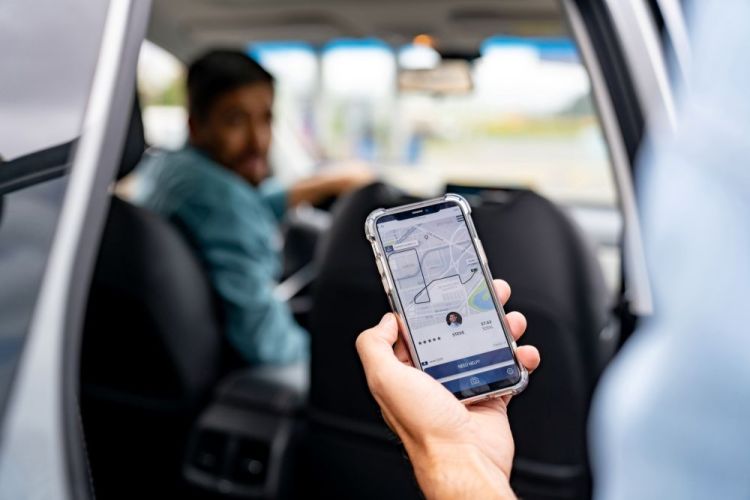
He joined after losing his business, seeking “to work freely… without the responsibility of other people,” and because he genuinely enjoyed driving. Uber’s market share quickly made it his main source of income: “they provide more passengers and more work,” he explains. Over the years he has seen other platforms come and go, but Uber remained constant and, in his eyes, increasingly dominant and increasingly controlling.
Dynamic pay, he says, has always been part of Uber’s self-presentation, but something changed after a Supreme Court ruling in favour of workers’ rights in 2021. “It became a bit more aggressive after the court case,” he recalls. “They became quite aggressive with it, that is my feeling.” This shift fundamentally altered the nature of his work. “There is no fixed tariff,” he says.
It can go to the bottom… For the same journey I could make fifteen pounds, I am offered six, seven pounds.
The volatility, more than the lower pay itself, has left him unable to plan a week’s income. “It makes the income very unpredictable, very unreliable.” He often tries to understand the gap between what he is paid and what passengers are charged. “I recently had one passenger paying twenty-five pounds and me getting only twelve and a half,” he says. But he does not ask often, as “it is not comfortable on the customer side.” This unpredictability had a profound emotional effect. “I used to go out to make a certain amount of money,” he explains. “Now I am leaving it to fate.” If he tries to chase earnings, “I feel like I’m abused more by Uber,” so he now works to protect his own mental state: “I control my mindset… not to be abused.”
A major factor in his loss of control is Uber’s six-second acceptance countdown. Jobs appear on the screen with a short, urgent timer; rejecting too many risks the algorithm withholding work. He calls this a form of cognitive pressure disguised as choice. “Do I like the six seconds? No, I don't like it. I feel like it’s against human rights,” he says.
Who can decide on something so vital, repetitively, in six, seven seconds… even though we are trained?.
These pressures of unpredictability, coercive timing, the constant mental alertness the system demands, have accumulated over years. Then, six months before this interview, he suffered a heart attack. “The whole thing happened on a weekday after I had worked for Uber,” he recalls. “It was a Wednesday. It was not a good Uber day. It was a slow Uber day.” That day he had been stressed about meeting a daily target. The following morning, after hours of discomfort, paramedics told him: “You had a heart attack.” He was taken to hospital, fitted with a stent, and remained there for five days. During that stay, he was also diagnosed with diabetes.
Reflecting on it, he says, “I was carrying the stress of Uber on my shoulders… I was thinking of work at that time.” The experience changed everything. “If I didn't have the heart attack, probably I would feel the stress ongoing,” he says. But now he sees his health as the priority. “My life is more important than whatever the income will be.” He has also observed something unsettling since his recovery: “Whether I work one or two days a week or not, I am in the same bracket. My hours can go up and down, but the money I make is around the same.” He believes there may be “a cap, a limit to how much you can earn,” built into the system. “The algorithm is playing its game,” he says. “Uber is trying to keep me within the same range.” This sense of being constrained extends to his working hours. He now concentrates on early mornings and early evenings. “Flexibility is a big hype,” he says. “If I don't work at the hours dictated by the market, I’m not making any money… I'm working at hours I have to work. I'm obliged to work.” His comparison is simple: a restaurant could open at night, but if it wants to survive, it must open when customers want food. That, he says, is the reality of Uber.
Airport jobs expose another flaw. When passengers need to catch flights, he avoids the shorter city-route the app recommends and instead takes the M25, which is faster but longer. Passengers ask for this, and he agrees: “I am not objecting.” He does the right thing, but then Uber refuses to pay for the extra mileage. After experiencing this “a number of times,” he has repeatedly contacted customer support, but he says, “I feel like I'm talking to myself.” Whenever support says they will “escalate to a specialised team,” he now interprets that as code for closing the complaint. “They escalate the issue to kill it.”
It is here that Mehmet makes one of his most serious points: that dynamic pricing harms not only drivers, but passengers. Tired drivers, he argues, are a direct risk. “If I'm tired, I will be crashing the car,” he says. “Dynamic pricing is not against the driver human rights only. It is against the passenger human rights as well.” Fatigue caused by extended hours, which drivers feel compelled to work to hit unstable income targets, creates an environment in which safety cannot be guaranteed. “Passengers expect a certain service… but they are not aware of the pressure the driver is under,” he explains.
Mehmet understands that Uber is a business, but he repeatedly returns to the idea of misplaced risk. “Dynamic pay should be managed intelligently,” he argues. “The price should not be paid by the driver… It shouldn’t be my risk. It should be the company’s risk.” Yet, because Uber dominates the market, “I have no option. If I am doing this job, I will be working with Uber.” The imbalance between platform power and driver vulnerability is, for him, the defining characteristic of dynamic pay. “Why am I paying the price of an algorithm?” he asks. “I am paying from my health and from my income.”
Mehmet’s account shows how dynamic pay combines income volatility with time-compressed decision-making, undermining health, safety, and making meaningful redress impossible.
At first, the job offered a sense of stability and autonomy, with a fixed 25 per cent commission and predictable earnings. That changed when Uber introduced dynamic pricing, which he experienced as a loss of control and transparency.
“When I started, I was on a fixed rate of 25 per cent commission,” Khurram explained. “Then they brought in this dynamic commission, so you’re not sure how much money they’ll take out of every trip”. The system also rolled a portion of holiday pay directly into each fare, which he said made it almost impossible to predict his income.
Despite recognising that many fares were not financially viable after deducting fuel, maintenance, and insurance, Khurram felt forced to accept nearly every job: “You keep thinking…if I won't accept it, someone else will”. The fear of losing work or being penalised by the algorithm shaped his decisions throughout the day. He gave the example of a 240-mile Heathrow–Birmingham return job that paid just £90, and a 31-mile round trip from Mayfair to Heathrow for £22. Both were well below what he considered sustainable.
Such experiences left Khurram convinced that the company relied on inexperienced or desperate drivers. “They capitalise on those kind of drivers … new in the industry. They just want to make money no matter what,” he said. “Any right-minded person wouldn’t do half the jobs offered to them in a day.”
He also described confusion around what determined the price. “It could be time of the day, demand in the area, driver’s availability, driver’s distance from the job, customer’s rating, my rating. There's so many things”, he said, noting that Uber often withheld key information, such as multiple stops, until after he had accepted a job. When drivers raised concerns, he said, Uber’s response was to hide behind the algorithm: “the system … we understand [it] is the system, but you're still controlling that system.”
The result was longer hours, greater fatigue, and growing tension at home. “We are more under pressure than before,” he explained. His working day extended from ten to twelve hours, with few breaks.
“I am sleeping at least two hours less than before, because I have to spend a couple of hours extra on the road now to make money. So, where I was doing 10 hours in past, I'm doing 12 hours now… So, we are thinking more about our work than our families… And the support from [Uber] is again, minimum”.
The fatigue, he said, also created safety risks: “So, we are doing more wrong things on the roads … we are parking wrong, we are having arguments for no reason because we are frustrated. And when you're frustrated, you make mistakes… even the customers have noticed it, like the drivers are more aggressive now than before… You're tired, you're spending long hours … your family's questioning like, why you are … spending this much time out there?”
He linked this to frustration and exhaustion, describing a workforce under continuous strain with minimal support from Uber.
Khurram’s story illustrates how dynamic pricing erodes transparency and pay stability, forcing workers into longer hours to maintain income while shifting commercial risk entirely onto them. For him, the system represents not flexibility but dependency, a constant balancing act between acceptance rates, algorithmic pressure, and personal exhaustion.
Khurram’s experience exposes the financial and psychological cost of unpredictable pay. This is also outlined in the experience of other drivers, including the story of Zara (case study 4) that further reveals how gender and safety intersect with these same stressors. Khurram’s account also demonstrates how variable take-home rates and information withholding intensify acceptance pressure, extending working hours and transferring fatigue and safety risks onto workers.
“When I started, there was a simple mathematical formula,” he explains. “You put the mileage and the time in Excel and you could calculate exactly what you’d get.” Over time that clarity disappeared. “Uber went from 100 per cent transparency… to 0 per cent transparency. Everything is ‘flexible’. The fare is flexible. The commission is flexible. What the driver gets is flexible. No one knows.”
This collapse in transparency has shaped the entire structure of his life. He now works “seven out of seven,” with weekdays of “10, 11, 12 hours,” and weekends only slightly shorter. The reason is simple: “Any small trick Uber did led to me working more. I always compensated the cuts from Uber with more time.” Every drop in pay translates directly into additional hours on the road.
Vladimir meticulously tracks his earnings and expenses. He knows exactly what each hour costs him in petrol, repairs, cleaning, car hire, and depreciation. And he knows how the pay has collapsed. “What’s frustrating is I get less than what I was getting nine years ago,” he says. He sees fares that once paid £10 now offering £7 or £8. He estimates he only accepts about “18 per cent of the jobs” the system sends him because so many offers are “unacceptable… six miles, seven pounds, eight pounds.” The frustration is visceral: “I want to smash my screen. It feels miserable.” His analysis of driver investment shocks him when he calculates it: "A driver that does it full time has costs of £2,000 a month. Imagine 50,000 drivers, we invest £1.2 billion a year to provide this service, drivers' money. I don't think the investors behind Uber invest this much. We are the big investors, not the investors."
The mental load of the job is built around continuous calculation. Every job Uber presents demands instant judgement: the time to pick-up, the likely delays, the petrol cost, whether the app’s route is realistic or a trap. “A new driver that starts now for Uber… they definitely earn less than minimum wage,” he says, because they haven’t yet learned these calculations. He gives examples: a £25 trip lasting an hour and a half becomes “seven pounds an hour after expenses.” A £5 station run that takes 20 minutes leaves the driver below minimum wage once costs are accounted for. “It’s miserable,” he repeats, always returning to that word because the maths simply does not work.
The need to constantly document what is happening has led him to build a personal archive of evidence. “My phone is full of screenshots,” he says. Screenshots of fares, of comparisons to older pricing, of inconsistencies in what Uber pays versus what it used to, of times and distances that do not match what he should have earned. Keeping these screenshots is part of how he tries to protect himself in a system that hides its workings from drivers.
His interactions with Uber’s fare review system reinforce this mistrust. When a fare is incorrect, he opens a case but almost always receives the same generic response. “Always the same,” he says. “It matches the time and distance.” He knows this is not true because he checks the time and distance himself. “It doesn’t match,” he says plainly. “And they close it.” Even when he sends screenshots proving that the platform underpaid him, the answer is the same: “It matches.” These disputes “never go anywhere,” and the repetition of the same scripted response leaves him feeling the platform is simply refusing to engage with reality.
Years of this work have left him not just exhausted but disillusioned. He talks openly about being disappointed in himself for staying so long in a job that deteriorated so significantly. "I'm ashamed of myself because when I finished uni in my 20s, I had a very good professional start. I worked for an American telecom company in the finance department, started a small business." How he ended up driving for Uber involves details he doesn't want to discuss, but the regret is profound. "You're not progressing in any way. You get rusty, your value decreases in the work environment. You're a driver, anyone can be a driver. But you invest all these years to help Uber grow with your time that you're not getting back, professionally at least, to get paid less and less and less. This is why I'm disgusted. I'm disappointed by me first of all."
He feels stuck between the need to work and the knowledge that the work is draining his health. “I put on weight… you work so much… seven out of seven,” he explains. His herniated disc has worsened. He now lives with chronic pain and haemorrhoids. “I can’t get rid of them,” he says. He has seen doctors multiple times. “I need to make a change. There’s so many reasons, Uber being one of the main ones.”
His financial situation reflects years of declining income. He took loans when he believed his income was stable. “I was counting on constant income… which decreased in time,” he says.
After nine years, he has reached a limit. “I’ll quit in maximum four months,” he says. He has already postponed travel plans and personal commitments because he could not afford time off. Now he is preparing to leave the industry entirely.
His assessment of the job, and of dynamic pay, remains stark and consistent: “It’s too unfair.” Everything else, his declining health, the screenshots, the fare disputes, the seven-day weeks, comes back to that fundamental conclusion.
She hoped platform work would provide flexibility and independence, but dynamic pricing soon undermined both.
“I work only throughout the whole day and … early in the morning till evening time… I find it very unfair that there are female drivers that want to work, but we can't work the areas that the male drivers can do because obviously … we're going to feel unsafe… So, throughout the day, they'll give us the lowest fares… It's just absolutely horrendous prices”, she explained. Safety concerns meant she avoided night shifts, the very periods when “surge” prices were often highest. As a result, her daily earnings remained low and unpredictable.
“The prices change so much, up and down,” she said.
“You just all over the place because you … can't know what … you're going to be earning. Like, there'll be days … and I'm like, oh my God … I can't live on this. Like, it could be 60 to 80 pounds … So how can you live off that kind of wage?”
Given that the company calculates working time only from passenger pick-up to drop-off, excluding long waiting periods between jobs, “It’s below even the minimum wage,” she said.
The uncertainty affected every part of her life. “If you’ve got commitments and family and children, then you just can't plan it because you don't know what your wage is going be, because every month your wage goes up and down, up and down” she said. “It drains you”. She described sleepless nights, poor diet, and a sense of constant anxiety about bills.
Dynamic pricing also complicated her sense of control over the job. She noticed the option for customers to make cash payments reactivating on her app even after she had turned them off, leaving her feeling unsafe: “Sometimes it happens. You’ve switched it off, but somehow Uber switches it back on”. This reinforced her perception that the platform’s systems prioritised revenue rather than driver safety.
When the level of payment dropped between acceptance and payment, her attempts to query this were dismissed: “They say, oh, have you got any … pictures or anything to send us to say that was a correct price? But surely their systems should be able to pick that up”. Such moments deepened her frustration, illustrating the lack of accountability within algorithmic pay systems.
Her schedule reflected the cost of this instability: six days a week, up to thirteen hours a day. “You have a day off? Yeah. You are absolutely exhausted”, she said. “But if I don't go the next day, I won't earn the money that I need to earn to pay all … outgoing ... So, it's just like … a cycle because you think, I need to do it”. This cycle left her socially isolated, working only to cover basic expenses.
“Obviously if they gave us good prices in the day as well, we could have a manageable … better life” she said. “Our health would be much better”. For Zara, dynamic pricing magnified inequality, exposing women drivers to both economic and physical insecurity. It trapped her in an exhausting loop of unpredictable earnings and deteriorating wellbeing, an experience that speaks to the broader consequences of algorithmic wage control.
Zara’s account shows how dynamic pay interacts with gendered safety constraints, excluding women from higher-paying hours and deepening income insecurity and exhaustion
At first, he saw it as a pathway to better pay and more freedom.
That sense of autonomy faded as platforms introduced dynamic pricing. Early “boosts” and promotional rates disguised an underlying trend of falling pay. “They didn’t really increase the pay,” he said.
“They just had these promotional things…called Boost where if you were getting, say, £2 for a certain trip it was now sort of doubled or tripled… but that was temporary. So, when that went down, they went back to their normal calculations and, and that's when I realised how bad it really was, you know? So, from that point, the pay started getting bad.”
As base rates fell, he relied on long hours to reach a minimum earnings target of £100 per day, based on what was necessary to cover their living expenses.
“But it means you start early in the morning and finish at least 10 to 12 at night … and you need to be working literally Monday to Sunday to make the money that you can pay your bills… I'm not sure you can have enough for saving… We have to work those hours because if you don't … then you're not going to survive.”
The system, he explained, rewards constant availability and penalises selective behaviour. “It knows how far you are willing to go, the type of pay you … prepare to accept. So, for instance, as a minimum fee, if you keep accepting £3…it will always come to you with £3.”
He described it as a form of auction: “It will send the same order to about 20 or even more drivers, and whoever accepts first gets the order. And so that basically means … [the chances of] a low order being accepted by somebody is very high, especially when it is very slow”.
He spoke about a recent innovation involving multiple orders being added together and presented as a single order of high value, which he regarded as a way of manipulating riders and drivers into accepting while also offering the company a higher profit margin.
Claude also noticed that dynamic pricing shaped not only pay but the rhythm of daily life. Over time, the pressure created exhaustion, poor sleep, and declining health.
“It means really you're not very stable on the wheel because you’re actually sleepy… how many hours you're working and how well you are sleeping per day … most drivers do not always have a good sleep if they're trying to reach a certain target.”
Despite the apparent flexibility, Claude felt increasingly dependent on the platform and linked this to deteriorating mental health and social isolation.
“Bike could break … any time. And if you don't have any money to fix it, that's you done. If you take a holiday or you … fell sick for too long … if anything happens and you are unable to work, then it means that you're going to be behind, your bills will be kicking in and that will affect your mental health and it becomes a horrible place to be. So many drivers trying to keep up with that by having a target and consistently working almost without break.”
Claude’s account captures the broader dynamics of algorithmic management, surveillance, constant competition, and wage instability, that push workers to accept declining pay for fear of losing access to work. Dynamic pricing feels like, he said, “it is trying to get drivers to accept the least amount possible.”
For Claude, flexibility has become an illusion. The platform decides when he works, what he earns, and how long he stays on the road. His experience reveals how data-driven pay systems reconfigure risk and dependency, reducing workers’ bargaining power and blurring the line between autonomy and control.
Claude’s account illustrates how behavioural data and acceptance histories are folded into dynamic pay, reinforcing downward pressure on earnings and dependence on long working hours.
Stay Updated
Want to hear about our latest news and blogs?
Sign up now to get it straight to your inbox