
The human price of dynamic pay
He joined after losing his business, seeking “to work freely… without the responsibility of other people,” and because he genuinely enjoyed driving. Uber’s market share quickly made it his main source of income: “they provide more passengers and more work,” he explains. Over the years he has seen other platforms come and go, but Uber remained constant and, in his eyes, increasingly dominant and increasingly controlling.
Dynamic pay, he says, has always been part of Uber’s self-presentation, but something changed after a Supreme Court ruling in favour of workers’ rights in 2021. “It became a bit more aggressive after the court case,” he recalls. “They became quite aggressive with it, that is my feeling.” This shift fundamentally altered the nature of his work. “There is no fixed tariff,” he says.
It can go to the bottom… For the same journey I could make fifteen pounds, I am offered six, seven pounds.
The volatility, more than the lower pay itself, has left him unable to plan a week’s income. “It makes the income very unpredictable, very unreliable.” He often tries to understand the gap between what he is paid and what passengers are charged. “I recently had one passenger paying twenty-five pounds and me getting only twelve and a half,” he says. But he does not ask often, as “it is not comfortable on the customer side.” This unpredictability had a profound emotional effect. “I used to go out to make a certain amount of money,” he explains. “Now I am leaving it to fate.” If he tries to chase earnings, “I feel like I’m abused more by Uber,” so he now works to protect his own mental state: “I control my mindset… not to be abused.”
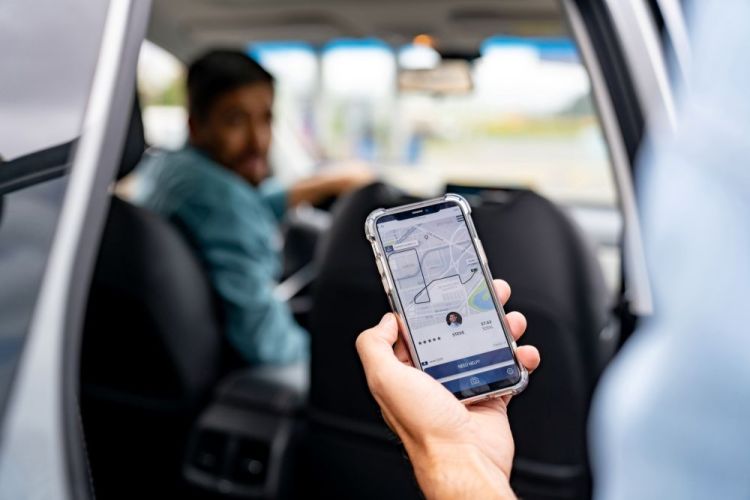
A major factor in his loss of control is Uber’s six-second acceptance countdown. Jobs appear on the screen with a short, urgent timer; rejecting too many risks the algorithm withholding work. He calls this a form of cognitive pressure disguised as choice. “Do I like the six seconds? No, I don't like it. I feel like it’s against human rights,” he says.
Who can decide on something so vital, repetitively, in six, seven seconds… even though we are trained?.
These pressures of unpredictability, coercive timing, the constant mental alertness the system demands, have accumulated over years. Then, six months before this interview, he suffered a heart attack. “The whole thing happened on a weekday after I had worked for Uber,” he recalls. “It was a Wednesday. It was not a good Uber day. It was a slow Uber day.” That day he had been stressed about meeting a daily target. The following morning, after hours of discomfort, paramedics told him: “You had a heart attack.” He was taken to hospital, fitted with a stent, and remained there for five days. During that stay, he was also diagnosed with diabetes.
Reflecting on it, he says, “I was carrying the stress of Uber on my shoulders… I was thinking of work at that time.” The experience changed everything. “If I didn't have the heart attack, probably I would feel the stress ongoing,” he says. But now he sees his health as the priority. “My life is more important than whatever the income will be.” He has also observed something unsettling since his recovery: “Whether I work one or two days a week or not, I am in the same bracket. My hours can go up and down, but the money I make is around the same.” He believes there may be “a cap, a limit to how much you can earn,” built into the system. “The algorithm is playing its game,” he says. “Uber is trying to keep me within the same range.” This sense of being constrained extends to his working hours. He now concentrates on early mornings and early evenings. “Flexibility is a big hype,” he says. “If I don't work at the hours dictated by the market, I’m not making any money… I'm working at hours I have to work. I'm obliged to work.” His comparison is simple: a restaurant could open at night, but if it wants to survive, it must open when customers want food. That, he says, is the reality of Uber.
Airport jobs expose another flaw. When passengers need to catch flights, he avoids the shorter city-route the app recommends and instead takes the M25, which is faster but longer. Passengers ask for this, and he agrees: “I am not objecting.” He does the right thing, but then Uber refuses to pay for the extra mileage. After experiencing this “a number of times,” he has repeatedly contacted customer support, but he says, “I feel like I'm talking to myself.” Whenever support says they will “escalate to a specialised team,” he now interprets that as code for closing the complaint. “They escalate the issue to kill it.”
It is here that Mehmet makes one of his most serious points: that dynamic pricing harms not only drivers, but passengers. Tired drivers, he argues, are a direct risk. “If I'm tired, I will be crashing the car,” he says. “Dynamic pricing is not against the driver human rights only. It is against the passenger human rights as well.” Fatigue caused by extended hours, which drivers feel compelled to work to hit unstable income targets, creates an environment in which safety cannot be guaranteed. “Passengers expect a certain service… but they are not aware of the pressure the driver is under,” he explains.
Mehmet understands that Uber is a business, but he repeatedly returns to the idea of misplaced risk. “Dynamic pay should be managed intelligently,” he argues. “The price should not be paid by the driver… It shouldn’t be my risk. It should be the company’s risk.” Yet, because Uber dominates the market, “I have no option. If I am doing this job, I will be working with Uber.” The imbalance between platform power and driver vulnerability is, for him, the defining characteristic of dynamic pay. “Why am I paying the price of an algorithm?” he asks. “I am paying from my health and from my income.”
Mehmet’s account shows how dynamic pay combines income volatility with time-compressed decision-making, undermining health, safety, and making meaningful redress impossible.
Stay Updated
Want to hear about our latest news and blogs?
Sign up now to get it straight to your inbox