
General Council Report 2025
Introduction
Welcome to the 157th TUC Congress in Brighton.
I’m looking forward to a vibrant, lively debate as the TUC’s 48 unions come together to decide our priorities for the year ahead. From the future of our public services to the challenges posed by artificial intelligence, we have a packed agenda.

And this year’s Congress takes place amid huge global uncertainty. The far right poses a clear and present danger across the world, with President Trump unleashing chaos in America and far beyond. As well as attacking federal workers, trade unions and migrants, the new regime in Washington has introduced punitive tariffs and turned its back on European security.
The Employment Rights Bill represents the biggest upgrade to workers' and trade union rights in a generation.
All of this, coupled with a dire economic inheritance from the Conservatives, has made it harder for our government to deliver its manifesto commitments. The TUC welcomed the agreement the UK reached with the EU in May to build a closer trade relationship, tackling some of the damage caused by Brexit.
We continue to work with the government to deliver the change people voted for last July. With Reform UK emerging as the largest party in the local elections, our priority must be to deliver the better jobs, rising living standards and improved public services working people deserve. That’s the best way to challenge the right’s narrative about a country in decline.
Despite a tight spending review, positive change is happening. The government is investing in public services, with NHS waiting lists coming down and 6,500 new teachers being recruited. The TUC continues to work with our affiliates to secure a fair deal for public sector workers who are fundamental to delivering better services.
Meanwhile, the new industrial strategy will create good, skilled jobs in every region, helping us meet the profound challenges posed by technological change and the climate emergency. The National Wealth Fund will deliver new investment in innovation and research. And Great British Energy, publicly owned railways and support for British Steel all signal a welcome recalibration of our economy.
At the heart of the government’s plan for change is the Make Work Pay agenda. The Employment Rights Bill represents the biggest upgrade to workers’ and trade union rights in a generation. Unions have campaigned vigorously for the legislation to be delivered in full, urging ministers to resist the business lobby’s orchestrated campaign to water down the reforms. Throughout, we have shown that stronger rights will deliver improvements in growth, productivity and industrial relations.
With insecurity a massive problem in our labour market, we have also urged the government to implement the new laws at the earliest opportunity. Stronger rights at work are overwhelmingly popular with the British people, including voters from across the political spectrum. Delivering better work isn't just good economics - it's also sound politics.
Inevitably, the government has not got everything right. The TUC opposed cuts to the winter fuel allowance and we had real concerns about plans to reform social security, making clear our opposition to cuts to disability benefits. Rather than hitting some of our poorest citizens with £5bn of cuts, we instead urged ministers to raise taxes on those at the top. Industrial- scale tax avoidance by the likes of Amazon only underlines the need for a fairer tax system.
We are the largest democratic mass movement in the country, and our five million-plus members work across a vast spectrum of occupations. But to remain the authentic voice of Britain at work, and to win for working people, we too must adapt to a world that is changing fast.
While government must take the lead in improving working people’s lives, trade unions remain powerful agents of change in their own right. We are the largest democratic mass movement in the country, and our five million-plus members work across a vast spectrum of occupations. But to remain the authentic voice of Britain at work, and to win for working people, we too must adapt to a world that is changing fast.
The TUC’s new organising strategy will help our affiliates recruit the next generation of trade union members and activists. I remain determined that we build a stronger, more inclusive movement, reflecting the diversity of today’s workforce. That’s why the TUC continues to develop schemes like our new Black activists’ programme, helping us diversify our reps base – the lifeblood of our movement.
I saw first-hand the appalling situation facing the Palestinian people in the West Bank, suffering under an illegal occupation. I also heard harrowing accounts of the humanitarian catastrophe in Gaza, where thousands of people have been killed.
More than ever, we must bring people together. With the far right and populist right pitting worker against worker – scapegoating migrants for problems caused by a failed economic system – our movement must promote unity. Rooted in antiracism, the TUC’s new anti-far right strategy shows how unions can tackle the politics of hate and division. And because the far-right threat is global, we must work with our sister unions overseas to defend the interests of workers, whatever their background.
Internationalism will always be part of our DNA. As I write, devastating conflicts continue to rage in Ukraine, Sudan and Gaza. In April, I travelled to Israel and Palestine where I met Israeli peace campaigners and trade unionists, Palestinian politicians and human rights defenders, and workers in the West Bank. I also addressed the conference of our Palestinian sister union centre, the PGFTU, in Ramallah.
During my visit, I saw first-hand the appalling situation facing the Palestinian people in the West Bank, suffering under an illegal occupation. I also heard harrowing accounts of the humanitarian catastrophe in Gaza, where thousands of people have been killed in the latest Israeli onslaught. The IDF’s blockade of Gaza – cutting off supplies of food, aid and medicines – rightly attracted international revulsion.
Throughout, the TUC has reiterated our calls for a new, immediate and permanent ceasefire; for the release of all hostages and political prisoners; and for respect for international law, including an end to all licences for arms traded with Israel. We have also called on the UK government to immediately recognise the state of Palestine, so we can begin the road towards a two-state solution.
In the Middle East and across the world, there's never been more need for our values of solidarity, equality and respect. Despite the huge challenges we face, I'm optimistic we can make progress - securing the better work, wages, rights and services working people are crying out for.
Let's build our movement - and win for the change we need.
Solidarity to all.
Paul Nowak
1.1 Organising strategy
The TUC is actively implementing a new organising strategy, developed through extensive consultation with affiliated unions and agreed by the TUC Executive Committee in May 2025. In line with resolution 72, this strategy is designed to support union organising and our affiliates’ efforts to secure union growth and high-quality, unionised jobs across the
UK economy. It reflects the collective priorities and insights gathered from unions following a series of focused roundtables and attendees at the collective bargaining summit, provides leadership and innovation, and facilitates the sharing of best practice to maximise impact.
The TUC’s strategy is acutely focused on three critical areas: engaging young workers, enhancing digital capacity for organising and expanding union presence in the private sector.
The strategy is being delivered through six interconnected activity strands:
- Supporting union recognition: We’re shaping policy through legislation like the Employment Rights Bill to extend union reach and secure recognition, especially for young workers in the private sector.
- Fostering inter-union relationships: The TUC facilitates joint initiatives, like the Our Work Matters campaign, to enhance
collective organising capacity and share best practices on vital issues. - Boosting union capacity: We’re increasing TUC-led training and expanding diversity programmes, including Black Activist Programmes, to equip organisers with skills to engage young workers and utilise new rights.
- Closing the digital skills gap: The TUC is piloting innovative digital tools (eg data visualisation and peer-to-peer texting) and establishing a digital organisers’ academy to boost digital organising capacity.
- Growing union power through communication: We’re running impactful public campaigns and refining messaging to demonstrate union relevance and highlight new rights’ benefits, encouraging new members.
- Utilising data for organising: The TUC provides crucial research and analysis to help unions target potential new members and identify the full potential of new rights for growth.
This strategy is designed to support union organising and our affiliates’ efforts to secure union growth and high-quality, unionised jobs across the UK economy.
This strategy, born from extensive collaboration with unions, ensures the TUC is providing practical and targeted support to our affiliates. We are working to ensure that unions are well-equipped to capitalise on new opportunities, particularly those arising
from changes to employment legislation, and to navigate the complexities of modern workplaces, ultimately driving recruitment and strengthening the collective power of working people.
1.2 TUC supporting unions in dispute: industrial action
From healthcare assistants to lecturers and phlebotomists to refuse workers, since Congress 2024 we have supported multiple unions involved in high-profile industrial disputes in both the public and the private sector, balloting millions of workers. Trade unions have achieved significant victories, securing improved pay and working conditions and winning on workplace matters including health and safety, pensions, recognition and more.

Since the project launched in January 2023, the TUC’s National Dispute Database has recorded over 2,000 individual industrial disputes, involving 34 different unions. We use the data to analyse dispute patterns and relationships, identify where the TUC can
add support, extract organising lessons and identify potential for coordinated action. We produce an internal quarterly report on industrial action and unions wins, an internal monthly scorecard monitoring usage of resources and an external weekly report to
over 350 campaigners and communicators across the movement with the ‘week ahead’ guide to industrial action.
We have recorded more than 100 union wins since Congress 2024, across all sectors, demonstrating the effectiveness of targeted industrial action.
Through the Solidarity Hub website, we have directly managed 87 requests for support both locally and nationally in the last year, across 18 different unions taking industrial action.
We have recorded more than 100 union wins since Congress 2024 across all sectors, demonstrating the effectiveness of targeted industrial action and the value of trade union membership and solidarity.
The TUC Solidarity Hub project continues to grow and play a vital role in supporting unions winning for workers. Since its launch in 2023, we have supported 26 unions in some capacity and more than 450 individual national and regional union campaigns. This support includes digital campaign support through Megaphone, sharing best practice and training for reps, as well as bespoke support including balloting advice, picket line support, solidarity videos, social media messages, research
and more.
Nearly 1.14 million people have taken action through Megaphone in support of union campaigns, and the Megaphone solidarity email list has become a key organising resource.
Through our collection of Solidarity Stories, we have captured and published detailed case studies of 52 union wins, featuring 22 different unions. These in-depth case studies demonstrate the power of belonging to a trade union and the importance of organising at work. Wins on terms and conditions, health and safety, equality matters and much more have been captured and published to amplify the great work being done daily by unions, and also to promote good trade unionism.
We have now captured insight into more than 70 new union recognition wins since TUC Congress 2024. These have been secured in sectors across the economy including retail, hospitality, local government, manufacturing, aviation, engineering and more. Where unions are winning new recognition agreements, we are capturing those stories to unearth the organising journey and amplify the success stories, navigating through the process of achieving recognition and winning collective bargaining coverage, in the interest
of learning lessons for the movement and sharing best practice.
Our TUC Growth Hub was launched with a new website designed to support unions to grow the movement. This will share and promote best practice on organising and winning recognition to ensure the movement can take full advantage of the new access and recognition rights being introduced through the Employment Rights Bill.
1.3 Digital organising and Megaphone
Building a strong and diverse union movement requires new techniques, tools and technology. In 2024 and 2025, the TUC expanded its support to help unions use digital tools to strengthen organising and amplify campaigns.
The TUC now provides hands-on digital organising assistance. In 2024/25, this included supporting GMB in its recognition bid at Amazon, facilitating peer-to-peer texting training for worker leaders at the Coventry warehouse, and support for unions using Zoom calls and WhatsApp to drive member action and engagement.
The Megaphone platform enables unions to run online petitions and digital actions that apply pressure on employers, mobilise members and build public support.
Over the past year, more than 60 campaigns were launched on the platform by 18 different unions. Nearly 1.14 million people have taken action through Megaphone in support of union campaigns, and the Megaphone solidarity email list has become a key organising resource.
Supporters are regularly encouraged to join a union, recruit others, promote campaigns in their workplaces and communities, donate to strike funds, and take other actions that strengthen the wider movement. The emerging TUC StrikeFunder project raised £19,000 over the past year to support union campaigns and picket lines.
1.4 Promoting trade unions: unionfinder and social media
Our social channels support and promote national campaigns, union disputes and trade unionism in general.
This year, our social media followers grew to a total of 700,000. We had significant growth in our TikTok and Instagram accounts, which now have 273,000 followers and 214,000 followers respectively.
We had a large number of viral posts including clips about Amazon workers’ efforts to unionise (10 million views), a video from Paul Nowak attacking Elon Musk (three million views), and vox pops telling voters the truth about Nigel Farage and Reform (three million views).
We also launched on new platforms including Threads, Bluesky and WhatsApp – as part of our ongoing effort to introduce trade unionism to bigger and more diverse groups of people.
The TUC’s unionfinder tool continues to play a key role in connecting workers with the support they need. Last year alone, the tool was used over 50,000 times, making it a powerful driver for growing and strengthening our movement.
1.5 TUC Education
TUC Education continued to play a vital role in empowering union reps, officers and members through high-quality training that strengthens unions’ ability to organise, campaign and represent workers.
Delivered via classroom settings in partnership with 13 further education (FE) college across England and Scotland, and increasingly online, the training is accredited by the National Open College Network (NOCN) and aligned with the TUC Passport to Progress.
Despite funding challenges in the FE sector, TUC Education expanded its digital provision in 2024, enabling broader access for union reps. The digital team supported unions including BALPA, SoR and Nautilus International with bespoke courses, while NASUWT, CWU and others adopted customised versions of the TUC’s digital credential programme.
A key innovation was the introduction of ‘practitioner’ digital credentials for workplace activities, such as building safety inspections – offering formal recognition and insight into reps’ contributions. Similar initiatives are planned for 2025.
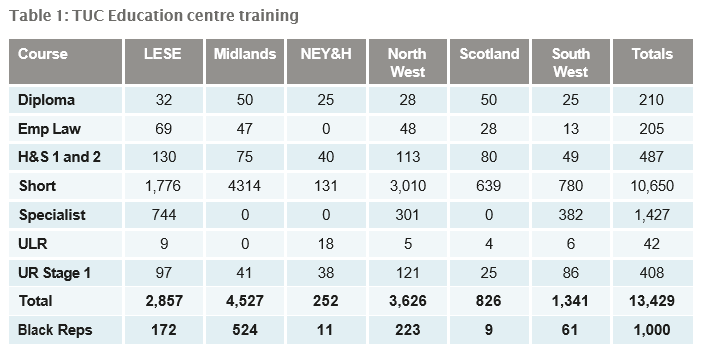
Participation in online training rose by six per cent in 2024, with 2,066 reps involved – up from 1,427 in 2023. Core courses saw strong growth: Union Reps 1 (272), Health and Safety 1 (202), and the Certificate in Employment Law (229). Union learning rep training tripled, and the Diploma in Employment Law rose from 89 to 128 participants.
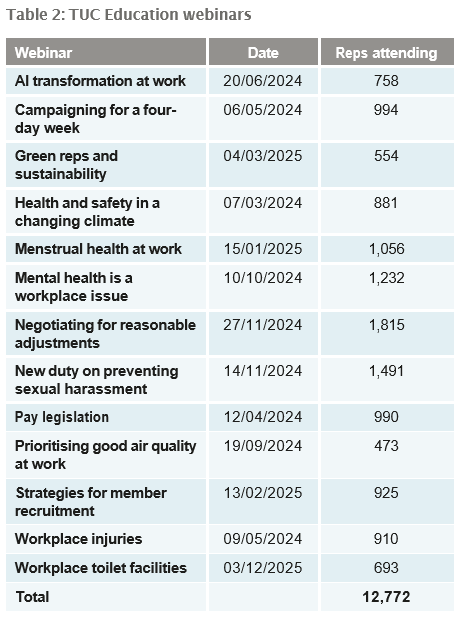
Webinars also proved popular, attracting 12,772 reps over the year. Topics such as negotiating reasonable adjustments for disabled workers (1,800 attendees) and preventing sexual harassment (1,500) highlighted the demand for accessible, expert-led learning.
The third annual Union Reps Connect conference drew a record 500 participants, reflecting strong interest in in-person learning and peer networking. Backed by the TUC Educational Trust, the event received overwhelmingly positive feedback. Plans for 2025 include regional networking and training days to prepare reps for new rights under the Employment Rights Bill.
The TUC Educational Trust has continued to support the work of educating and training workers, union members and activists. During 2024/25 the Trust continued support for the TUC Diversifying the Reps base project (including regional Black reps’ development programmes), the third Union Reps Connect conference, the launch of the new Union Reps website and regional educational events for reps about the dangers presented by the rise of the far right and right- wing populism.
1.6 Digital Lab
The TUC’s Digital Lab programme has worked to connect leaders and digital practitioners across the TUC’s affiliated unions, exploring areas of best practice in digital change for the movement.
In 2024/5, the programme produced events, training and reports, and coordinated with unions to share positive experiences more widely. The aim is to help TUC affiliates’ digital change projects to succeed – more quickly and with reduced risk or cost.
Major themes over the year have included: improving the effectiveness of unions’
digital channels for recruitment and retention; supporting unions to resist cyber-attacks, especially those originating from phishing; making practical use of generative artificial intelligence (AI), in line with union values; and supporting unions in transitioning
to a newer generation of membership systems.
Particular work in this area has focused on building data skills inside unions. A training programme and dedicated resources have supported union officers to create and share data insights with staff and reps, via dashboards and interactive visualisation.

1.7 Anti-Racism Taskforce oversight and implementation
The Implementation and Oversight Group has been highlighting ongoing initiatives to strengthen the representation of Black trade unionists. These efforts are rooted in the objectives of the TUC Anti- Racism Taskforce, established in 2020 in response to events such as the murder of George Floyd and the Covid-19 pandemic, both of which underscored systemic racial inequalities.
Following the announcement of the retirement of NASUWT general secretary Patrick Roach, who has played a significant role in chairing our Anti-Racism Taskforce, the Implementation and Oversight Group is moving into a new phase, with plans to engage more broadly with the General Council and ensure coordinated delivery.
The TUC launched the Anti- Racism Tracker at Congress in 2024 and has continued to support affiliates in delivering the commitments outlined in the Anti-Racism Taskforce Manifesto. The data dashboard concentrates on three key areas: representation, membership and union practices.
The TUC emphasises that, while setting targets and monitoring statistics are crucial, they must be balanced with reflective work to critically examine union structures. This initiative represents a pivotal moment for BME union members, as unions develop and implement measurable strategies to effectively confront racism.
Throughout the year, the TUC has engaged intensively with politicians and officials to influence the Employment Rights Bill in line with union priorities.
1.8 Make Work Pay: collective rights and defending the right to strike
After last year’s campaign to defend the right to strike, the TUC advocated for the Strikes (Minimum Service Levels (MSLs)) Act 2023’s full repeal in the Employment Rights Bill in line with composite 1. The TUC warmly welcomed the introduction of the Employment Rights Bill to parliament on 21 October, within 100 days of the election of the new Labour government. The bill sets out measures that, when implemented, will boost workers’ rights to collective bargaining and make it easier for unions to recruit and organise members.
The bill introduces rights for unions to access workplaces; measures to simplify the processes for statutory recognition and industrial action; and processes to strengthen collective consultation rights. It also abolishes the MSL legislation and almost all of the Trade Union Act 2016.
In August 2024, the government directed all public sector employers to disregard the MSL Act. This was a key moment in the TUC’s campaign, ensuring no worker faced this harmful legislation before its repeal.
In line with resolution 3, the TUC also pressed the justice minister to reach an agreement with the POA following the European Court of Human Rights granting of hearing of its case on the right to strike, though unfortunately no agreement has been reached to date.
Throughout the year, the TUC has engaged intensively with politicians and officials to influence the Employment Rights Bill in line with union priorities, which have been informed by regular discussions at the Executive Committee and General Council and the Union Legal Officers Network, to which all unions were invited to send a representative.
The government held a series of stakeholder roundtables on the bill during the autumn. The TUC organised pre-meetings for union attendees to coordinate unions’ views and input. Alongside the bill’s second reading, the government published a consultation on creating a modern framework for industrial relations. The TUC convened unions in advance of a union-roundtable with Justin Madders, parliamentary under-secretary of state at the Department for Business and Trade, to discuss union views on the proposals. The TUC’s written response argued for the inclusion of digital access and stronger enforcement of access rights; reform of the
statutory recognition process to prevent union-busting employer tactics gaming the system; and simplifying the process for industrial action.
Throughout the bill’s parliamentary progress, the TUC has circulated briefings to MPs and peers setting out TUC support for the bill and highlighting priorities for further consideration. Government amendments in the House of Commons included strengthening the enforcement of access rights and including digital access; strengthening the rules on unfair practices and freezing the bargaining unit once an application for recognition has been accepted; and introducing a formal process for agreeing access during a recognition process. In addition, the government announced that it would introduce model or off-the-shelf access agreements to facilitate fast-track access agreements.
Further details on how access rights will work in practice will be set out in secondary regulation, following further consultation.
1.9 Fair pay agreements and SSSNB
Following years of campaigning by unions and the TUC, the Employment Rights Bill sets out legislation to establish a fair pay agreement (FPA) in adult social care, through the establishment of an Adult Social Care Negotiating Body, as well as the creation of a School Support Staff Negotiating Body. This paves the way for negotiated sectoral minimum standards
for adult social care and school support staff.
The TUC has briefed parliamentarians and worked with officials and politicians to promote union priorities as the legislation has passed through parliament.
In line with resolution 48, the TUC has coordinated unions to support and shape the development of the FPA. With unions, the TUC has participated in the DHSC FPA Working Group and Task and Finish Groups covering the negotiating body, scope, dispute resolution and enforcement. A key priority has been to maximise the role of the FPA negotiating body by ensuring a broad scope in terms of remit and workforce coverage.
The TUC continues to call for the extension of FPAs to additional sectors.

1.10 HeartUnions Week
The TUC significantly expanded its HeartUnions campaign this year, leveraging its Megaphone digital platform to host 125 events nationwide, a substantial increase from 60 in 2024. These events facilitated 10,000–12,000 in-person conversations about union membership, more than doubling last year’s 4,000. Notably, one in five event organisers were new to running a union recruitment stall.
Beyond in-person outreach, TUC Education hosted a webinar on recruitment strategies, attended by 650 reps. Social media
efforts during the week were highly successful, generating 1.6 million impressions and 1 million video views for content promoting trade unionism. Each day of HeartUnions week, the TUC highlighted a new ‘solidarity story’ on its webpage, showcasing union reps’ workplace victories. The campaign also secured national media coverage, and visits to the HeartUnions web pages saw a 14 per cent increase compared to 2024.
2.1 Stronger employment rights
Following long-running TUC and union campaigning, the new government is committed to an ambitious set of employment rights reforms under its Plan to Make Work Pay. Ministers met their promise to table an Employment Rights Bill within 100 days of taking office.
This contains vital reforms to stop abusive zero-hours contracts, improve statutory sick pay and give protection from unfair dismissal from day one in the job. The bill also, in line with resolution 7, allows for the creation of a mandatory seafarers’ charter, to protect the working conditions of seafarers aboard ships operating regular services from UK ports and provides powers to maintain compliance with international law.
Workers will benefit from new protections against dismissal for pregnant women, mothers on maternity leave and mothers who return to work. The existing day one right to request flexible working will be strengthened. And employers will need to take ‘all reasonable steps’ to prevent sexual harassment of their employees, with an additional obligation on them to not permit harassment of their employees by third parties.
Workers will benefit from new protections against dismissal for pregnant women, mothers on maternity leave and mothers who return to work.
Guided by input from the Executive Committee, General Council and an expanded Union Legal Officers Network, the
TUC has provided briefings for MPs and peers throughout the legislative process. The TUC general secretary also gave oral evidence to the House of Commons bill committee.
The TUC has also engaged throughout with civil servants to ensure that General Council priorities are reflected in the bill.
A large conference was held at Congress House in December on making the case for fair work. Chief secretary to the Treasury Darren Jones used his speech to note the centrality of employment rights reforms to the government’s economic agenda.
The TUC responded to the government consultation on statutory sick pay, lobbying for the highest possible rate for low-paid workers. We also successfully pushed for agency workers to be included within the scope of measures on guaranteed-hours contracts.
The TUC has sought to defend the bill from attempts by employers to water down the proposals. We have also set out key areas where parliamentarians should give further consideration.
Among the issues we have highlighted is the issue of upfront fees charged to performers by casting directories, in line with resolution 4.
In line with resolution 7, the TUC has sought to defend measures in the bill aimed at ending fire-and-rehire – under pressure from the business lobby. Also, in line with resolution 7, the TUC has continued to press the government to follow its pledge to use secondary legislation to permit the use of electronic and workplace balloting in statutory ballots.
And in response to resolution 5, we have continued to press Home Office and Defra ministers on reforms to the
regulation and enforcement of migrant workers’ rights.
2.2 Health and safety
The TUC campaigned to ensure that the health, safety and welfare of workers are protected by strong unions and a growing network of health and safety representatives with access to high-quality resources. We produced webinars focused on building safety, working in hot weather, toilets, and stress; and held seminars and conferences and weeks of action for reps across Britain.
In response to composite 14, the TUC hosted a roundtable of unions to establish shared objectives in establishing violence at work as a safety concern and published new guidance for reps on preventative control measures for the risk of racist violence.
The TUC invigorated its campaign for the removal of asbestos and a national risk register: through meetings with ministers, a parliamentary inquiry into the legacy of Cape (the UK’s largest asbestos manufacturer), a one-day seminar for safety reps and
a week of action inspecting building safety, we continue to make this a priority in campaigning and organising. This work involved working closely with health and education unions, in response to resolutions 55 and 69.
In response to resolution 19, the TUC worked with the Heat Strike campaign to mobilise for a week of temperature safety inspections in July 2025, as well as co-hosting a webinar and seminar. In response to resolution 54, this year we addressed issues related to workplace wellbeing, stress and burnout through webinars and workshops for reps.
And through our relationship with the Health and Safety Executive (HSE), the TUC continued to push for change, including the introduction of a maximum working temperature, and for work-related suicide and sexual harassment in the workplace to be reportable, as outlined in resolutions 43 and 44.
2.3 Tackling the far right
Our work on tackling the far and populist right has continued to grow and develop, with a focus on supporting affiliates to effectively counter far- right activity in workplaces and communities.
In line with composite 10, the General Council adopted a comprehensive strategy that focuses on political education, our industrial response, targeted research, international solidarity and our political interventions
in the run up to local, devolved and the next general election.
Following a resolution from TUC Women’s Conference and in partnership with the IPPR and Hope not Hate, the TUC has commissioned research looking at the far right, misogyny and young men, the insight from which will shape our resources and educational content for affiliates.
The TUC has worked closely with affiliates across the country and curated and delivered
a programme of regional briefings outlining its strategy and priorities. These sessions have also included practical workshops and supported conversations on how best to counter false narratives and division.
We’re continuing to work with affiliates to gather information from workplaces and are continuing our work to highlight union wins and successes as part of our industrial and organising response to the far right.
Working across our equality committees, the TUC has also focused on building an intersectional response to the rise of the far and populist right, with strong representation at all our statutory conferences. In line with resolution 39, we continued to organise against hate speech towards the LGBT+ community, facilitating the Trade Unions for Trans and Non-binary Right Alliance, including meetings in Brighton and Cardiff.
Banning zero-hour contracts, introducing day one rights and tacking the scourge of insecure work will improve working conditions for Black workers across the country.
2.4 Anti-racism
The TUC Racial Justice and Equality Conference brought together trade unionists, academics, journalists and campaigners to discuss racial justice, workplace inequality, and the rise of the far right. Discussions focused on the strength and solidarity within the movement and provided an opportunity to network, debate and identify opportunities to collaborate on our shared priorities.
As the Employment Rights Bill makes it way through parliament, our focus has been on underlining the positive impact the provisions will have on Black workers. Banning zero-hour contracts, introducing day one rights and tackling the scourge of insecure work will improving working conditions for Black workers across the country.
With the government launching a consultation on ethnicity and disability pay gap reporting, trade unions have an urgent role in demonstrating why robust action on racial pay gaps is essential. The TUC organised a roundtable with trade union equality officers on sector- specific challenges on pay gap data and union engagement.
2.5 Tackling sexual harassment
Following the passing at Congress 2024 of the General Council statement on tackling sexual harassment and building preventative cultures in the movement, along with emergency resolution 2 and resolutions 38 and 43, the TUC has continued to support affiliates to progress this work and embed the commitments in the statement into its own structures.
We have continued to provide advice and consultation to affiliates seeking to undertake actions to address issues within their own organisations, advising on good practice and connecting affiliates with organisations that can also support them, as well as helping affiliates to access the TUC’s ‘Tackling and preventing sexual harassment’ training developed specifically for trade unions.
We launched our confidential reporting line delivered by the Survivors Trust for TUC staff and anyone attending TUC events, with a view to encouraging affiliates to use the templates and experience we have gained to engage the Survivors Trust and commission their own reporting lines if they do not (EHRC) to promote practical actions to support unions to fulfil their obligations under the Worker Protection Act.
We launched our groundbreaking report on Black women’s experiences of sexual harassment and have supported promoting the findings and recommendations through parliamentary events and workshops for affiliates.
Following the enactment of the Worker Protection Act in October 2024, the TUC continues to promote awareness of the act and the practical actions that employers should take to build preventative cultures. This includes attending union and stakeholder events to promote the risk-based approach we advocate for and to promote the TUC ‘Tackling and preventing sexual harassment’ toolkit, which is available on our dedicated webpage. And our TUC Education team delivered a reps’ webinar with the EHRC on the Worker Protection Act and what it means for workplaces.
The Employment Rights Bill contains several measures that will strengthen protections against sexual harassment, including introducing ‘all’ reasonable steps, granting the minster the power to set out all reasonable steps, strengthened protections for whistleblowers and reintroducing protections from third party-harassment. We continue to engage directly with government and affiliates on these elements of the bill as well as respond to formal consultations, informed by resolution 57. We have engaged in media work to promote the necessity of third-party protections and the popularity of them in the face of attacks from Reform and the Conservatives as a ‘ban on banter’.
2.6 Working time and flexible working
In line with resolution 10, the TUC has used its influencing and campaigning on the Employment Rights Bill, such as MP briefings and government engagement, to continue to call for stronger rights to flexible working, including an advertising duty.
Following attacks on flexible working in the media, the TUC released a joint statement calling for an end to the witch-hunt against flexible working and supporting the government’s ambition to make flexible working the default from day one for all workers.
The TUC submitted oral and written evidence to the House of Lords Home-based Working Committee. We used the submission to defend access to well-designed home and hybrid working, the need for stronger rights and the need
for all workers to have access to flexible working, not just those who can work from home.
2.7 Protecting equalities
Women
We responded to the Women and Equalities Select Committee call for evidence on paternity and parental leave, giving oral evidence to the committee ahead of the promised government review of the parental leave system, as referenced in resolution 41 ‘Closing the gender pay gap’.
The government launched a call for evidence on equal pay, pay transparency, dual discrimination, reasonable steps to tackle sexual harassment, the Public Sector Equality Duty (PSED) and commencing the socioeconomic duty. The TUC has engaged directly with government and its affiliates to inform its response to the call for evidence. This work will support calls in resolutions 40 and 41 to support rights to equal pay, closing the gender pay gap and making the PSED more effective.
We marked the TUC Equal Pay Day on 17 February 2025 this year – highlighting that the average woman effectively works for free for the first seven weeks of the year. We continue to call for the Employment Rights Bill to be implemented in full, which will include mandatory pay gap action plans, as well as banning exploitative zero-hours contracts, a right to sick pay from day one, strengthened dismissal protections for pregnant women and new mothers, better flexible working access and a fair pay agreement in social care, all of which will disproportionately benefit women.
We continue to be a steering group member of the Early Education and Childcare Coalition and have participated in ministerial meetings and events to lobby for investment and reform of the childcare system and support for the
workforce. We worked with Carers UK to launch a toolkit on negotiating for carers in the workplace. We continue to support calls for paid carers’ leave.
Working with the Northern TUC Women’s Committee and the Miscarriage Association, we developed a toolkit for supporting workers who have experienced pregnancy loss and we continue to campaign for paid time off, as referenced in resolution 23.
Alongside our continuing work on tackling sexual harassment and promoting the practical use of the Worker Protection Act, we continued to push for change, including that sexual harassment in the workplace be reportable to the HSE, as outlined in resolution 43, and we have supported the End not Defend campaign. We participated in a session hosted by the All-Party Parliamentary Group (APPG) on Domestic Violence and Abuse, discussing why it is a workplace issue and what employers can do to support victims/survivors, and we have participated in a range of webinars and events including for the White Ribbon campaign.
Black workers
The TUC has continued to engage with the government on numerous consultations and roundtables, including on extended equal pay rights and the enactment of dual discrimination provisions in the Equality Act 2010.
At Congress 2024, the TUC Race Relations Committee hosted a fringe event on the ethnicity pay gap, which currently sits at 14.4 per cent. The event included speakers from the Ethnicity Pay Gap Campaign and the Runnymede Trust as well as from GMB and UNISON.
A major focus was on how unions can use this data to demand structural changes in workplaces. Ethnicity pay
gap reporting is not just about numbers – it is a crucial step in addressing long-standing inequalities and holding employers accountable.
The TUC has responded comprehensively to the government consultation on ethnicity and disability pay gap reporting, in line with resolution 42, underlining calls for pay gap reporting to be extended to all employers with more than 50 staff.
Additional fringe events were held at TUC Congress 2024 focusing on securing a New Deal for Black workers, and on the launch of the TUC Anti- racism Tracker, which allows affiliates to monitor their progress against the manifesto commitments that arose from the Anti-Racism Taskforce.
In December, the TUC published groundbreaking research into Black women’s experience of sexual harassment in the workplace. The report And Then it Clicked… included a foreword from the chair of the Advisory Group, who steered the work.
The research has been spotlighted at various events, including a discussion at the TUC Women’s Conference where Dawn Butler MP shared a video statement of solidarity and support that emphasised the importance of the work.
The Executive Committee Tackling and Preventing Sexual Harassment Working Group agreed to embed the findings of the report and a network of ambassadors and champions is being created to support affiliates in adopting the
recommendations in the report.
Disabled workers
Resolution 34 called for the social model of disability to be at the heart of PIP claims to ensure disabled people’s
independence and dignity and for the government and the DWP to establish a new fairer system for PIP.
The TUC did not believe the government’s proposals to reform the disability and health- related benefits system, as set out in the Pathways to Work green paper, were in line with this policy. To address this, the TUC made a written submission to the Works and Pensions inquiry on the green paper, sent a briefing to MPs and has highlighted its concerns in its formal green paper response and in media comments.
The TUC held Disability Pay Gap Day on 7 November 2024, highlighting that the disability pay gap was £2.35 per hour (17.2 per cent), which is wider than the previous year. It made a response to the government consultation entitled ‘Equality (Race and Disability) Bill: mandatory ethnicity and disability pay gap reporting’ where it supported the bill and highlighted where it could go further.
The TUC launched new research looking at disabled workers’ access to reasonable adjustments. It found that over half (55 per cent) of disabled workers who had made a request had had implemented only some or none of their needed reasonable adjustments. It highlighted that disabled workers, once having made a request, were waiting too long for their adjustments to be put in place, with our research finding eight in ten (82 per cent) disabled workers who had made a request were still waiting between four months and over a year to have their agreed adjustments put in place.
The TUC also released new polling finding that nearly four in ten (39 per cent) of disabled workers have experiences bullying, discrimination and harassment at work.
The TUC also released new polling finding that nearly four in ten (39 per cent) of disabled workers have experienced bullying, discrimination and harassment at work.
This research and polling were used in discussions with the government and in the TUC response to the Charlie Mayfield review into employer and government action on encouraging disabled workers
and those in ill-health into work.
LGBT+ workers
In response to resolution 39, the TUC has integrated addressing anti-LGBT+ narratives into its anti-far-right strategy and into its trade union political education and organised two Trade Unions for Trans and Non-Binary Rights Alliance meetings where these issues were the focus.
The TUC marked Trans Awareness Week by promoting its guidance and materials on supporting trans and non-binary workers. For Transgender Day of Remembrance, we remembered those around the world who have been murdered as a result of transphobia.
The TUC marked Trans Awareness Week by promoting its guidance and materials on supporting trans and non-binary workers.
Following the Supreme Court’s ruling on the definition of sex in the Equalities Act and the EHRC guidance, the TUC’s general secretary Paul Nowak wrote to Bridget Philippson, minister for women and equalities, outlining concerns and requesting a meeting to discuss the issues further.
The TUC held a meeting of equality officers where affiliated unions discussed the real-life impact the judgement and guidance were having on trans and non-binary members. Unions highlighted the dangers the judgement and guidance posed to trans and non-binary people as well as gender-non- conforming cis women. The chairs of the LGBT+ Committee and Women’s Committee also met to discuss a set of principles to guide the TUC’s response to the judgement through the coming period.
The TUC and trans and non- binary members of the TUC’s LGBT+ Committee have continued to organise and hold meetings of the Trade Unions for Trans and Non-Binary Rights Alliance. The first meeting was held 23 November 2024 in Brighton to coincide with Trans Awareness Week and the Trans Day of Remembrance. It focused on combating far- right narratives, trans and non-binary access to health care and trans and non-binary workers’ experiences.
The second was held on 10 May 2025 to coincide with the International Day against Homophobia, Biphobia, Intersexphobia and Transphobia (IDAHOBIT) and focused on: DEI – the cold front blowing in from the US; sex, gender and data; and pushing back against the far right. Among the keynote speakers was Dame Nia Griffith DBE, Labour MP for Llanelli, parliamentary under-secretary of state (minister for equalities) and parliamentary under-secretary of state in the Wales Office. Each meeting was well attended with 70 delegates taking part in the conference.
3.1 The economy
The government inherited an economy that had been failed by a decade and a half of Conservative policies. Growth was the worst for at least a century, and workers had endured the longest pay crisis The TUC has called for a national conversation on tax, urging the government to consider a fairer and more progressive tax system, including taxes on wealth. for two centuries. Public services had been stretched to breaking point as a result of austerity policies, which had the aim of repairing the public finances but instead led to the public debt ratio continuing to rise. On top of this came the steepest rise in inflation for 40 years.
Composite 4 set out that the relationship between growth and public spending works in both directions. The TUC has continued to make a strong case for investment and, as the resolution sets out, has continued to call for a “significant real-terms increase in public spending and investment, both as an immediate necessity and as part of a longer-term economic strategy for sustainable growth”. At the autumn budget the newly elected Labour government took important steps in this direction.
At the Spending Review 2025, the government reported that real departmental spending growth would average 2.3 per cent (day-to-day and capital) over the parliament, greatly larger than any other parliament since the global financial crisis (excepting the coronavirus pandemic). Specifically on capital spending, public sector net investment as a share of GDP is set to rise to 2.6 per cent a year from 2.0 per cent under the Conservatives. The package included increased subsidies to help meet the goals of composite 9, including “making safe, affordable, well built, environmentally friendly housing available to all workers”.
The TUC has called for a national conversation on tax, urging the government to consider a fairer and more progressive tax system, including taxes on wealth.
These increases are financed in part by higher borrowing and also by increasing some taxes on wealth and raising employer National Insurance contributions. The International Monetary Fund (IMF) observed: “The authorities’ fiscal plans strike a good balance between supporting growth and safeguarding fiscal sustainability.”
There are still significant pressures on the economy. The Bank of England has held interest rates high. This has meant ongoing pressures on people and businesses, and a prolonged slump in household spending. There have been more promising signs at the
start of 2025, with stronger first-quarter GDP driven in part by stronger retail sales. However, US tariffs have had significant downward impacts on trade, despite the government’s success in negotiating a rapid trade deal.
The TUC has consistently argued, including at meetings of the Executive Committee with the governor of the Bank of England, that rate cuts need to come faster. We have warned that the dangers of a wage price spiral are exaggerated. Our analysis has shown in general that those countries with strong consumer demand have enjoyed stronger GDP growth, with no penalty in terms of higher inflation.
We have also urged the government to hold firm on spending increases, even in the face of higher interest rates and weaker growth than anticipated. This should involve a further shift of the burden of taxation from work to wealth. In line with composite 4 and resolution 11, the TUC has called for a national conversation on tax, urging the government to consider a fairer and more progressive tax system, including taxes on wealth. We have set out the case for the equalisation of capital gains tax with income tax. And our own polling shows strong public support for taxing those with the broadest shoulders more. We have also raised concerns about the Office for Budget Responsibility’s approach to modelling: having wrongly judged that Osborne’s austerity would crowd in private spending, it now judges that chancellor Rachel Reeves’s increased spending will crowd out private spending. As composite 4 recognised, there is a strong case to address these “unnecessarily restrictive and arbitrary fiscal rules”. The TUC response to the government’s spending review consultation urged review of these processes.

3.2 The labour market
According to the Labour Force Survey (LFS), over the past six months the employment rate is up to 75.1 per cent from 74.9 cent, but the unemployment rate is also up to 4.6 per cent from 4.3 per cent. The difference is made up by falling economic inactivity. However, inactivity because of sickness at 2.8 million is still at near record-high levels, down only marginally (65,000) on the autumn 2023 peak. A particular concern is the high level of youth unemployment, which is at half a million or 12.7 per cent.
Given concerns about the accuracy of these headline measures due to ongoing issues with the LFS, many commentators are focusing on payroll information. These suggest the labour market is fragile and show employee numbers – particularly for the private sector – falling since the middle of 2024. Total employee posts are down 270,000 over the year to May 2025. This is echoed by vacancy figures, which are now at 736,000 having fallen for 35 months. Total vacancies are now 83,000 (10.1 per cent) below their pre-Covid-19 (December2019- February 2020) level.
In response, the TUC has continued to make the case for less restrictive monetary policies along with ongoing government investment.
3.3 Industrial strategy
Our work in this area is guided by composites 5 and 18 along with resolutions 21 and 23.
Assistant general secretary Kate Bell has been appointed to the Industrial Strategy Advisory Council and in this role has informed the formation of the government’s industrial strategy with a focus on good jobs. The TUC held roundtables with the minister for industry and with the chair and vice-chair of the Industrial Strategy Advisory Council and affiliates to press this point.
More widely, the TUC has advocated for a strong industrial strategy that focuses on good job creation. This includes requiring companies that receive government support or contracts to create or support good jobs. We have also pushed for ambitious infrastructure investment from the government, successfully influencing projects such as electricity grid upgrades and the Sizewell C nuclear power station.
Through our Futureproofing Industry project, we have campaigned to lower industrial electricity prices to help secure the future of manufacturing jobs. We have also developed proposals to ensure that no oil or gas sector worker is left behind as the industry contracts, working closely with offshore workers’ unions and engaging the government on these proposals.
We launched the We Need A Plan campaign, which calls for a robust industrial strategy to ensure the long-term success
of manufacturing industries and to protect workers as industries evolve. We have also advocated for worker representation on all government-convened councils that develop industrial policies. This effort has led to successful trade union appointments to the Net Zero Council, the Net Zero Taskforce, and the Offshore Wind Industry Council’s skills taskforce.
In addition, the TUC has pushed for improved economic regulation that promotes workforce resilience, social justice, and increased long-term infrastructure investment. It has helped build connections between civil servants drafting industrial policies and the relevant unions. We have also supported and amplified the steel unions’ successful campaign for government
intervention to protect jobs at the Scunthorpe steelworks.
Finally, we have advocated for alignment with the EU on carbon tax mechanisms and welcomed the government’s commitment to align the Emissions Trading Schemes.
3.4 Pay and the national minimum wage
The TUC has campaigned to get wages rising across the economy. We have made regular media interventions that have highlighted the pay crisis and its impact on living standards.
We submitted evidence to the Low Pay Commission calling for the minimum wage to be raised to 75 per cent of median earnings so that it delivers a £15 per hour minimum – for all workers regardless of age. We led a delegation of unions to give oral evidence to the Low Pay Commission. Following submissions by the TUC and affiliates, the government announced an increase in the national living wage (NLW) to £12.21 per hour from April 2025. It also increased youth rates to £10 for 18- to 20-year- olds and £7.55 for under-18s.
The TUC Minimum Wage Enforcement Group has continued to meet, bringing together unions, advice agencies and relevant government departments and enforcement bodies.
We continue to contribute to the work of the Living Wage Foundation, promoting the voluntary living wage as a minimum rate for the lowest- paid workers.
3.5 Workers’ capital, corporate governance and executive pay
In November, the TUC participated in a ministerial roundtable on the (Draft) Audit and Corporate Governance Reform Bill. We welcomed the proposed bill but argued that wider reform was needed to equip the country and the economy for the challenges of the future. In line with resolutions 22 and 40, we proposed the inclusion of elected worker directors on company boards; reform of directors’ duties to remove the prioritisation of shareholder interests; and replacing ‘employee’ with ‘worker’ or ‘workforce’ throughout the Companies Act.
In February, the TUC responded to a Financial Reporting Council consultation on the Stewardship Code. We argued that how investors exercise their corporate governance rights has a significant impact on other company stakeholders, the environment and the wider public interest; and that the Stewardship Code’s core role
is to boost transparency and investor accountability for these impacts.
In July, a Private Members’ Bill calling for reform of directors’ duties had its second reading. The TUC circulated a briefing to MPs setting out its proposals and making the case for reform.
The TUC has continued to coordinate Trade Union Share Owners (TUSO), an initiative bringing together union funds to collaborate over voting and engagement with companies.
3.6 Social security and sick pay
The TUC’s work in this area was informed by resolutions 33, 34 and 47.
We continued to work with affiliated unions on tackling food poverty and campaigning for universal free school meals for children. We welcomed the government’s announcement that free school meals would be extended to all children in families claiming Universal Credit.
We made a submission to the government’s child poverty strategy, which acknowledged the role of social security in addressing this issue. We recognised that increasing employment levels, better job security and rising pay will increase household income, and that in-work benefits also play an essential role in improving living standards.
A union delegation met with the minister for employment to discuss child poverty. Issues with the design of Universal Credit (including around the five-week wait, assessment periods, and taper rates and work allowances) were raised. There was a separate conversation on these issues with Universal Credit with the minister for social security and disability.
Our campaign for decent sick pay was sustained, and we responded to the government’s consultation on Making Work Pay: strengthening statutory sick pay.
We highlighted the impact of the proposed cuts in disability and incapacity benefits announced in the green paper Pathways to
Work: reforming benefits and support to get Britain working. We also responded to the Work and Pensions Select Committee consultation on the green paper, assessing the impact of and setting out our opposition to government reforms and proposed cuts on disabled workers and also on younger workers, particularly those with neurodiversity challenges and others that are at greater risk of being out of employment, education or training. Employment minister Alison McGovern met with representatives of the TUC’s Disabled Workers Committee and Young Workers Committee to look at how the government can tailor employment support more effectively – the beginning of a regular dialogue that the minister has agreed to.
Our campaign for decent sick pay was sustained, and we responded to the government’s consultation on Making Work Pay: strengthening statutory sick pay.
We highlighted the impact of the proposed cuts in disability and incapacity benefits announced in the green paper Pathways to
Work: reforming benefits and support to get Britain working. We also responded to the Work and Pensions Select Committee consultation on the green paper, assessing the impact of and setting out our opposition to government reforms and proposed cuts on disabled workers and also on younger workers, particularly those with neurodiversity challenges and others that are at greater risk of being out of employment, education or training. Employment minister Alison McGovern met with representatives of the TUC’s Disabled Workers Committee and Young Workers Committee to look at how the government can tailor employment support more effectively – the beginning of a regular dialogue that the minister has agreed to.
3.7 Pensions
The TUC has continued to be the leading advocate for the interests of working people in the pension system.
We have engaged with the government to influence its two-phase pensions review. We coordinated union responses to the first phase, which focused on investments, through the Trade Union Pension Specialists network. We submitted responses to calls for evidence and consultations on consolidation of defined contribution schemes, the future of defined benefit funds, and local government pension scheme (LGPS) pooling. We also took part in ministerial roundtables on the scope of the review and organised union roundtables with ministers and officials at His Majesty’s Treasury (HMT) and Ministry of Housing, Communities and Local Government (MHCLG) to push for member representation on LGPS pools.
We campaigned for the government to carry out the second phase of the review, which will focus on adequacy, writing to the pensions minister in December to support this.
In April we held our pensions conference, with keynote speeches from the pensions minister and the chief executive of the Pensions Regulator.
In line with resolution 33, the TUC lobbied for the reversal of the decision to means test winter fuel payments (WFPs), raising this with the pensions minister and calling for a Work and Pensions Committee investigation, which we then submitted written evidence to. In June, the government raised the eligibility criteria to receive WFP from being in receipt of Pension Credit, to having an individual income of £35,000, meaning three-quarters of pensioners will now receive the benefit.
The success of government plans for economic growth hinges on repairing and rebuilding public services.
3.8 Strong public services
The success of government plans for economic growth hinges on repairing and rebuilding public services. Unions representing members in the public sector have worked with government to address shared challenges. Following composite 11, we have campaigned for:
- fully funded fair pay rises for public sector workers
- delivery of the Make Work Pay’s insourcing and procurement commitments
- stabilised funding for public services, including local government and post-16 education
- reconvening of the Public Services Forum or a similar mechanism to ensure meaningful engagement with trades unions in all public sector reform discussions.
While the government’s additional funding for pay decisions for 2024/25 and 2025/26 is welcome, we continue to advocate for proper trade union engagement on pay and wider terms and conditions to address the recruitment and retention crisis, long working hours and unsustainable workloads. Engagement is crucial for joint problem solving on cross-cutting issues, including the introduction of AI in public services.
3.9 National Health Service
In line with composite 12, the TUC has echoed health unions’ calls for inflation-proof pay rises for NHS staff as a first
step to addressing real-terms pay decline, recognising the immense damage caused by more than a decade of pay restraint.
In our evidence to the 2024 autumn budget and 2025 comprehensive spending review, we highlighted the 100,000+ vacancies in the NHS. We stressed that recruitment and retention challenges create unfair working conditions for the existing workforce, exacerbating stress and burnout while also holding back delivery of the government’s vision for the NHS.
We have engaged with unions and government on insourcing in the NHS, including practical support for unions campaigning to bring services back in-house. We have stressed that wholly owned subsidiaries in the NHS – known as SubCos – present very similar risks to outsourcing and should not be equated with bringing services back in-house.
As directed by resolution 45, we have worked with unions to consider how to more effectively represent neurodivergent members in the NHS through up-to-date training and resources, including a workshop at UnionReps Connect 2024. Our work in this area is also
informed by resolution 56.
3.10 Education
The TUC has supported education unions’ ambitions to work with government to determine fairer outcomes for the education workforce and learners. The creation of social partnership working with the
The TUC has supported education unions' ambition to work with government to determine fairer outcomes for the education workforce and learners.
The TUC has also called for sufficient social care spending to enable the FPA to deliver much- needed improvements in care sector workers’ pay and working conditions. This position was set out in our submissions to the Health and Social Care Select Committee’s inquiry on establishment of the Improving Education Together agreement has been a key milestone, bringing together unions, employer representatives and government with the explicit objective to “co-create the design and implementation of education policy”.
Alongside education unions and in line with composite 8, we have campaigned for the extension of free school meal (FSM) provision for primary and secondary school children and young people. We welcomed the government’s expansion of free school meals to families in receipt of Universal Credit as a step towards addressing food poverty. Kate Bell, TUC assistant general secretary, is
a member of the Department for Education’s Opportunities Mission Reference Group.
Funding for post-16 education has also been an area of focus. The TUC has repeatedly made the case to government that investment in post-16 education needs to be targeted to address the workforce crises in further education (FE) and higher education (HE) institutions, in accordance with resolution 64.
We have emphasised that the government’s ambitions for growth and public services will not be delivered without a well-funded and stable post- 16 education sector – and that fundamental barriers to training the workforce of the future, such as pay disparities faced by FE lecturers when compared to other teaching professions and industry roles, must be addressed.
In line with composites 14 and 15, we are working with education unions to understand how we can best support their efforts to improve the health, safety and wellbeing of the workforce and resist attacks on the teachers’ pension scheme. This includes activity undertaken through the Public Services Liaison Group.
3.11 Social care
In line with resolution 48, the TUC has worked with affiliates and government to develop a social care fair pay agreement (FPA). Adult Social Care Reform: the cost of inaction and the 2025 Spending Review.
We have also built understanding among government and other stakeholders around how an ambitious FPA can pave the way towards a comprehensive pay and conditions framework within a national care service. Alongside this, the TUC has made a strong case for a national social care workforce strategy.
The TUC has worked with affiliates to spotlight the exploitation faced by social care workers. We continue to convene a working group on international recruitment in social care with the DHSC. We have raised with the Home Office concerns about the exploitation of international recruits and worked with the Gangmasters and Labour Abuse Authority (GLAA) around the extension of labour provider licencing to the social care sector.
The TUC and its affiliates have secured care provider signup to the Dying to Work Charter and submitted joint evidence as core participants in the UK Covid-19 Inquiry module 6 on the care sector. TUC regions have built knowledge of the challenges faced by social care workers and priority policy measures needed, including through a TUC Midlands Carers’ Week webinar.
Following our participation in the 2024 International Labour Conference discussion on decent work in the care economy, we were invited to join the International Labour Organization (ILO) working group on care economy
statistics. We have also provided expert input into several academic studies.
3.12 Local government and fire and rescue
It has been a year of both continuity and change for local government.
There has been ongoing uncertainty for local government finances. Central government has made welcome interventions to ward off immediate threats of bankruptcy but has not tackled longer-term reform.
We have continued to advocate for a fair funding settlement for local government and the fire service that provides the capacity for local authorities to meet their responsibilities and that also addresses the unequal funding distribution across the country. Our work in this area has been informed by resolution 59.
More so than any other area, local government has borne the brunt of public funding cuts under previous governments. It has been left with expectations of delivering more with much less resource. Our submissions to the current government
on spending decisions have highlighted increased local government funding as a priority.
Change is on the horizon with the government’s devolution and local government reforms. We have undertaken a wide- ranging consultation with affiliates across England to review our position on devolution and to inform our response to the upcoming legislation on local government reform. In addition, we have commissioned independent research to build the social and economic case for preventative spending at a local level.
3.13 Civil service and justice
Our work in this area has been informed by resolutions 46, 58, 61 and 70. The TUC has emphasised to government the importance of inclusive reform of the prison education service.
Recent announcements that strengthen the link between a prisoner’s sentence and their engagement with prison education services make this more important than ever.
The government views implementation of AI and digital reform in the civil service as central to its mission of improving public sector productivity and anticipates £45bn in annual savings as a result. In response, we have established a cross-public-sector working group on this issue to support efforts to ensure worker voice in any changes in the civil service.
The TUC gave evidence to the Science, Innovation and Technology Select Committee to support its investigation of the use of new digital technologies across the public sector. We highlighted the importance of unions being brought in at the earliest possible stage of any digitisation project.
As affiliates have identified, the government’s plans on devolution provide an opportunity to push to re-
establish greater local control over the probation system. We will continue to support affiliates in making this case, in addition to the further asks set out in resolution 60.
In accordance with resolution 8, we will also work with affiliates that represent staff in quangos to lift all restrictions on informational picketing.
3.14 Public procurement and insourcing
The TUC has worked to ensure that public ownership and in-house delivery becomes the default setting for public services. We have worked with affiliates to build the evidence base for insourcing and developed detailed policy proposals for how public services that are currently outsourced can brought back in-house at the earliest opportunity, and with collectively agreed public sector terms and conditions.
We have amplified trade union experiences of insourcing to support delivery of the government’s commitment to deliver the biggest wave of insourcing of public services in a generation. This has included convening a roundtable bringing together trade unions and government officials to discuss trade union perspectives and learning.
We advocated for the spending review to harness insourcing to drive public sector productivity gains, end the extraction of profit from the public purse and guarantee decent working conditions for workers delivering essential public services.
We made a strong case for procurement reform to end the race to the bottom in outsourced services and developed proposals for a robust and comprehensive two-tier workforce code. We continue to convene affiliates in the procurement and outsourcing working group, which has provided a forum for engagement with government policy as well as wider learning and information sharing.
As part of the Our Work Matters campaign, we have supported affiliate organising and outsourced workers’ industrial action, held several webinars and run digital campaigning training for full-time officers.
We also supported the global union movement, including by presenting at a Public Services International workshop for trade unions on insourcing and re- municipalisation.
3.15 Transport
In line with composite 7 and emergency resolution 4, the TUC has consistently made the case for a progressive and accessible transport system and there has been a series of positive moves from the government on rail nationalisation and bus franchising and major investment in local transport.
We have made the case through multiple research briefings for MPs and stakeholders and direct engagement with officials for greater rail investment as a route to driving economic growth.
We have convened a working group on the government’s bus legislation, seeking to address concerns about workers’ terms and conditions and lack of data on workplace violence. We also pushed for greater freedom for local and regional authorities to establish new municipal bus services.
We have established new regular discussion and information-sharing forums with transport officials to better support policy making and government decisions.
We have directly lobbied ministers in support of expansion of aviation capacity, along with seeking assurances that this will be done in line with the government’s environmental commitments.
We were proud to support workers in the hard-fought Royal Fleet Auxiliary dispute, in line with emergency resolution 1, which delivered significant wins on pay and conditions when it concluded in January this year.
As set out in resolution 30, we have worked with affiliates to push the government on its support for seafarers. The Employment Rights Bill paves the way for a mandatory seafarers’ charter and new powers will see more frequent rest periods, more robust welfare and training requirements for operators, safer working patterns and greater protections for wages beyond UK waters.
We continue to support and coordinate the framework agreement between HS2 Ltd and unions in the sector. As part of the project’s current ‘reset’ initiative, we have agreed to jointly update and revise the framework agreement with a view to improving conditions for workers.
3.16 Arts and creative sector
The arts and creative sector is vital to the economy. Creative workers are key contributors to the UK’s success but they face economic vulnerability as noted in composite 6. They also face threats to freedom of expression, as noted in
resolution 24. The TUC supports the industrial interests and artistic freedom of creative workers, including through membership of the Industrial Strategy Advisory Council. We also support specific campaigns in the sector such as the
NUJ’s News Recovery Plan, as outlined in resolution 27 and campaigning efforts to improve conditions for freelancers in line with composite 2.
Workers in the broadcasting, arts and entertainment sectors are seeing their intellectual property rights infringed by artificial intelligence (AI) models. We have convened a regular working group of creative and education unions to coordinate a joint trade union response. We launched a manifesto on AI that outlines recommendations to address the impact of AI on creative work and workers. We also responded to the government’s consultation on AI and copyright, setting out our view that existing copyright laws should be enforced and strengthened.
Working with Labour peers and the PFA in line with resolution 32, we have been able to win key concessions in the Football Governance Bill to ensure that players were listed in the legislation as key stakeholders to be consulted.
3.17 Regions
The TUC North East, Yorkshire & Humber region, in its inaugural year, immediately engaged in supporting workers and their unions in disputes, particularly within higher education and the steel industry. A key activity has been organising briefings for activists and fostering a collective response to the rise of the populist far right.
The TUC Midlands region undertook significant campaign activity to improve public services and workers’ rights.
Through extensive joint union campaigning and lobbying, the region successfully saw the West Midlands Combined Authority (WMCA) introduce a publicly controlled bus network, a longstanding demand. It also secured a fair pay and conditions agreement for creative workers. In the East Midlands, the East Midlands Combined Authority (EMCA) now has a union seat on its board, and progress is being made towards signing the Dying to Work Charter.
The TUC London, East & South East region continued to champion key TUC priorities, including activity supporting the Our Work Matters insourcing campaign. The region also successfully ran its six-day Black Activists Programme for the second time and rolled out national seminars focused on combating the far right and populist movements.
The TUC South West region focused on strengthening parliamentary engagement with unions and supporting organising activity aimed at young workers. A key activity was a parliamentary event bringing together regional
secretaries from affiliated unions with MPs. The region also held its annual summer patrol activity, specifically designed to support recruitment of young workers.
The TUC North West region provided crucial support to unions engaged in industrial action, offering practical and targeted assistance during high-profile disputes at Livv Housing and the Royal Liverpool University Hospital. A significant focus for the region has been building a robust response to far-right violence following incidents in Southport and Liverpool in 2024. This involved hosting meetings and delivering training to support union representatives in addressing these challenges.
3.18 TUC Cymru report
Over the past year, TUC Cymru has advanced on all fronts – from education and equality to AI and caring responsibilities – proving that when workers unite and fight, real change happens.
Wales Union Learning Fund
The Wales Union Learning Fund (WULF) marked 25 years of helping thousands boost their skills and confidence. Despite severe funding cuts in 2024, we didn’t back down. We adapted, delivered, and impressed – securing full funding for 2025/26.
Activist development
Our activist programmes are thriving. Black, young, and women activists are stepping up, learning the ropes, and even running for Senedd seats. Some have taken their voices global, attending conferences on AI and fighting extremism.
AI
TUC Cymru is championing ethical AI in Wales through tripartite social partnership. Backed by new guidance and a worker-focused toolkit, this approach puts fairness, transparency, and people
at the heart of public sector innovation. We’re exploring devolved legislation to ensure AI protects and enhances jobs, focusing on reskilling rather than replacement.
Equality
We’ve launched a bold campaign against sexual harassment, with powerful videos, a new reps’ training course, and a clear message: it’s never acceptable at work.
We’re championing disabled workers, with new training and a toolkit already influencing policy. We’re also supporting
carers – those juggling work and unpaid care – by developing resources to push for better rights and recognition.
Welsh language rights are firmly on our agenda. A new charter
is helping workers use Welsh at work, supporting the goal of a bilingual Wales by 2050.
As the Welsh government delivers the Anti-Racism Action Plan, trade unions are ensuring workplaces provide fair, quality work for Black workers. We’ve published a 10-point action plan to help reps tackle racism at work.
We’re strategically organising, rebuilding unity and promoting solidarity across workplaces – ready to fight populist, divisive hatred in all Welsh workplaces.
Unions and the World of Work
The Unions and the World of Work project ensures the next generation knows its rights. With lessons in schools and colleges, young people are learning what unions do and why they matter.
Our message is clear: we’re not just reacting to change – we’re leading it.
4.1 A pro-worker approach for AI and digital technology
The TUC is developing new workstreams that build the union movement’s capacity to effect change, industrially and politically, on a range of artificial intelligence (AI)-related challenges.
Responding to the threats noted in composite 16, in March 2025 the TUC working group of creative unions published A TUC Manifesto: artificial intelligence for creative workers. The manifesto was produced with the assistance of a legal expert. The TUC lobbied government to address concerns in the high- profile debate about copyright and AI.
With an increasing drive for AI and digitalisation in the public sector, we have established a working group to foster collaboration between public sector unions. As part of this wider effort, a pilot project is underway to build the capacity of education unions to negotiate and campaign on AI. This will feed into efforts on policy development, organising and training across TUC affiliates.
With an increasing drive for AI and digitalisation in the public sector, we have established a working group to foster collaboration between public sector unions.
In Wales, the TUC and TUC Cymru led the development of new guidance on workers’ rights and algorithmic management that was subsequently officially adopted by the Welsh government. This is a significant step forward for policy that recognises the need for worker voice to ensure AI technologies are used fairly and effectively.
TUC Cymru also commissioned research on the impacts of AI on equalities. The new research has led to campaigning on the issue, including meetings with parliamentarians. The findings are feeding into a new training programme for reps in Wales.
Working with TUC Education and researchers at Queen Mary University, the TUC secured funding from the UK’s AI Security Institute to improve how workers can identify AI-related risks and harms in the workplace.
Building on our work on algorithmic management and the model AI and Employment Bill, we have lobbied government and policy-makers as well as supporting unions to understand and take action on AI at work.
Under the banner of a ‘Pro- worker AI and innovation strategy’, the TUC is developing a policy programme for technology that serves workers and builds a fair economy for all. This includes managing AI-related labour market disruption, skills policy (especially for young and other vulnerable workers, as noted in resolution 76), using the power of the public purse to ensure private AI providers of public services respect workers’ rights, empowering workers to collectivise data, and establishing the TUC as an authoritative voice on the future of technologies and the wider economy.
4.2 TUC’s role in the Covid-19 public inquiry
This year, the TUC has continued its engagement with the Covid-19 public inquiry, submitting witness statements and evidence across modules examining the pandemic’s impact on NHS, social care and education workers. We also contributed to modules on the Test and Trace system and financial support for individuals, businesses, and sectors.
Over the past year, TUC Cymru has advanced on all fronts – from education and equality to AI and caring responsibilities. More than 10 witnesses from the TUC and affiliated unions have given evidence, advocating for:
- a stronger social security system, including statutory sick pay for all workers at a liveable rate
- a standing furlough scheme to support workers and sectors during crises
- social partnership approaches to workplace pandemic management, uniting unions and employers
- an integrated social care system built on secure employment, collective agreements and partnership.
More than 7,000 workers have shared their pandemic experiences with the TUC, helping us centre their voices in our advocacy.
Following the release of the Module 1 report on pandemic preparedness, we’ve engaged with the government through the cabinet office’s resilience review. We continue to stress the vital role of trade unions in future crisis planning and pandemic response efforts.
4.3 Skills
Over the past year, the TUC has worked closely with its affiliated unions to advance skills policy and workforce development. This included supporting the campaign priorities set out in resolutions 62 and 64 advocating for renewed investment in skills and public services. We continue to promote the vital role of trade unions and union learning reps in helping workers access training and upskilling opportunities.
We have actively engaged with the Department for Education and the newly established Skills England to ensure that the voices and experiences of working people are central to the development of skills policy.
We submitted oral and written evidence to multiple consultations and calls for evidence, highlighting:
- the essential support unions provide to millions of workers across all sectors
- the lack of employer investment in training and development
- the damaging impact of past government disinvestment in skills
- ongoing concerns about the quality and accessibility of employer-led training and apprenticeships.
The TUC showcased how unions are addressing these challenges through collective bargaining and the promotion of lifelong learning, supported by both UK and international evidence. As part of our continued commitment to skills development, the TUC submission to the treasury for the autumn budget 2024 and the spring statement 2025 has called for the reinstatement
of the Union Learning Fund, to break down barriers to opportunity for the most marginalised workers and support businesses to grow. Additionally, the TUC called for a fundamental overhaul of the apprenticeship levy.
TUC staff and General Council members continue to play an active role in shaping skills’ policy. Steve Turner served as a member of the Manufacturing Skills Taskforce, as assistant general secretary of Unite. Sian Elliott, TUC director of organising, is co-chair of this taskforce, serves on the Higher Education Advisory Group, and is a board member of Skills England. Kate Bell, TUC assistant general secretary, is a member of the Industrial Strategy Advisory Council and participates in its People and Skills Working Group.
4.4 Just transition and net zero
The TUC work in this area is guided by composite 18 and resolution 19 and is also relevant to composite 5 and resolution 21.
We have maintained pressure on the government to establish Great British Energy, aiming to deliver good jobs and accelerate the build-out of clean power.
In line with composite 18, we have taken several key actions. We have maintained pressure on the government to establish Great British Energy, aiming to deliver good jobs and accelerate the build-out of clean power. Through our Futureproofing Industry project, we have supported officers and workplace reps in sectors such as ceramics, glass and automotive to scrutinise employers’ climate plans. We launched a new toolkit for workplace reps focused on climate action and a just transition and published proposals outlining how the government’s Warm Homes Plan can create good jobs, reduce household energy bills and help meet climate targets.
Additionally, we have helped foster solidarity between unions and wider civil society in support of just transition efforts, particularly in the automotive sector. We have also advocated for worker representation on all relevant government committees, supported preparations for a trade union year of climate action and begun publishing a series of case studies highlighting successful workplace industrial transformations.
In line with resolution 19, we have advocated for the government to introduce a heat furlough and establish a maximum workplace temperature. We have promoted the Heat Strike campaign, including the Week of Action, and provided spokesperson training for union reps on the risks from extreme heat in the workplace.
The TUC’s Trade Union Sustainable Development Advisory Committee (TUSDAC) has met bimonthly, including an extended strategy workshop, alongside regular meetings of the TUC’s energy unions.
4.5 Trade and the EU
In line with resolution 20, the TUC advocated for trade union objectives in the government’s ‘reset’ talks with the EU. The TUC, represented by Mike Clancy, general secretary, Prospect was elected chair of the Domestic Advisory Group for the UK-EU Trade and Cooperation Agreement in November. The TUC has used its role in the group to influence government, meeting a number of times with Cabinet Office minister for EU relations Nick Thomas-Symonds and senior cabinet office officials and agreeing positions with the employer and civil society groups that are also members of the group.
The TUC general secretary and the European Trade Union Confederation (ETUC) general secretary met minister Thomas- Symonds in May just ahead of the UK-EU summit to present the TUC and EU trade unions shared priorities for a closer UK-EU relationship. The TUC welcomed the outcomes of UK-EU summit in May as an important first step to closer UK-EU relations as it achieved a number of union goals, including reducing barriers to trade, linking UK and EU emissions trading schemes to prevent UK goods being hit by EU carbon border taxes and taking steps towards greater UK-EU mobility with the Youth Experience Scheme. The TUC raised with government the need for the UK to align with EU standards on employment rights in future negotiations with the EU.
We described the UK trade agreement with the US as taking the country “back from the brink” that the Trump administration’s tariffs would have particularly on the steel and automotive industries. We stated that we would stand up to protect workers’ data, public service and workers’ rights in any UK-US agreement.
4.6 TUC international engagement and solidarity work
Paul Nowak, Liz Snape MBE, Mariela Kohon, Rosa Crawford and Stephen Russell represented the TUC at the International Trade Union Confederation (ITUC) General Council, which most recently met in June 2025. The council has adopted policies on peace and common security and agreed to deepen strategic engagement with the International Labour Organization (ILO).
Kate Bell, Steve Turner (Unite) and Rosa Crawford represented the TUC on the ETUC Executive Committee.
The TUC also participated in the ETUC midterm conference in Belgrade, where parliamentary under secretary of state Justin Madders discussed the UK’s Employment Rights Bill and its alignment with progressive labour reforms in Spain and Austria.
In March, the TUC met with trade minister Douglas Alexander to raise concerns about UK trade negotiations with countries violating workers’ rights and international law, including the Gulf States and Israel.
4.7 TUC Aid and global solidarity
TUC Aid continued its support for trade unions in Cameroon, working with ITUC Africa to strengthen unions’ influence on the implementation of the African Continental Free Trade Agreement. It also funded a project with the Palestinian General Federation of Trade Unions and the General Union of Agriculture and Food Industries, supported by the Arab Trade Union Confederation, to protect women workers’ rights in agriculture.
In September, TUC Aid began supporting a project with the Trade Union Congress of Swaziland (TUCOSWA) in Eswatini to strengthen democratic structures in the trade union movement. The charity’s trustees have decided to close TUC Aid by the end of 2025 to focus on new forms of solidarity with our sister unions around the world.
4.8 Middle East engagement and advocacy
In line with composite 17 and emergency resolution 3, the TUC engaged regularly with UK officials and met with the minister for the Middle East in January and June. It organised a roundtable for affiliates and a parliamentary briefing in June. We welcomed the UK government’s decision to suspend trade talks with Israel, a move it had long advocated due to Israel’s ongoing violations of international law and Palestinian human rights.
Ahead of the UN Conference on the two-state solution in June, we released a video featuring General Council members calling for immediate UK recognition of the State of Palestine. We also issued a joint statement with unions from France and Canada.
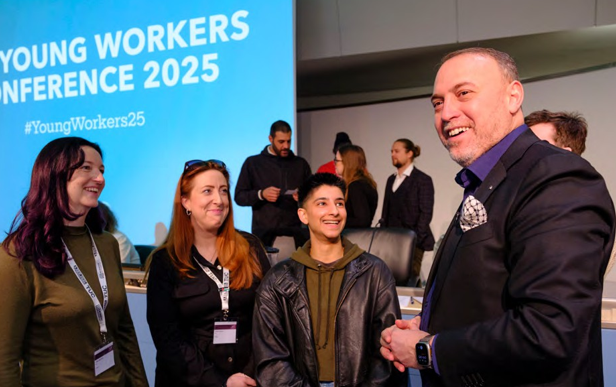
In April, general secretary Paul Nowak and assistant director for strategy and delivery Mariela Kohon visited Israel and Palestine. They met Palestinian workers involved in TUC Aid projects who described exploitative conditions in illegal settlements. Meetings were also held with the UK’s deputy ambassador to Israel, Palestinian authority ministers, the Histadrut and human rights NGOs including Al-Haq and B’Tselem. The delegation visited Palestinian communities under threat from settler violence,
and the general secretary addressed the Palestinian General Federation of Trade Unions’ Congress, reaffirming TUC solidarity.
We continued to advocate for:
- an immediate and permanent ceasefire and the release of all hostages and political prisoners
- immediate recognition of the State of Palestine
- revocation of the UK-Israel 2030 roadmap
- suspension of the UK-Israel Trade and Partnership Agreement
- an end to all licences for arms traded with Israel, meeting international law
- a ban on UK trade in illegal settlement goods
- decent work and public services in Gaza’s reconstruction
- sanctions on individuals inciting genocide against Palestinians.
In March, the TUC General Council issued a statement condemning violence in Gaza and produced a solidarity video for the UN’s International Day of Solidarity with the Palestinian People in November. The TUC supported workplace days of action for Palestine in November, February and May, and led efforts to secure a resolution on ETUC trade policy regarding Israel.
Palestinian Ambassador Husam Zomlot addressed the TUC Congress and also spoke at the Young Workers and Black Workers Conferences.
4.9 Human rights and labour standards
The TUC met with FCDO and DBT officials to advocate for new UK legislation mandating human, labour and environmental due diligence in global supply chains. It also collaborated with G7 sister centres to develop L7 positions for lobbying G7 ministers during Italy’s presidency. Eliza Ampomah represented the TUC at the L7 summit in Cagliari.
At the ILO Conference, the TUC delegation played a key role in securing agreement for a future convention on decent work in the platform economy. The ILO also adopted new standards on biohazards and informal workers’ rights. In the Committee on the Application of Standards, the TUC supported unions in Belarus, Georgia, Ghana, Hungary, Malaysia, Moldova and Zambia. The ILO voted to impose sanctions on Myanmar’s military regime and accepted Palestine as a non-member observer state.
The TUC supported an ITUC Africa-led ILO article 26 complaint against Saudi Arabia for severe exploitation of African migrant workers and the ban on independent unions.
4.10 Global trade union solidarity
Following the persecution of textile unions in Turkey, the TUC wrote to the Turkish embassy in protest. It also raised with the DBT concerns about trade union repression in the Philippines, urged the FCDO to support unions in Sudan, and backed efforts by Hong Kong trade unionists to organise workers in the UK.
5.1 Developing the TUC
We continued to implement our 2024–26 strategy, working under our five agreed aims of:
- a growing union movement that reflects the diversity of today’s working class and has the power to intervene effectively for workers
- workplaces where every worker has strong rights and is protected from
discrimination - a fairer economy that delivers secure jobs and rising wages and supports strong public
services - an economy where workers can shape and are prepared for the challenges of the
future - a strong TUC that is sustainable, effective and a great place to work.
To aid with the delivery of our strategy, we conducted a short review of our senior management team, adding new roles to ensure our effectiveness and a limited organisational reorganisation to reflect the new roles and focus. The full team now consists of:
- Paul Nowak, general secretary
- Kate Bell, assistant general secretary
- Kudsia Batool, director of equality
- Helen Bilton, director of operations
- Matt Dykes, assistant director of external relations
- Sian Elliott, director of organising
- Mariela Kohon, assistant director of strategy and delivery
- Alex Rossiter, director of communications
- Nicola Smith, director of policy
- Shavanah Taj, general secretary, TUC Cymru.
Other significant internal milestones have included reviewing our performance management system and our disciplinary and grievance policy and continuing our work to build an inclusive TUC. We completed a new round of our Black Talent and
Leadership programme, began implementing the findings of an LGBT+ listening exercise, and commenced a disabled workers’ listening exercise with staff. We also transitioned to a new finance system, providing greater security and efficiency for the organisation.
5.2 Sale of Congress House
As reported in the 2024 General Council report, following notice that major work would be required to meet incoming environmental standards, the General Council took the difficult decision to sell Congress House and seek a new modern home for the trade
union movement.
We appointed Newmark (formerly Gerard Eve) to assist with the project management of the sale, following a competitive tender process, and established an internal project group to guide the process of the sale, including legal preparation, financial management and the extensive task of clearing the basement and other storage spaces. Significant documents have been transferred to the TUC’s archives at Warwick, and one strand of the project focuses on preserving the history of Congress House.
The pension scheme agreed to transfer the charge held on Congress House to a new TUC building, with a deed of agreement signed between the TUC and the scheme to cover the period between the release of the charge and the establishment of a new one.
On June 28, the TUC agreed to prepare heads of agreement for a sale of Congress House.
This followed an exhaustive commercial sale process, supported by external agents, which saw over 100 viewings of the building and an initial 10 bids narrowed down to three bids.
The decision to proceed with the sale as set out above, was taken by the general secretary, on the advice of the TUC’s agents, and with the agreement of the TUC Trustees. This process was agreed by the Finance Committee in December 2024, and the
Executive Committee in January.
At the time of writing the TUC had entered a period of exclusivity with the potential purchaser during which legal
and technical due diligence was being undertaken.
Managing the sale of Congress House has also meant managing the difficult decision to close Congress Centre on 4 July, and the loss of valued staff members. We agreed an enhanced redundancy package with our staff unions and opened a voluntary redundancy scheme in May 2025. We would like to put on record the TUC’s thanks to these and all staff leaving the organisation for their dedicated service.
5.3 Congress and Congress Awards
We held a successful 2024 Congress in Brighton. Following the election of the first Labour government for 14 years, delegates at our annual showcase event debated a wide range of issues including winning a new deal at work, building a fairer economy
and building a stronger, more diverse trade union movement. The prime minister addressed Congress and we delivered a full programme of fringe and other events and speakers.
We were proud to present our Congress Awards in Brighton. The Health & Safety Award winner was Martina Vrajitory from GMB and the Organising Award went to Syed Hedi Naqvi from Usdaw. The winner of the Young Members’ Award was Helena Fletcher from UNISON. The winner of the ULR award was Darren Hincks from Unite. The Women’s Gold Badge recipient was Sharon Foster from UNISON.
5.4 TUC Comms Awards
The 47th Trade Union Comms Awards took place last October. Judges included Sam Jeffers, managing director of The
Shop, Luke Menzies, director of comms at the International Transport Workers Federation and Rob Sanders, TUC.
The categories and winners were:
- Best union journal | CSP
- Best recruitment and organising communication | RCM
- Best campaign communications | RMT
- Best media story | NEU
- Best use of social media | RMT
- Best communication from a smaller union | Nautilus International
- Lifetime achievement award – Rob Sanders.
5.5 Women’s Conference
The theme of TUC Women’s Conference 2025 was Resist, Persist, Deliver. Over 300 women from across the movement debated key issues including violence against women and girls, representation and leadership, and health and safety.
We hosted panels discussing the rise of misogyny and the far right and Black women’s experiences of sexual harassment. We hosted a series of workshops including supporting women’s leadership in the movement and becoming a health and safety rep.
5.6 LGBT+ Conference
The theme for the LGBT+ Workers Conference was Defeating the Narratives of Division. More than 250 people attended Conference in Congress House, with delegates debating key issues including international LGBT+ rights, the far right and hate speech/crime, LGBT+ health, trans rights and non-binary rights and issues raised as a result of the Supreme Court ruling that sex means biological sex in the Equality Act 2010 and accompanying EHRC guidance, and education.
We hosted two panel discussions, one on combating the far right and the other on racism within the rainbow.
5.7 Disabled Workers Conference
The theme of our Disabled Workers Conference was United We Resist. More than 200 people attended the conference, held in the Bournemouth International Centre, debating a range of issues including access to reasonable adjustments, disability leave, social security reform, disability pay gaps, accessibility, and access to work.
We hosted a panel discussion on changes to social security, with a range of keynote speakers including minister of state for social security and disability Stephen Timms.
5.8 Black Workers Conference
The theme of our Black Workers Conference was Educate. Agitate. Organise. Conference heard an address from Husam Said Zomlot, the Palestinian ambassador, and debated resolutions on topics including the rise of the far right, immigration and maternal health. Workshops included a session on communicating and campaigning effectively, as well as a dedicated workshop discussing how affiliates can create safe spaces for Black women to organise on workplace issues.
5.9 Young Workers Conference
More than 150 delegates from across the movement came together to debate key issues including organising young workers, affordable housing and tackling the far right. Workshops and fringes covered topics such as having one-to-one conversations, rights of workplace reps, apprenticeships, chairing skills and promoting trans and non-binary rights. The Palestinian ambassador, Husam Said Zomlot, also addressed Conferences.
5.10 Trades Councils Conference
Held in Congress House at the end of May, delegates debated resolutions covering opposing the rise of the far right, employment rights, artificial intelligence, public services and the right to protest. The conference was addressed by the TUC general secretary, Fraser McGuire (chair of the TUC Young Workers Forum) and Mike Masters, a representative of the striking Birmingham
bin workers.
5.11 TUC finances
The annual statement of accounts and balance sheet as at 31 December 2024 is set out in Appendix 3. It shows a total deficit and reduction in assets of £1.5m, reducing total funds from £73.3m to £71.8m. This was made up of tangible fixed assets and investments of £43.1m and pension assets of £26.0m , with net current assets of £3.6m being offset by long-term tax and employee liabilities of £0.9m. The deficit was driven by changes in the value of assets and liabilities, including continuing difficulty in the London commercial property market that led to a significant fall in property values, offset by an improvement in the pension scheme position. The operating deficit on ordinary activities of £451,000 also contributed to the deficit. It was made up of deficits of £508,000 on the administration fund and £283,000 on the Congress House dilapidations fund, partially offset by surpluses of £312,000 and £28,000 on the development and external grants funds respectively.
5.12 Administration and dilapidations funds
The administration fund (covering day-to-day office running expenses and staff costs) deficit on ordinary activities of £508,000 was due to ordinary income of £19.5m falling below ordinary expenditure of almost £20.0m. Ordinary income of £19.5m was £725,000 above budgeted income primarily because membership numbers increased above the 2023 figure, and exceeded our estimated number for 2024. Ordinary expenditure of £20.0m was almost £820,000 higher than budget, primarily due to the accelerated write-down of asset values relating to equipment that will no longer be used after the forthcoming office move.
The dilapidations fund was used for Congress House building repairs and showed a deficit of £283,000, reflecting £449,000 spent and £166,000 transfer in from the administration fund. There was a zero balance in the fund at the year-end, reflecting the plans to move from Congress House in 2025/6.
5.13 Development and external grants funds
In 2024, 10 per cent of the affiliation fee was allocated to the development fund, plus additional contributions from affiliates and grants for projects, and was used to promote new work and General Council initiatives across the TUC’s strategic aims, including ensuring workers’ voices are represented at the Covid-19 public inquiry.
The development fund showed an operating surplus of £312,000, made up of just under £1.729m of income offset by £1.417m of expenditure. £1.430m of affiliation fees were set aside to fund this work, with additional income of just under £299,000 received from external sources as contributions to the cost of the Covid-19 Inquiry legal fees, and sponsorship for other work. The operating surplus of £312,000 was caused by underspends across most projects following changes to plans after the general election, and particularly lower than expected fees for the Covid-19 Inquiry.
The external grants fund is made up of grants and payments from external funders such as devolved and local governments for specific programmes of work. The £28,000 surplus was made up of just over £2.856m of income mostly offset by expenditure of
£2.828m, with the difference due to the timing of income and expenditure flows.
5.14 Prospects and developments
A budget for the 2025 administration fund has been agreed by the General Council. This showed a projected deficit of £716,420, which includes £457,500 of expenditure associated with the office move and cessation of conference activities. The General Council approved an affiliation fee increase of five per cent for 2025.
The TUC has retained its Fair Tax accreditation.
5.15 TUC Finance Committee
The Finance Committee met five times in 2024–25. Significant issues of discussion included agreeing the outline processes for the sale of Congress House, and that the general secretary would consult with at least two of the TUC’s trustees before accepting a bid. The committee also agreed principles for the use of the assets arising from the sale.
The committee also discussed the arrangement with the Scottish Trades Union Congress (STUC). In 2016, the TUC agreed an arrangement for a transfer of resource from the TUC to the STUC of £200,000 per annum. This agreement was phased in, coming into effect in full in 2018. The committee agreed that the STUC discount applied would increase to £257,898 for 2025 and 2026, with a formal review to take place in 2026.
In addition to agreeing the TUC’s accounts and hearing from the auditors, the committee also discussed the general secretary’s pay, following a two-year freeze agreed after his appointment. This was delegated to a sub- committee consisting of the president and TUC trustees.
5.16 TUC Library collection
Located at London Metropolitan University, the TUC Library provides a wide range of resources on both the history and current activities of trade unions, industrial relations, labour history and adult education.
Six exhibitions are currently available to loan: The Life of Mary Macarthur; The History of Young Workers; 150 years of the TUC; The 1984/85 Miners’ Strike; The Russian Revolution; and American and British Labour Relations.
The TUC Library is also collaborating with the Coalition of Black Trade Unionists (UK) on a Black Trade Union Oral History project and is seeking volunteers to interview and be interviewed. To get involved, please visit: https://tuclibrary. blogs.londonmet.ac.uk
Our educational history websites – The Union Makes Us Strong, Workers’ War, Winning Equal Pay and Britain at Work – contain image archives and oral history and can all be accessed from www.unionhistory.info
Jeff Howarth, TUC librarian, retired after over a decade’s service managing the TUC Library (based at London Metropolitan University). We are very grateful to him for his dedication to preserving our history.
Enquiries, visits and inductions are very welcome and can be organised through the TUC Librarian at: London Metropolitan University Holloway Road Learning Centre 236–250 Holloway Road London N7 6PP tuclib@londonmet.ac.uk
Maureen Louisa Barwick, who died in September 2024, worked for the trade union movement after leaving school in 1950 until her retirement in 1993. She started as an officer junior at the TGWU and in 1970 joined the TUC’s Newcastle office, working for the next 23 years as a secretary to three regional education officers.
Keith Brookman, who died in February, was general secretary of the ISTC, a predecessor union of Community, from 1993 to 1999. A principled and determined champion of the steel industry, and of working people, he served on the TUC General Council from 1992 to 1998. He started his career at Ebbw Vale steelworks, becoming divisional organiser for the ISTC in 1973 and then the union’s assistant general secretary in 1985. A lifelong trade unionist, he also served on the TUC Educational Advisory Committee for Wales and on the Trade Union Fund Managers Charitable Trust. He became a Labour peer in 1998 and was active in the all-party parliamentary group on steel.
Jane McKay was an active member of the TGWU who served on the TUC General Council in 2002–03. During her long trade union career, she played a major role in the STUC, serving on its General Council and women’s committee. She was also secretary of Glasgow Trades Council, and active in a number of campaigns, including Chile Solidarity.
Dougie Rooney, who died in April, was TUC President in 2009–10 and served on the TUC General Council from 1998 to 2010. A national officer for Unite and its predecessor unions Amicus and AEEU, with responsibility for energy and utilities, he was deeply committed to trade unionism and working people. He started his working life as an apprentice at Ferranti, becoming an AEU branch officer at 18 and subsequently a shop steward and divisional organiser with the union. He was also active in the Labour Party, chairing Scottish Labour’s standing orders committee. A proud internationalist, he attended the ITUC conference in Canada and COSATU conference in South Africa during his time as TUC president.
Alan Shearn, who died in October, worked in the TUC’s South West region promoting our work on learning and skills. As a senior union support officer from 1999 to 2014, he campaigned for high-quality apprenticeships and delivered better learning opportunities to workers across the South West. In 2013, he was seconded to Usdaw as a project worker.
David Williams, who died in March, was general secretary of Cohse, a UNISON predecessor union and served on the TUC General Council from 1983 to 1986. He became Cohse’s regional secretary for Yorkshire in 1955, subsequently being appointed national officer in 1962 and assistant general secretary in 1974, before serving as general secretary from 1983 to 1987. A staunch defender
of the NHS and its workforce, he also served as an adviser to the World Health Organisation. A passionate member and supporter of the Labour Party, he served on its national executive committee from 1981 to 1983.
George Wright, who died in June, was instrumental in the establishment of Wales TUC and served as its first general secretary from 1974 to 1984. He was a TGWU official at the British Leyland plant in Longbridge, before becoming the union’s regional secretary for Wales in 1972. In this capacity, he helped make the constitutional case for a Wales TUC as an autonomous part of the TUC. Despite opposition, his campaign was successful, culminating in his election as general secretary. He became a key figure in the broader movement for Welsh devolution, with Wales TUC demonstrating how power could be devolved successfully. George Wright himself said: “I am a firm believer that the creation of Wales TUC was the first act of devolution in Wales”. He also played a key role in the establishment of the Welsh Development Agency, attracting Ford to invest in a new plant in Bridgend.
Stay Updated
Want to hear about our latest news and blogs?
Sign up now to get it straight to your inbox