General Council Report 2025
4.1 A pro-worker approach for AI and digital technology
The TUC is developing new workstreams that build the union movement’s capacity to effect change, industrially and politically, on a range of artificial intelligence (AI)-related challenges.
Responding to the threats noted in composite 16, in March 2025 the TUC working group of creative unions published A TUC Manifesto: artificial intelligence for creative workers. The manifesto was produced with the assistance of a legal expert. The TUC lobbied government to address concerns in the high- profile debate about copyright and AI.
With an increasing drive for AI and digitalisation in the public sector, we have established a working group to foster collaboration between public sector unions. As part of this wider effort, a pilot project is underway to build the capacity of education unions to negotiate and campaign on AI. This will feed into efforts on policy development, organising and training across TUC affiliates.
With an increasing drive for AI and digitalisation in the public sector, we have established a working group to foster collaboration between public sector unions.
In Wales, the TUC and TUC Cymru led the development of new guidance on workers’ rights and algorithmic management that was subsequently officially adopted by the Welsh government. This is a significant step forward for policy that recognises the need for worker voice to ensure AI technologies are used fairly and effectively.
TUC Cymru also commissioned research on the impacts of AI on equalities. The new research has led to campaigning on the issue, including meetings with parliamentarians. The findings are feeding into a new training programme for reps in Wales.
Working with TUC Education and researchers at Queen Mary University, the TUC secured funding from the UK’s AI Security Institute to improve how workers can identify AI-related risks and harms in the workplace.
Building on our work on algorithmic management and the model AI and Employment Bill, we have lobbied government and policy-makers as well as supporting unions to understand and take action on AI at work.
Under the banner of a ‘Pro- worker AI and innovation strategy’, the TUC is developing a policy programme for technology that serves workers and builds a fair economy for all. This includes managing AI-related labour market disruption, skills policy (especially for young and other vulnerable workers, as noted in resolution 76), using the power of the public purse to ensure private AI providers of public services respect workers’ rights, empowering workers to collectivise data, and establishing the TUC as an authoritative voice on the future of technologies and the wider economy.
4.2 TUC’s role in the Covid-19 public inquiry
This year, the TUC has continued its engagement with the Covid-19 public inquiry, submitting witness statements and evidence across modules examining the pandemic’s impact on NHS, social care and education workers. We also contributed to modules on the Test and Trace system and financial support for individuals, businesses, and sectors.
Over the past year, TUC Cymru has advanced on all fronts – from education and equality to AI and caring responsibilities. More than 10 witnesses from the TUC and affiliated unions have given evidence, advocating for:
- a stronger social security system, including statutory sick pay for all workers at a liveable rate
- a standing furlough scheme to support workers and sectors during crises
- social partnership approaches to workplace pandemic management, uniting unions and employers
- an integrated social care system built on secure employment, collective agreements and partnership.
More than 7,000 workers have shared their pandemic experiences with the TUC, helping us centre their voices in our advocacy.
Following the release of the Module 1 report on pandemic preparedness, we’ve engaged with the government through the cabinet office’s resilience review. We continue to stress the vital role of trade unions in future crisis planning and pandemic response efforts.
4.3 Skills
Over the past year, the TUC has worked closely with its affiliated unions to advance skills policy and workforce development. This included supporting the campaign priorities set out in resolutions 62 and 64 advocating for renewed investment in skills and public services. We continue to promote the vital role of trade unions and union learning reps in helping workers access training and upskilling opportunities.
We have actively engaged with the Department for Education and the newly established Skills England to ensure that the voices and experiences of working people are central to the development of skills policy.
We submitted oral and written evidence to multiple consultations and calls for evidence, highlighting:
- the essential support unions provide to millions of workers across all sectors
- the lack of employer investment in training and development
- the damaging impact of past government disinvestment in skills
- ongoing concerns about the quality and accessibility of employer-led training and apprenticeships.
The TUC showcased how unions are addressing these challenges through collective bargaining and the promotion of lifelong learning, supported by both UK and international evidence. As part of our continued commitment to skills development, the TUC submission to the treasury for the autumn budget 2024 and the spring statement 2025 has called for the reinstatement
of the Union Learning Fund, to break down barriers to opportunity for the most marginalised workers and support businesses to grow. Additionally, the TUC called for a fundamental overhaul of the apprenticeship levy.
TUC staff and General Council members continue to play an active role in shaping skills’ policy. Steve Turner served as a member of the Manufacturing Skills Taskforce, as assistant general secretary of Unite. Sian Elliott, TUC director of organising, is co-chair of this taskforce, serves on the Higher Education Advisory Group, and is a board member of Skills England. Kate Bell, TUC assistant general secretary, is a member of the Industrial Strategy Advisory Council and participates in its People and Skills Working Group.
4.4 Just transition and net zero
The TUC work in this area is guided by composite 18 and resolution 19 and is also relevant to composite 5 and resolution 21.
We have maintained pressure on the government to establish Great British Energy, aiming to deliver good jobs and accelerate the build-out of clean power.
In line with composite 18, we have taken several key actions. We have maintained pressure on the government to establish Great British Energy, aiming to deliver good jobs and accelerate the build-out of clean power. Through our Futureproofing Industry project, we have supported officers and workplace reps in sectors such as ceramics, glass and automotive to scrutinise employers’ climate plans. We launched a new toolkit for workplace reps focused on climate action and a just transition and published proposals outlining how the government’s Warm Homes Plan can create good jobs, reduce household energy bills and help meet climate targets.
Additionally, we have helped foster solidarity between unions and wider civil society in support of just transition efforts, particularly in the automotive sector. We have also advocated for worker representation on all relevant government committees, supported preparations for a trade union year of climate action and begun publishing a series of case studies highlighting successful workplace industrial transformations.
In line with resolution 19, we have advocated for the government to introduce a heat furlough and establish a maximum workplace temperature. We have promoted the Heat Strike campaign, including the Week of Action, and provided spokesperson training for union reps on the risks from extreme heat in the workplace.
The TUC’s Trade Union Sustainable Development Advisory Committee (TUSDAC) has met bimonthly, including an extended strategy workshop, alongside regular meetings of the TUC’s energy unions.
4.5 Trade and the EU
In line with resolution 20, the TUC advocated for trade union objectives in the government’s ‘reset’ talks with the EU. The TUC, represented by Mike Clancy, general secretary, Prospect was elected chair of the Domestic Advisory Group for the UK-EU Trade and Cooperation Agreement in November. The TUC has used its role in the group to influence government, meeting a number of times with Cabinet Office minister for EU relations Nick Thomas-Symonds and senior cabinet office officials and agreeing positions with the employer and civil society groups that are also members of the group.
The TUC general secretary and the European Trade Union Confederation (ETUC) general secretary met minister Thomas- Symonds in May just ahead of the UK-EU summit to present the TUC and EU trade unions shared priorities for a closer UK-EU relationship. The TUC welcomed the outcomes of UK-EU summit in May as an important first step to closer UK-EU relations as it achieved a number of union goals, including reducing barriers to trade, linking UK and EU emissions trading schemes to prevent UK goods being hit by EU carbon border taxes and taking steps towards greater UK-EU mobility with the Youth Experience Scheme. The TUC raised with government the need for the UK to align with EU standards on employment rights in future negotiations with the EU.
We described the UK trade agreement with the US as taking the country “back from the brink” that the Trump administration’s tariffs would have particularly on the steel and automotive industries. We stated that we would stand up to protect workers’ data, public service and workers’ rights in any UK-US agreement.
4.6 TUC international engagement and solidarity work
Paul Nowak, Liz Snape MBE, Mariela Kohon, Rosa Crawford and Stephen Russell represented the TUC at the International Trade Union Confederation (ITUC) General Council, which most recently met in June 2025. The council has adopted policies on peace and common security and agreed to deepen strategic engagement with the International Labour Organization (ILO).
Kate Bell, Steve Turner (Unite) and Rosa Crawford represented the TUC on the ETUC Executive Committee.
The TUC also participated in the ETUC midterm conference in Belgrade, where parliamentary under secretary of state Justin Madders discussed the UK’s Employment Rights Bill and its alignment with progressive labour reforms in Spain and Austria.
In March, the TUC met with trade minister Douglas Alexander to raise concerns about UK trade negotiations with countries violating workers’ rights and international law, including the Gulf States and Israel.
4.7 TUC Aid and global solidarity
TUC Aid continued its support for trade unions in Cameroon, working with ITUC Africa to strengthen unions’ influence on the implementation of the African Continental Free Trade Agreement. It also funded a project with the Palestinian General Federation of Trade Unions and the General Union of Agriculture and Food Industries, supported by the Arab Trade Union Confederation, to protect women workers’ rights in agriculture.
In September, TUC Aid began supporting a project with the Trade Union Congress of Swaziland (TUCOSWA) in Eswatini to strengthen democratic structures in the trade union movement. The charity’s trustees have decided to close TUC Aid by the end of 2025 to focus on new forms of solidarity with our sister unions around the world.
4.8 Middle East engagement and advocacy
In line with composite 17 and emergency resolution 3, the TUC engaged regularly with UK officials and met with the minister for the Middle East in January and June. It organised a roundtable for affiliates and a parliamentary briefing in June. We welcomed the UK government’s decision to suspend trade talks with Israel, a move it had long advocated due to Israel’s ongoing violations of international law and Palestinian human rights.
Ahead of the UN Conference on the two-state solution in June, we released a video featuring General Council members calling for immediate UK recognition of the State of Palestine. We also issued a joint statement with unions from France and Canada.
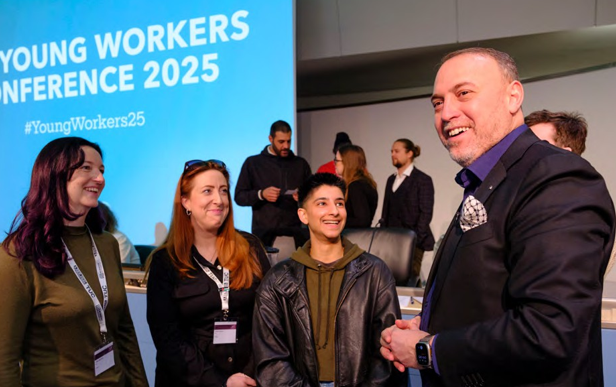
In April, general secretary Paul Nowak and assistant director for strategy and delivery Mariela Kohon visited Israel and Palestine. They met Palestinian workers involved in TUC Aid projects who described exploitative conditions in illegal settlements. Meetings were also held with the UK’s deputy ambassador to Israel, Palestinian authority ministers, the Histadrut and human rights NGOs including Al-Haq and B’Tselem. The delegation visited Palestinian communities under threat from settler violence,
and the general secretary addressed the Palestinian General Federation of Trade Unions’ Congress, reaffirming TUC solidarity.
We continued to advocate for:
- an immediate and permanent ceasefire and the release of all hostages and political prisoners
- immediate recognition of the State of Palestine
- revocation of the UK-Israel 2030 roadmap
- suspension of the UK-Israel Trade and Partnership Agreement
- an end to all licences for arms traded with Israel, meeting international law
- a ban on UK trade in illegal settlement goods
- decent work and public services in Gaza’s reconstruction
- sanctions on individuals inciting genocide against Palestinians.
In March, the TUC General Council issued a statement condemning violence in Gaza and produced a solidarity video for the UN’s International Day of Solidarity with the Palestinian People in November. The TUC supported workplace days of action for Palestine in November, February and May, and led efforts to secure a resolution on ETUC trade policy regarding Israel.
Palestinian Ambassador Husam Zomlot addressed the TUC Congress and also spoke at the Young Workers and Black Workers Conferences.
4.9 Human rights and labour standards
The TUC met with FCDO and DBT officials to advocate for new UK legislation mandating human, labour and environmental due diligence in global supply chains. It also collaborated with G7 sister centres to develop L7 positions for lobbying G7 ministers during Italy’s presidency. Eliza Ampomah represented the TUC at the L7 summit in Cagliari.
At the ILO Conference, the TUC delegation played a key role in securing agreement for a future convention on decent work in the platform economy. The ILO also adopted new standards on biohazards and informal workers’ rights. In the Committee on the Application of Standards, the TUC supported unions in Belarus, Georgia, Ghana, Hungary, Malaysia, Moldova and Zambia. The ILO voted to impose sanctions on Myanmar’s military regime and accepted Palestine as a non-member observer state.
The TUC supported an ITUC Africa-led ILO article 26 complaint against Saudi Arabia for severe exploitation of African migrant workers and the ban on independent unions.
4.10 Global trade union solidarity
Following the persecution of textile unions in Turkey, the TUC wrote to the Turkish embassy in protest. It also raised with the DBT concerns about trade union repression in the Philippines, urged the FCDO to support unions in Sudan, and backed efforts by Hong Kong trade unionists to organise workers in the UK.
Stay Updated
Want to hear about our latest news and blogs?
Sign up now to get it straight to your inbox