Post listing
'46' posts listed
Why does Reform UK want to rip up workers' rights? Follow the money
Reform UK invited unions to their conference, so we showed up to remind workers that Reform is not on their side. Last week, we held two major campaign actions outside the Reform Party conference in Birmingham to expose their links to offshore billionaires and how damaging their anti-worker policies are.

Equality doesn't end at the workplace door
At a time when Reform UK is calling for equality protections to be rolled back and some Reform-led councils are reducing visible support for LGBT+ communities, the public continues to back equality protections and LGBT+ inclusion.

A global breakthrough for platform workers: what the new ILO Convention means
Platform workers are for the first time the subject of a global labour standard following the adoption of the Decent Work in the Platform Economy Convention at the 114th International Labour Conference (ILC) in Geneva.

You have our support. It's time for the biggest wave of insourcing in a generation!
Last month, as part of the Our Work Matters campaign, seven brilliant public sector workers met with Chris Ward, the minister in charge of the government’s insourcing commitments.
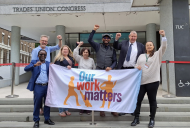
Reform UK wants to steal your rights - here's how workers are fighting back
Yesterday, union members and supporters held a day of action as part of the stop the steal campaign. Thousands of posters were delivered to workplaces and communities around the country to help spread the word about Reform UK’s threat to repeal the Employment Rights Act.

Why more than one million young people are out of work, education or training
The Milburn Review confirms the UK's NEET crisis is a long-term structural problem – not a result of workers' rights or higher pay.

A record-breaking rise in trade union membership
The most recent trade union stats brought some good news: trade union membership is up. In 2025, trade union membership rose by 192,000 and now sits at 6.57 million. This is the highest it’s been since 2020.
6 ways to protect jobs and households from the next gas price crisis
We can't keep paying the price for gas price shocks. Here's how to fix it.

The new Fair Work Agency – latest developments and union priorities
The new Fair Work Agency aims to strengthen enforcement of workers’ rights. This blog explains what it means, what’s changing next, and the key priorities unions will be pushing to ensure it delivers for working people.

Employment Rights Act 2025: What’s changing from 6 April
A further wave of employment rights introduced under the Employment Rights Act 2025 comes into force today.


Flexibility or fiction? Why the rise of talent platforms shows we need action on worker status
What do upmarket hotel Claridge’s, retailer Urban Outfitters and café chain Colicci’s have in common? They have all used so-called talent platforms: agencies that supply ostensibly self-employed workers to do roles such as shop assistants and baristas that most of us would expect to be employees.

It's official: Employment Rights Act will deliver a stronger fairer economy
Government officials have confirmed what unions and experts have been saying for years: better rights at work strengthen the economy as well as protecting workers. An updated impact assessment finds that the Employment Rights Act will improve working conditions and job security for 18 million workers, deliver a significant net gain to society, and provide a boost to growth and employment.

Employment Rights Act 2025: Narrowing the gap
Analysis led by Cambridge University researchers has confirmed that the government’s flagship Employment Rights Act 2025 will bring British employment protections closer to those of comparative countries.

Deadlock is broken – Employment Rights Bill passes
The Employment Rights Bill was finally passed by parliament. This marks a historic day for working people as the government’s flagship workers’ rights Bill has finally broken its House of Lords deadlock. Working people will enjoy more security, better pay and dignity at work thanks to this Bill, from now and for years to come.

The Conservatives’ plan to leave the ECHR is an attack on workers' rights
The Conservative Party’s latest flirtation with withdrawing from the European Convention on Human Rights (ECHR) is not just a reckless political stunt, it’s a direct threat to the rights and freedoms of working people across the country.

Don't let tribunal fees undermine the government's Plan to Make Work Pay
The government’s Plan to Make Work Pay promises stronger protections for workers, but apparent proposals to reintroduce employment tribunal fees risk undermining that progress.

Employment Rights Bill – a lifeline for four million insecure workers
The need for the government to rapidly implement its employment rights overhaul is laid bare by new TUC analysis that shows that one in eight workers is in insecure work.

Dear Prime Minister, deliver the Employment Rights Bill in full!
Four brilliant union members, Finnola, Sam, Ruweida, and Bella, headed to Parliament as part of the TUC's Make Work Pay campaign.
Public support fairer taxes to build a better Britain
Today's TUC polling confirms that across the UK there is support for fairer taxes - both to properly fund vital public services and to build a fairer country.

Obstruction on the line: Employment Rights Bill delayed by peers’ amendments
Workers anticipating overdue improvements to their rights will have to wait longer after Tory and Lib Dem peers voted to water down key protections.

The four big wins for workers in the new Industrial Strategy
To a stronger, fairer economy, one where more things are made in Britain by workers who are properly trained, fairly paid and respected for what they do. Much remains to still be done – but here are four key elements of the strategy that have a real potential to bring good jobs back to towns and cities across the UK.


New protections for workers closer as Employment Rights Bill approved by MPs
A major step was taken towards resolving key issues in the labour market last night after MPs voted to approve the government’s Employment Rights Bill.

Huge support for government’s plan to make work pay
The poll of over 21,000 people reveals huge backing across the country and across the political spectrum – including with Reform and Conservative voters – for key policies in Employment Rights Bill.

Protecting labour rights, human rights and the environment in global value chains
The Employment Rights Bill will greatly improve conditions for UK workers. Groundbreaking new rights will improve job security, strengthen labour market enforcement and facilitate greater collective bargaining through new union access rights and a Fair Pay Agreement in social care.

Sick pay decision for 2 million low-paid workers will impact families' living standards
How much should someone receive when they are off sick from work? This is the question that ministers will be considering in the early weeks of 2025. And the answer they arrive at will have a huge impact on many households’ budgets.

Collective voice: how the employment rights bill could boost the trade union presence at work
The bill sets out measures that will better equip unions to operate in modern workplaces. Including, union access to workplaces, fairer balloting rules, greater protection for trade unionists, beefed-up collective consultation rights, new rights for equality reps...

The Employment Rights Bill: a potential gamechanger
The government’s Employment Rights Bill offers a real moment of hope for working people. This landmark piece of legislation represents a positive and ambitious plan to make work pay. And it will benefit millions of workers, especially those trapped in low-paid and insecure employment.

A massive boost to workers’ rights: the new Employment Rights Bill
Within the 100-day deadline promised in opposition, the Labour government today tabled an employment rights bill that takes vital first steps in improving working lives for millions of people.

Huge support for Labour’s New Deal workers’ rights plans
A poll commissioned by the TUC shows huge backing across the political spectrum for improving protections at work and for the fundamental policies that underpin Labour’s New Deal for working people.
The New Deal gets one step closer
The new Labour government has taken the first step in reversing the country’s failed 14-year experiment with ultra-flexible labour markets by announcing plans for a law to boost workers’ rights.