Blog listing
Stay Updated
Want to hear about our latest news and blogs?
Sign up now to get it straight to your inbox
Welcome to TUC Congress 2026!
A great deal has happened since last year. We have seen a new prime minister enter Downing Street. We have witnessed conflict, instability and uncertainty on the international stage. And, of course, the ridiculous spectacle of Nigel Farage taking on a bin in Clacton.

We cannot give up on the fight for a better future
It’s not hard to see why things seem so bleak right now. Our politics feels fraught and divided with many people losing faith in our national institutions - and their ability to deliver.

Reflections on the General Strike, 100 years on
This year’s May Day celebrations have an added historical resonance for trade unionists. Monday 4 May marks the centenary of the start of the General Strike – a momentous event in British industrial and political history. But what is its real legacy? How did it shape trade unions in the decades after? And a century on, what are its lessons for today’s movement?
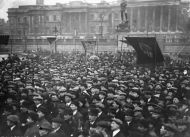
IWMD 2026 - Remember the dead. Fight for the living.
Today is our day. A day when workers across the world demand the right to be safe at work. A day when we call on governments, regulators and employers to act. And a day when we say, together: Remember the dead. Fight for the living.

Unity Works - and we're proving it again
Every day working people keep this country going - in our hospitals, shops, factories, railways and offices. And despite the challenges we face, there is a real appetite for change and a belief that Britain can do better.

HeartUnions week matters more than ever
This HeartUnions week help spread the message. Talk about unions. Be proud of what we achieve together. Because the truth is simple: when unions do well, working people do well - and when working people thrive, Britain becomes a fairer, kinder place for us all.

Only a relentless focus on living standards can stem the tide of the populist right
Government needs a relentless focus on affordability in 2026 or we risk the further rise of the far and populist right.

TUC Congress 2025 begins!
We're back in Brighton for our 157th TUC Congress. We come together at a pivotal time for working people, our movement and our country.
Video diary: My visit to the Israeli-occupied West Bank
Earlier this month, Paul Nowak visited the occupied West Bank, where he met with Palestinian trade unionists, Israeli and Palestinian human rights campaigners, and local politicians. Here are his reflections from the visit.

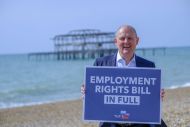
Huge support for government’s plan to make work pay
The poll of over 21,000 people reveals huge backing across the country and across the political spectrum – including with Reform and Conservative voters – for key policies in Employment Rights Bill.

Holocaust Memorial Day: remembering the past, striving for a better future
On January 27th the UK will observe Holocaust Memorial Day. It is a day we remember the millions murdered by the Nazis during the Holocaust, and in the genocides which followed in Cambodia, Rwanda, Bosnia and Darfur.

2025 has to be a year of delivery
Repairing and rebuilding Britain after 14 years of Tory chaos and decline is a massive challenge for the government. But 2025 has to be a year of delivery - continuing with the same broken status quo is not an option.

The Employment Rights Bill: a potential gamechanger
The government’s Employment Rights Bill offers a real moment of hope for working people. This landmark piece of legislation represents a positive and ambitious plan to make work pay. And it will benefit millions of workers, especially those trapped in low-paid and insecure employment.

Labour Conference 2024: A new era of hope and progress
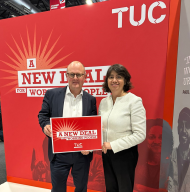
Paul Nowak reflects on Labour's first conference in power after 15 years, highlighting the party's commitment to the New Deal for Working People and the renewed importance of unions.
A win for our right to strike
This week, the government committed to formally repeal the Minimum Service Levels Act. This is an important milestone in the campaign to protect the right to strike that wouldn't have been possible without you.

How Labour can govern for working people
The trade union movement will work with Keir Starmer to deliver change.

It's time to apply the lessons of the minimum wage
Nowadays when we think of the national minimum wage (NMW), we think of what is roundly accepted as one of the great policy successes of our time. But we shouldn’t kid ourselves that there was unanimity about the need to raise wages.

Defending the right to strike: lessons from GCHQ
Forty years ago – on 25th Jan 1984 - Margaret Thatcher’s Conservative government attacked trade union rights at GCHQ.
Holocaust Memorial Day 2024
Freedom is fragile, and we must not take it for granted. That is the theme of this year’s Holocaust Memorial Day, marked on 27 January.

We won't stop defending the right to strike
After 13 long years of Conservative government, nothing works in this country anymore. But instead of getting on with fixing the mess they created, the government is focussed on attacking the right to strike.

It’s time to end the pay disparity that penalises disabled workers
Disabled people are more at risk of having to make the difficult decision between heating and eating.

We will defend the right to strike at all costs
Make no mistake – this is one of the most pernicious pieces of union-bashing legislation you will ever see.

We will not stand by and let them sack a single nurse, paramedic, teacher, railway worker or civil servant
It was fantastic to be joined by so many of you in Parliament Square on Monday night to send a clear message to the government:
We will not stand by while you attack our right to strike.

Ninety years on from the Nazi ban on free trade unions, the lessons remain relevant to us today
Ninety years ago, the Nazis banned free trade unions. Nine decades later, we remember this step towards tyranny and recommit ourselves to the defence of free trade unions in thriving democracies.

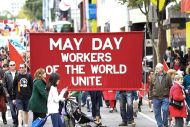
This May Day, let’s fight to win
This May Day, let’s resolve to fight for all working people, in all our wonderful diversity. Ultimately, that’s the best way to win the change we need.
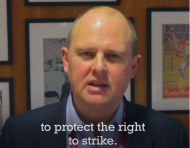
Defend the right to strike
Video blog: This week the government rushed their unfair, anti-democratic anti-strike bill through the House of Commons. Join our campaign to stop the bill.
“I want to build a stronger more diverse trade union movement”
I want my time leading the TUC to focus on one thing: making the trade union movement bigger, stronger and more diverse. That’s how we win for more workers.
UK government must follow US’ ‘worker-centred’ approach on trade
A fair and sustainable global trade is possible.

Why nuclear needs to be part of a just transition to a low-carbon economy
Unions support nuclear as part of a balanced energy mix that will deliver a just transition to a greener, fairer economy.