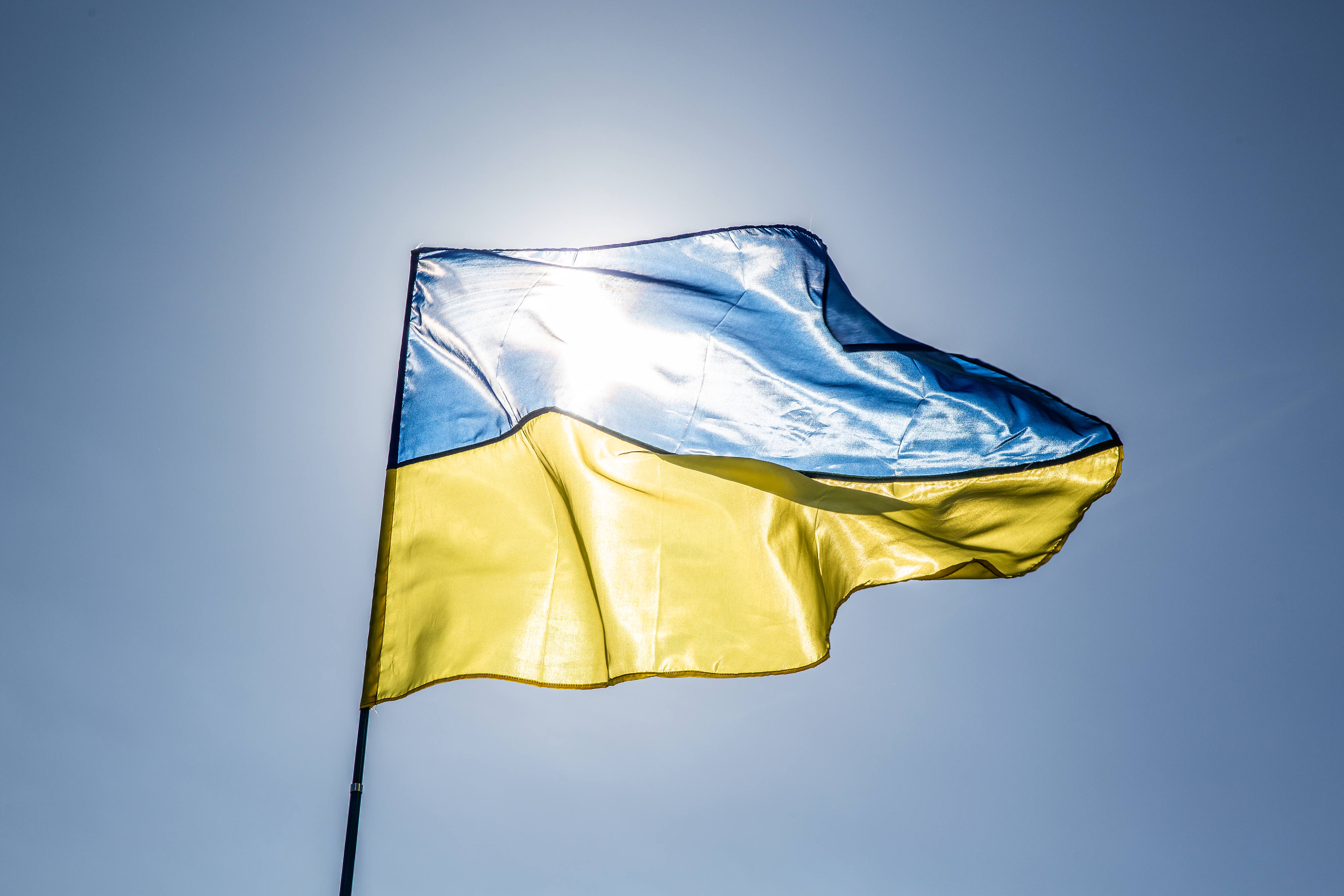

Ukraine now
Despite extraordinary pressure, Ukraine’s unions continue to defend workers, uphold democratic freedoms, and provide vital support to communities under fire. And as set out in the 2023 TUC Congress resolution C21 on Solidarity with Ukraine, the trade union movement in the UK stands firmly with them.
Unions on the frontline of resistance
Since February 2022, Ukrainian unions have carried out humanitarian work on a scale unprecedented in their history. Union‑run sanatoria have sheltered thousands of displaced people. FPU and KVPU affiliates have raised funds for protective equipment, generators, medical supplies and emergency repairs. Tens of thousands of union members now serve in Ukraine’s armed forces and territorial defence units.
Russia’s repeated attacks have also struck directly at the union movement. Recent ITUC reporting shows that trade union offices, education centres and miners’ unions in Donetsk and Vinnytsia have been hit by Russian missile strikes, part of a wider pattern of deliberate assaults on civilian infrastructure. 1
These attacks follow the same logic we see in occupied territories, where independent unions have been dissolved, workers forced into compliance, and activists detained, threatened or disappeared — clear violations of core ILO conventions on forced labour and freedom of association.
The challenges facing Ukraine’s unions today
Unions are playing a decisive role in keeping the country running — restoring power grids after attacks, supporting miners and transport workers under fire, and helping provide services in hospitals and schools. Yet they are also navigating a difficult domestic environment.
As highlighted in recent statements from UK and global unions, the Ukrainian government has continued to push labour‑market deregulation and the marginalisation of trade unions from public life — even as unions remain essential to the country’s survival. Proposed labour laws risk eroding collective bargaining, bypassing social dialogue and weakening workers’ rights at a time when workers’ contributions are central to national resilience.
The TUC and our international partners have been clear: if workers are essential to Ukraine’s defence, then their rights must be central to Ukraine’s future. This includes during wartime and in the reconstruction to come.
Global solidarity from the trade union movement
Across the world, unions have rallied to Ukraine’s side. Through theITUC,ETUC, and theILO Governing Body, trade unions have:
- condemned Russia’s aggression and the targeting of civilians
- documented labour‑rights abuses in occupied territories
- pressed governments to uphold humanitarian and military support to Ukraine
- coordinated assistance missions and material aid
- defended the role of FPU and KVPU in reconstruction planning
The ITUC’s most recent statement calls for “unwavering solidarity with Ukrainian workers and their unions in the face of continued aggression”, and highlights the scale of civilian casualties and attacks on union infrastructure.
UK unions have also acted together. On the fourth anniversary of the invasion, trade unions across Britain issued a joint statement 2 reaffirming solidarity with Ukraine’s workers and condemning forced labour, abductions, and the repression of trade union freedoms under Russian occupation.
TUC Congress Policy & our commitments
TUC Congress 2023 adopted Composite 21: Solidarity with Ukraine 3 , which sets out the movement’s clear position:
- Unconditional solidarity with Ukraine’s workers and trade unions
- Support for Ukraine’s right to self‑determination and for the withdrawal of Russian forces from all occupied territories
- Opposition to labour‑law deregulation that undermines workers’ rights
- Backing for a just reconstruction that embeds collective bargaining, social dialogue and decent work
- Support for Ukrainian refugees in the UK
And through our position in the International Labour Organisation we commit to:
- exposing violations of trade union and human rights in occupied areas
- using that role in the ILO to ensure international accountability
This policy and approach continues to guide our work with the FPU, KVPU and global union partners.
The road ahead
Ukraine’s unions have shown extraordinary courage and determination. They have kept workplaces operating under fire, defended democratic freedoms, and helped hold communities together through unimaginable hardship.
But they cannot do it alone. The international trade union movement — including the TUC and our affiliates — will continue to mobilise political, humanitarian and practical support. As the war continues and the work of reconstruction accelerates, our commitment is clear: strong unions are essential not only to winning the war, but also to winning the peace that must follow.
A short history of Ukraine's trade unions and how it shaped today's challenges
Since Ukraine’s independence in 1991, the country’s trade unions have undergone a profound and often turbulent transition. Both the Federation of Trade Unions of Ukraine (FPU) – the largest national centre and successor to the Soviet‑era union structures – and the Confederation of Free Trade Unions of Ukraine (KVPU) – formed from the post‑Soviet independent labour movement – have had to rebuild their role in a rapidly changing political economy, while defending workers’ rights amid repeated crises and ongoing conflict. Read more.