
Parents and unions agree: Educators need to be at the centre of AI in education
There is growing evidence that AI works worst when imposed from above. Across hospitals, offices, warehouses, and call centres, systems are sold by vendors, bought by executives, and handed down to workers. Problems surface late; adoption is uneven.
This is why the demand for 'worker voice' is diffusing from the labour movement into wider AI debates. When workers are shut out of decisions, AI systems are more likely to be unsafe, ineffective, or resisted. When workers have real influence, systems can be designed to solve real problems that improve work, rather than create new frustrations.
Nowhere is this more critical than in education. Efforts to bring technology into classrooms often mirror the worst features of top-down adoption elsewhere: opaque procurement, vendor-driven pilots, policies written far from the classroom. When AI adoption goes wrong in schools, educators’ working conditions suffer and children’s learning is affected. Giving educators a genuine seat at the table is critical to achieving better outcomes.
Unions are the primary vehicle for projecting worker voice at scale, and there is growing demand from the movement to understand, negotiate and advocate around AI and digital technologies. In response, the TUC and Connected by Data are leading a project focused on building educator power, bringing together nine education unions, to ensure AI and EdTech is shaped by educators.
Now research shows that parents agree.
What parents think
As part of this work, the TUC commissioned Survation to poll 1,251 UK parents of children under 18, to understand their views on AI in education. The survey explored parents’ awareness and understanding of AI, their trust in decision-makers, and their attitudes and concerns about AI in schools. The findings revealed that, while parents have significant and legitimate concerns about AI in education, they overwhelmingly trust educators to navigate these challenges, and they want educators firmly in control.
The data showed that parents have mixed views on the benefits of AI, and their confidence and enthusiasm correlates strongly along socio-economic lines. Parents with higher incomes, higher education levels, and experience of fee-paying schools were more confident in their understanding of AI and more likely to view it as having a positive impact on education (Figure 1).
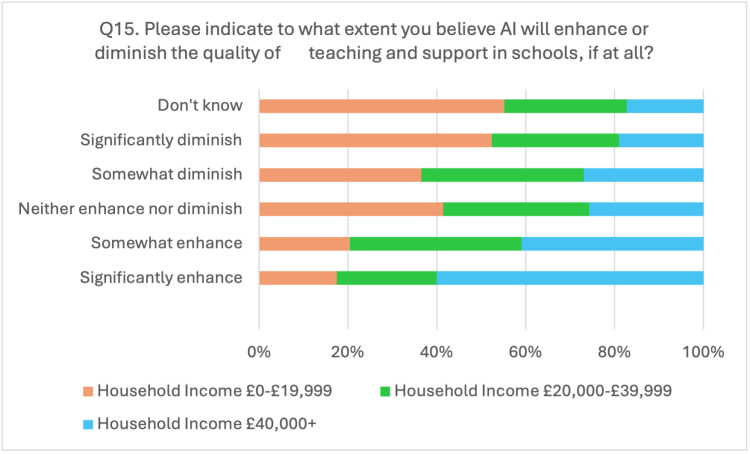
This gap likely reflects more than just digital literacy. Studies of digital transformation in public services show that technology complements existing institutional capacity — it tends to amplify what's already there rather than compensate for what's missing. Additionally, research by the Brookings Institution found that price barriers can exacerbate inequality between those schools that can afford the most advanced (and therefore the most accurate) AI models and those who cannot.
These concerns may be more front of mind to parents with lower incomes. Wealthier parents may be envisioning AI as another top-of-the-line tool in an already well-resourced school. For parents of children in under-resourced schools, the introduction of AI may be seen as more likely to compound existing problems than solve them.
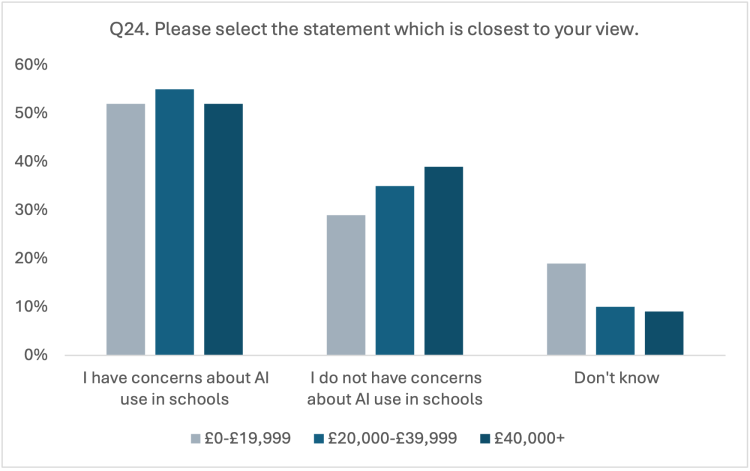
Despite these differences, half of parents report concerns about AI use in schools, regardless of income level (Figure 2). These concerns cluster around four issues: safety and wellbeing, data privacy, over-reliance on screens, and reducing teacher autonomy and professional judgement. Concerns about professional discretion are particularly pronounced among parents of special educational needs and disabilities (SEND) students, who are more worried than average about AI weakening the teacher-pupil relationship or stripping out professional discretion.
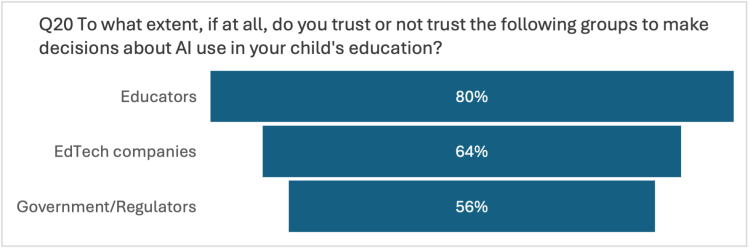
When asked what would increase their support for AI tools, the most powerful lever is educator endorsement. Half of parents say they would be more supportive of an AI tool if it were endorsed by educators. Across the survey, parents consistently say they want those closest to their children — teachers, specialists, school leaders, and other education staff — to be firmly in the driving seat when it comes to AI in schools. Educators are the most trusted group by a wide margin, with 80% net trust. Findings showed similar patterns across political lines: trust in educators was the majority for supporters of every political party based on 2024 General Election votes.
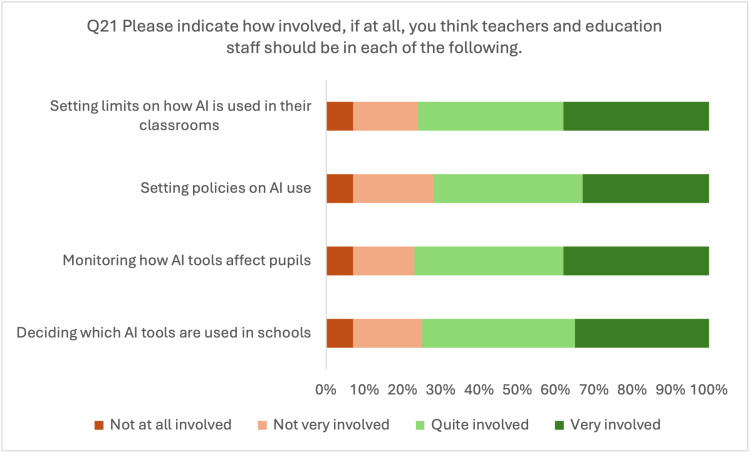
Even among parents who are the least confident using AI themselves — the group most sceptical overall — educators remain the most trusted group by far (Figure 4). Trust in EdTech companies and government shrinks for this group; trust in educators holds up. Parents also want educators to be keenly involved in AI governance — from setting policies, to deciding which tools are used, to monitoring impacts on pupils (Figure 5).
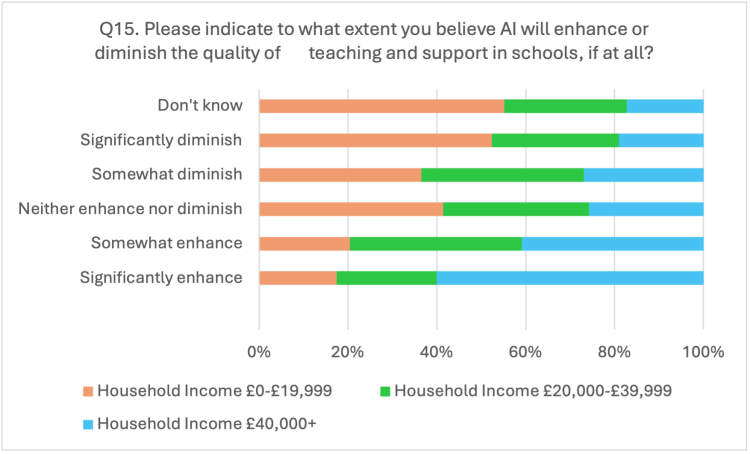
Overall, the poll showed that parents do not feel well informed about how AI is being used in schools, particularly those already facing disadvantage. They are not uniformly hostile to AI — in fact many are optimistic. Almost half of parents (47%) think AI will enhance teaching and support, while less than a quarter (23%) think it will diminish it. But uncertainty is high where confidence and information are low.
What parents do not want is AI entering classrooms quietly through procurement contracts, pilots, or national strategies, with educators expected to adapt after the fact. Instead, they want a system in which educators have a real voice and influence over AI from conception to adoption.
An urgent call for educator voice
The education unions involved in this project have set out what that model looks like.
To realise the potential of AI in education, educators and their unions must be central at every stage — from policy and design, through procurement and implementation, to evaluation. This is also the model parents are calling for: one that works for all children and keeps education human.
The joint statement includes the following:
As AI is being rolled out rapidly in education, there is an urgent need to ensure this is shaped by the expertise and professional judgement of these educators. We recognise that AI and education technology (EdTech) can complement human-centred education. But we know that AI cannot solve the education system’s deeper problems: underfunding, teacher shortages, overwhelming workloads, or the social and economic pressures educators face every day. And without clear guardrails, these technologies risk making existing problems worse and undermining both quality of education and students’ best interests.
To realise the potential that AI in education can offer, educators and their unions must be central to every stage of AI adoption, from policy formation and design, through procurement and deployment, to evaluation. All actors and institutions must ensure that AI and EdTech strengthens, not replaces or undermines, the vital relationships between all education workers and students.
End Notes:
Read more about the education project: Building educator power to shape AI
Source: Survation survey of UK parents for TUC, December 2025, n=1,251
Methodology: Online survey of 1,251 UK parents of children under 18, conducted by Survation on behalf of TUC and Connected by Data, 17-22 December 2025.
Stay Updated
Want to hear about our latest news and blogs?
Sign up now to get it straight to your inbox
