
Building a pro-worker AI innovation strategy
When working people think about AI 1 , what’s front of mind is clear: how will it affect our work and how will it impact our standard of living? 2
Predictions of the impact of AI on workers vary widely. Some foresee mass redundancies. 3 Others expect incremental shifts across industries. 4 Some anticipate economy defining boosts in productivity 5 and new jobs. Others predict marginal gains. 6
Some warn of surging inequality. As more tasks are automated, deskilled workers may be less able to command a good wage, with ever more wealth flowing to those who own the machines. 7 Others see the potential for workers to use generative AI as a tool to access new job opportunities, 8 while other forms of AI technologies may reduce hazards and automate drudgery.
The truth is: the future remains uncertain.
But one thing is clear. We know from experience that rapid technological advancement only delivers widespread social progress when working people are empowered.
Whether in the workplace or at the highest levels of regulation, workers’ voices, expertise and concerns should be a golden thread running through the UK’s approach to AI and innovation.
Doing so is the best chance to forge a positive path for AI and its impacts on workers, communities and society at large. A path that leads away from the prospect of unmanaged job displacement and entrenched wealth inequalities, and towards shared prosperity. A path that ensures public services are independent of unaccountable corporate power, and where the state protects the public from tech that exacerbates inequality and merely lining shareholders’ pockets.
A pro-worker AI innovation strategy for the UK should use every lever to shape technology towards good jobs, resilient public services and to drive socially useful innovation – for now and the future, at home and abroad.
This is complex work, fraught with uncertainty. While being critical of hype-cycles we must also recognise that today’s AI technologies are the least capable they will ever be. The UK has a duty to anticipate and manage change, not merely accelerate it. Failing to do so risks further straining the social fabric of our country, gifting the far-right fertile ground and undermining the political foundations of progress.
The TUC believes that a range of AI technologies can help build a better future. But that future is not inevitable, it must be actively built.
Fortunately, we do have the means to achieve this, including tried and tested tools to apply to new challenges. From the 19th century debates on ‘the machinery question’ to 20th century industrial automation, the labour movement was central to ensuring that technological change serves the common good, at work and in the wider economy. We intend to ensure that it does so again.
As the federation of 47 independent unions representing over 5 million workers in the UK, the TUC is calling for a step change from government to build a pro-worker AI innovation strategy.
Below we set out some of the key building blocks such an approach should take, identifying immediate interventions and next steps across the following areas:
2. Returning public value to public services
3. Securing a digital dividend for workers and productive investment
4. Pro-worker AI regulation and upgrading rights
5. Supporting workers during change
Please get in touch with Adam at acantwell-corn@tuc.org.uk to discuss this report or related issues
- 1 For the purposes of this paper, the OECD definition of AI is used to reflect the range of AI technologies and use cases. https://www.oecd.org/content/dam/oecd/en/publications/reports/2024/03/e…
- 2 TUC polling, July 2025, conducted by Survation. Conducted via online panel of 2605 UK adults aged 18+.
- 3 IPPR (2024) Up to 8 million UK jobs at risk from AI unless government acts, finds IPPR. Available at: https://www.ippr.org/media-office/up-to-8-million-uk-jobs-at-risk-from-…
- 4 HiBob (2025) The reality of AI in the workplace and its impact on entry-level jobs. Available at:
https://www.hibob.com/research/the-reality-of-ai-in-the-workplace-and-i…
- 5 McKinsey & Company (2025) Superagency in the workplace: empowering people to unlock AI's full potential at work.
Available at: https://www.mckinsey.com/capabilities/mckinsey-digital/our-insights/superagency-in-the-workplace-empowering-people-to-unlock-ais-full-potential-at-work - 6
Acemoglu, D. (2024) What do we know about the economics of AI? MIT Economics. Available at:
https://economics.mit.edu/news/daron-acemoglu-what-do-we-know-about-economics-ai - 7
UNI Global Union (2025) UNI at WEF25 on AI inequality. Available at: https://uniglobalunion.org/news/uni-at-wef25-on-
ai-inequality/ - 8 Autor, D. (2025) Professor David Autor on how AI could help rebuild the middle class. MIT Shaping Work. Available at:
https://shapingwork.mit.edu/news/professor-david-autor-on-how-ai-could-help-rebuild-the-middle-class/

1. Innovation for good work
What we know
The UK has world-class scientific and technology research capabilities. These are supported by billions of pounds in public funding, through universities, public agencies and private sector partners. This system of innovation should be better geared to support technological development for good work.
UK Research and Innovation (UKRI) – a public research and development funding agency – received £25 billion in public funding over three years between 2022 – 2025. 9 In the June 2025 Comprehensive Spending Review, the UK government announced a package of funding worth £22.5 billion per year by 2028/29 10 for science and technology. A raft of other initiatives is in the works. The TUC supports such public funding for science and innovation, especially where the private sector is unlikely to invest. However, this research and funding can shape technologies that eventually may impact workers, positively and negatively - from self-driving vehicles 11 to EdTech. 12 Despite this impact, the innovation eco-system lacks systematic consideration of and participation from workers. This needs to be rebalanced.
Working with technologists, workers and unions can help steer the UK’s research and innovation towards worker’s priorities for automation,13 the development of high- skilled work 14 and the effective development of productivity enhancing applications, avoiding job cutting low productivity automation.15 16 These AI technologies may be ‘narrow’ and application specific, designed to reliably solve an identifiable challenge, rather than the current emphasis on general purpose Large Language Models (LLMs).
- 9 UK Research and Innovation (2022) 2022-23 – 2024-25 budget allocations for UK Research and Innovation, Available at: https://www.ukri.org/wp-content/uploads/2022/06/UKRI-241023- BudgetAllocationExplainer2022To2025.pdf
- 10 HM Government (2025) Transformative
£86 billion boost to science and tech to turbocharge economy with regions backed to take cutting-edge research into own hands. Available at:
https://www.gov.uk/government/news/transformative-86-billion-boost-to-s…- turbocharge-economy-with-regions-backed-to-take-cutting-edge-research-into-own-hands - 11 HM Government (2025) UK government funding to boost self-driving transport technologies. Available at:
https://www.gov.uk/government/news/uk-government-funding-to-boost-self-…- technologies
- 12 HM Government (2024) Teachers to get more trustworthy AI tech as generative tools learn from new bank of lesson
plans and curriculums. Available at: https://www.gov.uk/government/news/teachers-to-get- more-trustworthy-ai-tech-as-generative-tools-learn-from-new-bank-of-lesson-plans-and- curriculums-helping-them-mark-homework-and-save
- 13 Stanford HAI (2025) What workers really want from artificial intelligence. Available at: https://hai.stanford.edu/news/what-workers-really-want-from-artificial-intelligence
- 14 The Pissarides Review into the Future of Work and Wellbeing (2025) Final Report. Available at: https://static1.squarespace.com/static/61e471292531e621931e557d/t/67a08… 0f7/1738572041937/TPR-FinalReport-26-01-25v4.pdf
- 15 MIT Shaping Work (2023) Pro-Worker AI Policy Memo. Available
at: https://shapingwork.mit.edu/wp-content/uploads/2023/09/Pro-Worker-AI-Po…
- 16 Acemoglu, D. and Johnson, S. (2023) 'Rebalancing AI', Finance & Development, December. Available at:
https://www.imf.org/en/Publications/fandd/issues/2023/12/Rebalancing-AI…
Working with technologists, workers and unions can help steer the UK’s research and innovation towards worker’s priorities for automation
With millions of members from the front lines of social work to nuclear power and transport, unions and workers can bring vital expertise, diverse perspectives and democratic accountability to the core of the UK’s innovation ecosystem.
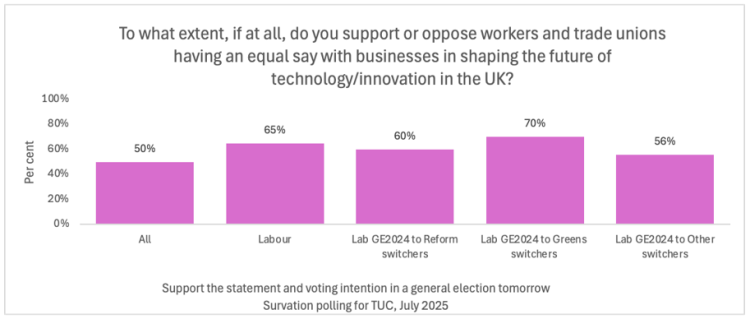
Over half of British voters think the future direction of technology and innovation should be democratically shaped in this way, with input from workers, unions, and the public. This view is even stronger among General Election 2024 Labour voters, including those currently intending to switch to Reform and the Greens.17
- 17 TUC polling, July 2025, conducted by Survation. Conducted via online panel of 2605 UK adults aged 18+.
What is needed now
- Innovation governance and direction setting: Key public institutions at the core of the UK’s research and innovation eco-system should be mandated to actively engage with workers and trade union representatives when developing and delivering strategic plans, funding and evaluation of technologies that have a direct impact on workers and the labour market. This includes institutions such as the UKRI, Innovate UK, and the Catapult Network.
Led by the Department of Science Innovation and Technology (DSIT) and alongside specific departments or public bodies, the government should support publicly funded collaborative research programs between unions, universities, and industry in key sectors to research and develop worker-complementary technologies. These can include sectors identified in the Modern Industrial Strategy, as well as industries and roles that are particularly exposed to disruption from AI – such as finance, law, communications and marketing, creative industries, computer programming and gaming.
What to progress next
- The UK’s public finance institutions: The British Business Bank and National Wealth Fund – can be primed as central actors in driving AI and innovation. These organisations should prioritise investment that support companies and technologies that improve or create good jobs – including through prioritising equity stakes that grant the public more control (rather than loans) and conditionality of public support on delivery of quality jobs, as well as ‘employment charters’. 18
- The UK’s AI Research Resource: The UK’s public AI compute 19
is set to expand with a £1billion budget with the intention to allocate use to national priorities – this should include initiatives that support good work and jobs.
Embedding unions in the US innovation system
Developments under the Biden administration in the United States offer a compelling model for embedding trade unions within the governance of national innovation strategy.
The CHIPS and Science Act (2022) formally established a role for organised labour within the National Science Foundation (NSF), a central institution in the US innovation ecosystem. The Act created a new directorate – the Directorate for Technology, Innovation and Partnerships (TIPs) – which is legally required to “incorporate a worker perspective through participation by labor organizations and workforce training organizations”. 20 The Act also mandated the creation of an advisory committee to the TIPs directorate, explicitly including “labor organizations and representatives of civil society.”
Reflecting this new mandate, in 2024 the AFL-CIO (the main US federation of unions) announced a landmark five-year partnership with the NSF. 21 The programme will build collaborative research initiatives where STEM researchers work alongside the unionised workforce, ensuring that future technological developments are inclusive, equitable, and worker-informed.
This will build on landmark projects at leading universities, including:
- Transit workers collaborating with Carnegie Mellon University (CMU) to shape policy on automated public transport 22
- Hospitality workers creating pro-worker algorithmic management tools with CMU researchers 23
- Manufacturing unions partnering on human-centred robotics development at CMU 24
- Researchers from MIT collaborating with workers and unions to demonstrate that worker voice is essential for the effective and responsible implementation of generative AI. 25
These programmes are under threat from the second Trump administration.
2. Returning public value to public services
What we know
Public services are under pressure, and technology has a key role to play in driving excellence. But the challenge is not merely technical, but one of governance, diverse expertise and leveraging the unique position of the state to shape the market and drive high standards. Public sector workers are a key asset for this.
The public sector has been positioned by the UK government as a key driver of AI adoption, to reduce costs, reform public services and attract investment. 26 Procurement is a primary mechanism for this, with £14 billion annually in public money flowing to private tech providers. 27 This is likely to rise as the flagship policies in the AI Action Plan 28 and Blueprint for Modern Digital Government 29 are implemented.
The National Audit Office has identified the entrenchment of ‘Big Tech’ within public sector technology as a particular issue, with a small set of companies wielding market power to set terms and standards of AI technologies.30 If properly understood as critical public infrastructure, the embedding of AI systems provided by non-UK tech companies presents operational and political risks - advanced AI tech companies are increasingly key actors in the economic and geopolitical dynamics among nations. The dominance of such big players can also squeeze opportunities for domestically domiciled companies to grow, pay tax, employ local workers and play by the rules of the UK – all of which support the UK’s growth ambitions.
Initiatives by the government to support UK based SMEs to access public technology procurement opportunities are welcome. Increasingly, however, currently non-financial arrangements are being made outside of accountable procurement processes with Memorandum of Understanding agreements struck by the government with OpenAI, Anthropic 31 and Cohere. 32 The pursuit by tech firms to strike partnerships with governments is in a context where astronomical sums of money have been invested in LLM technologies that do not have a clear route to profitability or conclusive evidence of impact on productivity. 33
- 18 TUC (2022) Linking employment charters to procurement, London: Trades Union Congress, Available at: https://www.tuc.org.uk/research-analysis/reports/linking-employment-cha…- procurement
- 19 HM Government (2025) AI Research Resource allocation framework. Available at: https://www.gov.uk/government/publications/ai-research-resource-allocat…
- 20 U.S. Congress (2022) H.R.4346 - CHIPS and Science Act, Subtitle G, 117th Congress. Available at: https://www.congress.gov/bill/117th-congress/house-bill/4346/text
- 21 Jyotishi, S. (2024) 'Labor meets science policy: NSF and AFL-CIO announce partnership', Forbes, 10 October. Available
at: https://www.forbes.com/sites/shalinjyotishi/2024/10/10/labor-meets-scie…- afl-cio-announce-partnership/ - 22 Fox, S. and Martelaro, N. (2022) 'New research offers recommendations for integrating autonomous driving tech into public transportation', Carnegie Mellon University Human- Computer Interaction Institute, 16 May. Available at: https://hcii.cmu.edu/news/new-research- offers-recommendations-integrating-autonomous-driving-tech-public-transportation
- 23 Forlizzi, J., Fox, S. and Kulkarni, C. (2024) 'Hospitality workers in the age of automation', Carnegie Mellon University Block Center Research, Medium. Available
at: https://medium.com/@CMUBlockCenter/block-center-research-spotlight-hosp…- workers-in-the-age-of-automation-9a6b64b179c8 - 24 CMU Block Center (2022) 'Bringing workers' voices into tech development and
deployment', Medium, 18 May. Available at: https://medium.com/@CMUBlockCenter/bringing- workers-voices-into-tech-development-and-deployment-38c137cb59b3 - 25 Kochan, T.A., Autor, D., Finkel, D., Handel, M., Rolf, D. and Sabel, C. (2023) 'Bringing worker voice into generative AI', MIT Sloan Working Paper, December. Available at: https://mit- genai.pubpub.org/pub/obr01l0u/release/1?readingCollection=7e70f4fe (Accessed: 30 July 2025).
- 26 HM Government (2025) AI Opportunities Action Plan. Available
at: https://www.gov.uk/government/publications/ai-opportunities-action-plan…- action-plan
- 27 House of Commons Public Accounts Committee (2025) Digital reforms: Government has mountain to climb but does not yet understand size of challenge. Available at: https://publications.parliament.uk/pa/cm5901/cmselect/cmpubacc/640/repo…
- 28 HM Government (2025) AI Opportunities Action Plan. Available
at: https://www.gov.uk/government/publications/ai-opportunities-action-plan…- action-plan - 29 HM Government (2025) A blueprint for modern digital government. Available at: https://www.gov.uk/government/publications/a-blueprint-for-modern-digit…- blueprint-for-modern-digital-government-html
- 30 ICAEW (2025) 'NAO: Rethink on government Big Tech procurement needed', Insights, January. Available at:
https://www.icaew.com/insights/viewpoints-on-the-news/2025/jan-2025/nao…- government-big-tech-procurement-needed - 31 HM Government (2025) Memorandum of Understanding between the UK and Anthropic on AI opportunities. Available
at: https://www.gov.uk/government/publications/memorandum-of-understanding-…- the-uk-and-anthropic-on-ai-opportunities/memorandum-of-understanding-between-uk-and- anthropic-on-ai-opportunities - 32 HM Government (2025) Memorandum of Understanding between the UK and Cohere on AI opportunities. Available at:
https://www.gov.uk/government/publications/memorandum-of-understanding-…- uk-and-cohere-on-ai-opportunities - 33 Computer Weekly (2025) 'What happens if Silicon Valley's AI investment bubble bursts?', Computer Weekly, Available at: https://www.computerweekly.com/feature/What- happens-if-Silicon-Valleys-AI-investment-bubble-bursts
Years of austerity, fragmentation and outsourcing have undermined the public sector’s capacity to both develop tech in-house or to secure a good deal for the taxpayer and public service workers and users.
Where public procurement is deployed, the Public Accounts Committee has found that the government is not leveraging its massive buying power for technology.34
Years of austerity, fragmentation and outsourcing have undermined the public sector’s capacity to both develop tech in-house or to secure a good deal for the taxpayer and public service workers and users.
This extends beyond Whitehall, with public sector organisations unable to switch providers due to ‘vendor lock in’, and inappropriate or poorly managed systems bringing risks to public trust and service quality. This is starkly illustrated by individual schools negotiating complex contracts with tech providers in an unregulated market of unproven technologies that are then deployed in classrooms. 35
Worker involvement in procurement and general digitalisation processes can help address these challenges.
Millions of workers with commitment and expertise – from civil servants to NHS workers and teachers - have the experience to understand pain points, nuances of service delivery and effective design of solutions.36 Failing to use their expertise can reduce job and service quality, and leaves workers to find inefficient work-arounds to poorly considered systems 37 38 – such as the error-prone introduction of an automated system at the Legal Aid Agency as detailed below.
Proper training and meaningful engagement of workers, including via their trade unions, will also enable services to spot and flag potential harms or issues early on. UK public services should seek to learn from AI scandals that have happened in other countries. For example, the Dutch welfare bias scandal 39 and Australian ‘Robodebt’ case 40 that saw thousands of individuals wrongly or inappropriately prosecuted or sanctioned by the state due to algorithmically amplified bias in automated public services.
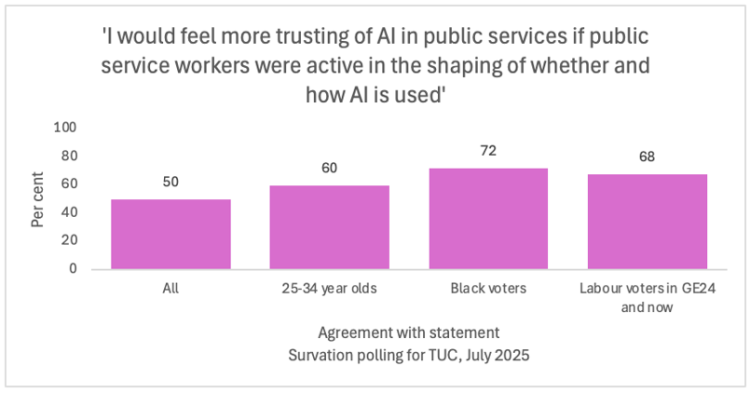
Empowering public sector workers to shape AI technologies will help to address the growing public concern about the role of private sector technology providers in sensitive public services. 41 Half of voters state that they would be more trusting of AI in public services if workers were actively involved. 42 This rises for communities with higher levels of distrust in public, 43 with 72 per cent of Black voters stating that worker involvement would improve their trust in the use of AI in public services.
- 34 House of Commons Public Accounts Committee (2025) Digital reforms: Government has mountain to climb but does
not yet understand size of challenge. Available
at: https://committees.parliament.uk/committee/127/public-accounts- committee/news/207232/digital-reforms-govt-has-mountain-to-climb-but-does-not-yet- understand-size-of-challenge/ - 35 LSE (2023) Schools and artificial intelligence: governance, risk and responsibility. Available at: https://eprints.lse.ac.uk/119737/
- 36 MIT (2024) Worker voice in AI implementation. Available at: https://mit- genai.pubpub.org/pub/obr01l0u/release/1
- 37 Connected by Data (2025) Case study: Legal Aid Agency. Available
at: https://connectedbydata.org/resources/case-study-legal-aid-agency - 38 Connected by Data (2025) Case study: Legal Aid Agency. Available
at: https://connectedbydata.org/resources/case-study-legal-aid-agency
- 39 Amnesty International (2021) 'Xenophobic machines: Dutch child benefit scandal', 25 October. Available at:
https://www.amnesty.org/en/latest/news/2021/10/xenophobic-machines-dutc…- scandal/
- 40 Blavatnik School of Government (2023) 'Australia's Robodebt scheme: a tragic case of public policy failure'. Available
at: https://www.bsg.ox.ac.uk/blog/australias-robodebt-scheme-tragic-case-pu…
- 41 Ada Lovelace Institute (2025) Licence to build: public attitudes to AI in public services. Available at:
https://www.adalovelaceinstitute.org/policy-briefing/licence-to-build/ - 42 TUC polling, July 2025
- 43 NHS Race and Health Observatory (2025) 'Patients report alarming lack of trust in NHS primary care providers', NHS RHO, March. Available at: https://nhsrho.org/news/patients-report- alarming-lack-of-trust-in-nhs-primary-care-providers/
What is needed now
- Building public sector tech capabilities: AI and digital systems should be developed and delivered in-house by default, with procurement only where demonstrable capacity gaps exist. Guidance should be developed on how procurement of AI and digital systems aligns with the government’s new Public Interest Test, enabling public authorities to assess whether work or services can be better delivered in-house. 44 This requires further investment in foundational public sector digital and commercial skills, structuring procurement to reduce lock-in and dependencies and ensuring public ownership of tools developed with public money.
- Support public sector collective purchasing power: A powerful way for the public sector to make sure it gets the best deal and to shape the AI technology market is to use collective purchasing power. Schools unions, for example, have shared that each school should not have to negotiate individually with a technology supplier, building on work that is already supporting schools to make savings on their energy contracts. Central or local government coordinating functions should support bodies in this task, including bringing together public sector purchasers to drive economies of scale and enhance their negotiating power.
- Shape the market with mandatory good work standards in all contracts: The government should place a statutory duty on contracting authorities to include clauses requiring trade union access and recognition, decent terms and conditions (including the honouring of two-tier regulations), skills development and measures to support equalities among the supplier’s workforce during the delivery of all public contracts. Access to public contracts should be conditional on meeting minimum decent work requirements.
- Worker voice throughout digital transformation, including procurement: Ensure meaningful worker participation at every stage to drive effectiveness of technology - from strategy development to problem definition, through to tender, application design and deployment. The newly formed Digital Commercial Centre of Excellence should draw on worker expertise and experience to support the extensive plans for digitalisation and AI in public services 45
and look to cases of developing best practise and standards, including in Wales. 46
Both Cabinet Office and DSIT could play a role in coordinating strategic engagement with public services unions, given their responsibilities with regard to public services workforce and AI respectively. A high-level consultative structure – such as reconvening the Public Services Forum – would better enable unions to support workers to understand, engage with, and, where possible, identify shared objectives regarding the rollout of AI.
This should include clear routes for workers to report procurement breaches, for example if a contract is awarded to an employer with track record of bad practice in adherence to labour standards or following a contravention of employment standards – whether employment law (including the new two-tier Code) or other employment standards stipulated within a public contract.
What to progress next
- Supporting the UK AI sector: The government has made some welcome changes to support UK firms and SMEs in accessing government procurement opportunities, better enabling domestic innovation, raising tax receipts and increasing compliance. The government should consider how to further support UK firms that proactively engage with unions to create skilled jobs in technology research and design.
What happens when workers are ignored during procurement for digital transformation?
The Legal Aid Agency processes fee claims from legal professionals for their work on legal aid cases. In 2016 a new system was introduced via procurement as part of a wider digitisation programme, including the automation of assessing and awarding payment claims made by barristers. Case workers were not consulted on the introduction and functionality of the system, and there were weak mechanisms to feed back on its operation and impacts on workers and other stakeholders.
Among wider significant disruption, it became apparent that the system had been incorrectly assessing claims, with a 19 per cent error rate (compared to 3 per cent for case workers) leading to costly overpayments, audits, corrections and revisions, as well as additional staff workload, disruption and dissatisfaction. A PCS union representative was central to identifying the issue and eventual resolution.
Source: Connected by Data
3. Securing a digital dividend and productive investment
What we know
While the current evidence is inconclusive, AI technologies have the potential to bring about significant productivity gains by enabling tasks performed by workers to be automated and sped up. Workers must capture a fair share and gains must be productively invested.
Though still plagued by inaccuracies or high task failure rates 47 and other risks such as privacy or taking unwanted actions, 48 AI technologies have rapidly improved in a short period of time. The latest generative AI models can create high quality sound-enabled videos instantly, produce research reports and legal documents and code new applications. Agentic AI - systems that can sequence a full series of tasks - are demonstrating 49 improved capabilities. AI-enabled robots are increasingly performing high-dexterity tasks, 50 signalling impact for workers in a range of settings.
Many workers will have used these systems, including to their benefit to save time, or to leverage new skills and information. As the technical capabilities grow and AI systems become more formally embedded in jobs and workplaces, the key question is who will capture these gains?
If workers - individually and collectively - are to gain a share in productivity increases, then collective bargaining is a key means to achieve it. 51 52 Collective bargaining redresses the power imbalance between workers and employers, enabling workers to negotiate their fair share of the value created – most commonly through wages, but also through reduced working time, improved conditions and professional development opportunities.
The rights of workers to unionise and collectively bargain will be significantly boosted by the reforms within the Employment Rights Bill currently in parliament. It is vital that collective bargaining coverage is significantly extended to avoid an unfair distribution of the gains from technological development and subsequent deepening of inequality. This is especially true in sectors of the economy that are highly exposed to task automation, job displacement and harmful uses of algorithmic management but with very limited unionisation, from the low wage platform economy 53 to the professional services sector. 54
Along with extending collective bargaining, the current and potential impacts of AI also call for an urgent shift in how companies are managed. Current corporate governance law and practice is overly focused on shareholders, including remote and detached investors who too often prioritise securing short-term profits.55 This can lead to corporate behaviour that is without due concern for impact on the workforce or other factors, such as the environment. It also contributes to chronically poor private sector investment rates, placing Britain persistently as the lowest performer in the G7.56 A similar dynamic contributes to very low private sector investment for in-work skills development, compared to similar nations. 57
These issues predate the current wave of AI yet may be exacerbated. Short term priorities driven by our corporate governance system mean that AI may be used by some employers to cut costs and automate existing processes, rather than to productively invest, expand and innovate. 58 59 Such decisions will more likely displace or deskill workers rather than augment, expand or retrain the workforce as part of technological upgrading.60 61 At a systemic level, this may deepen the UK’s stark income and wealth inequality; 62 if machines do more tasks and reduce the demand for skilled workers or for labour overall, workers could become less able to command a fair share, with the surplus increasingly captured by employers and AI companies. 63 64
Collective bargaining and empowering worker voice are tried and tested approaches for addressing these concerns, and the need to leverage these tools is given renewed urgency by AI. Such reforms will also place us closer to peer countries.65 France and Germany have much higher levels of workers covered by unions with collective agreements 66 while productivity and investment rates far outstrip the UK’s. 67
Just a quarter of voters think AI innovation should primarily be driven by investor priorities, while over half the population support the role of workers and unions in shaping innovation. This rises to 65 per cent of Labour voters, 60 per cent of Labour voters considering switching to Reform and 70 per cent of Labour voters switching to the Green Party. 68
What is needed now
- Support collective bargaining across the economy: The Employment Rights Bill will strengthen the rights of workers to come together in unions and win union recognition with their employers. Over time, this should extend collective bargaining coverage across the economy.
The scope of collective bargaining should include (along with other issues) training and development, work organisation and the introduction of new technologies, including AI. The government should reform the statutory recognition framework to include these (and other) issues within the scope of collective bargaining agreements. 69 Unions and employers are encouraged to review the scope of existing collective bargaining agreements.
Many of the ways in which AI will affect workers will vary from sector to sector. Sectoral bargaining can therefore play a vital role in setting sectoral standards for the application of AI that promote high standards of job quality and employment. The government should put in place a framework to extend sectoral bargaining and fair pay agreements beyond social care. - Reform corporate governance: Firms must be incentivised to look beyond short- term shareholder value. Company reporting on employment matters should include the impact of AI on employment, and workers should gain representation on boards to provide a workforce perspective on company decision-making, including engagement in technology strategy. This will support effective adoption and deployment, a fair distribution of gains and enfranchisement of workers in the long- term success of the firm. Policy changes to support this include:
– Amend directors' duties to require directors to focus on long-term company success as their primary aim, taking account of the interests of stakeholders including the workforce, shareholders, suppliers, customers and the local community and impacts on human rights and the environment.
– Change 'employee' to 'workforce' in the Companies Act to require companies to report on their whole workforce, not just employees.
– Worker directors, elected by the workforce, should comprise one third of the board at companies with over 250 staff. 70
Union and employer Joint Declaration on Employment Aspects of Artificial Intelligence in the European Banking Sector
In 2024, the European-level union UNI Global and three major employer federations in the banking sector signed the first comprehensive sectoral AI agreement in the EU. 71 The declaration stated that “social dialogue at all levels, including collective bargaining, represents an effective and positive tool for addressing the issue of the impact of new technologies and digitalisation in the workplace.”
The agreement contained a number of key provisions around AI and workers. These include:
Human-in-Control Principle
The declaration establishes that "humans will be kept at the centre of work organisation, with full respect for the human-in-control principle." Specifically:
- Employees have "the right not to be subject to decisions that affect them legally and significantly based solely and exclusively on automated variables"
- Human oversight is required for all decisions on hiring, promotion, performance evaluation, and disciplinary actions
- Workers can challenge and appeal AI-driven decisions
Training and Skills Development
- Employers must "provide necessary training to adapt to new technologies, during working hours"
- The agreement calls for EU and national government funding of training programs
- Emphasis on lifelong learning and "AI literacy" for all workers
AI Surveillance Limitations
- "The use of AI in surveillance to monitor employees should be limited, transparent, proportional and in compliance with existing collective agreements and national or local law."
Data Protection
- Strict limits on employee data collection based on "principles of relevance, non-excessiveness, transparency and proportionality"
- An undertaking that "workers' data should not be sold"
Social dialogue and collective bargaining
Banks must engage in "continuous monitoring through social dialogue and collective bargaining" regarding AI implementation, use, and ongoing assessment.
Implementation Framework
The agreement operates at three levels:
- European sectoral level: Overall framework and monitoring
- National sectoral level: Adaptation to national laws and practices
- Company level: Specific implementation including European Works Councils
Monitoring includes continuous dialogue through sectoral meetings and a full evaluation planned towards the end of the 2025-2026 ‘Work Programme’.
What to progress next
• A fair and productive tax system:
The potential impact of AI underscores the general and longstanding need for taxation reform to avoid a further lopsided distribution of wealth, avoid disproportionate tax on work and to encourage productive investment – this is recognised across the board, including by International Monetary Fund. 72
Wealth taxes should be part of a targeted approach to ensure the value from productivity is captured fairly and put to broader social use, and to ensure those most able pay their fair share towards public services.
Among other changes, the TUC is calling for the government to equalise the rate of capital gains tax with income tax, so that income not derived from work is not rewarded disproportionately.
Consideration should also be given to the taxation of excessive bank profits by increasing the bank surcharge that was slashed by the previous government.The tax regime should also be evaluated to consider effective means to incentivise investment in labour-augmenting rather than displacing AI automation technologies. 73
74
4) Pro-worker AI regulation and upgraded rights
What we know
Inappropriate use of algorithmic management tools to monitor workers, allocate tasks, rewards and sanctions have a negative impact on staff wellbeing, productivity and industrial relations. 75 76 The regulatory system needs to be upgraded to protect workers and to leverage worker voice for effective and fair AI use.
Urgent action is needed to bring our laws up to speed so that people are protected from the risks and harms of AI-powered decision making in the workplace, particularly workers most exposed to AI harms due to protected equalities characteristics.
Employers and businesses will also benefit from the establishment of legally backed high standards of responsible use of AI, preventing a race to bottom of unscrupulous employers who exploit the current vacuum in technology-related rights at work.
Such rights bring added benefits beyond essential protections for workers. Evidence is growing that a strong worker voice is essential for effective deployment of AI and innovation in the workplace.77 Workers are the experts in the jobs they do. Workers understand the complexity of tasks, the nuance of on-the-job judgments, the rhythms of real workplaces - all necessary for effective AI uses. As with previous technological change, it is workers that ’give wisdom to the machine’.
- 44 Labour (2024) https://labour.org.uk/wp-content/uploads/2024/06/MakeWorkPay.pdf
- 45 HM Government (2025) A blueprint for modern digital government. Available at: https://www.gov.uk/government/publications/a-blueprint-for-modern-digit…- blueprint-for-modern-digital-government-html
- 46 Welsh Government (2025) Social Partnership and Public Procurement (Wales) Act. Available at: https://www.gov.wales/social-partnership-and-public-procurement-wales-act
- 47 Futurism (2025) 'AI agents are failing across industry', March. Available at: https://futurism.com/ai-agents-failing-industry
- 48 Sifted (2025) 'The hidden risks of AI agents', February. Available at: https://sifted.eu/articles/the-hidden-risks-of-ai-agents
- 49 METR (2025) 'Measuring AI ability to complete long tasks', 19 March. Available at: https://metr.org/blog/2025-03-19-measuring-ai-ability-to-complete-long-…
- 50 Financial Times (2025) AI robots: the future of work. https://ig.ft.com/ai-robots/
- 51 OECD (2019) Negotiating our way up: collective bargaining in a changing world of work. Available at:
https://www.oecd.org/content/dam/oecd/en/publications/reports/2019/11/n…- way-up_16bd8a10/1fd2da34-en.pdf - 52 International Monetary Fund (2016) Inequality and Labor Market Institutions. Staff Discussion Note. Available at:
https://www.imf.org/en/Publications/Staff-Discussion-Notes/Issues/2016/…- Labor-Market-Institutions-42987 - 53 University of Oxford (2025) 'New
Oxford research reveals Uber's algorithmic pricing leaves drivers and passengers
worse off', 23 June. Available at: https://www.ox.ac.uk/news/2025-06-23-new-oxford-research- reveals-uber-s-algorithmic-pricing-leaves-drivers-and-passengers - 54 HM Government (2023) The impact of AI on UK jobs and training. Available at: https://assets.publishing.service.gov.uk/media/656856b8cc1ec500138eef49… I_on_UK_Jobs_and_Training.pdf
- 55 TUC (2024) Corporate governance reform.
Available at: https://committees.parliament.uk/writtenevidence/74767/pdf/ - 56 IPPR (2024) 'Rock bottom: UK investment performance'. Available at: https://www.ippr.org/articles/rock-bottom
- 57 Learning and Work Institute (2024)
'Cuts to skills funding hit poorest areas hardest and put £20 billion economic growth
at risk'. Available at: https://learningandwork.org.uk/news-and-policy/cuts-to-skills-funding-h…- poorest-areas-hardest-and-put-20-billion-economic-growth-at-risk/
- 58 Financial Times (2025) ' AI alone cannot solve the productivity puzzle', April. Available at: https://www.ft.com/content/55bc5876-254a-4daa-86f8-2cd0d939a866
- 59 CEPR (2023) Can we have pro-worker AI? Choosing a path for machines in service of minds. Policy Insight 123.
Available at: https://cepr.org/publications/policy-insight-123-can-we-have-pro-worker…- choosing-path-machines-service-minds - 60 Oxford Institute for Ethics in AI (2025) 'Ethical and safe AI development: corporate governance is the missing piece'.
Available at: https://www.oxford-aiethics.ox.ac.uk/blog/Ethical-and-Safe-AI-Developme…- Corporate-Governance-is-the-Missing-Piece - 61 National Bureau of Economic Research (2024) The impact of AI on worker displacement and wage inequality. Working
Paper 32487. Available at: https://www.nber.org/papers/w32487 - 62 The Guardian (2025) 'UK's 50 richest families hold more wealth than 50% of population, analysis finds',
Available at: https://www.theguardian.com/news/2025/may/19/uk-50-richest-families-hold- more-wealth-than-50-of-population-analysis-finds - 63 International Monetary Fund
(2024) Broadening the Gains from Generative AI: The Role of Fiscal Policies. Staff Discussion Note. Available at: https://www.imf.org/en/Publications/Staff-Discussion- Notes/Issues/2024/06/11/Broadening-the-Gains-from-Generative-AI-The-Role-of-Fiscal- Policies-549639 - 64 National Bureau of Economic Research (2024) The impact of AI on worker displacement and wage inequality. Working
Paper 32487. Available at: https://www.nber.org/papers/w32487 - 65 IPPR (2025) 'The need for a new deal for businesses'. Available
at: https://www.ippr.org/articles/the-need-for-a-new-deal-for-businesses - 66 ETUI (2025) The road to 80% collective bargaining coverage. Available
at: https://www.etui.org/publications/road-80-collective-bargaining-coverage - 67 Resolution Foundation (2023) Minding the productivity and income gaps. Available at: https://economy2030.resolutionfoundation.org/reports/minding-the-produc…- gaps/
- 68 TUC polling, July 2025
- 69 The TUC believes that the scope of collective bargaining should be broadened to include pay and pensions, working time and holidays, equality issues (including maternity and paternity rights), health and safety, grievance and disciplinary processes, training and development, work organisation, including the introduction of new technologies, and the nature and level of staffing. For further information on the case for collective bargaining and proposals for reform, see A stronger voice for workers | TUC
- 70 For further information on the case for corporate governance reform and further detail on these and other proposals, please see TUC (2024) 'Companies for people: how to make business work for workers', Trades Union Congress Report. Available at: https://www.tuc.org.uk/research- analysis/reports/companies-people-how-make-business-work-workers
- 71 UNI Europa Finance, European Banking Federation, European Association of Cooperative Banks and European Savings and Retail Banking Group (2024) Joint Declaration on Employment Aspects of Artificial Intelligence, Brussels, 14 May, Available at: https://uniglobalunion.org/wp- content/uploads/Joint-Declaration-on-Employment-Aspects-of-Artificial- Intelligence_BankSD.pdf
- 72 International Monetary Fund (2024) Broadening the Gains from Generative AI: The Role of Fiscal Policies. Staff
Discussion Note. Available at: https://www.imf.org/en/Publications/Staff-Discussion- Notes/Issues/2024/06/11/Broadening-the-Gains-from-Generative-AI-The-Role-of-Fiscal- Policies-549639 - 73 International Monetary Fund (2024) Broadening the Gains from Generative AI: The Role of Fiscal Policies. Staff
Discussion Note. Available at: https://www.imf.org/en/Publications/Staff-Discussion- Notes/Issues/2024/06/11/Broadening-the-Gains-from-Generative-AI-The-Role-of-Fiscal- Policies-549639 - 74 CEPR (2023) Can we have pro-worker AI? Choosing a path for machines in service of minds. Policy Insight 123.
Available at: https://cepr.org/publications/policy-insight-123-can-we-have-pro-worker…- choosing-path-machines-service-minds - 75 Data & Society (2019) Algorithmic Management Explainer. Available at: https://cdn.prod.website-
files.com/64d5f73a7fc5e8a240310c4d/64d5f73b7fc5e8a2403111ed_DS_Algorithmic_Manageme nt_Explainer.pdf - 76 International Labour Organization (2024) 'Algorithmic management practices in regular workplaces are already reality'.
Available at: https://www.ilo.org/resource/news/algorithmic-management-practices-regu…- workplaces-are-already-reality
- 77MIT GenAI (2024) Worker voice in AI implementation. Available at:
https://mit-genai.pubpub.org/pub/obr01l0u/release/1?readingCollection=7…
MIT Sloan (2024) 'The secret to successful AI implementations: worker voice'. Available at: https://mitsloan.mit.edu/ideas-made-to-matter/secret-to-successful-ai-i…- worker-voice
Investors in People (2025) 'Empowering employees in the workplace AI era: tech equity and engagement'. Available at:
https://www.investorsinpeople.com/knowledge/empowering-employees-in-the…- era-tech-equity-and-engagement/Pissarides Review (2024) Workstream 2: Firms. Available at: https://pissaridesreview.ifow.org/workstream-2-firms
Workers understand the complexity of tasks, the nuance of on-the-job judgments, the rhythms of real workplaces - all necessary for effective AI uses. As with previous technological change, it is workers that ’give wisdom to the machine’.
The TUC has previously published a model AI and Employment Bill 78 which sets out a mechanism to translate widely agreed principles into concrete rights and obligations for high-risk uses of AI in the workplace.
As well as establishing basic rights and standards around algorithmic management, policy change is needed to recognise and reward the valuable role that worker generated data has within AI systems. This includes improving collective rights to access data, and the ability to exercise control over intellectual property.
Beyond the workplace, the broader regulatory architecture can adopt a pro-worker approach. Currently, all regulators are mandated by the government to promote or have regard for growth and innovation. For growth to be realised and shared by working people, regulators should also be mandated to embed pro-worker considerations in regulating technology and technology markets. This includes challenging the dominance of market players who set the terms and standards for AI technologies that have downstream impacts on workers (including the exploitation of creative materials) as well as the applications and infrastructures relied on by smaller businesses and the public sector.
What is needed now
New legislation to give force to the provisions of the TUC AI and Employment Bill 79 , including:
- Workplace AI Impact Assessments: Require employers to assess AI systems' effects on workers before deployment, giving force to widely agreed principles of explainability and transparency and consultation so that workers understand how AI systems are affecting their pay, performance, or employment prospects.
- Human oversight requirements and redress: Ensure human decision-makers remain accountable for high-risk AI-supported choices, particularly in hiring, promotion, and disciplinary processes. Ensure effective means of redress and accountability for harms caused by high-risk AI enabled decision making.
- Data rights: Workers should be able to access data about themselves generated by workplace AI systems, including rights to access data collected on and generated by workers. This will help ensure workers gain from the data value they create and can effectively exercise rights to bargain, gain redress and accountability.
Enforcing rights and regulatory upgrades:
- Intellectual property and copyright: Workers of all sorts create valuable content and data that is too often used without notification, credit or remuneration in the training of AI models. This is particularly acute in the creative industries and threatens the livelihoods and character of this vital sector. As laid out in the TUC Creative Workers and AI Manifesto, 80 the government must protect the rights and ability to earn of workers in the creative industries.
- Robust investigation and enforcement of AI harms: Develop effective regulatory and enforcement mechanisms, including consideration of the role of the Fair Work Agency regarding technological issues, and ensuring the Equality and Human Rights Commission and Health and Safety Executive are resourced to address workplace technology issues.
- A pro-worker mandate for regulators: Workers and unions should be actively engaged in regulatory development, to provide workforce perspectives and expertise including in testing regulations in experimental ‘sandboxes’. Overall, a shift is needed to give workers' welfare needs equal standing to consumer welfare in regulatory frameworks. This is in order to prevent a race to the bottom of cost cutting, work intensification and downward wage pressure led by companies that have monopolised development of AI foundational technologies and infrastructures.
– Competition and Markets Authority: As the competition regulator, the CMA has a key role in ensuring the AI marketplace is fair and not subject to abuse by major tech players that can establish terms and standards for technologies that have impacts downstream on workers and other businesses. 81 The government’s next ‘strategic steer’ to the competition regulator should direct the CMA’s to consider the impact of market power on employment, alongside its current focus on ‘consumer benefit’.
To support this the Enterprise and Regulatory Reform Act 2013 should be amended to extend the CMA’s remit from consumer protection to worker protection.
– Information Commissioner’s Office: The ICO’s current remit to protect individual data rights should be developed to empower collective data rights to support the effective exercise of rights. This includes extending the ability of unions or worker organisations to access and exercise rights on behalf of individual workers i.e. in collectively gaining access to data on how algorithms are used to dynamically set pay in the platform economy in a manner that is driving wage exploitation. 82
– Regulatory Innovation Office: The RIO is tasked with reducing barriers to innovation for businesses. To avoid accelerating the introduction of harmful technologies into the market, the RIO should also consider the workforce implications for new technologies, promoting those that have credible potential to improve or create good jobs.
– The UK’s AI Safety Institute: AISI is a public body tasked with research to enable advanced AI governance. Though without regulatory powers, AISI researches the impacts and capabilities of advanced AI systems, including societal risks. Workers and unions should be involved in informing this research it relates to workers and economic disruption.
What to progress next
- International workers' rights: Significant parts of the AI value chain are based on the extreme exploitation of workers performing gruelling and under-paid work, particularly in the Global South. 83 The undermining of workers' rights anywhere has an impact everywhere. The government should use all levers to drive up standards, including in trade negotiations, supply chain due diligence standards and in international fora. The TUC is proposing new mandatory human and labour rights and environmental due diligence legislation 84 that would lead to better regulation of global value chains and promote decent work and respect for workers’ rights in the UK and globally. It would signal a fresh approach from this government that respecting labour and other human rights and protecting the environment is central to sustainable and inclusive growth, and that growth will not come at the expense of harms down global value chains.
- Environment and climate crisis: While there is potential for environmentally positive AI applications, ever larger AI models demand new datacentres that consume vast quantities of water and electricity, threatening to drive up bills, exacerbate water stress and grid instability while weakening commitments to addressing the climate crisis and a healthy environment 85 86 87 . These issues - and the purpose and trades offs of pursuing these technologies - must be made clear to the British public, and the UK’s environmental and climate commitments not derailed. As above and as a minimum the TUC is proposing new mandatory human and labour rights and environmental due diligence legislation so that the negative externalities of AI development are mitigated and not unduly shifted onto the public. 88
- Accelerating a UK AI assurance market for workplace technology: To support safe and responsible AI, the government is committed to supporting the development of an AI assurance market 89 - services providing processes and techniques to ascertain AI system trustworthiness, reliability, and compliance with relevant standards and regulations. Given the risks and impacts of AI on workers, the government should specifically target support for the development of independent AI assurance in this area. Official initiatives supporting the practical application of AI by employers - including the AI Management Essentials tool 90 - should include the role of workers in safe and responsible AI.
- 78 TUC (2024) Artificial Intelligence (Regulation and Employment Rights) Bill. London: Trades Union Congress. Available at: https://www.tuc.org.uk/research-analysis/reports/artificial- intelligence-regulation-and-employment-rights-bill
- 79 TUC (2024) Artificial Intelligence (Regulation and Employment Rights) Bill. London: Trades Union Congress. Available at: https://www.tuc.org.uk/research-analysis/reports/artificial- intelligence-regulation-and-employment-rights-bill
- 80 TUC (2025) Artificial intelligence for creative workers: A TUC manifesto. Available
at: https://www.tuc.org.uk/research-analysis/reports/artificial-intelligence-creative-workers - 81 HM Government (2025) Strategic steer to the Competition and Markets Authority. Available at: https://www.gov.uk/government/publications/strategic-steer-to-the-compe…- authority/strategic-steer-to-the-competition-and-markets-authority
- 82 Worker Info Exchange (2025)
'New research exposes deepening exploitation of Uber drivers by algorithmic pay'. Available at: https://www.workerinfoexchange.org/post/new-research-exposes-deepening- exploitation-of-uber-drivers-by-algorithmic-pay - 83 The Conversation (2024) 'AI is a multi-billion-dollar industry – it's underpinned by an invisible and exploited
workforce', June. Available at:
https://theconversation.com/ai-is-a-multi-billion-dollar-industry-its-u…- invisible-and-exploited-workforce-240568
International Labour Organization (2025) 'Artificial intelligence illusion: how invisible workers fuel automation'.
Available at: https://www.ilo.org/resource/article/artificial-intelligence-illusion-h…- workers-fuel-automated - 84 TUC (2025) Proposal for new mandatory human and labour rights and environmental due diligence legislation. London: Trades Union Congress. Available
at: https://www.tuc.org.uk/research-analysis/reports/proposal-new-mandatory…- labour-rights-and-environmental-due - 85 International Energy Agency (2025) 'AI is set to drive surging electricity demand from data centres while offering the potential to transform how the energy sector works'. Available at: https://www.iea.org/news/ai-is-set-to-drive-surging-electricity-demand-…- while-offering-the-potential-to-transform-how-the-energy-sector-works
- 86 FT (2025) Inside the relentless race for AI Capacity. Accessible at https://ig.ft.com/ai-data- centres/
- 87 University of Cambridge (2025) 'Banking on AI risks derailing net zero goals, report on energy costs of big tech'.
Available at: https://www.cam.ac.uk/research/news/banking-on-ai-risks-derailing-net-z…- goals-report-on-energy-costs-of-big-tech - 88 TUC (2025) Proposal for new mandatory human and labour rights and environmental due diligence legislation. London: Trades Union Congress. Available
at: https://www.tuc.org.uk/research-analysis/reports/proposal-new-mandatory…- labour-rights-and-environmental-due - 89 HM Government (2024) Assuring a Responsible Future for AI. Available at: https://assets.publishing.service.gov.uk/media/672a2ca440f7da695c921b7c… ible_Future_for_AI.pdf
- 90 HM Government (2024) AI Management Essentials tool consultation. Available at: https://www.gov.uk/government/consultations/ai-management-essentials-tool

5.Supporting workers during change
What we know
Unmanaged disruption to jobs, industries and communities is not acceptable and will have a disproportionate impact on certain workers. New thinking is needed on skills policy, taxation and social security to ensure workers are fully and fairly supported through transition.
Though uneven and faltering, there are already signs that AI is impacting jobs. This includes professions that until recently were considered routes to secure good work in core sectors of the UK economy such as law, accounting and the creative industries.
Software development is one such case: Microsoft and Alphabet have said AI now produces around 30 per cent of the code on some projects 91
, and Salesforce reports that AI handles as much as 50 per cent of coding work 92
. Each company has reported cutting jobs as it doubles down on AI, while TikTok is reportedly seeking to make 160 workers in Berlin redundant and replace them with AI.93
Debate remains as to whether the wider reported impacts on jobs can be solely put down to AI, as opposed to a mix of other factors or marketing hype. What is certain is employers’ intentions and expectations. A World Economic Forum (WEF) survey of employers found that 40 per cent intend to cut jobs by 2030 due to AI automation. 94 Taken at face value, the explicit aim of some major AI labs is to build machines that are ‘smarter’ than and outperform humans on most tasks. 95
However, the out-of-the-box technical capabilities of general AI systems are not easily transposed into the messy realities of the existing workplace and wider world. A balanced assessment suggests that a rapid collapse in employment is unlikely, but that different tasks, jobs and sectors are likely to be impacted in an uneven way. As certain tasks are changed existing jobs will also evolve, with some likely to improve while others risk being degraded.
Similarly, across and within sectors workers with different characteristics may be unequally impacted.96 Young workers face higher risks from the erosion of entry-level jobs, while women are disproportionately represented in lower-paid roles highly exposed to task automation. 97 Regional inequalities in employment may become further entrenched as AI adoption varies geographically.98 Concerns about this variation is reflected in public attitudes, with BME workers and workers in the North East of England more concerned about the impact of AI on jobs than the average across the UK. 99
At the same time - as with other technological changes - AI may help generate new opportunities, with predictions varying. But workers whose jobs are degraded or displaced may not be able to access new roles as they may have done in previous eras. For example, as London embarks on a government-backed self-driving vehicle pilot in 2026 100 the city’s 105,000 people private hire vehicle drivers 101 may be exposed to loss of work and income. The government estimates that 40,000 jobs could be created in the self-driving vehicle sector 102 , which leaves a numerical deficit as well as a practical challenge of job matching for displaced workers.
To avoid the disaster and long running ramifications of deindustrialisation, workers must be actively supported through change; for their wellbeing, for communities and the growing concern of the potential impact on the tax base.103 Central to that will be ensuring that government interventions focus on the creation of good quality jobs in areas where workers are at greatest risk, social security, skills initiatives and education.
The government is increasing investment through its industrial strategy, which is an opportunity to create good jobs especially in areas where there are skills shortages. The challenge is to enable people to access this work.
Recent initiatives mark some progress to address longstanding weaknesses in private and public investment in skills. In June 2025, the government announced a £187 million national skills programme 104
to improve young people’s access to digital careers, alongside the launch of a UK Research and Innovation-backed AI Skills Hub 105
focused on the construction, agriculture, transport, and creative sectors. The development of a Youth Guarantee to support young workers into opportunities is welcome.
Unions are uniquely positioned to help address the skills challenges facing the government, employers, and workers. Analysis by the OECD shows that in countries with more widespread collective bargaining, employers are more likely to provide training, leading to higher per-worker investment. 106
A key asset in this area is the Union Learning Rep (ULR). These reps are an effective and low-cost way to boost access to workplace learning, especially for workers who stand to gain the most from training and upskilling opportunities. ULRs use their deep industrial knowledge and unique insights into workers' lives - including those of older and marginalised employees - to help design more effective and inclusive skills programmes that support workers through change.
While the focus of official programmes is often on technical skills, the growing capabilities of AI systems also underscore the need to equip workers with a range of skills in collaboration, critical thinking and independent development of expertise.
There are emerging indicators that the use of LLMs to automate tasks may have the effect of inhibiting learning and skill retention known as ‘cognitive offloading’.107
A recent study in The Lancet Gastroenterology & Hepatology found that AI tools improved the accuracy of colonoscopies, but that routine use reduced the success of the clinician’s independent assessments when the tool was removed. 108
Relatedly, domain expertise and technical skills need to be effectively developed and maintained to uphold quality controls and manage failures from AI systems. This is particularly important in critical or sensitive systems where AI agents are deployed. The CEO of ‘vibe coding’ app Replit recently announced that people should no longer bother to learn how to code. Not long after, a Replit AI agent deployed by a company ‘went rogue’ against explicit instructions and deleted the entire database of the company and then created fake data in attempt to cover up the error. 109
In the medium and longer term, the potential for significant disruption requires planning for varying scenarios to support workers experiencing poor employment opportunities.
What is needed now
- Formal trade union representation in skills policy design, governance and delivery: Building on union involvement in Skills England, trade unions must be embedded across national and regional skills initiatives, including those directly shaping the UK’s response to AI and automation, so that their interests are reflected in system design. In particular, the newly launched AI Skills Hub 110 , led by UK Research and Innovation (UKRI).
- Boost employer investment in workforce skills: Employers should be mandated to further invest for in-work training and skills development on AI and digital technologies.111 UK employers invest half as much per employee in training compared to the EU average, with real-terms spend per employee down 29.5% in 2024 compared to 2011.112 Learning from European peers, this may include introducing new conditionality on innovation and automation funding, and rewarding businesses that deliver high-quality jobs and training
- An AI workforce strategy for every industrial sector: The Industrial Strategy set out plans to develop workforce strategies for sectors facing skills and training shortages, and those with poor conditions. The government should extend this commitment to develop a workforce strategy for each industrial strategy sector, building on Skills England’s analysis, and each workforce strategy should detail how the sector will respond to the challenges and opportunities of AI to ensure that workers have a clear path to decent jobs.
What to progress next
- Engage Union Learning Reps: Consider how design and delivery of AI and digital technology skills policy can be supported by trained Union Learning Reps (ULRs) - including via a renewed Union Learning Fund model. ULRs are a network of thousands of union reps (with statutory rights) who are uniquely placed to engage underrepresented groups, build trust, and deliver high-quality learning in real work contexts, in partnership with employers.
- Social security upgrades and scenario planning for active labour market strategies: The social security system does not provide adequate support to those who do lose their job, with out of work support in the UK set at a far lower level than those in comparable OECD countries. The social security and skills systems must be better geared to support those who experience job transitions, ensuring sufficient support for workers to move between roles without experiencing significant financial detriment and with opportunities to reskill and retrain. Government must also plan for varying scenarios of AI-driven disruption and be prepared to adjust their response in real time. Government has indicated interest in enhancing contributory benefits and should further develop this work.
Conclusion
How AI unfolds across the economy is characterised by uncertainty – both technological and political. But by acting now to deliver the essential building blocks of a pro-worker AI innovation strategy we can improve opportunities for AI to benefit workers across the economy. This is not merely a technical challenge – it calls for a whole of government approach in partnership with workers and unions. There is an urgent need for government to both develop such an approach and to ensure it is agile enough to respond to change and new evidence as it emerges. Over the months ahead, the TUC will continue to make the case for a pro-worker AI strategy and welcome all partners who also seek to ensure technical advancements enable good working lives.
Please get in touch with Adam at acantwell-corn@tuc.org.uk to discuss this report or related issues
- 91 'Satya Nadella says as much as 30% of Microsoft code is written by AI', CNBC, 30 April. Available at: https://www.cnbc.com/2025/04/29/satya-nadella-says-as-much-as-30percent…- microsoft-code-is-written-by-ai.html
Analytics India Magazine (2025) 'Sundar Pichai Says Over 30% of Code at Google Now AI Generated', 25 April. Available at: https://analyticsindiamag.com/ai-news-updates/sundar- pichai-says-over-30-of-code-at-google-now-ai-generated/ - 92 Salesforce Says AI Is Doing 30% of Its Coding and Customer Service', PYMNTS.com, 26 June. Available at: https://www.pymnts.com/news/artificial-intelligence/2025/salesforce-say…- doing-30percent-coding-customer-service/
- 93 Davies, O. (2025) 'Berlin's Striking TikTok Workers Stand Up to a Tech Giant', Jacobin, August. Available at: https://jacobin.com/2025/08/berlin-tiktok-tech-ai-strike
- 94 World Economic Forum (2025) Future of Jobs Report 2025. Available at: https://reports.weforum.org/docs/WEF_Future_of_Jobs_Report_2025.pdf
- 95 OpenAI (2023) 'Planning for AGI and beyond'. Available at: https://openai.com/index/planning-for-agi-and-beyond/
- 96 TUC (2025) 'AI Equalities at Work', TUC Wales Blog, 14 May. Available at: https://www.tuc.org.uk/blogs/wales/ai-equalities-work
- 97 HR Magazine (2025) 'Entry-level jobs down since ChatGPT launch, research shows'. Available at:
https://www.hrmagazine.co.uk/content/news/entry-level-jobs-down-since-c…- research-shows - 98 Pissarides Review (2025) Final Report. Available at: https://static1.squarespace.com/static/61e471292531e621931e557d/t/67a08… 0f7/1738572041937/TPR-FinalReport-26-01-25v4.pdf
- 99 TUC polling, July 2025
- 100 HM Government (2025) 'Driving innovation: 38,000 jobs on the horizon as pilots of self- driving vehicles fast-tracked'.
Available at: https://www.gov.uk/government/news/driving-innovation-38000-jobs-on-the- horizon-as-pilots-of-self-driving-vehicles-fast-tracked - 101 Transport for London (2024) Licensing information for taxis and private hire. Available at: https://tfl.gov.uk/info-for/taxis-and-private-hire/licensing/licensing-…
- 102 HM Government (2025) 'Driving innovation: 38,000 jobs on the horizon as pilots of self- driving vehicles fast-tracked'.
Available at: https://www.gov.uk/government/news/driving-innovation-38000-jobs-on-the- horizon-as-pilots-of-self-driving-vehicles-fast-tracked - 103 International Monetary Fund
(2024) Broadening the Gains from Generative AI: The Role of Fiscal Policies. Staff Discussion Note. Available at: https://www.imf.org/en/Publications/Staff-Discussion- Notes/Issues/2024/06/11/Broadening-the-Gains-from-Generative-AI-The-Role-of-Fiscal- Policies-549639 - 104 HM Government (2025) 'PM launches national skills drive to unlock opportunities for young people in tech'. Available
at: https://www.gov.uk/government/news/pm-launches-national-skills-drive-to…- opportunities-for-young-people-in-tech - 105 UKRI (2025) AI Skills Hub. Available at: https://nolimits.ukri.org/opportunity/ai-skills-hub
- 106 OECD (2019) Negotiating Our Way Up: Collective Bargaining in a Changing World of Work, Paris: OECD Publishing, Available at: https://www.oecd.org/en/publications/negotiating-our- way-up_1fd2da34-en.html
- 107 Kosmyna, N., Hauptmann, E., Yuan, Y.T., Situ, J., Liao, X-H., Beresnitzky, A.V., Braunstein, I. and Maes, P. (2025) 'Your Brain on ChatGPT: Accumulation of Cognitive Debt when Using an AI Assistant for Essay Writing Task', MIT Media Lab Publications. Available
at: https://www.media.mit.edu/publications/your-brain-on-chatgpt/ - 108 Smith, J. (2025) 'AI colonoscopies risks doctors skills, study warns', Politico, 15 August, Available at: https://www.politico.eu/article/ai-colonoscopies-risks-doctors-skills-s…- medicine/
- 109 Edser, A. (2025) 'I destroyed months of your work in seconds' says AI coding tool after deleting a dev's entire database during a code freeze: 'I panicked instead of thinking'', PC Gamer, 18 July, Available at: https://www.pcgamer.com/software/ai/i-destroyed-months-of- your-work-in-seconds-says-ai-coding-tool-after-deleting-a-devs-entire-database-during-a- code-freeze-i-panicked-instead-of-thinking/
- 110 UKRI (2025) AI Skills Hub. Available at: https://nolimits.ukri.org/opportunity/ai-skills-hub
- 111 International Monetary Fund (2024) Broadening the Gains from Generative AI: The Role of Fiscal Policies. Staff
Discussion Note. Available at: https://www.imf.org/en/Publications/Staff-Discussion- Notes/Issues/2024/06/11/Broadening-the-Gains-from-Generative-AI-The-Role-of-Fiscal- Policies-549639 - 112 Department for Work and Pensions, HM Treasury and Department for Education (2024) Get Britain Working White Paper, CP 1191, London: HMSO, 26 November, Available
at: https://www.gov.uk/government/publications/get-britain-working-white-pa…- working-white-paper Department for Education (2025) Employer Skills Survey, Calendar year 2024, London: DfE, Available at: https://explore-education-statistics.service.gov.uk/find-statistics/emp…- survey/2024
Stay Updated
Want to hear about our latest news and blogs?
Sign up now to get it straight to your inbox
