
TUC sets out plan for a pro-worker AI stategy
Predictions of the impact of AI on workers vary widely – it is a technology with a diverse range of applications to automate tasks.
Some foresee mass redundancies. Others expect small shifts across industries. Some anticipate huge boosts to economic productivity and new jobs. Others predict marginal gains.
Some warn of surging inequality. As more tasks are automated, deskilled workers may be less able to command a good wage, with ever more wealth flowing to those who own the machines. Others see the potential for workers to use generative AI as a tool to access new job opportunities, while other forms of AI technologies may reduce hazards and automate drudgery.
The truth is: the future remains uncertain.
Everyday there is new information – from claims that the latest ChatGPT launch was a flop, to Tik Tok announcing hundreds of layoffs in the UK as they double down on AI.
But one thing is clear. We know from experience that rapid technological advancement only delivers widespread social progress when working people are empowered. Whether in the workplace or at the highest levels of regulation, workers’ voices, expertise and concerns should be a golden thread running through the UK’s approach to AI and innovation.
The TUC believes that a range of AI technologies can help build a better future. But that future is not inevitable, it must be actively built. Fortunately, we have the means to achieve this, including tried and tested tools to apply to new challenges. From the 19th century debates on ‘the machinery question’ to 20th century industrial automation, the labour movement was central to ensuring that technological change better serves the common good, at work and in the wider economy.
The TUC is calling for an approach that uses every lever to shape technology towards good jobs, resilient public services and to drive socially useful innovation – for now and the future, at home and abroad. Towards that end the TUC has set out the building blocks for a ‘Pro-worker AI Innovation Strategy’ for the UK. The full report can be read here with a brief summary of the key building blocks below.

1. Innovation for good work:
The UK has world-class scientific and technology research capabilities. These are supported by billions of pounds in public funding, through universities, public agencies and private sector partners. UK Research and Innovation (UKRI) – a public research and development funding agency – received £25 billion in public funding over three years between 2022 – 2025. In the June 2025 Comprehensive Spending Review, the UK government announced a package of funding worth £22.5 billion per year by 2028/29.
This system of innovation should be better geared to support technological development for good work. This includes putting conditions on to the tens of billions of pounds of public money spent on AI research and development to ensure workers are supported, rather than deskilled or replaced by AI tech.
Key public institutions at the core of the UK’s research and innovation eco-system should be mandated to actively engage with workers and trade union representatives when developing and delivering strategic plans, funding and evaluation of technologies that have a direct impact on workers and the labour market.
Working with technologists, workers and unions can help steer the UK’s research and innovation towards worker’s priorities for automation, the development of high- skilled work and the effective development of productivity enhancing applications, avoiding job cutting low productivity automation.
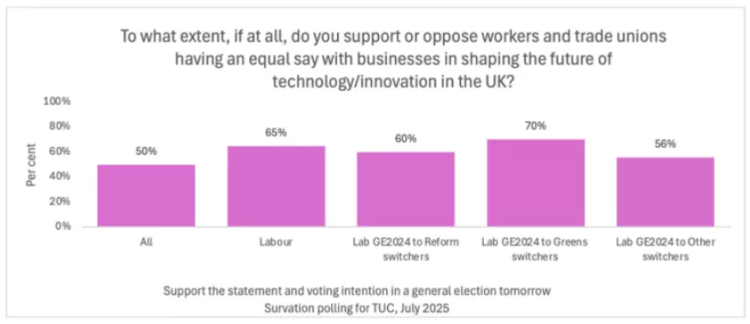
According to polling commissioned by the TUC, most of the public support a greater role for worker and unions in shaping innovation and technology.
2. Returning public value to public services
Public services are under pressure, and technology has a key role to play in driving excellence. But the challenge is not merely technical, but one of governance, diverse expertise and leveraging the unique position of the state to shape the market and drive high standards. Public sector workers are a key asset for this.
However, Big Tech dominance squeezes opportunities for domestically domiciled companies to grow, pay tax, employ local workers and play by the rules of the UK. And the public sector isn’t effectively using its massive buying power to shape the technology market and get a good deal for workers and the public alike.
A key policy will be making sure ‘good work’ strings are attached to the billions of pounds of taxpayers’ money spent on private sector tech involvement in public services. This could bolster support for the UK’s AI industry, while also building public sector tech capacity in-house.
In addition, we should ensure that workers’ voices are heard throughout the digital transformation process, from initial strategy development to problem definition, through to tender, application design and deployment – drawing on best practise and standards, including in Wales. This could be a key element of government procurement deals with the private sector.
3. Securing a digital dividend for workers and productive investment
While the current evidence is inconclusive, AI technologies have the potential to bring about significant productivity gains by enabling tasks performed by workers to be automated and sped up. Workers must capture a fair share of the benefits of this and gains must be productively invested.
At current, the dominance of short term priorities driven by our corporate governance system mean that AI may be used by some employers to cut costs and automate existing processes, rather than to productively invest, expand and innovate. Such decisions will more likely displace or deskill workers rather than augment, expand or retrain the workforce as part of technological upgrading. This may deepen the UK’s stark income and wealth inequality.
The TUC is calling for policy change to ensure workers secure a ‘digital dividend’ of any AI productivity gains by:
- Empowering workers to shape firms’ decision making – including by putting workers on boards
- Requiring companies to invest in workforce skills and training
- Improving pay and conditions and extending collective bargaining across the economy
- Progressing reform of the tax system – including potential wealth taxes and equalising capital gains tax with income tax.
4. Pro worker AI regulation and upgrading rights
Inappropriate use of algorithmic management tools to monitor workers, allocate tasks, rewards and sanctions have a negative impact on staff wellbeing, productivity and industrial relations. The regulatory system needs to be upgraded to protect workers and to strengthen worker voice to ensure effective and fair AI use.
Putting in place the guardrails so that workers are protected from AI harms at work and ensuring worker involvement in determining whether and how AI is used, starting with implementation of the TUC’s model AI Bill.
This includes Workplace Impact Assessments, ensuring humans are in control of AI systems and new data rights for workers including protecting the livelihoods of content creators who are currently exploited by the unauthorised use of their work for training AI models.

5. Supporting workers during change
Unmanaged disruption to jobs, industries and communities is not acceptable and will have a disproportionate impact on certain workers. The UK learnt the lessons of this in the deindustrialisation of the 1980s. New thinking is needed on skills policy, taxation and social security to ensure workers are fully and fairly supported through transition.
For example, ensuring trade union involvement in skills policy and addressing the chronically low rates of private sector investment for in-work training
An additional key component is strengthening the UK’s social security and skills systems to be better geared to support those who experience job transitions as a result of AI disruption – supporting workers to move between roles without significant financial detriment and allowing them opportunities to reskill and retrain.
Next steps
How AI unfolds across the economy is characterised by uncertainty – both technological and political. But by acting now to deliver the essential building blocks of a pro-worker AI innovation strategy we can improve opportunities for AI to benefit workers across the economy. The TUC will continue to make the case for a pro-worker AI strategy for the UK and welcome all partners who also seek to ensure technical advancements enable good working lives.
Stay Updated
Want to hear about our latest news and blogs?
Sign up now to get it straight to your inbox
