Employment Rights Act 2025: Narrowing the gap
While improving dignity and wellbeing at work, the research by the Department for Business and Trade and University of Cambridge found that improved labour laws have also boosted employment rates and productivity. The analysis was based on the Cambridge Centre for Business Research Labour Regulation Index (CBR-LRI), a dataset on labour laws across the world from the 1970s onwards. It found that the ERA moved up the UK’s overall labour-law score.
The Employment Rights Act (ERA) 2025 marks the most significant upgrade to workers’ rights in a generation. After decades of missed opportunities and anti-union legislation, the UK has now taken a major step forward in meeting the levels of protection seen in our OECD and EU counterparts.
This upgrade narrows the long-standing gap with peer economies in the OECD and EU.
Catching up where it counts
Crucially, the Act tackles one‑sided flexibility by ending exploitative zero‑hours practices. It creates enforceable rights to reasonable notice of shifts, compensation for short‑notice cancellations, and an offer of guaranteed hours after a reference period, with these safeguards also extended to agency workers.
Those reforms place the UK at or above the level of protection now common among advanced economies that have moved in recent years to regulate on‑call work and unpredictable scheduling.
Family‑friendly rights are also strengthened. Paternity and unpaid parental leave become day‑one rights, and a new statutory bereavement leave is created. When benchmarked against a representative sample of OECD countries, these ERA measures lift the UK from below the average level of protection on leave rights, to the stronger end of the spectrum. This is precisely the kind of alignment UK unions have campaigned for, modern rules that reflect the realities of caring and work.
On dismissal rights, the ERA gives workers protection from unfair dismissal after six months in the job, rather than the current two years. Workers fired and rehired on worse terms will be deemed to have been unfairly dismissed in most situations. The UK’s dismissal‑law score rose accordingly, stated the researchers, moving closer to OECD and EU averages.
The Act also restores balance in industrial relations by repealing recent anti-union laws and giving unions the right to access workplaces to talk to workers. It reduces some of the red tape stopping unions gaining recognition to negotiate on behalf of workers and takes action against employers who punish workers for taking industrial action.
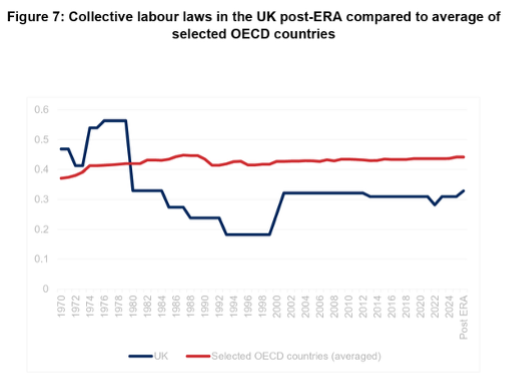
These reforms take the UK back towards the OECD average, a welcome re‑centring on international norms after years of divergence. But the UK still lags behind most similar countries.
A move in the right direction
Set against fifty years of data, the UK has trailed the OECD and EU averages on overall labour‑law protection since the early 1980s. The ERA does not erase this gap, but it does narrow it: post‑implementation, the UK will still remain marginally below the OECD and EU averages, a measurable improvement on 2025. In areas the Act directly targets, zero‑hours, specific leave rights, and key trade‑union protections, the UK is now at, near or above peer‑country standards. The remaining shortfall reflects parts of the framework the ERA doesn’t touch.
Good for fairness and good for the economy
What about jobs and productivity? The analysis shows that across the world strengthening labour law has, on average, raised employment. The ERA’s package is expected to lead to the same result, with an estimated modest boost to jobs. Where the Act breaks new ground for UK law, including on the regulation of zero hours contracts, the analysis indicates that the adoption of similar laws in other OECD countries in the recent past has led to productivity and employment improvements. The data across OECD countries demonstrates that reforms like the ERA’s zero‑hours rules, leave rights and trade‑union measures are associated with higher employment and productivity, an important counter to the right-wing myth that stronger rights cost jobs. Put simply: bringing the UK closer to international norms is compatible with, and in fact supports, a stronger economy.
Why this matters for workers now
From guaranteed hours to family rights from the first day in the job and stronger unfair‑dismissal protections, the ERA means more predictable pay packets, safer routes to challenge bad practice, and a stronger voice at work. For unions, enhanced access and recognition procedures reduce barriers to organising, enabling the collective solutions that underpin fair productivity gains. These are practical tools millions will feel in rota stability, in confidence to start families, and in protection from workplace abuse.
Still more work to do
On the areas that the ERA addressed, the UK’s ranking shot up, but there are still parts of Labour’s Plan to Make Work Pay that are not covered in the ERA. The absence of reform in these areas dragged down the UK’s rating.
For instance, the lack of reform on employment status, which determines which rights workers get, impacted the UK’s score on regulations on zero hours contracts. To close this gap, the government must take swift action to deliver on its commitment to move towards a single worker status.
There’s still more work to do to finish the job the ERA started. There’s a need to ensure that as the ERA is implemented, its provisions remain as strong as possible, and that the full Make Work Pay package is fully implemented.
Stay Updated
Want to hear about our latest news and blogs?
Sign up now to get it straight to your inbox
