Blog listing
Stay Updated
Want to hear about our latest news and blogs?
Sign up now to get it straight to your inbox
Don't let tribunal fees undermine the government's Plan to Make Work Pay
The government’s Plan to Make Work Pay promises stronger protections for workers, but apparent proposals to reintroduce employment tribunal fees risk undermining that progress.

Obstruction on the line: Employment Rights Bill delayed by peers’ amendments
Workers anticipating overdue improvements to their rights will have to wait longer after Tory and Lib Dem peers voted to water down key protections.

New protections for workers closer as Employment Rights Bill approved by MPs
A major step was taken towards resolving key issues in the labour market last night after MPs voted to approve the government’s Employment Rights Bill.

Sick pay decision for 2 million low-paid workers will impact families' living standards
How much should someone receive when they are off sick from work? This is the question that ministers will be considering in the early weeks of 2025. And the answer they arrive at will have a huge impact on many households’ budgets.

Collective voice: how the employment rights bill could boost the trade union presence at work
The bill sets out measures that will better equip unions to operate in modern workplaces. Including, union access to workplaces, fairer balloting rules, greater protection for trade unionists, beefed-up collective consultation rights, new rights for equality reps...

A massive boost to workers’ rights: the new Employment Rights Bill
Within the 100-day deadline promised in opposition, the Labour government today tabled an employment rights bill that takes vital first steps in improving working lives for millions of people.

UK needs massive workers’ rights boost to match global norm
Worker protections in the UK lag behind other developed countries in almost every area and the gap has been widening, new research for the TUC has shown.

The New Deal gets one step closer
The new Labour government has taken the first step in reversing the country’s failed 14-year experiment with ultra-flexible labour markets by announcing plans for a law to boost workers’ rights.
Better worker protections are coming and opponents must stop swimming against the tide
The UK’s long experiment with a low-rights, low-wage economy is drawing to an end, and employers need to recognise now is not the time for foot-dragging.

Unions court win means agency workers can no longer be used to break strike action
Unions have scored an important win against the government’s attacks on trade unions. The High Court has quashed a legal change that ministers made last year that allowed employment agencies to supply workers to replace those on strike.

Government does U-turn but rights still at risk
The deregulatory dreams of Tory extremists have collided with reality, forcing the government to overhaul its much-criticised Retained EU Law (Revocation and Reform) Bill.

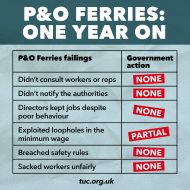
One year on from P&O Ferries, the government is still letting workers down
It’s been a year since the P&O Ferries sackings, but nothing has been done to stop another one.
Fighting the anti-strike law
The government is attempting to rush through Parliament new laws that could undermine workers’ ability to take strike action to defend their pay and conditions.

Countdown starts on vital rights
If a Bill currently being considered by Parliament becomes law, many workers' rights and protections could be swept away at the stroke of midnight on 1 January 2024.

Ministers should seek to resolve strikes, not bring in strike-breakers
The proposal to allow employers to bring in agency workers to fill in for striking workers, is a shameful outcome for a government that only a few years ago promised to “protect and enhance” workers’ rights.

From P&O to private schools: protect workers from a hire and fire culture
P&O Ferries’ attempt to bypass employment laws in its dismissal of 800 seafarers is the product of many of the same woeful UK labour rights that allow fire-and-rehire.

Ministers’ Brexit law plans could sink future workers’ rights wins
Plans to give precedence to domestic law over EU-derived law could have dramatic effects on workers' rights, despite a major court win secured by plumber Gary Smith over holiday pay.

Policymakers need to stop ignoring the facts and tackle insecure work
Insecure work soared after the last financial crisis as employers offered many workers only temporary, zero - or short-hours contracts. But more than a decade on since the bank-led crash, policymakers have failed to introduced measures to tackle it.

Uber rights U-turn is just the latest stage of the journey to decent work
A screeching U-turn by Uber on wages, pensions and holiday pay is the just the latest stage in the journey to ensure that all work - including in the gig economy - is decent work.

Fire and rehire tactics are levelling down pay
Employers have taken advantage of lockdown and cut-throat “fire-and-rehire” tactics to slash the pay and conditions of one in four workers, according to TUC polling.

Three years of silence – the government’s response to electronic balloting must be lost in the post
You can order your shopping, pay your bills and even vote in many political party ballots online. But when it comes to voting in union elections, the government insists only paper postal ballots will do.

Five ways to clamp down on modern slavery
Five years after companies became subject to new modern slavery laws, workers still experience extreme exploitation in many parts of the UK economy.

Local lockdowns require local furlough schemes
The government needs to move swiftly to safeguard jobs in areas facing stricter local lockdowns.

Short-time working scheme - a win for unions
Workers at firms hard hit by the coronavirus lockdown are to continue to get wage subsidies, after the government bowed to pressure from trade unions and others.

Employment tribunals need resources, not a sticking plaster
The government has announced a mixed bag of reforms to the creaking tribunal system, but only significant investment will ensure working people receive timely access to justice.

£13 a day isn’t enough - isolating workers need proper sick pay
The government's proposed payouts for low-paid workers forced to self-isolate don't go far enough.

With 3.6 million in insecure work, we have an opportunity for change
TUC research has revealed that millions of people are stuck in insecure work. Improving job quality will lead to better outcomes for all.

Local lockdowns reveal the need to protect workers’ wages
With local lockdowns now in place across much of Northern England, more is needed to protect workers who are forced to self-isolate.

From deckchair to desperation: the government must help holidaymakers facing quarantine
Thousands of returning holidaymakers face hardship after being forced to go into quarantine. The government and employers must ensure that they are protected.

Protect self-employed workers and extend the Self Employment Scheme
The Self Employment Scheme unions fought for has helped protect livelihoods - now the government must extend it