“Members were involved at every step”: How Sheffield Hallam UCU stopped an attack on their pensions
After years of restructures and job losses, Sheffield Hallam UCU members found themselves facing another threat. The university wanted to transfer large numbers of academic staff to a wholly-owned subsidiary company, meaning they would no longer be directly employed by the university and would lose access to the Teachers’ Pension Scheme (TPS).
This came after a bruising few years. The previous Vice-Chancellor stood down in late 2023, and within weeks of the new Vice-Chancellor arriving, the University had opened a voluntary severance scheme. Redundancies were described as voluntary, but members clearly felt coerced; over 1,000 jobs have been lost in just two years, on top of losses stretching back over the last decade that had previously mainly affected professional services staff in Unison, GMB and Unite.
The branch did not accept that this was simply a result of the funding crisis facing higher education. Members went through the University’s public accounts and published two State of the University reports. Their analysis revealed a pattern of increasing expenditure and increasing take up of loans and debt, based on no material increase to the university’s financial position.
UCU Officer at Sheffield Hallam University Bob Jeffery spoke to the TUC about how their members fought back.
Bob said: “Our central argument was that if the University had not engaged in risky behaviour, it would have better placed to withstand the financial headwinds it has experienced.”
Putting evidence into the public domain helped members challenge the idea that job losses or outsourcing were the only available options to university managers.
The pension attack
In March 2026, the University announced plans to cut £26.6 million, most of which coming from staffing costs. At the heart of the plan was a proposal to create a new category of teaching staff, who would be outsourced to a (limited) subsidiary company. Management tried to argue that the employer contribution rate to the pension scheme was too expensive and wanted to remove access to TPS by outsourcing.
The attack on pensions was an attack on pay. Members could be paid more in industry but accepted lower salaries knowing that their pension was deferred pay, giving them greater security in retirement. The proposal for a subsidiary company was also an attack on terms and conditions, and a threat to the Union. On the former, UCU nationally has seen how privatisation has been used to launder terms and conditions across the sector over the last decade, while on the latter, creating two different employers would have increased fragmentation of the workforce, meaning different bargaining units which would have required separate ballots for any future industrial disputes.
A win for management at Sheffield Hallam would have encouraged even more employers to follow the same route.
The plan began to unravel the more closely UCU examined it. To be submitted to the Research Excellence Framework (an expectation for research active academics), staff have to be employed directly by a university. Management suggested transferring “teaching-only staff” to the SubCo, while keeping research-active staff in the university. But staff did not fit neatly into those boxes: academics become less and more research active at different times in their careers. This would have meant placing the majority of staff in the subsidiary, with only a small minority directly employed by SHU, potentially cutting off opportunities for the majority of staff to do research (a component of academic work that many see as central to their job).
The threat wasn’t localised to Sheffield. Other universities were and are looking at subsidiary companies as a way of cutting pension costs, and UCEA is actively lobbying for more ‘flexibility’ over TPS. Sadly, some staff have already been transferred to a SubCo and lost access to their TPS pensions at Coventry University, Solent University in Southampton, Staffordshire University in Stoke-on-Trent, while plans are afoot to attack pensions at London South Bank University, University of Cumbria, University of Sunderland and more. A win for management at Sheffield Hallam would have encouraged even more employers to follow the same route.
A decisive mandate
SHU UCU won its strongest statutory ballot turnout in recent history. 72.6 per cent of members voted, with 87.7 per cent of those voting for strike action, and 93.2 per cent backing action short of a strike.
The result was driven by the proposals, but it also rested on years of organising at a local level. The branch have a track record of industrial action. When the university tried to delay a nationally-agreed pay rise for 11 months in 2025, the branch pushed it back and secured a shorter delay.
When an offer was made, it was taken straight back to members, so their demands were taken into the next set of talks.
SHU UCU announced 18 strike days across May and June, over SubCo, job cuts, and other attacks on terms and conditions. A breakthrough came through after the 13th day.
Ruth Beresford, UCU Officer and Negotiator during the strike action, credits a high level of member engagement as a strength of the campaign. She said:
“When an offer was made, it was taken straight back to members, so their demands were taken into the next set of talks. The final offer that was voted on was shaped by members, we pushed management for more based on what members were telling us. Open communication and transparency between negotiators and members, and regular branch meetings and conversations on the picket line, made this a truly engaged and collective fight back. We had a core, elected negotiating team, as well as additional ad-hoc negotiators, to further democratise the process and keep more members in the loop at all times”.
This member engagement was accompanied by staunch support from UCU’s regional officials in Yorkshire and Humber, at every step of the negotiations.
Taking the argument beyond the campus
The branch sought to generate public leverage throughout the campaign. The State of the University reports gave members the evidence they needed to raise alarm bells more widely and create a public conversation. That led to strong engagement from Abtisam Mohamed MP, who addressed university management on behalf of the branch, and to local councillors taking a strong public position on the university’s approach. The branch also published a report into the ‘human impact’ of the proposals, with anonymised quotes from members, to raise awareness of the huge psychological, emotional and physical toll on staff of what was happening.
Hallam UCU also received many generous donations to its local strike fund, including an extraordinary £5,000 contribution from ASLEF’s Annual Delegate Meeting.
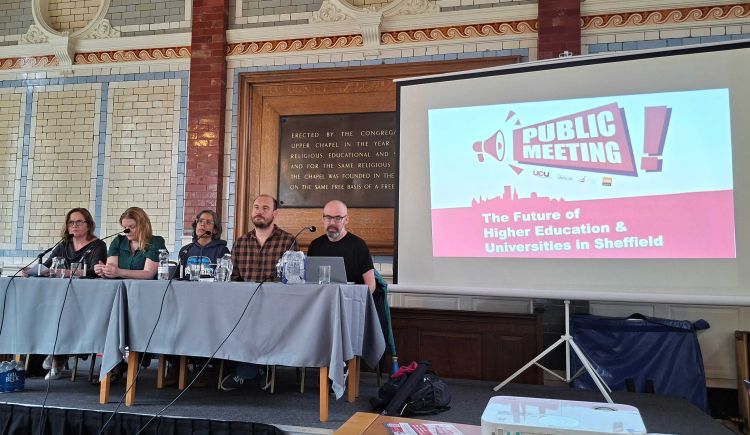
Working together with sister unions at SHU (Unison, Unite and GMB) and the unions at University of Sheffield and the University of Sheffield International college, a city-wide public meeting was called into the future of higher education in Sheffield. This meeting brought together local politicians, the TUC, unions, members of staff and the general public, to highlight the plight of cuts across universities, and raise awareness about issues such as the proposed subsidiary.
Hallam UCU also received many generous donations to its local strike fund, including an extraordinary £5,000 contribution from ASLEF’s Annual Delegate Meeting. This practical solidarity from across the trade union movement helped members sustain their action.
The government also announced it would be reducing employers’ contributions to the TPS from April 2027, which Bob credits to the lobbying UCU members undertook nationwide, leading to MPs across the country pushing for a government solution. Revising the employers’ contribution gave the university more breathing room to negotiate.
A major win
On 14 June 2026, after 13 consecutive days of strike action and talks, the members accepted an offer that ended the strike action.
Management confirmed that they would drop outsourcing proposals, with academic staff remaining directly employed by the university and keeping their existing pension arrangements, in a move that protects staff conditions and will safeguard the stability of teaching provision for students.
