
Young people and work - a call to action
“Overwhelmingly [young people] want to work. In a survey carried out for this review, 84% of NEET young people said they want to find a job, education or training. I do not accept the caricature of a generation that is not interested in employment. I do not accept that mental health is simply an excuse. Nor do I accept that the answer is to tell young people who are struggling simply to try harder. These are myths. Sometimes cruel ones. Young people are not to blame. Institutions that should have provided opportunities to them are the ones that have failed.” 1
Alan Milburn’s interim Young People and Work report rightly recognises that the crisis of over one million young people not in employment, education or training is not the fault of young people themselves. Rather, a generation has been failed by the institutions meant to support and prepare them for work, as well as an economy that didn’t provide opportunities that were available to previous generations.
Milburn identifies interlocking failures across the youth labour market, education and skills, health, welfare and the system design. These are not inevitable. They are the result of choices by the previous Conservative government - to pursue austerity, starving education, health, social services and local government of funding, leaving a generation to grow up without the support they need to succeed; to shift apprenticeships away from young people and double down on labour market deregulation, so that good routes into secure employment were not available for this generation when they entered adulthood; and through these choices to trap our economy in a doom loop, with growth never returning to pre-financial crisis levels, regional and wealth inequalities becoming further entrenched after years of industrial decline, and a challenging economic climate leading to vacancy falls. There is no evidence that higher youth unemployment can be attributed to the minimum wage – rather vacancies have fallen in sectors highly exposed to weak household demand, rising costs of energy and food, and the high costs of rent and financing.
To turn the trajectory of ever rising NEET rates around, we need to address failures on each of these levels. Milburn rightly recognises that the NEET crisis is the result of a whole system failure. We focus in this report on the changes that are needed in key areas of TUC expertise: jobs and skills.
Most urgently, those young people already locked out of the labour market should be supported into work. Real experience of paid work is the most effective ways of getting young people into sustained, unsubsidised employment in the long term. The Government’s Jobs Guarantee is a welcome initiative and should be scaled up, made available to young people sooner, and put on a long-term footing.
To prevent more young people falling through the cracks, more must be done at the key cliff edges at 16 and 18, Milburn identifies - when a young person moves out of compulsory schooling and then when statutory participation duties end and institutions relinquish responsibility without anyone currently responsible for picking it up. We need to tilt the incentives in favour of young people remaining in education or training post 16 and 18 – by improving the quality and access to Further Education (FE) and apprenticeships, and by providing the right financial incentives to stay in learning and earning. Most urgently, the government should introduce a new youth learning allowance, building on the kind that existed in England under the last Labour Government, and continues in Scotland, Wales and Northern Ireland, to support and enable16- and 17-year-olds to remain in full-time education.
Finally, to bring down the NEET rate at scale, we need a growing economy generating demand for young people’s talents, and a labour market offering well paid jobs of good quality that can provide sustainable employment to young people. As Milburn sets out:
“This review unashamedly extols the virtues of work. Not any work, at any price, under any conditions. But good work. Work that gives structure to the day, purpose to the week, confidence to the person and contribution to the country. Work is not only about income, although income matters. It is about connection. It is about self-respect. It is about independence. For young people especially, the first steps into work are often the first steps into adult life.”
Recent government pledges of widespread re-industrialisation and using government procurement to boost good jobs and skills are an opportunity to increase opportunities for young people, leveraging the power of government insourcing and infrastructure procurement to create pathways into high-quality careers for young people. As the economy undergoes profound change driven by new technologies, the transition to net zero, and shifting labour markets, building skills and pathways to these sectors which will have a high demand for workers in the future will be essential.
Rather than viewing employment rights upgrades and minimum wage increases as in opposition to solving the NEET crisis, they are in fact essential components to addressing it in the long term. In order to find stability, support and progression in a job, a basic pre-requisite is predictable hours, secure contracts and knowing how much they will take home at the end of each week. This can be supported by incentivising employers to invest in and train young people. Similarly, a fair minimum wage that sees young people paid the same as older workers doing the same jobs, and that provides enough to live on, is essential to building incentives to work.
- 1 1GOV.UK 2026, Milburn- Young People and Work Interim Report https://www.gov.uk/government/publications/young-people-and-work-interi…;
Who are today’s NEETs
As of 2026 (Q2) there are 981,000 young people not in employment, education or training.
In Milburn’s interim review, he identified key characteristics of today’s NEETs:
“The majority are economically inactive rather than unemployed. And for those who become NEET early, the likelihood of remaining so increases sharply over time.
“These risks are not evenly distributed. A young person growing up with low attainment, poor health and limited family resources faces a materially higher likelihood of becoming NEET. Place reinforces that divide.”
The TUC has investigated recent census data,2 to identify further trends in young people who are NEET. We find poverty remains one of the strongest predictors of becoming NEET, alongside health, geography and caring responsibilities. Gender is a consistent dividing line throughout the report, though rarely a straightforward one. It appears that young men and women still have very different experiences entering the labour market and have markedly different outcomes. For young people with a disability, from BME backgrounds, or living in deprived areas, these disadvantages rarely act alone but compound one another.
A key finding is that education alone cannot solve youth exclusion. Qualifications still matter greatly, but they are no longer a guarantee of security. Whereas previously data suggested that new graduates were significantly more likely to be employed than young people without a degree a TUC investigation into latest census data suggests that higher education alone cannot resolve youth exclusion. Particularly male graduates are more likely to be NEET than those with A level or equivalent qualifications, while more than a fifth of young women completing apprenticeships are still becoming NEET. Notably, this does not seem to be the case with young men, of which only one in eight remain NEET after finishing an apprenticeship. We explore below the issue of occupational segregation in apprenticeship subjects, which is still prevalent and may be partly to blame.
Jobs Guarantee
The Government’s first priority should be supporting those young people already NEET and locked out of the labour market.
The TUC welcomed the government’s decision to adopt our long-standing call for a Jobs Guarantee for young people. The scheme guarantees fully funded, six-month paid jobs (25 hours of work) to all eligible 18 to 24-year-olds who have been on Universal Credit and looking for work for 18 months. The Jobs Guarantee is expected to support over 90,000 young people over the next three years. 3
As set out in our previous report ‘An Ambitious Plan for Young People’, 4 we know that job guarantee schemes work. The previous Labour Government’s Future Jobs Fund (FJF) delivered clear benefits for participants, employers and society, giving participants recent experience of a real job with a real wage, opportunities to gain new skills and an employer reference. The need for this type of scheme has become all the more pressing since the coalition government cancelled the Future Jobs Fund and Conservative Government’s Covid-era Kickstart scheme came to an end. The number of NEET young people who have never had a job has been steadily rising over the last twenty years, and now 6 in 10 NEET young people have never worked, compared to 4 in 10 when the FJF was introduced. 5
A recent report by the Resolution Foundation sets out that targeted schemes like the job guarantee are significantly more cost-effective than broad based demand-side support such as changes to employer National Insurance. 6
The Jobs Guarantee should be central to the Government’s solution to the NEET crisis, and there are thousands more young people who could benefit if the scheme criteria were widened.
The TUC is calling for the government to scale up and bring forward the number of places available, by shortening the time young people have to be on Universal Credit before they can access the Jobs Guarantee from 18 months to 6, and scaling up the number of places from 90,000 to 225,000 over three years.
We estimate that the cost of a scheme of this would be an additional £1billion.7 These costs would be far outweighed by the benefits of an effective scheme that gets young people into work, and reduces the amount of time they spend unemployed or inactive. As Milburn’s interim report sets out, a period of unemployment or inactivity early in a person’s life causes long-running scars – young people lose out on approximately £52,000 of lost earnings over their lifetimes for each year spent out of employment or training. 8 This has effects on our economy as a whole, as young people out of work are a drag on growth, productivity and living standards, as well as draining Government’s benefit spending, public services like health and mental health services. We estimate that the long run benefits of scaling up the job guarantee scheme to 225,000 places would be almost £4.6 billion, the total benefits of the scheme are set against costs over time, using the standard Treasury approach. This far outweighs the upfront investment by a ratio of 2.69. This means for every £1,000 of government spending on the programme, £2,690 of revenue is generated for the Exchequer in the long run. Even a more moderate change to the criteria bringing eligibility forward to 12 months and increasing the places to 135,000 over three years would produce £2.74 bn of benefits in the long run compared to a £1bn investment, at a cost to benefit ratio of 2.67. And we estimate this would only cost the government an additional £337 million to what it has already committed too. With these outcomes assessed over 30 years, both options hit breakeven within eight years. Given the caution we have taken in assessing the scheme’s impacts, outcomes and long-run benefits of the scheme could well be higher.
Overall results in real terms - in 2026/27 prices
- 2 ONS 2006 - Characteristics of young people not in education, employment, or training (NEET), England Statistical bulletins- https://www.ons.gov.uk/employmentandlabourmarket/peoplenotinwork/econom… acteristicsofyoungpeoplenotineducationemploymentortrainingneetengland/previousreleases
- 3 3GOV.UK 2026 – Jobs Guarantee - https://www.gov.uk/government/publications/jobs-guarantee
- 4 TUC 2025, An Ambitious Plan for Young People - https://www.tuc.org.uk/researchanalysis/reports/ambitious-plan-young-people
- 5 GOV.UK 2026, Milburn- Young People and Work Interim Report - see annex – table 3 https://view.officeapps.live.com/op/view.aspx?src=https%3A%2F%2Fassets… edia%2F6a7986ade9c8ef7358ccc053%2Fanalytical-annex-data-tables.ods&wdOrigin=BROWSELINK
- 6 Resolution Foundation 2026, Take a chance on me, https://www.resolutionfoundation.org/publications/take-a-chance-on-me/
- 7 We estimate that the total cost an expanded scheme jobs guarantee scheme of 225,000 places and eligibility after 6 months of unemployment would be £1.7bn, and our estimate of the current government jobs guarantee scheme is 687m, as this has been committed the additional cost would be one billion. The cost benefit analysis for the government scheme has been modelled by us and not the government, their own modelling is likely to be different from us. Analysis on costings and cost benefit analysis has been carried out by Landman Economics – the full methodology is available here - https://www.tuc.org.uk/sites/default/files/2026-08/jobguaranteeschemes-…
- 8 GOV.UK 2026, Milburn- Young People and Work Interim Report https://www.gov.uk/government/publications/young-people-and-work-interim-report
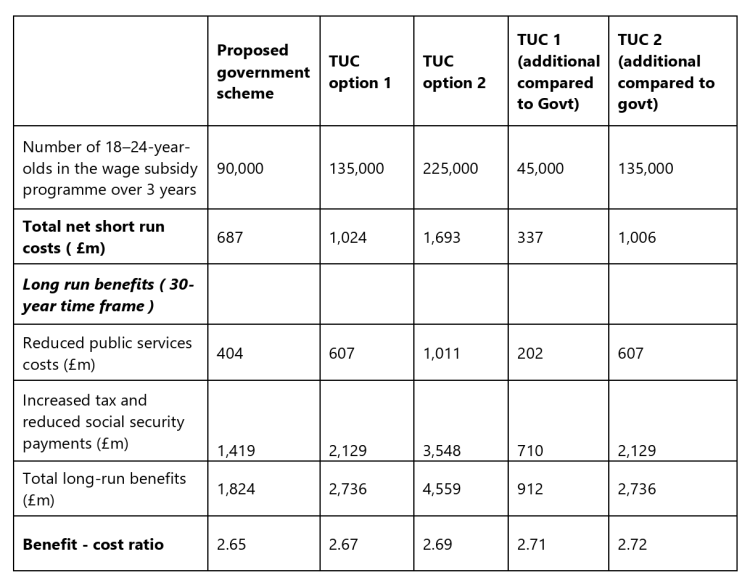
Source - Analysis on costings and cost benefit analysis has been carried out by Landman Economics - full methodology can be downloaded here.
The upcoming 10-year plan for Britain due to be unveiled by the Prime Minister provides an opportunity for the Jobs Guarantee scheme to be central to a 10-year ambition to turn the country around. The UK has seen many youth employment schemes come and go – Kickstart, the Youth Obligation, the Youth Grant, Young Person’s Guarantee and New Deal for Young people – to name a few, but the benefits of these youth employment schemes are best felt over the long term. An expanded Youth Guarantee scheme should be put on a permanent footing, with the flexibility to expand when youth unemployment rises and scaled back when the economy strengthens.
TUC analysis shows just under half (45.3%) of 18–24-year-old NEET young people in the UK are not claiming out of work benefits. 9 This hardest to reach group of ‘hidden NEETs’ currently has no support to access employment support. Alongside expanding the existing Jobs Guarantee scheme, access routes should be developed for young people who are not claiming Universal Credit, but are leaving education with a high risk of becoming NEET.
Stronger focus on prevention
Beyond support for young people already NEET, the government should take a stronger preventative approach, encouraging young people to continue to engage in learning and earning beyond the ‘cliff edges’ at 16 and 18 when a large number of young people disengage. As Milburn points out – the NEET risk is not evenly distributed across the 16 to 24 age range. It rises sharply at the point where formal participation requirements end. 10
Rates of participation in further education and apprenticeships in particular have been falling, while more young people are now pursuing higher education than ten years ago. While higher education will continue to be an important destination for young people to gain lifelong skills, our focus is on addressing the shortfall in FE and apprenticeship engagement among this generation’s young people.
FE - Financial incentives
In order to be an attractive option to young people who might otherwise fall out of education or training, FE courses must be available, good quality and make financial sense.
Starting with financial incentives, an effective participation system must use early opportunities to encourage young people to continue in education and training and prevent them falling into disengagement. Part of this must be to ensure that young people from low-income families should be able to enter and remain in education or training without financial hardship, but instead that financial incentives reward continued participation.
The government has recognised that finances can put people off continuing in education or training, by rightly introducing a bursary to remove a key financial barrier to apprenticeships. 11
The same financial issues can often be in play for students considering further study. In evidence from 2023, the APPG for students found that FE colleges say they are seeing students in “financial desperation”. A survey of FE students found 72% said they were facing costs that were putting them in financial difficulty, 23% said energy was the main cost pressure and 21% said transport was the main issue. 12
While Scotland, Wales and Northern Ireland provide an Education Maintenance Allowance (EMA) to young people to discourage them from disengaging from education, England is the outlier in having no such scheme.
An EMA of up to £30 a week was available in England for 16- to 19-year-olds from lower-income backgrounds from 2004 to 2011, distributing around £564 million a year in its last year.13 When this was scrapped by the Coalition Government, a replacement 16-19 bursary fund was introduced in England in 2011. The value of this replacement scheme stood at £156 million in 2024-514 , a fifth of £842m (in 2024-5 prices) spent on EMA in 2010-11.15 In addition, the bursary scheme does not provide a regular income stream but can be a one-off payment.16
As Milburn’s interim review highlights, the government spends 25 times more on dealing with the consequences of youth unemployment through the benefits system, than it does on supporting them into employment. Shifting to prevention, including support to encourage young people to stay in education and training, will be key to tackling the NEET crisis.
The current cost of living crisis requires a renewed look at the case for a youth learning allowance in England. Since EMA was scrapped in 2011, the cost of living has risen sharply, and young people face higher study-related costs, including travel, equipment and digital access.
The TUC proposes a new youth learning allowance, modelled on the former Education Maintenance Allowance (EMA), while learning the lessons from some of the potential limitations of the former scheme. This allowance could help keep young people remain engaged in education and should form part of a wider package of support.
According to recent TUC and Hold Sway polling, there’s strong support for providing financial support for young people getting education, training or skills to help with their careers. Around three-quarters (77 per cent) of people support the policy. The policy is popular across the political spectrum, with 76 per cent of Reform voters and 84 per cent of Labour voters expressing support. 17
We propose the allowance should be available to young people who have started an education or training course in FE between the ages of 16 to 20. This extended age range will include those who decide to return to FE at a later age, providing a similar incentive to if they had continued directly from 16. Eligibility should not include those who turn 16 while still at school, or who go on to higher education or apprenticeships as there are other forms of financial support for those pathways.
We propose the allowance could be a set £40 and for eligibility this goes to the young person whose family income is under £32,250,18 as an uprating of the threshold of the former EMA scheme.
There have been multiple positive evaluations of EMA in England and the devolved nations. Previous IFS research from 2009 found EMA significantly increased participation rates in post-16 education among young adults who were eligible to receive it.19 In particular, it increased the proportion of eligible 16-year-olds staying in education from 65% to 69%, and increased the proportion of eligible 17-year-olds in education from 54% to 61%. The largest effects were among the poorest groups, and the majority of the increase came from the NEET population.
As recently as 2024, a review published of the Welsh EMA scheme concluded that the Welsh government should continue to administer EMA, targeting it at young people from low-income households and continue to put financial support directly into the pockets of post-16 learners. The report also says - overall, while the EMA did not serve as the single determinant for students' decisions to stay in post-16 education, it played a substantial role in alleviating financial stress, enabling more focused study, and contributing to their overall well-being. 87 per cent of survey EMA recipients thought that the allowance either definitely or possibly helped them to attend school or college on a more regular basis.20
Along the same lines, a recent study published in the BMJ Public Health Journal found the abolition of the EMA in England was associated with increased psychological distress among young people in low-income households.21
A more recent report by the IFS and Nuffield Foundation complicates the evidence on EMA. The report found that in the long run, EMA did not have an impact on attainment and may have reduced earnings and employment in the long run, mainly because students had weaker connections to the labour market – as EMA could have made students less likely to work part-time during their studies, or because students might have directed students away from work-based training which would have provided better preparation for the labour market.
But while this evaluation points to the need for improvement in an updated scheme, it does not provide compelling evidence providing financial support to young people in further education.
Young people should not have to work long hours in ways that disrupt their education, and the EMA was intended to reduce that financial pressure. If reduced paid work meant some young people missed out on valuable work experience, the answer should be to build appropriate work experience into courses and training, not to expect lowincome students to work more. The majority of young people would not have been entitled to EMA while it was available, and yet these young people from better-off families were not expected to increase their working hours to improve future earnings. The same point applies to the estimated long-term effects on earnings and employment: the solution is to provide high-quality, relevant work experience earlier, rather than treating reduced work at ages 16 and 17 as a long-term loss.
The government has already taken steps to embedding work experience more closely into education – announcing plans for Strategic Authorities to bring together schools, colleges and employers to help secure meaningful work experience opportunities,22 and 10,000 new work experience and skills opportunities for young people. 23 As part of the design of a new youth learning allowance for young people, the government should look at further ways to ensure that high quality courses build-in meaningful work experience and skill development.
Key ways to improve the quality and therefore long-term outcomes from FE are explored in the next section.
Support for FE provision
When it comes to encouraging more young people to stay in education or training, the flip side of financial incentives is quality – opportunities must be worthwhile, and provide young people with good quality learning to develop skills for later life.
Further education has been hollowed out by a decade of real-term cuts. Spending per pupil in 25-26 is £7,900, down 8% of 2010 – this is both significantly lower and a larger drop compared to spending per pupil on higher education, which stands at £9,900 per pupil. 5% down on 2010. 24
The Labour government has provided a welcome spending boost to FE, with the Post16 Education and Skills White Paper confirming an extra £450 million in the 16 –19 budget between 2025-26 and 2026-27. 25
However, even after these increases, college funding per student would remain around 6% below its 2010–11 level, while school sixth-form funding would remain around 18% lower. Overall, recent funding increases reverse some, but not all, of the real-terms decline experienced during the 2010s, and comes at a time of growing demand for 1618 education. 26
A good teacher or staff member is often the key to keeping a young person engaged and making the most of their further education, but the FE workforce has been reducing over time. Whilst recent numbers have been relatively stable, historic data suggests the number of teachers in general FE fell by a quarter between 2010/11 and 2018/19. 27
Despite their crucial role supporting some of the most disadvantaged pupils, FE teachers earned around 20 per cent less than secondary school teachers in 2025. This gap has widened considerably over the last five years. In real terms, FE teacher pay has declined by almost 20 per cent since 2011, at the same time as average UK earnings have increased by four per cent. 28 Although individual colleges make decisions about FE teacher pay, these decisions are inevitably based on what they are able to afford. Action to improve FE provision must start with addressing pay for FE workers, and rebuilding funding for FE overall. 29
Apprenticeships
The new government brings a renewed focus on technical education and apprenticeships, and the investment already announced to remove the financial barrier to apprenticeships is welcome – although given the existing pressure on staff this should be supported by investment to deliver it. 30 This comes on top of welcome changes to the Growth and Skills Levy, investment in foundation and shorter apprenticeships and increased ambition for the number of apprenticeship starts across the parliament.
However, as set out in the TUC’s previous report ‘An ambitious plan for young people’, the UK apprenticeship system continues to face significant challenges.
TUC analysis has found that between 2017/18 and 2024/25 apprenticeship start rates for 19–24-year-olds have reduced by 14 per cent and by 30 per cent for under 19s. This is in comparison to an increase in start rates for those aged 25 and over of 17 per cent. 31
As with FE, to improve apprenticeships as a route for young people who might otherwise become NEET, they must be accessible, good quality and make financial sense.
First, we need to boost the number of apprenticeships available. The apprenticeship levy currently applies to large employers with a payroll over £3 million - just 2% of UK employers. 32 This narrow scope limits its impact and reach, and there is a strong case for broadening it. As the Fabians have pointed out, SMEs account for nearly 97 per cent of the decline in apprenticeship starts since the levy was introduced. 33 The government should further explore how the Growth and Skill levy can be made to work more effectively, including looking at whether lowering the threshold while requiring a lower contribution rate for smaller employers would bring more SMEs into the levy, and thereby encourage more apprenticeships from SMEs.
Second, apprenticeships must be fairly accessible to all. TUC analysis found that, while there is a roughly equal number of men and women enrolling on apprenticeships overall, there continues to be a stark gender divide in the kinds of apprenticeships studied by men and women. Over 40 per cent of men who completed apprenticeships did so in STEM fields, compared to just 6.8 per cent of women. Men were more than 10 times as likely as women to achieve an apprenticeship in Engineering and
Manufacturing Technologies. 34 As outlined above, the latest census data shows that a fifth of women who complete an apprenticeship go on to become NEET compared to one in eight men – a significant disparity. A simplified access system, as well as more flexible modular learning options will be key to reducing barriers and improving access to apprenticeships. Driving up apprenticeship quality will also require a strong voice for workers, as well as using union capacity to negotiate for better training standards, in particular ensuring apprentices receive sufficient training time.
Finally, apprenticeships must make financial sense, however the current apprenticeship minimum pay rate remains a barrier to both access and completion.
The UK has a persistently high drop-out rate for apprenticeships. In 2024/5 the apprenticeship achievement rate was 65%, meaning over a third either dropped out, delayed, or failed their apprenticeship. 35 Apprentices most often cite poor-quality training and financial issues as reasons for leaving - in a 2024 Department for Education survey, of Level 2 apprentices who dropped out, nearly 40 per cent mentioned financial problems as contributing factors. 36 44 per cent of leavers cite insufficient training time and 43 per cent cite poor training quality as reasons for leaving early. 37 What is not measured is the number of young people who are put off apprenticeships altogether because of low rates of pay.
The apprenticeship rate has long been lower than the main rate of minimum wage, but in during around 2015-2023 increases in the apprentice rate fell well behind the main rate. From 2024 onwards there has been some catching up, but the apprenticeship rate should continue rising substantially, and in the long-term aim to converge with the main rate. According to Low Pay Commission analysis, in 2025 83% of apprentices are already paid above the apprentice rate, suggesting increases in the minimum wage rate for apprentices would be affordable. 38
Good quality jobs to move into
Finally, improving the NEET rate in the long term will require broader changes to our labour market and pathways to good quality work.
Recent announcements that procurement will prioritise good jobs and skills is welcome. The government has an opportunity to use the industrial strategy and 10-year infrastructure pipeline to create sustainable, quality apprenticeships in industries we know will be in demand. Funding for infrastructure projects should come with requirements for apprenticeship delivery; a certain percentage of apprenticeships should be ringfenced for 18–24-year-olds and apprenticeships should also be targeted at people without a Level 2 qualification.
The quality of work that young people move into will be a key determinant of how long they stay engaged. Poor quality jobs can be more damaging to health than unemployment, and can cause a cycle of young people joining and dropping out of the workplace and worsening mental health. Research by Timewise and the TUC found poor job quality is “key driver” of young people leaving work due to ill health. 39 Lowpaid and precarious sectors and occupations are most likely to have people dropping out of the labour market into inactivity due to ill-health. These are also the sectors and jobs which disproportionately have young people working in them. Measures that strengthen job security and job quality in key sectors where high numbers of young people work – like hospitality, retail, and social care – are essential to tackling rising economic inactivity. Improving jobs in these sectors would lead to improvements to young people’s labour market participation as well as significant knock-on fiscal benefits.
Full implementation of the employment rights act is a key lever to improving the NEETs rate in the long term. While Milburn rightly recognises the pastoral burden on employers from the current cohort of young people entering the labour market – the pre-requisite to a supportive workplace is having a secure contract, predictable hours, and fair wages.
It has always been and always will be the case that everyone needs a first job and no young person will enter the labour market with paid work experience - there will always be a role for employers, government, unions and civil society to work together to support young people into their first jobs.
Conclusion
The UK’s NEET problem is not an accident – it is the result of choices by the previous Conservative government to deny young people that support that was available to previous generations when they were growing up, and a failure to catch them when the fell into unemployment and inactivity early on.
The government now has an opportunity to make different choices – to help young people to enjoy the fulfilment and many benefits that come from good quality work.
Young people who are already NEET need support into employment. The Government’s Jobs Guarantee is a vital mechanism to provide targeted support to those out of work. It should be scaled and made available sooner to unlock £4.6bn in benefits over the long term.
The government should have a stronger focus on prevention – introducing a new education support payment to encourage young people to remain in learning and earning, while driving up the quality of FE and apprenticeship opportunities through fair pay for FE workers, apprentices and improving access to underrepresented groups.
Finally, the government should harness the power of re-industrialisation to create career pathways for young people, and implement the Employment Rights Act in full to ensure young people are in good quality work, that gives them the opportunity to build confidence, stability and progression.
- 9 Landman Economics 2026, unpublished analysis on data on NEET young people in the UK not claiming out of work benefits
- 10 GOV.UK 2026, Milburn- Young People and Work Interim Report - https://www.gov.uk/government/publications/young-people-and-work-interim-report
- 11 GOV.UK 2026, Government invests in young people with more opportunities close to home, https://www.gov.uk/government/news/government-invests-in-young-people-with-more-opportunitiesclose-to-home
- 12 APGG 2023 - Further education students in England hit by extreme poverty, https://www.theguardian.com/education/2023/jul/03/further-education-stu…
- 13 House of Commons Briefing Paper, 16-19 bursaries for further education in England, https://researchbriefings.files.parliament.uk/documents/SN06154/SN06154.pdf
- 14 ESFA 2024-5, Annual Report and Accounts https://assets.publishing.service.gov.uk/media/6877a3520263c35f52e4dc7f/ESFA_ARA_2024_to_2025.pdf
- 15 TUC analysis has updated the amount spent in 2010/11 ( £564 million to 2024/5 prices ) to allow comparison
- 16 House of Commons Briefing Paper, 16-19 bursaries for further education in England, https://researchbriefings.files.parliament.uk/documents/SN06154/SN06154.pdf
- 17 Unpublished analysis
- 18 This threshold is based on the £20 817 income threshold for EMA in 2011 adjusted for 2026 prices.
- 19 Journal of Human Resources- 2009, https://jhr.uwpress.org/content/44/4/827.abstract
- 20 Wales Government 2025 - Response to the Independent Review of the EMA Scheme in Wales https://www.gov.wales/response-independent-review-ema-scheme-wales-february-2025-html
- 21 BMJ Public Health 2025- Mental health of UK youth following the removal of the Education Maintenance Allowance in England, https://bmjpublichealth.bmj.com/content/3/1/e001677
- 22 GOV.UK 2026, From today Britain will value the hard hat as much as the graduation cap, https://www.gov.uk/government/news/pm-from-today-britain-will-value-the…
- 23 GOV.UK 2026, 10,000 work experience opportunities for young people as Sainsbury's joins national drive to tackle youth unemployment, https://www.gov.uk/government/news/10000-work-experience-opportunities-for-young-people-assainsburys-joins-national-drive-to-tackle-youth-unemployment
- 24 IFS 2025, Annual report on education spending in England: 2025–26, https://ifs.org.uk/publications/annual-report-education-spending-england-2025-26
- 25 IFS 2025, Funding, finance and reform: an analysis of the Post-16 Education and Skills White Paper | Institute for Fiscal Studies https://ifs.org.uk/publications/funding-finance-and-reform-analysis-post-16education-and-skills-white-paper
- 26 IFS 2025, Funding, finance and reform: an analysis of the Post-16 Education and Skills White Paper | Institute for Fiscal Studies https://ifs.org.uk/publications/funding-finance-and-reform-analysis-post-16education-and-skills-white-paper
- 27 NFER 2026, The Further Education Teacher Workforce in England Annual Report 2026, https://www.nfer.ac.uk/publications/the-further-education-teacher-workforce-in-england-annual-report2026/
- 28 NFER 2026, New evidence reveals pay gap between FE and secondary school teachers is widest since at least 2010, https://www.nfer.ac.uk/press-releases/new-evidence-reveals-pay-gap-betw…
- 29 AOC 2026, FE leaders and unions issue stark funding, https://www.aoc.co.uk/news-campaignsparliament/aoc-newsroom/fe-leaders-and-unions-issue-stark-funding-warning-to-dfe
- 30 GOV.UK 2026, Government invests in young people with more opportunities close to home https://www.gov.uk/government/news/government-invests-in-young-people-w…
- 31 GOV.UK 2026, Academic year 2025/26 Apprenticeships, https://explore-educationstatistics.service.gov.uk/find-statistics/appr…
- 32 GOV.UK 2026, Guidance Pay Apprenticeship Levy, https://www.gov.uk/guidance/pay-apprenticeshiplevy
- 33 Fabian Society 2025, How to make the growth and skills levy work, https://fabians.org.uk/wpcontent/uploads/2025/08/FABIANS-YFF-CIPD-Making-the-Growth-and-Skills-Levy-Work-Final-draftPDF.pdf
- 34 GOV.UK 2026, Academic year 2025/26 Apprenticeships, https://explore-educationstatistics.service.gov.uk/find-statistics/apprenticeships/2025-26
- 35 GOV.UK 2026, Academic year 2025/26 Apprenticeships, https://explore-educationstatistics.service.gov.uk/find-statistics/appr…
- 36 IFF Research. (2023). Apprenticeship evaluation 2023: Learner and non-completer surveys. https://www.gov.uk/government/publications/apprenticeship-evaluation-20…
- 37 GOV.UK , Academic year 2024/25 Apprenticeships, https://explore-education-statistics.service.gov.uk/find-statistics/apprenticeships/2024-25
- 38 Low Pay Commission 2025, Low Pay Commission Report 2025, https://www.gov.uk/government/publications/low-pay-commission-report-2025/low-pay-commissionreport-2025-html
- 39 Timewise 2026, Young workers need better jobs, not just more jobs, https://timewise.co.uk/article/young-workers-need-better-jobs-not-just-more-jobs/
Stay Updated
Want to hear about our latest news and blogs?
Sign up now to get it straight to your inbox