A fairly funded package of cost-of-living support
For most people, the cost of living remains the most important facing the UK. After years of falling real wages, poor growth and successive price shocks, too many people are struggling to afford the essentials and almost everyone is falling short of their aspirations for quality of life.
There is an urgent need for action. The Government should urgently target support to those worst hit by failed government policy and successive economic shocks, while recognising that almost everyone has been struggling so support for middle-income households will also be needed. Decades of austerity, poor growth and privatisation have led to deep structural problems with the UK economy that have left too many households vulnerable to financial shocks. Improving living standards will help us to shift towards a virtuous cycle of better growth, and drive up living standards in the long term.
This report sets out some policy options for immediate action on living standards and sets out how they could be funded fairly:
- A social tariff to cut energy bills for low- and middle-income households.
- Free bus travel for under-22s to support young people to access work, training and education.
- An increase in child benefit to support families that have been hit by the cost of living.
- A reduction in the Universal Credit taper rate to put money into low-paid workers’ pockets and reduce disincentives to work.
- An increase in the funding for the Crisis and Resilience Fund to help support low-income households with financial shocks and to build financial resilience.
Section One
Living standards
Living standards and the cost of living are the number one issue facing the country. A new HoldSway poll, commissioned by the TUC, finds that the cost of living is currently the top national issue. When asked to list their top three priorities for the government, the most common answer was the cost of living (56 per cent). 1
When people who had flagged the cost of living as a priority issues were asked specifically which three specific prices should be a priority for government, energy bills (80 per cent) came out on top.
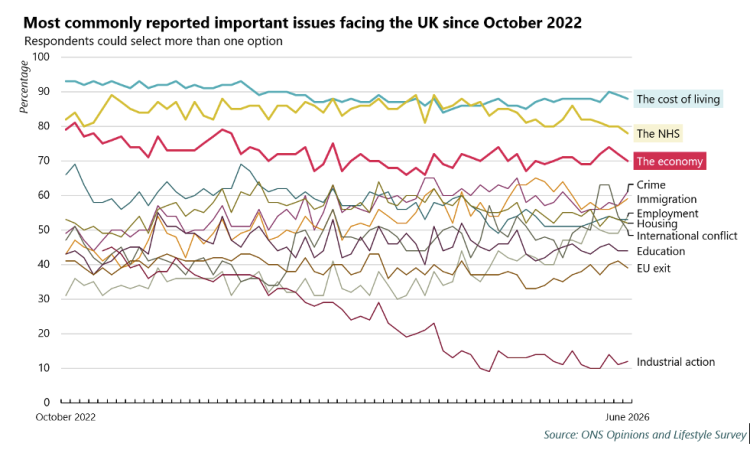
The salience of the cost-of-living crisis isn’t new. The cost of living has consistently been the most important issue facing the public since the ONS began its Opinions and Lifestyle survey in 2022 2, with around 9-in-10 people reporting it as an important issue facing the country.
- 1HoldSway conducted survey questions for the TUC as part of a nationally representative of 2019 adults in Great Britain, The survey was conducted online between 24-30 July, 2026.
- 2Public opinions and social trends, Great Britain: June 2026, ONS (2026). Available at: https://www.ons.gov.uk/peoplepopulationandcommunity/wellbeing/bulletins/publicopinionsandsocialtrendsgreatbritain/june2026
In his first speech as prime minister, Andy Burnham rightly identified the need to provide immediate cost-of-living relief and support alongside long-term plans to improve the economy. We welcome the government’s focus on the cost of living, as well as already announced policies, such as the return to a £2 bus cap and the VAT cut from energy bills.
Now it must go further. The TUC is calling for a package of cost-of-living support to lower cost of essentials, support incomes and increase labour market participation.
The living standards crisis has been a long time in the making
The cost-of-living crisis has been a long time in the making. Following the 2008 financial crisis, we’ve seen a 16-year pay squeeze, the longest in two centuries. 3 This has hit workers’ pockets. Real average weekly earnings would now be £334 higher than they are if real wage growth had instead grown at pre-2008 rates since the crisis. 4
Living standards have stagnated across the same period. Real household disposable income (RHDI) per person, a measure of living standards that looks at the real purchasing power of households, has grown by just 0.6 per cent a year since 2008. Before 2008, it typically grew by 2.5 per cent a year. Despite welcome action from the Government, weak growth in living standards and pay is forecast to continue over the next five years. 5
Stagnant wages and living standards are partly the result of the then Conservative government’s decision to pursue austerity politics from 2010 onwards. While the economy was still recovering from the financial crisis, the government starved the public sector of funds, imposed pay cuts on public sector workers, tore up the social safety net and hollowed out the state. The post-financial crisis era also saw a rise in insecure work 6 and in-work poverty. 7 Austerity itself took place in the context of over forty years of widespread privatisation of public services.
The combination of austerity and privatisation left the country, and households, ill-equipped to deal with crises and financial shocks such as the pandemic and the economic impact of international instability.
This all culminated in the cost-of-living crisis, when energy and food costs drastically increased following Russian’s invasion of Ukraine. While prices have stabilised recently, both remain relatively high. As the economy was showing early signs of improvement, the US began its illegal war in Iran. This has unleashed economic shockwaves that will now ripple through the economy, pushing inflation and energy bills up for households still being hit hard by the increased cost of essentials.
This living standards crisis, however, hasn’t been felt by everyone. Income and wealth inequalities within our economy mean the wealthy few have been protected, and in some cases profited, from hard times. The 1980s saw a massive rise in income inequality that has stubbornly remained since. 8 Household wealth in the Great Britain is distributed even more unequally than household income. Today, the richest 10 per cent of the population hold four times the total wealth held by the poorest half. 9
- 317-year wage squeeze the worst in two hundred years, TUC (2018). Available at: https://www.tuc.org.uk/blogs/17-year-wage-squeeze-worst-two-hundred-years
- 4UC analysis of ONS spreadsheet A01 using CPI (May 2026=100).
- 5OBR Economic and fiscal outlook – March 2026, OBR (2026). Available at: https://obr.uk/efo/economic-and-fiscal-outlook-march-2026/
- 6The scale of insecure work in the UK, TUC (2025). Available at: https://www.tuc.org.uk/research-analysis/reports/scale-insecure-work-uk
- 7Sharp rise in number of children growing up in poverty in working households, TUC (2024). Available at: https://www.tuc.org.uk/blogs/sharp-rise-number-children-growing-poverty-working-households
- 8Income inequality in the UK, House of Commons Library (2026). Available at: https://commonslibrary.parliament.uk/research-briefings/cbp-7484/
- 9Household total wealth in Great Britain: April 2020 to March 2022, ONS (2025). Available at: https://www.ons.gov.uk/peoplepopulationandcommunity/personalandhouseholdfinances/incomeandwealth/bulletins/totalwealthingreatbritain/april2020tomarch2022
Section Two
Urgent action needed
Cost-of-living support is urgently needed to give people some breathing space in the short term, and the confidence to start spending again.
While there are no quick fixes, we can start now - with immediate support to help people afford the essentials, as well as to maintain demand in the economy and rebuild confidence in the power of government to do good.
Below, we set out policies that provide support in a number of priority areas. Starting with energy bills, the cost of energy has increased dramatically since 2022 and looks to potentially rise further because of the uncertainty caused by the US war with Iran. Bringing down energy bills for most households helps ease the pressure and means less of households’ budgets are being absorbed by energy costs. Cutting energy bills also brings down inflation, as the rising cost of energy is currently the biggest contributor to rising inflation. 10
Secondly, families face higher costs when inflation rises – support through child benefit supports a large swathe of families with the cost of living, as well as having the greatest impact on the lowest incomes, helping many more children out of poverty.
Third, while the cost-of-living crisis has been felt across incomes, those at the sharp end have been the hardest hit and are most vulnerable to the price shocks coming down the track from the Iran war. Support is needed to both help with immediate costs and help build financial resilience to future income shocks. This helps to avoid future issues such as problem debt.
Finally, young people face particular barriers. We’re currently facing a crisis in youth unemployment and a million young people are not in employment, education or training (NEET). This goes beyond an immediate concern – periods of unemployment or inactivity when you are young has a scarring impact on future employment and finances. 11
The below policies are options designed to address these priority areas and get money into the pockets of those who need it, remove barriers and disincentives to work, and to ease cost-of-living pressures. There’s a combination of universal support and support for those living at the sharp end, as well as support for families and young people. Each policy could be implemented relatively quickly.
Support with energy bills
Support for low and middle households with rising energy bills would help two-thirds of households with what we’ve been told is the country’s top concern.
The TUC has already set out detailed proposals for a crisis-proof, targeted, flexible approach to domestic energy support. 12 The proposal is a permanent, flexible, multi-level social tariff that provides a percentage reduction to energy bills to all those on lower incomes. This should be established as an ongoing social tariff for all lower-income households while including a built-in trigger for additional temporary support uplifts during acute energy cost crises.
This approach would cost between just under £4bn and £6bn per annum, with the variance depending on variations in the wholesale cost of energy and the duration of the current energy crisis.
Supporting families
When inflation is high, families with children can often be hit harder due to the additional costs of essentials such as food and energy. Specific support for families is therefore a priority. It ensures that parents are able to feed their children without cutting back on meals themselves, and it helps to keep and bring children out of poverty.
One way to support families directly is to increase child benefit. Freezes to child benefit under the previous Conservative government eroded its real value, taking money away from families.
In real terms, child benefit is now 15 per cent lower than it was in 2010. This means a family with one child is £255 a year worse off than they would have been if child benefit had risen in line with inflation across this time, and a family with two children is £422 a year worse off.
The Labour Government was right to end the two-child limit – which will lift hundreds of thousands of children out of poverty.
Now it’s time to go further. Child benefit should be increased by £10 a week for all children. For an eligible family with two children, this would be a boost of £1,040 a year.
Child Poverty Action Group (CPAG) estimates that this increase would benefit 11 million children and cost the government an estimated £5 billion a year. 13
Child benefit goes to most families, getting money directly into households, with a particular impact on those with the lowest incomes, for whom £10 a week makes the biggest difference. Parents will receive some amount of child benefit as long as neither parent earns above £80,000 a year, and the full amount as long as neither parent earns above £60,000 a year. CPAG estimating that a £10 increase in child benefit for all children will lead to 400,000 children being pulled out of poverty. 14
Support for low-income households hit by financial shocks
Problem debt is often the result of income shocks, such as a sudden unexpected cost or a change at work, that makes a person’s finances no longer manageable. We’ve seen recent price shocks as a result of international instability, and this may happen again with the war in Iran. Income shocks can happen to anyone, but some households, especially low-income households, are more vulnerable to an income shock turning into a debt problem. 14
The Crisis and Resilience Fund (CRF) is a scheme run by local councils to help support low-income households with financial shocks and to help build financial resilience.
It’s currently funded at £1 billion a year and is set to last until March 2029. Local authorities have discretion over eligibility. The scheme was introduced in April 2026, but builds on the Household Support Fund, which was in place since the pandemic.
An LGA survey of councils found that only 28 per cent of councils felt that the £1 billion a year funding would be sufficient to meet local welfare needs to a great or moderate extent. 15 Increasing the funding by £1 billion a year would allow councils to provide a stronger safety net for those facing a financial shock. Building this resilience helps to keep people out of problem debt in the long term.
Removing disincentives to work for those on Universal Credit
While the current Universal Credit (UC) system needs wider reform 17,one particularly helpful measure that could quickly improve the system and help people get more of the money they earn is to reduce the taper rate.
Under the current system, a claimant who is in work will be subject to a “taper rate” of 55 per cent. The taper rate means that for every £1 a claimant earns, their UC payment goes down by 55p. For those with a work allowance, the taper rate only applies over the work allowance.
For those on Universal Credit but earning above the National Insurance primary threshold and the Income Tax Personal Allowance, the taper rate interacts with the tax system to create a high “marginal deduction rate”. The marginal deduction rate is the percentage of each extra £1 earnt that is deducted either through tax or withdrawn welfare support. Some UC claimants in work face a marginal deduction rate of 70 per cent. 18 That means that for every £1 they earn, they only keep 30p.
The TUC calls for the taper rate to be reduced due as this high marginal deduction rate is unfair and acts as a disincentive to work. Reducing the taper would help working people on UC keep more of the money they earn, and help with the rising cost of living. We estimate it would cost the government around £4.3 billion a year. 19
Improving young people’s access to work and training
We also need to support young people with both the cost of living and with access to work and training.
Young people have been particularly badly affected by poor economic performance and declining public services - as evidenced by just under one million young people being not in employment, education or training (NEET) and the high youth unemployment rate. While youth unemployment today is rising, it remains some way below previous peaks. That said, the risk of unemployment young people face today relative to all workers is high and has been rising for many years.
As well as being hugely damaging for those individuals, when added to poor projections for living standards and the widening wealth gap young people’s declining prospects combine to people’s pessimism that things will not get better for the next generation.
It’s therefore vital that we take steps to remove barriers to work for young people.
A significant barrier young people face when access work, training and education is transport. The recently published interim report from the Milburn Review, which has been set up to look at why so many young people are NEET, identifies transport as a hidden barrier of youth participation in the labour market:
Transport recurred repeatedly as a hidden driver of youth detachment from the labour market. Transport is the infrastructure of participation. If a young person cannot physically get to the college, the interview, the apprenticeship or the job, nothing else the system offers matters. For too many young people, they cannot. 20
It adds that “for a NEET young person with no income who is not claiming benefits, public transport is not a cost. It is an impossibility”. 21
To help remove the hidden barrier of transport, free bus travel should be provided for all those under 22 in England. This would remove a cost for young people, as well as supporting them to access more opportunities, whether that’s education, training or work.
A similar scheme already exists in Scotland and has impressive uptake: 82 per cent of eligible under 22s people have signed up for the scheme. It has opened up opportunities for young people to access work, training and education. Evaluation of the scheme has shown that it has been “highly successful and beneficial for young people”, providing them with greater independence, reducing the amount of young people missing out on education and work opportunities due to access or travel restrictions, and opening up new opportunities for work and education. 22
We estimate that, if there’s a similar uptake and cost per person to Scotland’s scheme, it would positively impact 9.7 million young people in England at a cost of £1.9 billion a year. 23 The scheme could run in a similar way to Scotland’s, with people aged 5 to 21 applying for a pass that is then used to tap on to buses. The bus company is then reimbursed for the trip by government. Under 5s do not need to apply as they already have free bus travel.
Introducing the scheme in England would also build upon similar schemes in London, where free bus travel is available for under 18s, and Manchester, where free bus travel is currently available for 16- to 18-year-olds but is set to be extended to 11- to 18-year-olds from January 2027. 24 Wales also has a popular scheme of £1 bus fares for young people. 25
Free bus travel will not alone remove all the transport related barriers that affect young people. Other issues, such as areas where bus services have been cut, will still need to be addressed in the long term. However, it’s a vital step that will increase the demand for bus use, save money for young people, and open up access to opportunities for training and work.
Funding a package of support
While many households have been struggling with the cost of living, not everyone has been badly hit. Banks have raked in massive profits, partly due to the high interest rates that have worsened household finances. And the wealthy have continued to accumulate wealth, without paying fair tax on it.
A package of cost-of-living support can be funded through taxes on wealth and the banks. This would mean that the new prime minister can fund a living standards package while keeping to his commitment to both stick to the fiscal rules and the 2024 Labour manifesto commitment not to raise the main rates of income tax, VAT or National Insurance.
Increasing the bank surcharge
The bank surcharge is an additional 3 per cent corporation tax on the profits of banking companies above £100 million. This was reduced from 8 per cent in April 2023 by the Conservatives.
Since then, banks have raked in eyewatering profits, partly due to higher interest rates that badly hit households. Alongside these massive profits, the banks have been paying themselves the highest bonuses we’ve seen since the financial crisis. 26
Our analysis has shown that returning the surcharge to 8 per cent would raise £9 billion over the next four years. But the surcharge could be increased further:
A 16 per cent surcharge, which is doubling what it originally was before the Conservatives cut it, would deliver £24bn over four years.
A 35 per cent surcharge, which would be the same level as the windfall tax the Conservatives imposed on energy companies, would deliver £60bn over four years.
We know that raising the bank surcharge to fund cost of living support is popular. Our polling found that 68 per cent of people support reducing energy bills for low-income households paid for by a new tax on banks. This has strong support across voters of all political parties. A windfall tax on the profits of banks that have made extra profits from the recent high interest rates is generally popular, with 65 per cent support.
Reforming the Capital Gains Tax (CGT) system
Capital Gains Tax (CGT) is a tax on the profit when an asset that has increased in value is sold. It’s the gain that is taxed, rather than the total amount of money received for the asset.
CGT currently has a main rate of 18 per cent and a higher rate of 24 per cent. This is lower than the rates for Income Tax, and means that money made from assets is taxed at a lower rate than money made from working. CGT should be reformed to have the same rates as Income Tax: a basic rate of 20 per cent, a higher rate of 40 per cent, and an additional rate of 45 per cent.
CenTax estimates that equalising CGT rates with Income Tax rates and closing loopholes in the system would raise £11.3 billion a year. 27 Our polling found that the majority of people (52 per cent) support equalising CGT.
A wider approach to fairer taxes
The two policies above build upon wealth taxation already introduced in the past two years. They build steps towards a fairer tax system. A fairer tax system relies on redistributive and progressive taxation, and ensures we all contribute to the revenues the government needs to improve our public services, reduce poverty and grow our economy. It’s one where those with higher incomes, who are better able to afford a higher contribution, pay a larger share.
It’s also one where we see existing tax rules properly enforced. To make this possible, we need to see more funding and resources given to the HMRC to ensure that the government can properly enforce existing taxes on the wealthy. This is a popular policy, with our polling finding that it’s supported by two-thirds (67 per cent) of people, with majority support across voters of all political parties.
Now’s the time to act
It’s vital that the government acts now on living standards. The cost-of-living remains the key issue for people across the country. People don’t feel like the economy is working for them, and the majority believe that the economy is getting worse.
Government must show people that it understands how hard things are and set out clear policies to improve their lives.
A living standards package that includes universal support, as well as tailored support for young people, families and those hit hardest, would help people deal with short term price shocks, be a first step towards a long-term solution on living standards, and start to show people that the government is stepping in to support them. It should also kick start a path towards growth and re-distribution.
- 10Consumer price inflation, UK: July 2026, ONS (2026). Available at: https://www.ons.gov.uk/economy/inflationandpriceindices/bulletins/consumerpriceinflation/july2026
- 11The Wage Scar from Youth Unemployment, Gregg, P & Tominey, E (2004). Available at: https://www.bristol.ac.uk/media-library/sites/cmpo/migrated/documents/wp97.pdf and Being NEET in early adulthood has ‘scarring effect’ into midlife, UCL (2026). Available at: https://cls.ucl.ac.uk/being-neet-in-early-adulthood-has-scarring-effect-into-midlife/
- 12Futureproof social tariffs, TUC (2026). Available at: https://www.tuc.org.uk/sites/default/files/2026-05/Domestic_energy_support_policy_proposal.pdf
- 13Next steps on child poverty - CPAG briefing, CPAG (2026). Available at: https://cpag.org.uk/news/next-steps-child-poverty-cpag-briefing
- 14Ibid.
- 14What is an income shock?, StepChange (2018). Available at: https://www.stepchange.org/Portals/0/partnerships/Factsheets/stepchange-debt-charity-what-is-an-income-shock.pdf
- 15Crisis and Resilience Fund Survey: July to September 2025. LGA (2025). Available at: https://www.local.gov.uk/sites/default/files/documents/Crisis%20and%20Resilience%20Fund%20survey%202025%20report.pdf
- 17A replacement for Universal Credit, TUC (2022) https://www.tuc.org.uk/research-analysis/reports/replacement-universal-credit
- 18Reducing the Universal Credit taper rate and the effect on incomes, House of Commons Library (2022). Available at: https://commonslibrary.parliament.uk/reducing-the-universal-credit-taper-rate-and-the-effect-on-incomes/
- 19The estimate is based on UKMOD, a tax-benefit microsimulation software (UKMOD version B2025.05). UKMOD is maintained, developed and managed by the Centre for Microsimulation and Policy Analysis (CeMPA) at the University of Essex. The results and their interpretation are the author’s sole responsibility.
- 20Young people and work: interim report, GOV.UK – DWP (2026). Available at: https://www.gov.uk/government/publications/young-people-and-work-interim-report/young-people-and-work-interim-report
- 21Ibid.
- 22Young Persons’ Free Bus Travel Scheme - Year 1 Evaluation, Transport Scotland (2023). Available at: https://www.transport.gov.scot/media/2seo55bg/year-1-evaluation-young-persons-free-bus-travel-scheme.pdf
- 23To get the number of young people in England who would potentially benefit from the scheme, we have applied the uptake rate in Scotland (82 per cent) to the population of people in England aged 5 to 21 according to the most recent ONS population estimates (dataset: Estimates of the population for England and Wales). To estimate the cost per year, we’ve then applied the average cost per young person using the scheme in Scotland to the English population.
- 24Free bus travel for 11 to 16-year-olds confirmed, BBC (2026). Available at: https://www.bbc.co.uk/news/articles/cvg7q27qg1eo
- 25More than two million cheaper bus journeys taken by young people thanks to £1 scheme, Llywodraeth Cymru (2026). Available at: http://gov.wales/more-two-million-cheaper-bus-journeys-taken-young-people-thanks-1-scheme
- 26Bank bonuses hit £25 billion as TUC says hike in bank windfall tax “long overdue”, TUC (2026). Available at: https://www.tuc.org.uk/news/bank-bonuses-hit-ps25-billion-tuc-says-hike-bank-windfall-tax-long-overdue
- 27Ten tax reforms to raise over £50 billion a year for UK public services, TaxJustice (2026). Available at: https://taxjustice.uk/blog/how-to-raise-50-billion-for-public-services-our-ten-tax-reforms/
Stay Updated
Want to hear about our latest news and blogs?
Sign up now to get it straight to your inbox