
Disrupting digital pathways
This report was commissioned by the TUC and delivered by Human Future Agency to provide a comprehensive and first-of-its-kind overview for the union movement of how far-right and Reform UK adjacent narratives spread across major digital platforms in 2025; who is spreading them and who is engaging with them; and how we can use this solid evidence base to test innovative digital-first strategies for disrupting these far-right pathways and winning over key target audiences. Because exposure to these pathways is more likely to drive support for policies and behaviour that damage workers and wider solidarity, building support for alternatives can help support union organising and policies that enhance workers’ rights and build cross-community solidarity. Research was comprehensive, drawing on social media data, search trends, social listening, and using tools like Modash, GA4, in-app insights and more.
The findings from this report lay the foundation for a longer-term research project to understand how we can move audiences who are persuaded or tempted by far-right messages. We will disseminate insights to our affiliated unions, looking at effective messaging and how to deploy these messages on digital platforms and beyond.
A note on defining ‘the far right’
There is no one set definition. The TUC sees “the far right” as an umbrella term that encompasses individuals and organisations who create policies and leverage narratives for their own gain that broadly are nationalist, anti-democratic, racist, misogynistic, homophobic, transphobic and ableist.
These groups and individuals’ political outlook are more extreme, hardline and divisive than those of the centre right of the mainstream political spectrum.
Beyond the umbrella term, the far right can be split into two subgroups: the radical and extreme right. Our work is focussed on the anti-worker policies and positions adopted by far-right parties and activists in the UK.
As far-right presence and influence online and offline grow sharply, it is crucial to understand how these messages are spread and received in digital spaces.
This report serves as the first digital mapping of the far right from the union movement perspective, with the aim of directly supporting unions. By strengthening understanding in this area, it seeks to enable more coordinated and strategic responses, and to contribute to building a genuine, compelling alternative to the far right.
Insights: a snapshot
- Influencer ecosystems shape our understanding of issues and dominate online engagement: far-right influencers and movements exploit the attention economy and algorithms, reinterpreting niche issues and encourage ‘ragebait’ content – a tactic that uses anger to drive engagement and monetisation of their content. Progressive groups struggle to compete with this strategy as it leaves little room for balance and accuracy, whereas the far-right care less about being right and more about simplified narratives.
- Criticism from “organisational” or “establishment” voices can reinforce rather than weaken support for far-right figures: a noticeable pattern of institutional distrust shows us that when media or legal systems condemn far-right figures, this is often reframed as evidence of persecution. Messages are judged more on who is perceived to be delivering them, so institutional voices must be wary of directly attacking people like Nigel Farage, who can then claim “the elites” are after them.
- A fragmented but connected far-right ecosystem, shaped by UK and US influences: In 2025, over a quarter of all content captured on far-right channels and topics originated in the US. While their presence is fragmented with different ideologies, they converge around shared enemies and grievance-based framing; it’s an ecosystem of influencers and channels who boost each other's content and ensure messages reach far and wide. This requires progressive organisations to look at different tools and tactics (paid, targeted, influencer outreach) for different audiences and not treat the digital landscape as homogenous.
- Economic insecurity is a key driver of far-right digital content but is redirected into grievance narratives: economic anxiety is condensed into simplified blame narratives, meaning influencers take issues like housing or job insecurity and blame minoritised communities, offering distractions without real solutions. This creates a significant gap for unions to step into, knowing how central economic insecurity is to how people feel.
Overall, influence is shaped less by individual messages and more by exploiting the algorithms, messenger networks across the US and UK, and repeatedly blaming minoritised communities instead of giving real answers. Attention is often triggered by mainstream events, while interpretation is shaped within influencer-led spaces that tend to reward outrage and simplification.
Recommendations: a snapshot
We are uniquely placed to build an effective pushback against far-right narratives online. This report will delve deeper into each of the following eight recommendations, which serve as the starting point for this work:
- Invest in the platforms where audiences are already engaging.
- Use trusted and relatable voices.
- Talk about the issues people care about and give them clear solutions.
- Tailor messages to different audience groups
- Meet the moment.
- Build international, regional and domestic networks to amplify and reinforce content
- Talk about the perception gap.
- Test, learn and adapt your comms work.
Unions can and should play a more effective and active role in pushing back against online narratives by understanding how these narratives develop and spread. Beyond engaging within the same platforms where these discussions take place, like YouTube, unions need voices that these audiences find trustworthy and credible.
The insights in this report are designed to empower affiliates to take clear, strategic action that can impact how our progressive values are shared and amplified online. In the run up to the general election, it is crucial that trade unions can articulate our vision clearly – there has never been a more important time to understand the tools far right actors use online and take decisive steps to counter their reach.
Deep dive one: Insights
The research phase of this project analysed approximately 28,400 publicly available social media data across major platforms. We looked at post titles, captions, and user reactions to understand how far-right-adjacent issues are discussed online in the UK. This should be treated as a focused sample of platform discourse in 2025.
Analysis was based on keyword sets and phrases aligned with the policy areas and worldview dimensions identified in the Hope Not Hate survey (e.g. border control, economic pressure, trust in institutions, public order, and cultural change). The full dataset is not available publicly, but please get in touch if you’d like more information.
It’s important to note that some far-right discourse is not captured in this dataset, as more extreme discussion often occurs in closed or private spaces (such as private Telegram groups or encrypted channels) beyond the reach of social listening tools. As a result, extreme sentiment is likely under-represented and more research in this area would be valuable. Despite this underrepresentation, content referenced throughout the report reflects hostile or inflammatory views and should be read with appropriate caution.
The analysis identified several recurring themes shared by online accounts.
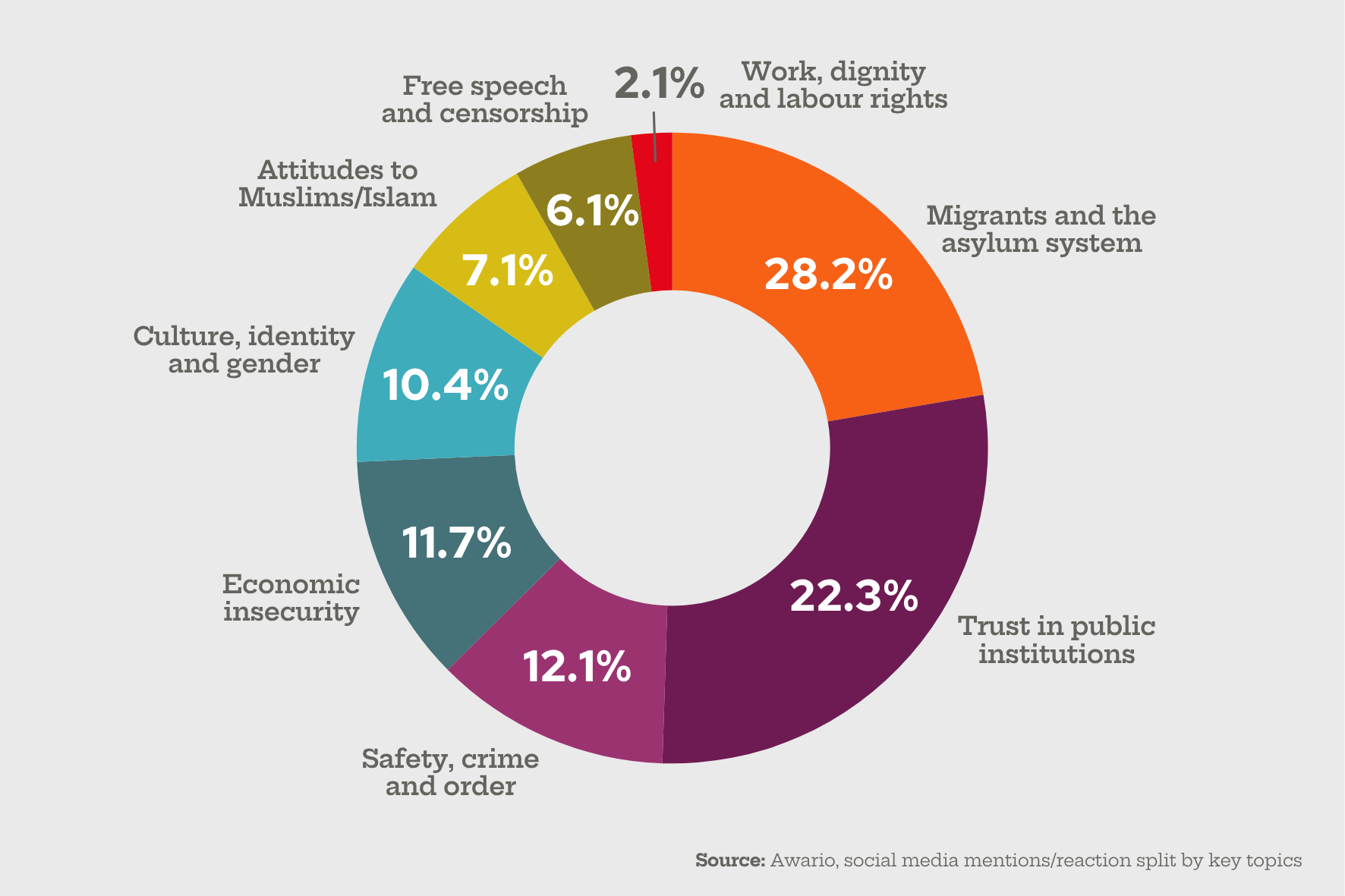
- Migration and asylum: This was the most discussed topic. It is often linked to concerns about borders, public services, and national identity. Levels of content increases during major news events. Example video one and two.
- Trust in institutions: There is widespread discussion about a lack of trust in government, media, and public bodies. Criticism of institutions is common and often reinforces existing scepticism. Example video one and two.
- Safety, crime, and public order: Concerns about crime and policing are frequently raised, often connected to wider worries about fairness, social stability and protecting women and girls. Example video one and two.
- Economic insecurity: Many posts refer to rising costs, wages, and housing. However, these issues are often simplified, with no solutions given other than blaming migration or institutions for failing people. Example video one and two.
- Culture and identity: Discussions around free speech, cultural change, and identity are common, particularly among younger audiences who tend to lean into US podcasters and channels and whose politics are experienced as online culture war rather than economics. Example video one and two.
- Atittudes to Islam: Blame narratives with misinformation and disinformation focusing on Muslims was prevalent. Example video one and two.
- Free speech and censorship: Bad faith actors lamenting that “free speech” no longer exists in the UK, focused on a misguided and misinformed “silencing dissenting voices” framing. Example video.
- Work, dignity and labour rights: Content focusing on the then Employment Rights Bill and how it affects people. Example video one and two.
Most content related to migrants and the asylum system, with complaints about and lack of trust in public institutions following closely.
Insight one: Influencers and the online ecosystem
Even though traditional media is often what draws our attention to an issue when big news breaks, influencers and online communities on social media are where stories reach more people, as influencers drive engagement through emotionally charged “ragebait” content. Algorithms reward content that gets more clicks and shares by pushing this content out to more people, meaning there’s less space for nuanced or balanced viewpoints because this type of content doesn’t typically get rewarded.
Far-right movements are very good at using these online spaces to further their own aims and have exploited this platform strategy and the way algorithms work. Beyond algorithms favouring ragebait, people are encouraged to make their own content and spread it quickly. This often happens through anonymous accounts, which helps expand the reach of stories. This presents a challenge to progressive groups, who typically have less capacity and budget for creating content or expertise in how to make the most of platform strategies to react effectively and efficiently. The values that progressive groups hold also mean we would not use the same tactics to exploit the algorithms with ragebait.
In this imbalance, harmful narratives can spread easily, while positive messages struggle to get the same level of attention or impact. However, there is also an opportunity to work within the algorithm and flood the space with worker voices alongside impactful social-first content. And by reprioritising digital communications and campaigns and skilling up progressive organisations in how to make the most of the platforms we’re engaging with, we can level up and have significant influence.
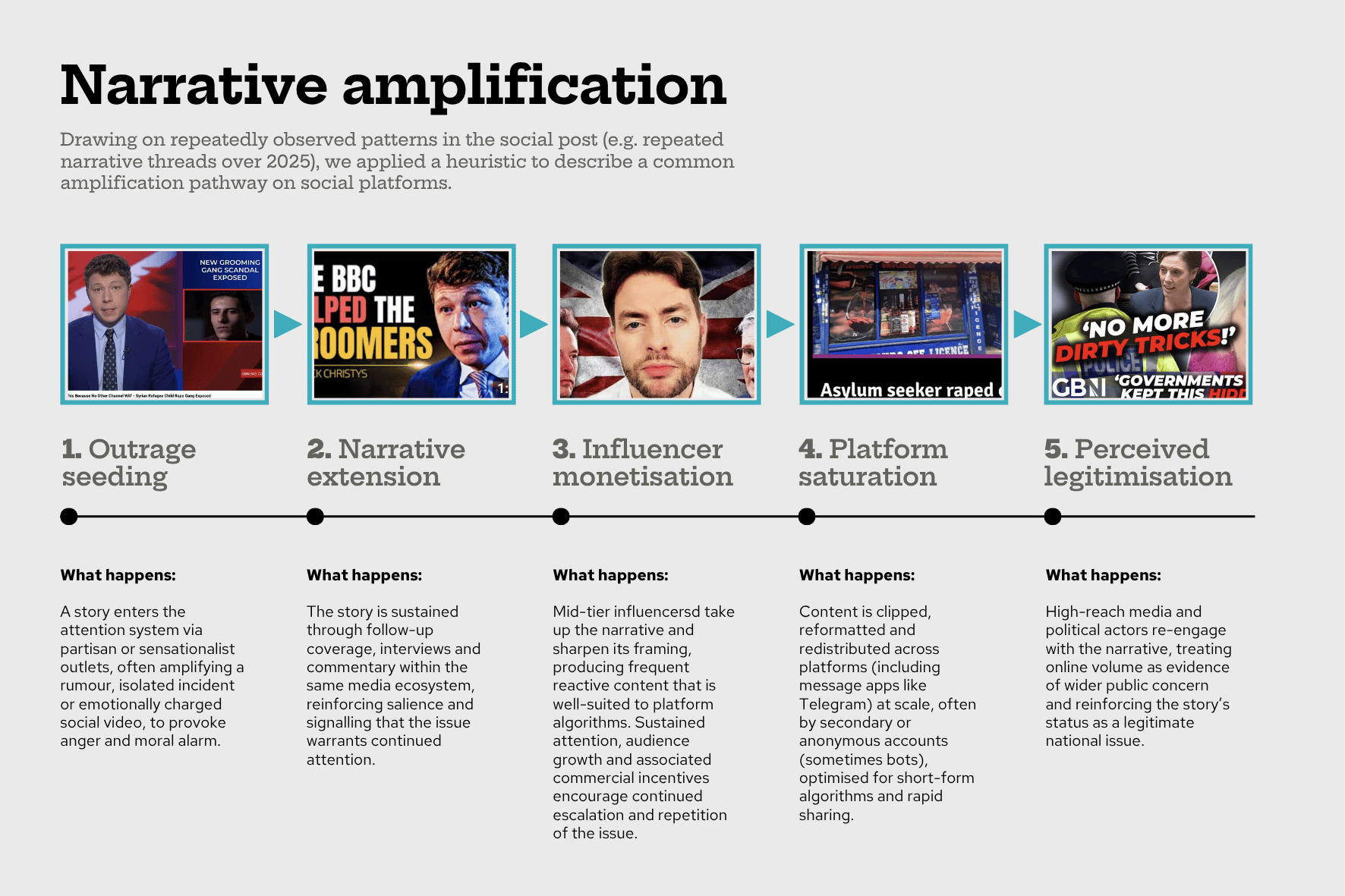
Analysis has also shown a common pattern in how issues are amplified on social platforms. It speaks to how actors are responsive to niche news or news coming from traditional media, and how they are operating within a network of influencers – sharing and building on each other’s content. This pattern helps us understand the opportunities to break the pathway or to replicate in ethical ways.
Insight two: Institutional mistrust reinforces far-right support
We define institutional voices as the voice of an organisation or movement speaking from a recognised social role, with a claim to legitimacy and public responsibility. This is based on Douglass North’s definition of institutions. The Edelman Trust Barometer tracks trust across institutions such as government, business, media and NGOs and paints a picture of institutional scepticism, grievance and fragmentation. Ipsos Veracity 2025 found that 45% of Brits trust trade union officials to tell the truth, down from 49% in 2024. British Social Attitudes also found that trust and confidence in Britain’s system of government is at a record low.
The December 2025 spike in coverage of Nigel Farage’s allegations of racism illustrates the dynamic of institutional mistrust and how it reinforces far-right support clearly. Although mainstream reporting was overwhelmingly critical, online reactions were often supportive or dismissive of the allegations.
This reflects a broader pattern of institutional distrust, where condemnation by the media or legal system is reframed as evidence of persecution, mirroring U.S. culture-war logics.
When audiences assume bias in media and public institutions, institutional criticism can reinforce far-right narratives rather than weaken them. Framing communications as “anti–far right” may further entrench this effect, as it signals an oppositional boundary and encourages audiences to interpret messages through a lens of hostility.
This means that direct rebuttal, particularly from institutions, can have the opposite of the intended effect. Messages are judged less on their content and more on who is perceived to be delivering them. Progressive organisations should therefore be wary of thinking a message has landed well just because there’s been a good reaction in traditional media; instead, look further and examine how this is landing on social media spaces and through target audiences’ interactions and comments.
Insight three: US and UK far-right: fragmented but strategically aligned
In 2025, over a quarter of all content captured on far-right channels and topics originated in the US. This creates convergence around themes such as free speech, institutional distrust, and identity politics.
Overall, the far-right’s online presence is best understood as a fragmented but strategically aligned ecosystem. It spans hardline conservatism, populist anti-establishment politics, and ethno-nationalist positions. These strands differ ideologically but converge around shared enemies and grievance-based framing.
The growing overlap between UK and U.S. influencer ecosystems is most stark on YouTube, where video “recommendations” or suggestions for what to view next and cross-posting surface high-reach American culture-war content to UK audiences.
This shows us that the ecosystem operates as a connected network shaped by shared narratives, platform dynamics, and cross-border influence, rather than central coordination. This can be a helpful way to understand how we can develop informal partnerships around shared policies or beliefs and understand that our campaigns will be more effective if we focus our work on each fragment and issue, rather than treating far-right channels and influencers as fully whole or the same. It also highlights the need to build cross-border partnerships with our U.S. counterparts to build early warning systems for identifying trending narratives that may soon be prevalent in the UK.
Insight four: Economic insecurity as a key driver used for blame narratives
Economic insecurity, such as low wages, unemployment and high rent, is a frequently referenced issue, yet is rarely connected to a need for strong worker rights or advocating for progressive union values.
Instead, economic insecurity is condensed into simplified blame narratives. Influencers commonly blame material pressures on targets such as migrants, liberal elites, or the “woke left.”
These messages are effective because they offer clear and emotionally resonant explanations of hardship, allowing people to make sense of economic strain without engaging with more complex structural causes.
This highlights a gap that unions could work with. Economic insecurity is central to how people feel, but it is rarely linked to actual solutions, leaving space for other actors to define both the problem and the blame. Trade unions have the solutions, and with impactful campaigning and resources, we can move audiences effectively into more progressive spaces.
Deep dive two: Accounts spreading these views
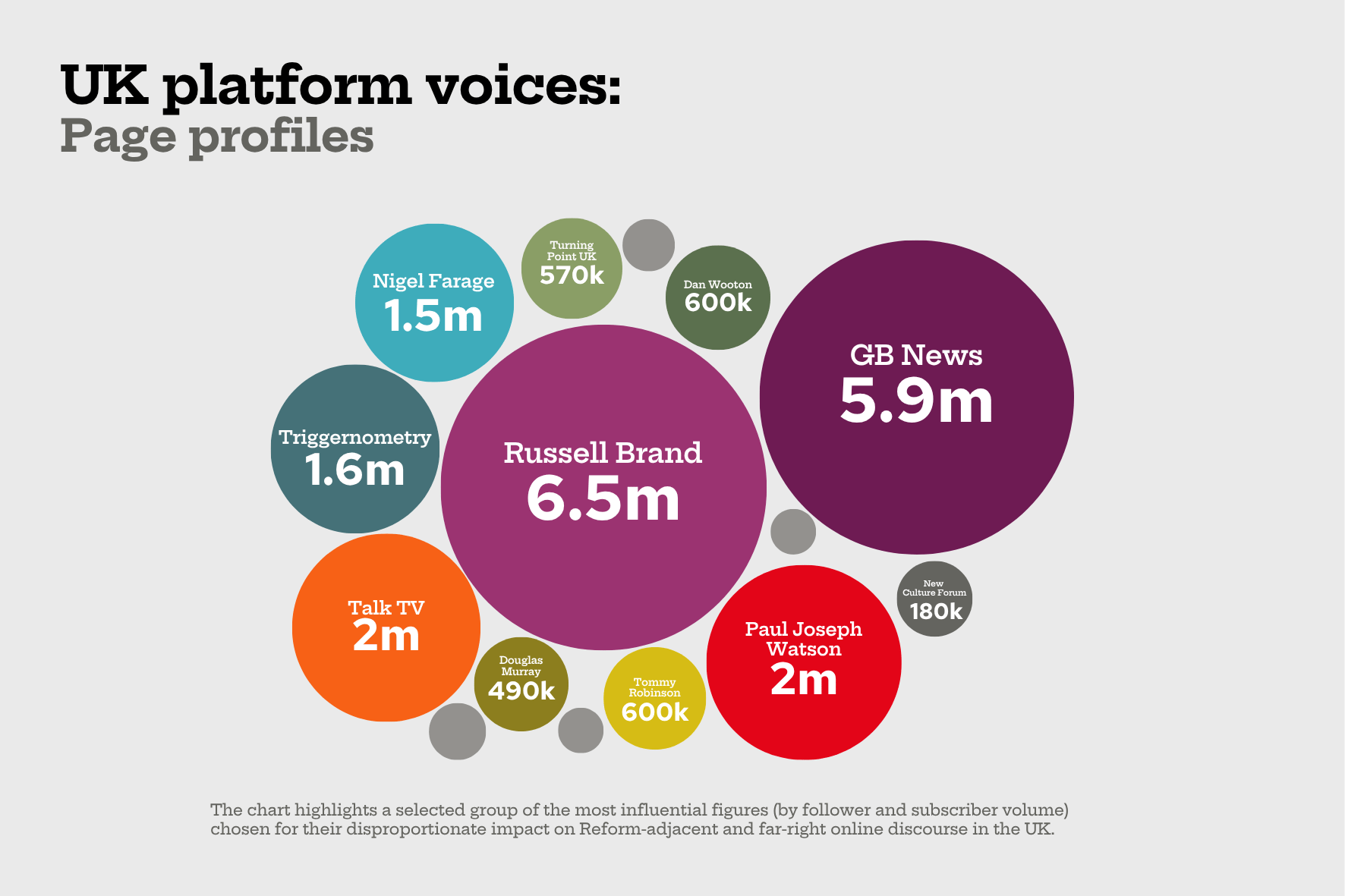
There are a range of influencers and channels that spread far-right messages which have high levels of engagement:
- Broadcast-linked platforms (such as GB News and TalkTV): These provide a steady flow of content that is widely shared online.
- Online commentators (such as Russell Brand, Paul Joseph Watson,
and Triggernometry): These creators discuss current events in detail and shape how their audiences interpret them. - Political figures (such as Nigel Farage): These figures connect online discussions (such as blaming migrants for housing issues) within mainstream politics and reach a wide audience.
- Campaign-style figures (such as Tommy Robinson): These accounts use more direct and emotional messaging and encourage active participation e.g. the Unite the Kingdom rally.
Below is a summary of high-profile channels.
| Channel | Platform | Core age | Subscribers/ followers |
| Russell Brand | YouTube | 25-54 | 6,500,000 |
| GB News | TikTok | 18-34 | 3,300,000 |
| GB News | YouTube | 35-64 | 2,000,000 |
| Paul Joseph Watson | YouTube | 18-44 | 2,000,000 |
| Triggernometry | YouTube | 25-54 | 1,600,000 |
| Talk TV | YouTube | 35-64 | 1,380,000 |
| Nigel Farage | lnstagram | 25-54 | 980,000 |
| Talk TV | TikTok | 18-34 | 630,000 |
| GB News | lnstagram | 35-64 | 600,000 |
| Tommy Robinson | YouTube | 25-54 | 600,000 |
| Dan Wooton Outspoken | YouTube | 25-54 | 600,000 |
| Douglas Murray | lnstagram | 30-64 | 490,000 |
| Nigel Farage | YouTube | 35-64 | 450,000 |
| New Culture Forum | YouTube | 35-64 | 380,000 |
| Turning Point UK | YouTube | 18-34 | 345,000 |
| Turning Point UK | lnstagram | 18-34 | 223,000 |
| Leo Kearse | YouTube | 25-54 | 160,000 |
| Laurence Fox | YouTube | 35-64 | 150,000 |
| Katie Hopkins | YouTube | 35-64 | 90,000 |
Deep dive into three profiles:
- GB News:
a. GB News is a major broadcaster within the UK’s right-leaning media landscape, combining live TV with a strong presence across YouTube, Instagram, and TikTok. Its content often pushes politically charged stories that are then picked up and amplified by online influencers and commentators. In online discussions, it acts less as a standalone news source and more as a reference point within reaction-driven social media content. Recent attacks on the BBC by figures on the US right, including Donald Trump, have helped strengthen this positioning and coincided with rising audience share for GB News in the UK.
b. Its biggest audience is on YouTube, with further reach through clipped content on TikTok and Instagram. Engagement is driven more by individual presenters than by the channel itself. The audience is mainly UK-based men aged 25–64, particularly in large cities. Its style is presenter-led, confrontational, and built around debate, conflict, and viral clips. The
channel frames itself as offering “common sense” perspectives rather than extreme views. Recurring themes include immigration as a sign of political failure, crime and protest as evidence of social decline, threats to free speech, and claims that political and media elites are disconnected from ordinary people
- Russell Brand:
a. When Brand emerged into the public sphere, he built trust with working-class and anti-establishment audiences through campaigns focused on inequality, corporate power, and distrust of traditional media. His YouTube channel now acts as a hub for commentary on current events, community-building, and directing followers to alternative platforms like Rumble and Locals. He often frames criticism of himself, including criminal allegations, as part of wider patterns of media bias, censorship, and elite coordination. While not openly far-right, his content sits within the broader UK-US alternative media space shaped by populist and anti-establishment narratives.
b. His audience is mainly based in the UK and US, aged 25–54, with strong overlap among wellness, libertarian, and institutionally sceptical communities. His style is long-form and reflective, mixing current affairs with personal, spiritual, and moral commentary. He presents his views as independent inquiry rather than party politics. Common themes include media persecution, elite corruption, free speech, censorship, public health as a form of social control, and the idea of personal or spiritual “awakening” as resistance to political and cultural power.
- Nigel Farage:
a. Farage consistently presents politics as a fight between “ordinary people” and out-of-touch elites, positioning himself as an outsider voice within mainstream politics and media. He acts as a bridge between public frustration and formal political debate, giving protest-style grievances a more mainstream and respectable platform.
b. He is most active on YouTube and Instagram, but his reach is boosted heavily by appearances on broadcast outlets like GB News and wider press coverage. His audience is mainly UK men aged 35–64, including Reform supporters, disillusioned Conservatives, and some Labour switchers. His style is calm, conversational, and framed as “common sense” rather than ideological. His content focuses on immigration, distrust in democratic institutions, threats to free speech, and national decline blamed on political elites. More recently, he has also used language around cryptocurrency and artificial intelligence to appeal to younger male audiences interested in tech and innovation.
Not everyone shaping public opinion online is doing so from an obvious political position. Some of the most influential figures are those who appear apolitical on the surface, yet their voices shape how people think and talk about key issues – like Russell Brand.
But influence isn’t just about follower numbers. There’s often a gap between how influential someone seems and the actual reach they have - we might believe certain commentators are major players, but their real audience is limited, take Katie Hopkins for example. That gap reminds us that influence isn’t reserved for the few with the highest followers. Each of us, in our workplaces and communities, can have a voice that matters, particularly where we have higher trust, personal relationships and credibility.
Beyond this, many online influencers move quickly from one topic to another, chasing attention rather than communicating a consistently clear set of values. Often, their motivation is profit (the more your content is viewed, the more you can earn in advertising revenue) or visibility over genuine conviction or belief about the issue they’re talking about. Our task is to cut through that noise and build influence founded on principles, solidarity, and the shared values that underpin the trade union movement.
Deep dive three: Target audiences
Audiences the actors are reaching have been mapped onto the Hope not Hate ReformUK supporter segmentation, to provide a framework that can be replicated by other organisations.
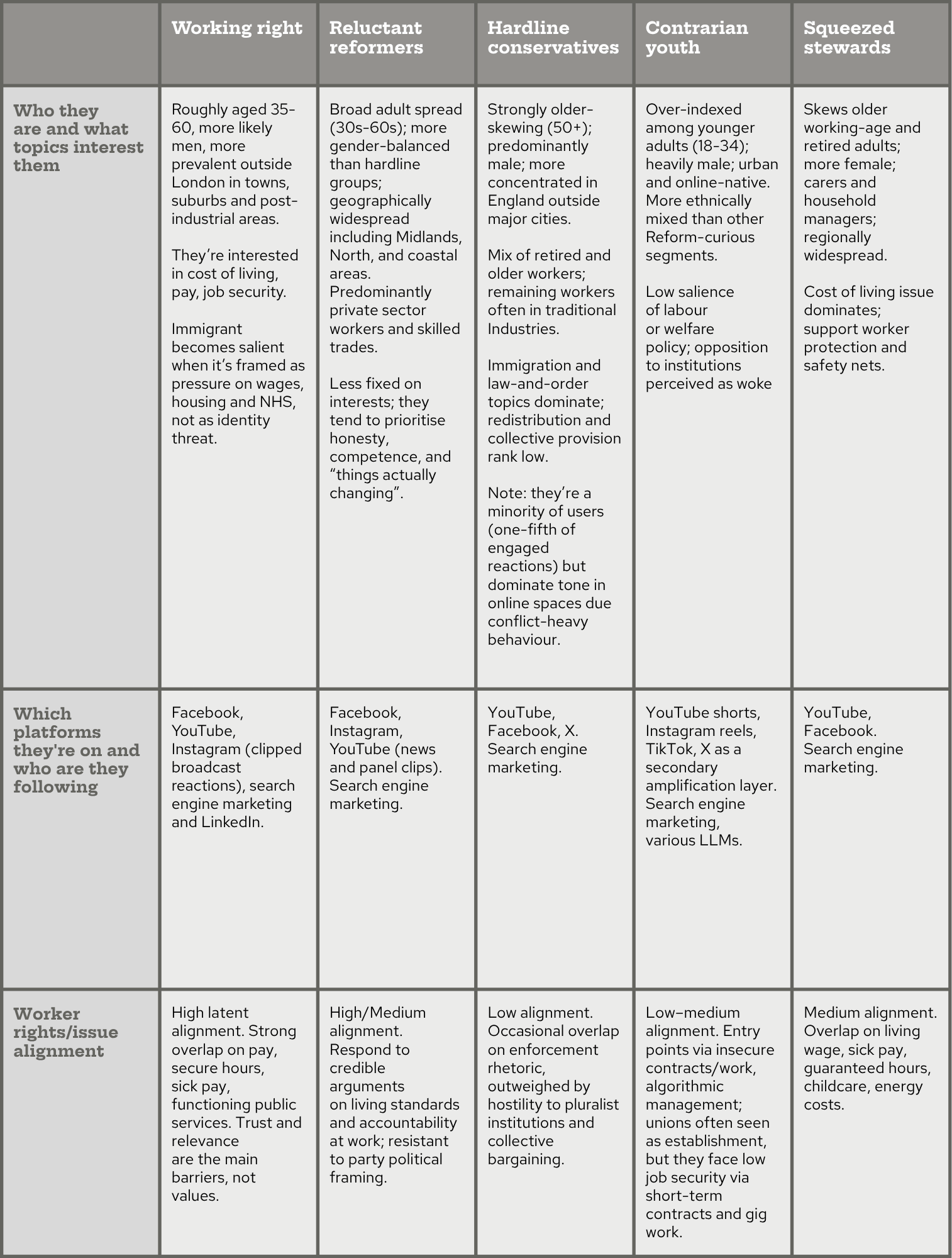
Of the audiences covered above, three are naturally more aligned to worker issues: working right, reluctant reformers, and contrarian youth. As with any piece of work, it’s important to prioritise an initial set of target audiences and develop creative and testing, but in a limitless world the optimal approach is to have substantial budget to create testing plans that have the potential to reach all target audiences. Part of the tactical approach is to consider worker issues and progressive union values beyond what organisational accounts can do.
Before we develop content to reach specific audiences, it’s crucial to understand how each audience group interacts online, to build a picture of their pressure points and understand them better. Through this, unions can map how, if any, audiences overlap onto their existing audiences, recognising that some unions will be naturally better placed to speak to those than others.
Influencer outreach is a vital part of ongoing work to combat the far-right online. In the age of peer to peer news, they must now be viewed as its own channel of influence and campaigns, a vital part of the softer brand work for progressive organisations to build audiences. This can range from worker content creators, lifestyle or cultural influencers, and micro influencers who have a smaller but more invested audience base. This is especially important when we look at different audiences and who unions might struggle to reach or have low trust in, such as the contrarian youth segment who are likely to see unions as ‘establishment’.
Recommendations
Based on these findings, the following approaches are suggested:
- Invest in platforms audiences already engage in. Messages are more likely to land if they appear in the spaces people already spend time in, rather than trying to draw them elsewhere. This may raise conversations about ethics on engaging with platforms run by far-right – but if you choose to reach these audiences, the most effective ways to do so, is to reach
them where they’re at. An example of this is seeing how salient X continues to be as a space for discussion and content, despite many users leaving to use BlueSky or other platforms. To be absent from such dominating spaces would mean not getting these messages out in spaces that people continue to spend time in.
- Use trusted and relatable voices. People respond to individuals they find credible and familiar. Many of the most politically influential voices are not overtly political, which creates an opportunity to work with messengers outside the trade union movement, or rooted actively within their workplace communities, who can connect more naturally with these audiences.
- Talk about the issues people care about and give them clear solutions. While many actors talk about the cost of living, wages, housing and public services, there is less clarity on what should be done. Unions are well placed to fill this gap, but solutions need to be communicated in clear, accessible terms, using the right messenger and platform to reach the intended audience.
- Tailor messages to different audience groups. Different audiences respond to different tones, formats and priorities. A single, uniform approach is unlikely to be effective. Messaging should be adapted to reflect how different
groups engage with content and what matters most to them. Unions should consider this when developing communications plans and launching campaigns. To reach specific audiences at scale, it is likely necessary to use targeted tools and paid promotion. This allows messages to be placed directly in front of the people most likely to engage with them.
- Meet the moment and keep it going. When traditional press or wider conversations related to your work peak, be prepared to respond online and to do so quickly. Think about rapid sign off procedures that allow you to respond within minutes, not hours, and comms lines and content you can create in a rough and ready way. Crucially, though, impact comes from sustained engagement, not one-off campaigns. Think about how you follow up to keep the moment going.
- Build networks to amplify and reinforce content. Work with allies and aligned organisations to boost each other’s content. Coordinated activity can increase reach and help messages travel further, rather than relying on single accounts or campaigns. This allows us to level up and be better placed to combat far-right influencer ecosystems.
- Talk about the perception gap. Give union reps and members insights into how online discussions are shaped, specifically the fact that narratives are spread by small but highly active groups, often driven by financial motivation. This can help challenge the perception that these voices reflect majority opinion.
- Test, learn and adapt your comms work. Trial different messages, formats and approaches, and be open to some not working. Use practical indicators such as positive engagement, shares and audience growth as signals of what is effective and build from there.
As listed in the recommendations, there are a myriad of ways we can test pushing back effectively, but key here is the willingness to test iteratively and lean into the content creator space, as opposed to seeking perfection each time and relying only on branded organisational accounts for all audiences. We know that one messenger will not speak to every audience group. Instead of looking at digital content homogenously, we need to embed strategic campaigns and varying creative that we test among specific target audiences.
We know that we have the tools needed to campaign effectively but often struggle with resources and guidance. This report helps unions fill in the gaps to develop campaigns to meet the moment and go further.
We know that unions can do this work, but it can be hard without the insights, budget and capacity. This is why it’s important to start conversations around resource and budget, and how we can work together to share learnings. We need to start seeing ourselves building an ecosystem rather than acting alone and recognising that one comms person will not be able to match the output of the far right.
Next steps
This report is part of a longer-term digital strategy project. The next phase involves testing different interventions that may disrupt the pipeline that far-right audiences may be taken on, starting with testing pre-roll ads to inoculate against far-right channels, and developing a network across US and UK union movements.
Insights from this testing will form the basis for a follow-up report and workshops with unions on how to take the recommendations forward. In the interim, we have started to apply these insights already, by building networks of workers who can speak compellingly to their peers, giving workers the skills and confidence to create content that challenges far-right narratives online. Additionally, we are exploring creator vs institutional voices as effective messengers for key target audiences identified for the movement (women aged 25-40 and young people in the private sector).
If you are interested in the insights from the report or would like to book a briefing with the TUC on how to apply insights, please contact unityworks@tuc.org.uk.
Stay Updated
Want to hear about our latest news and blogs?
Sign up now to get it straight to your inbox
