
Behind the app
The shop assistant folding your shirt and placing it in the carrier bag is actually a self-employed entrepreneur. Or so some stores would have you believe.
After years of rising insecurity in the labour market, some employers are taking matters a step further and hiring staff from agencies that claim to supply self-employed freelancers.
Despite outrage at the beginning of this year, 1 which prompted ministerial fury and a number of employers to pledge to drop the practice, 2 analysis by the TUC has found that many employers continue to use these platforms.
This can mean that the barista, hired via an agency to make flat whites in a coffee shop is being treated the same as the plumber who owns their own business, sets their own hours and prices and deals with multiple customers.
Even Clarridge’s, a hotel so upmarket that travel guides refer to it as an “annexe of Buckingham Palace”, has turned to the apps. 3
This matters because different categories of workers enjoy different rights from protection from unfair dismissal to trade union rights. Employees have full rights. Those deemed workers have some protections, such as entitlement to the minimum wage but miss out on others such as unfair dismissal protection. Those treated as self-employed have virtually no employment rights. This complexity can be exploited by an employer determined to evade their responsibilities.
- 1Wall, T. (2025). “Gig economy firms warned by UK government they may be operating illegally.” The Guardian. Available at: https://www.theguardian.com/business/2025/jan/25/gig-economy-firms-warned-by-uk-government-they-may-be-operating-illegally (Accessed 16 December 2025).
- 2Butler, S. (2025). “Uniqlo, Gymshark and Lush stop hiring UK workers via gig economy apps”. The Guardian. Available at: https://www.theguardian.com/business/2025/jan/05/uniqlo-gymshark-and-lush-stop-hiring-uk-workers-via-gig-economy-apps (Accessed 16 December 2025).
- 3Wall, T. (2024). “Gig economy firm under fire for telling restaurants they can avoid UK’s new tipping laws”. The Guardian. Available at: https://www.theguardian.com/business/2024/nov/03/gig-economy-firm-under-fire-for-telling-restaurants-they-can-avoid-uks-new-tipping-laws (Accessed 16 December 2025). Claridge’s is also listed on the Brigad website as a client.
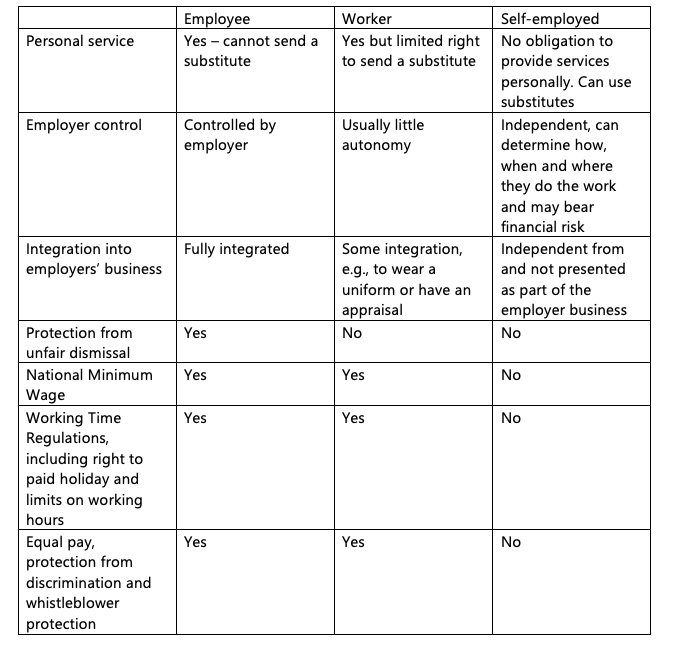
Casualisation and precarity are significant features of the current UK labour marker. 4 TUC analysis of labour market data shows that 4 million people in 2024 were in insecure work, which includes low-paid self-employed workers and those with worker status. 5 This amounts to around one eighth of the entire workforce. Though a small proportion of the insecure workforce are employees, the vast majority in this position do not enjoy the full employee protections, as they are deemed to be workers or self-employed by the people hiring them.
The government has set to work to improve this position, by cracking down on exploitative practices and enhancing employment rights. 6
The resultant Employment Rights Act 2025 extends sick pay to the lowest paid workers and protection against unfair dismissal will soon be available from six months into a job.
A key missing element is action to ensure that employers cannot evade their responsibilities by denying that those who do work for them are actually their workers and are in fact self-employed. However, the government has committed to reviewing employment status.
This report looks at the impacts of the casualisation of work, and fissured nature of the UK’s worker status framework on workers. It looks specifically at the use of talent platforms: websites or apps that connect people who want to offer services with people who want to pay for them. The work is usually short-term, and the platform acts as a middleman between the two sides. 7 The report examines how casualisation and miscategorisation are exacerbated by talent platforms. It goes on to explore how strengthening protections around employment status can guard against one-sided flexibility, and ensure that employment status laws can offer protections against miscategorisation.
Background
Many people are genuinely self-employed. They operate their own businesses and are in charge of their own working patterns.
However, some employers exploit the UK’s complex legal landscape and weak labour market enforcement infrastructure to claim those who work for them are self-employed. This is an attempt to escape the rights afforded to workers and employees such as rest breaks, pension contributions and entitlement to tips. Miscategorising workers as ‘self-employed’ is prevalent in the UK labour market, with bogus self-employment being a significant issue in the gig-economy. 8
In 2021, the Supreme Court issued a landmark judgment. It ruled that Uber drivers, who the platform deemed to be self-employed, were actually workers and were therefore entitled to key employment rights. This includes entitlement to minimum wage and holiday pay. 9 In making this determination, the Court looked at the degree of control Uber exercised over the drivers. A key fact of this case was that the drivers were subordinate and dependent on Uber. Drivers were not able to substitute their services and send another driver in their place. However, the Court found that the obligation to work personally created a level of control by Uber. 10
Many workers continue to be classified as self-employed by the platforms they work for. This is often justified because they have a contractual right to engage a substitute to do their work.
Now, it is becoming clear that in other parts of the economy, beyond areas like food delivery and ride hailing typically regarded as “gig” or platform economy roles, employers are using staff without affording them the rights and protections owed to workers or employees.
If you walked into the clothes store, Urban Outfitters, in Camden you would almost certainly be shocked if you discovered that the shop assistant who bagged up your shirt was a self-employed contractor, similar to a builder adding a home extension. Yet, many workers, including those at the fashion chain, are being hired as self-employed freelancers with no legal rights to the minimum wage, paid sick leave. Indeed, many have to apply for their role every time they want to work a single shift.
- 4Klair, A. (2025). “The scale of insecure work in the UK”. TUC. Available at: https://www.tuc.org.uk/research-analysis/reports/scale-insecure-work-uk (Accessed 16 December 2025).
- 5Klair, A. (2025) at note 4.
- 6Labour Party (2024). “Labour’s Plan to Make Work Pay: delivering a new deal for working people.” Available at: https://labour.org.uk/wp-content/uploads/2024/06/MakeWorkPay.pdf (Accessed 16 December 2025).
- 7Lenaerts, K. et al (2018). “Online Talent Platforms, Labour Market Intermediaries and the Changing World of Work”. CEPS & IZA. Available at: https://cdn.ceps.eu/wp-content/uploads/2018/05/CEPS_IZA_OnlineTalentPlatforms.pdf (Accessed 16 December 2025).
- 8UK Parliament (2017). “Self-employment and the Gig Economy”. Work and Pensions Committee. Available at: https://publications.parliament.uk/pa/cm201617/cmselect/cmworpen/847/84702.htm (Accessed 16 December 2025).
- 9Brem, A. (2023). ”The Impact of Uber in the UK”. Uber. Available at: https://www.uber.com/en-GB/newsroom/the-impact-of-uber-in-the-uk-2/ (Accessed 16 December 2025).
- 10Uber BV and others v Aslam [2021] UKSC 5. Available at: https://supremecourt.uk/uploads/uksc_2019_0029_judgment_19c9de2253.pdf (Accessed 16 December 2025).

Without proper regulation, there is a risk that we start to see such practices become normalised, creating a race to the bottom across the UK labour market.
Temper and similar digital talent platforms, work by facilitating matching between client companies and workers for individual work shifts. They operate in sectors ranging from hospitality and retail to logistics. While some of them refer to themselves as employment agencies, platforms like Temper do not – seeing their gig-workers as self-employed contractors. This means they don’t provide workers with all the rights to which a worker or employee would be entitled. Nevertheless, it is evident that someone working in a shop or kitchen would almost certainly meet the legal threshold for ‘worker status’. 11 For instance, being limited in their ability to send a substitute where training is required for a position, 12 obligations to wear a uniform, and the degree of control exercised by the client business.
In 2025, the Minister for Employment Rights Justin Madders asked the labour market enforcement authority, the Employment Agency Standards Inspectorate, to investigate the ‘talent platform’ companies YoungOnes and Temper. He said:
“We find it entirely unacceptable for employers to avoid their legal obligations by claiming someone is self-employed when they are not. Action that reeks of this exploitation is intolerable, and we will not hesitate to ask all relevant authorities to scrutinise such employers.” 13
Young Ones stopped operating in the UK from 30 September 2025. But several similar talent platforms remain, including Temper, Brigad and Stint. Several employers such as Uniqlo, Lush, and Gymshark also pledged to stop using talent platforms. 14
But some big names in retail and hospitality are still listed as clients of such platforms including Urban Outfitters and upscale hotel Claridge’s.
Case study 1: Colicci Café
Temper advertises London-based positions on its platform that are well below the London living wage. This is a figure independently calculated to reflect the real cost necessary to cover the essentials that workers and their families need to live with dignity, security and stability in London One such shift for a self-employed barista is advertised by Colicci Café, which describes itself as a ‘family-run' café that operates across London’s royal parks and “cherished public spaces”. Its social media profile says it is “all about quality coffee served by trained baristas.” So, if you wanted to work as one such trained barista, what could you expect?
You would have to already have at least one year experience as a barista. Despite this experience, the position only offers £12.50 per hour for a 6.5-hour shift, just 29p above national minimum wage. If a worker chooses the ‘DirectPay’ option so that they can receive their payment immediately after the client confirms the end of their shift, then they will have to pay a 2.9 per cent fee, meaning they end up with 7p below the national minimum wage for someone over 21 years old. Moreover, someone wanting to work this shift would have to buy their own all-black outfit if they didn’t already own one (‘no rips’ specified). The job advert warns: “You will be sent home if you are not in the correct uniform.” If you are successful in applying for the shift, and buy your uniform in anticipation, Colicci Café retains the right to cancel your shift with just 24 hours' notice without paying a penny. If it cancels with less then 24 hours’ notice, it pays 50 per cent of the shift cost. If the unlucky applicant has already spent money on their uniform, for childcare, for travel, they might be down money for a shift they never had.
This ‘family business’ café have nearly 5,000 ratings from users and is described by Temper as being one of their ‘biggest clients’. 15 This indicates that it is frequently advertising for individual shifts rather than paying for a permanent member of staff with full employment rights and protections. Rather than being recruited, workers have to apply for a shift every time they want the work.
- 11Labour Party (2024) at note 6.
- 12Pines and Needles ’Manager’ job advertisement on Temper (26 November 2025). Accessed 26 November 2025.
- 13Wall. T. (2025). ”‘So immoral’: gig economy workers charged fee to get paid quicker”. The Guardian. Available at: https://www.theguardian.com/business/2025/jan/11/so-immoral-gig-economy-workers-forced-to-pay-fee-to-receive-their-wages (Accessed 16 December 2025).
- 14Butler, S. (2025) at note 2.
- 15Email from Temper to users (27 October 2025). ”
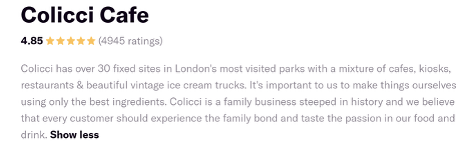
This case study starkly illustrates how platforms like Temper enable businesses to shift risks and cost onto workers while denying them the security and dignity of a proper job. Colicci Café may present itself as a family-run enterprise serving quality coffee in cherished public parks, but behind the branding lies a model that undermines fair pay, job security, and basic respect for workers. It’s a reminder that without stronger regulation, one-sided flexibility that favours the bosses will continue to erode hard-won rights - one shift at a time.
Case study 2: Urban Outfitters
In November 2025, Urban Outfitters, Inc. reported record sales in its third quarter, surpassing already ambitious expectations and sending its share price soaring. Net income for the quarter alone was an eye-watering $116.4 million (£87.3 million GBP). 16
At the same time, Urban Outfitters was recruiting workers as self-employed contractors on a shift-by-shift basis across its stores in the UK, from Glasgow to Bath. These workers have no job security, no promotion opportunities, no access to entitlements like statutory sick pay or pension contributions.
The job ad says that the successful applicants will help ‘champion the Urban Outfitters “Peers Training Peers” approach’ even though these peers might be on contracts with the full entitlements accorded to employees. On the face of it, Urban Outfitters doesn’t treat workers it hires through Temper as peers at all, instead, they’re precarious and disposable labour.
It goes on to say that if someone ‘nailed [their] shift’, they could be added to a ‘Favourite Pool’ which means that the worker will be invited back more often. No offer of a contract, no mention of improved pay or conditions. Instead, the workers will still be treated as self-employed ‘freelancers’, despite an acknowledgement of sustained need for workers. What we’re seeing is a mechanism to keep workers permanently insecure, despite clear evidence of ongoing staffing needs.
The pay for roles in its Camden store is £12.50. This is the lowest salary that a Temper client can offer. As with the example above, if a worker chooses the ‘DirectPay’ option so that they can receive their payment immediately once the client confirms the end of their shift, then they will have to pay a 2.9 per cent fee, meaning they end up with 7p below the national minimum wage for someone over 21 years old. With over 100 people applying for individual shifts, the ability to meaningfully negotiate a salary is farcical. Instead, Urban Outfitters leverages one-sided flexibility, taking advantage of a precarious and often desperate workforce while paying out millions to investors.
Case study 3: Pines and Needles
Temper does not limit its services to hiring for junior positions. It enables clients to source store managers as purported “freelancers.” This practice raises serious questions about employment status and rights.
To apply for the position as a self-employed store manager, applicants must have completed their store manager/assistant store manager training; worked for Pines and Needles in the past (on or off Temper); have significant retail or customer service experience (e.g., as team leader or manager) on their Temper profile. These requirements resemble those for a standard employment contract, not freelance work. The suggestion that a successful applicant could send a substitute (a criterion often taken into account by the courts as a marker of genuine self-employment) is implausible given these requirements.
Pines and Needles confirms that it prioritises candidates who can work multiple shifts, including weekends and those who’ve undertaken Pines and Needles’ training, requirements that are at odds with supposedly self-employed arrangements.
One of the ways to check for bogus self-employment is whether someone is given instructions on how to do their work and whether they can choose when or where they work. The requirement for training and requirement to be available for certain days, even when they’re formally able to apply on a shift-by-shift basis, points to a high likelihood of bogus self-employment.
The job advert warns that applicants will ‘need to be comfortable lifting heavy trees’ and that, capitalised for emphasis, they must be ‘happy to work outside at all times in all weathers.’ Yet if a worker pulls a muscle lifting a Christmas tree or falls ill after working in freezing conditions, as they’re being treated as ‘self-employed’ they have no entitlement to statutory sick pay.
Despite the low wages, poor conditions, and failure to offer basic employment rights, another essential criterion is that applicants must ‘love Christmas’.
Swapping out protections
Talent platforms business models dictate what rights people have access to, and how much they’re able to fight for better conditions. Going through the impact on workers, we see a picture of platforms enabling the degradation of conditions and facilitating a race to the bottom.
Precarity
It is not unusual for employers to rely on agency staff to meet demand in the short term, for instance to cover for staff on sick leave. However, these talent platforms advertise themselves as structural solution to staffing needs. 17 Rather than providing decent jobs, some client companies appear to be using these talent platforms to avoid hiring staff with full employment rights entitlements. The more that companies can rely on people undertaking individual gig-work shifts, the more the risks and uncertainties created by a lack of planning are placed onto workers. Where workers need to apply for every single shift they want to work, they will be even more scared of pressing for better conditions out of fear that they won’t be offered another shift or will be left a bad review.
Low Pay
Self-employed people do not have a right to national minimum wage, unlike workers and employees. As a result, employers can seek to use miscategorisation of employment status to push pay below national minimum wage.
Though the platforms advertise the fact that workers have the option to negotiate over their salary, workers’ precarity and the number of applicants for each role limits any leverage to negotiate their pay upwards. One example on Temper shows a position for West Ham United’s retail team offering payment just 29p over National Minimum wage for someone over the age of 21 having over 149 applicants. 18 The cards are stacked against anyone trying to negotiate for higher pay in this situation. Beyond this, individual shift work, where a manager can decide to not hire you for another shift without triggering any risks of violating unfair dismissal legislation means that workers might be fearful of retaliation. The stark imbalance of power is plainly apparent.
Temper offers two payment systems. One involves 'freelancers’ paying 2.9 per cent of their total pay for ‘DirectPay’. Under this option, workers are paid after the client confirms that the worker has finished their shift. As Temper allows clients to pay £12.50 per hour, any worker that opts for the ‘DirectPay’ option ends up with 7p less than the national minimum wage as a result. The alternative option is to wait for the clients to pay within 14 to 30 days. Temper notes on its website that it’s possible that a client doesn’t pay within the agreed timeframe. 19 This risk is entirely offloaded onto the worker, with Temper assuming no responsibility.
Young Ones used the same model. The platform charged workers 4.8 per cent of their earnings for immediate payment or 2.9 per cent to be paid in three days. Otherwise, they would typically have had to have waited 30 days. Prior to the introduction of this system, the workers were paid in three days, without a charge. One worker who had used YoungOnes found themselves waiting even longer, saying “they can’t really badger their managers because working as a freelancer you have no voice, you might not get any more shifts if you are seen as outspoken.” 20
Risks are therefore offloaded onto the weakest people in the employment relationship. In a business model that relies on precarious and low-paid workers to pick up shifts, few will be able to easily absorb the risk of non-or late payment.
Shift changes & cancellations
Workers can benefit from the option to work flexibly. However, a lack of safeguards had led to flexibility becoming one-sided, with workers bearing all the risk and unable to plan and live. Temper advertises its flexible start and end time option to companies. 21 This allows client companies to advertise a role without confirming its start or end times, and allows them to change the times by up to three hours. When someone signs up for the shift they see the original times with a notification that flexible times apply.
The option for shift cancellation notice is set by the client company on Temper. 22 It can choose options ranging from ‘Super Strict’, where either party can cancel without consequence up to a week before the start of the shift, to ‘Flexible’ where the cancellation period is up to 24 hours before the shift starts. If the shift is cancelled, the worker is only able to claim 50 per cent of the original amount, with only seven days to claim the compensation. This practice is normalised and even advertised as a ‘Flexible’ option for client companies, exacerbating the trend of workers having less predictability so they can plan their lives effectively.
In 2024, 2.4 million workers in the UK reported feeling ‘very anxious’ about unexpected changes to hours. 23This anxiety is amplified by a system that builds short term shift changes and cancellations into its business model, and encourages businesses to rely on shift-by-shift recruitment rather than invest in their workforce in a way that allows workers to plan their lives around set hours.
Tipping
In 2023, tipping laws were extended to cover agency workers, to “improve fairness for workers by ensuring that the tips consumers leave in recognition of good service and hard work are going to the workers as intended.” 24 Nevertheless, Temper writes that client companies decide, on a shift by shift basis, whether the worker get a portion of any tips. In this sense, client companies can hire someone without offering breaks, without offering employment security, and profit even further from the power imbalance by retaining any tips earned by the worker. 25
Collective bargaining
Trade unions and collective bargaining are the most effective tools for addressing power imbalances in the workplace. By giving workers a collective voice, they help secure better pay, fairer conditions, and stronger protections across entire sectors. This helps to ensure that working people have real influence over the decisions that affect their lives. However, collective bargaining rights are only afforded to workers. In 2021, the UK Supreme Court ruled that couriers hired through the talent platform Deliveroo did not qualify as workers, and resultantly, did not have the right to collectively bargain as a trade union. 26 A workforce made up or saturated with agency workers or the bogusly self-employed is less able to improve conditions in their workplace or sector as a result of this barrier.
Lack of entitlements
Workers on talent platforms face all the risks associated with their roles without access to standard employment protections, such as insurance, protective gear, paid sick leave, holiday pay, or parental leave. Roles are advertised that require people to bring their own protective equipment or warn that they’ll work long hours lifting heavy objects. 27 Nevertheless, if this takes a toll on their health, they‘ll have to bear the cost themselves. The lack of access to such entitlements leaves these workers financially vulnerable during illness or injury, unable to plan for time off or family responsibilities, and often without recourse in cases of unfair treatment or unsafe working conditions. Over time, this can contribute to economic insecurity, poor health outcomes, and a widening gap in labour market protections between traditional employees and those who have to rely on talent platforms to source income
Bogus self-employment also means that workers miss out on their pensions. The Pensions Act 2008 introduced automatic enrolment into workplace pensions to tackle the widespread issue of inadequate retirement savings among employees. However, this system does not extend to the self-employed. While they can access the same pension platforms developed for auto-enrolment, participation is entirely voluntary and lacks the employer contributions and default enrolment that employees benefit from.
Miscategorisation through bogus self-employment passes the burden of safety net support to the welfare state as these workers are not auto enrolled into pensions schemes. This ultimately risks an old-age poverty crisis, as the gig economy workforce moves to retirement age. 28 In July 2025, the government revived the Pensions Commission in order to confront retirement crisis, finding that over 3 million self-employed are not saving into a pension. 29 This is a welcome commitment and underlines the seriousness of the issue.
Equalities impacts
Insecure work disproportionately affects groups of workers who are already discriminated against in the workplace. TUC research shows that in 2024 16.3 per cent of Black and Minority Ethnic (BME) workers are likely to be in insecure work. This compares to 10.8 per cent of white workers. In 2011 the proportion of BME workers in insecure work was 12.2 percent, compared to 10.5 per cent for white workers. In raw numbers, the number of BME workers in insecure work increased by over 2 and half times from 360,000 to 935,000. 30
Towards single status
In its Plan to Make Work Pay, the Government committed to “move towards a single status of worker and transition towards a simpler two-part framework for employment status”. This suggests a transition to a system where you’re either a worker with full rights or you’re genuinely self-employed.
The Employment Rights Act 2025 provides welcome improved protections for workers and employees. These include rights to protection from unfair after six months of starting a new job, sick pay from the first day of illness and its extension to low earners, and greater rights for workers to organise collectively through their trade unions. However, without further action on status, this could incentivise bad employers to circumvent the upgraded employment rights and protections by classifying individuals as self-employed.
A way forward
In advancing their commitment to move towards a simpler two-tier system that distinguishes between workers and the genuinely self-employed, the government should take a four-pronged approach to make sure a holistic framework is adopted. This should include:
The presumption of worker status
Diminishing the importance of the contractual undertaking to perform personal service
Empowering labour market enforcement and employment tribunals
Removing employment agency loopholes
Presumption of worker status
To strengthen protections against bogus self-employment, there's a need for a presumption of worker status. That means when there’s a question about someone’s worker status, for example when a case is taken to the employment tribunal, the starting point should be that the person is a worker, and therefore entitled to rights like holiday pay, protection from unfair dismissal, and the minimum wage. It would be up to the employer to prove otherwise.
This isn’t a radical idea. It’s an approach that’s been taken elsewhere in UK employment law. The National Minimum Wage Act 1998, for example, presumes that someone qualifies for the minimum wage if the question of eligibility arises in the first instance. That principle can be extended to any assessment of employment status.
This change would help ensure that access to rights is the starting point, not the exception. It would shift the burden away from vulnerable workers and onto those who seek to deny them protections.
The Employment Rights Act 2025 establishes a new Fair Work Agency (FWA) that combines several labour market enforcement authorities. The FWA is being granted powers to be able to take claims to an employment tribunal on behalf of workers. This could help to allow for strategic interventions, particularly where an employer is systemically violating workers’ rights, for instance by miscategorising their workers as self-employed.
The FWA will have to take proactive role in assessing and determining worker status. As worker status determines the employment rights and entitlements that’s available to workers, the ability to decide on worker status will be central to the FWA’s power to carry out its enforcement functions. Miscategorisation of worker status is rampant in low-paid sectors such as in the platform economy. For instance, miscategorising workers such as Uber drivers as self-employed had resulted in their exclusion from sick pay and annual leave entitlements prior to the Supreme Court decision in 2021. 31To avoid the often extended and difficult process of bringing a claim to an employment tribunal to decide on worker status, the FWA should have sufficient powers, training and resources to be able to make such determinations to inform their enforcement decisions.
Diminishing personal service
The courts have denied someone’s worker status where there has been a functioning substitution clause in their contract that allows them to send someone else to do their work. 32 However, this overlooks that in many cases it is implausible that the original worker wouldn’t be expected to do some, if not the bulk, of the work personally.
To ensure that workers are protected against the cynical use of widely drafted substitution clauses to diminish entitlements, it’s important to direct attention to the actual facts rather than placing disproportionate weight on the contract. Diminishing the importance of a contractual undertaking to perform personal services in the statutory definition can help achieve this.
One way of rebalancing this determination would be requiring the courts to consider whether the expectation is that the worker personally performs any work or service. This would look beyond the emphasis on the contract and instead will look to actual performance. This would intensify the focus on whether the individual is genuinely running their own business for clients or customers, or are they were simply providing labour? By focusing minds on the concrete working relationship, this approach would simply ask the courts to exclude genuinely independent business undertakings.
Preventing employment agency loopholes
Employment agencies and personal service companies place an intermediary between the worker and the client. This means that there often won’t be a contract directly between the two, nor will it be possible to find an implied contract, as the law sets out that this is only possible where it’s necessary for ‘business efficacy’. 33
The result of this complex situation is that agency workers aren’t seen as employees of the client. Nor are they employed by the agency, which doesn’t direct or control the agency’s worker while they’re working. This creates confusion, especially when employment tribunals focus on day-to-day control or whether the worker is truly working “for” the agency. While there is some legal authority to suggest agency workers can be classified as workers, the case law is thin. 34
It’s imperative that recruitment via an agency does not create a loophole that allows unscrupulous employers to get around providing the full roster of employment rights and entitlements. We need to make sure that whoever controls the work is held to account, whether it’s the agency or the client company. The government must consult closely with social partners, such as trade unions, to figure out who should hold the responsibility and design a system that puts workers’ interests first and ensures fair treatment.
Conclusion
While the Employment Rights Act 2025 introduces significant new rights, it doesn’t provide the certainty and parity promised by a single status of worker. Instead, a two-tier framework remains, where employees enjoy full rights, including protections against unfair dismissal and redundancy, while workers have only limited protections, and those deemed self-employed are left with virtually none. This hierarchy, determined by complex legal tests, continues to expose millions to insecurity and legal risk. For genuine fairness and clarity, a single status of worker is essential. The four-pronged approach suggested above should act as the starting point to ensure that we avoid continuing a multi-tiered system that leaves workers unable to access key rights and protections.
- 16McCullough, O. (2025). ”Press Release: URBN Reports Record Q3 Sales and Income”. URBN. Available at: https://investor.urbn.com/news-releases/news-release-details/urbn-reports-record-q3-sales-and-income (Accessed 16 December 2025).
- 17Temper (2025). ”Hiring logistics staff— exactly when you need them?” Temper. (Archived). Available at: https://web.archive.org/web/20250714094242/https://go.temper.works/en-gb/business/logistics (Accessed 16 December 2025).
- 18West Ham United Online Store ‘warehouse assistant‘ job advertisement on Temper (15 December 2025).
- 19Temper (2025). “Freeflexer Terms and Conditions“. Temper. Available at:https://uk.temper.works/terms-and-conditions/freeflexers (Accessed 16 December 2025).
- 20Wall. T. (2025). ”‘So immoral’: gig economy workers charged fee to get paid quicker”. The Guardian. Available at: https://www.theguardian.com/business/2025/jan/11/so-immoral-gig-economy… (Accessed 16 December 2025)
- 21Temper (2022). ”How do I set up flexible start and end times?” Temper. Available at:https://help.temper.works/en/articles/6676028-how-do-i-set-up-flexible-start-and-end-times (Accessed 16 December 2025).
- 22Temper (2023). ”What is the cancellation policy?” Temper. Available at: https://help.temper.works/en/articles/6676019-what-is-the-cancellation-policy (Accessed 16 December 2025).
- 23Cominetti, N. & McCurdy, C. (2025). ”Low Pay Britain 2025: Where next for the Government’s employment reforms?” Resolution Foundation. Available at: https://www.resolutionfoundation.org/publications/low-pay-britain-2025/ (Accessed 16 December 2025).
- 24UK Parliament (2023). ”Employment (Allocation of Tips) Bill: Explanatory Notes”. UK Parliament. Available at: https://bills.parliament.uk/publications/49594/documents/2848 (Accessed 16 December 2025).
- 25Temper (2022). ”Do I also get a part of the tip?“ Temper. Available at: https://help.temper.works/en/articles/6573502-do-i-also-get-a-part-of-the-tip (Accessed 16 December 2025).
- 26Independent Workers Union of Great Britain v Central Arbitration Committee and another [2023] UKSC 43. Available at: https://www.supremecourt.uk/cases/uksc-2021-0155 (Accessed 16 December 2025).
- 27Hived Delivery Silvertown ’driver’ job advertisement on Temper (16 September 2025).
- 28UK Parliament (2017). “Self-employment and the Gig Economy”. Work and Pensions Committee. Available at:https://publications.parliament.uk/pa/cm201617/cmselect/cmworpen/847/84… (Accessed 16December 2025).
- 29UK Government (2025). ”Press release: Government revives landmark Pensions Commission to confront retirement crisis that risks tomorrow’s pensioners being poorer than today’s”. Department for Work and Pensions & HM Treasury. Available at: https://www.gov.uk/government/news/government-revives-landmark-pensions-commission-to-confront-retirement-crisis-that-risks-tomorrows-pensioners-being-poorer-than-todays (Accessed 16 December 2025).
- 30Klair, A. (2025) at note 4.
- 31Uber BV & others v Aslam [2021] UKSC 5
- 32Independent Workers Union of Great Britain v Central Arbitration Committee and another [2023] UKSC 43 at note 26.
- 33See: Marks and Spencer plc v BNP Paribas Securities Services Trust Company (Jersey) Limited and anor [2015] UKSC 72
- 34See: Ryanair v Lutz [2024] IRLR 299
Stay Updated
Want to hear about our latest news and blogs?
Sign up now to get it straight to your inbox
