
Earning + Learning campaign: Why are some student workers paid less than the price of a croissant?
Co-authored by Kim Allen (University of Leeds), Rachel Cohen (City St George’s, University of London), Lilith Brouwers (University of Leeds), Kirsty Finn (University of Manchester) and Kate Hardy (University of Leeds)
Student workers are one of the largest yet most overlooked groups of young workers in the UK. As Young Workers Month is underway, a new TUC-backed campaign - Earning + Learning - provides tools to help trade unions reach and recruit this cohort of young workers.
Young workers belong in trade unions. Bad experiences lead to low expectations of work and a sense that this is 'just how work is'. Trade unions bring workers together to challenge exploitative practices, feel empowered as a collective, and provide advice, support and information about their workplace rights. If you're not already a union member, find the right union for you using our Union Finder tool.
Students are a major part of the young workforce
Too often, students are viewed primarily as learners. But academic research behind the campaign shows that that most young people begin working while they are in school or college. Paid work is not simply about gaining experience or earning extra spending money. In the context of the ongoing cost-of-living crisis, and spiralling costs of education, paid work has become essential for many students.
Student workers are concentrated in sectors where unions are already organising young workers, including retail, hospitality, leisure and care. Our research shows that while students comprise only around 4 per cent of the overall workforce, they account for as much as a fifth of workers in frontline retail and hospitality.
Our research also challenges the stereotype that student jobs are low-skilled or always temporary. Student workers often take on significant responsibilities, including supervising colleagues, training new starters, and undertaking specialist roles. Many remain in the same workplace for extended periods, with around 40 per cent of students aged over 16 having been in their current job for a year or more.
For unions, this matters. Student workers are not simply passing through workplaces. They are a substantial and important section of the workforce. Student work is also when young people first learn what it means to be a worker – and, potentially, about trade unions in the workplace.
Student workers face many of the same problems as other young workers
Student workers encounter a range of workplace problems that are symptomatic of insecure work: low pay, long hours, harassment, including sexual harassment, and poor treatment.
The students we spoke to had experience of not being paid, being paid late, or not receiving national minimum wage for their age. For workers under 16, their pay is entirely unregulated. As one school student in our research asked rhetorically, 'Tell me why my hourly wage was less than one of their croissants?’
Many student workers are employed on zero-hours contracts and fear retaliation if they speak up including losing out on shifts. TUC research refutes claims that zero-hours contracts support students to balance work and studies: four in five workers on these contracts experience frequent last-minute scheduling and over half report shift cancellations with less than 24 hours’ notice. The need to balance work alongside inflexible study hours makes these workers especially vulnerable to employers who refuse requests for flexibility.
Students feel replaceable and have little power in the workplace. As one of our participants, Laura, explained:
‘[In] a lot of jobs you’re getting quite exploited, it’s kind of difficult to try and get change or say anything because employers don’t really care…. There wouldn’t be any unionising because we were all kids so that wasn’t really possible.’
Many student workers lack knowledge of their employment rights or feel unable to assert them. Part of the problem is cultural. Student work is often dismissed as a temporary rite of passage rather than recognised as genuine work. Poor conditions are frequently normalised as something young people simply must endure. This can lead young workers to accept mistreatment and discourage them from seeking support collectively. Employers too might assume that student workers are only temporary and presume they are unlikely to challenge unfair practices.
Importantly, our research also highlights that student work is a gender issue. At any time, women students are more than 50 per cent more likely than the equivalent male students to be in paid work. This means that the harms associated with student work are disproportionately borne by young women. Unionising student workers therefore has an important equality dimension and should be part of wider strategies to address gender inequalities in the workplace.
What can unions do to engage and support student workers?
Alongside student unions, teachers and careers services, trade unions can play a vital role in educating student workers about their employment rights and supporting them to assert these.
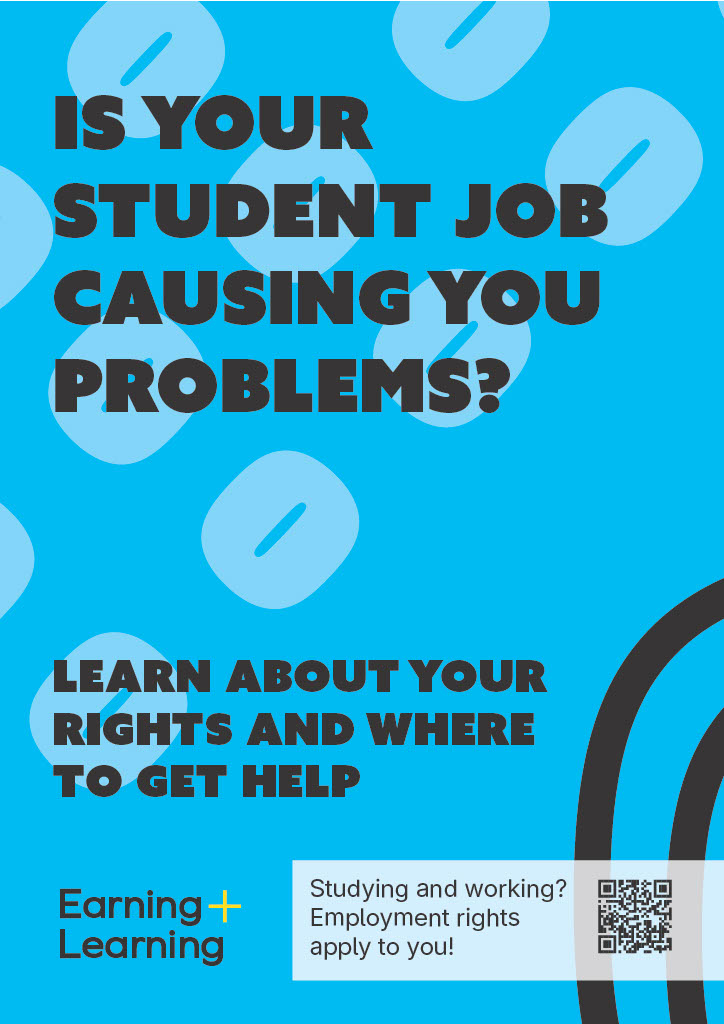
The Earning + Learning campaign can help union activists and reps in these efforts. The website provides advice about students’ rights at work and information on topics including the minimum wage, calling in sick, joining a union, and how to deal with problems at work. It includes downloadable and printable posters and postcards. Union reps and trade union activists can display these at events and in workplaces and share them in branch meetings and digital spaces.
The campaign also includes a short briefing for trade unions on student employment and supporting student workers.
The student workers who helped create this campaign had a clear message: student workers need information, support and a collective voice.
Daisy Goodall, TUC Young Workers Lead, says:
Young Workers Month offers an opportunity to redouble our efforts to engage with student and young workers. The TUC is proud to support the Earning + Learning campaign, which was co-developed with students and young people. Now, we need to get out there and share these brilliant resources!
*Explore the Earning + Learning campaign website and resources. If you want to hear more about the research that underpins this campaign, are interested in working together to organise student workers, or looking for speakers or training on this topic, get in touch with the team via our website Contact page, or email k.allen1@leeds.ac.uk.
Stay Updated
Want to hear about our latest news and blogs?
Sign up now to get it straight to your inbox


