TUC Cymru Congress 2026 - Reflections on our work since Congress 2024
This biennial report reflects the intense period of work since we last met in 2024. During that time, Wales has continued to navigate the ongoing effects of the cost‑of‑living crisis, while workers and communities have faced sustained pressure on living standards and public services. Yet through it all, unions in Wales have led the charge in defending rights, improving pay and conditions, and giving working people the tools they need to thrive.
We have continued our commitment to building a more equal Wales by widening participation and supporting new generations of activists. Our Black and Women’s Activist Development Programmes, Young Worker’s Programme, and our growing support for disabled, LGBTQ+, and migrant workers’ networks are helping to cultivate a confident, diverse leadership ready to strengthen our movement for the future.
Preparing workers for the future remains central to our mission. The Wales Union Learning Fund continues to transform opportunities for thousands of workers every year - particularly those who may previously have been excluded from training and progression. With rapid technological change reshaping workplaces, our work on artificial intelligence, digital rights, and workplace transformation is more important than ever.
We have also deepened our contribution to Wales’s just transition. Our research, partnerships, and campaigning ensure that climate action delivers not only environmental benefits but also good jobs, strong communities, and fairness for workers - especially those in industries undergoing the greatest change.
The Social Partnership and Public Procurement (Wales) Act is now firmly embedded across the public sector. The Social Partnership Duty represents a significant milestone in the journey that so many within our movement began decades ago: ensuring that workers’ voices are integral to decision‑making in Wales. Our task now is to ensure that this framework delivers meaningful improvements for workers and communities across the nation.
Only a strong, confident trade union movement can deliver social justice for workers. As we look ahead, our commitment remains unwavering: to build our movement, strengthen solidarity between unions, and secure a fairer future for all workers in Wales.
- Social Partnership
Social partnership working continues to grow in Wales. The Social Partnership Council (SPC) has been established for over two years and is undertaking work in several areas.
The SPC has received the first round of social partnership duty reports from public bodies across Wales. Trade union SPC members have identified the need for consistency and improvement in reporting, which is to be considered in the next Welsh Government term.
An SPC procurement sub-group has been established and trade union colleagues from across the movement have been appointed to the group. A working group on artificial intelligence has been established, and a programme of work is under development.
The SPC has delivered advice to Welsh Ministers on business grants with emphasis on the importance of strengthening fair work and trade union engagement through the grants process.
TUC Cymru has developed and delivered social partnership training to various audiences including training for delivery at workplace level.
The previous Workforce Partnership Council has been disbanded and replaced by a Public Sector Future Workforce Forum which aims to be more dynamic and flexible to suit the needs of the workforce.
New Social Partnership structures are now up and running in the transport and creative sectors.
Social Partnership arrangements in social care continue to progress core trade union issues.
Model recognition agreements have received endorsement and promotion by Welsh Government, Social Care Wales, and employer representatives. Work continues on improving the worker voice in the sector as well as on key workforce health and safety matters.
- Dying To Work Charter
The TUC Dying to Work Charter is a voluntary pledge for employers to support workers who receive a terminal diagnosis. Launched in 2016 by the TUC, the campaign was inspired by Jacci Woodcock, a sales manager who faced threats of dismissal after being diagnosed with terminal breast cancer. The charter aims to eliminate the “additional and avoidable stress” of job insecurity, ensuring that employees facing the end of their lives are treated with dignity and compassion rather than being forced out through stressful capability procedures.
At its core, the charter is about providing choice and financial security. By signing, employers commit to not dismissing any person because of a terminal condition.
This protection allows workers to decide for themselves whether they wish to continue working - often for the therapeutic distraction or financial stability - or leave to spend time with loved ones. Crucially, maintaining employment ensures that families remain eligible for “death in service” benefits, which can be lost if a terminally ill worker is dismissed or forced into early retirement.
The initiative has gained significant momentum, now covering over two million workers across the UK. High-profile signatories include major private companies like Santander, Royal Mail, and the Co-op, as well as public sector bodies such as NHS Scotland and numerous local councils. Beyond the initial pledge, the charter encourages employers to review their sick pay policies, provide specialised training for HR and managers, and offer access to employee assistance programmes that include counselling and financial advice.
Some of the organisations that have signed in Wales over the past two years are:
- South Wales Police
- North Wales Police
- Betsi Cadwallader Health Board
- Grwp Llandrillo Menai
- Wales Union Learning Fund (WULF)
Over the past two years, the Wales Union Learning Fund (WULF) has continued to prove itself one of Wales’s most effective tools for boosting workers’ confidence, skills and long‑term employability. The 2025 WULF Learners Report, based on feedback from more than 800 learners, shows that 90 per cent of participants reported increased confidence, with many also reporting better communication, motivation and work-life balance. Crucially, WULF is opening doors for workers who face additional barriers: 23 per cent of learners reported a disability and 36 per cent had childcare responsibilities – far above national averages – demonstrating WULF’s role in widening access to training for those least likely to receive it elsewhere.
WULF’s impact has also been strongly felt in workplaces across Wales. Among those who took part in longer accredited courses, 85 per cent said they felt more able to support colleagues, and nearly a third reported clear improvements in job performance. 14 per cent secured a new job role directly because of their WULF training, and of those, 76 percent received a pay rise - evidence that WULF is directly supporting progression, higher pay and better job security. 90 per cent of learners reporting increased self‑confidence and significant improvements in communication, motivation, and workplace performance.
The programme’s contribution to Wales’s wider economy has been equally impressive.
The learner report shows that employers are not only benefiting from a more skilled and engaged workforce, but are also willing to co‑invest: employers contributed over £2.5 million towards WULF‑supported training during the 2022–25 period, demonstrating strong confidence in union‑led learning.
WULF has now supported more than 100,000 workers in just the past three years, strengthening the national skills base at a time when Wales faces rapid technological, economic and workforce change. A significant proportion of these learners are older workers - predominantly those aged 50-59 – helping to retain valuable experience and productivity in the Welsh labour market, while also bucking the wider trend that younger people are typically the ones who engage most in training.
Since Congress last met, the evidence shows that WULF continues to be transformational for Wales, expanding opportunities for those too often locked out of training; strengthening workplace capability, wellbeing and fairness; and generating measurable economic benefits for employers and the Welsh economy. By continuing to remove barriers to learning and enabling workers to thrive, WULF remains one of the most important social partnership achievements in Wales - delivering real change for workers and real value for the nation.
- Sexual harassment campaign
As trade unionists we are keen to make workplaces fairer, more equal and safer in every way for workers. However sexual harassment has been a blight on workers experiences and unfortunately, it’s not a trend that is decreasing. As our society becomes more online, new ways emerge in which content becomes hate, and that spills over into workplaces.
In our campaign plan on sexual harassment, we had two main aims. Firstly, we wanted to change policy on sexual harassment, and then we wanted to launch a large-scale campaign.
It is a pleasure to report that we achieved both and more. We teamed up with colleagues in the wider TUC and other groups such as Rights of Women and Fawcett Society and formed a coalition called ‘This is not working’.
That coalition worked with Wera Hobhouse MP on the ‘Worker Protection Act’; a piece of legislation that was enacted on 24 October 2025 and mandates a protective duty that UK employers take ‘reasonable steps’ to protect sexual harassment of employees. It strengthens protections and allows tribunals to uplift compensation.
With this new legislation, we wanted to give employers the opportunity to learn about their duty, and for workers to be aware of their increased rights. Through working with Cowshed PR and holding focus groups, we were able to discover that many people largely felt they understood what sexual harassment was, but didn’t know who to turn to for support. We wanted to place trade union reps as key people within that supporting role and developed the ‘We’ll Support You’ campaign – a campaign which encompassed both social media outputs alongside a learning offer in conjunction with Adult Learning Wales for reps across Wales.
Our social media video is one of our most watched, and our learning opportunity for reps has been offered across Wales. In addition to our toolkit on sexual harassment, we have a campaign toolkit, social media outputs, posters and website outputs.
We know that this is a campaign we will continue to work on, and our aims are to extend this work into business and education spaces.
- Black Activists Development Programme
The third cohort of the TUC Cymru Black Activist Development Programme (BADP) is nearing completion and set to finish in June with the fourth cohort starting in early July and already recruiting.
Since the start of our Black Activists Development Programme in 2023, we have had 28 incredible participants, one man and all the rest women of varying age. The facilitator, Humie Webbe, provides modules to understand union structures, union rule books, how to tackle discrimination, speaking skills, motion writing, CV writing and the importance of allyship.
We also provided them with opportunities to attend events and contribute, including General Council and Women’s Council of the Isles. We celebrated their achievements at the Senedd, sponsored by Vaughan Gething MS and Jayne Bryant MS. The first cohort of participants were offered work experience by Jayne Bryant MS, and we hope to build on this offer with other ministers in the future.
We will continue to stay connected with participants from the previous cohorts and follow their development post-Programme, bringing them together with the Women’s Activist Development Programme participants with a view to creating future organising activities to promote trade unionism and build strength and unity across activist structures.
The recent Senedd elections saw one member of each of the first three cohorts from BADP standing and we wish them all the best in the political world.The development of the Programme participants is a credit to the facilitator Humie Webbe and the participants give as much to each other as they gain in the Programme. Many have gone on to change jobs and career paths, focus on development in local communities and making changes in their workplaces. It is this, we hope, that will encourage more to join on BADP4 and beyond.
- Black History Month
Marking Black History Month has become a core part of TUC Cymru’s calendar.
Over the last two years we have held another two Black History Month events in the Pierhead in Cardiff Bay.
In 2024 we launched the TUC Cymru Anti Racism in the Workplace toolkit.The 2025 Black History Month was labelled “Celebrating Our Past and Protecting Our Future” and invited trade unions and pupils from local schools to note why we celebrate Black History Month, what we have learned and what we need to continue to learn and work on.
With the changing political climate, we know that this subject must continue to be highlighted and marked.
- Women’s Activist Development Programme
The second cohort of women are two thirds of the way through their programme.
The TUC Cymru Women’s Activist Development Programme (WADP) is a confidence‑building and leadership‑focused initiative designed to support women trade unionists in Wales to become stronger, more effective activists. It helps participants develop campaigning skills, deepen their understanding of equality issues, and build networks across the Welsh trade union movement.
WADP continues to be an effective and transformative initiative within the Welsh trade union movement, in no small part because of our brilliant participants and our tutor Humie Webbe. Specifically designed to empower women activists, build confidence, and strengthen leadership capacity, the programme has become a cornerstone of TUC Cymru’s equality and organising work.
The programme offers a blend of:
- Workshops and training sessions on campaigning, communication, and leadership.
- Peer learning, enabling participants to share experiences and build solidarity.
- Mentoring and support, helping women navigate union structures and opportunities.
- Practical campaigning experience, often linked to live equality or workplace issues.
- Confidence‑building activities, which participants consistently identify as transformative.
The learning environment is intentionally collaborative, inclusive and empowering, and will provide women with a path in which they can grow within our trade union movement.
We’re proud of this programme, and hope you are too. When you see us looking for participants for the third cohort of women to join us, I hope you’ll consider nominating yourself or someone who is looking to develop their trade union work.
- Young Workers Academy
In January 2026, TUC Cymru launched the Young Workers Academy, a bold and intensive series of workshops designed to build the leadership, organising, and campaigning capacity of young trade unionists in Wales.
This ongoing programme aims to strengthen our movement’s ability to respond to division in our workplaces and communities with solidarity, internationalism, and action.
Delivered in partnership with Jarrow Insights and Trademark Belfast, the programme includes five weekend modules covering:
- Political Economy for Young Workers
- Digital Organising and AI in the Workplace
- Confronting the Far Right
- Social Listening and Campaign Strategy
- International Solidarity and Movement Building
Working with affiliates, TUC Cymru nominated 15 young members who were seeking to actively engage with new and innovative organising practices to support mobilisation and delivery within their trade unions.
With the course set to conclude in June 2026, participants will be able to attend an international development opportunity through TUC Cymru’s Taith fund
- Taith and international movement building
We have participated in a 24-month project using the Welsh Government’s Taith fund to provide international development opportunities for 30 trade union participants from the Black Activist Development Programme, Women’s Activist Development Programme and Young Workers Academy.
The purpose of the programme is to empower activists from our equality strands to explore how international trade union partners are organising in the face of a changing world of work.
Big changes are indeed underway, from AI and Just Transition to social partnership, the rise of the far right across Europe and emerging economies. The impact of these changes is not shared equally. The aim of the programme was to ensure that whilst we develop strategy to organise around these changes, our voices are diverse and representative of the voices our movement represents.
Belgium trip:
In February 2025, the first delegation included a trip to an ETUI Conference hosted in Leuven, Belgium between 18-22 February 2025. The trip explored the future of work and AI. The trip supported TUC Cymru’s strategic focus on understanding AI’s impact on workers in Wales and enabled activists to engage with European experts, trade unions and researchers while sharing their own workplace experiences. Delegates were also briefed on TUC‑commissioned research outlining how AI affects different groups of workers, ensuring they could meaningfully contribute to discussions on equality, rights and the future of work.
Across the ETUI conference and the FES workshop, participants examined major themes including algorithmic management, platform work, job quality, data protection, workplace surveillance, bias in automated decision‑making and the gendered implications of AI. Working closely with FES, the delegation took part in a dedicated roundtable on AI in the workplace, hearing from sector specialists on the challenges facing unions and the regulatory gaps emerging from rapid technological change.
Through these activities, participants deepened their understanding of AI’s risks and opportunities, strengthened their confidence in engaging with debates about digital transformation and built valuable networks with European trade unionists working on similar issues.
Germany trip:
The delegation’s visit to Germany focused on exploring how trade unions across Europe are responding to the growing influence of far‑right and populist ideologies in workplaces and communities. Through meetings with trade union leaders, political representatives, youth organisations and civil‑society groups, delegates examined strategies for strengthening democracy, promoting inclusive work environments, and supporting communities experiencing economic transition.
Key themes included alliance‑building across civic society, engaging young people in democratic participation, addressing the concerns of “left‑behind” communities, and learning from Germany’s approach to structural change, worker transition, and decarbonisation. These discussions enabled delegates to draw parallels with challenges faced in Wales, particularly ahead of the 2026 Senedd elections, and to reflect on how Welsh trade unions can respond proactively to similar political and social trends.
Alongside policy‑focused sessions, the programme incorporated a wide range of practical activities designed to deepen delegates’ understanding of Germany’s labour movement. These included site visits, strategic workshops, community engagement meetings, and participation in cultural and democratic events such as a feminist youth festival and Cologne Pride. Delegates also took part in daily briefings, training sessions, and reflective discussions to consolidate their learning and strengthen group cohesion.
Through these varied experiences, the trip provided valuable opportunities for shared learning, cross‑border collaboration, and the development of new ideas to support TUC Cymru’s future work on democracy, equality, and combatting far‑right narratives in workplaces and communities.
Upcoming trips: Germany, June 2026 & Ireland 2026
We have two final trips planned as part of this project working with our partner organisations in Germany and Ireland. Both trips will be offered to participants of our Young Worker Academy and will be centred around the themes of the course: political economy, combatting the rise of the far right, AI and digital technologies, as well as new ways of organising.
- Twf Charter
The Twf Charter was launched at the National Eisteddfod in 2025 and is an enabling framework consisting of four core principles. It helps workers, their trade union branches and employers to work together to create inclusive bilingual workplaces and increase the use of Welsh at work. ‘Twf’ simply means ‘growth’ or ‘expansion’.
The Twf Charter was developed by TUC Cymru as a tool to assist workers, their trade union branches and employers to work together to support the provision of inclusive bilingual workplaces as a matter of equity, fairness and linguistic justice; and to grow, facilitate, promote, support and strengthen the use of Welsh at work.
Welsh Government, Cyngor Gwynedd, Carmarthenshire County Council and Natural Resources Wales have already committed to implementing the Twf Charter in their organisations with full engagement with the trade union branches.
- Removing Profit from Social Care
TUC Cymru has campaigned with affiliates operating in social care for the removal of profit from the sector. As a movement, the legislation to remove profit from looked after children’s services was welcomed, but we remain clear that this commitment must be extended across all social care services in Wales.
Campaign activity has included working closely with the Centre for International Corporate Tax Accountability and Research (CICTAR) to evidence how profit is systematically extracted from the sector and offshored into tax havens.
This evidence has been highlighted through various means including lobbying activities, fringe events at various political conferences, and through a webinar which featured as part of the Rebuilding Unity Autumn programme.TUC Cymru had a community action day in December highlighting our townhall event taking place in Pontypridd.
A survey was undertaken of 1,000 people of all political persuasions across Wales to gain an insight into current understanding and views of how social care operates in Wales. The survey showed that 79 per cent of the public want to see profit making removed from care and 64 per cent support the ambition to establish a National Care Service for Wales.
Whilst we are successfully winning the public case for a removal of profit from all social care, it remains important to campaign on this issue to ensure it is put into practice by the next Welsh Government.
Our petition on this issue continues to grow in numbers and will serve as a strong message to the next government that removing profit from social care remains a campaign priority for the trade union movement in Wales.
- Tackling divisive narratives in workplaces, online and in our communities
TUC Cymru recognised and has responded to the rise of the far right and populist narratives in Wales.
In September 2025 we organised a conference called Rebuilding Unity which was attended by 100 trade unionists. They heard about the rise of Reform in Wales and how to talk about certain issues like immigration, and delegates contributed to a discussion about the next steps they’d like to see trade unions take in this space.
During the rest of the autumn we held a series of webinars attended by approximately 170 people, to give trade union activists the tools to have difficult conversations on the topics of immigration, culture, social care and green issues. We also had a session focussing on how to talk about these issues in online spaces.
TUC Cymru has created a new workshop for branches to discuss how to understand and challenge far right and populist ideologies.
The one-day session explores the roots of these movements, their impact on society, and practical strategies to counter their influence. TUC Cymru, in collaboration with Adult Learning Wales, has already created a new one-day TU Education course called Communication Skills for Difficult Conversations. The course helps reps increase their confidence in navigating difficult conversations in a way that promotes respect, heals divisions, and turn divisive talk into opportunities for solidarity and organising.
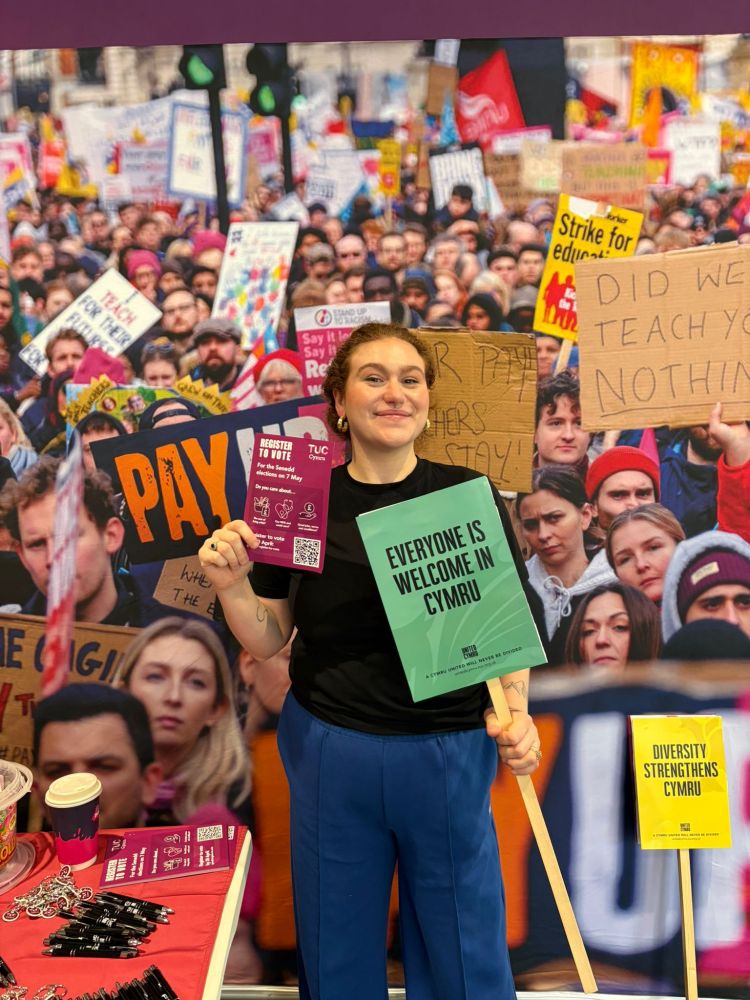
In March 2026 we launched a new campaign called United Cymru. The purpose of the campaign is to get trade unionists and other progressive workers in Wales to promote the value of unity over division.
The campaign started with an invitation for workers to order United Cymru posters and stickers in order to show how many people believe in a united, caring, welcoming Wales. The campaign also invites workers to get involved in the training on having difficult conversations and, through a WhatsApp group, empowers them to have these conversations in real life and online using evidence-based messages provided by TUC Cymru. Much of this work, and TUC Cymru’s campaign to encourage people to register to vote, is focussed on five target constituencies where we believe we can make a difference to the level of divisive narratives in communities and workplaces.
- Artificial Intelligence (AI)
The project “AI: Preparing the workforce; ready for the future”, led by TUC Cymru, aimed to ensure workers have access to reliable information on AI’s workplace impact and to equip unions to negotiate effectively on AI issues. This initiative emerged from a 2024 TUC Cymru Congress resolution and was embedded in the organisation’s 2024–26 strategic plan, identifying AI as a priority area.
Objectives and activities
The project focused on three core activities:
- Research and dissemination – investigating AI’s impact on workers in Wales and sharing findings through guides, webinars, blogs, and videos.
- Training and awareness – developing tailored training for union reps and supporting union-led courses for workers.
- Policy influence – shaping Welsh Government policy on AI through social partnership and advocacy.
Key Achievements
- Research outputs: the flagship report AI Inequalities at Work by the Data Justice Lab examined discriminatory impacts of AI across dimensions such as disability, age, ethnicity, and language. Complementary blogs and social media videos amplified engagement.
- Workshops and toolkits: collaborations with Connected by Data produced a toolkit for embedding worker voice in AI procurement. Additional workshops promoted worker-centric AI approaches, aligning with feedback from government and TUC at UK level.
- Training development: a new course for union reps on AI and equality took place in Spring 2026, complementing existing union-led worker training supported by the Wales Union Learning Fund.
- Policy wins: TUC Cymru successfully influenced Welsh Labour’s manifesto commitments, securing pledges for union involvement in AI rollout and establishing AI centres of excellence. The Workforce Partnership Council (WPC) guidance on AI in the public sector was negotiated and disseminated, though adoption by local bodies remains uneven. A Social Partnership Council sub-group on AI and skills has also been established.
Evaluation and Lessons
The project demonstrated strong collaboration across teams and with external partners, reinforcing the value of strategic project management and reference groups.
While research credibility and policy influence were notable successes, challenges remain in ensuring widespread adoption of guidance and sustaining engagement at branch level.
Overall, the project advanced union capacity on AI, strengthened policy influence, and laid foundations for future training and advocacy, positioning TUC Cymru as a leader in ethical AI implementation in Wales.
- Futureproofing industry and skills for the future
TUC Cymru has worked with affiliates to ensure worker voice remains at the heart of the transition to new industry in Wales.
Working with unions in heavy industry and manufacturing, TUC Cymru has identified key sites of concern where plans for transition to greener industry could affect or negatively impact workers at those sites.
Such sites include both carbon-intensive industries and those actively pursuing a route to greener operations. In the case of the former, we have made clear that the failures of recent years in effective industrial planning cannot persist and we played a key role in making sure the worker perspective in Wales was taken account of in the UK Government’s Industrial Strategy.
In the case of the latter, we have continued to support affiliates and make representations to Welsh Government to drive home the point that existing workers must be able to access and benefit from new, green jobs. We maintain the position that new industry cannot be served by an external or itinerant workforce.
To stop repeating the mistakes of the past, we need the investment and opportunities of new industry to serve workers in Wales and their communities.
A key area for the development of offshore wind and new industry in Wales has been the development of Freeports. Over the past year, TUC Cymru has coordinated union efforts to ensure the Wales Freeports incorporate support of trade unions and commitments to Fair Work. We have made great strides in this area, working closely with the Celtic Freeport to set up a Workers Consultative Forum.
Through collaboration with our affiliates and the Freeport, the draft framework looks to be an effective platform for workers within the Freeport zone.
- TUC Cymru Education
Since the last Congress in 2024, TUC Cymru Education is expected to have provided training and briefings to more than 3500 reps.*
TUC Cymru supports and provides funding for TUC (multi-union) courses and single union programme courses including those offered by Unite, UNISON, GMB, Usdaw, PCS and CWU.
Working closely with our two partner trade union studies centres in Coleg Gwent and Adult Learning Wales, we have been able to provide a varied programme of formal accredited training. More widely within TUC Cymru we have also provided an offer of informal learning opportunities to reps through a wide range of events, webinars, networks, workshops and other events.
The majority of reps coming through the programme over the last two years have attended initial stage 1 (or single union equivalent) courses aimed at union reps and health and safety reps. Smaller numbers went on to attend stage 2 courses. Regular equality courses were also offered as part of the programme, with smaller numbers of union learning rep courses and other short courses or briefings on a wide variety of topics.
In the last two years, TUC Cymru Education has developed new training courses to help build reps confidence and skills in addressing important workplace issues such as Tackling and Preventing Sexual Harassment, AI and Digital Technology, Disability in the Workplace, Making the Case for Insourcing and Communication Skills for Difficult Conversations. Union Reps Stage 1 and Stage 2 and Health and Safety Reps Stage 1 and 2 and Union Learning Reps Stage 1 courses have been fully rewritten to modernise and update them to reflect the Welsh context. A new Union Learning Reps (ULR) Stage 2 course has also been successfully piloted, to support the continuing professional development of ULRs.
A positively received Social Partnership training course and online interactive learning guide for reps have been developed. And this has been built on more recently with work to develop and roll out joint training on working together in social partnership for managers and reps in public bodies in Wales.
Since the last Congress, TUC Cymru Education has adapted its core training for union reps and health and safety reps to provide a modular course offer so reps can still access the same high-quality training and qualifications but now in shorter modules, allowing more flexibility to better meet the needs of reps.
TUC Cymru now also offers national all-Wales tutor-led online virtual classroom courses to ensure reps across Wales can access training and to support the viability of the training offer to reps from smaller unions and more remote areas of Wales, while maintaining the quality of fully tutor-led provision.
An analysis of reps attending the formal training programme during April 24 – March 25** found relatively good levels of representation (compared to national population/union member averages) of reps from younger age groups, reps from Black and minority ethnic backgrounds and disabled reps. This is encouraging and may be seen as an indication of the positive impact of the activist development programmes which TUC Cymru has run during the last few years.
However, women are still significantly underrepresented in the formal training programme by a large margin. This indicates more work is needed to increase the number of women coming forward as reps and taking up training to help make our movement more representative of the membership and wider workforce.
*Estimated numbers at the time of writing, as the finalised statistics for Jan –May 2026 were not yet available.
**Data for April 25 – March 26 not included as full data not available at the time of writing
- Social Media
The past two years have seen TUC Cymru reach more workers and activists across Wales than ever before. We deliver a regular package of engaging, high-quality content across a range of nine social media channels (increasing from seven channels in 2024). Our outputs include: Facebook, Instagram, TikTok, YouTube, X, Threads, Bluesky and LinkedIn.
Our social media following of 7.0K in 2024 has increased to 9.5K followers across our platforms in 2026, including the creation of new LinkedIn and Bluesky accounts. We have integrated the usage of Linktree to our offering, as a cross-platform resource to ensure no matter where our audience finds us, TUC Cymru’s offerings are always visible.
We have produced a broad range of inspiring films and engaging campaigns on social media amassing hundreds of thousands of views, such as our We’ll Support You Campaign which garnered 200K views cross-platforms.
We have also produced viral standalone content, pressing news coverage and engaging ads that have individually broken records for viewership across our platforms.
We look forward to continuing our work to support the efforts and voices of unions and activists across Wales over the next two years.