
Save British ceramics
The British ceramics industry stands at a critical juncture. Once a global leader, this cornerstone of Britain’s manufacturing and design heritage has seen a wave of closures and consolidation that now threatens its existence. Around 20,000 people are still directly employed in ceramics, with around half of those jobs concentrated in the West Midlands. These jobs represent centuries of accumulated craft and technical skill, but are also capabilities that are strategically vital to the UK’s wider Industrial Strategy, national security and economic resilience.
Ceramics are fundamental to modern industry: advanced refractories line steel and glass furnaces; precision components enable energy generation, defence systems and medical devices; tiles, sanitaryware, and bricks shape the built environment; and British gift and tableware is sought around the world. No sector provides a clearer bridge between our cultural identity and industrial base.
Yet the ceramics industry faces severe and mounting pressures. One of the most energy-intensive sectors in the UK, it was hit hard by the gas price crisis and received less support to weather it than its European competitors. Sky high industrial electricity prices hold back the ability of British ceramics to compete internationally. At the same time, unfair dumping of cheap, high-carbon products and “fake-ware” outlets undermine authentic British brands. These pressures are directly threatening site closures and job losses across much of the industry.
For decades the ceramics industry has fallen through policy gaps, and communities have suffered. It is clear that in order for the ceramics industry to survive, government must take action immediately to alleviate threats and stabilise the sector. It is also clear that in order to thrive in the future economy, ceramics sites must be supported to decarbonise, both to keep pace with markets that are moving rapidly away from high carbon products, and to reduce their exposure to volatile international energy markets. As the lifetimes of new kilns and production lines span decades, it is critical that sites making upgrade investments in the near term are supported through policy and funding to opt for clean technologies.
With targeted energy support, a business-friendly trade environment, and investment in low-carbon manufacturing, innovation and skills, the UK can rebuild ceramics into a cutting edge, jobs-rich industry and a strategic driver of economic resilience.
A joint policy briefing put together by the Trades Union Congress, GMB and Green Alliance
With thanks to:
Stoke-On-Trent’s Labour Members of Parliament, Dr. Russ Hall (Lead for Reduction of Industrial Emissions and Net-Zero, High Value Manufacturing Catapult), Tony Kinsella (Chief Executive, Lucideon), Rob Flello (Chief Executive, Ceramics UK), Dr. Yi Cui (Ph.D (Cantab), CEng, FIMMM)
Foreword
“Our ceramics industry is the envy of the world.
From world class tableware, to high end materials for industry; there has never been a more important time for us to shine a light on the role ceramics plays for the UK economy.
The human story of our potteries though is what makes the industry so special.
Here in Stoke On Trent, the home of the UK potteries, ceramics runs through every community, every street, every home.
We are a proud city of potters, and a city determined to fight for the industry’s future.
20,000 highly skills jobs across the UK rely on the sector, and it is the voices and experiences of those working people that will be so important to the future of UK ceramics.
That’s why this intervention from GMB trade union, the Trade Union Congress and Green Alliance is so important.”
- Allison Gardner MP, Gareth Snell MP, David Williams MP
“Pottery is in our blood here in Stoke.
When I’m at work, if I look to my left I see my daughter. If I look to my right, I see my granddaughter.
Each of them doing work they’re proud of, creating a product unique to our town.
The voices of working people like my daughter and granddaughter matter more now than ever.
We will never allow what happened to so many industries before us happen to our potteries.
With our union, we are forcing decision makers to sit up and listen.
Because sky high energy bills, and a market too easily swamped by bogus ceramic products from abroad are hitting Stoke hard.
We need a plan to safeguard jobs here in Stoke, for my generations of working people to come.”
- Sharon Yates, GMB Rep and fourth generation Stoke-On-Trent potter
Our priorities
A thriving ceramics sector in the UK is attainable, but it won’t happen without a concerted policy effort. Given the breadth and complexity of the sector, characterised by numerous small and dispersed sites, there can be no one-size-fits-all approach. Upgrading technology, accessing new markets, and cutting emissions will look very different in different sites, and support for the sector must accommodate this diversity. Nonetheless, ceramics sites also face certain common challenges – exorbitant industrial electricity costs, limited access to funding and support, weakened demand.
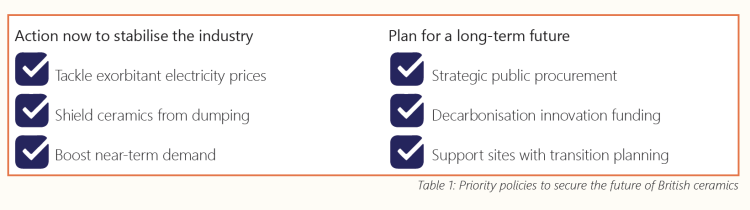
This report sets out urgent measures needed to stabilise the industry today, alongside strategic steps required to secure its long-term future. These priorities are summarised in Table 1.
Part 1: Pathways towards a future ceramics industry
The path towards decarbonisation is complex for ceramics, a sector characterised by smaller, dispersed sites that mostly don’t benefit from infrastructural developments within localised industrial clusters. Different technology routes—such as electrification, hydrogen, and carbon capture—will vary in suitability depending on site characteristics, scale, and product type. As a result, the sector’s transition will necessarily involve a mix of technological approaches to achieve emissions reductions while maintaining productivity and competitiveness. This section provides a brief overview of key decarbonisation pathways, and outlines the potential for product diversification to futureproof the ceramics industry.
Electrification
Electrification will be an important pathway for ceramics decarbonisation. On a solely technical basis, it is estimated that up to 78% of heat demands for ceramic production can be met with electricity and technologies already available (notwithstanding production and economic challenges), and up to 99% is electrifiable with technologies that are under development.[1]
Electrified heating processes are more efficient than gas powered heating processes and have the benefit of zero emissions at the point of use. As the national grid decarbonises electrical energy will provide an important route for the decarbonisation of heating processes, in particular in the near term for lower-temperature processes such as drying, glazing, and higher value or small batch sites. Microwave assisted firing has the potential to significantly reduce energy use and firing times but is currently limited by scale up challenges.
However, high electricity prices and prohibitive capital costs limit the near-term opportunity for large-scale, high-temperature operations such as brick manufacture, and refractories, which employ extremely high temperature processes are not currently technically able to electrify. Firms also face high immediate costs to stop production and convert to electricity. Wider feasibility will depend on affordable electricity prices, advances in kiln technology, capital cost support and strengthened local power infrastructure. Technology is advancing in this area, as demonstrated in Box 1, however so far ceramics sites in the UK have been falling behind in this crucial area of technological development. 1
Box 1: Examples of ceramics electrification in Europe
Industrial scale brickmaking, Austria: Wienerberger’s GreenBricks initiative at its site in Uttendorf, Austria introduced the world’s first industrial-scale electric kiln for brick firing in early 2025, powered entirely by renewable electricity (the site is located next to a hydropower facility). The project cost €30 million, of which €5 million in capital expenditure and €1.7 million in research and development were subsidised by the Austrian government, through a national climate fund (‘New Energy for Industry’) aimed at accelerating industrial decarbonisation. 2 It should be noted that the bricks produced are a different specification to UK bricks.
Floor & wall tiles, Spain: Equipe Ceramicas opened an 100% electric kiln at its facility in Onda, Castellon in 2024. The new kiln is the result of a two-year research and development collaboration with the Institute of Ceramic Technology (ITC) at Jaume I University and kiln manufacturer Systemfoc, supported by a €2 million investment from Equipe Cerámicas and an additional €878k grant from the Valencian Institute of Competitiveness and Innovation – a public body promoting industrial innovation. 3
EU ceramics electrification pilots: The EU is currently funding research pilots in Greece, Germany and Spain under the ‘Electrifying High-Temperature Ceramics’ (e-LITHE project) which seeks to demonstrate new electrified high-temperature heating technologies over 1000°C for the ceramic industry. 4
Hydrogen
Hydrogen has potential to offer an alternative to natural gas for high-temperature firing, capable of replicating the performance of natural gas in certain contexts. It is particularly suited to large industrial sites with continuous production and the potential for connection to emerging hydrogen networks. Where hydrogen is pursued, green hydrogen offers the clearest potential for the site to be futureproofed into the long-term. For companies next to bigger industrial clusters, blue hydrogen presents a potential route to short term decarbonisation (as it will be tied to carbon capture and storage). However, the higher cost of hydrogen combined with potential residual greenhouse gas emissions and infrastructure gaps and limited supply limits viability. Over time, if these barriers are addressed and costs come down, it could play a role in decarbonising the most energy-intensive parts of the sector where electrification isn’t currently possible.
Alternative fuels
Low-carbon fuels such as biogas, biomethane, and synthetic fuels could offer near-term decarbonisation by substituting for natural gas with modified equipment. They are most applicable to medium- and high-temperature processes where electrification or hydrogen are not yet feasible. However there can be supply issues with alternative fuels; their suitability depends on reliable local supply and sustainable feedstock sourcing, as bio-based fuels can drive land use challenges and don’t always guarantee genuine carbon reductions. These fuels could represent an important transitional step toward deeper decarbonisation but over the longer-term biomass should play a minimal role in energy provision.
Material and product innovation
Reformulating clays, glazes, and additives to enable lower firing temperatures, shorter dwell times at peak temperatures, or faster sintering – the stage where material fuses and hardens - offers another route to cutting energy use. Greater use of recycled materials and design for reuse can also reduce embodied carbon. Cold sintering could offer an important low temperature, low energy, zero emissions route for ceramics in the longer term. However, it is not currently proven at a commercial scale.
Material innovation is particularly relevant to specialist ceramics and tableware, supporting both decarbonisation and product differentiation.
Carbon Capture, Use and Storage (CCUS)
While technically possible, CCUS is generally unsuitable for the ceramics sector. Most sites are small and geographically dispersed, and kiln exhaust streams are relatively dilute, making carbon capture costly and inefficient. Only a handful of large sites co-located with industrial clusters might find CCUS viable in the long term. While some pilot and research level projects may make CCUS more suitable for the sector in the long term, cost and transport barriers still remain. For the sector as a whole, resources are better directed toward fuel switching, efficiency, and material innovation.
Diversification opportunities
Product diversification can offer one potential pathway for some ceramics sites to futureproof their operations, by tapping into high-growth sectors such as renewable energy, electric vehicles, aerospace, and healthcare. Whilst some higher volume sites may not be suited to adapting their operations for advanced and technical ceramics production, there may still be viable opportunities to process input materials for these sectors, thereby onshoring more of the value chain, and reducing reliance on traditional, lower-margin products facing higher international competition.
Mantec Technical Ceramics provides a strong example, having successfully expanded from conventional ceramics into advanced applications like porous membranes and lightweight refractories for industrial use. With targeted investment, skills development, and research collaboration, other UK ceramics manufacturers could follow this path, strengthening the sector’s resilience and global competitiveness.
Subsectors and challenges
The UK ceramics industry spans a wide range of production types, from small artisanal kilns to large brickworks and advanced manufacturers serving medical, aerospace and defence sectors. While many challenges are shared, there are significant differences in fuels, processes and market dynamics that shape pressures faced by each subsector and their path to decarbonisation. As a result many will not have access to planned hydrogen networks or to carbon capture and storage infrastructure. This diversity demands tailored approaches to capital support and transition planning, recognising that a single model of decarbonisation will not meet the needs of such a varied industry.
Download Table 2: Ceramics subsectors and challanges
- 1 https://fcarchitects.org/wp-content/uploads/2024/10/FCA-Report-Decarbonizing-High-Temperature-Heat.pdf
- 2 https://www.wienerberger.com/en/stories/2024/20241204-GreenBricks-Electric-Kiln-Revolutionizes-Brick-Production.html
- 3 https://www.equipeceramicas.com/en/presentacion-horno-100-electrico/
- 4 https://www.energy.kth.se/heat-and-power-technology/current-projects/elithe-electrification-of-ceramic-industries-high-temperature-heating-equipment-1.1312636
Part 2: Policies
Act now to stabilise the sector
Tackle exorbitant energy prices
Ceramics has long fallen through policy gaps, left unsupported by schemes designed to ease pressures for energy-intensive industry. Gas makes up around 80 per cent of energy use and 60 per cent of costs at a typical ceramics site, making it one of the UK’s most gas intensive industries. Until the industry has been supported to decarbonise, it’s important that any energy support to industry considers both fuel types. The forthcoming British Industry Competitiveness Scheme (BICS) which will remove certain green levies from eligible ceramics sites was a welcome announcement within the Industrial Strategy. However the proposed scheme does not go far enough, fast enough to close the competitiveness gap with Europe and prevent further job losses and closures in the ceramics sector.
We urge government to enable ceramics to participate in the existing British Industry Supercharger scheme, by altering the Business Level Test definition that currently excludes the sector. Otherwise, government must either bring forward the start of the BICS or offer interim support on electricity costs to sites on the brink of closure. It is our position that such support, whether through the BICS or otherwise, should be exchequer funded, so as not to impose costs on other consumers.
To support the economic viability of electrifying ceramics firing and heating processes where suitable as a technology pathway, we also strongly support the introduction of an ‘electrification business model’ in order to close the gap between gas and electricity costs. However, it is vital that such a scheme is not funded through levies on gas prices or other industrial users, which would penalise sites that are unable to electrify due to wider barriers such as lack of grid connection or equipment capital costs. It is also important that any electricity price discount scheme should be accompanied by support to accommodate non-operational cost barriers too, such as stoppage time and feasibility planning associated with the technology switch. Any support of this kind should be designed to protect employees during site stoppages.
Government should also introduce a targeted gas price stabilisation mechanism for firms on the gas-intensive list, activating only when wholesale prices exceed a defined threshold for a sustained period, and dependent on producers submitting a decarbonisation plan. Support should apply to a capped share of historical consumption and include profit-control provisions so suppliers cannot gain windfalls. This would provide short-term protection for strategic manufacturers like ceramics during volatility spikes, preventing unnecessary closures while avoiding permanent subsidies or market distortion.
Shield from dumping, ‘fake-ware’ and carbon leakage
The tableware and brickmaking sectors in particular are under extreme threat from the dumping of cheap, imitation import products. Government must extend anti-dumping measures on Chinese produced tableware and kitchen products until July 2029, and should extend protections for the tile industry and sanitary ceramic sector.
To protect against the rise in falsely branded goods (‘fake-ware’), government should explore a geographic protection similar to Geographical Indication status in the UK and EU but extended to non-food products, for example to protect the ‘Royal Stafford’ or ‘Produced in UK’ brand.
To shield ceramics from unfair competition from high-carbon imports, it should be incorporated into the forthcoming Carbon Border Adjustment Mechanism (CBAM), albeit on clear and realistic timetable which gives UK producers time to decarbonise while providing the clarity and certainty needed to attract investment. Introduction will only be possible with careful planning, action on energy prices and targeted transition support from Government, ensuring that the sector’s overall access to free UK Emissions Trading allowances is maintained until the CBAM is in place. Much of ceramic’s carbon footprint comes from process emissions, but the sector also ships large volumes of heavy, low-value goods. Extending CBAM to transport would expose the true carbon footprint of imports, and better protect a decarbonised UK industry from higher carbon competitors. It will be important to ensure close alignment with the EU CBAM, as part of linkage agreements and the wider EU-UK reset.
Without a CBAM, the UK risks replacing domestic ceramic production with more carbon intensive imports, undermining both climate goals and domestic jobs.
Public contracts to boost near-term demand
In the immediate term, the government could use direct procurement to create anchor demand for the domestic ceramics industry. By prioritising UK-made tableware in key public institutions and government hospitality, the government can provide demand certainty for domestic manufacturers. This could extend to adopting initiatives like The GMB’s Potter’s Pledge across key institutions, including British embassies worldwide, and potentially linking support to mechanisms such as Royal Warrants.
Plan for a long-term future
Strategic public procurement
There is a critical opportunity for government to use strategic procurement to leverage the national house building programme to provide a predictable and strong demand for ceramics, through:
i) Incentivising shorter supply chains in tendering for capital projects, and building projects which receive either direct or indirect Government support
ii) Introducing tax-weighted procurement scoring to account for the fiscal contribution of domestic supply chains
For example, government could design procurement frameworks (for strategic capital infrastructure projects more broadly) to incentive shorter supply chains and local sourcing through targeted bonus structures, such as awarding additional points to contractors who demonstrate measurable reductions in supply chain distances and increased use of UK-produced materials, particularly those which are critical for national infrastructure. It would be important that this would accompany wider procurement criteria to ensure good job quality along the supply chain within contracted suppliers.
Government should also explore how it can strengthen social value scoring for house building projects either directly or indirectly supported by public funding (through reduced price/facilitated land purchases or publicly funded supporting infrastructure) to ensure it promotes shorter supply chains and UK manufactured materials, which would be in line with criteria provided within the 2025 Social Value model. 5
The Department for Energy Security and Net Zero has done important work in developing the Clean Industry Bonus to support shorter supply chains. This is not direct procurement, but shows how government can support local sourcing and investment within international trade law.
For direct government purchasing contracts, government could introduce scoring that rewards bidders for the tax income that the UK based supplier generates including income tax, VAT and other taxes paid throughout their domestic supply chain. In effect, this would reflect the fiscal return to the Treasury that results from supporting domestic production, which can offset a price differential of around 20–30% compared with imported alternatives. Importantly, it would be effectively cost-neutral to government: the higher upfront purchase price would be offset by tax revenues retained within the UK economy.
By prioritising UK-made ceramics in public projects, procurement can strengthen both traditional and technical sub-sectors. Clear sourcing criteria—emphasising low-carbon processes, responsible employment, and product traceability—would reward firms investing in energy efficiency, electrification, and alternative fuels.
Establish a Decarbonisation Innovation Fund to support deployment in gas intensive industries
Historically CAPEX support programmes have been instrumental in enabling UK firms to modernise and adopt cutting edge decarbonisation technology. However, the Industrial Energy Transformation Fund (IETF) has now been discontinued, the structure of many programmes has created barriers to small and medium sized manufacturers which make up much of the UK ceramics industry; high minimum thresholds for bids, blocks on aggregate bids and complex bureaucracies have shut many ceramic producers out of decarbonisation support.
The now closed IETF, which provided grants for decarbonisation projects, should be replaced and with a stronger, more accessible programme that provides targeted financial support to high carbon manufacturers seeking to employ transformative technologies (through electrification and other technological routes), or to diversify production away from high carbon processes or products.
Alongside a scheme for direct grant funding, the National Wealth Fund (NWF) should consider establishing a specialist Decarbonisation Innovation Fund – strongly championed and named by MP Allison Gardner MP - specifically aimed at catalysing the investment which will decarbonise and futureproof foundational industry, with a stream specifically targeting gas intensives. Housed within the NWF, the fund could provide patient capital to unlock investment for firms currently excluded from commercial finance, supporting the industry to modernise rather than decline, and ensuring the UK maintains the manufacturing capacity needed to meet housing targets and deliver critical infrastructure upgrades. It is critical that such a scheme is designed in tandem with operating cost support such as business models for hydrogen and electrification.
The benefit to both the wider economy and to Treasury revenues is two fold:
- preventing the negative impacts of decline and closure, including stranded technology, skills, workforce, capital stock
- supporting the expansion of high growth sectors and supply chains that underpin them
Local economies where ceramics manufacturers are based tend to be highly dependent on ceramics employment. A single large site or cluster can sustain hundreds of skilled jobs, supplier networks and a significant share of local GVA. Targeted support will protect not only individual firms and workforces but the economic stability of whole areas, reinforcing the government’s wider missions on growth, resilience, energy security and fiscal responsibility.
A Business Transition Hub for SMEs
Many ceramics manufacturers don’t have access to cross-cutting data and analysis on technology pathways or market diversification opportunities. This is especially the case for small and medium-sized, British-owned companies. Accessing this information is expensive for individual companies with limited revenue – especially if the pathways and payback remain speculative.
This makes it very difficult for ceramics sites to develop plans to decarbonise and/or diversify their operations in line with the future needs for the sector.
This barrier could be resolved by launching a government-run Business Transition Hub, funded to provide pro-active guidance, technology insights and market intelligence to SMEs in ceramics and other high-carbon sectors on futureproofing pathways, risk analysis, and decarbonisation and diversification planning. The hub could be standalone, or housed within and existing service. The cost would be in the single-digit millions. This service should also be accessible to unions representing workers in high carbon manufacturing industry. France’s public investment bank, Bpifrance, offers an example of a decarbonisation planning service available to SMEs, see Box 2.
Additionally, existing institutions (e.g. Innovate UK, Scottish Enterprise – by Scottish Government agreement, the High Value Manufacturing Catapult) should be officially tasked with providing pro-active futureproofing advice, and collaborating with the Business Transition Hub.
Box 2: Bpifrance decarbonisation planning support for SMEs
France’s public investment bank, Bpifrance, offers support to SMEs to develop detailed decarbonisation roadmaps, as well as sector-specific market diagnostics and ongoing advisory support through the implementation phase. This goes significantly beyond the energy audits and feasibility studies previously offered under the UK’s Industrial Energy Transformation Fund (IETF), in terms of level of detail and continuity of support.
Conclusion
With the right policy framework, ceramics can once again be a source of national strength—an industry that embodies the UK’s manufacturing heritage while driving its low-carbon future. Delivering this transformation will require more than short-term relief; it demands a coherent strategy that tackles energy costs, supports investment in decarbonisation, and stimulates domestic demand through smart procurement and targeted innovation funding.
Through approaches including establishing mechanisms such as the Decarbonisation Innovation Fund, reforming procurement to reward UK value creation, and creating a dedicated Business Transition Hub for SMEs, government can help ceramics manufacturers modernise rather than decline. These steps would not only safeguard ceramics jobs and communities, but also reinforce Britain’s industrial resilience, enabling the sector to play its full role in delivering clean growth, infrastructure renewal, and economic stability across the UK.
Stay Updated
Want to hear about our latest news and blogs?
Sign up now to get it straight to your inbox
