
Securing futures for young people
Young people have been let down by years of Conservative neglect – austerity, the growth of insecure work, declining apprenticeship opportunities and a cost-of-living crisis. We are now facing a significant problem in young people’s labour market participation.
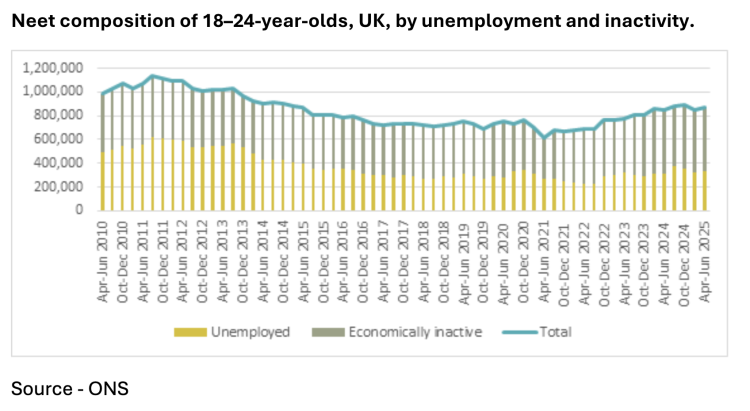
Latest ONS data shows that almost a million (948,000) 16–24-year-olds are not in education, employment and training (NEET). This is up from 800,000 in 2019 and a growing proportion are young disabled people. For those in work, too many are trapped in low pay, insecure jobs with limited progression opportunities.
The government has started to address this - the new Youth Guarantee for 18–21-year-olds, apprenticeship reform, an industrial strategy which puts jobs at its core and the plan to Make Work Pay to ensure secure, well-paid work.
However, to meet the scale of the challenge, we urge the government to go further and introduce a national jobs guarantee for young people designed and delivered with trade unions. 1
The scheme would give young people vital experience of a high-quality job with a real wage, opportunities to gain new skills and an employer reference which will support them into further employment. And previous schemes show they work.
A national jobs guarantee for young people
The national scheme should provide six months of employment paid at least the national minimum wage, or the union negotiated rate for that job, with placements regionally allocated based on need.
Placements should be prioritised for those aged 18-24 who have been NEET for six or more months and young people aged 18-24 who are at high risk of becoming long-term NEET.
In the scheme, job placements should:
- Be additional, to ensure that jobs are not replacing existing roles.
- Meet local labour market needs to ensure sustainability of skills and experience.
- Be designed to ensure the young person gets skills to move into permanent work and provide quality training to put workers on a pathway to at least Level 3.
- Ensure access to trade unions.
- Provide community, public benefit and/or help decarbonise.
- Have clear minimum standards for quality, and
- Be sustainable, this could be a route into an apprenticeship or a guaranteed job interview.
Given the high number of disabled young people who are NEET, a government scheme must ensure placements are accessible and free from discrimination, such as providing part time placements, fast track access to Access to Work and requirements on employers to ensure reasonable adjustments are put in place rapidly.
Benefits and cost
Our proposed scheme would require government funding to cover a minimum wage salary (but employers could and should go higher than this), NI and minimum automatic pension contributions and an individual payment to cover training and onboarding costs. But the scheme would more than pay for itself.
Our assessment is that guaranteeing a 100,000 job placements equivalent to 6 months full time for those 18–24-year-olds furthest away from the labour market would cost the government £1.032 billion over a two-year period. But that this would return £2.9 billion in the long run. The benefits are based on better employment and earnings outcomes, reduced benefit spending, higher taxes and lower costs to public services.
The table below shows the full breakdown, funding up to 300,000 placements over a two-year period and bringing in over £8 billion in the long run.
- 1Our jobs guarantee is in England as the devolved nations have existing Youth Guarantee provisions.
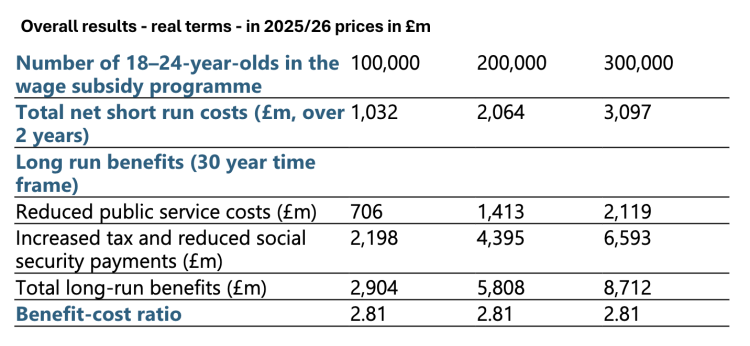
The benefit-cost ratio of the programme is estimated at 2.81, with every £1,000 of (net) government spending on the programme generating £2,810 of net revenue for the Exchequer. With these outcomes assessed over 30 years, the scheme hits breakeven within a decade. This would mean:
- 100,000 placements in a 2-year period would cost £1.03 bn but return £2.9bn.
- 200,000 placements in a 2-year period would cost £2.06 bn but return £5.8bn.
- 300,000 placements in a 2-year period would cost £3.1bn but return £8.7bn.
The whole Youth Guarantee should receive a ring fenced centrally funded budget to be delivered locally. Support for young people should not be funded by cutting social security. This could remove vital financial support that helps young people into opportunities.
Quality apprenticeships and work
We’re also calling on the government to ringfence roles for young people in the industrial strategy. This would provide good quality jobs for life for young people and in turn a skilled, long-term workforce that will drive economic growth.
It’s also popular – polling shows that three quarters of people think young people should have the highest priority access to apprenticeships.
The government’s plan to Make Work Pay will improve the quality of work for young people. We strongly believe that good quality work is key to keeping young people in the labour market.
Given the high number of young disabled people who are NEET, the government should take steps to build on this to make work more accessible and remove barriers that prevent disabled people who want to work from doing so. We want to see reforms to reasonable adjustment legislation and action to protect and improve the essential Access to Work scheme.
With long-term unemployment leading to lasting labour market scars and negative health outcomes, urgent action is needed. The government must be bold and secure young people’s livelihoods into the future.
Stay Updated
Want to hear about our latest news and blogs?
Sign up now to get it straight to your inbox