Employment Rights Bill – a lifeline for four million insecure workers
The need for the government to rapidly implement its employment rights overhaul is laid bare by new TUC analysis that shows that one in eight workers is in insecure work.
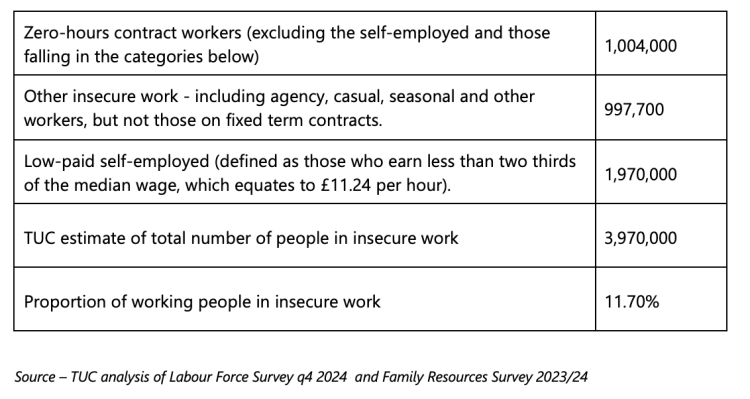
The figures, based on official government data show that four million people are in insecure work in the UK. This is around one in eight of the workforce.
This is a huge surge from 2011 when 3.2 million people were in insecure work.
It means that after 14 years of Conservative-led governments this increased by around 800,000.
Between 2011 and 2024, the proportion of those in insecure work grew from 10.7 percent of the workforce to 11.8 percent.
Measures to crack down on exploitative zero hours contracts and give workers greater protection from dismissal have been held up by Conservative and Lib Dem peers in the House of Lords.
But once the Bill receives Royal Assent, they are due to be implemented during 2027.
Composition of Insecure work 2024 – using the TUC definition
Impact of insecure work
Insecure work has an enormous effect on people at work. The prospect of having work offered or cancelled at short notice makes it hard for workers to budget for household bills, plan a fulfilling private life and meet caring responsibilities.
Insecure work is also low-paid in comparison to permanent employment, leaving many insecure workers struggling financially. Insecurity and low pay go hand in hand.
TUC polling shows the hardship and challenges faced by insecure workers :
Over half of insecure workers are offered shifts with less than 24 hours’ notice. Four in five workers on zero hour contracts (ZHCs) report frequent last-minute scheduling, rising to 85 percent among carers on ZHCs.
Two-thirds of ZHC workers received no compensation the last time their hours were cancelled, with mothers and carers most likely to lose out.
Most insecure workers say they would prefer stable hours, with over 80 percent of ZHC workers wanting consistent schedules with optional overtime. Yet one third of people on ZHC said that their employer had denied their request for guaranteed hours. This shows the pressing need for the Employment Rights Bill’s rapid implementation.
One in four insecure workers cannot refuse hours. Of those who have refused hours previously, around a fifth of workers get penalised for doing so while a further fifth face bullying from managers as a result.
Nearly two-thirds of insecure workers struggle to cover basic living costs. Over 70 percent have worked while sick due to lack of sick pay, and nearly 80 percent of students on ZHCs say their education suffers as a result.
Who is disproportionately affected by insecure work?
Insecure work is skewed to lower paying industries – elementary occupations, plant and machinery operatives, caring and leisure; and certain skilled trades occupations.
Likewise, TUC analysis also shows the growth in insecure work has been fuelled mainly by lower-paid sectors of the economy. In care, leisure, service occupations and elementary occupations the number of people in precarious employment has increased by 600,000 (+70 percent) between 2011 and 2014. This also account for three quarters of the net increase in insecure work during this period.
While roughly equal proportions of women and men work in elementary occupations (9.2 percent and 9.8 percent respectively) caring, leisure and other services occupations account for 14.2 percent of women’s employment, compared to 3.6 per cent of men’s. And 78.5 percent of people employed in this latter group of occupations are women.
Our research also finds that Black and Minority Ethnic (BME) workers are more likely to be in insecure work at 16.3 percent compared to 10.8 percent of white workers. Our analysis also found BME workers account for just over two-thirds of the growth in insecure work.
The TUC says this underlines why tackling the scourge of insecure work will help advance gender and race equality at work.
Employment Rights Bill
So we are urging the government to “stand firm” in the face of cynical attacks on the Employment Rights Bill from Conservative and Lib Dem peers. The Bill is now set for parliamentary ping pong - but despite the best efforts of the opposition, when it passes it could transform working lives for millions of workers now and into the future.
Stay Updated
Want to hear about our latest news and blogs?
Sign up now to get it straight to your inbox
