
Taiwanese Days
Just before Christmas, the TUC issued a call to the trade unions organising at Port Talbot for a representative to attend the Net-Zero Emission and Just Transition conference, organised by Ray Cheng and the Taiwanese Trade Unions. Tom Hoyles from GMB kindly volunteered. Here's Tom's perspective.
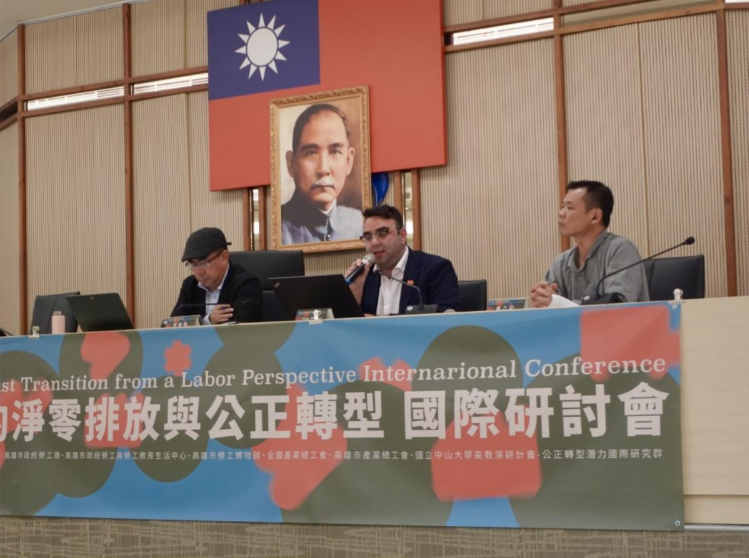
Taiwan bears all the hallmarks of a country with a proud industrial heritage. It had a mainly agricultural economy before the dawn of the 20th century. The island underwent rapid industrialisation in the 1930s and again after Chiang Kai-shek and retreating Nationalist forces used it as a safe haven during the Chinese Civil War, and it has remained so ever since.
You can feel the smoke and petrol fumes in the air as you walk around the streets of Kaohsiung. It is still an overwhelmingly manufacturing-based economy, with small, medium and large manufacturers building everything from motorbike components, computer chips and to the much-lauded semiconductor technology. The conference was an eye-opening one, and although it mainly focused on Taiwanese domestic issues, the topics discussed are just as relevant in Port Talbot, which is about 6000 miles away.
Speaking about Port Talbot, I pointed out that the main problem was the lack of a plan for steel; the UK has become more comfortable importing it, and the incentive in the West has been to buy it from other countries. Cheap foreign imports and the huge carbon emissions they produce create a toxic mix, leading global companies to downsize their operations in some countries in favour of those outside of the COP agreements.
Taiwan also faces significant risks. If it closes its steel plant, it will have to find alternative sources for materials, but unfortunately, the leading steel supplier they continue to have a prolonged conflict with. The People's Republic of China’s position on Taiwan is that it still seeks reunification by whatever means, and in recent years, we’ve seen an escalation in the Taiwan Straits. My point at the conference, then and now, is the same: Port Talbot highlights the key question for us as a global movement.
How do we make this transition work?
Port Talbot is an example where it didn’t work.
Thousands of workers are thrown on the scrapheap because government policies are far more interested in chasing percentage reductions in emissions than examining the nitty gritty of a sustainable economy. The key flaw, of course, is that whichever port produces the steel—be it Port Talbot or the Port of Kaohsiung - the emissions are all part of a global discharge. In fact, one of the worst aspects of offshoring steel is that it is produced in much more carbon-intensive ways elsewhere, and that’s before we even consider the poor working conditions involved. Recently, Labour’s industrial plan has been a step in the right direction, but we still have many questions about how we source and fuel our economy ethically in a rapidly diverging world.
One eye-opening aspect was the array of young climate activists in attendance at the conference. Their primary concerns focused on the environmental impact that carbon-intensive industries have on the island.
They remind me a lot of Gen Z here; they are big on climate issues, but few are making the jump to organised labour. A big question for us is how can we reconcile this new breed of environmental activist to our movement? How can we clothe them in the values of solidarity?
The risk is that if we don’t, we could see a transition that results in thousands of well-paying jobs disappearing, putting older generations out of work and cutting off the pathway for their generation.
Any transition must be a just one. It should prioritise jobs and people, whether in the South China or Celtic Seas.
Tom Hoyles
GMB Wales & South West Region