Meet the TUC President, Maria Exall
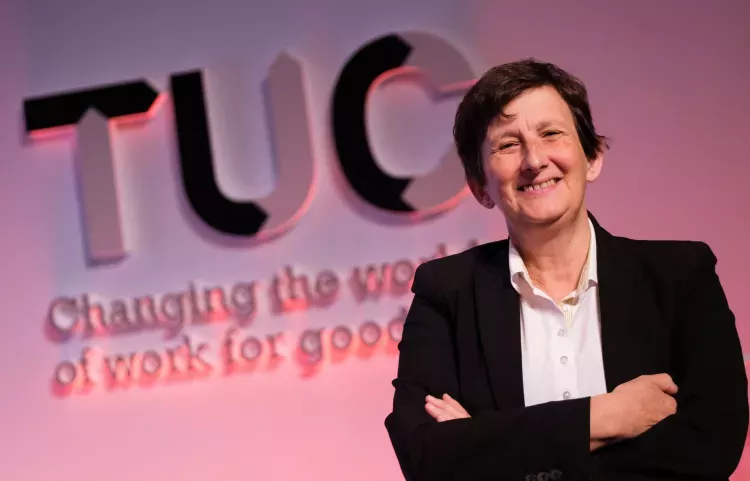
Maria is an officer in the Greater London branch of the Communication Workers’ Union (CWU), and chair of the TUC’s LGBT committee. She is TUC President 2022-23.
“Things are best understood, perhaps, from the margins,” says Maria Exall, sitting in a quiet corner of Congress House – the TUC’s headquarters in London.
A socialist, a practising Catholic, and a lesbian, Exall’s intersection of identities have often made her an outsider. As a communications engineer, she comes from a male-dominated industry; one in which she says the gender imbalance has barely improved since she began in the 80s. She’s a trade unionist and a member of the Communication Workers Union – but also has a PhD in philosophy and theology. And it’s from this position on the sidelines that – in October last year – she was elected the TUC’s first (out) LGBT+ president.
When I meet her, Exall has come straight from a TUC executive meeting, which the president chairs. Having just listened to industrial action report-backs from train drivers, health workers, and teachers, she seems reassuringly upbeat. “The year I’ve been president has been one of the busiest in terms of industrial action,” she says.
In her lifetime, it’s been the most busy. After 13 years of a Conservative government, and while public sector pay struggles against inflation, the union movement has a fight on its hands. I ask her if, perhaps – having lived and fought through decades of institutional homophobia – this is a fight for which she’s well prepared.

“Of course, my LGBT activism fed into my general political activism,” Exall says. She campaigned against Section 28 – the law brought in by Thatcher’s government, banning the ‘promotion’ of homosexuality in schools and local authorities. She was part of a gay rights group who stormed the Ideal Home Exhibition in 1988, in protest of this homophobic legislation. Their rallying cry was: “An ideal home has lesbians in it”.
The gay rights movement, Exall says, equipped her with a lot of the skills she’d need as a trade unionist. “You have to organise together,” she says of her early days as an LGBT+ liberation activist, “And you’re making alliances, and learning that you need to have different people helping you”. The movement also taught her to stand firm on issues of principle - a skill which is undoubtedly useful in any form of activism.
When Exall joined the National Communications Union, a forerunner of the Communication Workers Union, in 1988, she quickly tried to import the fight for LGBT+ rights into the union movement.
She was part of discussions to introduce a (as it was then) lesbian and gay committee; a motion which was voted down that year, but won the following year.
Now, she’s bringing the energy she’s so used to pumping into LGBT+ rights into solidarity with trans people.
I’m very proud this year that we’ve put our organising where our mouth is in terms of recognising the demonisation and the awful torrents of abuse our trans, non-binary and gender diverse members get.
Exall oversaw the launch of the Trade Unions for Trans Rights Network in April this year. At a time in which trans people are being targeted with a lot of the same hatred and misinformation that was thrown at gay people in the days of Section 28, Exall wants trans people to know that the trade unions – at least – are on their side.
“The load of crap that’s put on trans people now is very reminiscent of where it was then,” she says, referring to homophobia in the 80s and 90s, “including tropes about children and all that”. This moral panic, she says, is a deliberate tactic to set people against each other, “and that’s the opposite of what the trade union movement is about,” she says.
Likewise, Exall sees her Catholicism (which she describes as “progressive”) as a call to stand in solidarity with marginalised people. While her trade unionism, her religion, and her involvement in the LGBT+ rights movement might be seen as conflicting ideologies, Exall sees them as one and the same.
Her Catholicism, which is part of her Italian heritage, imbued her – growing up – with the idea that, “we’re on this earth to help each other”.
She points out that trade unions are recognised in Catholic teaching as having a place in society. Although the idea of Jesus being a socialist – which I propose – is a step too far, but only because – as Exall puts it – “that’s anachronistic”. “All the major religions have that idea of basic radical egalitarianism,” she says, “If it’s an Abrahamic religion, you’re all children of God – so everyone’s equal, everyone’s your sibling.”
In terms of what she’s done differently, as the first out LGBT+ TUC president, Exall says she wanted to bring equality “much more into the mainstream”.She sees her sexuality – and the expectation to stand up for others in the LGBT+ community – as both a responsibility and a privilege.
There’s a joy in the LGBT community,” she says, “in being able to represent all the diversities of our community.
Something almost akin to queer privilege also allowed Exall to enter the male- dominated communications industry. Lesbian women, especially those who are gender nonconforming, are more likely to question – from an early age – gender roles. When she began working as a telephone engineer, many of her lesbian friends were doing traditionally male jobs – “they were doing things like being carpenters, working as plasterers,” she says. Among Exall’s friends, there was a notable ‘women in manual trades thing’. So it came as a surprise to her that – in fact – there were very few women doing her job as a communications engineer. There remain few, today. Sometimes from within the LGBT+ bubble, anything can seem possible.

When it comes to her priorities as TUC president, Exall is resolute: “Victory in all our disputes, and a Labour government,” she says, “simple as that, really”. More specifically, she has her eye on employment laws, and their anti-union bias.
Legal blocks on workers’ rights to unionise have been a growing problem, with Rishi Sunak bringing in legislation to enforce minimum service levels in sectors like transport, schools, and healthcare.“ Talk about taking away civil rights…,” Exall says.
Perhaps, if there’s anyone who’s prepared to take on one of the most anti-union governments in Europe, it’s a woman who is a communications engineer, a trade unionist with a doctorate and a lesbian Catholic.
