Wigan Pier Project
So, this year’s special TUC Congress – marking 150 years of working people coming together to fight back against exploitation – feels the perfect place to launch the Daily Mirror’s Wigan Pier Project, as we retrace Orwell’s famous steps.
The idea for our project came back in April 2015, when I visited a church in Wigan with the local Labour MP Lisa Nandy and the Rev Denise Hayes. “It is wicked what this government is doing,” Rev Hayes told me. “We have children with hypothermia. We have had to open a food bank. None of the houses round here have carpets.
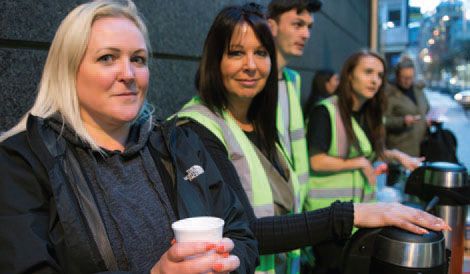
You see sheets and towels on an asphalt floor. The levels of poverty are soul-destroying.” Rev Hayes looked at the battered second-hand Penguin paperback I was carrying, The Road to Wigan Pier. “I think Orwell would weep if he saw Wigan now,” she said. Over the last 18 months, along with my colleagues
Claire Donnelly and Andy Stenning, we have followed Orwell’s original hand-drawn 1936 map through Coventry, Birmingham, Stourbridge, Wolverhampton, Penkridge, Stafford, Stoke-on-Trent, Macclesfield, Rudyard Lake, Manchester, Wigan, Liverpool, Sheffield, Barnsley, and Leeds.
We’ve knocked on every door Orwell did and stopped at every place he stopped at, recording our findings in a special print and interactive digital project built by my colleague Adam Walker.
On Tuesday evening, we launch in Manchester, as part of the official TUC fringe, at the People’s History Museum in Spinningfields – a few minutes’ walk from Congress.
Now in one of the most expensive postcodes in Manchester, the PHM is only a mile from where Orwell walked the ‘smoke-dim slums’ of the 1930s, and had to pawn his expensive scarf to pay for lodgings. It’s also near Wood Street Mission, a children’s charity which has been supporting people since 1869. In the past year, it has helped over 10,000 people with coats, clothes, washing powder, toys, toiletries and, perhaps even more poignantly, nappies and school uniforms. Like the 1984 and Animal Farm writer, we’ve found modern-day Manchester to be a city with mixed fortunes. The early council house Orwell stayed in and so admired is still standing and still helping a low-income working family keep a roof over their heads.
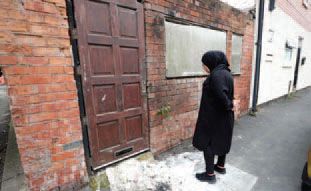
But in some parts of Manchester and elsewhere, he would also have recognised the damp, cramped and squalid homes we visited, and been shocked by the numbers of people living in destitution on the street.
Since Orwell’s day, things have of course got immeasurably better, thanks to the advent of the welfare state and the NHS.
But we are now in the 8th year since David Cameron declared the ‘Age of Austerity’, and in towns like Wigan up and down the country, the result is a deep and growing poverty that should have belonged to the past.
Meanwhile, the slums, once banished from towns and cities by the post-war miracle of social housing, have returned in towns and cities across the UK in the form of privately rented hovels.
The reason we wanted to launch the Wigan Pier Project at the TUC in its 150th year, is because trade unions are still the most vibrant antidote we have to deep poverty. When protesters were killed at Peterloo in the events leading up to the TUC’s foundation, they were protesting at exactly the same things that are making people exhausted, hungry and angry today.
And more generally the TUC grew out of the realization that unless working class people opposed big capital with collective strength, they would always be exploited. Today, the neoliberal project has driven a horse and cart through even basic ideas of decent pay and conditions – even as austerity has ripped apart the social safety net.
Our journey has been strewn with stories of people going hungry on zero-hours contracts, unable to heat their houses on short hours, struggling with low-paid self-employment or treated like animals by unaccountable agencies.
The mines of Orwell’s day have been replaced by windowless warehouses where people sweat without natural light, and are simply substituted when they collapse or become too sick to work. The docks, where some men were picked and others were sent home hungry, have become the agencies where bosses play God with employees’ shifts and livelihoods.
I will never forget the man we found sobbing in a Staffordshire foodbank kiosk in a supermarket carpark, who told us ‘it was come here or take my own life’.
Or the ex-serviceman outside, who walked seven miles to work and back every day because he didn’t always get work and couldn’t risk the bus fare. Or the child who showed me her damp bedroom in Manchester with mould growing up the wall and the holes where the rats lived.

In 2018, we are at another point of reckoning. The great deprivations of 150 years ago led to the TUC. After Orwell’s journey through the deprivations of the 1930s, his generation built the welfare safety net.
Now that safety net is in tatters, and it’s our generation’s turn to be the difference. Of course, retracing Orwell’s steps has not just shown us a microcosm of the many millions of people living in poverty in post-austerity Britain. It’s also shown us the best of Britain, the people who run the foodbanks and support their neighbours despite having very little themselves. The people who are somehow managing to survive the worst an austerity-obsessed government can throw at them with their dignity intact.
Trade unionists are at the heart of those communities and that fight back, shoulder to shoulder with people. Orwell knew that. Trade unionists put him up on several points during his journey, they acted as guides and introduced him to people.
They formed some of the only opposition – then as now – to ever deepening poverty. In Manchester in recent months, we’ve seen trade unionists take on food giants like McDonalds and TGI Fridays, bus companies and care homes.
In Wigan, we’ve seen trade unionists fight attempts to privatise NHS jobs like portering and cleaning and win hands down. And across the country we’ve seen unions support workers in and out of work.
Today, when one in nine workers is in insecure work, you are needed more than ever. So, eight decades on, do please join us for a drink and a chat about the Wigan Pier Project at the People’s History Museum on Tuesday night.
You’ll be amongst friends.