

Anti-Racism data dashboard
The Anti-Racism Tracker serves as a platform offering guidance and resources for unions, members, and activists to monitor and build upon their progress.
To further advance our work, the Implementation and Oversight Group is introducing measures to assess the movement’s collective achievements through a new data dashboard and movement-wide targets.
The data dashboard focuses on three main areas: representation, membership, and the unions themselves, providing a framework for us to genuinely progress towards the anti-racist values we are committed to. These indicators sit alongside and compliment the work of the TUC Anti-Racism Taskforce, in particular the Anti-Racism manifesto, equality campaign plan and anti-racism action plan.
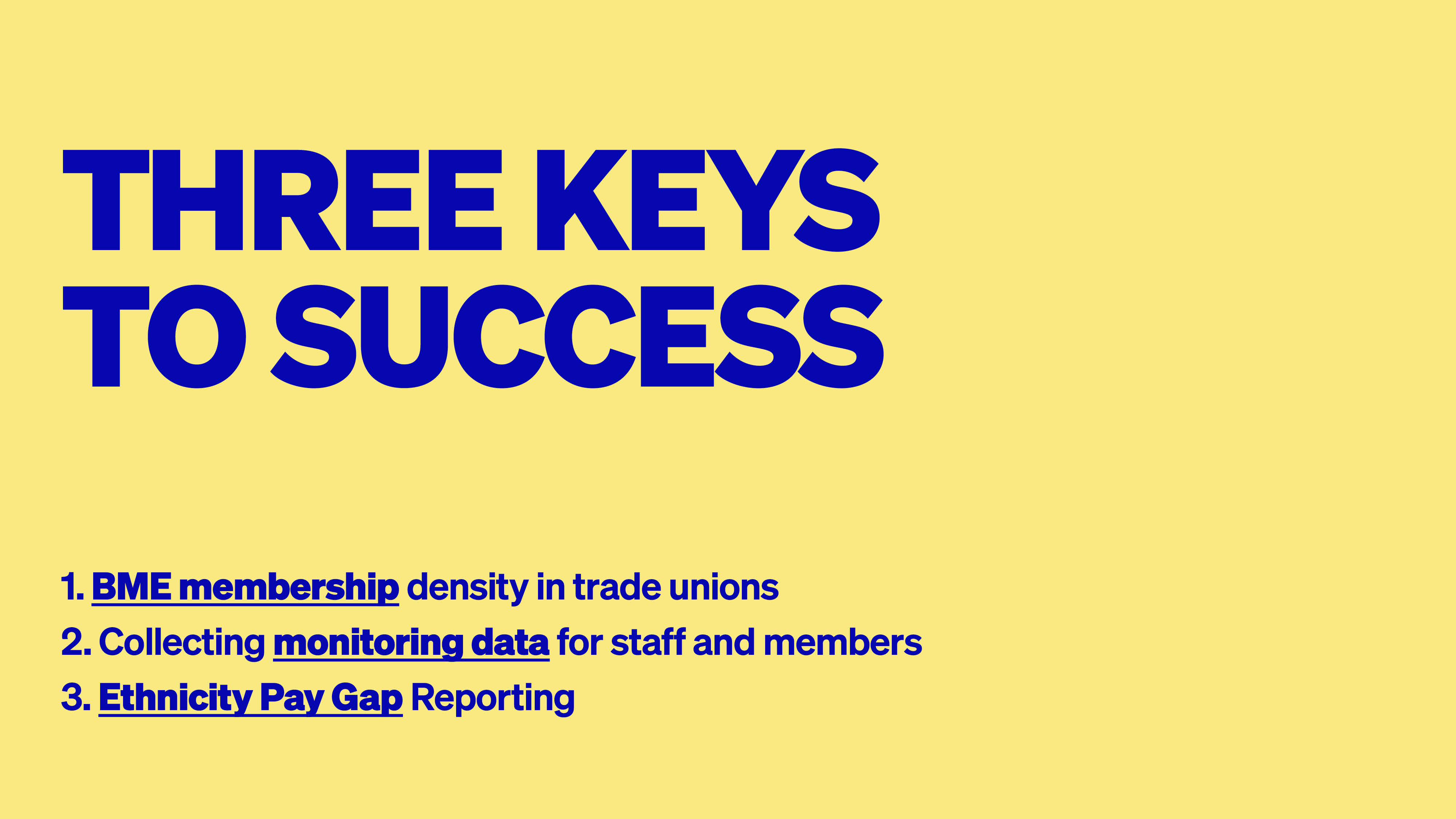
These targets align with the commitments outlined in the manifesto and the tracker, offering high-level visibility to the trade union movement and beyond on the progress we are making.
The dashboard will be publicly available on the TUC website and updated annually.
The Implementation and Oversight phase, initiated after the conclusion and recommendations of the Anti-Racism Taskforce in 2022, spans five years. The targets set forth will coincide with the culmination of this five-year period.
By Congress 2027, we aim to achieve demonstrable and tangible changes within our trade union movement to bolster the confidence of Black members.
1. BME membership density in trade unions
Achieving a truly diverse movement is a crucial goal for our unions.
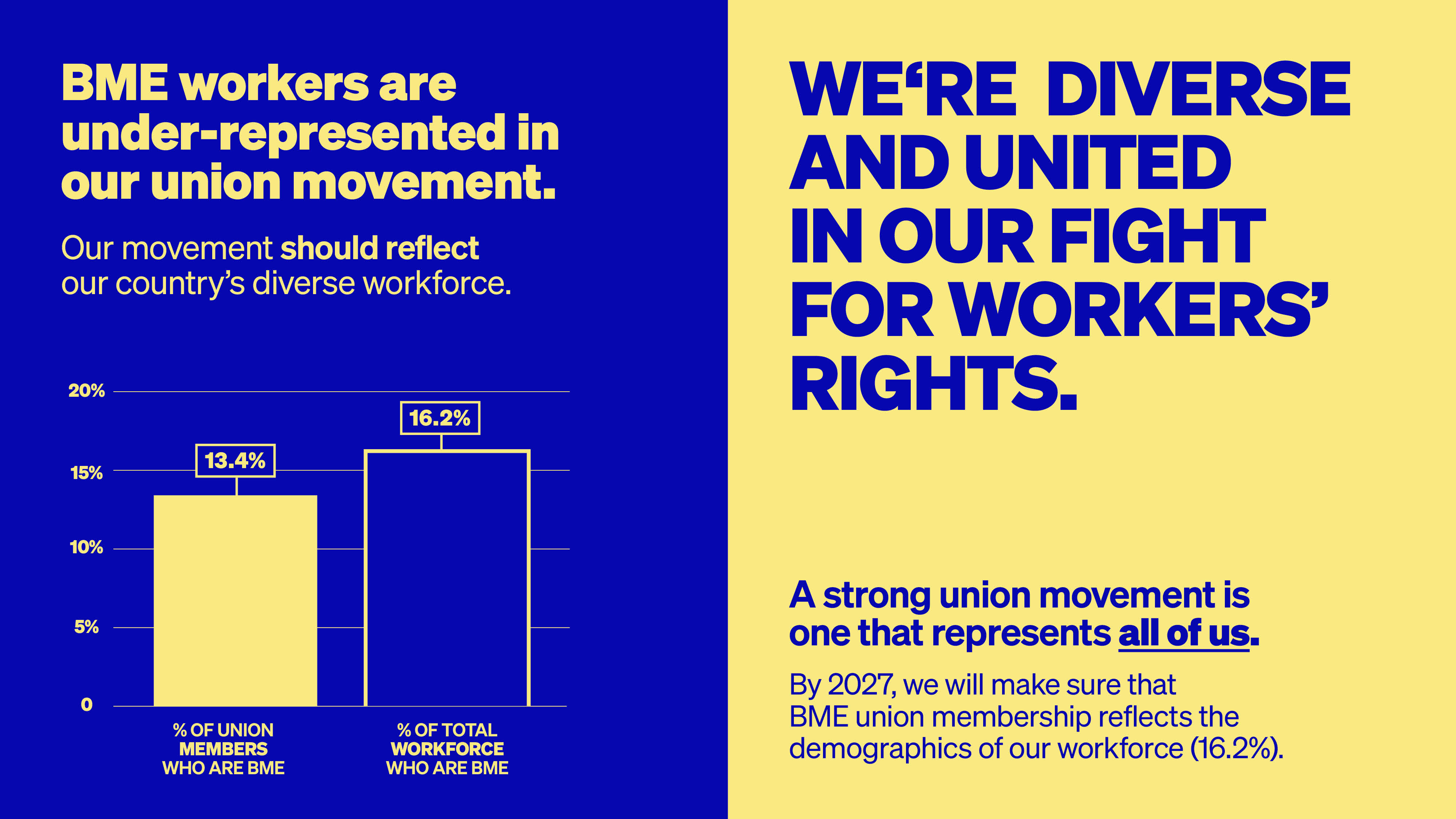
Currently, Black and Minority Ethnic (BME) employees are underrepresented in union membership. While BME individuals account for 16.2% of the total workforce, they only comprise 13.4% of union members.
Our objective is to ensure that by 2027, the composition of union membership mirrors the demographic makeup of the broader British workforce. This alignment is vital for accurately representing and supporting all workers in the UK, ensuring that our movement reflects the diversity of the country.
Current status: BME membership in unions in 2024: 13.4%
Target for 2027: BME membership to reflect the population workforce: 16.2%
This target underscores our commitment to inclusivity and the importance of engaging BME employees in the union movement to strengthen our collective voice and advocacy efforts.
2. Unions collecting monitoring data for staff and members
Monitoring and recording BME data for trade union staff and their membership is essential for building a stronger movement. It is equally important to understand the leadership roles held by BME members and staff.
While many unions already provide some breakdowns for their national executive members, 61% of unions know breakdown by ethnicity for national executive members.
Additionally, it should encompass BME representation within trade union senior management teams. The Equality audit shows that 61% of unions collect race equality monitoring data for their National Executive members.
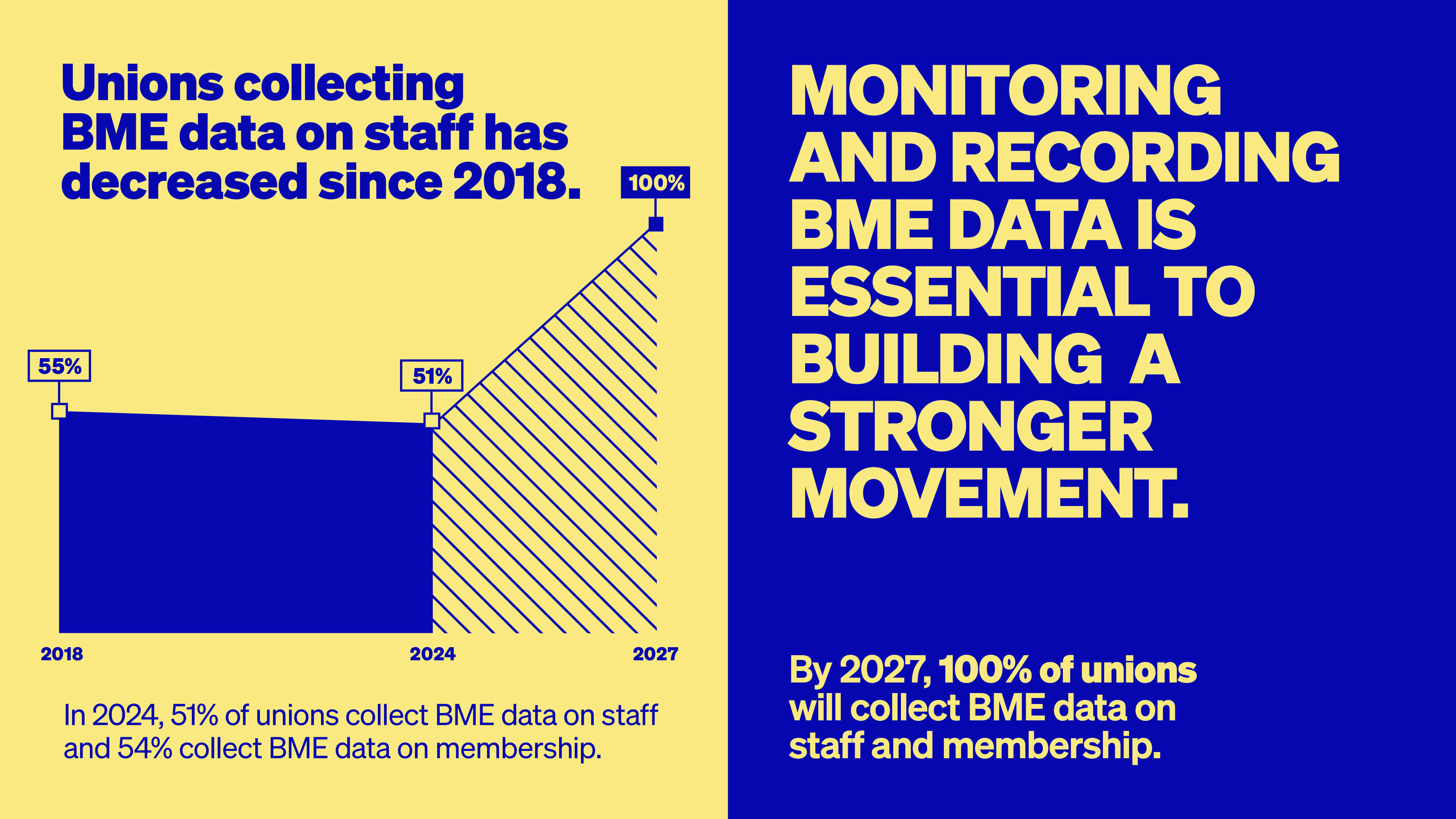
Just half of unions have records of BME staff, compared with 55% in 2018.
In all cases the likelihood of a union keeping these statistics is lower the smaller the size band of the union.
This fall in diversity monitoring follows a decline already seen in the period 2014–2018.
Many unions that collect equality data on their membership are unable to provide completely accurate statistics. 54% of the unions (22 unions) collect and can provide data on the number of people from a BME background in their membership. Among these unions, the BME population made up between 0.1 and 40 per cent of their membership.
Current status:
Unions collecting monitoring data on BME staff in 2024: 51%
Unions collecting data on BME membership in 2024: 54%
Target for 2027: 100%
3. Ethnicity Pay Gap reporting
Ethnicity pay gap reporting is an area where we have already made substantial strides. With the new government's endorsement, we now need to extend this progress through proactive engagement with employers and by setting an example within our own practices as trade union employers.
Leading by example means ensuring our actions align with the demands we place on others, including businesses and the government.
Our campaign for closing the pay gaps is not just a call for justice but a tangible effort to improve outcomes for all workers and strengthen union bargaining.
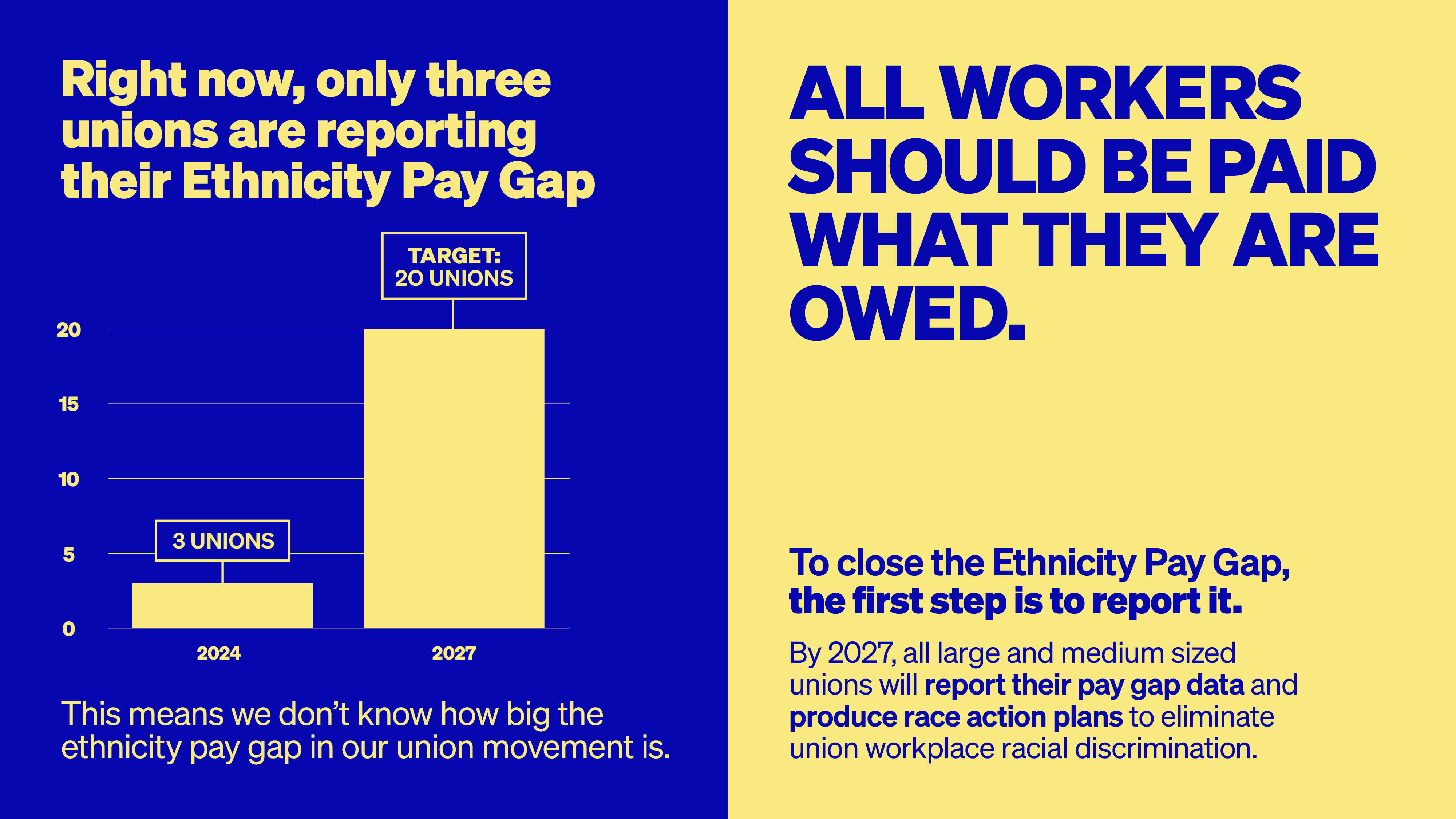
The TUC is calling on all employers – including our unions - with over 50 employees to report their pay gap data and develop action plans to address it.
Current Status: Unions Reporting Their Ethnicity Pay Gap: 3 unions
Target for 2027: 20 unions
All unions with 50 or more employees should be reporting their pay gap data and producing actionable plans to eliminate disparities.
By 2027, we aim for comprehensive engagement from all qualifying unions, ensuring that pay gap data is transparently recorded and used to drive meaningful change. With a commitment to publish a movement wide ethnicity pay gap report in 2027.
For more information contact Riz Hussain, Anti-Racism Officer TUC, rhussain@tuc.org.uk