
Automotive site transitions to Europe's first circular economy factory
TUC Worker-Led Transition Project
The TUC worker-led transition project partners with manufacturing workers to futureproof industrial jobs. This case study is part of a worker-led transitions series, highlighting international examples where workers across sectors are playing an important role in the transition of their workplaces, helping to secure good quality work and shape their industries into the future.
Site details
Site name: Renault Flins
Operator: Renault
Location: Flins
Country: France
Date: 2020 - Present
Context
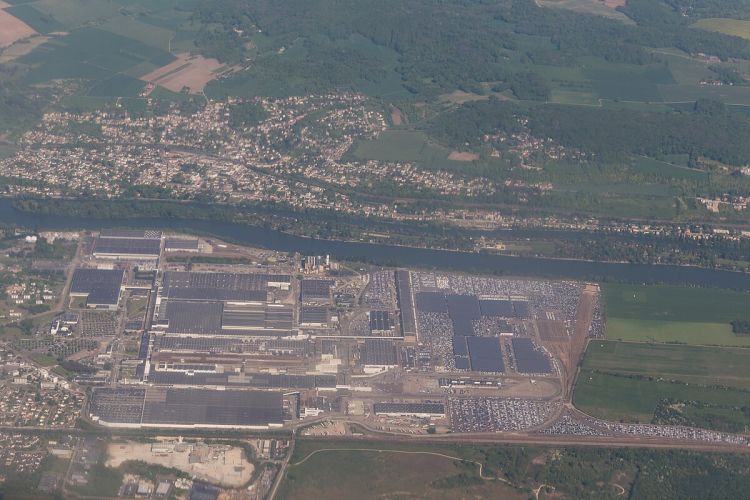
French multinational automotive manufacturer Renault was founded in 1899 and has played a key role in shaping the global automotive industry. Their Flins production site, located in Yveline near Paris, opened in 1952 and has since more produced more than 18 million vehicles – including Renault’s first mass-produced electric vehicle model. Today, the plant employs approximately 1755 people 1 , who are represented mainly by the Confédération Générale du Travail (CGT) and Confédération Française Démocratique du Travail (CFDT).
The challenge
Globally, the automotive sector has faced growing pressure to accelerate its shift to more sustainable practices. While many manufacturers have already committed to electric vehicle production, there is a growing recognition of the need to adopt ‘circular economy’ practices: moving away from existing approaches to production (raw materials extraction – production – usage – disposal) towards a more ‘circular’ model that maximises the re-use and recycle of key vehicle components (e.g. batteries, metals). Such practices are implemented to reduce environmental impacts, such as those associated with mining for lithium and rare earth metals needed for batteries and end of life disposal.
The European Union (EU) has also adopted the End of Life Vehicle Directive which encourages the recycling, reuse and recovery of vehicle components to reduce waste and extend the life of vehicles, an initiative also set out as part of the European Green Deal’s Circular Economy Action Plan. Amidst growing pressure, Renault has set sustainability goals which aim for carbon neutrality in Europe by 2040, and worldwide by 2050, and integration of circular economy principles across its operations.
Electric vehicle (EV) production is central to the automotive’s industry’s transition away from internal combustion engines. Whilst this provides a jobs pathway for the sector, automotive workers are facing significant pressures across Europe, and often this transition is experienced as a threat to jobs and wages. Protecting the future of automotive jobs will require a strong policy and investment approach that combines opportunities in EV production and supply chain, with circular economy vehicle recycling initiatives, and transition and diversification support for the Internal Combustion Engine (ICE) supply chain.
Driven by a steady decline in vehicle production levels at the Flins site over the past 50 years, market shifts towards electrification and sustainability demands, in 2020 Renault made the strategic decision to end traditional automotive manufacturing at the site and transform it into Renault’s flagship initiative for building a circular economy hub for sustainable mobility in the sector. Known as the ‘RE-FACTORY’, the site would shift away from manufacture of vehicles towards extending the life of vehicles. This means that old or damaged vehicles could be reconditioned to make them less carbon intensive, batteries could be refurbished, and end of life vehicles could be remanufactured, re-used or recycled. 2
In doing so, the company set out to address environmental goals whilst maintaining industrial activity, as Renault CEO, Luca de Meo explained: “This plant, with an objective of a negative CO2 balance by 2023, is fully in line with the Group’s global strategy by combining circular economy, reduction of emissions, development of skills and the creation of new value-generating activities.” 3
What workers did
Amid a broader decline in automotive production and stricter environmental regulations, trade unions have long voiced concerned about the future of the site. When the transformation was announced, workers at the plant recognised the urgent need to actively engage with the process. The shift to production represented a significant industrial change, but also a crucial opportunity to secure long-term employment in the new clean industry.
CGT has historically played an active role in negotiations and disputes related to job security and the future of manufacturing at Flins and has consistently advocated for the continuation of vehicle production, highlighting the broader implications for employment and industrial capacity in France. 4 While the unions supported the goal of futureproofing jobs, they expressed serious concerns about the rapid pace of the transformation and a lack of transparency regarding its long-term impact on workers’ livelihoods. But with changes set in motion, workers knew they needed to ensure that they were at the table every step of the way to negotiate a fair transition of the site that would secure the future of as many jobs as possible.
Unions also raised concerns about the gap between Renault’s public commitments on jobs, hiring and production and what would be delivered in practice – particularly considering the indirect impacts of changes to production on suppliers and the local economy – and the discrepancies between the number of permanent contracts promise and those actually implemented. 5 The unions’ primary objective has been to safeguard employment and ensure that both the plant and its workforce remain fully operationally throughout the transformation – a key concern amid the post-COVID industry downturn.
At the national level, in 2021, Renault management and trade unions (representing 76% of all trade union representation) signed a multi-year trade union agreement for France – known as the ‘Re-Nouveau France 2025.’ 6 The agreement outlined Renault’s transformation strategy in France. Key provisions included commitments not to close any sites covered by the agreement, the recruitment of 2,500 new workers, and the launch of the ‘Re-Know’ University – a joint initiative with trade unions to offer 10,000 new training, upskilling and professional development programmes, including diploma-level training for emerging roles in the EV sector.
How were obstacles overcome?
Upskilling and workforce transformation: A key challenge was to ensure that workers at the Flins site were equipped with the skills required for the factory’s new operations. Close collaboration between unions and management resulted in the development of a comprehensive upskilling and training programme with Renault establishing a dedicated training campus on site, specifically designed to provide professional skills training and diplomas to Flins employees. 7
Shifting roles: There has been growing anxiety among employees about the slow roll-out of new activities, possible job reductions and evolving roles due to the simplification of manufacturing methods, including reclassifications reflected in pay. 8 In 2023, driven by mounting fears over job security, CGT organised a strike to put pressure on the company and called for increased government intervention to strengthen the French automotive sector.
What was the result?
As of March 2024, the plant no longer manufactures new vehicles and is now Europe’s first circular economy mobility factory. The new plant is structured around four key divisions:
RE-TROFIT: Focuses on the retrofitting and refurbishment of used vehicles. Operational since 2021, the division is expected to recondition more than 45,000 used vehicles annually by the end of 2025.
RE-ENERGY: Develops applications for second-life battery use and explores new energy systems.
RE-CYCLE: Manages the recycling and reuse of automotive parts and materials.
RE-START: An innovation and training centre project including an innovation centre for ‘Industry 4.0’ plus a training campus offering diploma-level training programmes to reskill Flins workers. 9
The site transformation marks a major shift in the industry highlighting how the automotive industry can adapt to meet environmental and economic challenges. All of the workers at the site have been retained and retrained in new skills required for the plant, futureproofing their jobs. The plant now employs 3,000 workers. Renault plans to use the experiences at the Flins site as a roadmap for the transformation of the whole company. 10
In December 2024, Renault signed a new social contract covering 2025-2027 focused on strengthening social protection and skills development, which applies to the company’s 40,000 employees across France. The agreement includes the establishment of a job observatory to monitor emerging and changing professions. 11
However, CGT did not sign the agreement, criticising some of the worker rights and benefits included. CGT also announced a national mobilisation in October 2025, demanding greater clarity and accountability from Renault regarding investment plans, hiring practices (particularly the balance between permanent and temporary contracts) and more transparent decision-making.
Successes and lessons learnt
Vocational and skills development: Union negotiations ensured that the transition of this site came with strong job protections and training commitments. Worker training has been crucial to Renault’s transformation. As new technologies are introduced, workers must adapt to new tasks. Training was the first point of employee involvement, and workers have actively contributed to and shaping new production processes. Technical skills are delivered through structured programmes.12
Social dialogue in practice: France’s institutionalised model of labour relations enabled negotiation around the transition from an early stage. Formal company-wide agreements were negotiated collectively with major unions, covering issues from job protection to training. While some unions –expressed concerns with measures set out in agreements, the structured dialogue has enabled a more transparent process for managing the change and supporting skills transitions.
- 1 https://www.renaultgroup.com/en/group/refactory/
- 2 https://www.ellenmacarthurfoundation.org/circular-examples/groupe-renault
- 3 www.media.renaultgroup.com
- 4 https://eprints.lse.ac.uk/102522/4/Revised_Manuscript_with_Minor_Revisions.pdf
- 5 https://lagazette-yvelines.fr/2025/07/03/les-syndicats-de-renault-flins-inquiets-pour-lavenir-du-site/
- 6 https://media.renaultgroup.com/renault-group-signs-off-on-a-three-year-trade-union-agreement-that-places-france-at-the-heart-of-its-value-creating-activities/ https://news.industriall-europe.eu/documents/upload/2025/1/638736543342999648_Renault_social_protection_agreement.pdf
- 7 www.renaultgroup.com
- 8 https://news.industriall-europe.eu/documents/upload/2023/9/638295992005322852_Renault_training-2.pdf
- 9 https://media.renaultgroup.com/renault-group-1st-anniversary-of-the-refactory-and-inauguration-of-the-factory-vo-in-flins/
- 10 https://www.europarl.europa.eu/RegData/etudes/STUD/2022/733972/IPOL_STU(2022)733972_EN.pdf
- 11 https://news.industriall-europe.eu/documents/upload/2025/1/638736543342999648_Renault_social_protection_agreement.pdf
- 12 https://www.europarl.europa.eu/RegData/etudes/STUD/2022/733972/IPOL_STU(2022)733972_EN.pdf
