TUC response to the Equality Law Call for Evidence
The TUC exists to make the working world a better place for everyone. We bring together more than 5.2 million working people who make up our 48 member unions. We believe all workers deserve respect, and the opportunity to make the most of their talents.
We have a long and proud history of promoting equality for all our members. We strive to end all forms of discrimination, bigotry and stereotyping. We oppose any violence or intimidation, bullying or disrespect, towards any group that faces discrimination, and from whatever quarter. The TUC’s commitment to equality is written into our constitution and into that of our member unions.
Unions play a vital role in ensuring that rights under the Equality Act are respected and upheld by way of collective bargaining, raising awareness of rights amongst employers and employees, assisting in resolution of disputes, providing support to members in pursuing claims to the employment tribunal, as well as adopting strategic litigation to clarify legal issues and establish norms to be followed in the workplace
We welcome this government’s commitment to equality as set out in its Make Work Pay commitments, the Employment Rights Bill and the forthcoming Equality (Race and Disability) Bill.
The TUC has consulted with affiliates and stakeholders in developing its response to this call for evidence. In doing so our response sets out evidence, themes and key priorities for reform. We expect that many of our affiliates will respond also and will provide more detailed and sector-based evidence.
Enforcement
It will be apparent from our response that there is a clear enforcement gap when it comes to many of the areas this call for evidence covers. Where relevant we have set out more detail in each section, but the TUC believes while there are specific measures that can be taken to improve enforcement in certain areas, adequate funding and capacity of the bodies relevant to this call for evidence, namely the Equality and Human Rights Commission (EHRC) and the Employment Tribunal system are essential to deliver effective regulation and enforcement of equalities law.
We welcome the provisions set out in the employment rights bill to give workplace equality representatives the right to paid facility time to undertake their trade union duties. Equality reps have a key role to play in driving positive action on equalities in the workplace as well as resolving and enforcing issues in the workplace before they reach tribunal. Equality reps must have the powers and protections to carry out their role to full effect, including the right to be involved in collective bargaining on equality issues.
It’s vital that union representatives have access to enough paid facility time to properly carry out their duties. A significant number of trade union reps report that they do not have enough facility time to carry out their trade union activities and duties. Employers exercise too much discretion over how much facility time to allow trade union reps and can take an overly restrictive interpretation as to what is “reasonable” facility time. Going forward the TUC believes that the relevant legislation should be amended to mirror the facility time provisions in Section 4 of the Safety Representatives and Safety Committees Regulations 1977. Health and safety reps are entitled to paid time off “as shall be necessary” to discharge their functions and other reps, including equality reps, should be entitled to equivalent provision of paid facility time.
Equality and Humans Rights Commission (EHRC)
For the EHRC to be able to operate effectively and carry out its regulatory role, it will need adequate resourcing. However, over the last decade the EHRC’s ability to deliver on its role and purpose have been undermined through funding cuts and other political factors, meaning that effective enforcement and advancement of workplace equality rights in practice has been limited. The cuts have resulted in the closure of the Commission helpline and regional offices, both of which were providing advice to individuals and organisations. The EHRC now takes fewer strategic legal cases, and fewer first-instance cases are taken by the commission. This limits both the advancement of the law and the deterrent impact of an effective regulator. Shrinking staff resources have led to fewer inquiries, s 31 assessments and investigations being conducted.
The Government’s Make Work Pay agenda and the enforcement of the Worker Protection Act 2023 will place increased regulatory obligations on the EHRC. An effective and well-resourced EHRC is also necessary for the effective enforcement of the Public Sector Equality Duty (PSED). But the organisation is not currently sufficiently resourced to deliver even existing responsibilities.
It is important to put the EHRC budget cuts into perspective. In 2007 when the EHRC opened it had budget of £70 million and a staff contingent of 525, this was based on its expanded remit with new policy areas including human rights, age, LGBT+ and religion or belief. Now it has a budget of around £17.5 million and around 200 staff which is roughly equivalent to the staff and budget of one of its legacy commissions (RRC, EOC and DRC). Its current staff and funding basis will not allow it to fulfil its full potential nor to deliver new responsibilities. Reverting to 2007 funding levels in real terms would require the EHRC’s budget to be increased to £115 million. 1
Tribunals
The last publicly available minutes of the National User Group (Employment Tribunals) show that there are large delays in some areas of the system. The minutes record that “For hearings longer than 10 days, the picture is also mixed. The North East can still list these cases in the first half of 2025. Wales, Midlands West, London Central, South West and the South East (BSE and Norwich) are listing these cases in the second half of 2025. London East, Midlands East, the North West, and South East (Watford, Reading, Cambridge) are listing these cases in the first half of 2026. The longest waiting times are in London South, which is listing these cases in the first half of 2027.” This clearly shows that many workers wait a considerable length of time to access justice.
The TUC also understands that the proportion of ‘open track’ cases being heard by the tribunal has increased. These cases are more complex and take longer to deal with. The ET system needs increased resources to deal with its current case load, which is increasing in length and complexity.
There should be a review of the suitability of the premises that host the employment tribunals and the physical resources, such as recording equipment, that are necessary for the smooth functioning of the tribunal system. Inadequate physical resources have hampered the smooth functioning of the tribunal system and contributed to delays. Consultation should take place with the President of the Tribunal, Judge Barry Clarke, who will be able to advise on resources that are needed to bring the physical resources of the tribunal system up to a proper functioning level.
The TUC also understands that there is an issue with the recruitment and retention of staff that support the administrative functions of the tribunal system. Further resources are needed to ensure that the tribunal system has sufficient administrative staff to process claims in a reasonable time frame.
- 1 TUC Calculations
Equal Pay and pay discrimination
Pay discrimination remains widespread despite the introduction of equal pay legislation on the grounds of sex being introduced over 50 years ago, and gender pay gap reporting being introduced in 2017, as well as legislation that enables workers with other protected characteristics to bring claims of indirect pay discrimination (for example on the grounds of race) through the Equality Act.
While equal pay and pay gaps are not the same, they are often linked, and discriminatory pay practices can be a large contributor to pay gaps. Conversely, within individual employers, a low pay gap can sometimes mask the existence of unequal pay. However, given that [un]equal pay is not regulated or monitored, pay gaps data can provide an indicator of the scale and scope of pay discrimination and how it can compound for people with multiple protected characteristics.
Pay gaps
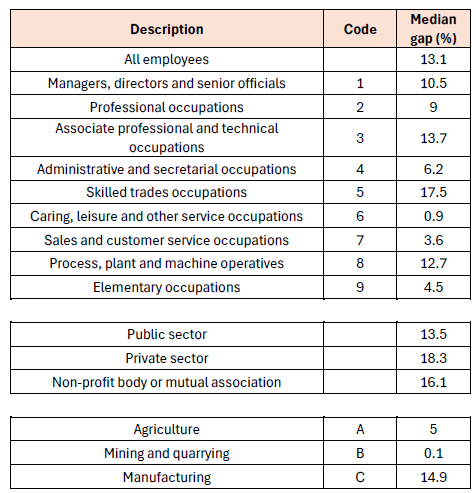
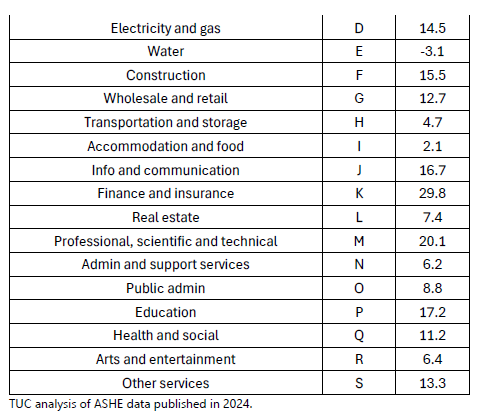
TUC analysis shows that the median gender pay gap across the economy is 13.1 per cent. However, there are variations by sector and occupational classification (see table below).
The pay gap for disabled workers is 17.2 per cent (equivalent to £2.35 per hour). Our analysis suggests this gap has widened from the previous year when the pay gap for disabled workers in comparison to non-disabled workers was 14.6 per cent. Disabled women workers face even greater pay disparity, with a pay gap in comparison to non- disabled men of 24 per cent (equivalent to £4.05 per hour). 2
Official statistics are inadequate when it comes to pay and ethnicity pay gaps. The two main sources of pay data from the ONS do not record ethnicity. These are the Annual Survey of Hours and Earnings (ASHE) and Average Weekly Earnings (AWE). Instead, we are left to rely on the Labour Force Survey and Annual Population Survey which have lower quality earnings data.
The ONS has published reports on ethnicity pay gaps but the most recent one was published in 2020. This publication shows a raw gap of 2.3 per cent in 2019, with a median hourly wage of £12.11 for Black 3 workers compared to £12.40 for white workers. Longhi and Brynin (2017) 4 have produced more in-depth work highlighting ethnicity pay gaps over a few years using the same data sources. This shows that there are significant gaps between white and Black workers, but the longer timeframe inevitably makes it less responsive to recent shifts. 5
Reasonable adjustments
TUC research published in May 2025 found that over half (55 per cent) of disabled workers who had put in a request had either only some of their request or none of their needed reasonable adjustments implemented. Of those that had their request turned down, one in five were given no reason. Of those whose requests were partially or fully accepted, eight in 10 were waiting between four and 12 months for their reasonable adjustments to be put in place. 6
Without reasonable adjustments in the workplace being supported, many disabled workers are faced with having to either reduce their working hours or stop working altogether, contributing to the disability pay and employment gaps. The TUC is therefore calling for a duty to respond to requests for reasonable adjustments within a specified time, to stop the cycle of employers ignoring reasonable adjustment requests, leading to disabled workers having to leave their job or reduce their hours when they would not do so if their adjustments were met. Ideally, employers should respond to requests within two weeks.
Equal pay claims
Analysis of tribunal data suggests that equal pay claims reaching tribunal rose 6 per cent in 2023 (13,600 cases) and have risen overall by 30 per cent since 2020. 7 Trade unions have been essential in supporting workers to bring equal pay claims. Our affiliate GMB alone is supporting 30,000 workers in equal pay claims. Across the top five supermarket chains there are currently equal pay claims ongoing that cover 112,000 workers. 8
Outsourcing
The TUC’s position is that that public ownership and inhouse delivery should be the default setting for public services. Enabling a service to be delivered in a way that is directly controlled and operated by the responsible public authority, with directly employed public sector workers, can bring a range of benefits to the public authority and to public service workers, local economies and service users. These include decent work for public sector workers, flexibility for authorities to allocate resources where they are needed in a timely manner, improved democracy and accountability, and service quality improvements and greater efficiencies which help deliver value for public money.9
Services which are currently outsourced should be brought back in-house at the earliest opportunity, and with collectively agreed public sector staff terms and conditions. Urgency should be given to insourcing contracts associated with highly insecure working conditions for the outsourced workers involved in delivering them, with trade unions closely involved in determining priority sectors and contracts.
We have welcomed the government’s manifesto pledged to implement a New Deal for Working People, which includes an ambitious set of commitments to deliver ‘the biggest wave if insourcing in a generation’ and decent work in public services. As a package these policies would have a significant impact on the employment terms and conditions of workers delivering public services. Ending the widespread outsourcing of public services can also support wider objectives of delivering quality public services; restoring trust in democracy, government and public institutions; securing value for money and the effective use of public expenditure; and supporting transparency and accountability in relation to public contracts.
These measures are needed because several decades of public service outsourcing have led to a race to the bottom on pay, and terms and conditions. Contractors will compete based on reduced labour costs and there is often a reduction in collective bargaining in outsourced services, leading to an erosion of the terms and conditions of workers providing services that have been outsourced.
Two-tier workforces emerge when new staff taken on by a contracted public service supplier are employed on different – and invariably worse - terms and conditions to staff who were transferred to the same contractor under TUPE - either from a public authority following initial outsourcing of a public service, or from a different supplier of the same public service.
There are however loopholes that employers will exploit to get around TUPE. Unions told us that whilst TUPE regulations protect outsourced employees, in their experience employers will often find ways to harmonise terms and conditions with the existing workforce which can result in de-recognition of trade unions and the withdrawal of terms and conditions that had been negotiated under collective bargaining agreements. 2014 amendments to TUPE regulations watered down protections and improvements that transferred workers derived from collective agreements. This means outsourced workers are often no longer entitled to collectively agreed inflationary pay rises as transferees will not be bound by post-transfer collective bargaining between transferor and union.
There is a lack of survey or large-scale administrative data on outsourcing, or its effects on workers. 10 Action taken by trade union members on outsourced contracts have highlighted the pay and conditions disparities and unfair treatment faced by outsourced workers and that low-paid workers, women and Black and minority ethnic (BME) workers are typically most affected. These workers are more likely to work in services which have higher propensity to be outsourced: cleaning, cashiering, catering, facilities management and manual roles such as hospital porter and security guard.
Recent research from the RMT found that BME workers represent 25 per cent of the English Train Operating Companies (TOCs) workforce in RMT membership but 58 per cent of both cleaning and catering staff working in outsourced contracts for the TOCs. 11
The action taken by Barts NHS Trust workers, supported by Unite the Union, saw 1,800 outsourced workers, many of whom were BME, brought back in-house following industrial action, after it was revealed they were being paid 15 per cent less than directly-employed NHS staff. 12
Outsourced workers face several barriers when trying to access equal pay. Often outsourced workers move from a transparent public sector pay system to a system that is set by individuals, the lack of transparency then makes it harder for workers to identify and challenge pay discrimination. Furthermore, once outsourced workers move to a private employer that has no connections to the public authority, they can no longer rely on comparators employed by the original public authority should they wish to raise an equal pay claim.
It had been thought that there was more potential in using the requirement of the Equality Act 2010 in Section 41, which prohibits discrimination against contract workers compared to directly employed staff. But the Court of Appeal’s decision in the case of Boohene vs Royal Parks London stated that complaints about contractual matters such as pay can only be brought against a workers’ own employer not against the client in an outsourcing relationship.
Workers may also fear losing hours or other forms of retaliation if they challenge their employer on pay issues. Unions have told us that migrant workers in the care sector are particularly vulnerable because of the fear of losing their work visa sponsor if their employer is sanctioned.
Conversely, in Wales, public services like health, education, and social care are devolved to the Welsh government, meaning Wales has the power to shape its own approach. This has led to Wales having a more cautious or limited approach to outsourcing compared to England.
There is a stronger emphasis on public or not-for-profit delivery models, especially in health and social care. For example, the NHS in Wales has not embraced private sector delivery to the same extent as NHS England.
Wales has its own procurement policies and increasingly distinct legislation, including the Social Services and Well-being (Wales) Act 2014, which promotes well-being and cooperation rather than market-based approaches. While outsourcing does happen (e.g. IT, cleaning, catering), there is a preference in many Welsh councils for in-house provision. School services are more often delivered by local authorities than private firms.
There is a greater political consensus in Wales around protecting public services from marketisation, influenced by Labour dominance in Welsh politics. Wales also has stronger public sector union influence through sectoral bargaining, the Workforce Partnership Council, and the Social Partnership Council structures, which are tripartite with TUC Cymru coordinating the trade union side.
In short, it's important to clarify that Wales has different legislative and policy priorities due to devolution. This is different from England’s more market-driven approach. In contrast to England, Wales has taken a more public-sector led approach. The Welsh way of working – ‘Social Partnership and Public Procurement' legislation supports this position.
Making the right to equal pay effective
The TUC unequivocally supports the right to equal pay for same work, like work or work of equal value. The principle of equal pay for work of equal value is essential to women’s economic equality given that it seeks to address the undervaluing of historically feminised labour and highlights the prevalence and impact of occupational segregation because of stereotypes in relation to sex/gender more broadly. Given the prevalence of pay discrimination disproportionately impacting disabled and BME workers, we support the principle of extending the right to equal pay to race and disability.
However, there are issues with the existing equal pay system that will need to be addressed first, both to ensure that the system is effective in challenging unequal pay for women and that extending it to other protected characteristics has the desired positive impact. In consultation with our affiliates some of the key issues to be addressed and options for this are set out below.
Comparators
Equal pay is the one area of discrimination law where claimants must be able to identify an actual comparator in the same employment who is being treated differently to them (this is a particularly unusual requirement for cases of indirect discrimination).
The requirement for an actual comparator makes it difficult to challenge situations where there is occupational segregation and a job predominantly occupied by women attracts a relatively low pay rate because of stereotypes about the value of women’s
work or indirectly discriminatory practices that prevent women entering a wider variety of jobs (hence the wide part-time gender pay gap).
The need to identify an actual comparator for equal pay claims based on ethnicity and disability would likely prove even more challenging given that currently data for the purposes of understanding pay discrimination on the ground of ethnicity is poor and given that the diversity of ethnicity and disability characteristics means it will be difficult in practice to identify a suitable workplace comparator. The TUC has set out our view on data gathering for the purposes of ethnicity and disability pay gap reporting in our response to the ethnicity and disability pay gap consultation. 13
Pay transparency and job evaluations
There is a clear lack of pay transparency that means it can be very hard for individuals to identify pay discrimination. Many organisations do not have clear pay and grading structures or processes around additional payments such as bonuses and there is no obligation on employers to disclose pay data beyond macro level.
A lack of pay transparency in recruitment processes can also entrench pay inequality, many jobs do not advertise salaries or grading bands upfront. Similarly, many organisations ask for salary history, yet evidence suggests this can have a negative impact on confidence in pay negotiations and pay outcomes. Evidence from the United States suggests that where salary history questions have been banned, it has had a positive impact on outcomes for women and BME workers. 14
The EU Pay Transparency Directive has introduced the right of women workers in the EU to access greater pay transparency. Without legislating for better pay transparency the UK risks not being aligned and falling behind its European counterparts.15
Further, existing legislation provides no mandatory obligations to carry out job evaluations or equal pay audits or a legal framework for what a good evaluation should include. This again inhibits the ability of employers, employees and unions to establish if an equal pay issue exists and how to rectify it. It also leaves significant space for employers to frustrate and prolong the process. Unions have told us that employers will produce job descriptions running into hundreds of pages to frustrate the process of job evaluations and audits.
The NEU, in surveying its members, has found a recurring theme of unequal recognition and reward for taking on additional responsibilities in schools and colleges. Members told them they were not compensated for pastoral and diversity work, which were often referred to as ‘passion projects’ by leadership. Instead, only colleagues who undertook roles traditionally associated with the award of teaching and learning responsibility payments, such as curriculum and exam focused work, were appropriately
remunerated. Since there is currently no mandatory obligation on employers to carry out job evaluations, it is very difficult to establish if an equal pay issue exists in this type of scenario.
A speculative attempt by disadvantaged teachers to test a claim for equal pay in the employment tribunal would not only be slow, complex and costly, but it would also require, at some stage in the proceedings, the appointment of an independent expert to determine whether certain additional responsibilities are equal to others in terms of demand, skill and effort. This is another example of where mandatory job evaluations would make it much easier for employers and employees and less burdensome for tribunals to establish if a discriminatory pay issue exists.
Length, complexity and cost
The difficulties in gathering evidence to establish pay discrimination and a suitable comparator, a lack of mandatory and clear frameworks for establishing job evaluations and equal value, and the fact that each individual within a collective equal pay claim needs to be considered (some equal pay claims involve hundreds, even thousands of workers) means that in order to bring an equal pay claim you would likely need a full legal team. This makes the reality of equal pay too costly and out of reach for many workers unless they have the support of their union. Ongoing supermarket equal pay claims demonstrate this, for example the ASDA case has been ongoing for over a decade. 16
Equal pay enforcement
Enforcement of equal pay is lacking. Cases are lengthy and complex and even if successful, claimants may still find that compensation and resolution is not forthcoming and/ or can take years – the Glasgow City Council case is an example of this.17
The complaints led, individualised model, also means that it is a right that is enforced once a breach has been proven, rather than a proactive right that addresses structural pay discrimination. Better enforcement is needed to both ensure equal pay claims are dealt with effectively and to drive a more proactive, systemic approach.
Equal pay falls within the Equality and Human Rights Commission’s (EHRC) remit. However, over the last decade its budgets and capacity have been reduced, limiting its ability to carry out enforcement action. Similarly, the tribunal system has also been underfunded and faced severe cuts, leading to delays and backlogs. The complex and lengthy nature of the existing equal pay claims is likely exacerbating issues for the tribunal system.
The TUC therefore believes any effective enforcement and proactive action to tackle systemic unequal pay requires dedicated specialist expertise and resources. Our affiliated union GMB has developed detailed proposals for an equal pay enforcement unit.
For enforcement to be effective the regulator must:
- Have the power to order disclosure of pay information
- Have powers to run a quasi-judicial process to aid in pre-claim diligence.
- Have the power to award costs.
- Have the powers to proactively consider whether employers are paying equal pay for equal work. A regulator should be able to consider issues within employers that are identified to them by a range of sources including trade unions, individual workers, law firms etc.
Recommendations
Alongside enforcement measures set out above the TUC recommends the below measures to make the right to equal pay effective:
- Enabling hypothetical and cross employer comparators.
- Mandatory obligations on employers to carry out job evaluations.
- Reintroducing the Statutory Questionnaires which were abolished in 2014.18
- Legislating for pay transparency measures in recruitment processes, such as advertising pay upfront and ending the salary history question.
More broadly the government should consider how the introduction of mandatory gender pay gap action plans can also support embedding some of the actions necessary to tackle unequal pay. As set out in our ethnicity and disability pay gap consultation response, we strongly believe that action plans to close ethnicity and disability pay gaps should be mandatory as well.19
We also want pay gap reporting extended to organisations with 50+ employees. The recently introduced EU Pay Transparency Directive requires smaller employers to report on their gaps but less frequently than larger employers. Consideration on what can be learnt from the pay transparency directive and how we can ensure the UK does not fall behind EU standards must be given.
Furthermore, we welcome the government’s proposal to include outsourced workers in gender pay gap reporting. However, we are concerned that if contractors themselves do not meet the 250+ employee threshold then significant numbers of outsourced workers will remain excluded from pay gap reporting and the true scale of pay gaps will be obscured. It could also risk the perverse incentive of employers seeking to outsource more lower-paid work, typically done by women, BME and Disabled people to reduce their pay gaps. The TUC believes this is another reason to lower the reporting threshold and to look at ways to improve official data and reporting regarding outsourced workers.
Sectoral bargaining and collective responses are an important route to equal pay and transparent pay structures. The improved access and recognition rights for trade unions included in the Employment Rights Bill will be important for helping workers to organise and negotiate pay equality and establish better pay structures.
- 2 Equality (Race and Disability) Bill: mandatory ethnicity and disability pay gap reporting consultation | TUC
- 3 The TUC Race Relations Committee uses Black (with a capital ‘B’) as an umbrella term to bring together people with a shared history. ‘Black’ is used in a broad political and inclusive sense to describe people in the UK who have suffered from colonialism and enslavement in the past and continue to experience racism and diminished opportunities in today’s society
- 4 The ethnicity pay gap - Institute for Social and Economic Research (ISER)
- 5 ibid
- 6 Disabled workers' access to reasonable adjustment | TUC
- 7 HR Magazine - Equal pay claims rise for third consecutive year
- 8 Landmark equal pay case: Far reaching implications for employers – Wards Solicitors in Bristol & South West
- 9 APSE (2019) Rebuilding capacity: The case for insourcing contracts.
- 10 As JRF has noted, traditional surveys used for economic and social research do not ask about outsourcing, and as a result JRF and Black Thrive have commissioned a nationally representative survey, with the aim of creating more detailed data on the scale and composition of the outsourced workforce in the UK, and the experiences of outsourced workers (still underway at the time of writing). – reference - https://medium.com/inside-jrf/black-thrive-and-jrf-launch-a- new-project-on-outsourcing-and-ethnicity-in-the-uk-5875273a75d9
- 11 https://www.rmt.org.uk/news/public-document-library/rmt-report-outsourc…- inequality-in-rail/
- 12 The Barts Health Victory Is a Blow to the Outsourcing Agenda
- 13 Equality (Race and Disability) Bill: mandatory ethnicity and disability pay gap reporting consultation | TUC
- 14 End Salary History - Equal Pay Day 2021 briefing | The Fawcett Society
- 15 Pay transparency in the EU - Consilium
- 16 Asda workers advance to final stage in equal pay claim - Personnel Today
- 17 Glasgow City Council workers protest over equal pay settlement in long-running payment row
| Glasgow Times - 18 Discrimination questionnaires - Employment Tribunal Claims
- 19 Equality (Race and Disability) Bill: mandatory ethnicity and disability pay gap reporting consultation | TUC
Strengthening protections from combined discrimination
The TUC supports strengthening protections for combined discrimination through enacting section 14 of the Equality Act and extending protections to multiple protected characteristics, as opposed to two.
TUC research demonstrates that combined discrimination is common for people with intersecting protected characteristics. This has been shown to be particularly prevalent in our research on experiences of sexual harassment.
Our research on LGBT+ workers’ experiences of sexual harassment found that seven in 10 had experienced some form of sexual harassment in the workplace and some experiences were compounded for LGBT+ workers with multiple protected characteristics. 20
For example:
- More than a third of LGBT women (35 per cent) who responded to our survey had experienced unwanted touching, for example placing hands on their lower back or knee, compared to around one in six men who responded to our survey (16 per cent).
- More than half (53 per cent) of LGBT women had experienced unwelcome jokes of a sexual nature, in comparison to four in ten gay, bisexual and trans (GBT) men (44 per cent).
- Around half (47 per cent) of LGBT women had experienced unwelcome questions/ comments about their sex life, as had four in ten GBT men.
- Four in ten gay, bisexual and trans BME men who responded to our survey reported unwelcome verbal sexual advances compared to just over two in ten (23 per cent) GBT white men.
A key finding from the TUC’s research report And then it Clicked regarding Black women’s experiences of sexual harassment was the overlapping nature of racism, sexism and sexual harassment. 65 per cent of respondents told us they had experienced sexual harassment at work, with 35 per cent telling us they had been subjected to comments that diminish women in general or Black women specifically. 21 This reflects findings from previous TUC research which found that more than a third of Black women said the discrimination they experienced at work was because of their race and sex. 22
In our recent research 73 per cent of the women surveyed said that they had also been bullied or harassed, with 53 per cent subjected to racist remarks or comments either directed at them or made in their presence.
Some examples from the qualitative research we gathered are set out below:
“The man sees the woman as available, just because she is not white, sexually available, and vulnerable. But I think also, there is another kind of sexual harassment, which is giving bad treatment to a woman of colour, because she is a woman of colour. So again, I think it's for both reasons. And she is more vulnerable.” Focus group participant, ‘And then it Clicked’
“Being able to articulate that and to say, why am I getting this this treatment, is it sexual harassment? Or is it ignorance? Is it racism? Is it the fact that we should be grateful that we are getting this attention as Black women so therefore why are we complaining? And I think once we start being able to articulate it, and to use those words, like with me, suddenly something clicks, and you are like, hang on a minute, yes, it was wrong.” Focus group participant, ‘And Then it Clicked’.
How I understand sexual harassment for black women is going to be a bit difficult because for instance, I've had odd comments of, oh a big bum, big chest, big lips. Because these are the physical aspects that are expected of a black woman, you don't actually take them as being sexual harassment. Honestly speaking, I'm 33 and it's only recently from our work that I started to learn that these comments are not right.” Focus group participant, ‘And Then it Clicked’.
“We work in environments where we do get misogyny, we can get racially abused, we can be stereotyped, we can be called the angry Black woman if we defend ourselves.” Focus group participant, ‘And then it Clicked’.
The recent examples emerging from the McDonalds scandal also demonstrate how age and sex can intersect to make younger women more vulnerable to workplace discrimination, bullying, harassment and sexual harassment.23 TUC research has also highlighted this, finding that two in three women aged 25-34 had experienced, bullying, verbal abuse or sexual harassment while at work (in comparison to three in five women overall).24
TUC research published in 2022 looking at Black workers’ experiences of racism in the workplace found that younger BME workers were significantly more likely to experience racist jokes or banter in the workplace (40 per cent of BME workers aged 18-24 in comparison to 27 per cent of all BME workers). 25
TUC research published in 2024 looking at broader experiences of bullying, harassment and discrimination of LBGT+ workers found that just over half (52 per cent) had experienced at least one form of bullying, harassment or discrimination linked to their sexual and/or gender identity at work in the last five years. Black LGBT workers were more likely than their white counterparts to have been excluded from work related meetings, conversations or social events. A quarter of young LGBT workers said their working environment made them uncomfortable – for example experiencing stereotypes about LGBT people (compared to 16 per cent of the full sample). 26
The TUC believes strengthening protections from combined discrimination could also support women going through peri/menopause as women would be able to raise issues and possible cases on the combined grounds of age, sex and disability. Case law has established that in some instances a woman going through menopause may have protections under the protected characteristic of disability but only if the symptoms and impact meet the criteria.
Strengthened protections through combined discrimination, however, would make it much clearer to employers that they have a duty to not discriminate against menopausal women, and would support workers going through menopause to know they are protected from discrimination regardless of the severity or changing nature of their symptoms. And it would support the government’s proposals to introduce workplace menopause action plans and encourage employers to take a proactive approach.
Survey research conducted by Wales TUC found that 85 per cent of respondents, the majority of whom were women workers, said that menopause affected their working lives. This rose to nine out of 10 for women workers with direct experience of the menopause and fell to just over three quarters (77 per cent) of those with no direct experience of the menopause. In the same research over a quarter of women workers said that menopause was treated negatively in their workplace, this rose to 29 per cent for those who had direct experience of menopause. 27
Impact
Any form of discrimination or harassment can have significant negative effects on the individuals and on the wider workplace culture. But compounded experiences for people and groups who experience multiple forms of discrimination can have profound effects on their mental well-being and lead to further exclusion and marginalisation in the workplace, some may leave the workplace altogether.
For example, our research into disabled women’s experiences of sexual harassment 28 found that:
- One in eight had left their job or employer.
- One in five said that it had negatively affected their relationships with colleagues.
- One in six said it had a negative impact on their performance at work.
- Over a third said it had had a negative impact on their mental health. Similarly, our 2017 report Is Racism Real? 29
found that:
• 42 per cent of BME women did not feel able to report their experience of discrimination to their employers and 44 per cent did not report incidents of bullying and harassment.
• 41 per cent of BME women who had experienced bullying and harassment in the workplace said they wanted to leave their jobs but could not afford to.
• 37 per cent of BME women had left a job because of assault or physical violence.
• 57 per cent of BME women polled reported that the bullying and harassment they experienced at work affected their mental health.
A 2022 report Broken Ladders from the Runnymede Trust and the Fawcett Society found that 28 per cent of BME women had been blocked from progression by their manager (compared to 19 per cent of white women) and 42 per cent had been passed over for promotion despite good feedback (compared to 27 per cent of white women). The same report found that 52 per cent of BME women experience recruitment discrimination such as being asked for UK qualifications or asked for ethnicity information outside of monitoring purposes. 30
TUC research into bullying, harassment and discrimination of disabled workers has found that workplace cultures present major barriers to remain in work. Just over half of disabled workers have experienced some form of bullying, harassment or discrimination in the last 12 months, this rises to nearly 60 per cent for disabled women.
Beyond emotional and professional impacts, the experience leads to more structural disruptions in the workplace. Over a quarter of respondents said the bullying, harassment and discrimination they experience made them want to leave their job but that they were unable to due to financial or other constraints (28 per cent). An equal proportion (28 per cent) avoided certain work situations – such as meetings, courses, or particular shifts – to avoid the perpetrator. One in five had to take time off work (20 per cent) or reported a negative impact on their physical health (20 per cent). 31
It also has implications for being able to take a complaint or case forward as often a claimant will have to effectively choose where the evidence is strongest. This not only diminishes their experiences; it also does not highlight all aspects of what is going on in the workplace and how different behaviours and attitudes may be compounding to create a discriminatory workplace environment (and how it should be addressed). As one participant noted in the TUC And then it Clicked report:
“I know from speaking with our lawyers, our legal team at work, and if you have any case of potential discrimination, because it's so hard discrimination in general is so hard to prove. Yeah, that they do when it gets to the point that you're going to tribunal, they do have to decide where is the evidence strongest. And unfortunately, that does mean, wrongly in my opinion, that you have to choose between is this sexual harassment? Is this racism?”
Recommendation
The TUC supports strengthening protections from combined discrimination. We would like to see the enactment of section 14 of the Equality Act 2010 and broadening the provision beyond dual discrimination.
We believe this would enable greater protections from workplace harassment and discrimination and improve recourse to justice for workers with multiple intersecting protected characteristics by:
- Making employers more aware of what combined discrimination is, how to recognise it and how to address it. This could be supported with practical guidance and case studies from the relevant regulatory bodies and would
encourage employers to take a more proactive and preventative approach to creating workplaces free from all forms of discrimination and harassment. - Giving workers confidence to raise their experiences of combined discrimination with their employer and through their recognised union.
- Enabling workers and unions when taking a case to be able to gather all the relevant evidence to ensure that the workers’ full experience of discrimination, harassment and/or victimisation is demonstrated. Rather than putting people in a position of having to choose between a type of discrimination, which can be
mentally harmful as well as limiting the evidence available when building a case.
- 20 LGBT_Sexual_Harassment_Report_2019_AW.indd
- 21 Black women's experience of sexual harassment in the workplace | TUC
- 22 Is Racism Real? | TUC
- 23 McDonald's workers speak out over sexual abuse claims - BBC News
- 24 New TUC poll: 2 in 3 young women have experienced sexual harassment, bullying or verbal abuse at work | TUC
- 25 Still rigged: racism in the UK labour market | TUC
- 26 bullyingharassmentanddiscriminationofLGBTpeopleintheworkplace.pdf
- 27 Wales TUC, (2017), Menopause: A Workplace Issue, available at https://www.tuc.org.uk/sites/default/files/Menopause%20survey%20report%20FINAL_0.pdf
- 28 Sexual harassment of disabled women in the workplace | TUC
- 29 Is Racism Real? | TUC
- 30 Broken Ladders
- 31 Number of disabled workers facing bullying, discrimination and harassment “shockingly high”,
TUC warns | TUC (Full report forthcoming)
Ensuring the PSED is met by all bodies carrying out public functions
The Public Sector Equality Duty (PSED) has great potential to effect widespread change where inequality and discrimination are concerned. The PSED requires that all public authorities including government departments must give due regard to eliminating unlawful discrimination, advancing equality of opportunity and fostering good relations between those who have a protected characteristic (as defined in the Equality Act 2010) and those who do not. Given its focus on public bodies, functions and policy it has much more capacity to affect structural inequality than individual litigation.
However, since its introduction it has not been effectively enforced and there are issues with the duty that need to be considered if it is to achieve its potential.
Equality Impact Assessments
There is a general duty for public authorities to give due regard to equality in their decision making. This general duty is supported by specific duties. These specific duties vary across Britain. In Scotland and Wales there are more extensive specific duties. In England there are two specific duties:
Publish information to demonstrate compliance with the general duty including information about the impact of a body’s policy or decision on employees or people who share a protected characteristic. Public bodies with fewer than 150 staff do not have to publish information on employees.
Prepare and publish one or more equality objective that the body thinks it should achieve.
Case law has established in more detail the principles that underpin ‘due regard’ in practice 31 and the EHRC has produced technical guidance for public bodies. However, understanding and compliance with the duty in England is still lacking.
Equality Impact Assessments (EQIAs) are a key mechanism for understanding the potential equality implications of a policy or budget decision and demonstrating due regard has been given before a decision has been taken, but there is no obligation to carry out EQIAs in England and evidence would suggest that often EQIAs are either of poor quality or not carried out at all. 33
This was particularly evident during the Covid-19 pandemic. 34 TUC research found that several decisions had a disproportionate negative impact on equalities groups, 35 as did an inquiry by the Women and Equalities Select Committee. The TUC and a number of charities wrote to the EHRC to call for an investigation into the then government regarding their compliance with equality law. 36
The increased adoption of artificial intelligence (AI) and digital tools into public services raises new challenges and risks for equalities, including the risk of high-profile incidents of discrimination seen in the Netherlands, Australia and Denmark. EQIAs should specifically account for these risks, and involve the workforce in understanding, monitoring and mitigating these risks including in the organisational decisions and processes around technology.
In contrast, in Wales, the Public Sector Equality Duty is supplemented by specific duties set by the Welsh Government under the Equality Act 2010 (Wales Specific Duties) Regulations 2011.
Welsh public bodies are legally required to prepare Strategic Equality Plans, conduct equality impact assessments, and engage with stakeholders representing protected groups. Unlike England, Wales imposes additional equality duties on public authorities, including mandatory annual reporting and broader employment data analysis.
In summary, Wales takes a more strategic and participatory approach, requiring deeper engagement, transparency, and accountability. England’s duties are more focused on reporting and compliance.
Procurement, outsourcing, non-public bodies
The PSED (and the Social Value Act) do enable public authorities to give due regard when making procurement and outsourcing decisions, but there is no specific duty or obligation to do so contained within the PSED. 37 This limits the potential positive impact of the PSED when making procurement decisions.
Similarly, more clarity is needed to define when non-public bodies carrying out public functions must be compliant with the PSED. For example, large private sector organisations that deliver essential services integral to society and private and academy schools. It is not clear to what extent they would be bound by the PSED and through discussion with our affiliates, lack of clarity allows organisations to argue they are not covered by the PSED.
For example, education unions have highlighted that a person who is not a public authority but who exercises public functions must comply with the PSED but only in relation to those public functions and not in relation to its private law
obligations. Private employers that provide services to the public sector, such as academies, may not necessarily be caught by the PSED in relation to any of their employment functions. Unions are sometimes confronted with this argument when seeking employment related equality data. It is essential that employment for the performance of a public function, often paid for by the public, is itself a public function.
Furthermore, the tripartite nature of the employment relationship between local authorities, governing bodies and school staff in local authority-maintained schools, can cause confusion as to who has responsibility to meet the PSED in matters relating to staff. The DfE’s guidance The Equality Act 2010 and Schools is very clear that schools have a PSED in relation to pupils but is silent on any duty that may be owed to school staff. Further, it does not mention the obligations that local authorities may owe under the PSED as the employer of school staff.
Enforcement
The EHRC is the body responsible for enforcing the PSED. While the regulator has produced some high quality and detailed technical guidance on how to comply with the duty, budget cuts have negatively impacted the EHRCs ability to take strategic litigation action, proactively support the duty and enforce where necessary.
The EHRC has an office in Cardiff with a team dedicated to Wales. They conduct research and provide advice to the Welsh Government and the Senedd (Welsh Parliament) on equality and human rights matters. They monitor the implementation of the Equality Act 2010 in Wales and have powers to enforce compliance with the law.
While the EHRC in Wales has not pursued legal proceedings against public services, it has effectively driven compliance through monitoring exercises, formal warnings, and sector-wide guidance. Its interventions have resulted in 100 % compliance among further education colleges and recurrent engagement on equality duties across the Welsh public sector.
Although EHRC does not directly enforce through legal powers, the Public Services Ombudsman for Wales (PSOW)—a separate body—can issue binding Special Interest Reports when human rights/equality breaches are identified. Over the past five years, four such reports have been issued, all of which resulted in successful compliance.
Recommendations
For the PSED to be more effective and drive equality as originally intended the TUC recommends the below actions:
Introduce an obligation to produce Equality Impact Assessments on all public bodies, including government departments with clear principles of what to consider so that the approach and quality of EQIAs are consistent.
Ensure staff responsible for Equality Impact Assessments are fully trained in how to carry them out.
Introduce a duty on public sector employers to report progress made towards eliminating the barriers to progression faced by equality groups in the workplace.
Clarification of who must comply with the PSED in relation to non-public bodies carrying out/ delivering public functions or essential services.
Removal of thresholds that exclude public bodies with fewer than 150 members of staff from having to publish information on general compliance in regards their employees.
Increase the resources and capacity of the EHRC so it can proactively support the duty and take strategic litigation.
Extend applicability of the Public Sector Equality Duty to outsourced public contracts.
Consider how the PSED can be used to better effect in public procurement decisions.
Creating and maintaining workplaces free from harassment
The TUC has extensive research on the prevalence and impact of sexual harassment in the workplace. Our research has shown that half of all women have experienced some form of sexual harassment while carrying out their jobs. 38 This rises to 7 in 10 for disabled women 39 and LGBT+ workers 40 , and our recent research looking specifically at Black women’s experiences found that of the women we surveyed 65 per cent had experienced sexual harassment.41
TUC polling from 2023 found that two in three women aged between 18 and 34 have experienced sexual harassment, bullying and verbal abuse at work, with half of those women saying the harassment they experienced was perpetrated by a third party.42
What is common in all our research is that experiences of sexual harassment are typically not isolated incidents and most people do not report their experiences to an employer, with around 80 per cent not making a report.
Across all our research the reasons for not reporting are similar:
Not being believed or taken seriously by the employer or action being taken.
Lack of faith in the reporting process and how complaints are handled.
Fear of further victimisation.
Worries about the impacts on relationships with colleagues.
Worries about the impact on career progression.
Research from other organisations 43 and the McDonalds cases highlight that workers in insecure work are also more at risk of sexual harassment and less likely to report because of their precarious employment status. 44 TUC research shows that women are more likely to be on zero hours contracts than men, with Black women and disabled women being most likely to be on these types of contracts. 45
Tackling sexual harassment in the workplace
Below we set out core areas that must be considered by employers and any statutory guidance to support employers to fulfil their legal obligations to effectively identify, tackle and prevent sexual harassment in the workplace. All policies and approaches should be negotiated with a recognised trade union.
Risk-based approach
The TUC advocates for a risk-based approach to creating and maintaining workplaces free from harassment. It should be a requirement that employers (of any size) must carry out a risk assessment of their working environment to identify risks and scenarios that create an enabling culture where harassment can occur and then consider how they will reasonably mitigate those risks.
This supports a proactive approach to tackling harassment as set out in ILO C190 of which the UK is a signatory 46 , and the recently enacted Worker Protection Act and updated guidance from the EHRC. A proactive risk-based approach is also something employers are familiar with through health and safety legislation. Given the physical and mental impacts of harassment, we feel it is appropriate to extend a health and safety type framework to tackling and preventing sexual harassment. Anecdotal evidence from trade unions suggests that since the Worker Protection Act came into effect in October 2024, not enough employers are proactively committing to risk assessments despite it being clearly recommended by the EHRC technical guidance. This supports the case for making risk-assessments a mandatory requirement.
The TUC has developed a template risk assessment for union reps and employers to use in the workplace. 47 Our toolkit is not exhaustive, and we advocate unions and employers adapting the template so that it reflects their working environment/ sector. However, a risk-assessment template should cover:
Working environment – this section should cover practical factors such as lone or unsociable hours working, events or peak trading periods that might increase risk, working away from the main place of work or fully remote working, working with third parties. It should also look at workplace culture issues such as a general acceptance (or not) of casual ‘banter’ or sexism that is hard to challenge and high stress environments and power dynamics.
People – this section should cover the characteristics of the workforce, contract types and whether are there links between characteristics and working patterns/ environments. For example, what are the characteristics of the cleaning team in your workplace and are they more likely to be working lone or unsociable hours.
Outside the working environment – this section should consider any factors outside of the usual working environment or hours and any potential risks, such as a work-related social event.
Management structures and reporting processes – this section should cover the structure of the organisation, how staffing decisions are made, diversity of leadership, and whether staff are aware of reporting routes and processes. Staff awareness should not be assumed, and organisations may want to consider an anonymous climate or staff survey to better understand how their workforce genuinely feels about their working environment and the information and reporting routes available to them (see below).
Risk assessments should then be used to help determine actions that the organisation will take, they should be reviewed regularly and when circumstances change that might lead to changes in risk, and actions should be communicated transparently to workers. Risk assessments and any actions stemming from them should be negotiated and agreed with a recognised trade union.
An example of a positive risk-based approach is Unite the Union’s Get Me Home Safely campaign.48 Recognising the risk that hospitality workers face when working unsociable hours, Unite have successfully campaigned and bargained for workplace policies that mean employers ensure their staff are able to get home safely, for example by covering the cost of a taxi. Although the campaign started with hospitality, it has expanded to cover all industries and is now an international trade union campaign and a council motion, which has been adopted by 16 local authorities across England, Wales and Scotland.
Volunteers
The TUC believes volunteers should have the same protections in the workplace as any worker. It would make no sense to have a scenario where some people in the workplace are protected, and others are not, especially given that in many scenarios volunteers and paid staff may interact. If an organisation is having to think about risks, then they should be thinking about the risks holistically to include paid employees, contractors, volunteers, third parties and so on. Employers will be familiar with this approach through their existing health and safety obligations, where measures must cover anyone in the workplace. Volunteering is a well-recognised route into work.
Failure to protect volunteers particularly those disproportionately affected by sexual harassment such as disabled women and young women, puts additional barriers to paid employment in the way of women who already face discrimination and inequality in the workplace.
Reporting
As our research has shown an absence of reporting does not mean an absence of sexual harassment and the cultures that enable it. Most victim-survivors do not report their experiences to their employer. A sign of a healthy workplace culture is one were people feel comfortable and safe to report issues. Safe reporting routes and robust recording of incidences are therefore essential to encourage people to report their own experiences or experiences they have witnessed and ensure that employers have an accurate picture of their workplace and can respond accordingly.
Safe reporting routes
It is essential that workers can make disclosures and access information about the processes and support available to them. As part of the organisational risk assessment employers should consider what reporting routes are available to staff and whether anyone may be excluded from accessing them and take steps to redress such situations. Reporting mechanisms should consider multiple reporting options for workers that do not only rely on a line manager with independent or third-party options for reporting. This should include anonymous or confidential methods such as telephone helplines, online reporting tools or signposting to trade unions and third- sector sexual harassment specialist services.
Records and data keeping
Record and data keeping regarding sexual harassment in the workplace is poor. Most of the public evidence we have in relation to workplace harassment has come from trade union, academic and third sector organisation research rather than proactively from employers.
There should be a requirement on employers to record and report on all incidences of sexual harassment that have been reported in the workplace, including anonymous reports. This should be part of an organisations’ reporting requirement. Even where a report is anonymous an employer can still act by reiterating workplace policies and providing refresher training for all staff for example.
In 2024 TUC Congress passed a motion calling for a legal requirement for employers to report sexual harassment and violence similar to reporting accidents in the workplace (RIDDOR). This would enable safe reporting routes and accurate data on an ongoing basis. As noted elsewhere, the TUC believes that sexual harassment is not just an equalities issue, it is a health and safety issue, therefore applying a health and safety approach and framework would be appropriate and support the effectiveness of existing legislation such as the Worker Protection Act, Health and Safety Regulations, the PSED and obligations under ILO C190.
Anonymous climate surveys
Alongside our template risk assessment, the TUC has developed a template anonymous climate survey. 49 An anonymous climate survey is not just for the purposes of understanding the prevalence of sexual harassment within a workplace, it should seek to understand the broader workplace culture. This will include understanding to what extent sexism and other forms of discrimination are tolerated, and how aware and confident staff feel in policies, reporting routes and procedures. The TUC believes it is reasonable for all employers to carry out some form of anonymous staff survey or consultation to understand the culture within their organisation, this can then act as a baseline to benchmark any future progress alongside better and more accurate data recording. This should be negotiated and agreed with the recognised trade union.
Policies
Every workplace must have an anti-sexual harassment policy. Whilst this can and should sit alongside other workplace policies regarding bullying and harassment the TUC advocates that it is a separate and specific policy and is negotiated with a recognised trade union.50 A good workplace policy will:
Signal the organisations intent and commitment
Give clear definitions of sexual harassment and some examples – relevant to the workplace/ sector.
Include legal definitions and the Worker Protection Act.
Make clear who is covered by the policy and who is expected to comply (employees, agency and casual workers, third parties etc).
Highlight reporting routes.
Set out processes and responses for dealing with formal, informal and anonymous reports.
Sign post to support.
Should not just be a document – needs to be supported by an action plan and regular, clear communication and progress updates.
Policies should also be highlighted during induction and onboarding processes for new members of staff and contractors etc.
Transparency
The above steps will support creating more transparency within an organisation in relation to harassment and building a preventative culture.
However, it is also important that transparency is considered when dealing with complaints (whilst also maintaining confidentiality and any relevant legal protections during the complaints process). This means ensuring that anyone involved in considering or investigating a complaint is independent from the people or part of the organisation involved, that there is transparency around the process and a timeline for dealing with reports.
Further, the TUC echoes the concerns of the Women and Equalities Select Committee report in 2019 51 and others that the imbalance of power between employers and workers has led to the unlawful and disreputable use of non-disclosure agreements in cases of sexual harassment. Too often NDAs are used to silence those who report incidences of sexual harassment and protect perpetrators and organisations. The TUC therefore recommend that confidentiality clauses are only used in exceptional circumstances such as to protect individuals who genuinely wish to remain anonymous. Our response to the inquiry on confidentiality agreements can be found here.
Accountability
Corporate governance structures have ultimate responsibility for ensuring workers have a safe working environment, establishing the cultural norms and standards of behaviour expected for all of those in a workplace.
Assessing the risk of sexual harassment relates to key elements of board-level governance from organisational culture, retention and promotion of staff, risk management, and crisis management. However, a 2017 survey found 77 per cent of boards had not discussed sexually inappropriate behaviour and/or sexism in the workplace. 52 The most common reasons given for this failure was that boards did not perceive there to be a sexual harassment problem or that they did not consider sexual harassment a board-level responsibility.
The TUC believes it is reasonable to require boards to consider workplace culture and the risk of sexual harassment as an integral part of their overall risk management oversight function. For further details on the how a board can do this, please see our 2019 response to the Government Equalities Office consultation on workplace sexual harassment. 53
Training
It is essential that staff are trained to understand what sexual harassment is, the cultures that enable it and what can be done to tackle it. Specific training for those more likely to receive disclosures or deal with cases (line managers, HR professionals, nominated workplace responders) should also be provided alongside broader awareness and understanding training for all staff. Some form of training should be considered mandatory for all staff within an organisation. It should not be a one-off ‘tick box’, and it should be revisited if an incidence has occurred.
Enforcement
As we have highlighted in our evidence workplace sexual harassment is widespread but action to tackle it is lacking. For the newly introduced Worker Protection Act to be effective, enforcement will be key. Concerns regarding the resourcing and capacity of the EHRC and the tribunal system have been set out earlier in this response. Other issues for consideration have been set out below as well as consideration of the role of the Health and Safety Executive (HSE).
EHRC
As an individual cannot bring a claim for the breach of the preventative duty alone, strategic enforcement by the Equality and Human Rights Commission (EHRC) to drive culture change will need to be robust. The TUC’s response to a 2019 consultation by the Government Equalities Office regarding workplace sexual harassment set out several further recommendations to strengthen the enforcement and investigation powers of the EHRC in relation to the (then proposed) preventative duty and we believe these should still be considered where appropriate. 54
Tribunals
Where individuals do want to take sexual harassment claims to tribunal which will enable consideration of the preventative duty as well, there are several issues to address.
Regarding the tribunal system, there are several reasons why someone may not bring a tribunal claim regarding sexual harassment. Often victims find the process intrusive, re- traumatising, complex and lengthy. Greater input from trauma informed specialists into how the justice system can work better for victim-survivors should be introduced so that there are better outcomes for victim-survivors and to support the government’s commitment to halving Violence Against Women and Girls within a decade.
In preparing our consultation response we held roundtables and direct discussions with unions. Several unions raised concerns that if the threshold for reasonable steps is not set high enough and is not clearly defined, employers may be able to use the statutory defence to absolve themselves of liability and push liability onto individuals.
For example, if a worker in the first instance only brings a claim against the employer and the reasonable steps is interpreted by the tribunal too leniently, then the worker potentially faces being out of time to raise a claim against the individual also.
In addition, a low threshold duty will mean that even if individuals are named and proceedings brought against them, the employer could potentially avoid liability and the judgment be issued against individuals, the majority of whom will be unable to meet any award made. If those steps are not set at a high threshold, then workers will be left having to name their employer and multiple individuals who have discriminated against them. This will likely prolong the tribunal process due to the number of people who will be party to the proceedings and who will all have to submit their own responses if the organisation raises the statutory defence.
Reinstating the power for employment tribunals to make recommendations where employers are found liable will also help to drive culture change. Sexual harassment is often symptomatic of a workplace culture of bullying and harassment, and where an employment tribunal finds this to be the case, a chair should be able to make specific recommendations to remedy this and influence workplace cultural change.
HSE
Tackling workplace harassment and violence is a health and safety as well as an equalities issue. As stated in previous sections, we believe that there is a case for extending the health and safety framework and approach to workplace sexual harassment and violence particularly in terms of risk-assessments and the reporting and recording of incidences similar to the RIDDOR framework. The HSE would be well placed to have a role in overseeing these aspects alongside the EHRC and trade unions.
As with other enforcement bodies the HSE would need adequate resourcing to do so. Supporting the health of Britain's workforce is a government priority, and to ensure jobs are not a cause of ill-health, adequate and long-term funding is necessary for regulators, including the Health and Safety Executive (HSE) and local authority regulation, to effectively enforce health and safety laws, and ensure employers who put workers at risk face appropriate consequences. The HSE needs the appropriate capacity to research emerging health risks, and to perform its new function as the Building Safety Regulator. The CIPD have set out that HSE funding needs to rise £100m a year to restore funding to at least 2009/10 levels in real terms.55
55 'Strong partnerships, good jobs, productive workplaces' (June, 2024), Prospect and CIPD, available at: https://library.prospect.org.uk/id/2024/June/12/Strong-partnerships-goo…- productive-workplaces
Commencing the Socio-Economic Duty (SED)
The TUC supports the enactment of the socio-economic duty in the Equality Act 2010. Enabling this duty would put a positive action on public policy decision making at national, regional and local level. This would directly support meeting the government’s opportunity mission as well as positively impacting the government’s other missions to support economic growth, ensure sustainable public services and deliver safer communities by placing positive action to tackle inequality at the heart of decision making.
The TUC has previously set out further steps to tackle class-based discrimination and support the socio-economic duty working in practice. These are set out in detail in our 2019 report ‘Building Working Class Power’ and cover class pay gap reporting, data monitoring, protections from class discrimination and enacting and extending combined discrimination provisions within the Equality Act (as the government is proposing).
- 31 Equality-Impact-Assessments-WBG-Briefing-2024.pdf
- 33 FINAL-submission-Equality-Act-enforcement-inquiry.pdf
- 34 Covid-19 Inquiry TUC submissions and recordings | TUC
- 35 https://www.tuc.org.uk/research-analysis/reports/pregnant-and-precarious-new-and- expectant-mums-experiences-work-during, https://www.tuc.org.uk/workingparents, https://www.tuc.org.uk/research-analysis/reports/dying-job-racism-and-risk-work
- 36 Unions and charities call on EHRC to investigate whether government has broken equality law during pandemic | TUC
- 37 Buying-Social-Justice-final-report-Nov-2023-1.pdf
- 38 https://www.tuc.org.uk/research-analysis/reports/still-just-bit-banter
- 39 https://www.tuc.org.uk/research-analysis/reports/sexual-harassment-disabled-women- workplace
- 40 https://www.tuc.org.uk/campaigns/lgbt-sexual-harassment
- 41 https://www.tuc.org.uk/research-analysis/reports/black-womens-experience-sexual- harassment-workplace
- 42 https://www.tuc.org.uk/news/new-tuc-poll-2-3-young-women-have-experienced-sexual- harassment-bullying-or-verbal-abuse-work
- 43 FLEX_TacklingSH_Final.pdfFLEX_TacklingSH_Final.pdf
- 44 McDonalds CEO has “serious questions to answer” over “predatory” use of zero-hours contracts | TUC
- 45 Women are “bearing the brunt” of exploitative zero-hours contracts | TUC
- 46 Convention C190 - Violence and Harassment Convention, 2019 (No. 190)
- 47 TUC, Tackling and preventing sexual harassment checklist, SH Checklist.pdf (please note this was developed in 2020 and we are in the process of updating it to take greater account of the impact on platforms such as Teams, Zoom, Googlemeet and Whatsapp (or similar) in the workplace).
- 48 Get ME Home Safely | Make Our Communities & Workplaces Safer
- 49 UC Anonymous Climate Survey, SH climate survey .docx
- 50 TUC Template workplace policy sexualharassmenttemplatereps_0.docx
- 51 The use of non-disclosure agreements in discrimination cases: Government response to the Committee's Ninth Report
- 52 Corporate Governance Update: Boards, Sexual Harassment, and Gender Diversity
- 53 Sexual harassment in the workplace - TUC response to GEO technical consultation | TUC
- 54 Sexual harassment in the workplace - TUC response to GEO technical consultation | TUC
Stay Updated
Want to hear about our latest news and blogs?
Sign up now to get it straight to your inbox